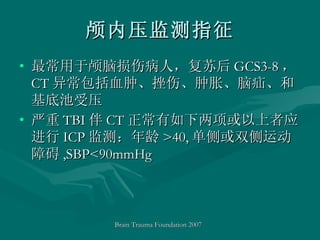
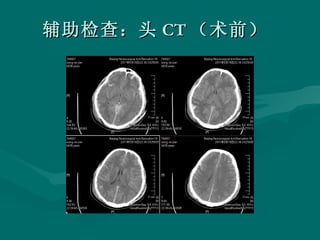
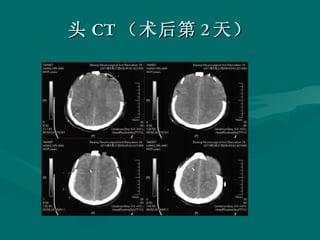
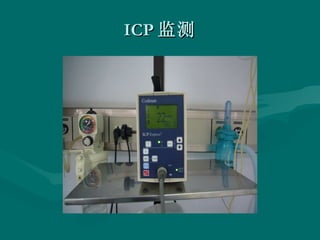
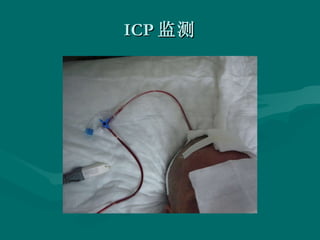
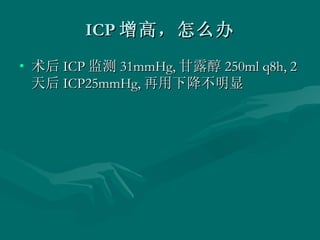
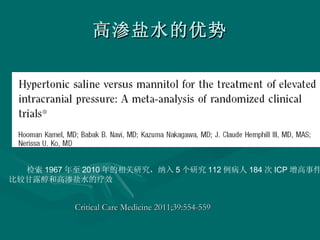
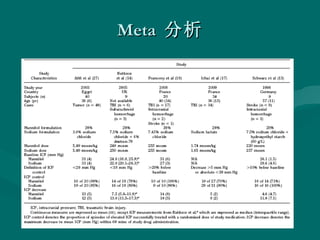
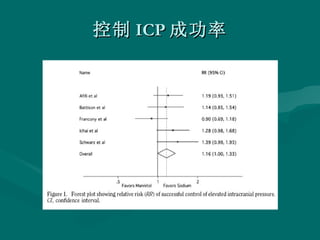
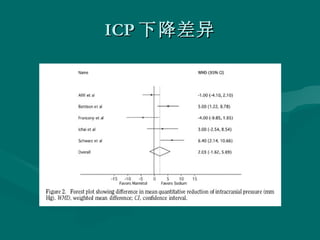
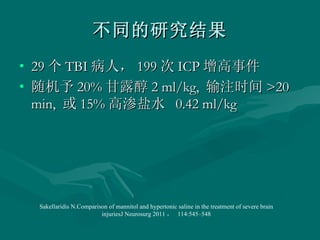
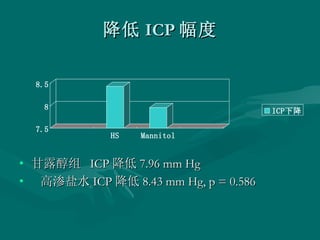
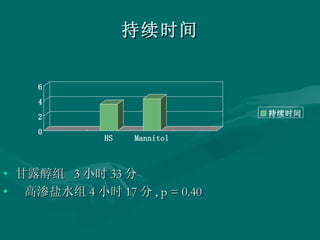
颅内压监测可能指征 脑外伤病人由于气管插管、镇静或肌松不能配合进行神经功能检查 巨大脑梗死有脑积水的 SAH 中枢神经系统肿瘤 中枢神经系统感染 Narayan RK, Kishore PR, Becker DP, et al. Intracranial pressure: to monitor or not to monitor? A review of our experience with severe head injury. J Neurosurg 1982;56:650-659
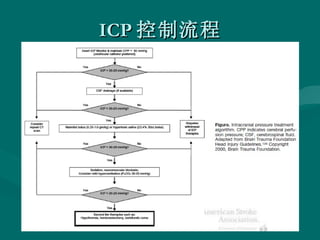
颅内压控制目标 ICP 的控制目标在<20mmHg,CPP 保持在 60-70mmHg 不鼓励通过使用血管加压素或增加心肌收缩力来增加 CPP ,这样可能引起其他甚至包括 ARDS 的副作用 Robertson CS, Valadka AB, Hannay HJ, et al. Prevention of secondary ischemic insults after severe head injury. Crit Care Med 1999;27:2086-2095 Contant CF, Valadka AB, Gopinath SP, et al. Adult respiratory distress syndrome: a complication of induced hypertension after severe head injury. J Neurosurg 2001;95:560-568
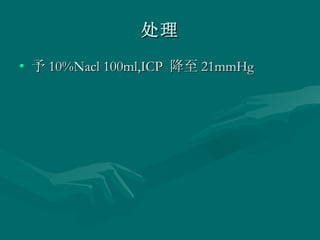
高渗盐水降低 ICP 原理通过建立 BBB 内外渗透梯度减少脑水含量 血脑屏障对钠离子通透性很低,对于血脑屏障完整的机体,应用高渗盐水后,脑部血管内的氯化钠浓度远高于组织间隙和细胞内的氯化钠浓度,产生渗透压差,水分从细胞内和组织间液中进入血管内,颅内压降低,减轻脑水肿 使内皮细胞和红细胞脱水增加血管直径和红细胞变形能力,增加血容量改善脑血流 Betz AL Sodium transport in capillaries isolated from rat brain Neurochem,1983 , 41(4) : 1150 . Fraser PA . Measurement of filtration coefficient in single cerebral microvessels of the frog. Physiology , 2004 , 24 1990 , 323-343 .
34.
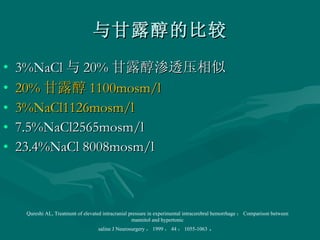
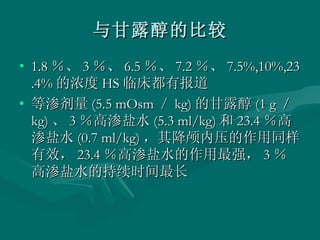
与甘露醇的比较 3%NaCl 与20% 甘露醇渗透压相似 20% 甘露醇 1100mosm/l 3%NaCl1126mosm/l 7.5%NaCl2565mosm/l 23.4%NaCl 8008mosm/l Qureshi AL, Treatment of elevated intracranial pressure in experimental intracerebral hemorrhage : Comparison between mannitol and hypertonic saline J Neurosurgery , 1999 , 44 : 1055-1063 .
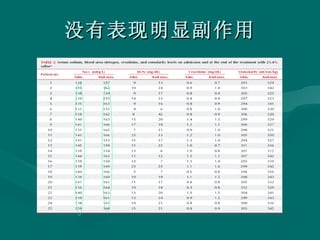
副作用 --- 中枢神经系统桥脑中央髓鞘溶解:多见于动物脑外伤模型或者临床中治疗慢性疾病补充钠盐的过程中,或者亚急性低钠血症补钠盐的过程中,每天的血钠增加不超过 10-20 mmol/ L 可以避免其发生。 在临床应用 HS 控制 ICP 增高时,应注意钠盐的输注速度 Kraus GE. Cerebralspinal fluid endothelin-1 and endothelin-3 levels in normal and neurosurgical patients:a clinical study and literature review. Surg Neurol 1991,35:20-29
43.
副作用 --- 中枢神经系统昏迷和癫痫 --- 血浆渗透压和血钠浓度的改变有关 脑内出血 --- 凝血功能障碍所致 颅内压反跳 --- 通常出现在 HS 间断推注或者连续滴注突然中止的情况下 dams RD . Central pontine mydindysis . Principle of neurology . New York : McGraw Hill , 1997 , 1125 Schell R M.Salt , starch , and water on the brain . J Neurceurg Anesthesiol.1996,8 : 178 .
44.
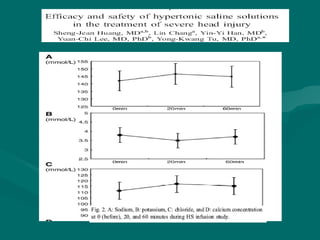
副作用 --- 全身高钠血症 充血性心力衰竭 低钾血症、高氯性酸中毒、 凝血功能失调 急性肾功能衰竭 Suarez Jl : Editorial comment : Salting the brain to improve CBF in SAH patients . Stroke , 2003 , 34 : 1396 . Vivo P . Hypertonic saline solution : a safe alternative to mannitol 18 % in neurosurgery . Minerva—Anesthosiol , 200l,67 : 603 Suarez JI . Treatment of refractory intracranial hypertension with 23.4 % saline . Crit Care Med , 1998 , 26 : Ill8 .
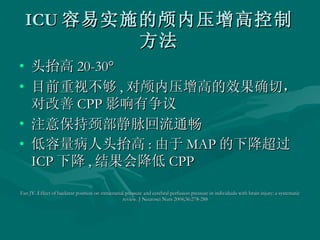
ICU 容易实施的颅内压增高控制方法 头抬高20-30 ° 目前重视不够 , 对颅内压增高的效果确切,对改善 CPP 影响有争议 注意保持颈部静脉回流通畅 低容量病人头抬高 : 由于 MAP 的下降超过 ICP 下降 , 结果会降低 CPP Fan JY. Effect of backrest position on intracranial pressure and cerebral perfusion pressure in individuals with brain injury: a systematic review. J Neurosci Nurs 2004;36:278-288
56.
镇静肌松 躁动、咳嗽、人机对抗会使 ICP明显增高,因此需要充分的镇静,甚至使用肌松剂 巴比妥和丙泊芬都是通过降低代谢需求、 CBF 和脑血容量下降达到降低 ICP 的作用 使用过程中注意监测 EEG 、 BIS 注意巴比妥对血流动力学的影响丙泊芬对代谢的影响 Vasile B, Rasulo F, Candiani A, Latronico N. The pathophysiology of propofol infusion syndrome: a simple name for a complex syndrome. Intensive Care Med 2003;29:1417-1425 BrainTrauma Foundation2007
57.
过度通气 通过降低 CBF达到降低 ICP 效果,有引起脑缺血的危险 程度和持续时间不清楚 短期使用控制 ICP 迅速增高,平时保持在正常水平 应该避免慢性过度通气,低碳酸会影响其他控制 ICP 药物的效果,而且可能引起缺血 Coles JP, Minhas PS, Fryer TD, et al. Effect of hyperventilation on cerebral blood flow in traumatic head injury: clinical relevance and monitoring correlates. Crit Care Med 2002;30:1950-1959 Sheinberg M, Kanter MJ, Robertson CS, et al. Continuous monitoring of jugular venous oxygen saturation in head-injured patients. J Neurosurg 1992;76:212-217
58.
低温治疗 RCT 研究的结论低温治疗不改善病人的预后,而且病人肺炎、伤口感染、电解质和凝血异常的风险增加,目前不推荐常规使用只有一项研究说明低温治疗对难治性高 ICP 有益 Clifton GL. Is keeping cool still hot? An update on hypothermia in brain injury. Curr Opin Crit Care 2004;10:116-119 Clifton GL, Miller ER, Choi SC, et al. Lack of effect of induction of hypothermia after acute brain injury. N Engl J Med 2001;344:556-563 Polderman KH. Application of therapeutic hypothermia in the intensive care unit. Opportunities and pitfalls of promising treatment modality-part 2: practical aspects and side effects. Intensive Care Med 2004;30:757-769 Jiang J, Yu M, Zhu C. Effect of long-term mild hypothermia therapy in patients with severe traumatic brain injury: 1-year follow-up review of 87 cases. J Neurosurg 2000;93:546-549