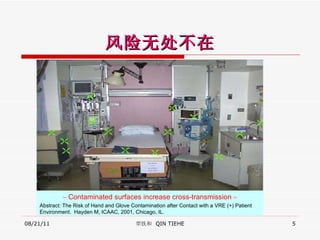
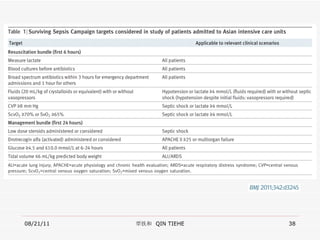
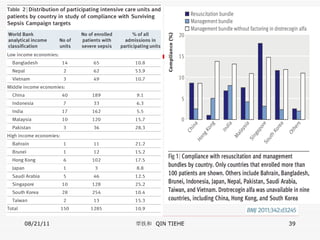
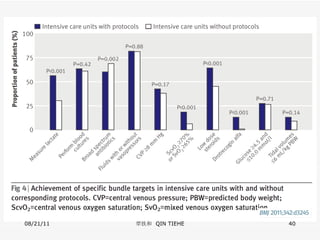
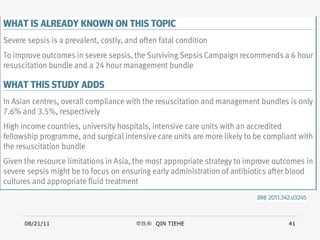
风险无处不在 08/21/11 覃铁和 QIN TIEHE ~ Contaminated surfaces increase cross-transmission ~ Abstract: The Risk of Hand and Glove Contamination after Contact with a VRE (+) Patient Environment. Hayden M, ICAAC, 2001, Chicago, IL.
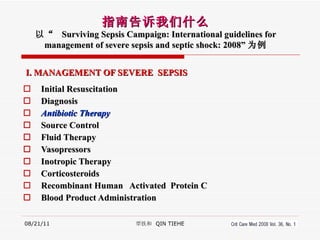
I. MANAGEMENT OFSEVERE SEPSIS Initial Resuscitation Diagnosis Antibiotic Therapy Source Control Fluid Therapy Vasopressors Inotropic Therapy Corticosteroids Recombinant Human Activated Protein C Blood Product Administration 08/21/11 覃铁和 QIN TIEHE 指南告诉我们什么 以“ Surviving Sepsis Campaign: International guidelines for management of severe sepsis and septic shock: 2008” 为例
23.
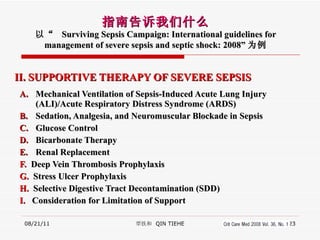
II. SUPPORTIVE THERAPYOF SEVERE SEPSIS Mechanical Ventilation of Sepsis-Induced Acute Lung Injury (ALI)/Acute Respiratory Distress Syndrome (ARDS) Sedation, Analgesia, and Neuromuscular Blockade in Sepsis Glucose Control Bicarbonate Therapy Renal Replacement F. Deep Vein Thrombosis Prophylaxis G. Stress Ulcer Prophylaxis H. Selective Digestive Tract Decontamination (SDD) I. Consideration for Limitation of Support 08/21/11 覃铁和 QIN TIEHE 指南告诉我们什么 以“ Surviving Sepsis Campaign: International guidelines for management of severe sepsis and septic shock: 2008” 为例
24.
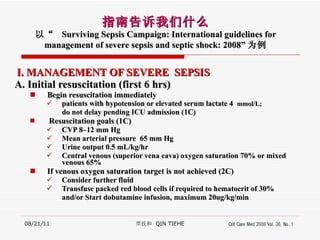
I. MANAGEMENT OFSEVERE SEPSIS A. Initial resuscitation (first 6 hrs) Begin resuscitation immediately patients with hypotension or elevated serum lactate 4 mmol/L; do not delay pending ICU admission (1C) Resuscitation goals (1C) CVP 8–12 mm Hg Mean arterial pressure 65 mm Hg Urine output 0.5 mL/kg/hr Central venous (superior vena cava) oxygen saturation 70% or mixed venous 65% If venous oxygen saturation target is not achieved (2C) Consider further fluid Transfuse packed red blood cells if required to hematocrit of 30% and/or Start dobutamine infusion, maximum 20ug/kg/min 08/21/11 覃铁和 QIN TIEHE 指南告诉我们什么 以“ Surviving Sepsis Campaign: International guidelines for management of severe sepsis and septic shock: 2008” 为例
25.
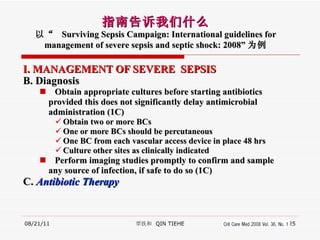
I. MANAGEMENT OFSEVERE SEPSIS B. Diagnosis Obtain appropriate cultures before starting antibiotics provided this does not significantly delay antimicrobial administration (1C) Obtain two or more BCs One or more BCs should be percutaneous One BC from each vascular access device in place 48 hrs Culture other sites as clinically indicated Perform imaging studies promptly to confirm and sample any source of infection, if safe to do so (1C) C. Antibiotic Therapy 08/21/11 覃铁和 QIN TIEHE 指南告诉我们什么 以“ Surviving Sepsis Campaign: International guidelines for management of severe sepsis and septic shock: 2008” 为例
26.
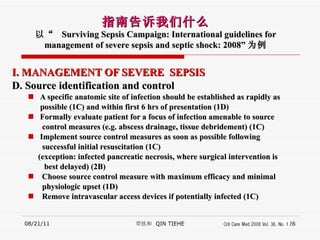
I. MANAGEMENT OFSEVERE SEPSIS D. Source identification and control A specific anatomic site of infection should be established as rapidly as possible (1C) and within first 6 hrs of presentation (1D) Formally evaluate patient for a focus of infection amenable to source control measures (e.g. abscess drainage, tissue debridement) (1C) Implement source control measures as soon as possible following successful initial resuscitation (1C) (exception: infected pancreatic necrosis, where surgical intervention is best delayed) (2B) Choose source control measure with maximum efficacy and minimal physiologic upset (1D) Remove intravascular access devices if potentially infected (1C) 08/21/11 覃铁和 QIN TIEHE 指南告诉我们什么 以“ Surviving Sepsis Campaign: International guidelines for management of severe sepsis and septic shock: 2008” 为例
27.
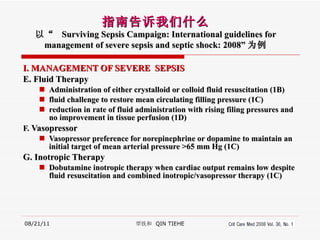
I. MANAGEMENT OFSEVERE SEPSIS E. Fluid Therapy Administration of either crystalloid or colloid fluid resuscitation (1B) fluid challenge to restore mean circulating filling pressure (1C) reduction in rate of fluid administration with rising filing pressures and no improvement in tissue perfusion (1D) F. Vasopressor Vasopressor preference for norepinephrine or dopamine to maintain an initial target of mean arterial pressure >65 mm Hg (1C) G. Inotropic Therapy Dobutamine inotropic therapy when cardiac output remains low despite fluid resuscitation and combined inotropic/vasopressor therapy (1C) 08/21/11 覃铁和 QIN TIEHE 指南告诉我们什么 以“ Surviving Sepsis Campaign: International guidelines for management of severe sepsis and septic shock: 2008” 为例
28.
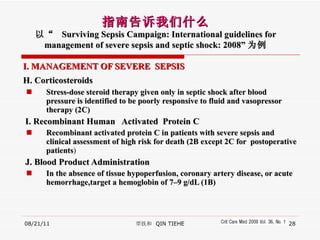
I. MANAGEMENT OFSEVERE SEPSIS H. Corticosteroids Stress-dose steroid therapy given only in septic shock after blood pressure is identified to be poorly responsive to fluid and vasopressor therapy (2C) I. Recombinant Human Activated Protein C Recombinant activated protein C in patients with severe sepsis and clinical assessment of high risk for death (2B except 2C for postoperative patients ) J. Blood Product Administration In the absence of tissue hypoperfusion, coronary artery disease, or acute hemorrhage,target a hemoglobin of 7–9 g/dL (1B) 08/21/11 覃铁和 QIN TIEHE 指南告诉我们什么 以“ Surviving Sepsis Campaign: International guidelines for management of severe sepsis and septic shock: 2008” 为例
29.
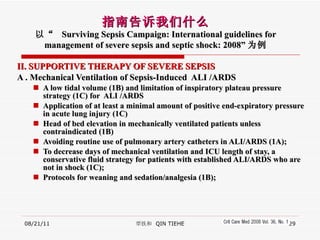
II. SUPPORTIVE THERAPYOF SEVERE SEPSIS A . Mechanical Ventilation of Sepsis-Induced ALI /ARDS A low tidal volume (1B) and limitation of inspiratory plateau pressure strategy (1C) for ALI /ARDS Application of at least a minimal amount of positive end-expiratory pressure in acute lung injury (1C) Head of bed elevation in mechanically ventilated patients unless contraindicated (1B) Avoiding routine use of pulmonary artery catheters in ALI/ARDS (1A); To decrease days of mechanical ventilation and ICU length of stay, a conservative fluid strategy for patients with established ALI/ARDS who are not in shock (1C); Protocols for weaning and sedation/analgesia (1B); 08/21/11 覃铁和 QIN TIEHE 指南告诉我们什么 以“ Surviving Sepsis Campaign: International guidelines for management of severe sepsis and septic shock: 2008” 为例
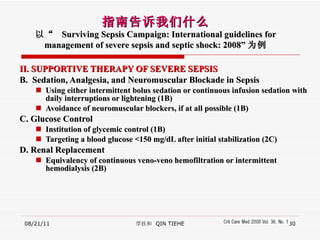
30.
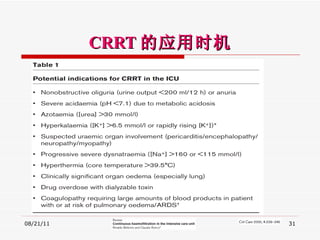
II. SUPPORTIVE THERAPYOF SEVERE SEPSIS B. Sedation, Analgesia, and Neuromuscular Blockade in Sepsis Using either intermittent bolus sedation or continuous infusion sedation with daily interruptions or lightening (1B) Avoidance of neuromuscular blockers, if at all possible (1B) C. Glucose Control Institution of glycemic control (1B) Targeting a blood glucose <150 mg/dL after initial stabilization (2C) D. Renal Replacement Equivalency of continuous veno-veno hemofiltration or intermittent hemodialysis (2B) 08/21/11 覃铁和 QIN TIEHE 指南告诉我们什么 以“ Surviving Sepsis Campaign: International guidelines for management of severe sepsis and septic shock: 2008” 为例
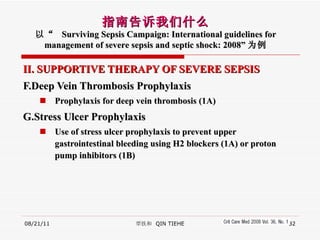
II. SUPPORTIVE THERAPYOF SEVERE SEPSIS F.Deep Vein Thrombosis Prophylaxis Prophylaxis for deep vein thrombosis (1A) G.Stress Ulcer Prophylaxis Use of stress ulcer prophylaxis to prevent upper gastrointestinal bleeding using H2 blockers (1A) or proton pump inhibitors (1B) 08/21/11 覃铁和 QIN TIEHE 指南告诉我们什么 以“ Surviving Sepsis Campaign: International guidelines for management of severe sepsis and septic shock: 2008” 为例
![感染控制 --- 抗生素之外的话题 覃铁和 [email_address] 广东省人民医院 重症医学科( ICU )](https://image.slidesharecdn.com/random-110821010401-phpapp01/85/slide-1-320.jpg)