The Renaissance  Architecture
The Introduction The Origin of the term "Renaissance" The early Renaissance The high Renaissance The Later  Renaissance The photo gallery
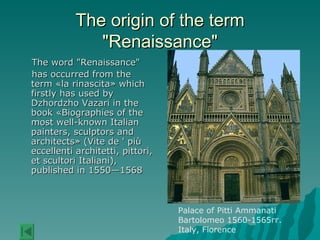
The origin of the term "Renaissance" The word "Renaissance"  has occurred from the term «la rinascita» which firstly has used by Dzhordzho Vazari in the book «Biographies of the most well-known Italian painters, sculptors and architects» (Vite de ' più eccellenti architetti, pittori, et scultori Italiani), published in 1550—1568 Palace of Pitti Ammanati Bartolomeo 1560-1565 гг.  Italy, Florence
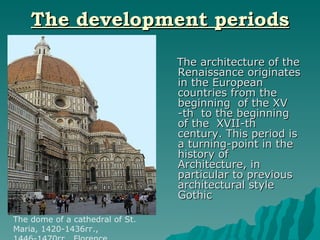
The development periods The architecture of the Renaissance originates in the European countries from the beginning  of the XV -th  to the beginning of the  XVII-th century. This period is a turning-point in the history of Architecture, in particular to previous architectural style  Gothic The dome of a cathedral of St. Maria, 1420-1436гг., 1446-1470гг., Florence
The development periods It is possible to allocate three basic periods: The early Renaissance or quattrocento, approximately coincides with XV century.  The high Renaissance, the first quarter of XVI century.  Mannerism or Later the Renaissance (apprx. 1520—1600).
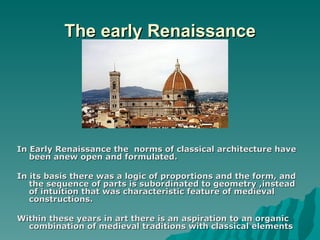
The early Renaissance In Early Renaissance the  norms of classical architecture have been anew open and formulated. In its basis there was a logic of proportions and the form, and the sequence of parts is subordinated to geometry ,instead of intuition that was characteristic feature of medieval constructions. Within these years in art there is an aspiration to an organic combination of medieval traditions with classical elements
The early Renaissance In temple building by the basic type there is a basilica with a flat ceiling or with Christ  arches, but in elements  Architects are guided by the Greek-Roman monuments in aspiration of formation of extensive, free spaces in buildings.  More often at registration of buildings there is a Corinthian warrant with various modifications of a capital.
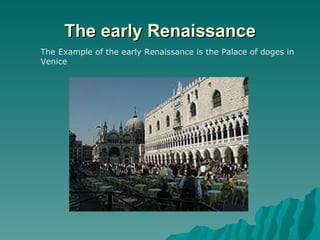
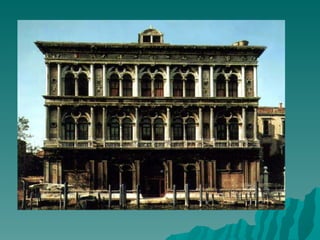
The early Renaissance The Example of the early Renaissance is the Palace of doges in Venice
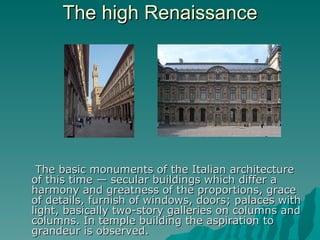
The basic monuments of the Italian architecture of this time — secular buildings which differ a harmony and greatness of the proportions, grace of details, furnish of windows, doors; palaces with light, basically two-story galleries on columns and columns. In temple building the aspiration to grandeur is observed. The high Renaissance
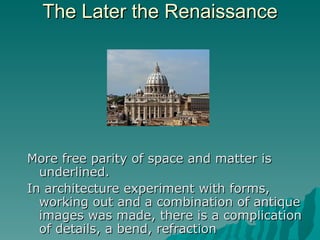
The Later the Renaissance More free parity of space and matter is underlined. In architecture experiment with forms, working out and a combination of antique images was made, there is a complication of details, a bend, refraction
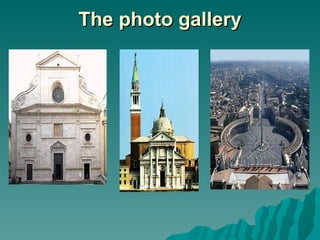
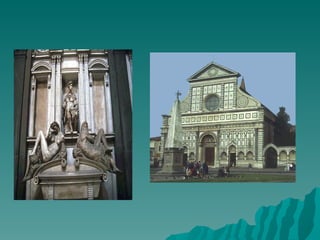
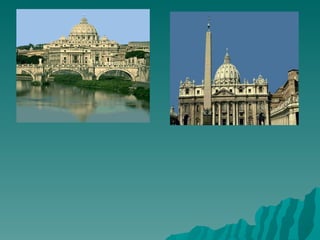
The photo gallery


Thanks for attention

ренессанс уткина и муратова

  • 1.
  • 2.
    The Renaissance Architecture
  • 3.
    The Introduction TheOrigin of the term "Renaissance" The early Renaissance The high Renaissance The Later Renaissance The photo gallery
  • 4.
    The origin ofthe term "Renaissance" The word "Renaissance" has occurred from the term «la rinascita» which firstly has used by Dzhordzho Vazari in the book «Biographies of the most well-known Italian painters, sculptors and architects» (Vite de ' più eccellenti architetti, pittori, et scultori Italiani), published in 1550—1568 Palace of Pitti Ammanati Bartolomeo 1560-1565 гг. Italy, Florence
  • 5.
    The development periodsThe architecture of the Renaissance originates in the European countries from the beginning of the XV -th to the beginning of the XVII-th century. This period is a turning-point in the history of Architecture, in particular to previous architectural style Gothic The dome of a cathedral of St. Maria, 1420-1436гг., 1446-1470гг., Florence
  • 6.
    The development periodsIt is possible to allocate three basic periods: The early Renaissance or quattrocento, approximately coincides with XV century. The high Renaissance, the first quarter of XVI century. Mannerism or Later the Renaissance (apprx. 1520—1600).
  • 7.
    The early RenaissanceIn Early Renaissance the norms of classical architecture have been anew open and formulated. In its basis there was a logic of proportions and the form, and the sequence of parts is subordinated to geometry ,instead of intuition that was characteristic feature of medieval constructions. Within these years in art there is an aspiration to an organic combination of medieval traditions with classical elements
  • 8.
    The early RenaissanceIn temple building by the basic type there is a basilica with a flat ceiling or with Christ arches, but in elements Architects are guided by the Greek-Roman monuments in aspiration of formation of extensive, free spaces in buildings. More often at registration of buildings there is a Corinthian warrant with various modifications of a capital.
  • 9.
    The early RenaissanceThe Example of the early Renaissance is the Palace of doges in Venice
  • 10.
    The basic monumentsof the Italian architecture of this time — secular buildings which differ a harmony and greatness of the proportions, grace of details, furnish of windows, doors; palaces with light, basically two-story galleries on columns and columns. In temple building the aspiration to grandeur is observed. The high Renaissance
  • 11.
    The Later theRenaissance More free parity of space and matter is underlined. In architecture experiment with forms, working out and a combination of antique images was made, there is a complication of details, a bend, refraction
  • 12.
  • 13.
  • 14.
  • 15.
  • 16.