www.qunaieer.com
‫ﺗﻨﻈﯿﻢ‬
‫اﻟﻤﺤﺎﺿﺮة‬ ‫طﺮﯾﻘﺔ‬
•‫اﻷﺳﺎﺳﯾﺔ‬ ‫واﻟﻣﻔﺎھﯾم‬ ‫اﻟﻣﺻطﻠﺣﺎت‬ ‫ﺷرح‬
•‫ﺑﺎﻟﻌرﺑﻲ‬ ‫واﻟﺷرح‬ ‫ﺑﺎﻹﻧﺟﻠﯾزي‬ ‫اﻟﻌرض‬ ‫ﺷراﺋﺢ‬ ‫وأﻏﻠب‬ ‫اﻟﻣﺻطﻠﺣﺎت‬
•‫ﻟﻸﺳﺎﺳﯾﺎت‬ ‫ﻣﻔﺻل‬ ‫ﺷرح‬
•‫اﻟﺷﮭﯾرة‬ ‫ﻟﻠﺧوارزﻣﯾﺎت‬ ‫ﺳرﯾﻌﺔ‬ ‫إﺷﺎرات‬
•‫ﺑﺳﯾطﺔ‬ ‫ﻋﻣﻠﯾﺔ‬ ‫أﻣﺛﻠﺔ‬
•‫ﻣﻘﺗرﺣﺔ‬ ‫ﺗﻌﻠم‬ ‫ﺧطﺔ‬
‫اﻵﻟﺔ؟‬ ‫ﺗﻌﻠﻢ‬ ‫ھﻮ‬ ‫ﻣﺎ‬
•‫ﺑﺎﻟﺗﻔﺻﯾل‬ ‫ﺑرﻣﺟﺗﮫ‬ ‫ﻣن‬ ً‫ﻻ‬‫ﺑد‬ ‫ﻧﻔﺳﮫ‬ ‫ﻣن‬ ‫اﻟﺗﻌﻠم‬ ‫اﻟﺣﺎﺳب‬ ‫ﯾﻣﻛن‬ ‫ﻋﻠم‬ ‫ھو‬
•‫ﻧﻣﺎذج‬ ‫ﺑﻧﺎء‬ ‫طرﯾﻖ‬ ‫ﻋن‬ ‫اﻟﺑﯾﺎﻧﺎت‬ ‫ﺟوھر‬ ‫اﺧﺗزال‬)models(‫واﻟﺗوﻗﻌﺎت‬ ‫اﻟﻘرارات‬ ‫واﺗﺧﺎذ‬ ،
‫ﻋﻠﯾﮭﺎ‬ ً‫ء‬‫ﺑﻧﺎ‬ ‫اﻟﻣﺳﺗﻘﺑﻠﯾﺔ‬
Regression
•Regression analysis is a statistical
process for estimating the relationships
among variables
•Used to predict continuous outcomes
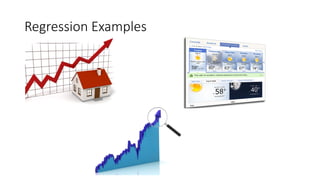
Regression Examples
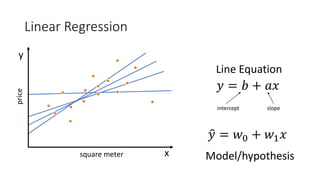
Linear Regression
Line Equation
𝑦𝑦 = 𝑏𝑏 + 𝑎𝑎𝑎𝑎
�𝑦𝑦 = 𝑤𝑤0 + 𝑤𝑤1 𝑥𝑥
intercept slope
x
y
square meter
price
Model/hypothesis
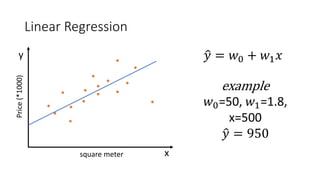
Linear Regression
x
y �𝑦𝑦 = 𝑤𝑤0 + 𝑤𝑤1 𝑥𝑥
square meter
Price(*1000)
example
𝑤𝑤0=50, 𝑤𝑤1=1.8,
x=500
�𝑦𝑦 = 950
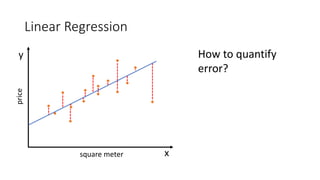
Linear Regression
x
y How to quantify
error?
square meter
price
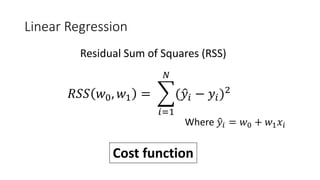
Linear Regression
𝑅𝑅𝑅𝑅𝑅𝑅 𝑤𝑤0, 𝑤𝑤1 = �
𝑖𝑖=1
𝑁𝑁
(�𝑦𝑦𝑖𝑖 − 𝑦𝑦𝑖𝑖)2
Residual Sum of Squares (RSS)
Where �𝑦𝑦𝑖𝑖 = 𝑤𝑤0 + 𝑤𝑤1 𝑥𝑥𝑖𝑖
Cost function
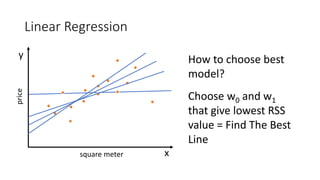
Linear Regression
How to choose best
model?
Choose w0 and w1
that give lowest RSS
value = Find The Best
Line
x
y
square meter
price
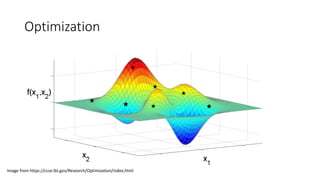
Optimization
Image from https://ccse.lbl.gov/Research/Optimization/index.html
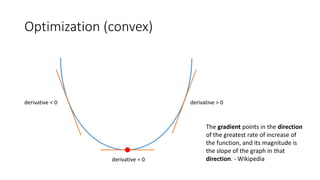
Optimization (convex)
derivative = 0
derivative > 0derivative < 0
The gradient points in the direction
of the greatest rate of increase of
the function, and its magnitude is
the slope of the graph in that
direction. - Wikipedia
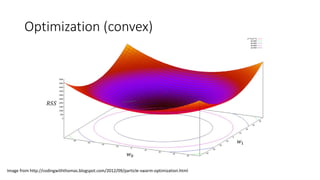
Optimization (convex)
Image from http://codingwiththomas.blogspot.com/2012/09/particle-swarm-optimization.html
𝑅𝑅𝑅𝑅𝑅𝑅
𝑤𝑤0
𝑤𝑤1
Optimization (convex)
• First, lets compute the gradient of our cost function
• To find best lines, there are two ways:
• Analytical (normal equation)
• Iterative (gradient descent)
Where �𝑦𝑦𝑖𝑖 = 𝑤𝑤0 + 𝑤𝑤1 𝑥𝑥𝑖𝑖
𝛻𝛻𝑅𝑅𝑅𝑅𝑅𝑅(𝑤𝑤0, 𝑤𝑤1) =
−2 ∑𝑖𝑖=1
𝑁𝑁
[�𝑦𝑦𝑖𝑖 − 𝑦𝑦𝑖𝑖]
−2 ∑𝑖𝑖=1
𝑁𝑁
[�𝑦𝑦𝑖𝑖 − 𝑦𝑦𝑖𝑖]𝑥𝑥𝑖𝑖
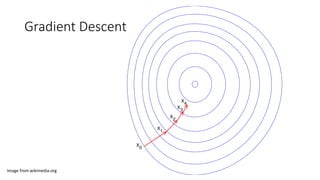
Gradient Descent
𝒘𝒘𝑡𝑡+1
= 𝒘𝒘𝑡𝑡
− 𝜂𝜂𝜂𝜂𝜂𝜂𝜂𝜂𝜂𝜂
𝑤𝑤0
𝑡𝑡+1
𝑤𝑤1
𝑡𝑡+1 =
𝑤𝑤0
𝑡𝑡
𝑤𝑤1
𝑡𝑡 − 𝜂𝜂
−2 ∑𝑖𝑖=1
𝑁𝑁
[�𝑦𝑦𝑖𝑖 − 𝑦𝑦𝑖𝑖]
−2 ∑𝑖𝑖=1
𝑁𝑁
[�𝑦𝑦𝑖𝑖 − 𝑦𝑦𝑖𝑖]𝑥𝑥𝑖𝑖
Update the weights to minimize the cost function
𝜂𝜂 is the step size (important hyper-parameter)
Gradient Descent
Image from wikimedia.org
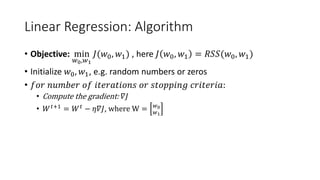
Linear Regression: Algorithm
• Objective: min
𝑤𝑤0,𝑤𝑤1
𝐽𝐽(𝑤𝑤0, 𝑤𝑤1) , here 𝐽𝐽 𝑤𝑤0, 𝑤𝑤1 = 𝑅𝑅𝑅𝑅𝑅𝑅(𝑤𝑤0, 𝑤𝑤1)
• Initialize 𝑤𝑤0, 𝑤𝑤1, e.g. random numbers or zeros
• 𝑓𝑓𝑓𝑓𝑓𝑓 𝑛𝑛𝑛𝑛𝑛𝑛𝑛𝑛𝑛𝑛𝑛𝑛 𝑜𝑜𝑜𝑜 𝑖𝑖𝑖𝑖𝑖𝑖𝑖𝑖𝑖𝑖𝑖𝑖𝑖𝑖𝑖𝑖𝑖𝑖𝑖𝑖 𝑜𝑜𝑜𝑜 𝑠𝑠𝑠𝑠𝑠𝑠𝑠𝑠𝑠𝑠𝑠𝑠𝑠𝑠𝑠𝑠 𝑐𝑐𝑐𝑐𝑐𝑐𝑐𝑐𝑐𝑐𝑐𝑐𝑐𝑐𝑐𝑐:
• Compute the gradient: 𝛻𝛻𝐽𝐽
• 𝑊𝑊𝑡𝑡+1
= 𝑊𝑊𝑡𝑡
− 𝜂𝜂𝜂𝜂𝐽𝐽, where W = 𝑤𝑤0
𝑤𝑤1
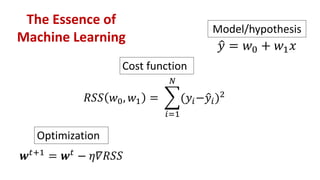
Model/hypothesis
Cost function
Optimization
�𝑦𝑦 = 𝑤𝑤0 + 𝑤𝑤1 𝑥𝑥
𝑅𝑅𝑅𝑅𝑅𝑅 𝑤𝑤0, 𝑤𝑤1 = �
𝑖𝑖=1
𝑁𝑁
(𝑦𝑦𝑖𝑖−�𝑦𝑦𝑖𝑖)2
𝒘𝒘𝑡𝑡+1
= 𝒘𝒘𝑡𝑡
− 𝜂𝜂𝜂𝜂𝜂𝜂𝜂𝜂𝜂𝜂
The Essence of
Machine Learning
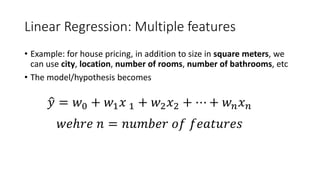
Linear Regression: Multiple features
• Example: for house pricing, in addition to size in square meters, we
can use city, location, number of rooms, number of bathrooms, etc
• The model/hypothesis becomes
�𝑦𝑦 = 𝑤𝑤0 + 𝑤𝑤1 𝑥𝑥 1 + 𝑤𝑤2 𝑥𝑥2 + ⋯ + 𝑤𝑤𝑛𝑛 𝑥𝑥𝑛𝑛
𝑤𝑤𝑒𝑒ℎ𝑟𝑟𝑟𝑟 𝑛𝑛 = 𝑛𝑛𝑛𝑛𝑛𝑛𝑛𝑛𝑛𝑛𝑛𝑛 𝑜𝑜𝑜𝑜 𝑓𝑓𝑓𝑓𝑓𝑓𝑓𝑓𝑓𝑓𝑓𝑓𝑓𝑓𝑓𝑓
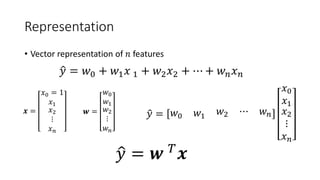
Representation
• Vector representation of 𝑛𝑛 features
�𝑦𝑦 = 𝑤𝑤0 + 𝑤𝑤1 𝑥𝑥 1 + 𝑤𝑤2 𝑥𝑥2 + ⋯ + 𝑤𝑤𝑛𝑛 𝑥𝑥𝑛𝑛
𝒙𝒙 =
𝑥𝑥0 = 1
𝑥𝑥1
𝑥𝑥2
⋮
𝑥𝑥𝑛𝑛
𝒘𝒘 =
𝑤𝑤0
𝑤𝑤1
𝑤𝑤2
⋮
𝑤𝑤𝑛𝑛
�𝑦𝑦 = 𝒘𝒘 𝑇𝑇
𝒙𝒙
�𝑦𝑦 = 𝑤𝑤0 𝑤𝑤1 𝑤𝑤2 ⋯ 𝑤𝑤𝑛𝑛
𝑥𝑥0
𝑥𝑥1
𝑥𝑥2
⋮
𝑥𝑥𝑛𝑛
Representation
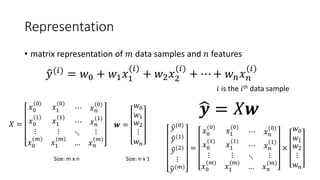
• matrix representation of 𝑚𝑚 data samples and 𝑛𝑛 features
�𝑦𝑦(𝑖𝑖)
= 𝑤𝑤0 + 𝑤𝑤1 𝑥𝑥1
(𝑖𝑖)
+ 𝑤𝑤2 𝑥𝑥2
(𝑖𝑖)
+ ⋯ + 𝑤𝑤𝑛𝑛 𝑥𝑥𝑛𝑛
(𝑖𝑖)
𝑋𝑋 =
𝑥𝑥0
(0)
𝑥𝑥1
(0)
⋯ 𝑥𝑥𝑛𝑛
(0)
𝑥𝑥0
(1)
𝑥𝑥1
(1)
⋯ 𝑥𝑥𝑛𝑛
(1)
⋮
𝑥𝑥0
(𝑚𝑚)
⋮
𝑥𝑥1
(𝑚𝑚)
⋱
…
⋮
𝑥𝑥𝑛𝑛
(𝑚𝑚)
𝒘𝒘 =
𝑤𝑤0
𝑤𝑤1
𝑤𝑤2
⋮
𝑤𝑤𝑛𝑛
�𝒚𝒚 = 𝑋𝑋𝒘𝒘
𝑖𝑖 is the 𝑖𝑖th data sample
Size: m x n Size: n x 1
�𝑦𝑦(0)
�𝑦𝑦(1)
�𝑦𝑦(2)
⋮
�𝑦𝑦(𝑚𝑚)
=
𝑥𝑥0
(0)
𝑥𝑥1
(0)
⋯ 𝑥𝑥𝑛𝑛
(0)
𝑥𝑥0
(1)
𝑥𝑥1
(1)
⋯ 𝑥𝑥𝑛𝑛
(1)
⋮
𝑥𝑥0
(𝑚𝑚)
⋮
𝑥𝑥1
(𝑚𝑚)
⋱
…
⋮
𝑥𝑥𝑛𝑛
(𝑚𝑚)
×
𝑤𝑤0
𝑤𝑤1
𝑤𝑤2
⋮
𝑤𝑤𝑛𝑛
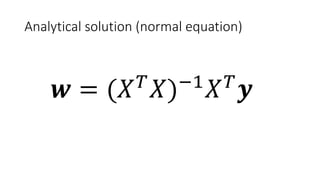
Analytical solution (normal equation)
𝒘𝒘 = (𝑋𝑋 𝑇𝑇
𝑋𝑋)−1
𝑋𝑋 𝑇𝑇
𝒚𝒚
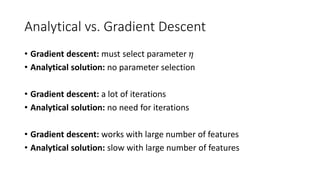
Analytical vs. Gradient Descent
• Gradient descent: must select parameter 𝜂𝜂
• Analytical solution: no parameter selection
• Gradient descent: a lot of iterations
• Analytical solution: no need for iterations
• Gradient descent: works with large number of features
• Analytical solution: slow with large number of features
Demo
• Matrices operations
• Simple linear regression implementation
• Scikit-learn library’s linear regression
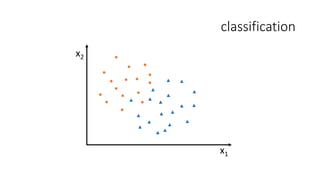
Classification
classification
x1
x2
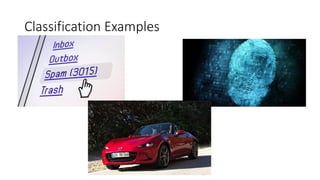
Classification Examples
Logistic Regression
• How to turn regression problem into classification one?
• y = 0 or 1
• Map values to [0 1] range
𝑔𝑔 𝑥𝑥 =
1
1 + 𝑒𝑒−𝑥𝑥
Sigmoid/Logistic Function
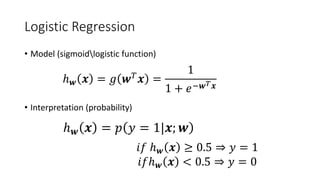
Logistic Regression
• Model (sigmoidlogistic function)
• Interpretation (probability)
ℎ𝒘𝒘 𝒙𝒙 = 𝑔𝑔 𝒘𝒘𝑇𝑇
𝒙𝒙 =
1
1 + 𝑒𝑒−𝒘𝒘𝑇𝑇 𝒙𝒙
ℎ𝒘𝒘 𝒙𝒙 = 𝑝𝑝 𝑦𝑦 = 1|𝒙𝒙; 𝒘𝒘
𝑖𝑖𝑖𝑖 ℎ𝒘𝒘 𝒙𝒙 ≥ 0.5 ⇒ 𝑦𝑦 = 1
𝑖𝑖𝑖𝑖ℎ𝒘𝒘 𝒙𝒙 < 0.5 ⇒ 𝑦𝑦 = 0
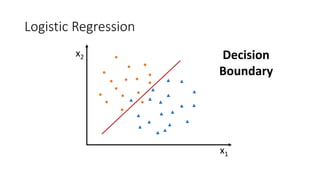
Logistic Regression
x1
x2 Decision
Boundary
Logistic Regression
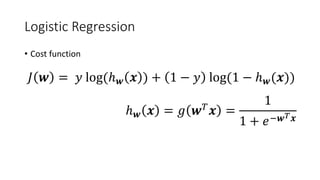
• Cost function
𝐽𝐽 𝒘𝒘 = 𝑦𝑦 log(ℎ𝒘𝒘 𝒙𝒙 ) + 1 − 𝑦𝑦 log(1 − ℎ𝒘𝒘(𝒙𝒙))
ℎ𝒘𝒘 𝒙𝒙 = 𝑔𝑔 𝒘𝒘𝑇𝑇
𝒙𝒙 =
1
1 + 𝑒𝑒−𝒘𝒘𝑇𝑇 𝒙𝒙
Logistic Regression
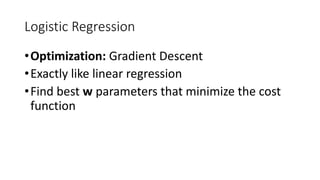
•Optimization: Gradient Descent
•Exactly like linear regression
•Find best w parameters that minimize the cost
function
Logistic Regression: Algorithm
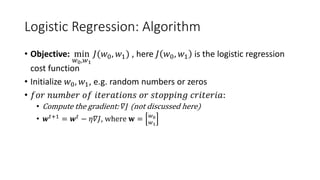
• Objective: min
𝑤𝑤0,𝑤𝑤1
𝐽𝐽(𝑤𝑤0, 𝑤𝑤1) , here 𝐽𝐽 𝑤𝑤0, 𝑤𝑤1 is the logistic regression
cost function
• Initialize 𝑤𝑤0, 𝑤𝑤1, e.g. random numbers or zeros
• 𝑓𝑓𝑓𝑓𝑓𝑓 𝑛𝑛𝑛𝑛𝑛𝑛𝑛𝑛𝑛𝑛𝑛𝑛 𝑜𝑜𝑜𝑜 𝑖𝑖𝑖𝑖𝑖𝑖𝑖𝑖𝑖𝑖𝑖𝑖𝑖𝑖𝑖𝑖𝑖𝑖𝑖𝑖 𝑜𝑜𝑜𝑜 𝑠𝑠𝑠𝑠𝑠𝑠𝑠𝑠𝑠𝑠𝑠𝑠𝑠𝑠𝑠𝑠 𝑐𝑐𝑐𝑐𝑐𝑐𝑐𝑐𝑐𝑐𝑐𝑐𝑐𝑐𝑐𝑐:
• Compute the gradient: 𝛻𝛻𝐽𝐽 (not discussed here)
• 𝒘𝒘𝑡𝑡+1 = 𝒘𝒘𝑡𝑡 − 𝜂𝜂𝜂𝜂𝐽𝐽, where 𝐰𝐰 = 𝑤𝑤0
𝑤𝑤1
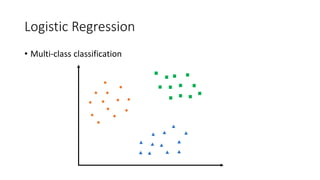
Logistic Regression
• Multi-class classification
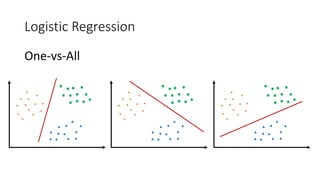
Logistic Regression
One-vs-All
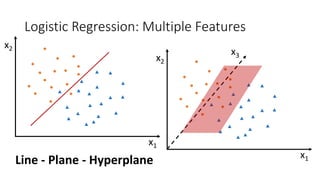
Logistic Regression: Multiple Features
x1
x2
x1
x2
x3
Line - Plane - Hyperplane
Demo
• Scikit-learn library’s logistic regression
Other Classification Algorithms
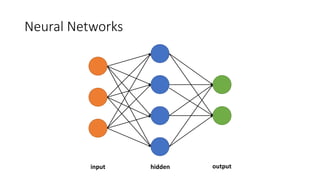
Neural Networks
input hidden output
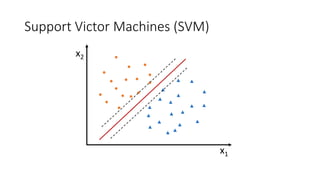
Support Victor Machines (SVM)
x1
x2
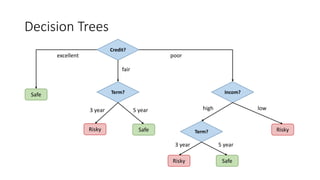
Decision Trees
Credit?
Term? Incom?
Term?
Safe
SafeRisky
SafeRisky
Risky
excellent poor
fair
3 year 5 year high low
3 year 5 year
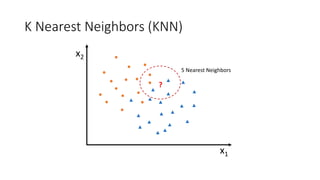
K Nearest Neighbors (KNN)
x1
x2
?
5 Nearest Neighbors
Clustering
Clustering
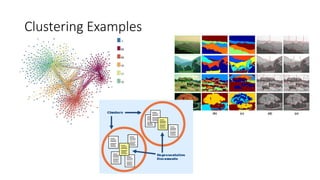
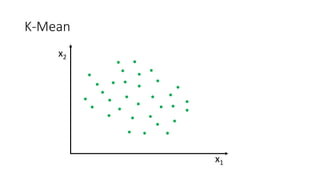
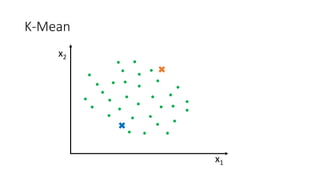
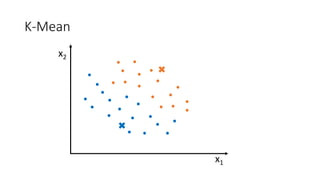
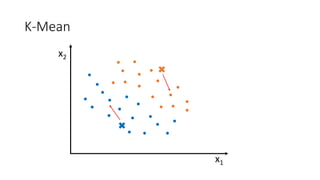
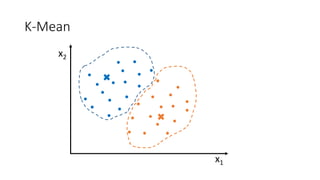
•Unsupervised learning
•Group similar items into clusters
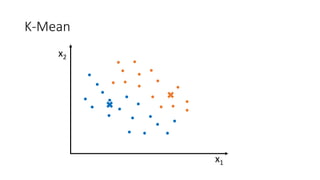
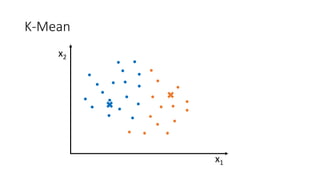
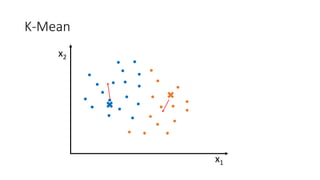
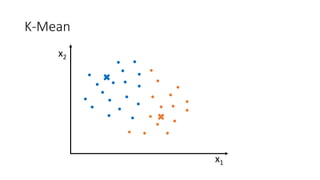
•K-Mean algorithm
Clustering Examples
K-Mean
x1
x2
K-Mean
x1
x2
K-Mean
x1
x2
K-Mean
x1
x2
K-Mean
x1
x2
K-Mean
x1
x2
K-Mean
x1
x2
K-Mean
x1
x2
K-Mean
x1
x2
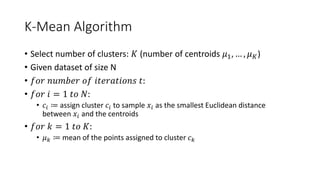
K-Mean Algorithm
• Select number of clusters: 𝐾𝐾 (number of centroids 𝜇𝜇1, … , 𝜇𝜇𝐾𝐾)
• Given dataset of size N
• 𝑓𝑓𝑜𝑜𝑜𝑜 𝑛𝑛𝑛𝑛𝑛𝑛𝑛𝑛𝑛𝑛𝑛𝑛 𝑜𝑜𝑜𝑜 𝑖𝑖𝑖𝑖𝑖𝑖𝑖𝑖𝑖𝑖𝑖𝑖𝑖𝑖𝑖𝑖𝑖𝑖𝑖𝑖 𝑡𝑡:
• 𝑓𝑓𝑓𝑓𝑓𝑓 𝑖𝑖 = 1 𝑡𝑡𝑡𝑡 𝑁𝑁:
• 𝑐𝑐𝑖𝑖 ≔ assign cluster 𝑐𝑐𝑖𝑖 to sample 𝑥𝑥𝑖𝑖 as the smallest Euclidean distance
between 𝑥𝑥𝑖𝑖 and the centroids
• 𝑓𝑓𝑜𝑜𝑜𝑜 𝑘𝑘 = 1 𝑡𝑡𝑡𝑡 𝐾𝐾:
• 𝜇𝜇𝑘𝑘 ≔ mean of the points assigned to cluster 𝑐𝑐𝑘𝑘
Demo
• Scikit-learn library’s k-mean
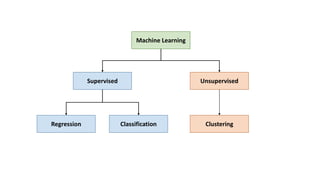
Machine Learning
Supervised Unsupervised
ClassificationRegression Clustering
Other Machine Learning Algorithms
•Probabilistic models
•Ensemble methods
•Reinforcement Learning
•Recommendation algorithms (e.g., Matrix
Factorization)
•Deep Learning
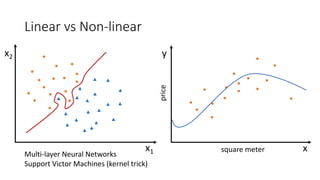
Linear vs Non-linear
x1
x2
x
y
square meter
price
Multi-layer Neural Networks
Support Victor Machines (kernel trick)
Kernel Trick 𝐾𝐾 𝑥𝑥1, 𝑥𝑥2 = [𝑥𝑥1, 𝑥𝑥2, 𝑥𝑥1
2
+ 𝑥𝑥2
2
]
Image from http://www.eric-kim.net/eric-kim-net/posts/1/kernel_trick.html
Practical aspects
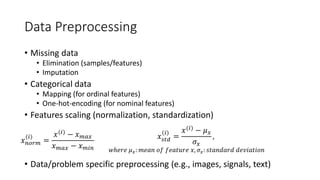
Data Preprocessing
• Missing data
• Elimination (samples/features)
• Imputation
• Categorical data
• Mapping (for ordinal features)
• One-hot-encoding (for nominal features)
• Features scaling (normalization, standardization)
• Data/problem specific preprocessing (e.g., images, signals, text)
𝑥𝑥𝑛𝑛𝑛𝑛𝑛𝑛𝑛𝑛
(𝑖𝑖)
=
𝑥𝑥(𝑖𝑖) − 𝑥𝑥 𝑚𝑚𝑚𝑚𝑚𝑚
𝑥𝑥 𝑚𝑚𝑚𝑚𝑚𝑚 − 𝑥𝑥 𝑚𝑚𝑚𝑚𝑚𝑚
𝑥𝑥𝑠𝑠𝑠𝑠𝑠𝑠
(𝑖𝑖)
=
𝑥𝑥(𝑖𝑖) − 𝜇𝜇𝑥𝑥
𝜎𝜎𝑥𝑥
,
𝑤𝑤ℎ𝑒𝑒𝑒𝑒𝑒𝑒 𝜇𝜇𝑥𝑥: 𝑚𝑚𝑚𝑚𝑚𝑚𝑚𝑚 𝑜𝑜𝑜𝑜 𝑓𝑓𝑓𝑓𝑓𝑓𝑓𝑓𝑓𝑓𝑓𝑓𝑓𝑓 𝑥𝑥, 𝜎𝜎𝑥𝑥: 𝑠𝑠𝑠𝑠𝑠𝑠𝑠𝑠𝑠𝑠𝑠𝑠𝑠𝑠𝑠𝑠 𝑑𝑑𝑑𝑑𝑑𝑑𝑑𝑑𝑑𝑑𝑑𝑑𝑑𝑑𝑑𝑑𝑑𝑑
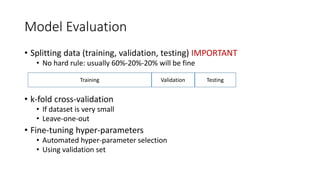
Model Evaluation
• Splitting data (training, validation, testing) IMPORTANT
• No hard rule: usually 60%-20%-20% will be fine
• k-fold cross-validation
• If dataset is very small
• Leave-one-out
• Fine-tuning hyper-parameters
• Automated hyper-parameter selection
• Using validation set
Training Validation Testing
Performance Measures
• Depending on the problem
• Some of the well-known measure are:
• Classification measures
• Accuracy
• Confusion matrix and related measures
• Regression
• Mean Squared Error
• R2 metric
• Clustering performance measure is not straight forward, and will not
be discussed here
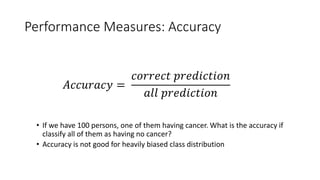
Performance Measures: Accuracy
• If we have 100 persons, one of them having cancer. What is the accuracy if
classify all of them as having no cancer?
• Accuracy is not good for heavily biased class distribution
𝐴𝐴𝐴𝐴𝐴𝐴𝐴𝐴𝐴𝐴𝐴𝐴𝐴𝐴𝐴𝐴 =
𝑐𝑐𝑐𝑐𝑐𝑐𝑐𝑐𝑐𝑐𝑐𝑐𝑐𝑐 𝑝𝑝𝑝𝑝𝑝𝑝𝑝𝑝𝑝𝑝𝑝𝑝𝑝𝑝𝑝𝑝𝑝𝑝𝑝𝑝
𝑎𝑎𝑎𝑎𝑎𝑎 𝑝𝑝𝑝𝑝𝑝𝑝𝑝𝑝𝑝𝑝𝑝𝑝𝑝𝑝𝑝𝑝𝑝𝑝𝑝𝑝
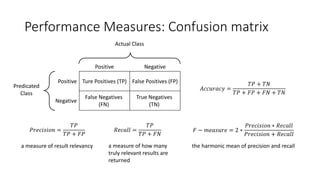
Performance Measures: Confusion matrix
NegativePositive
False Positives (FP)Ture Positives (TP)Positive
True Negatives
(TN)
False Negatives
(FN)
Negative
Predicated
Class
Actual Class
𝐴𝐴𝐴𝐴𝐴𝐴𝐴𝐴𝐴𝐴𝐴𝐴𝐴𝐴𝐴𝐴 =
𝑇𝑇𝑇𝑇 + 𝑇𝑇𝑇𝑇
𝑇𝑇𝑇𝑇 + 𝐹𝐹𝐹𝐹 + 𝐹𝐹𝐹𝐹 + 𝑇𝑇𝑇𝑇
𝑃𝑃𝑃𝑃𝑃𝑃𝑃𝑃𝑃𝑃𝑃𝑃𝑃𝑃𝑃𝑃𝑃𝑃 =
𝑇𝑇𝑇𝑇
𝑇𝑇𝑇𝑇 + 𝐹𝐹𝐹𝐹
𝑅𝑅𝑅𝑅𝑅𝑅𝑅𝑅𝑅𝑅𝑅𝑅 =
𝑇𝑇𝑇𝑇
𝑇𝑇𝑇𝑇 + 𝐹𝐹𝐹𝐹
𝐹𝐹 − 𝑚𝑚𝑚𝑚𝑚𝑚𝑚𝑚𝑚𝑚𝑚𝑚𝑚𝑚 = 2 ∗
𝑃𝑃𝑃𝑃𝑃𝑃𝑃𝑃𝑃𝑃𝑃𝑃𝑃𝑃𝑃𝑃𝑃𝑃 ∗ 𝑅𝑅𝑅𝑅𝑅𝑅𝑅𝑅𝑅𝑅𝑅𝑅
𝑃𝑃𝑃𝑃𝑃𝑃𝑃𝑃𝑃𝑃𝑃𝑃𝑃𝑃𝑃𝑃𝑃𝑃 + 𝑅𝑅𝑅𝑅𝑅𝑅𝑅𝑅𝑅𝑅𝑅𝑅
a measure of result relevancy a measure of how many
truly relevant results are
returned
the harmonic mean of precision and recall
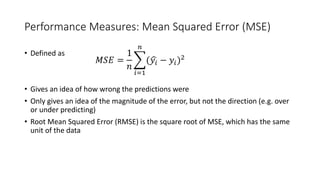
Performance Measures: Mean Squared Error (MSE)
• Defined as
• Gives an idea of how wrong the predictions were
• Only gives an idea of the magnitude of the error, but not the direction (e.g. over
or under predicting)
• Root Mean Squared Error (RMSE) is the square root of MSE, which has the same
unit of the data
𝑀𝑀𝑀𝑀𝑀𝑀 =
1
𝑛𝑛
�
𝑖𝑖=1
𝑛𝑛
(�𝑦𝑦𝑖𝑖 − 𝑦𝑦𝑖𝑖)2
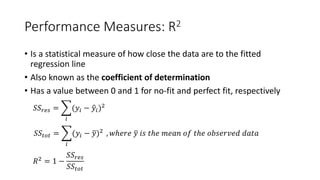
Performance Measures: R2
• Is a statistical measure of how close the data are to the fitted
regression line
• Also known as the coefficient of determination
• Has a value between 0 and 1 for no-fit and perfect fit, respectively
𝑆𝑆𝑆𝑆𝑟𝑟𝑟𝑟𝑟𝑟 = �
𝑖𝑖
(𝑦𝑦𝑖𝑖 − �𝑦𝑦𝑖𝑖)2
𝑆𝑆𝑆𝑆𝑡𝑡𝑡𝑡𝑡𝑡 = �
𝑖𝑖
(𝑦𝑦𝑖𝑖 − �𝑦𝑦)2 , 𝑤𝑤ℎ𝑒𝑒𝑒𝑒𝑒𝑒 �𝑦𝑦 𝑖𝑖𝑖𝑖 𝑡𝑡ℎ𝑒𝑒 𝑚𝑚𝑚𝑚𝑚𝑚𝑚𝑚 𝑜𝑜𝑜𝑜 𝑡𝑡ℎ𝑒𝑒 𝑜𝑜𝑜𝑜𝑜𝑜𝑜𝑜𝑜𝑜𝑜𝑜𝑜𝑜𝑜𝑜 𝑑𝑑𝑑𝑑𝑑𝑑𝑑𝑑
𝑅𝑅2 = 1 −
𝑆𝑆𝑆𝑆𝑟𝑟𝑟𝑟𝑟𝑟
𝑆𝑆𝑆𝑆𝑡𝑡𝑡𝑡𝑡𝑡
Dimensionality Reduction
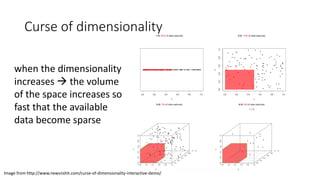
Curse of dimensionality
Image from http://www.newsnshit.com/curse-of-dimensionality-interactive-demo/
when the dimensionality
increases  the volume
of the space increases so
fast that the available
data become sparse
Feature selection
• Comprehensive (all subsets)
• Forward stepwise
• Backward stepwise
• Forward-Backward
• Many more…
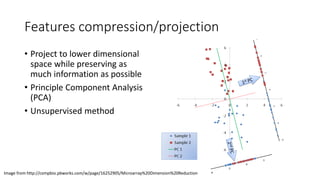
Features compression/projection
• Project to lower dimensional
space while preserving as
much information as possible
• Principle Component Analysis
(PCA)
• Unsupervised method
Image from http://compbio.pbworks.com/w/page/16252905/Microarray%20Dimension%20Reduction
Overfitting and Underfitting
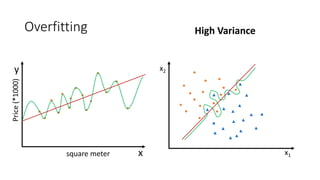
Overfitting
x
y
square meter
Price(*1000)
x1
x2
High Variance
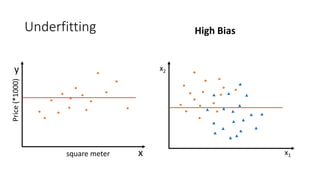
Underfitting
x1
x2
x
y
square meter
Price(*1000)
High Bias
Training vs. Testing Errors
•Accuracy on training set is not representative of
model performance
•We need to calculate the accuracy on the test
set (a new unseen examples)
•The goal is to generalize the model to work on
unseen data
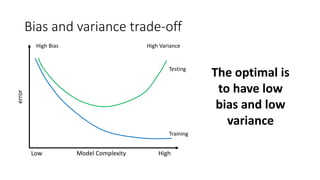
Bias and variance trade-off
Model Complexity
error
Low High
Testing
Training
High Bias High Variance
The optimal is
to have low
bias and low
variance
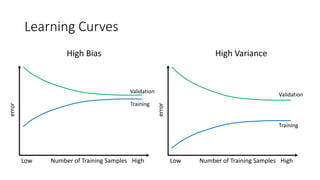
Learning Curves
High Bias High Variance
Number of Training Samples
error
Low High
Validation
Training
Number of Training Sampleserror Low High
Validation
Training
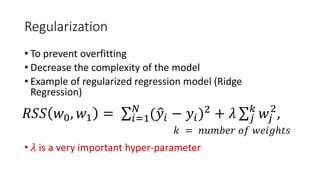
Regularization
• To prevent overfitting
• Decrease the complexity of the model
• Example of regularized regression model (Ridge
Regression)
• 𝜆𝜆 is a very important hyper-parameter
𝑅𝑅𝑅𝑅𝑅𝑅 𝑤𝑤0, 𝑤𝑤1 = ∑𝑖𝑖=1
𝑁𝑁
(�𝑦𝑦𝑖𝑖 − 𝑦𝑦𝑖𝑖)2
+ 𝜆𝜆 ∑𝑗𝑗
𝑘𝑘
𝑤𝑤𝑗𝑗
2
,
𝑘𝑘 = 𝑛𝑛𝑛𝑛𝑛𝑛𝑛𝑛𝑛𝑛𝑛𝑛 𝑜𝑜𝑜𝑜 𝑤𝑤𝑤𝑤𝑤𝑤𝑤𝑤ℎ𝑡𝑡𝑡𝑡
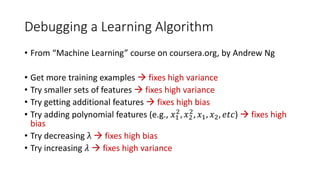
Debugging a Learning Algorithm
• From “Machine Learning” course on coursera.org, by Andrew Ng
• Get more training examples  fixes high variance
• Try smaller sets of features  fixes high variance
• Try getting additional features  fixes high bias
• Try adding polynomial features (e.g., 𝑥𝑥1
2
, 𝑥𝑥2
2
, 𝑥𝑥1, 𝑥𝑥2, 𝑒𝑒𝑒𝑒𝑒𝑒)  fixes high
bias
• Try decreasing λ  fixes high bias
• Try increasing 𝜆𝜆  fixes high variance
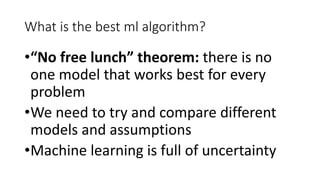
What is the best ml algorithm?
•“No free lunch” theorem: there is no
one model that works best for every
problem
•We need to try and compare different
models and assumptions
•Machine learning is full of uncertainty
‫ﻣﺘﻼزﻣﺔ‬‫وﯾﻜﺎ‬
Weka syndrome
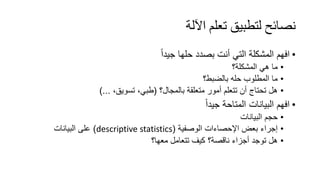
‫اﻵﻟﺔ‬ ‫ﺗﻌﻠﻢ‬ ‫ﻟﺘﻄﺒﯿﻖ‬ ‫ﻧﺼﺎﺋﺢ‬
•ً‫ا‬‫ﺟﯾد‬ ‫ﺣﻠﮭﺎ‬ ‫ﺑﺻدد‬ ‫أﻧت‬ ‫اﻟﺗﻲ‬ ‫اﻟﻣﺷﻛﻠﺔ‬ ‫اﻓﮭم‬
•‫اﻟﻣﺷﻛﻠﺔ؟‬ ‫ھﻲ‬ ‫ﻣﺎ‬
•‫ﺑﺎﻟﺿﺑط؟‬ ‫ﺣﻠﮫ‬ ‫اﻟﻣطﻠوب‬ ‫ﻣﺎ‬
•‫ﺑﺎﻟﻣﺟﺎل؟‬ ‫ﻣﺗﻌﻠﻘﺔ‬ ‫أﻣور‬ ‫ﺗﺗﻌﻠم‬ ‫أن‬ ‫ﺗﺣﺗﺎج‬ ‫ھل‬)،‫ﺗﺳوﯾﻖ‬ ،‫طﺑﻲ‬(...
•ً‫ا‬‫ﺟﯾد‬ ‫اﻟﻣﺗﺎﺣﺔ‬ ‫اﻟﺑﯾﺎﻧﺎت‬ ‫اﻓﮭم‬
•‫اﻟﺑﯾﺎﻧﺎت‬ ‫ﺣﺟم‬
•‫اﻟوﺻﻔﯾﺔ‬ ‫اﻹﺣﺻﺎءات‬ ‫ﺑﻌض‬ ‫إﺟراء‬)descriptive statistics(‫اﻟﺑﯾﺎﻧﺎت‬ ‫ﻋﻠﻰ‬
•‫ﻣﻌﮭﺎ؟‬ ‫ﺗﺗﻌﺎﻣل‬ ‫ﻛﯾف‬ ‫ﻧﺎﻗﺻﺔ؟‬ ‫أﺟزاء‬ ‫ﺗوﺟد‬ ‫ھل‬
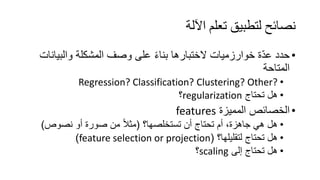
‫اﻵﻟﺔ‬ ‫ﺗﻌﻠﻢ‬ ‫ﻟﺘﻄﺒﯿﻖ‬ ‫ﻧﺼﺎﺋﺢ‬
•‫واﻟﺑﯾ‬ ‫اﻟﻣﺷﻛﻠﺔ‬ ‫وﺻف‬ ‫ﻋﻠﻰ‬ ً‫ء‬‫ﺑﻧﺎ‬ ‫ﻻﺧﺗﺑﺎرھﺎ‬ ‫ﺧوارزﻣﯾﺎت‬ ‫ة‬ّ‫د‬‫ﻋ‬ ‫ﺣدد‬‫ﺎﻧﺎت‬
‫اﻟﻣﺗﺎﺣﺔ‬
•Regression? Classification? Clustering? Other?
•‫ﺗﺣﺗﺎج‬ ‫ھل‬regularization‫؟‬
•‫اﻟﻣﻣﯾزة‬ ‫اﻟﺧﺻﺎﺋص‬features
•‫ﺗﺳﺗﺧﻠﺻﮭﺎ؟‬ ‫أن‬ ‫ﺗﺣﺗﺎج‬ ‫أم‬ ،‫ﺟﺎھزة‬ ‫ھﻲ‬ ‫ھل‬)‫ﻧﺻوص‬ ‫أو‬ ‫ﺻورة‬ ‫ﻣن‬ ً‫ﻼ‬‫ﻣﺛ‬(
•‫ﻟﺗﻘﻠﯾﻠﮭﺎ؟‬ ‫ﺗﺣﺗﺎج‬ ‫ھل‬)feature selection or projection(
•‫إﻟﻰ‬ ‫ﺗﺣﺗﺎج‬ ‫ھل‬scaling‫؟‬
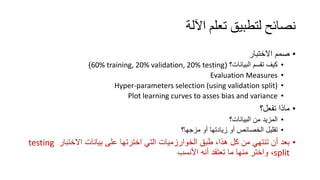
‫اﻵﻟﺔ‬ ‫ﺗﻌﻠﻢ‬ ‫ﻟﺘﻄﺒﯿﻖ‬ ‫ﻧﺼﺎﺋﺢ‬
•‫اﻻﺧﺗﺑﺎر‬ ‫ﺻﻣم‬
•‫اﻟﺑﯾﺎﻧﺎت؟‬ ‫ﺗﻘﺳم‬ ‫ﻛﯾف‬)60% training, 20% validation, 20% testing(
•Evaluation Measures
•Hyper-parameters selection (using validation split)
•Plot learning curves to asses bias and variance
•‫ﺗﻔﻌل؟‬ ‫ﻣﺎذا‬
•‫اﻟﺑﯾﺎﻧﺎت؟‬ ‫ﻣن‬ ‫اﻟﻣزﯾد‬
•‫ﻣزﺟﮭﺎ؟‬ ‫أو‬ ‫زﯾﺎدﺗﮭﺎ‬ ‫أو‬ ‫اﻟﺧﺻﺎﺋص‬ ‫ﺗﻘﻠﯾل‬
•‫اﻻﺧﺗﺑﺎر‬ ‫ﺑﯾﺎﻧﺎت‬ ‫ﻋﻠﻰ‬ ‫اﺧﺗرﺗﮭﺎ‬ ‫اﻟﺗﻲ‬ ‫اﻟﺧوارزﻣﯾﺎت‬ ‫طﺑﻖ‬ ،‫ھذا‬ ‫ﻛل‬ ‫ﻣن‬ ‫ﺗﻧﺗﮭﻲ‬ ‫أن‬ ‫ﺑﻌد‬testing
split‫اﻷﻧﺳب‬ ‫أﻧﮫ‬ ‫ﺗﻌﺗﻘد‬ ‫ﻣﺎ‬ ‫ﻣﻧﮭﺎ‬ ‫واﺧﺗر‬ ،
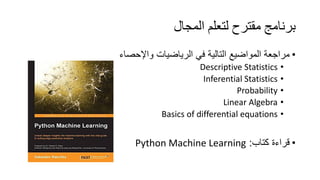
‫اﻟﻤﺠﺎل‬ ‫ﻟﺘﻌﻠﻢ‬ ‫ﻣﻘﺘﺮح‬ ‫ﺑﺮﻧﺎﻣﺞ‬
•‫واﻹﺣﺻﺎء‬ ‫اﻟرﯾﺎﺿﯾﺎت‬ ‫ﻓﻲ‬ ‫اﻟﺗﺎﻟﯾﺔ‬ ‫اﻟﻣواﺿﯾﻊ‬ ‫ﻣراﺟﻌﺔ‬
•Descriptive Statistics
•Inferential Statistics
•Probability
•Linear Algebra
•Basics of differential equations
•‫ﻛﺗﺎب‬ ‫ﻗراءة‬:Python Machine Learning
‫اﻟﻤﺠﺎل‬ ‫ﻟﺘﻌﻠﻢ‬ ‫ﻣﻘﺘﺮح‬ ‫ﺑﺮﻧﺎﻣﺞ‬
•‫دورة‬ ‫ﻓﻲ‬ ‫اﻟﺗﺳﺟﯾل‬“Machine Learning”‫ﻓﻲ‬coursera.org
•www.coursera.org/learn/machine-learning
•‫اﻟﺗﻣﺎرﯾن‬ ‫ﺟﻣﯾﻊ‬ ‫وﺣل‬
•‫اﻵﻟﺔ‬ ‫ﺑﺗﻌﻠم‬ ‫اﻟﻌﻼﻗﺔ‬ ‫ذات‬ ‫واﻟﻣﻛﺗﺑﺎت‬ ‫ﺑرﻣﺟﺔ‬ ‫ﻟﻐﺔ‬ ‫ﺗﻌﻠم‬
•Matlab
•Python
•R
‫اﻟﻤﺠﺎل‬ ‫ﻟﺘﻌﻠﻢ‬ ‫ﻣﻘﺘﺮح‬ ‫ﺑﺮﻧﺎﻣﺞ‬
•‫ﻓﻲ‬ ‫اﻟﺗﺳﺟﯾل‬‫ﻛﺎﺟل‬)www.kaggle.com(‫اﻟﺑﯾﺎﻧﺎت‬ ‫ﺑﻌض‬ ‫ﻋﻠﻰ‬ ‫واﻟﻌﻣل‬ ،
‫اﻟﻣﺗﺎﺣﺔ‬ ‫واﻟﺗﺣدﯾﺎت‬.
•‫ﻟﻠﺑداﯾﺔ‬ ‫ﻣﻘﺗرح‬:
•Titanic: Machine Learning from Disaster
https://www.kaggle.com/c/titanic
•House Prices: Advanced Regression Techniques
https://www.kaggle.com/c/house-prices-advanced-regression-
techniques
•Digit Recognizer
https://www.kaggle.com/c/digit-recognizer
‫اﻟﻤﺠﺎل‬ ‫ﻟﺘﻌﻠﻢ‬ ‫ﻣﻘﺘﺮح‬ ‫ﺑﺮﻧﺎﻣﺞ‬
•‫ﺗﺣﺗﺎﺟﮭﺎ‬ ‫أﻧك‬ ‫اﻵن‬ ‫ﺗﻌرف‬ ‫اﻟﺗﻲ‬ ‫اﻷﻣور‬ ‫ﻟﺗﻘوﯾﺔ‬ ‫واﻟرﯾﺎﺿﯾﺎت‬ ‫ﻟﻺﺣﺻﺎء‬ ‫أﺧرى‬ ‫ﻣراﺟﻌﺔ‬
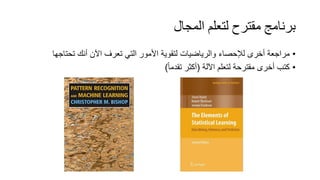
•‫اﻵﻟﺔ‬ ‫ﻟﺗﻌﻠم‬ ‫ﻣﻘﺗرﺣﺔ‬ ‫أﺧرى‬ ‫ﻛﺗب‬)ً‫ﺎ‬‫ﺗﻘدﻣ‬ ‫أﻛﺛر‬(
‫اﻟﻤﺠﺎل‬ ‫ﻟﺘﻌﻠﻢ‬ ‫ﻣﻘﺘﺮح‬ ‫ﺑﺮﻧﺎﻣﺞ‬
•‫ﺗرﯾده‬ ‫ﻣﺟﺎل‬ ‫ﻋﻠﻰ‬ ‫اﻟﺗرﻛﯾز‬
•‫ﻟﻸﻋﻣﺎل‬ ‫اﻟﻣﺳﺗﻘﺑﻠﻲ‬ ‫اﻟﺗﻧﺑؤ‬)‫ﻛﺎﻟﺗﺳوﯾﻖ‬(
•‫اﻟطﺑﯾﻌﯾﺔ‬ ‫اﻟﻠﻐﺎت‬ ‫ﻣﻌﺎﻟﺟﺔ‬
•‫اﻟﺣﺎﺳب‬ ‫رؤﯾﺔ‬
•‫أﻋﻣﺎﻟك‬ ‫ﻧﺗﺎﺋﺞ‬ ‫اﻋرض‬
•‫ﻋﻣﻠك‬ ‫اﻟﻧﺎس‬ ‫ﺷﺎرك‬)‫واﻟﻧﺗﺎﺋﺞ‬ ‫اﻟﻛود‬ ‫ﻣﺛل‬(‫رأﯾﮭم‬ ‫واطﻠب‬
•‫ﺑﮫ‬ ‫ﺗﺧﺻﺻت‬ ‫اﻟذي‬ ‫اﻟﻣﺟﺎل‬ ‫ﻓﻲ‬ ‫دورة‬ ‫أﻗم‬
‫وإﻧﺼﺎﺗﻜﻢ‬ ‫ﺣﻀﻮرﻛﻢ‬ ‫ﻋﻠﻰ‬ ‫ﻟﻜﻢ‬ ً‫ا‬‫ﺷﻜﺮ‬

مدخل إلى تعلم الآلة

  • 1.
  • 2.
    ‫اﻟﻤﺤﺎﺿﺮة‬ ‫طﺮﯾﻘﺔ‬ •‫اﻷﺳﺎﺳﯾﺔ‬ ‫واﻟﻣﻔﺎھﯾم‬‫اﻟﻣﺻطﻠﺣﺎت‬ ‫ﺷرح‬ •‫ﺑﺎﻟﻌرﺑﻲ‬ ‫واﻟﺷرح‬ ‫ﺑﺎﻹﻧﺟﻠﯾزي‬ ‫اﻟﻌرض‬ ‫ﺷراﺋﺢ‬ ‫وأﻏﻠب‬ ‫اﻟﻣﺻطﻠﺣﺎت‬ •‫ﻟﻸﺳﺎﺳﯾﺎت‬ ‫ﻣﻔﺻل‬ ‫ﺷرح‬ •‫اﻟﺷﮭﯾرة‬ ‫ﻟﻠﺧوارزﻣﯾﺎت‬ ‫ﺳرﯾﻌﺔ‬ ‫إﺷﺎرات‬ •‫ﺑﺳﯾطﺔ‬ ‫ﻋﻣﻠﯾﺔ‬ ‫أﻣﺛﻠﺔ‬ •‫ﻣﻘﺗرﺣﺔ‬ ‫ﺗﻌﻠم‬ ‫ﺧطﺔ‬
  • 3.
    ‫اﻵﻟﺔ؟‬ ‫ﺗﻌﻠﻢ‬ ‫ھﻮ‬‫ﻣﺎ‬ •‫ﺑﺎﻟﺗﻔﺻﯾل‬ ‫ﺑرﻣﺟﺗﮫ‬ ‫ﻣن‬ ً‫ﻻ‬‫ﺑد‬ ‫ﻧﻔﺳﮫ‬ ‫ﻣن‬ ‫اﻟﺗﻌﻠم‬ ‫اﻟﺣﺎﺳب‬ ‫ﯾﻣﻛن‬ ‫ﻋﻠم‬ ‫ھو‬ •‫ﻧﻣﺎذج‬ ‫ﺑﻧﺎء‬ ‫طرﯾﻖ‬ ‫ﻋن‬ ‫اﻟﺑﯾﺎﻧﺎت‬ ‫ﺟوھر‬ ‫اﺧﺗزال‬)models(‫واﻟﺗوﻗﻌﺎت‬ ‫اﻟﻘرارات‬ ‫واﺗﺧﺎذ‬ ، ‫ﻋﻠﯾﮭﺎ‬ ً‫ء‬‫ﺑﻧﺎ‬ ‫اﻟﻣﺳﺗﻘﺑﻠﯾﺔ‬
  • 5.
  • 6.
    •Regression analysis isa statistical process for estimating the relationships among variables •Used to predict continuous outcomes
  • 7.
  • 8.
    Linear Regression Line Equation 𝑦𝑦= 𝑏𝑏 + 𝑎𝑎𝑎𝑎 �𝑦𝑦 = 𝑤𝑤0 + 𝑤𝑤1 𝑥𝑥 intercept slope x y square meter price Model/hypothesis
  • 9.
    Linear Regression x y �𝑦𝑦= 𝑤𝑤0 + 𝑤𝑤1 𝑥𝑥 square meter Price(*1000) example 𝑤𝑤0=50, 𝑤𝑤1=1.8, x=500 �𝑦𝑦 = 950
  • 10.
    Linear Regression x y Howto quantify error? square meter price
  • 11.
    Linear Regression 𝑅𝑅𝑅𝑅𝑅𝑅 𝑤𝑤0,𝑤𝑤1 = � 𝑖𝑖=1 𝑁𝑁 (�𝑦𝑦𝑖𝑖 − 𝑦𝑦𝑖𝑖)2 Residual Sum of Squares (RSS) Where �𝑦𝑦𝑖𝑖 = 𝑤𝑤0 + 𝑤𝑤1 𝑥𝑥𝑖𝑖 Cost function
  • 12.
    Linear Regression How tochoose best model? Choose w0 and w1 that give lowest RSS value = Find The Best Line x y square meter price
  • 13.
  • 14.
    Optimization (convex) derivative =0 derivative > 0derivative < 0 The gradient points in the direction of the greatest rate of increase of the function, and its magnitude is the slope of the graph in that direction. - Wikipedia
  • 15.
    Optimization (convex) Image fromhttp://codingwiththomas.blogspot.com/2012/09/particle-swarm-optimization.html 𝑅𝑅𝑅𝑅𝑅𝑅 𝑤𝑤0 𝑤𝑤1
  • 16.
    Optimization (convex) • First,lets compute the gradient of our cost function • To find best lines, there are two ways: • Analytical (normal equation) • Iterative (gradient descent) Where �𝑦𝑦𝑖𝑖 = 𝑤𝑤0 + 𝑤𝑤1 𝑥𝑥𝑖𝑖 𝛻𝛻𝑅𝑅𝑅𝑅𝑅𝑅(𝑤𝑤0, 𝑤𝑤1) = −2 ∑𝑖𝑖=1 𝑁𝑁 [�𝑦𝑦𝑖𝑖 − 𝑦𝑦𝑖𝑖] −2 ∑𝑖𝑖=1 𝑁𝑁 [�𝑦𝑦𝑖𝑖 − 𝑦𝑦𝑖𝑖]𝑥𝑥𝑖𝑖
  • 17.
    Gradient Descent 𝒘𝒘𝑡𝑡+1 = 𝒘𝒘𝑡𝑡 −𝜂𝜂𝜂𝜂𝜂𝜂𝜂𝜂𝜂𝜂 𝑤𝑤0 𝑡𝑡+1 𝑤𝑤1 𝑡𝑡+1 = 𝑤𝑤0 𝑡𝑡 𝑤𝑤1 𝑡𝑡 − 𝜂𝜂 −2 ∑𝑖𝑖=1 𝑁𝑁 [�𝑦𝑦𝑖𝑖 − 𝑦𝑦𝑖𝑖] −2 ∑𝑖𝑖=1 𝑁𝑁 [�𝑦𝑦𝑖𝑖 − 𝑦𝑦𝑖𝑖]𝑥𝑥𝑖𝑖 Update the weights to minimize the cost function 𝜂𝜂 is the step size (important hyper-parameter)
  • 18.
  • 19.
    Linear Regression: Algorithm •Objective: min 𝑤𝑤0,𝑤𝑤1 𝐽𝐽(𝑤𝑤0, 𝑤𝑤1) , here 𝐽𝐽 𝑤𝑤0, 𝑤𝑤1 = 𝑅𝑅𝑅𝑅𝑅𝑅(𝑤𝑤0, 𝑤𝑤1) • Initialize 𝑤𝑤0, 𝑤𝑤1, e.g. random numbers or zeros • 𝑓𝑓𝑓𝑓𝑓𝑓 𝑛𝑛𝑛𝑛𝑛𝑛𝑛𝑛𝑛𝑛𝑛𝑛 𝑜𝑜𝑜𝑜 𝑖𝑖𝑖𝑖𝑖𝑖𝑖𝑖𝑖𝑖𝑖𝑖𝑖𝑖𝑖𝑖𝑖𝑖𝑖𝑖 𝑜𝑜𝑜𝑜 𝑠𝑠𝑠𝑠𝑠𝑠𝑠𝑠𝑠𝑠𝑠𝑠𝑠𝑠𝑠𝑠 𝑐𝑐𝑐𝑐𝑐𝑐𝑐𝑐𝑐𝑐𝑐𝑐𝑐𝑐𝑐𝑐: • Compute the gradient: 𝛻𝛻𝐽𝐽 • 𝑊𝑊𝑡𝑡+1 = 𝑊𝑊𝑡𝑡 − 𝜂𝜂𝜂𝜂𝐽𝐽, where W = 𝑤𝑤0 𝑤𝑤1
  • 20.
    Model/hypothesis Cost function Optimization �𝑦𝑦 =𝑤𝑤0 + 𝑤𝑤1 𝑥𝑥 𝑅𝑅𝑅𝑅𝑅𝑅 𝑤𝑤0, 𝑤𝑤1 = � 𝑖𝑖=1 𝑁𝑁 (𝑦𝑦𝑖𝑖−�𝑦𝑦𝑖𝑖)2 𝒘𝒘𝑡𝑡+1 = 𝒘𝒘𝑡𝑡 − 𝜂𝜂𝜂𝜂𝜂𝜂𝜂𝜂𝜂𝜂 The Essence of Machine Learning
  • 21.
    Linear Regression: Multiplefeatures • Example: for house pricing, in addition to size in square meters, we can use city, location, number of rooms, number of bathrooms, etc • The model/hypothesis becomes �𝑦𝑦 = 𝑤𝑤0 + 𝑤𝑤1 𝑥𝑥 1 + 𝑤𝑤2 𝑥𝑥2 + ⋯ + 𝑤𝑤𝑛𝑛 𝑥𝑥𝑛𝑛 𝑤𝑤𝑒𝑒ℎ𝑟𝑟𝑟𝑟 𝑛𝑛 = 𝑛𝑛𝑛𝑛𝑛𝑛𝑛𝑛𝑛𝑛𝑛𝑛 𝑜𝑜𝑜𝑜 𝑓𝑓𝑓𝑓𝑓𝑓𝑓𝑓𝑓𝑓𝑓𝑓𝑓𝑓𝑓𝑓
  • 22.
    Representation • Vector representationof 𝑛𝑛 features �𝑦𝑦 = 𝑤𝑤0 + 𝑤𝑤1 𝑥𝑥 1 + 𝑤𝑤2 𝑥𝑥2 + ⋯ + 𝑤𝑤𝑛𝑛 𝑥𝑥𝑛𝑛 𝒙𝒙 = 𝑥𝑥0 = 1 𝑥𝑥1 𝑥𝑥2 ⋮ 𝑥𝑥𝑛𝑛 𝒘𝒘 = 𝑤𝑤0 𝑤𝑤1 𝑤𝑤2 ⋮ 𝑤𝑤𝑛𝑛 �𝑦𝑦 = 𝒘𝒘 𝑇𝑇 𝒙𝒙 �𝑦𝑦 = 𝑤𝑤0 𝑤𝑤1 𝑤𝑤2 ⋯ 𝑤𝑤𝑛𝑛 𝑥𝑥0 𝑥𝑥1 𝑥𝑥2 ⋮ 𝑥𝑥𝑛𝑛
  • 23.
    Representation • matrix representationof 𝑚𝑚 data samples and 𝑛𝑛 features �𝑦𝑦(𝑖𝑖) = 𝑤𝑤0 + 𝑤𝑤1 𝑥𝑥1 (𝑖𝑖) + 𝑤𝑤2 𝑥𝑥2 (𝑖𝑖) + ⋯ + 𝑤𝑤𝑛𝑛 𝑥𝑥𝑛𝑛 (𝑖𝑖) 𝑋𝑋 = 𝑥𝑥0 (0) 𝑥𝑥1 (0) ⋯ 𝑥𝑥𝑛𝑛 (0) 𝑥𝑥0 (1) 𝑥𝑥1 (1) ⋯ 𝑥𝑥𝑛𝑛 (1) ⋮ 𝑥𝑥0 (𝑚𝑚) ⋮ 𝑥𝑥1 (𝑚𝑚) ⋱ … ⋮ 𝑥𝑥𝑛𝑛 (𝑚𝑚) 𝒘𝒘 = 𝑤𝑤0 𝑤𝑤1 𝑤𝑤2 ⋮ 𝑤𝑤𝑛𝑛 �𝒚𝒚 = 𝑋𝑋𝒘𝒘 𝑖𝑖 is the 𝑖𝑖th data sample Size: m x n Size: n x 1 �𝑦𝑦(0) �𝑦𝑦(1) �𝑦𝑦(2) ⋮ �𝑦𝑦(𝑚𝑚) = 𝑥𝑥0 (0) 𝑥𝑥1 (0) ⋯ 𝑥𝑥𝑛𝑛 (0) 𝑥𝑥0 (1) 𝑥𝑥1 (1) ⋯ 𝑥𝑥𝑛𝑛 (1) ⋮ 𝑥𝑥0 (𝑚𝑚) ⋮ 𝑥𝑥1 (𝑚𝑚) ⋱ … ⋮ 𝑥𝑥𝑛𝑛 (𝑚𝑚) × 𝑤𝑤0 𝑤𝑤1 𝑤𝑤2 ⋮ 𝑤𝑤𝑛𝑛
  • 24.
    Analytical solution (normalequation) 𝒘𝒘 = (𝑋𝑋 𝑇𝑇 𝑋𝑋)−1 𝑋𝑋 𝑇𝑇 𝒚𝒚
  • 25.
    Analytical vs. GradientDescent • Gradient descent: must select parameter 𝜂𝜂 • Analytical solution: no parameter selection • Gradient descent: a lot of iterations • Analytical solution: no need for iterations • Gradient descent: works with large number of features • Analytical solution: slow with large number of features
  • 26.
    Demo • Matrices operations •Simple linear regression implementation • Scikit-learn library’s linear regression
  • 27.
  • 28.
  • 29.
  • 30.
    Logistic Regression • Howto turn regression problem into classification one? • y = 0 or 1 • Map values to [0 1] range 𝑔𝑔 𝑥𝑥 = 1 1 + 𝑒𝑒−𝑥𝑥 Sigmoid/Logistic Function
  • 31.
    Logistic Regression • Model(sigmoidlogistic function) • Interpretation (probability) ℎ𝒘𝒘 𝒙𝒙 = 𝑔𝑔 𝒘𝒘𝑇𝑇 𝒙𝒙 = 1 1 + 𝑒𝑒−𝒘𝒘𝑇𝑇 𝒙𝒙 ℎ𝒘𝒘 𝒙𝒙 = 𝑝𝑝 𝑦𝑦 = 1|𝒙𝒙; 𝒘𝒘 𝑖𝑖𝑖𝑖 ℎ𝒘𝒘 𝒙𝒙 ≥ 0.5 ⇒ 𝑦𝑦 = 1 𝑖𝑖𝑖𝑖ℎ𝒘𝒘 𝒙𝒙 < 0.5 ⇒ 𝑦𝑦 = 0
  • 32.
  • 33.
    Logistic Regression • Costfunction 𝐽𝐽 𝒘𝒘 = 𝑦𝑦 log(ℎ𝒘𝒘 𝒙𝒙 ) + 1 − 𝑦𝑦 log(1 − ℎ𝒘𝒘(𝒙𝒙)) ℎ𝒘𝒘 𝒙𝒙 = 𝑔𝑔 𝒘𝒘𝑇𝑇 𝒙𝒙 = 1 1 + 𝑒𝑒−𝒘𝒘𝑇𝑇 𝒙𝒙
  • 34.
    Logistic Regression •Optimization: GradientDescent •Exactly like linear regression •Find best w parameters that minimize the cost function
  • 35.
    Logistic Regression: Algorithm •Objective: min 𝑤𝑤0,𝑤𝑤1 𝐽𝐽(𝑤𝑤0, 𝑤𝑤1) , here 𝐽𝐽 𝑤𝑤0, 𝑤𝑤1 is the logistic regression cost function • Initialize 𝑤𝑤0, 𝑤𝑤1, e.g. random numbers or zeros • 𝑓𝑓𝑓𝑓𝑓𝑓 𝑛𝑛𝑛𝑛𝑛𝑛𝑛𝑛𝑛𝑛𝑛𝑛 𝑜𝑜𝑜𝑜 𝑖𝑖𝑖𝑖𝑖𝑖𝑖𝑖𝑖𝑖𝑖𝑖𝑖𝑖𝑖𝑖𝑖𝑖𝑖𝑖 𝑜𝑜𝑜𝑜 𝑠𝑠𝑠𝑠𝑠𝑠𝑠𝑠𝑠𝑠𝑠𝑠𝑠𝑠𝑠𝑠 𝑐𝑐𝑐𝑐𝑐𝑐𝑐𝑐𝑐𝑐𝑐𝑐𝑐𝑐𝑐𝑐: • Compute the gradient: 𝛻𝛻𝐽𝐽 (not discussed here) • 𝒘𝒘𝑡𝑡+1 = 𝒘𝒘𝑡𝑡 − 𝜂𝜂𝜂𝜂𝐽𝐽, where 𝐰𝐰 = 𝑤𝑤0 𝑤𝑤1
  • 36.
  • 37.
  • 38.
    Logistic Regression: MultipleFeatures x1 x2 x1 x2 x3 Line - Plane - Hyperplane
  • 39.
  • 40.
  • 41.
  • 42.
  • 43.
  • 44.
    K Nearest Neighbors(KNN) x1 x2 ? 5 Nearest Neighbors
  • 45.
  • 46.
    Clustering •Unsupervised learning •Group similaritems into clusters •K-Mean algorithm
  • 47.
  • 48.
  • 49.
  • 50.
  • 51.
  • 52.
  • 53.
  • 54.
  • 55.
  • 56.
  • 57.
    K-Mean Algorithm • Selectnumber of clusters: 𝐾𝐾 (number of centroids 𝜇𝜇1, … , 𝜇𝜇𝐾𝐾) • Given dataset of size N • 𝑓𝑓𝑜𝑜𝑜𝑜 𝑛𝑛𝑛𝑛𝑛𝑛𝑛𝑛𝑛𝑛𝑛𝑛 𝑜𝑜𝑜𝑜 𝑖𝑖𝑖𝑖𝑖𝑖𝑖𝑖𝑖𝑖𝑖𝑖𝑖𝑖𝑖𝑖𝑖𝑖𝑖𝑖 𝑡𝑡: • 𝑓𝑓𝑓𝑓𝑓𝑓 𝑖𝑖 = 1 𝑡𝑡𝑡𝑡 𝑁𝑁: • 𝑐𝑐𝑖𝑖 ≔ assign cluster 𝑐𝑐𝑖𝑖 to sample 𝑥𝑥𝑖𝑖 as the smallest Euclidean distance between 𝑥𝑥𝑖𝑖 and the centroids • 𝑓𝑓𝑜𝑜𝑜𝑜 𝑘𝑘 = 1 𝑡𝑡𝑡𝑡 𝐾𝐾: • 𝜇𝜇𝑘𝑘 ≔ mean of the points assigned to cluster 𝑐𝑐𝑘𝑘
  • 58.
  • 59.
  • 60.
    Other Machine LearningAlgorithms •Probabilistic models •Ensemble methods •Reinforcement Learning •Recommendation algorithms (e.g., Matrix Factorization) •Deep Learning
  • 61.
    Linear vs Non-linear x1 x2 x y squaremeter price Multi-layer Neural Networks Support Victor Machines (kernel trick)
  • 62.
    Kernel Trick 𝐾𝐾𝑥𝑥1, 𝑥𝑥2 = [𝑥𝑥1, 𝑥𝑥2, 𝑥𝑥1 2 + 𝑥𝑥2 2 ] Image from http://www.eric-kim.net/eric-kim-net/posts/1/kernel_trick.html
  • 63.
  • 64.
    Data Preprocessing • Missingdata • Elimination (samples/features) • Imputation • Categorical data • Mapping (for ordinal features) • One-hot-encoding (for nominal features) • Features scaling (normalization, standardization) • Data/problem specific preprocessing (e.g., images, signals, text) 𝑥𝑥𝑛𝑛𝑛𝑛𝑛𝑛𝑛𝑛 (𝑖𝑖) = 𝑥𝑥(𝑖𝑖) − 𝑥𝑥 𝑚𝑚𝑚𝑚𝑚𝑚 𝑥𝑥 𝑚𝑚𝑚𝑚𝑚𝑚 − 𝑥𝑥 𝑚𝑚𝑚𝑚𝑚𝑚 𝑥𝑥𝑠𝑠𝑠𝑠𝑠𝑠 (𝑖𝑖) = 𝑥𝑥(𝑖𝑖) − 𝜇𝜇𝑥𝑥 𝜎𝜎𝑥𝑥 , 𝑤𝑤ℎ𝑒𝑒𝑒𝑒𝑒𝑒 𝜇𝜇𝑥𝑥: 𝑚𝑚𝑚𝑚𝑚𝑚𝑚𝑚 𝑜𝑜𝑜𝑜 𝑓𝑓𝑓𝑓𝑓𝑓𝑓𝑓𝑓𝑓𝑓𝑓𝑓𝑓 𝑥𝑥, 𝜎𝜎𝑥𝑥: 𝑠𝑠𝑠𝑠𝑠𝑠𝑠𝑠𝑠𝑠𝑠𝑠𝑠𝑠𝑠𝑠 𝑑𝑑𝑑𝑑𝑑𝑑𝑑𝑑𝑑𝑑𝑑𝑑𝑑𝑑𝑑𝑑𝑑𝑑
  • 65.
    Model Evaluation • Splittingdata (training, validation, testing) IMPORTANT • No hard rule: usually 60%-20%-20% will be fine • k-fold cross-validation • If dataset is very small • Leave-one-out • Fine-tuning hyper-parameters • Automated hyper-parameter selection • Using validation set Training Validation Testing
  • 66.
    Performance Measures • Dependingon the problem • Some of the well-known measure are: • Classification measures • Accuracy • Confusion matrix and related measures • Regression • Mean Squared Error • R2 metric • Clustering performance measure is not straight forward, and will not be discussed here
  • 67.
    Performance Measures: Accuracy •If we have 100 persons, one of them having cancer. What is the accuracy if classify all of them as having no cancer? • Accuracy is not good for heavily biased class distribution 𝐴𝐴𝐴𝐴𝐴𝐴𝐴𝐴𝐴𝐴𝐴𝐴𝐴𝐴𝐴𝐴 = 𝑐𝑐𝑐𝑐𝑐𝑐𝑐𝑐𝑐𝑐𝑐𝑐𝑐𝑐 𝑝𝑝𝑝𝑝𝑝𝑝𝑝𝑝𝑝𝑝𝑝𝑝𝑝𝑝𝑝𝑝𝑝𝑝𝑝𝑝 𝑎𝑎𝑎𝑎𝑎𝑎 𝑝𝑝𝑝𝑝𝑝𝑝𝑝𝑝𝑝𝑝𝑝𝑝𝑝𝑝𝑝𝑝𝑝𝑝𝑝𝑝
  • 68.
    Performance Measures: Confusionmatrix NegativePositive False Positives (FP)Ture Positives (TP)Positive True Negatives (TN) False Negatives (FN) Negative Predicated Class Actual Class 𝐴𝐴𝐴𝐴𝐴𝐴𝐴𝐴𝐴𝐴𝐴𝐴𝐴𝐴𝐴𝐴 = 𝑇𝑇𝑇𝑇 + 𝑇𝑇𝑇𝑇 𝑇𝑇𝑇𝑇 + 𝐹𝐹𝐹𝐹 + 𝐹𝐹𝐹𝐹 + 𝑇𝑇𝑇𝑇 𝑃𝑃𝑃𝑃𝑃𝑃𝑃𝑃𝑃𝑃𝑃𝑃𝑃𝑃𝑃𝑃𝑃𝑃 = 𝑇𝑇𝑇𝑇 𝑇𝑇𝑇𝑇 + 𝐹𝐹𝐹𝐹 𝑅𝑅𝑅𝑅𝑅𝑅𝑅𝑅𝑅𝑅𝑅𝑅 = 𝑇𝑇𝑇𝑇 𝑇𝑇𝑇𝑇 + 𝐹𝐹𝐹𝐹 𝐹𝐹 − 𝑚𝑚𝑚𝑚𝑚𝑚𝑚𝑚𝑚𝑚𝑚𝑚𝑚𝑚 = 2 ∗ 𝑃𝑃𝑃𝑃𝑃𝑃𝑃𝑃𝑃𝑃𝑃𝑃𝑃𝑃𝑃𝑃𝑃𝑃 ∗ 𝑅𝑅𝑅𝑅𝑅𝑅𝑅𝑅𝑅𝑅𝑅𝑅 𝑃𝑃𝑃𝑃𝑃𝑃𝑃𝑃𝑃𝑃𝑃𝑃𝑃𝑃𝑃𝑃𝑃𝑃 + 𝑅𝑅𝑅𝑅𝑅𝑅𝑅𝑅𝑅𝑅𝑅𝑅 a measure of result relevancy a measure of how many truly relevant results are returned the harmonic mean of precision and recall
  • 69.
    Performance Measures: MeanSquared Error (MSE) • Defined as • Gives an idea of how wrong the predictions were • Only gives an idea of the magnitude of the error, but not the direction (e.g. over or under predicting) • Root Mean Squared Error (RMSE) is the square root of MSE, which has the same unit of the data 𝑀𝑀𝑀𝑀𝑀𝑀 = 1 𝑛𝑛 � 𝑖𝑖=1 𝑛𝑛 (�𝑦𝑦𝑖𝑖 − 𝑦𝑦𝑖𝑖)2
  • 70.
    Performance Measures: R2 •Is a statistical measure of how close the data are to the fitted regression line • Also known as the coefficient of determination • Has a value between 0 and 1 for no-fit and perfect fit, respectively 𝑆𝑆𝑆𝑆𝑟𝑟𝑟𝑟𝑟𝑟 = � 𝑖𝑖 (𝑦𝑦𝑖𝑖 − �𝑦𝑦𝑖𝑖)2 𝑆𝑆𝑆𝑆𝑡𝑡𝑡𝑡𝑡𝑡 = � 𝑖𝑖 (𝑦𝑦𝑖𝑖 − �𝑦𝑦)2 , 𝑤𝑤ℎ𝑒𝑒𝑒𝑒𝑒𝑒 �𝑦𝑦 𝑖𝑖𝑖𝑖 𝑡𝑡ℎ𝑒𝑒 𝑚𝑚𝑚𝑚𝑚𝑚𝑚𝑚 𝑜𝑜𝑜𝑜 𝑡𝑡ℎ𝑒𝑒 𝑜𝑜𝑜𝑜𝑜𝑜𝑜𝑜𝑜𝑜𝑜𝑜𝑜𝑜𝑜𝑜 𝑑𝑑𝑑𝑑𝑑𝑑𝑑𝑑 𝑅𝑅2 = 1 − 𝑆𝑆𝑆𝑆𝑟𝑟𝑟𝑟𝑟𝑟 𝑆𝑆𝑆𝑆𝑡𝑡𝑡𝑡𝑡𝑡
  • 71.
  • 72.
    Curse of dimensionality Imagefrom http://www.newsnshit.com/curse-of-dimensionality-interactive-demo/ when the dimensionality increases  the volume of the space increases so fast that the available data become sparse
  • 73.
    Feature selection • Comprehensive(all subsets) • Forward stepwise • Backward stepwise • Forward-Backward • Many more…
  • 74.
    Features compression/projection • Projectto lower dimensional space while preserving as much information as possible • Principle Component Analysis (PCA) • Unsupervised method Image from http://compbio.pbworks.com/w/page/16252905/Microarray%20Dimension%20Reduction
  • 75.
  • 76.
  • 77.
  • 78.
    Training vs. TestingErrors •Accuracy on training set is not representative of model performance •We need to calculate the accuracy on the test set (a new unseen examples) •The goal is to generalize the model to work on unseen data
  • 79.
    Bias and variancetrade-off Model Complexity error Low High Testing Training High Bias High Variance The optimal is to have low bias and low variance
  • 80.
    Learning Curves High BiasHigh Variance Number of Training Samples error Low High Validation Training Number of Training Sampleserror Low High Validation Training
  • 81.
    Regularization • To preventoverfitting • Decrease the complexity of the model • Example of regularized regression model (Ridge Regression) • 𝜆𝜆 is a very important hyper-parameter 𝑅𝑅𝑅𝑅𝑅𝑅 𝑤𝑤0, 𝑤𝑤1 = ∑𝑖𝑖=1 𝑁𝑁 (�𝑦𝑦𝑖𝑖 − 𝑦𝑦𝑖𝑖)2 + 𝜆𝜆 ∑𝑗𝑗 𝑘𝑘 𝑤𝑤𝑗𝑗 2 , 𝑘𝑘 = 𝑛𝑛𝑛𝑛𝑛𝑛𝑛𝑛𝑛𝑛𝑛𝑛 𝑜𝑜𝑜𝑜 𝑤𝑤𝑤𝑤𝑤𝑤𝑤𝑤ℎ𝑡𝑡𝑡𝑡
  • 82.
    Debugging a LearningAlgorithm • From “Machine Learning” course on coursera.org, by Andrew Ng • Get more training examples  fixes high variance • Try smaller sets of features  fixes high variance • Try getting additional features  fixes high bias • Try adding polynomial features (e.g., 𝑥𝑥1 2 , 𝑥𝑥2 2 , 𝑥𝑥1, 𝑥𝑥2, 𝑒𝑒𝑒𝑒𝑒𝑒)  fixes high bias • Try decreasing λ  fixes high bias • Try increasing 𝜆𝜆  fixes high variance
  • 84.
    What is thebest ml algorithm? •“No free lunch” theorem: there is no one model that works best for every problem •We need to try and compare different models and assumptions •Machine learning is full of uncertainty
  • 85.
  • 86.
    ‫اﻵﻟﺔ‬ ‫ﺗﻌﻠﻢ‬ ‫ﻟﺘﻄﺒﯿﻖ‬‫ﻧﺼﺎﺋﺢ‬ •ً‫ا‬‫ﺟﯾد‬ ‫ﺣﻠﮭﺎ‬ ‫ﺑﺻدد‬ ‫أﻧت‬ ‫اﻟﺗﻲ‬ ‫اﻟﻣﺷﻛﻠﺔ‬ ‫اﻓﮭم‬ •‫اﻟﻣﺷﻛﻠﺔ؟‬ ‫ھﻲ‬ ‫ﻣﺎ‬ •‫ﺑﺎﻟﺿﺑط؟‬ ‫ﺣﻠﮫ‬ ‫اﻟﻣطﻠوب‬ ‫ﻣﺎ‬ •‫ﺑﺎﻟﻣﺟﺎل؟‬ ‫ﻣﺗﻌﻠﻘﺔ‬ ‫أﻣور‬ ‫ﺗﺗﻌﻠم‬ ‫أن‬ ‫ﺗﺣﺗﺎج‬ ‫ھل‬)،‫ﺗﺳوﯾﻖ‬ ،‫طﺑﻲ‬(... •ً‫ا‬‫ﺟﯾد‬ ‫اﻟﻣﺗﺎﺣﺔ‬ ‫اﻟﺑﯾﺎﻧﺎت‬ ‫اﻓﮭم‬ •‫اﻟﺑﯾﺎﻧﺎت‬ ‫ﺣﺟم‬ •‫اﻟوﺻﻔﯾﺔ‬ ‫اﻹﺣﺻﺎءات‬ ‫ﺑﻌض‬ ‫إﺟراء‬)descriptive statistics(‫اﻟﺑﯾﺎﻧﺎت‬ ‫ﻋﻠﻰ‬ •‫ﻣﻌﮭﺎ؟‬ ‫ﺗﺗﻌﺎﻣل‬ ‫ﻛﯾف‬ ‫ﻧﺎﻗﺻﺔ؟‬ ‫أﺟزاء‬ ‫ﺗوﺟد‬ ‫ھل‬
  • 87.
    ‫اﻵﻟﺔ‬ ‫ﺗﻌﻠﻢ‬ ‫ﻟﺘﻄﺒﯿﻖ‬‫ﻧﺼﺎﺋﺢ‬ •‫واﻟﺑﯾ‬ ‫اﻟﻣﺷﻛﻠﺔ‬ ‫وﺻف‬ ‫ﻋﻠﻰ‬ ً‫ء‬‫ﺑﻧﺎ‬ ‫ﻻﺧﺗﺑﺎرھﺎ‬ ‫ﺧوارزﻣﯾﺎت‬ ‫ة‬ّ‫د‬‫ﻋ‬ ‫ﺣدد‬‫ﺎﻧﺎت‬ ‫اﻟﻣﺗﺎﺣﺔ‬ •Regression? Classification? Clustering? Other? •‫ﺗﺣﺗﺎج‬ ‫ھل‬regularization‫؟‬ •‫اﻟﻣﻣﯾزة‬ ‫اﻟﺧﺻﺎﺋص‬features •‫ﺗﺳﺗﺧﻠﺻﮭﺎ؟‬ ‫أن‬ ‫ﺗﺣﺗﺎج‬ ‫أم‬ ،‫ﺟﺎھزة‬ ‫ھﻲ‬ ‫ھل‬)‫ﻧﺻوص‬ ‫أو‬ ‫ﺻورة‬ ‫ﻣن‬ ً‫ﻼ‬‫ﻣﺛ‬( •‫ﻟﺗﻘﻠﯾﻠﮭﺎ؟‬ ‫ﺗﺣﺗﺎج‬ ‫ھل‬)feature selection or projection( •‫إﻟﻰ‬ ‫ﺗﺣﺗﺎج‬ ‫ھل‬scaling‫؟‬
  • 88.
    ‫اﻵﻟﺔ‬ ‫ﺗﻌﻠﻢ‬ ‫ﻟﺘﻄﺒﯿﻖ‬‫ﻧﺼﺎﺋﺢ‬ •‫اﻻﺧﺗﺑﺎر‬ ‫ﺻﻣم‬ •‫اﻟﺑﯾﺎﻧﺎت؟‬ ‫ﺗﻘﺳم‬ ‫ﻛﯾف‬)60% training, 20% validation, 20% testing( •Evaluation Measures •Hyper-parameters selection (using validation split) •Plot learning curves to asses bias and variance •‫ﺗﻔﻌل؟‬ ‫ﻣﺎذا‬ •‫اﻟﺑﯾﺎﻧﺎت؟‬ ‫ﻣن‬ ‫اﻟﻣزﯾد‬ •‫ﻣزﺟﮭﺎ؟‬ ‫أو‬ ‫زﯾﺎدﺗﮭﺎ‬ ‫أو‬ ‫اﻟﺧﺻﺎﺋص‬ ‫ﺗﻘﻠﯾل‬ •‫اﻻﺧﺗﺑﺎر‬ ‫ﺑﯾﺎﻧﺎت‬ ‫ﻋﻠﻰ‬ ‫اﺧﺗرﺗﮭﺎ‬ ‫اﻟﺗﻲ‬ ‫اﻟﺧوارزﻣﯾﺎت‬ ‫طﺑﻖ‬ ،‫ھذا‬ ‫ﻛل‬ ‫ﻣن‬ ‫ﺗﻧﺗﮭﻲ‬ ‫أن‬ ‫ﺑﻌد‬testing split‫اﻷﻧﺳب‬ ‫أﻧﮫ‬ ‫ﺗﻌﺗﻘد‬ ‫ﻣﺎ‬ ‫ﻣﻧﮭﺎ‬ ‫واﺧﺗر‬ ،
  • 89.
    ‫اﻟﻤﺠﺎل‬ ‫ﻟﺘﻌﻠﻢ‬ ‫ﻣﻘﺘﺮح‬‫ﺑﺮﻧﺎﻣﺞ‬ •‫واﻹﺣﺻﺎء‬ ‫اﻟرﯾﺎﺿﯾﺎت‬ ‫ﻓﻲ‬ ‫اﻟﺗﺎﻟﯾﺔ‬ ‫اﻟﻣواﺿﯾﻊ‬ ‫ﻣراﺟﻌﺔ‬ •Descriptive Statistics •Inferential Statistics •Probability •Linear Algebra •Basics of differential equations •‫ﻛﺗﺎب‬ ‫ﻗراءة‬:Python Machine Learning
  • 90.
    ‫اﻟﻤﺠﺎل‬ ‫ﻟﺘﻌﻠﻢ‬ ‫ﻣﻘﺘﺮح‬‫ﺑﺮﻧﺎﻣﺞ‬ •‫دورة‬ ‫ﻓﻲ‬ ‫اﻟﺗﺳﺟﯾل‬“Machine Learning”‫ﻓﻲ‬coursera.org •www.coursera.org/learn/machine-learning •‫اﻟﺗﻣﺎرﯾن‬ ‫ﺟﻣﯾﻊ‬ ‫وﺣل‬ •‫اﻵﻟﺔ‬ ‫ﺑﺗﻌﻠم‬ ‫اﻟﻌﻼﻗﺔ‬ ‫ذات‬ ‫واﻟﻣﻛﺗﺑﺎت‬ ‫ﺑرﻣﺟﺔ‬ ‫ﻟﻐﺔ‬ ‫ﺗﻌﻠم‬ •Matlab •Python •R
  • 91.
    ‫اﻟﻤﺠﺎل‬ ‫ﻟﺘﻌﻠﻢ‬ ‫ﻣﻘﺘﺮح‬‫ﺑﺮﻧﺎﻣﺞ‬ •‫ﻓﻲ‬ ‫اﻟﺗﺳﺟﯾل‬‫ﻛﺎﺟل‬)www.kaggle.com(‫اﻟﺑﯾﺎﻧﺎت‬ ‫ﺑﻌض‬ ‫ﻋﻠﻰ‬ ‫واﻟﻌﻣل‬ ، ‫اﻟﻣﺗﺎﺣﺔ‬ ‫واﻟﺗﺣدﯾﺎت‬. •‫ﻟﻠﺑداﯾﺔ‬ ‫ﻣﻘﺗرح‬: •Titanic: Machine Learning from Disaster https://www.kaggle.com/c/titanic •House Prices: Advanced Regression Techniques https://www.kaggle.com/c/house-prices-advanced-regression- techniques •Digit Recognizer https://www.kaggle.com/c/digit-recognizer
  • 92.
    ‫اﻟﻤﺠﺎل‬ ‫ﻟﺘﻌﻠﻢ‬ ‫ﻣﻘﺘﺮح‬‫ﺑﺮﻧﺎﻣﺞ‬ •‫ﺗﺣﺗﺎﺟﮭﺎ‬ ‫أﻧك‬ ‫اﻵن‬ ‫ﺗﻌرف‬ ‫اﻟﺗﻲ‬ ‫اﻷﻣور‬ ‫ﻟﺗﻘوﯾﺔ‬ ‫واﻟرﯾﺎﺿﯾﺎت‬ ‫ﻟﻺﺣﺻﺎء‬ ‫أﺧرى‬ ‫ﻣراﺟﻌﺔ‬ •‫اﻵﻟﺔ‬ ‫ﻟﺗﻌﻠم‬ ‫ﻣﻘﺗرﺣﺔ‬ ‫أﺧرى‬ ‫ﻛﺗب‬)ً‫ﺎ‬‫ﺗﻘدﻣ‬ ‫أﻛﺛر‬(
  • 93.
    ‫اﻟﻤﺠﺎل‬ ‫ﻟﺘﻌﻠﻢ‬ ‫ﻣﻘﺘﺮح‬‫ﺑﺮﻧﺎﻣﺞ‬ •‫ﺗرﯾده‬ ‫ﻣﺟﺎل‬ ‫ﻋﻠﻰ‬ ‫اﻟﺗرﻛﯾز‬ •‫ﻟﻸﻋﻣﺎل‬ ‫اﻟﻣﺳﺗﻘﺑﻠﻲ‬ ‫اﻟﺗﻧﺑؤ‬)‫ﻛﺎﻟﺗﺳوﯾﻖ‬( •‫اﻟطﺑﯾﻌﯾﺔ‬ ‫اﻟﻠﻐﺎت‬ ‫ﻣﻌﺎﻟﺟﺔ‬ •‫اﻟﺣﺎﺳب‬ ‫رؤﯾﺔ‬ •‫أﻋﻣﺎﻟك‬ ‫ﻧﺗﺎﺋﺞ‬ ‫اﻋرض‬ •‫ﻋﻣﻠك‬ ‫اﻟﻧﺎس‬ ‫ﺷﺎرك‬)‫واﻟﻧﺗﺎﺋﺞ‬ ‫اﻟﻛود‬ ‫ﻣﺛل‬(‫رأﯾﮭم‬ ‫واطﻠب‬ •‫ﺑﮫ‬ ‫ﺗﺧﺻﺻت‬ ‫اﻟذي‬ ‫اﻟﻣﺟﺎل‬ ‫ﻓﻲ‬ ‫دورة‬ ‫أﻗم‬
  • 94.