international business, 5th edition
chapter 17
international
operations
management
Chapter Objectives 1

       • Describe the nature of international
         operations management
       • Analyze the supply chain management
         and vertical integration decisions facing
         international production managers
       • Analyze the meaning of productivity and
         discuss how international firms work to
         improve it


17-2
Chapter Objectives 2

       • Explain how firms control quality and
         discuss total quality management in
         international business
       • Analyze how international firms control
         the information their managers need to
         make effective decisions


17-3
Operations Management

         Operations management is the set of
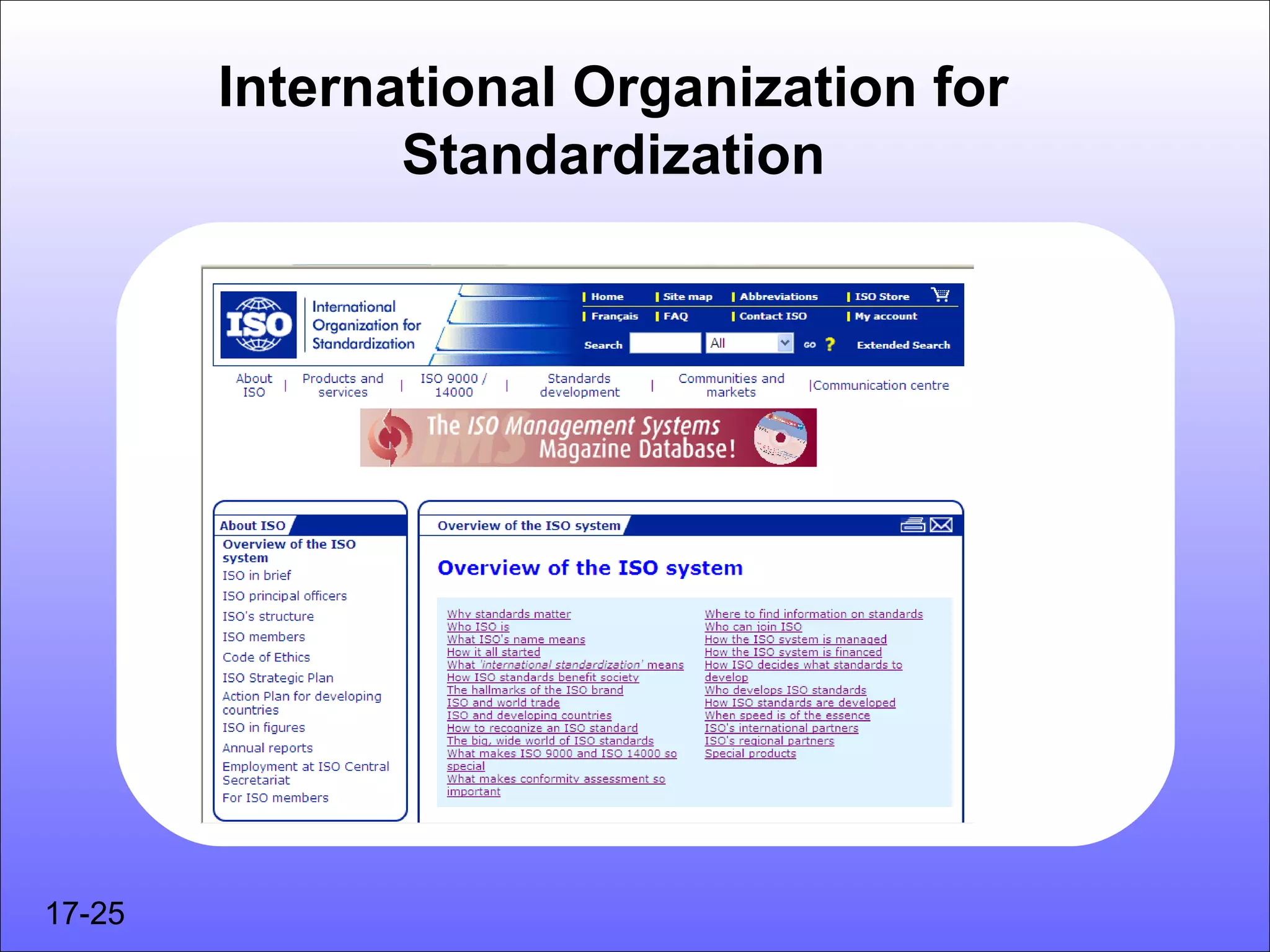
       activities an organization uses to transform
        different kinds of inputs (materials, labor,
        and so on) into final goods and services.
        International operations management
           refers to the transformation-related
            activities of an international firm.


17-4
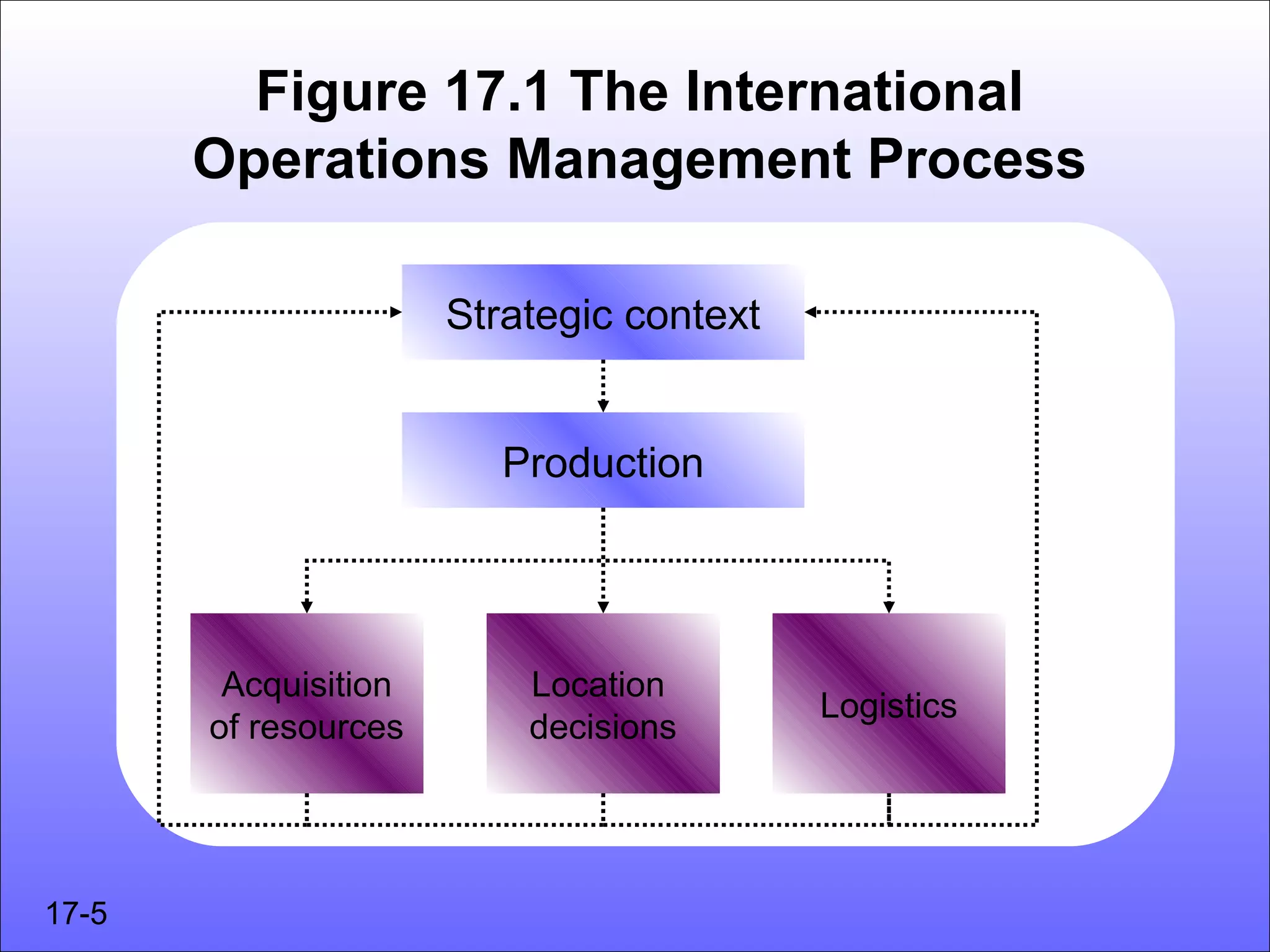
Figure 17.1 The International
       Operations Management Process

                      Strategic context


                         Production


        Acquisition       Location
                                          Logistics
       of resources       decisions


17-5
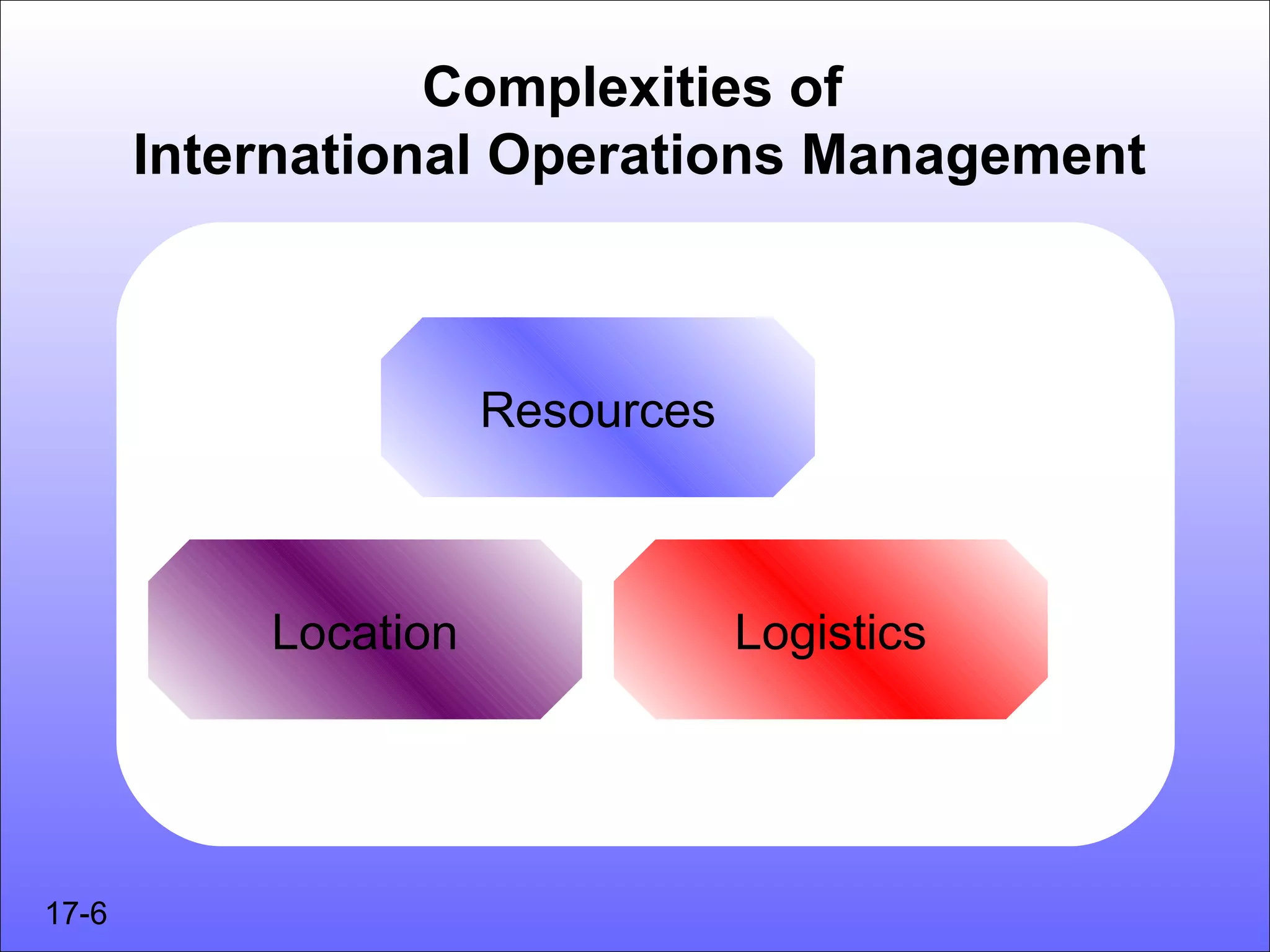
Complexities of
       International Operations Management


                      Resources


           Location               Logistics


17-6
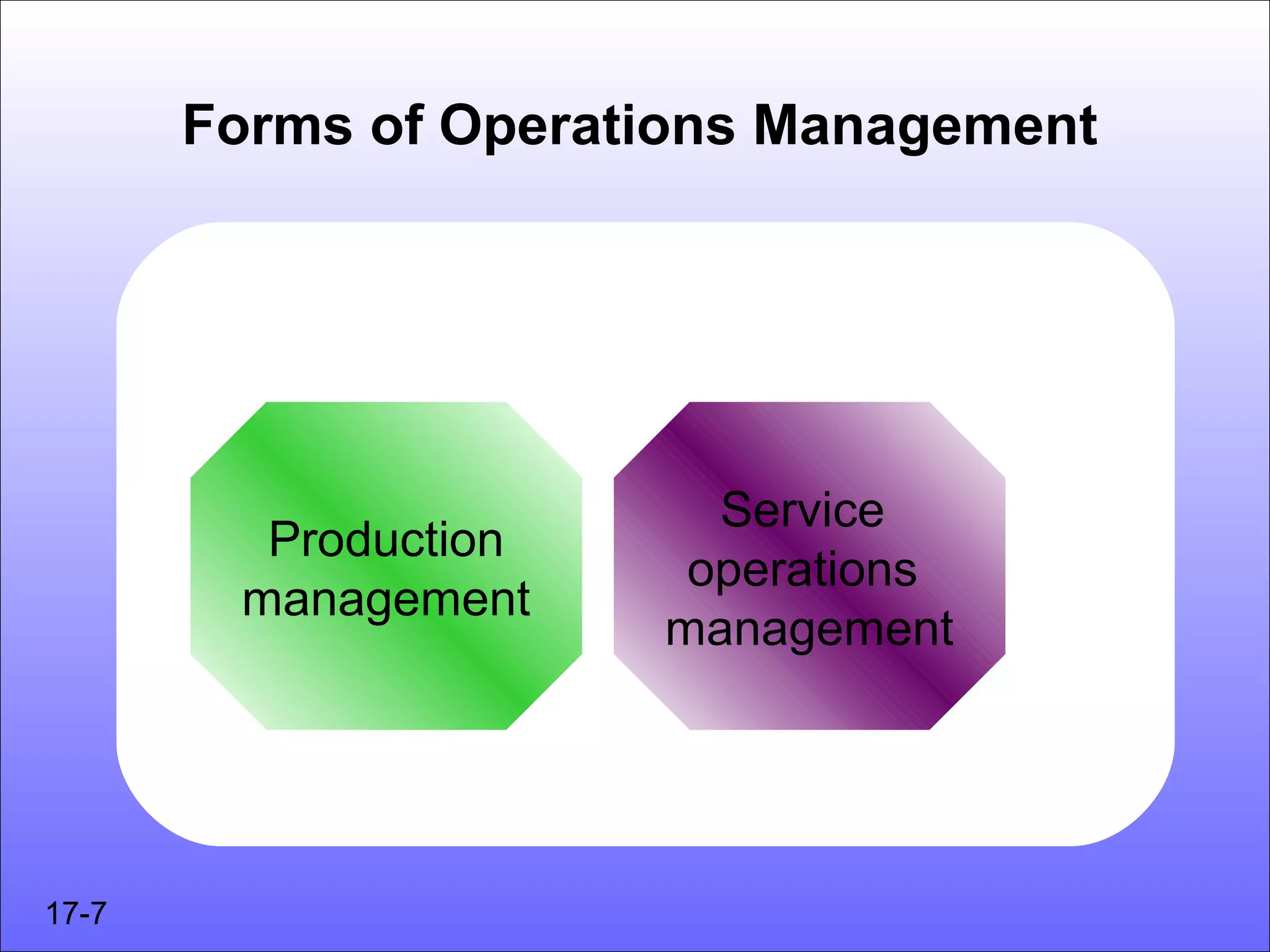
Forms of Operations Management


                        Service
         Production
                       operations
        management
                      management


17-7
Supply Chain Management

       Supply chain management
           is the set of processes and steps a
        firm uses to acquire the
       various resources
            it needs to create its products.


17-8
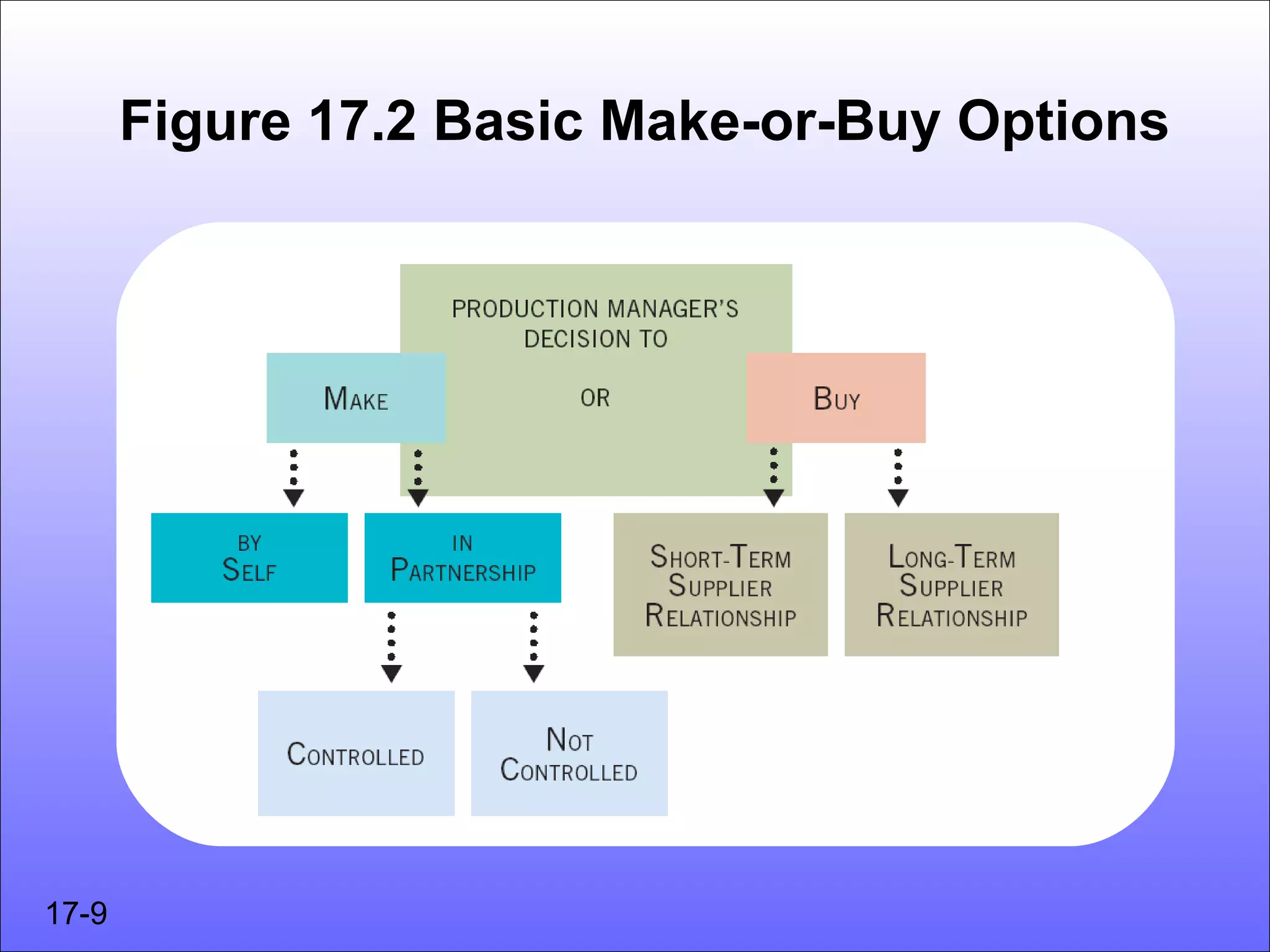
Figure 17.2 Basic Make-or-Buy Options


17-9
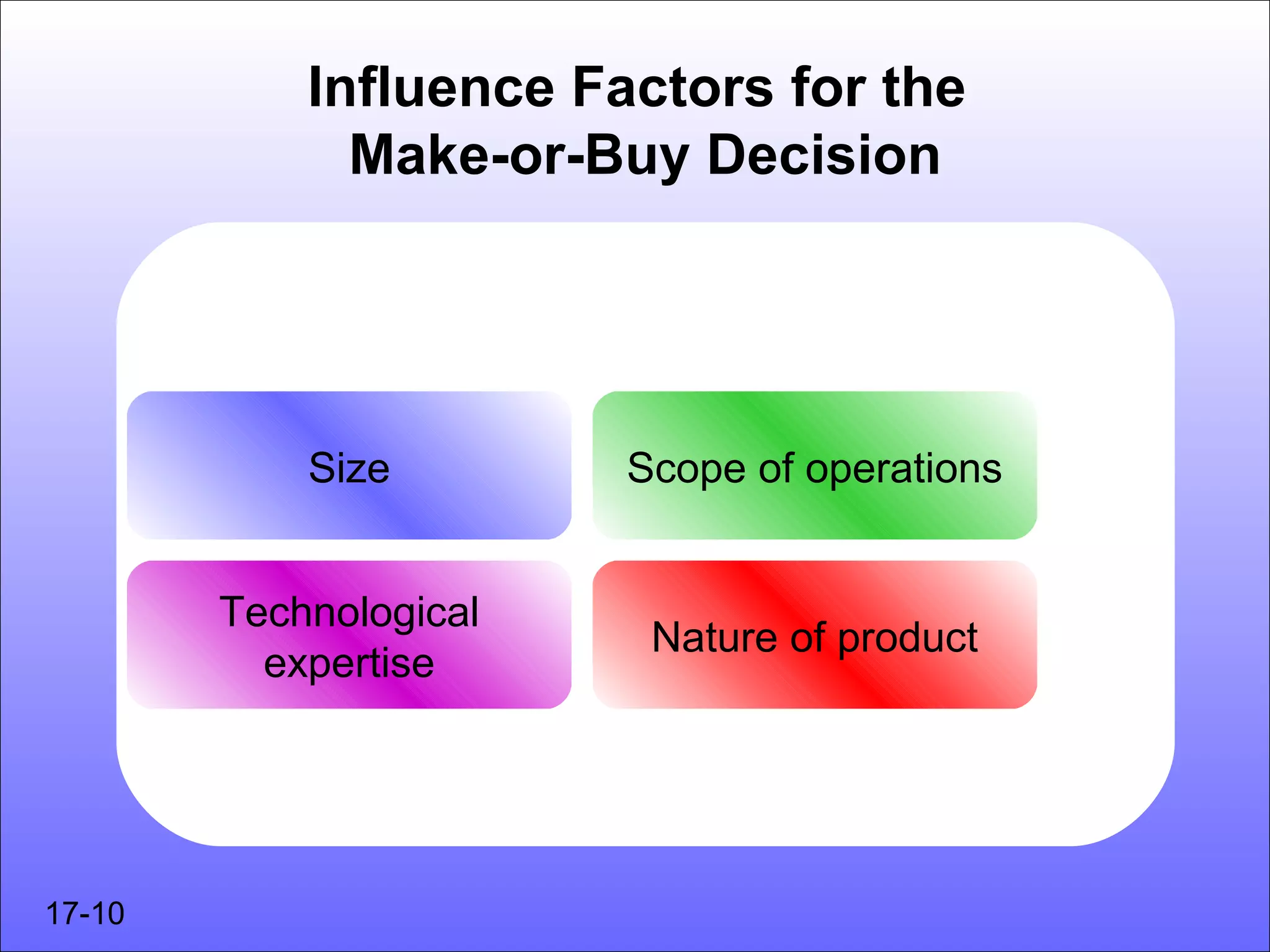
Influence Factors for the
              Make-or-Buy Decision


            Size        Scope of operations


        Technological
                         Nature of product
          expertise


17-10
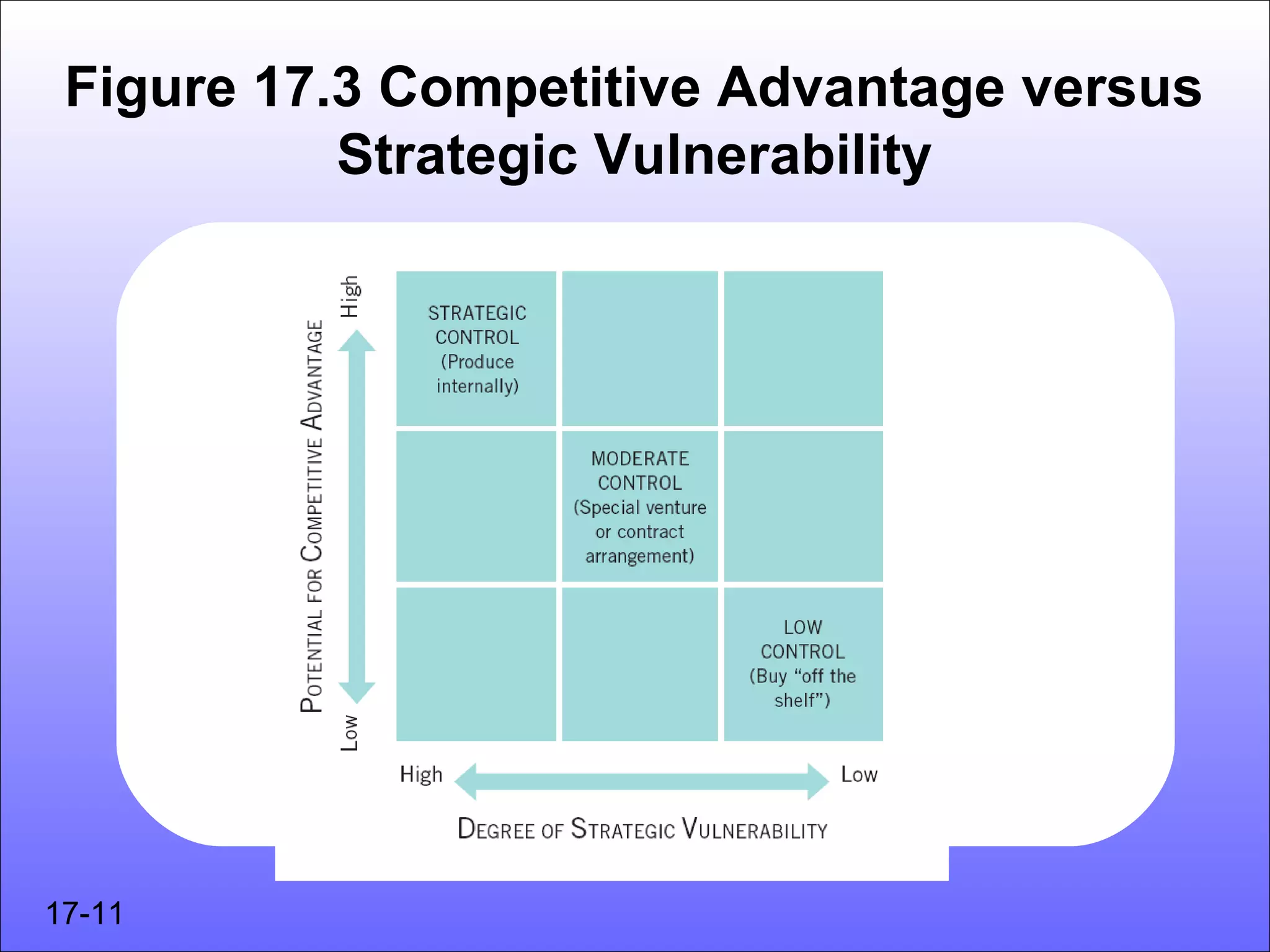
Figure 17.3 Competitive Advantage versus
           Strategic Vulnerability


17-11
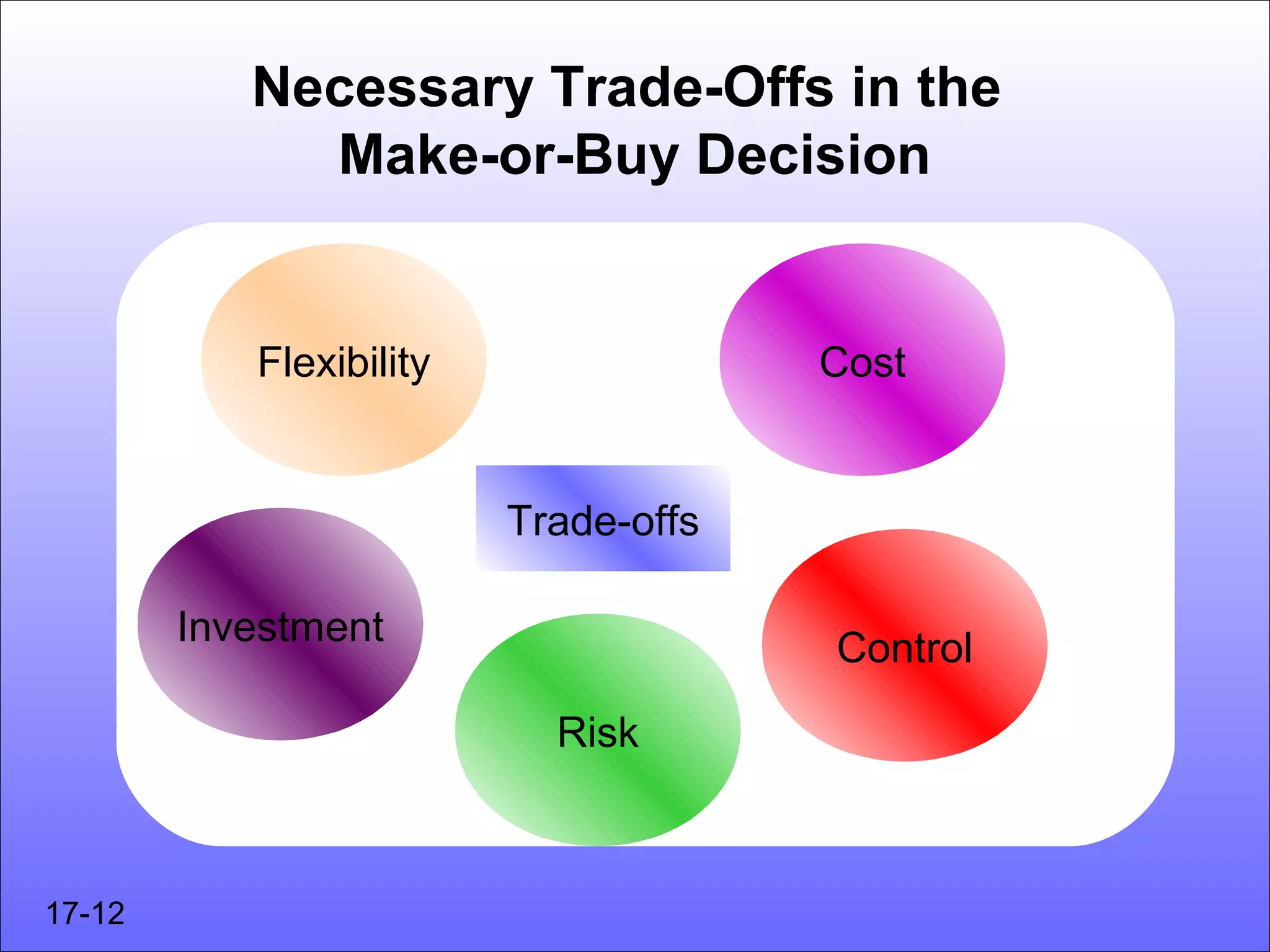
Necessary Trade-Offs in the
             Make-or-Buy Decision


           Flexibility                Cost


                         Trade-offs

        Investment                    Control

                           Risk


17-12
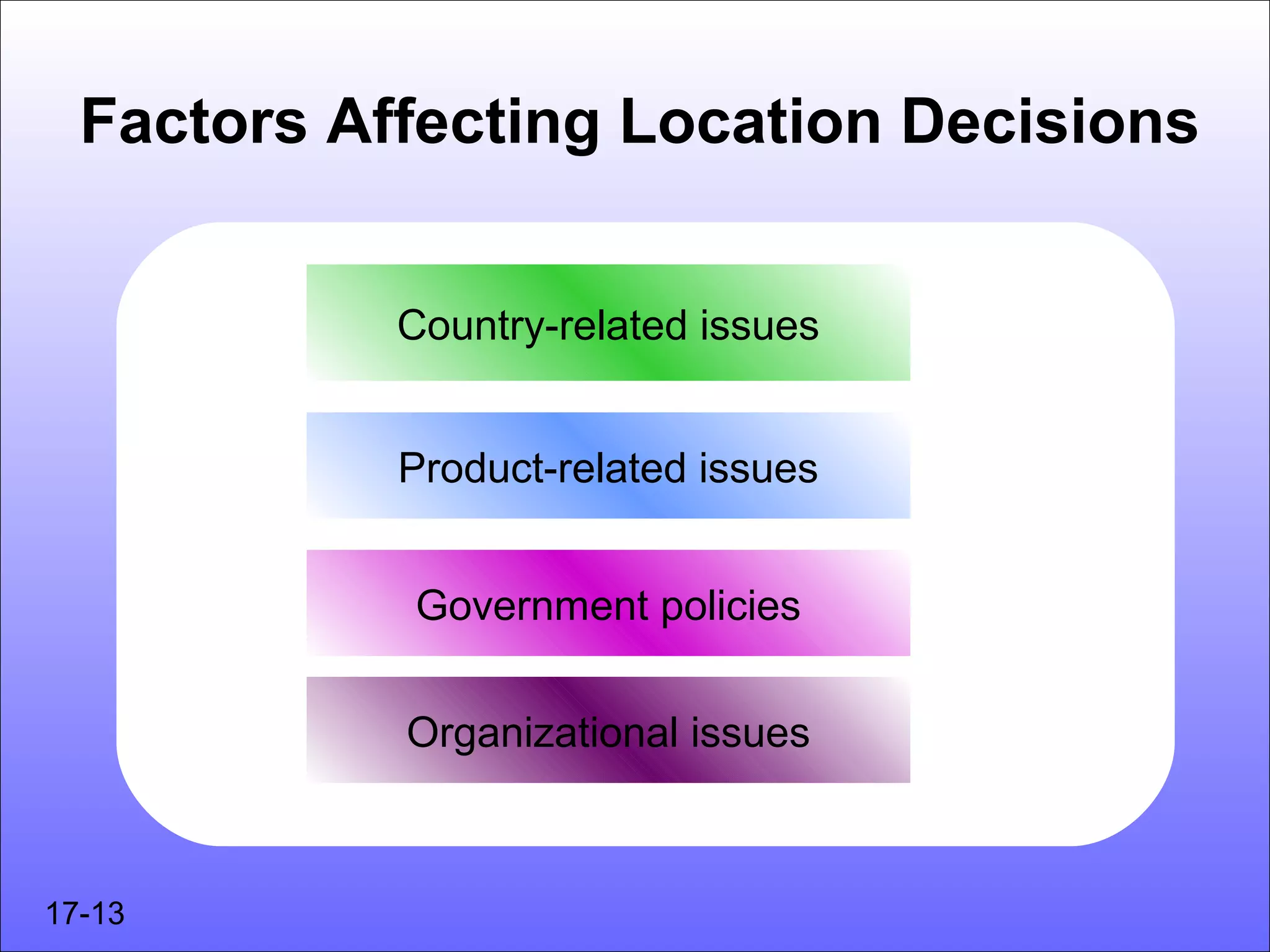
Factors Affecting Location Decisions


            Country-related issues


            Product-related issues


            Government policies


            Organizational issues


17-13
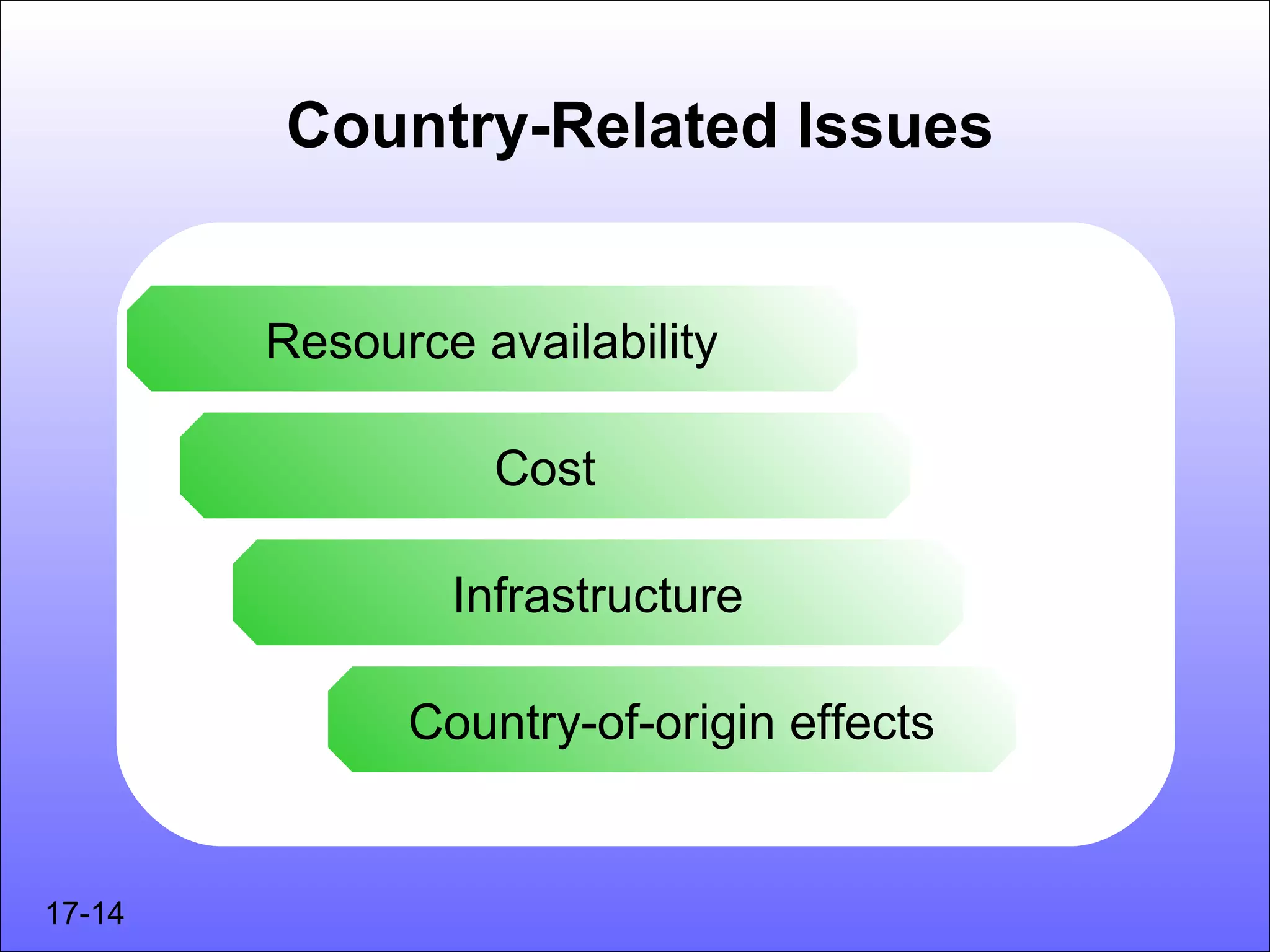
Country-Related Issues


        Resource availability

                  Cost

                Infrastructure

              Country-of-origin effects


17-14
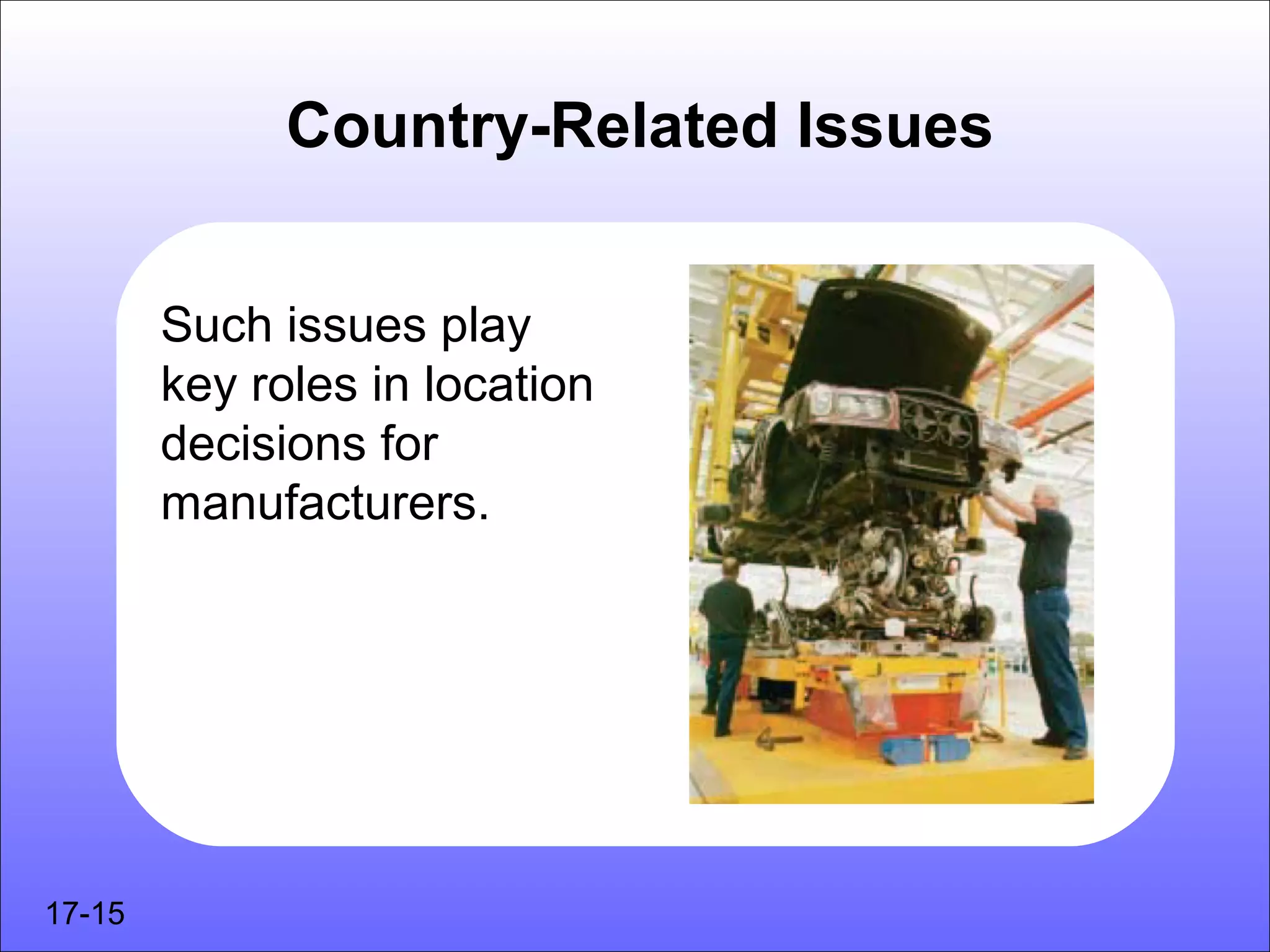
Country-Related Issues


        Such issues play
        key roles in location
        decisions for
        manufacturers.


17-15
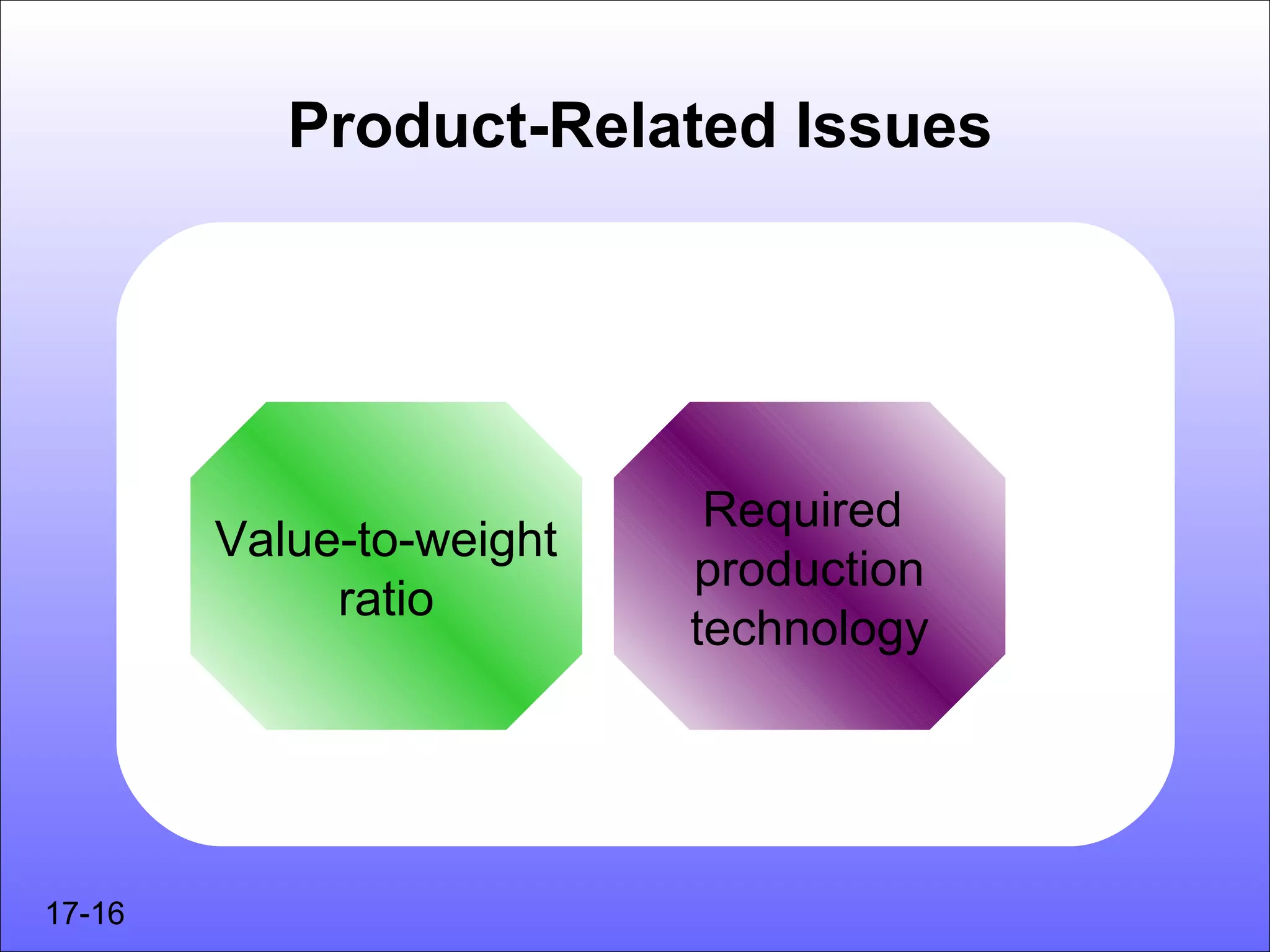
Product-Related Issues


                           Required
        Value-to-weight
                          production
             ratio
                          technology


17-16
Government Policies

        • Stability of political process
        • National trade policies
        • Economic development incentives
        • Existence of foreign trade zones
          (FTZ)


17-17
Organizational Issues


           Business strategy


             Organizational
               structure


          Inventory management
                  policies


17-18
International Logistics

                International logistics is the
            management of the flow of materials,
        parts, supplies, and other resources
             from suppliers to the firm; the flow of
             materials, parts, supplies, and other
          resources within and between units of the
        firm itself; and the flow of finished products,
           services, and goods from the
                       firm to customers.


17-19
Factors Distinguishing International and
             Domestic Logistics


                  Transport
                  distance


                  Number of
               transport modes


                 Complexity of
               regulatory content


17-20
Characteristics of International Services


        • Services are intangible
        • Services are not storable
        • Services may require customer
          participation
        • Services may be tied to the purchase of
          other products


17-21
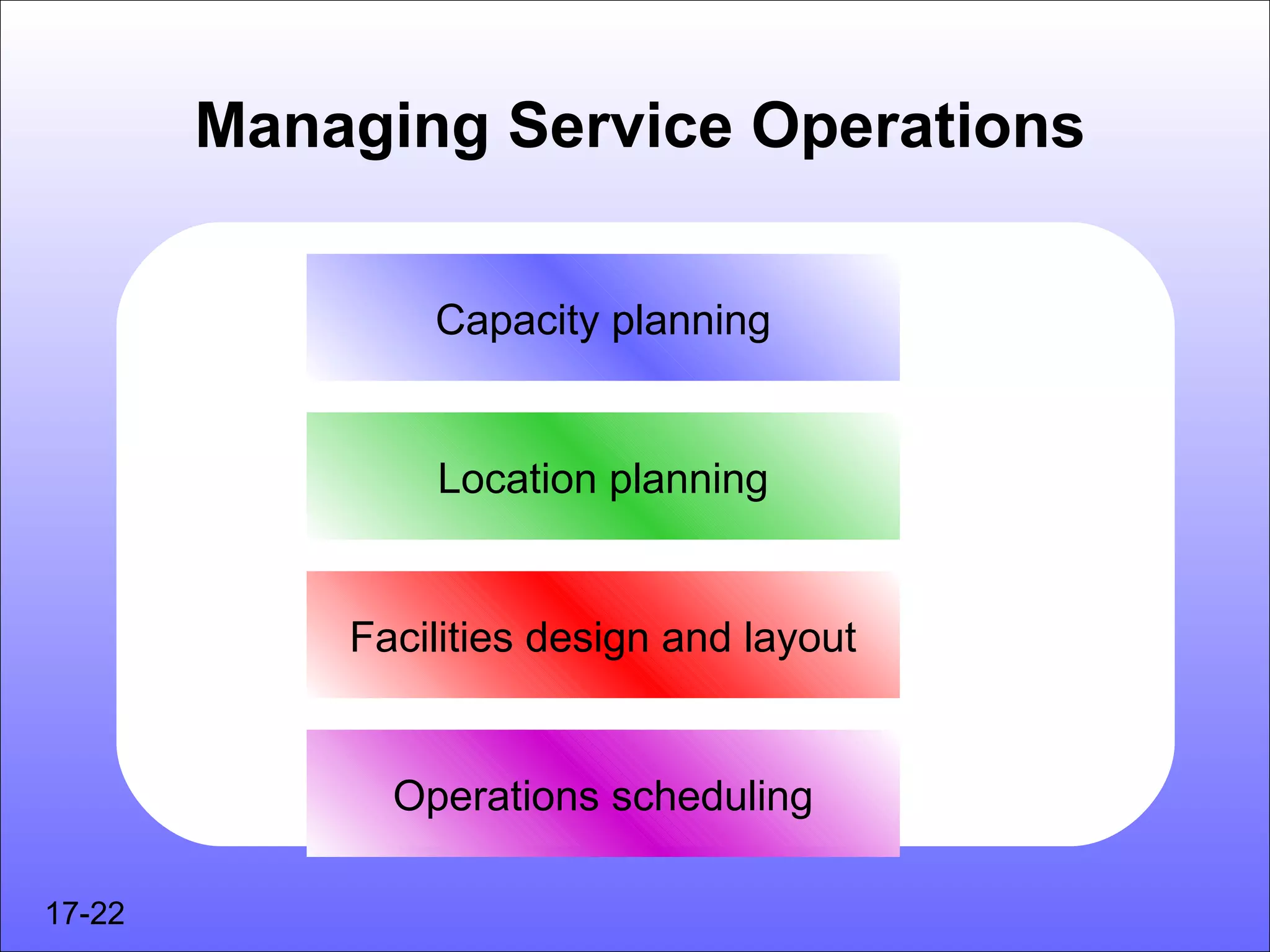
Managing Service Operations

                Capacity planning


                Location planning


            Facilities design and layout


              Operations scheduling

17-22
Productivity

            Productivity is an
        economic measure
           of efficiency that summarizes the
         value of outputs relative to the value
        of the inputs used
                   to create the outputs.


17-23
Strategies for Enhancing Productivity


        • Spend more on R&D
        • Improve operations
        • Increase employee involvement


17-24
International Organization for
               Standardization


17-25
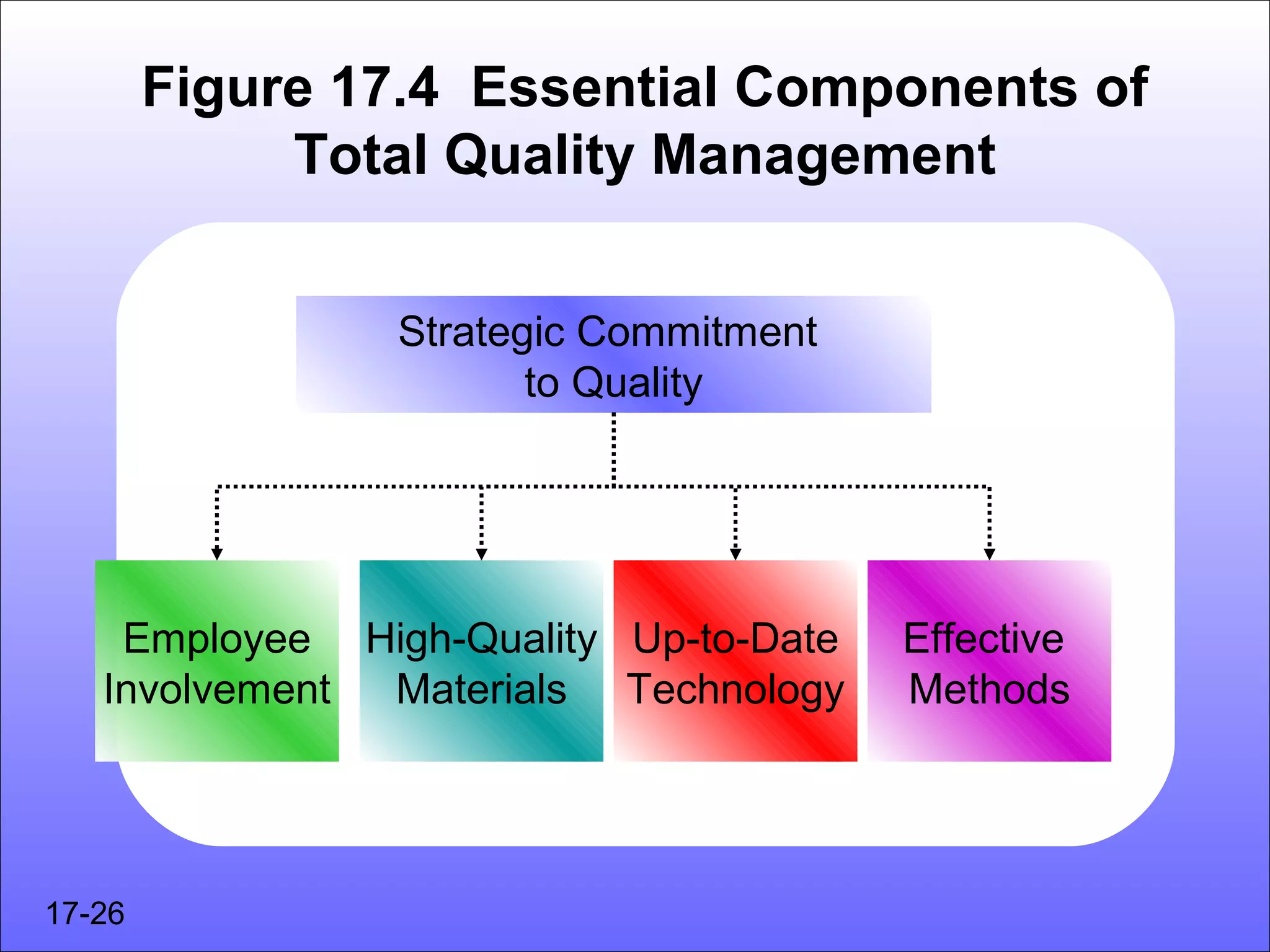
Figure 17.4 Essential Components of
             Total Quality Management


                Strategic Commitment
                       to Quality


    Employee High-Quality Up-to-Date   Effective
   Involvement Materials Technology    Methods


17-26
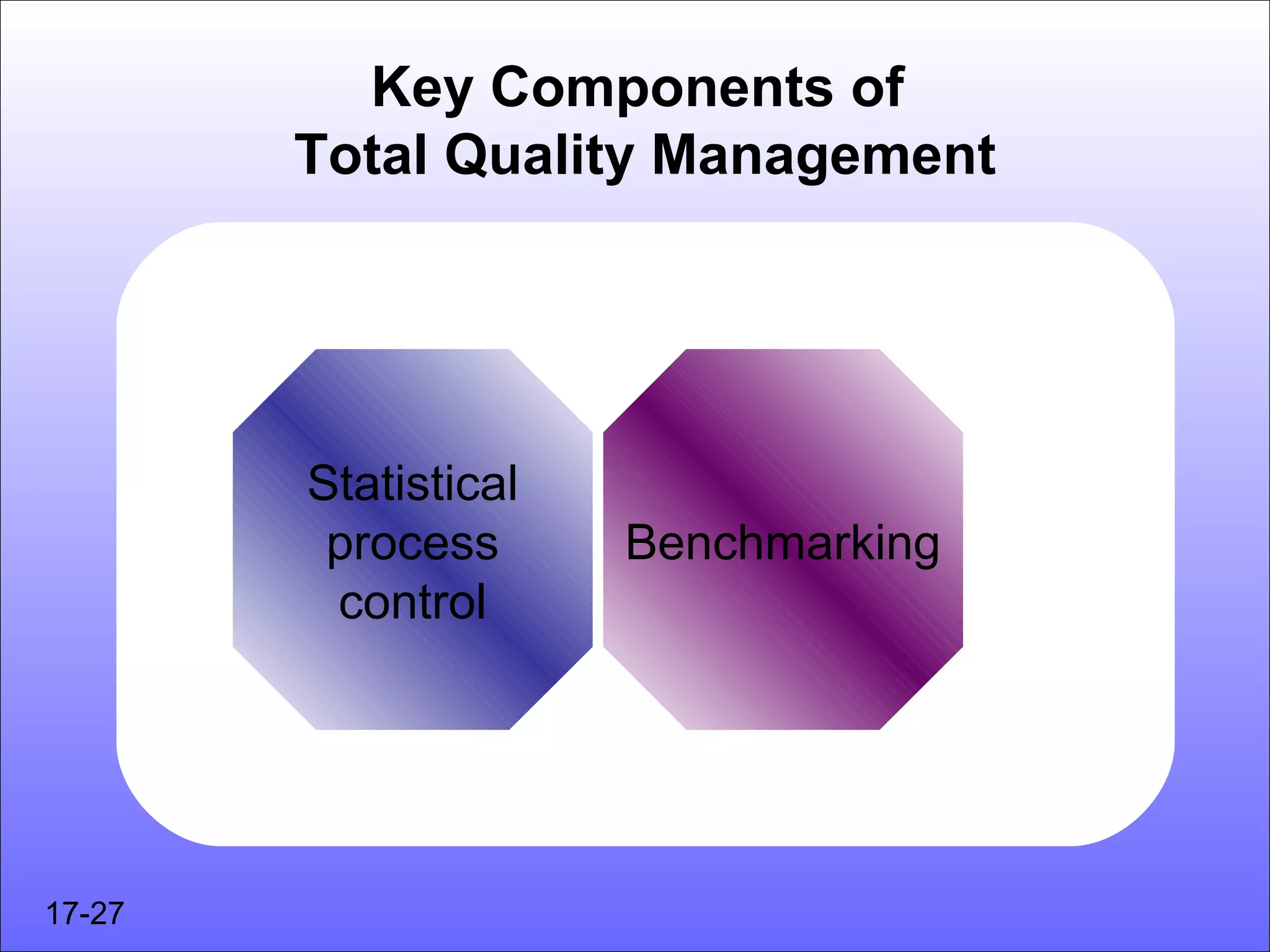
Key Components of
        Total Quality Management


        Statistical
         process      Benchmarking
         control


17-27

межд. операц. менеджмент

  • 1.
    international business, 5thedition chapter 17 international operations management
  • 2.
    Chapter Objectives 1 • Describe the nature of international operations management • Analyze the supply chain management and vertical integration decisions facing international production managers • Analyze the meaning of productivity and discuss how international firms work to improve it 17-2
  • 3.
    Chapter Objectives 2 • Explain how firms control quality and discuss total quality management in international business • Analyze how international firms control the information their managers need to make effective decisions 17-3
  • 4.
    Operations Management Operations management is the set of activities an organization uses to transform different kinds of inputs (materials, labor, and so on) into final goods and services. International operations management refers to the transformation-related activities of an international firm. 17-4
  • 5.
    Figure 17.1 TheInternational Operations Management Process Strategic context Production Acquisition Location Logistics of resources decisions 17-5
  • 6.
    Complexities of International Operations Management Resources Location Logistics 17-6
  • 7.
    Forms of OperationsManagement Service Production operations management management 17-7
  • 8.
    Supply Chain Management Supply chain management is the set of processes and steps a firm uses to acquire the various resources it needs to create its products. 17-8
  • 9.
    Figure 17.2 BasicMake-or-Buy Options 17-9
  • 10.
    Influence Factors forthe Make-or-Buy Decision Size Scope of operations Technological Nature of product expertise 17-10
  • 11.
    Figure 17.3 CompetitiveAdvantage versus Strategic Vulnerability 17-11
  • 12.
    Necessary Trade-Offs inthe Make-or-Buy Decision Flexibility Cost Trade-offs Investment Control Risk 17-12
  • 13.
    Factors Affecting LocationDecisions Country-related issues Product-related issues Government policies Organizational issues 17-13
  • 14.
    Country-Related Issues Resource availability Cost Infrastructure Country-of-origin effects 17-14
  • 15.
    Country-Related Issues Such issues play key roles in location decisions for manufacturers. 17-15
  • 16.
    Product-Related Issues Required Value-to-weight production ratio technology 17-16
  • 17.
    Government Policies • Stability of political process • National trade policies • Economic development incentives • Existence of foreign trade zones (FTZ) 17-17
  • 18.
    Organizational Issues Business strategy Organizational structure Inventory management policies 17-18
  • 19.
    International Logistics International logistics is the management of the flow of materials, parts, supplies, and other resources from suppliers to the firm; the flow of materials, parts, supplies, and other resources within and between units of the firm itself; and the flow of finished products, services, and goods from the firm to customers. 17-19
  • 20.
    Factors Distinguishing Internationaland Domestic Logistics Transport distance Number of transport modes Complexity of regulatory content 17-20
  • 21.
    Characteristics of InternationalServices • Services are intangible • Services are not storable • Services may require customer participation • Services may be tied to the purchase of other products 17-21
  • 22.
    Managing Service Operations Capacity planning Location planning Facilities design and layout Operations scheduling 17-22
  • 23.
    Productivity Productivity is an economic measure of efficiency that summarizes the value of outputs relative to the value of the inputs used to create the outputs. 17-23
  • 24.
    Strategies for EnhancingProductivity • Spend more on R&D • Improve operations • Increase employee involvement 17-24
  • 25.
    International Organization for Standardization 17-25
  • 26.
    Figure 17.4 EssentialComponents of Total Quality Management Strategic Commitment to Quality Employee High-Quality Up-to-Date Effective Involvement Materials Technology Methods 17-26
  • 27.
    Key Components of Total Quality Management Statistical process Benchmarking control 17-27

Editor's Notes

  • #5 Regardless of a firm’s product, the goal of its international operations managers is to design, create, and distribute goods or services that meet the needs and wants of customers worldwide and to do so profitably.
  • #6 Figure 17.1 illustrates the international operations management process. As shown, a firm’s strategic context provides a necessary backdrop against which it develops and then manages its operations functions. Flowing directly from the strategic context is the question of standardized versus customized production. The positioning of a firm along this continuum in turn helps dictate the appropriate strategies and tactics for other parts of the operations management process. The next part of international operations management is the activities and processes connected with the acquisition of the resources the firm needs to produce the goods or services it intends to sell. Location decisions—where to build factories and other facilities—are also important. In addition, international operations managers are concerned with logistics and materials management—the efficient movement of materials into, within, and out of the firm. This framework organizes the chapter.
  • #7 The basic complexities inherent in operations management stem from the production problem itself—where and how to produce various goods and services. Operations managers typically must decide important and complex issues in three areas: Resources : Managers must decide where and how to obtain the resources the firm needs to produce its products. Key decisions relate to supply chain management and vertical integration. Location : Managers must decide where to build administrative facilities, sales offices, and plants, how to design them, and so on. Logistics : Managers must decide on modes of transportation and methods of inventory control.
  • #8 Although some similarities exist between creating goods and creating services for international markets, there also are major fundamental differences. Operations management decisions, processes, and issues that involve the creation of tangible goods are called production management , and those involving the creation of intangible services are called service operations management . The following slides focus on production management; service operations management will be addressed later in the presentation.
  • #9 Because the production of most manufactured goods requires a variety of raw materials, parts, and other resources, the first issue an international production manager faces is deciding how to acquire those inputs. Other common terms for this activity include sourcing and procuring. Supply chain management clearly affects product cost, product quality, and internal demands for capital. Because of these impacts, most international firms approach supply chain management as a strategic issue to be carefully planned and implemented by top management.
  • #10 The first step in developing a supply chain management strategy is to determine the appropriate degree of vertical integration. Vertical integration is the extent to which a firm either provides its own resources or obtains them from other sources. At one extreme, firms that practice relatively high levels of vertical integration are engaged in every step of the operations management process as goods are developed, transformed, packaged, and sold to customers. Various units within the firm can be seen as suppliers to other units within the firm, which can be viewed as the customers of the supplying units. At the other extreme, firms that have little vertical integration are involved in only one step or just a few steps in the production chain. They may buy their inputs and component parts from other suppliers, perform one operation or transformation, and then sell their outputs to other firms or consumers. The extent of a firm’s vertical integration is the result of a series of supply chain management decisions made by production managers. In deciding how to acquire the components necessary to manufacture a firm’s products, its production managers have two choices: The firm can make the inputs itself, or it can buy them from outside suppliers. This choice is called the make-or-buy decision . A decision to buy rather than make dictates the need to choose between long-term and short-term supplier relationships. A decision to make rather than buy leaves open the option of making by self or making in partnership with others. If partnership is the choice, yet another decision relates to the degree of control the firm wants to have.
  • #11 The make-or-buy decision can be influenced by a firm’s size, scope of operations, and technological expertise and by the nature of its product. For example, because larger firms are better able to benefit from economies of scale in the production of inputs, larger automakers such as GM and Fiat are more likely to make their parts themselves, whereas smaller automakers such as Saab or BMW are more likely to buy parts from outside suppliers. At other times the make-or-buy decision will depend on existing investments in technology and manufacturing facilities. For example, personal computer manufacturers such as Dell and IBM must decide whether they want to make or buy microprocessors, memory chips, disk drives, motherboards, and power supplies. Because of its extensive manufacturing expertise with mainframe computers, IBM is more likely to make a PC component in-house, whereas Dell is more likely to rely heavily on outside suppliers. All else being equal, a firm will choose to make or buy simply on the basis of whether it can obtain the resource cheaper by making it internally or by buying it from an external supplier.
  • #12 Figure 17.3 highlights the need to balance competitive advantage against strategic vulnerability when resolving the make-or-buy decision. If a high potential for competitive advantage exists along with a high degree of strategic vulnerability, the firm is likely to maintain strategic control by producing internally. However, if the potential for competitive advantage and the degree of strategic vulnerability are both low, the firm will need less control and therefore will be more likely to buy “off the shelf.” Finally, when intermediate potential for competitive advantage and moderate degree of strategic vulnerability call for moderate control, special ventures or contract arrangements may be most appropriate.
  • #13 Making a component has the advantage of increasing the firm’s control over product quality, delivery schedules, design changes, and costs. Buying a component from an external supplier has the advantage of reducing the firm’s financial and operating risks. Buying from others lowers the firm’s level of investment. By not having to build a new factory or learn a new technology, a firm can free up capital for other productive uses. Buying from others also reduces a firm’s training costs and expertise requirements. A firm that buys rather than makes retains the flexibility to change suppliers as circumstances dictate. This is particularly helpful in cases in which technology is evolving rapidly or delivered costs can change as a result of inflation or exchange rate fluctuations.
  • #14 An international firm that chooses to make rather than buy inputs faces another decision: Where should it locate its production facilities? In reaching a location decision, the firm must consider country-related issues, product-related issues, government policies, and organizational issues. These issues will be discussed on the following slides.
  • #15 Resource availability and cost constitute a primary determinant of whether an individual country is a suitable location for a facility. As suggested by the classical trade theories and the Heckscher-Ohlin theory, countries that enjoy large, low-cost endowments of a factor of production will attract firms needing that factor of production. Infrastructure also affects the location of production facilities. Most facilities require at least some minimal level of infrastructural support. To build a facility requires construction materials and equipment as well as materials suppliers and construction contractors. More important, electrical, water, transportation, telephone, and other services are necessary to utilize the facility productively. In addition, access to medical care, education, adequate housing, entertainment, and other related services are almost certain to be important for the employees and managers who will work at the facility as well as for their families. Country-of-origin effects also may play a role in locating a facility. Certain countries have “brand images” that affect product marketing.
  • #17 The product’s value-to-weight ratio affects the importance of transportation costs in the product’s delivered price. Goods with low value-to-weight ratios, such as iron ore, cement, coal, bulk chemicals, and raw sugar and other agricultural goods, tend to be produced in multiple locations to minimize transportation costs. Conversely, goods with high value-to-weight ratios, such as microprocessors or diamonds, can be produced in a single location or handful of locations without loss of competitiveness. The production technology used to manufacture the good also may affect facility location. A firm must compare its expected product sales with the efficient size of a facility in the industry. If a firm’s sales are large relative to an efficient-sized facility, the firm is likely to operate many facilities in various locations. If its sales are small relative to an efficient-sized facility, the firm probably will utilize only one plant.
  • #18 Government policies also may play a role in the location decision. The stability of the political process within a country can clearly affect the desirability of locating a factory there. A government that alters fiscal, monetary, and regulatory policies seemingly on whim and without consulting the business community raises the risk and uncertainty of operating in that country. Unforeseen changes in taxation policy, exchange rates, inflation, and labor laws are particularly troublesome to international firms. National trade policies also may affect the location decision. To serve its customers, a firm may be forced to locate a facility within a country that has high tariff walls and other trade barriers. Economic development incentives may influence the location decision. Communities eager to create jobs and add to the local tax base often seek to attract new factories by offering international firms inexpensive land, highway improvements, job-training programs, and discounted water and electric rates. An international firm also may choose a site based on the existence of a foreign trade zone (FTZ). An FTZ is a specially designated and controlled geographical area in which imported or exported goods receive preferential tariff treatment. A country may establish FTZs near its major ports of entry and/or major production centers. It then allows international firms to import products into those zones duty free for specified purposes.
  • #19 A firm’s business strategy may affect its location decisions in various ways. A firm that adopts a cost leadership strategy must seek out low-cost locations, whereas a firm that focuses on product quality must locate facilities in areas that have adequate skilled labor and managerial talent. A firm may choose to concentrate production geographically to better meet organizational goals. A firm’s organizational structure also influences the location of its factories. For example, adoption of a global area structure decentralizes authority to area managers. These managers, seeking to maintain control over their area, are likely to favor locating factories within their area to produce goods sold within the area. A firm’s inventory management policies are also affected by plant location decisions. Inventory management is a complex task all operations managers must confront. They must balance the costs of maintaining inventory against the costs of running out of materials and/or finished goods. The costs of maintaining inventory include those associated with storage (operating a warehouse, for example), spoilage and loss (some stored inventory gets ruined, damaged, or stolen), and opportunity costs (an investment in inventory cannot be put to other business uses). Factory location affects the level of inventory that firms must hold because of the distances and transit times involved in shipping goods. Factory location becomes particularly critical when the just-in-time (JIT) inventory management system is adopted. With this approach a firm’s suppliers deliver their products directly to the firm’s manufacturing center, usually in frequent small shipments, just as they are needed for production.
  • #20 The first two sets of activities usually are called materials management , and the third set often is called physical distribution, or, more simply, distribution. The role of logistics is particularly important for firms that have developed integrated, but geographically dispersed, manufacturing and distribution networks where parts may be made in one country for assembly in a second country for sale in a third country.
  • #21 Three basic factors differentiate domestic and international materials management functions. The first is simply the distance involved in shipping. Shipments within even the largest countries seldom travel more than a couple of thousand miles, and many shipments travel much less. The second basic difference between domestic and international materials management functions is the sheer number of transport modes that are likely to be involved. Shipments within the same country often use only a single mode of transportation, such as truck or rail. However, shipments that cross national boundaries, and especially shipments traveling great distances, almost certainly involve multiple modes of transportation. Third, the regulatory context for international materials management is much more complex than for domestic materials management. Most countries regulate many aspects of their internal transportation systems—price, safety, packaging, and so on. Shipments that cross through several countries are subject to the regulations of each of those countries. Although various economic trade agreements, such as the North American Free Trade Agreement, have sought to streamline international shipping guidelines and procedures, transporting goods across national boundaries is still complex and often involves much red tape.
  • #22 An international service business is a firm that transforms resources into an intangible output that creates utility for its customers. Services have several unique characteristics that create special challenges for firms that want to sell services in the international marketplace. In particular, services often are intangible, are not storable, require customer participation, and may be linked with tangible goods. A consumer who goes to an accountant to obtain financial advice leaves with intangible knowledge that cannot be held or seen. Often they cannot be created ahead of time and inventoried or saved for future usage. An empty airline seat, an unused table in a restaurant, and an unsold newspaper all lose their economic value as soon as their associated window of opportunity closes, that is, after the plane takes off, the restaurant kitchen closes, and the next day’s newspaper is printed. Capacity planning is deciding how many customers a firm will be able to serve at a given time. International services such as tourism cannot occur without the physical presence of the customer. Many firms offer product -support services—assistance with operating, maintaining, and/or repairing products for customers. Such services may be critical to the sale of the related product.
  • #23 Capacity planning is deciding how many customers the firm will be able to serve at one time. Because of the close customer involvement in the purchase of services, capacity planning affects the quality of the services provided to customers. As with production management, location planning is important for international service operations. By definition most service providers must be close to the customers they plan to serve (exceptions might be information providers that rely on electronic communication). Indeed, most international service operations involve setting up branch offices in each foreign market and then staffing each office with locals. International service facilities also must be carefully designed so the proper look and layout are established. At times firms operating internationally may highlight their foreign identity or blend their home country heritage with the local culture. International service firms must schedule their operations to best meet the customers’ needs.
  • #24 Productivity is important for various reasons. For one thing, it helps determine a firm’s overall success and contributes to its long-term survival. For another, productivity contributes directly to the overall standard of living within a particular country. If the firms within a country are especially productive, the country’s citizens will have more products and services to consume. Moreover, the firm’s goods and services can be exported to other countries, thereby bringing additional revenues back into the country of origin. Each of these factors positively impacts gross domestic product and thus benefits the whole country.
  • #25 There are several general strategies a firm can pursue in its efforts to maintain and/or boost productivity. The starting point in improving productivity is often to invest more heavily in R&D. Through R&D firms identify new products, new uses for existing products, and new methods for making products. Each of these outcomes in turn contributes directly to higher productivity. Another important way to increase productivity is to improve operations. This is where control comes in; a firm seeking to increase productivity needs to examine how it does things and then look for ways to do them more efficiently. Replacing outmoded equipment, automating selected tasks, training workers to be more efficient, and simplifying manufacturing processes are all ways to improve operations and boost productivity. Productivity can be improved by increasing employee involvement. The idea is that if managers give employees more say in how they do their jobs, those employees will become more motivated to work and more committed to the firm’s goals. Further, because they are the ones actually doing the jobs, the employees probably have more insights than anyone else into how to do the jobs better. Increased involvement is generally operationalized through the use of self-managed teams. Groups of workers are formed into teams, each of which has considerable autonomy over how it does its job.
  • #26 Operations management also helps firms maintain and enhance the quality of their products and/or services. Indeed, quality has become such a significant competitive issue in most industries that control strategies invariably have quality as a central focus. The American Society for Quality Control has defined quality as the totality of features and characteristics of a product or service that bear on its ability to satisfy stated or implied needs. The International Organization for Standardization (ISO) has been working to develop and refine an international set of quality guidelines. These guidelines, called collectively ISO 9000: 2000, provide the basis for a quality certification that is becoming increasingly important in international business. The guidelines were updated and revised in 2000. The ISO 9000 standards cover such areas as product testing, employee training, record keeping, supplier relations, and repair polices and procedures. Firms that want to meet these standards apply for certification and are audited by a firm chosen by the ISO's domestic affiliate. These auditors review every aspect of the firm's business operations in relation to the standards.
  • #27 Firms today compete on the basis of quality. Quality is directly linked with productivity. Higher quality means increased productivity because of fewer defects, fewer resources devoted to reworking defective products, and fewer resources devoted to quality control itself. Finally, higher quality helps firms develop and maintain customer loyalty. Total quality management (TQM) is an integrated effort to systematically and continuously improve the quality of an organization’s products and/or services. TQM programs vary by firm and must be adapted to fit each firm’s unique circumstances. As shown in Figure 17.4, TQM must start with a strategic commitment to quality. This means the quality initiative must start at the top of the firm, and top managers must be willing to commit the resources necessary to achieve continuous improvement. With a strong strategic commitment as a foundation TQM programs rely on four operational components to implement quality improvement. Employee involvement almost always is cited as a critical requirement in quality improvement. All employees must participate in helping to accomplish the firm’s quality-related objectives. Materials also must be scrutinized. Firms often can improve the quality of their products by requiring higher-quality parts and materials from their suppliers and procuring inputs only from suppliers whose commitment to quality matches their own. The firm also must be willing to invest in new technology to become more efficient and to achieve higher-quality manufacturing processes. Finally, the firm must be willing to adopt new and improved methods of getting work done.
  • #28 Firms using TQM have a variety of tools and techniques from which they can draw, including statistical process control and benchmarking. Statistical process control is a family of mathematically based tools for monitoring and controlling quality. Its basic purposes are to define the target level of quality, specify an acceptable range of deviation, and then ensure that product quality is hitting the target. Benchmarking is the process of legally and ethically studying how other firms do something in a high-quality way and then either imitating or improving on their methods.