international business, 5th edition
chapter 1
an overview of
international
business
Chapter Objectives

      • Discuss the meaning of international
        business
      • Explain the importance of understanding
        international business
      • Identify and describe the basic forms of
        international business activities
      • Discuss the causes of globalization
      • Comprehend the growing role of
        emerging markets in the global economy
1-2
The Business of the Olympics


1-3
The Business of the Olympics

      • Intense reflection of international
        business
      • Government of games by IOC
      • Competition for hosting
      • Revenue sources for the Olympics
         – Broadcast rights
         – Corporate sponsorships

1-4
What Is International
                 Business?

      • Business transactions between
        parties from more than one country
      • Parties may include
        – Private individuals
        – Individual companies
        – Groups of companies
        – Governmental agencies
1-5
How Does International Business
           Differ from Domestic?

      • Currency conversion
      • Legal systems
      • Culture
      • Availability of resources


1-6
Why Study International
                Business?

      • Large organizations
      • Foreign-owned subsidiaries
      • Small businesses
      • Competitors
      • Business techniques and tools
      • Cultural literacy
1-7
International
             Business Activities

      • Exporting and Importing
      • International Investments
      • Licensing, Franchising, and
        Management Contracts


1-8
Exporting and Importing

      • Exporting: selling of products made
        in one’s own country for use or
        resale in other countries
      • Importing: buying of products made
        in other countries for use or resale
        in one’s own country


1-9
Figure 1.1 Exports as a % of GDP


1-10
Visible and Invisible Trade

       • Trade in Goods
         – Merchandise exports and imports
         – Visible trade

       • Trade in Services
         – Service exports and imports
         – Invisible trade

1-11
Exporting at Boeing


1-12
International Investments

       • Capital supplied by residents of one
         country to residents of another
       • Two categories:
         – Foreign direct investments
         – Portfolio investments


1-13
Other Forms of
       International Business Activity


                   Management
                    contracts


       Licensing                Franchising


1-14
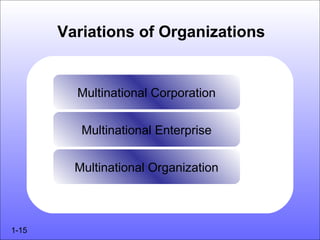
Variations of Organizations


         Multinational Corporation


          Multinational Enterprise


         Multinational Organization


1-15
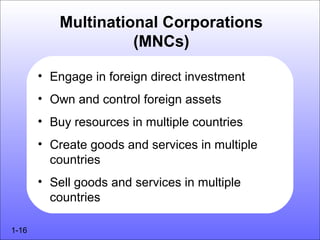
Multinational Corporations
                    (MNCs)

       • Engage in foreign direct investment
       • Own and control foreign assets
       • Buy resources in multiple countries
       • Create goods and services in multiple
         countries
       • Sell goods and services in multiple
         countries

1-16
Table 1.1 The Largest MNCs

       • ExxonMobil          • Chevron
       • Wal-Mart            • DaimlerChrysler
       • Royal Dutch Shell   • Toyota Motor
       • BP                  • Ford Motor
       • General Motors      • ConocoPhillips


1-17
Motives for Globalization

       • To leverage core competencies
       • To acquire resources and supplies
       • To seek new markets
       • To better compete with rivals


1-18
Environmental Change and
                Globalization


        Changes in
                      Technological
         Political
                        Changes
       Environments


1-19
Figure 1.2 World Exports
         as a % of World GDP


1-20
Figure 1.3 Foreign Direct
       Investment Relative to World GDP


1-21
Globalization and
                  Emerging Markets

       • Argentina        • Mexico
       • Brazil           • Poland
       • China            • South Africa
       • India            • South Korea
       • Indonesia        • Turkey


1-22
Framework of Book

       • The World’s Marketplaces
       • International Environment
       • Managing International Business
       • Managing International Business
         Operations


1-23

Презентация. Введение в международный бизнес

  • 1.
    international business, 5thedition chapter 1 an overview of international business
  • 2.
    Chapter Objectives • Discuss the meaning of international business • Explain the importance of understanding international business • Identify and describe the basic forms of international business activities • Discuss the causes of globalization • Comprehend the growing role of emerging markets in the global economy 1-2
  • 3.
    The Business ofthe Olympics 1-3
  • 4.
    The Business ofthe Olympics • Intense reflection of international business • Government of games by IOC • Competition for hosting • Revenue sources for the Olympics – Broadcast rights – Corporate sponsorships 1-4
  • 5.
    What Is International Business? • Business transactions between parties from more than one country • Parties may include – Private individuals – Individual companies – Groups of companies – Governmental agencies 1-5
  • 6.
    How Does InternationalBusiness Differ from Domestic? • Currency conversion • Legal systems • Culture • Availability of resources 1-6
  • 7.
    Why Study International Business? • Large organizations • Foreign-owned subsidiaries • Small businesses • Competitors • Business techniques and tools • Cultural literacy 1-7
  • 8.
    International Business Activities • Exporting and Importing • International Investments • Licensing, Franchising, and Management Contracts 1-8
  • 9.
    Exporting and Importing • Exporting: selling of products made in one’s own country for use or resale in other countries • Importing: buying of products made in other countries for use or resale in one’s own country 1-9
  • 10.
    Figure 1.1 Exportsas a % of GDP 1-10
  • 11.
    Visible and InvisibleTrade • Trade in Goods – Merchandise exports and imports – Visible trade • Trade in Services – Service exports and imports – Invisible trade 1-11
  • 12.
  • 13.
    International Investments • Capital supplied by residents of one country to residents of another • Two categories: – Foreign direct investments – Portfolio investments 1-13
  • 14.
    Other Forms of International Business Activity Management contracts Licensing Franchising 1-14
  • 15.
    Variations of Organizations Multinational Corporation Multinational Enterprise Multinational Organization 1-15
  • 16.
    Multinational Corporations (MNCs) • Engage in foreign direct investment • Own and control foreign assets • Buy resources in multiple countries • Create goods and services in multiple countries • Sell goods and services in multiple countries 1-16
  • 17.
    Table 1.1 TheLargest MNCs • ExxonMobil • Chevron • Wal-Mart • DaimlerChrysler • Royal Dutch Shell • Toyota Motor • BP • Ford Motor • General Motors • ConocoPhillips 1-17
  • 18.
    Motives for Globalization • To leverage core competencies • To acquire resources and supplies • To seek new markets • To better compete with rivals 1-18
  • 19.
    Environmental Change and Globalization Changes in Technological Political Changes Environments 1-19
  • 20.
    Figure 1.2 WorldExports as a % of World GDP 1-20
  • 21.
    Figure 1.3 ForeignDirect Investment Relative to World GDP 1-21
  • 22.
    Globalization and Emerging Markets • Argentina • Mexico • Brazil • Poland • China • South Africa • India • South Korea • Indonesia • Turkey 1-22
  • 23.
    Framework of Book • The World’s Marketplaces • International Environment • Managing International Business • Managing International Business Operations 1-23

Editor's Notes

  • #4 The website of the International Olympics Committee explains the sources of revenue generated by the Olympics. More information on the business of the Olympics is on the next slide.
  • #5 The chapter opens with a discussion of the business behind the Olympic Games. Cities worldwide compete to host the games. The decision is made by the International Olympic Committee (IOC). The cities want to host the games because of the economic growth that can be generated. The Olympics generates revenue from television coverage and corporate sponsors. The highest level of corporate sponsorship for the Olympics costs $60-80 million. Companies are willing to pay these high fees for the opportunity to market their products to consumers worldwide.
  • #7 Domestic business involves transactions occurring within the boundaries of a single country, while international business transactions cross national boundaries. In addition, the countries may use difference currencies, forcing at least one party to convert its currency for another. The legal systems may vary or even be incompatible. The cultures may differ and the resources may vary. For example, one country may be rich in natural resources, but poor in skilled labor. Still, the basic skills and knowledge needed to be successful are generally similar whether one is doing business domestically or internationally.
  • #8 Large organizations are likely to have international operations or at least be affected by the global economy. Student may work for a company that is owned by a foreign subsidiary. Small businesses are growing their businesses by selling in foreign markets, using foreign-made materials, and competing with foreign firms. Studying international business helps students to compete with students from other countries. It is also important for staying abreast of the latest business techniques and tools, such as JIT systems. Lastly, studying international business helps students to become culturally literate, meaning that they can better understand and appreciate the similarities and differences of the world’s people.
  • #9 These three international business activities will be presented on the following slides.
  • #10 International business activity historically first took the form of exporting and importing.
  • #12 Exporting and importing activities are often divided into two groups: trade in goods and trade in services. The British call trade in goods visible trade. It is trade in tangible products such as clothing. Trade in services is known as invisible trade and it includes intangible products like banking and travel.
  • #13 In 2005, exports accounting for 60% of Boeing’s commercial aircraft sales.
  • #14 The second major form of international business activity is international investments. Foreign direct investments (FDI) are investments made for the purpose of actively controlling property, assets, or companies located in host countries. For example, Ford’s investment in Sweden’s Volvo Corporation is a foreign direct investment. Portfolio investments are purchases of foreign financial assets (stocks, bonds, cds) for a purpose other than control. For example, a Danish pension fund purchased 1,000 shares of Sony common stock.
  • #15 In addition to exporting, importing, and investments, there are also other forms of international business activity. These include management contracts, licensing, and franchising. Licensing is a contractual arrangement in which a firm in one country licenses the use of its intellectual property to a firm in another country in exchange for a royalty payment. Franchising is a specialized form of licensing which occurs when a firm in one country authorizes a firm in another to utilize its operating systems as well as its brand names, trademarks, and logos for a royalty payment. A management contract is an arrangement wherein a firm in one country agrees to operate facilities or provide other management services to a firm in another country for an agreed-upon fee. Examples include Marriott and Hilton which do not own all of the hotels that bear their brand names.
  • #16 There are different types of international organizations. The term multinational corporation (MNC) is used to identify firms that have extensive involvement in international business. MNCs typically own and control foreign assets, buy resources in a variety of countries, create goods or services, and then sell those goods and services in a variety of countries. Some international organizations are not true MNCs and they may be termed multinational enterprises (MNEs). The term multinational organization (MNO) may be used to describe any international organization, whether for-profit or not-for-profit.
  • #17 This slide describes the characteristics of MNCs.
  • #18 This table includes the world’s largest MNCs as of July 2006.
  • #19 Globalization can be defined as the inexorable integration of markets, nation-states, and technologies in a way that is enabling individuals, corporations, and nation-states to reach around the world faster, farther, cheaper, and deeper than ever before. This slide provides the motives for companies to globalize. One major motive is the opportunity to leverage a core competency that a firm has developed in its home market. A core competency is a distinctive strength or advantage that is central to a firm’s operation.