Identification of types of sprayers and
dusters, parts, function, calibration,
operation and maintenance
Practical No 04
AG 1207 - Agricultural Implements and Machines
2/24/2022 P.A.S.S. Pushpakumara | ATI - Gampaha 1
Sprayers
2/24/2022 P.A.S.S. Pushpakumara | ATI - Gampaha 2
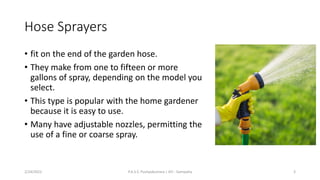
Hose Sprayers
• fit on the end of the garden hose.
• They make from one to fifteen or more
gallons of spray, depending on the model you
select.
• This type is popular with the home gardener
because it is easy to use.
• Many have adjustable nozzles, permitting the
use of a fine or coarse spray.
2/24/2022 P.A.S.S. Pushpakumara | ATI - Gampaha 3
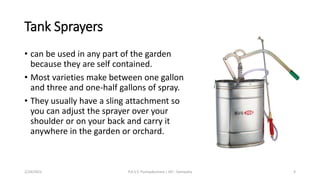
Tank Sprayers
• can be used in any part of the garden
because they are self contained.
• Most varieties make between one gallon
and three and one-half gallons of spray.
• They usually have a sling attachment so
you can adjust the sprayer over your
shoulder or on your back and carry it
anywhere in the garden or orchard.
2/24/2022 P.A.S.S. Pushpakumara | ATI - Gampaha 4
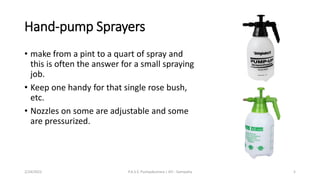
Hand-pump Sprayers
• make from a pint to a quart of spray and
this is often the answer for a small spraying
job.
• Keep one handy for that single rose bush,
etc.
• Nozzles on some are adjustable and some
are pressurized.
2/24/2022 P.A.S.S. Pushpakumara | ATI - Gampaha 5
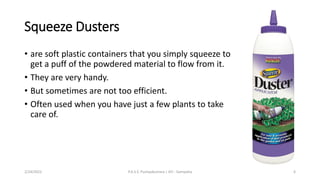
Squeeze Dusters
• are soft plastic containers that you simply squeeze to
get a puff of the powdered material to flow from it.
• They are very handy.
• But sometimes are not too efficient.
• Often used when you have just a few plants to take
care of.
2/24/2022 P.A.S.S. Pushpakumara | ATI - Gampaha 6
Aerosols
• many of the major companies now package insecticides and various
other products in aerosol containers.
• These are especially handy for small spraying jobs.
• The distance the spray will travel and the coarseness of the mist are
predetermined on most all types.
• Keep them out of reach of the children.
2/24/2022 P.A.S.S. Pushpakumara | ATI - Gampaha 7
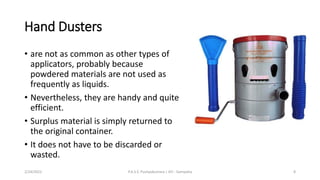
Hand Dusters
• are not as common as other types of
applicators, probably because
powdered materials are not used as
frequently as liquids.
• Nevertheless, they are handy and quite
efficient.
• Surplus material is simply returned to
the original container.
• It does not have to be discarded or
wasted.
2/24/2022 P.A.S.S. Pushpakumara | ATI - Gampaha 8
2/24/2022 P.A.S.S. Pushpakumara | ATI - Gampaha 9
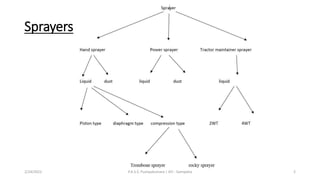
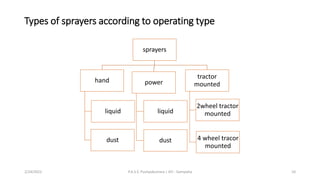
Types of sprayers according to operating type
sprayers
hand
liquid
dust
power
liquid
dust
tractor
mounted
2wheel tractor
mounted
4 wheel tracor
mounted
2/24/2022 P.A.S.S. Pushpakumara | ATI - Gampaha 10
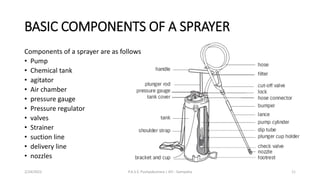
BASIC COMPONENTS OF A SPRAYER
Components of a sprayer are as follows
• Pump
• Chemical tank
• agitator
• Air chamber
• pressure gauge
• Pressure regulator
• valves
• Strainer
• suction line
• delivery line
• nozzles
2/24/2022 P.A.S.S. Pushpakumara | ATI - Gampaha 11
Pump :
• A pump is a device used to move fluids, such as liquids or slurries, or gases
from one place to another. A pump displaces a volume by physical or
mechanical action. Most hydraulic sprayers are equipped with positive
displacement pumps capable of developing pressure, required for many
spraying jobs. The discharge capacity of these pumps is approximately
proportional to the speed. A pressure relief valve or by-pass valve is
required to protect these positive acting pumps from damage when the
discharge line is closed and for the convenience of the operator.
Tank:
It is the container to hold the chemical solution. It is made up of PVC, Brass,
etc. It is usually made of metal sheet or synthetic rubber or plastic having
good resistant quality against corrosion, erosion, and similar actions. The size
of the tank varies according to the pump capacity and the requirements.
2/24/2022 P.A.S.S. Pushpakumara | ATI - Gampaha 12
Agitator:
• It is the device which stirs the solution and keep the contents in
homogenous condition. Positive agitation of spray material in the
tank is essential to permit using the full range of spray materials
including powdery emulsions, fungicides, cold water paints or other
spray material. The propeller or paddle type mechanical agitators or
hydraulic agitators are very common.
Air chamber:
• In a reciprocating type pump, an air chamber is provided on the
discharge line of the pump to level out the pulsations of the pump
and thus providing a constant nozzle pressure
2/24/2022 P.A.S.S. Pushpakumara | ATI - Gampaha 13
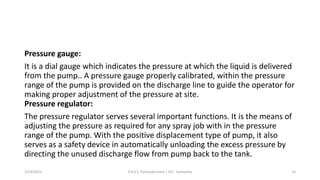
Pressure gauge:
It is a dial gauge which indicates the pressure at which the liquid is delivered
from the pump.. A pressure gauge properly calibrated, within the pressure
range of the pump is provided on the discharge line to guide the operator for
making proper adjustment of the pressure at site.
Pressure regulator:
The pressure regulator serves several important functions. It is the means of
adjusting the pressure as required for any spray job with in the pressure
range of the pump. With the positive displacement type of pump, it also
serves as a safety device in automatically unloading the excess pressure by
directing the unused discharge flow from pump back to the tank.
2/24/2022 P.A.S.S. Pushpakumara | ATI - Gampaha 14
Valves:
A valve is a device that regulates the flow of a fluid (gases, liquids, fluidized solids,
or slurries) by opening, closing, or partially obstructing various passageways.
• Cut-off valve is provided in the delivery line to control the flow from the pump,
• By-pass valve is provided in the delivery line to by-pass the flow from pump to
tank when flow in delivery line is reduced than the pump capacity
• Relief valve - It is an automatic device to control the pressure of fluid or gas
within a range a predetermined pressure.
Strainer : It is a small circular plastic ring with nylon wire mesh to filter any dust
particle coming with the chemical solution It is included in the suction line
between the chemical tank and the check valves. In some sprayers strainers are
provided at the mouth of the chemical tank. Eg. Knapsack sprayers
2/24/2022 P.A.S.S. Pushpakumara | ATI - Gampaha 15
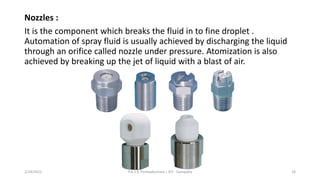
Nozzles :
It is the component which breaks the fluid in to fine droplet .
Automation of spray fluid is usually achieved by discharging the liquid
through an orifice called nozzle under pressure. Atomization is also
achieved by breaking up the jet of liquid with a blast of air.
2/24/2022 P.A.S.S. Pushpakumara | ATI - Gampaha 16
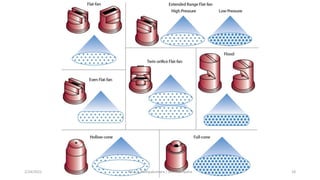
Hydraulic energy nozzles types
Cone type
• Hollow cone type – recommended for the application of
insecticides/fungicides to field crop. Produce acicular pattern. More
liquid concentrated of the pattern. Less in the centre. Produce fine
smaller droplets.
• Solid cone type – produce full cone spray pattern. Droplets are larger
than hollow cone type. Goods for soil applied and systemic
herbicides.
2/24/2022 P.A.S.S. Pushpakumara | ATI - Gampaha 17
2/24/2022 P.A.S.S. Pushpakumara | ATI - Gampaha 18
Flat fan nozzle
• Regular flat fan type nozzle-
• sprays a narrow oval pattern with lighter edges. Ideal for spraying flat
surfaces. Use for spraying herbicides and some insecticides.(spraying walls for
vector control)
• Even flat fan nozzle –
• produce a narrow rectangular pattern with a sharp cut of edges. Provide uniform distribution
across the entire width of the spray band. Suitable for spraying in pre post emergence
herbicide.
• Deflector/impact/anvil/flooding nozzle-
• produce a wide angle flat fan spray patern.large droplets. More droplets land
at the outer edges of the fan and the pattern is rather uneven. Used for pre
and post emergence herbicide and liquid fertilizer
2/24/2022 P.A.S.S. Pushpakumara | ATI - Gampaha 19
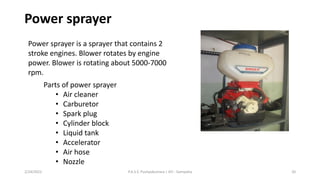
Power sprayer
Power sprayer is a sprayer that contains 2
stroke engines. Blower rotates by engine
power. Blower is rotating about 5000-7000
rpm.
Parts of power sprayer
• Air cleaner
• Carburetor
• Spark plug
• Cylinder block
• Liquid tank
• Accelerator
• Air hose
• Nozzle
2/24/2022 P.A.S.S. Pushpakumara | ATI - Gampaha 20
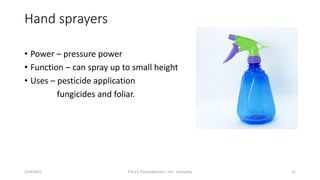
Hand sprayers
• Power – pressure power
• Function – can spray up to small height
• Uses – pesticide application
fungicides and foliar.
2/24/2022 P.A.S.S. Pushpakumara | ATI - Gampaha 21
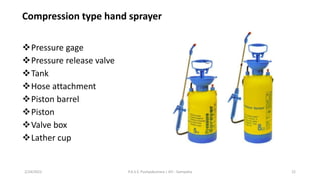
Compression type hand sprayer
❖Pressure gage
❖Pressure release valve
❖Tank
❖Hose attachment
❖Piston barrel
❖Piston
❖Valve box
❖Lather cup
2/24/2022 P.A.S.S. Pushpakumara | ATI - Gampaha 22
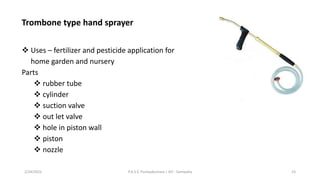
Trombone type hand sprayer
❖ Uses – fertilizer and pesticide application for
home garden and nursery
Parts
❖ rubber tube
❖ cylinder
❖ suction valve
❖ out let valve
❖ hole in piston wall
❖ piston
❖ nozzle
2/24/2022 P.A.S.S. Pushpakumara | ATI - Gampaha 23
Sprayer maintenance
• Rinse the sprayer nozzle – always nozzle should be cleans the pure water.
Not use wares or other things for clean the nozzle.
• Changing one chemical to another – first we have to wash sprayer tank
with detergent at two times. Before wash the tank need to drain out all the
chemicals in the tank. We have to wash all the filters and other valves.
• Lubrication – need to lubrication for piston pump. Lubrication should be
carried out carefully. Because if we use much lubricant can block the
valves.
• Tank fill with chemicals – first fill with water and then fill chemical. Because
to protect our tank.
• Storing – when not use store in good and safety place. And also store the
nozzle separately. Because protect the nozzle.
2/24/2022 P.A.S.S. Pushpakumara | ATI - Gampaha 24
2/24/2022 P.A.S.S. Pushpakumara | ATI - Gampaha 25

Sprayers.pdf

  • 1.
    Identification of typesof sprayers and dusters, parts, function, calibration, operation and maintenance Practical No 04 AG 1207 - Agricultural Implements and Machines 2/24/2022 P.A.S.S. Pushpakumara | ATI - Gampaha 1
  • 2.
  • 3.
    Hose Sprayers • fiton the end of the garden hose. • They make from one to fifteen or more gallons of spray, depending on the model you select. • This type is popular with the home gardener because it is easy to use. • Many have adjustable nozzles, permitting the use of a fine or coarse spray. 2/24/2022 P.A.S.S. Pushpakumara | ATI - Gampaha 3
  • 4.
    Tank Sprayers • canbe used in any part of the garden because they are self contained. • Most varieties make between one gallon and three and one-half gallons of spray. • They usually have a sling attachment so you can adjust the sprayer over your shoulder or on your back and carry it anywhere in the garden or orchard. 2/24/2022 P.A.S.S. Pushpakumara | ATI - Gampaha 4
  • 5.
    Hand-pump Sprayers • makefrom a pint to a quart of spray and this is often the answer for a small spraying job. • Keep one handy for that single rose bush, etc. • Nozzles on some are adjustable and some are pressurized. 2/24/2022 P.A.S.S. Pushpakumara | ATI - Gampaha 5
  • 6.
    Squeeze Dusters • aresoft plastic containers that you simply squeeze to get a puff of the powdered material to flow from it. • They are very handy. • But sometimes are not too efficient. • Often used when you have just a few plants to take care of. 2/24/2022 P.A.S.S. Pushpakumara | ATI - Gampaha 6
  • 7.
    Aerosols • many ofthe major companies now package insecticides and various other products in aerosol containers. • These are especially handy for small spraying jobs. • The distance the spray will travel and the coarseness of the mist are predetermined on most all types. • Keep them out of reach of the children. 2/24/2022 P.A.S.S. Pushpakumara | ATI - Gampaha 7
  • 8.
    Hand Dusters • arenot as common as other types of applicators, probably because powdered materials are not used as frequently as liquids. • Nevertheless, they are handy and quite efficient. • Surplus material is simply returned to the original container. • It does not have to be discarded or wasted. 2/24/2022 P.A.S.S. Pushpakumara | ATI - Gampaha 8
  • 9.
  • 10.
    Types of sprayersaccording to operating type sprayers hand liquid dust power liquid dust tractor mounted 2wheel tractor mounted 4 wheel tracor mounted 2/24/2022 P.A.S.S. Pushpakumara | ATI - Gampaha 10
  • 11.
    BASIC COMPONENTS OFA SPRAYER Components of a sprayer are as follows • Pump • Chemical tank • agitator • Air chamber • pressure gauge • Pressure regulator • valves • Strainer • suction line • delivery line • nozzles 2/24/2022 P.A.S.S. Pushpakumara | ATI - Gampaha 11
  • 12.
    Pump : • Apump is a device used to move fluids, such as liquids or slurries, or gases from one place to another. A pump displaces a volume by physical or mechanical action. Most hydraulic sprayers are equipped with positive displacement pumps capable of developing pressure, required for many spraying jobs. The discharge capacity of these pumps is approximately proportional to the speed. A pressure relief valve or by-pass valve is required to protect these positive acting pumps from damage when the discharge line is closed and for the convenience of the operator. Tank: It is the container to hold the chemical solution. It is made up of PVC, Brass, etc. It is usually made of metal sheet or synthetic rubber or plastic having good resistant quality against corrosion, erosion, and similar actions. The size of the tank varies according to the pump capacity and the requirements. 2/24/2022 P.A.S.S. Pushpakumara | ATI - Gampaha 12
  • 13.
    Agitator: • It isthe device which stirs the solution and keep the contents in homogenous condition. Positive agitation of spray material in the tank is essential to permit using the full range of spray materials including powdery emulsions, fungicides, cold water paints or other spray material. The propeller or paddle type mechanical agitators or hydraulic agitators are very common. Air chamber: • In a reciprocating type pump, an air chamber is provided on the discharge line of the pump to level out the pulsations of the pump and thus providing a constant nozzle pressure 2/24/2022 P.A.S.S. Pushpakumara | ATI - Gampaha 13
  • 14.
    Pressure gauge: It isa dial gauge which indicates the pressure at which the liquid is delivered from the pump.. A pressure gauge properly calibrated, within the pressure range of the pump is provided on the discharge line to guide the operator for making proper adjustment of the pressure at site. Pressure regulator: The pressure regulator serves several important functions. It is the means of adjusting the pressure as required for any spray job with in the pressure range of the pump. With the positive displacement type of pump, it also serves as a safety device in automatically unloading the excess pressure by directing the unused discharge flow from pump back to the tank. 2/24/2022 P.A.S.S. Pushpakumara | ATI - Gampaha 14
  • 15.
    Valves: A valve isa device that regulates the flow of a fluid (gases, liquids, fluidized solids, or slurries) by opening, closing, or partially obstructing various passageways. • Cut-off valve is provided in the delivery line to control the flow from the pump, • By-pass valve is provided in the delivery line to by-pass the flow from pump to tank when flow in delivery line is reduced than the pump capacity • Relief valve - It is an automatic device to control the pressure of fluid or gas within a range a predetermined pressure. Strainer : It is a small circular plastic ring with nylon wire mesh to filter any dust particle coming with the chemical solution It is included in the suction line between the chemical tank and the check valves. In some sprayers strainers are provided at the mouth of the chemical tank. Eg. Knapsack sprayers 2/24/2022 P.A.S.S. Pushpakumara | ATI - Gampaha 15
  • 16.
    Nozzles : It isthe component which breaks the fluid in to fine droplet . Automation of spray fluid is usually achieved by discharging the liquid through an orifice called nozzle under pressure. Atomization is also achieved by breaking up the jet of liquid with a blast of air. 2/24/2022 P.A.S.S. Pushpakumara | ATI - Gampaha 16
  • 17.
    Hydraulic energy nozzlestypes Cone type • Hollow cone type – recommended for the application of insecticides/fungicides to field crop. Produce acicular pattern. More liquid concentrated of the pattern. Less in the centre. Produce fine smaller droplets. • Solid cone type – produce full cone spray pattern. Droplets are larger than hollow cone type. Goods for soil applied and systemic herbicides. 2/24/2022 P.A.S.S. Pushpakumara | ATI - Gampaha 17
  • 18.
  • 19.
    Flat fan nozzle •Regular flat fan type nozzle- • sprays a narrow oval pattern with lighter edges. Ideal for spraying flat surfaces. Use for spraying herbicides and some insecticides.(spraying walls for vector control) • Even flat fan nozzle – • produce a narrow rectangular pattern with a sharp cut of edges. Provide uniform distribution across the entire width of the spray band. Suitable for spraying in pre post emergence herbicide. • Deflector/impact/anvil/flooding nozzle- • produce a wide angle flat fan spray patern.large droplets. More droplets land at the outer edges of the fan and the pattern is rather uneven. Used for pre and post emergence herbicide and liquid fertilizer 2/24/2022 P.A.S.S. Pushpakumara | ATI - Gampaha 19
  • 20.
    Power sprayer Power sprayeris a sprayer that contains 2 stroke engines. Blower rotates by engine power. Blower is rotating about 5000-7000 rpm. Parts of power sprayer • Air cleaner • Carburetor • Spark plug • Cylinder block • Liquid tank • Accelerator • Air hose • Nozzle 2/24/2022 P.A.S.S. Pushpakumara | ATI - Gampaha 20
  • 21.
    Hand sprayers • Power– pressure power • Function – can spray up to small height • Uses – pesticide application fungicides and foliar. 2/24/2022 P.A.S.S. Pushpakumara | ATI - Gampaha 21
  • 22.
    Compression type handsprayer ❖Pressure gage ❖Pressure release valve ❖Tank ❖Hose attachment ❖Piston barrel ❖Piston ❖Valve box ❖Lather cup 2/24/2022 P.A.S.S. Pushpakumara | ATI - Gampaha 22
  • 23.
    Trombone type handsprayer ❖ Uses – fertilizer and pesticide application for home garden and nursery Parts ❖ rubber tube ❖ cylinder ❖ suction valve ❖ out let valve ❖ hole in piston wall ❖ piston ❖ nozzle 2/24/2022 P.A.S.S. Pushpakumara | ATI - Gampaha 23
  • 24.
    Sprayer maintenance • Rinsethe sprayer nozzle – always nozzle should be cleans the pure water. Not use wares or other things for clean the nozzle. • Changing one chemical to another – first we have to wash sprayer tank with detergent at two times. Before wash the tank need to drain out all the chemicals in the tank. We have to wash all the filters and other valves. • Lubrication – need to lubrication for piston pump. Lubrication should be carried out carefully. Because if we use much lubricant can block the valves. • Tank fill with chemicals – first fill with water and then fill chemical. Because to protect our tank. • Storing – when not use store in good and safety place. And also store the nozzle separately. Because protect the nozzle. 2/24/2022 P.A.S.S. Pushpakumara | ATI - Gampaha 24
  • 25.