Plant protection appliances
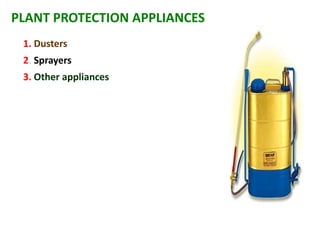
PLANT PROTECTION APPLIANCES
1. Dusters
2. Sprayers
3. Other appliances
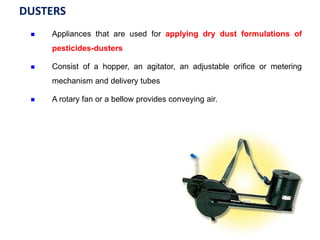
DUSTERS
 Appliances that are used for applying dry dust formulations of
pesticides-dusters
 Consist of a hopper, an agitator, an adjustable orifice or metering
mechanism and delivery tubes
 A rotary fan or a bellow provides conveying air.
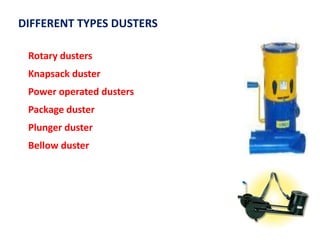
DIFFERENT TYPES DUSTERS
Rotary dusters
Knapsack duster
Power operated dusters
Package duster
Plunger duster
Bellow duster
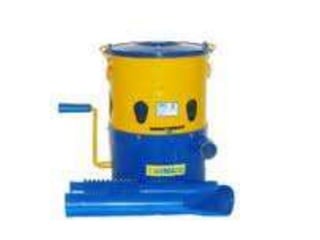
Rotary dusters
• Also called crank dusters or fan type dusters-Vary in
design as shoulder mounted, back mounted or belly
mounted
• Consists of blower with gearbox and a hopper with a
capacity to hold 4-5kg dusts
• Operated by rotating a crank and motion-transmitted
through gear box to blower
• An agitator -connected to one of gears- air current
produced by blower draws dust from hopper and
discharges out through a delivery tube- may have one or
two nozzles
• Dusting field crops, vegetables and small trees and
bushes in orchards-efficiency is 1-1.5 ha/day
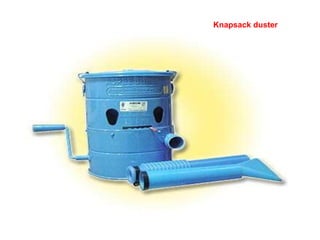
Knapsack duster
• Consists of a dust container of 2-5 kg capacity
through which air current -blown by means of
bellows - worked by hand lever attached to one
side of container
• Air blast takes dust into delivery pipe and
discharges out in an intermittent manner
• For low crops and for spot application
Knapsack duster
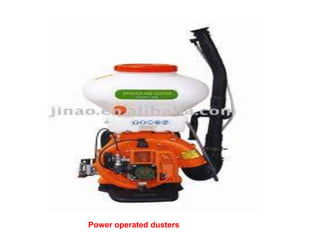
Power operated dusters
• Work by means of a petrol engine -1-3 HP
• Larger dusters-many engines of 15-75 HP-mounted to
tractors
• For covering larger and tall trees and suitable for
controlling locusts- A power duster with a single outlet
can cover 2 ha/day
Power operated dusters
Plunger duster:
This is a simple pump to which a dust chamber is
connected.
The pump generates an air blast that is passed on to the
dust chamber causing the dust to blow out through
delivery tube.
It is used in kitchen garden.
Package duster
• Provided with a rubber on a leather or plastic container-
when squeezed, a puff of air emits dust into a small
cloud-
• Capacity ranges from 0.5-1 kg-kitchen gardens
Bellow duster:
This type of duster works on compressing bellow to
produce an air blast for ejecting the dust out in small
clouds.
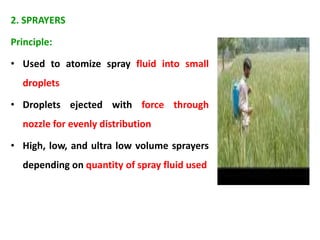
2. SPRAYERS
Principle:
• Used to atomize spray fluid into small
droplets
• Droplets ejected with force through
nozzle for evenly distribution
• High, low, and ultra low volume sprayers
depending on quantity of spray fluid used
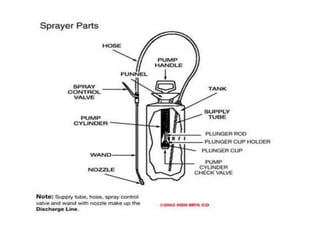
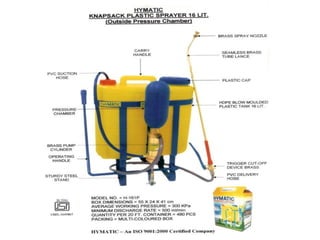
Parts of a sprayer
The important parts are
 Tank
 Pump
 Agitator
 Pressure gauge
 Valves
 Filters
 Pressure chamber
 Hose
 Spray lance
 Cut of device
 Boom
 Nozzle
Parts of a sprayer
Tank
• To hold spray fluid- may be built inside or outside- Capacity
varies from 1-2700 litres of spray fluid
• Made up of stainless steel, brass, fibre or plastic material
• A filler hole-present at top and provided with an agitator
and strainer
Pump
• Necessary for atomizing spray fluid
• Consists of a piston (which creates pressure) and four
valves to regulate fluid in one direction
Parts of a sprayer
Agitator
• Provided in most of sprayers to maintain uniform dispersal
condition of pesticide used
Pressure gauge
• Provided along with sprayer to assess effective functioning
of sprayer
• To guide operator to adjust pressure for spraying
Valves
• Govern direction of flow of spray fluid
• Fitted with system and direct fluid through nozzle
Strainer/Filler
• Present in a sprayer-to keep out dirty material and protect
pump from abrasion, avoid mal-functioning of valves, and
prevent clogging of nozzles
• Present over filler hole between tank and pump, between
pump and spray lance, and within spray lance
Spray lance
• Nozzle of a sprayer -usually attached to a brass rod of variable
designs
• Length varies from 35-90cm- detachable- nozzle may form a
part of the lance
Hose
• Attached with the sprayer on one end and spray lance on other
end
• Light enough, non-absorbent, oil resistant, durable and flexible
Cut-off device
• Provided to shut-off flow of liquid-either spring activated
or knob operated
Boom
• Spray lance carries more than one nozzle-known as boom-
normally coupled with power sprayers
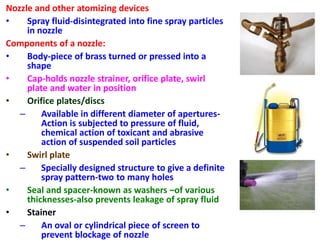
Nozzle and other atomizing devices
• Spray fluid-disintegrated into fine spray particles
in nozzle
Components of a nozzle:
• Body-piece of brass turned or pressed into a
shape
• Cap-holds nozzle strainer, orifice plate, swirl
plate and water in position
• Orifice plates/discs
– Available in different diameter of apertures-
Action is subjected to pressure of fluid,
chemical action of toxicant and abrasive
action of suspended soil particles
• Swirl plate
– Specially designed structure to give a definite
spray pattern-two to many holes
• Seal and spacer-known as washers –of various
thicknesses-also prevents leakage of spray fluid
• Stainer
– An oval or cylindrical piece of screen to
prevent blockage of nozzle
Commonly used nozzles
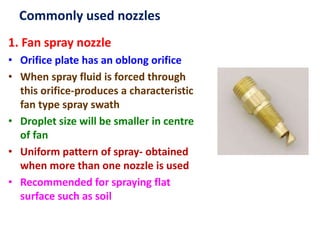
1. Fan spray nozzle
• Orifice plate has an oblong orifice
• When spray fluid is forced through
this orifice-produces a characteristic
fan type spray swath
• Droplet size will be smaller in centre
of fan
• Uniform pattern of spray- obtained
when more than one nozzle is used
• Recommended for spraying flat
surface such as soil
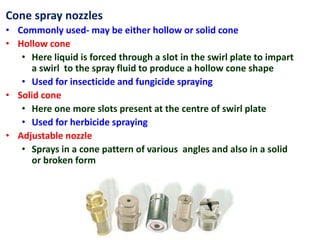
Cone spray nozzles
• Commonly used- may be either hollow or solid cone
• Hollow cone
• Here liquid is forced through a slot in the swirl plate to impart
a swirl to the spray fluid to produce a hollow cone shape
• Used for insecticide and fungicide spraying
• Solid cone
• Here one more slots present at the centre of swirl plate
• Used for herbicide spraying
• Adjustable nozzle
• Sprays in a cone pattern of various angles and also in a solid
or broken form
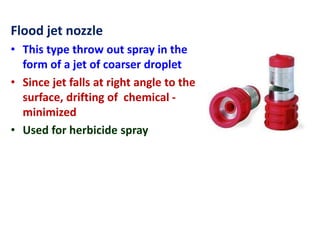
Flood jet nozzle
• This type throw out spray in the
form of a jet of coarser droplet
• Since jet falls at right angle to the
surface, drifting of chemical -
minimized
• Used for herbicide spray
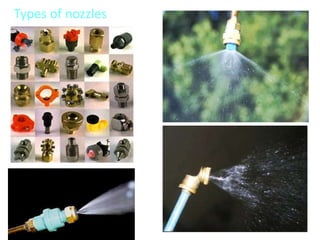
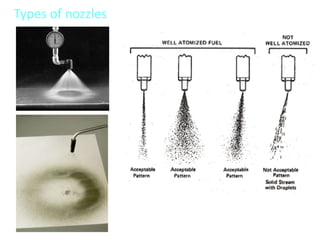
Types of nozzles
Types of nozzles
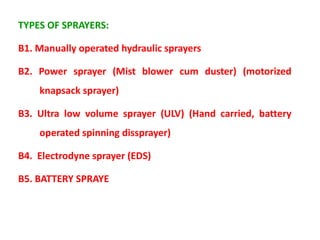
TYPES OF SPRAYERS:
B1. Manually operated hydraulic sprayers
B2. Power sprayer (Mist blower cum duster) (motorized
knapsack sprayer)
B3. Ultra low volume sprayer (ULV) (Hand carried, battery
operated spinning dissprayer)
B4. Electrodyne sprayer (EDS)
B5. BATTERY SPRAYE
TYPES OF SPRAYERS:
B1. Manually operated hydraulic sprayers
Hand syringe
Hand sprayer
Bucket pump sprayer
Knapsack sprayer
Rocker sprayer
Foot sprayer (pedal pump)
Manually operated compression sprayers
a. Pneumatic hand sprayer
b.Pneumatic knapsack sprayer
B2. Power sprayer (Mist blower cum duster) (motorized
knapsack sprayer)
The spray fluid is blown out by an air current produced in the
machine.
It consists of the following parts: 1. Chemical tank (12 lit.) 2.
Fuel tank (2.5 lit.), 3. Engine (1 - 2 hp), 4. Carburetor, 5.
Spark plug, 6. Blower assembly 7. Delivery system 8.
Nozzle system 9. Starter pulley
High volume sprayers
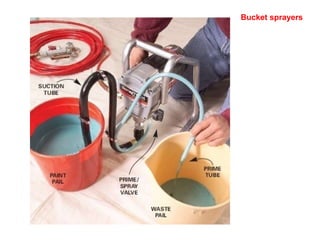
Bucket sprayers
• Consists of either a double action pump with
two cylinders or a single pump with one
cylinder
• In single acting pimp- spray discharge -
discontinuous since fluid is ejected only during
downward compress stoke, while in double
pump, discharge -continuous
Bucket sprayers
High volume sprayers
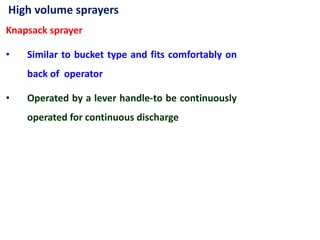
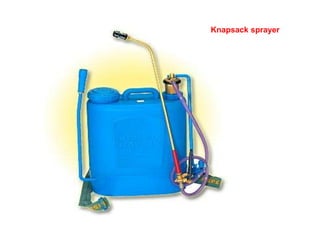
Knapsack sprayer
• Similar to bucket type and fits comfortably on
back of operator
• Operated by a lever handle-to be continuously
operated for continuous discharge
Knapsack sprayer
High volume sprayers
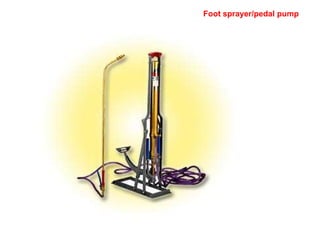
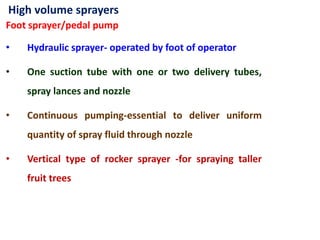
Foot sprayer/pedal pump
• Hydraulic sprayer- operated by foot of operator
• One suction tube with one or two delivery tubes,
spray lances and nozzle
• Continuous pumping-essential to deliver uniform
quantity of spray fluid through nozzle
• Vertical type of rocker sprayer -for spraying taller
fruit trees
Foot sprayer/pedal pump
High volume sprayers
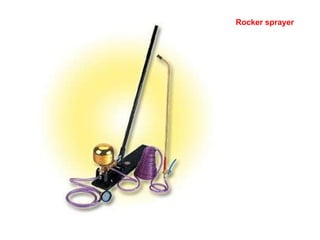
Rocker sprayer
• Used for spraying trees and tall field crops
• Consists of pump assembly, a rocking lever,
pressure chamber, suction hose, delivery hose
and spray lance with nozzle
• Rocking movement of lever, pressure can be
built in tank
Rocker sprayer
High volume sprayers
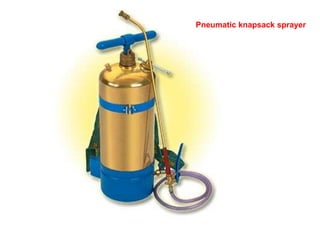
Pneumatic knapsack sprayer
• Used to spray large quantity of liquid
• Container of spray fluid - acts as pressure
chamber- An air pump -attached to chamber
• Inner end of discharge pipe runs down to
bottom of container and its outlet ends in a
nozzle
• Tank -filled to ¾ capacity -pump worked to
build sufficient pressure upon spray fluid
Pneumatic knapsack sprayer
LOW VOLUME SPRAYERS
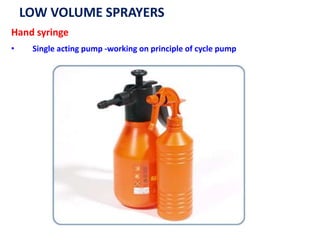
Hand syringe
• Single acting pump -working on principle of cycle pump
LOW VOLUME SPRAYERS
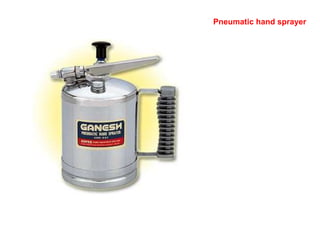
Pneumatic hand sprayer
• Container of spray fluid -acts as pressure chamber-An air
pump attached to chamber-inner end of discharge pipe
runs down to bottom of container- outlet ends in a nozzle
• Tank -filled to ¾ capacity -pump worked to build sufficient
pressure upon spray fluid
Pneumatic hand sprayer
LOW VOLUME SPRAYERS
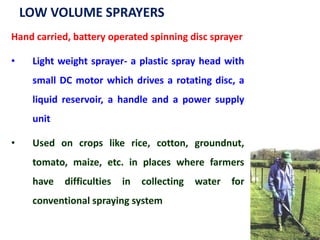
Hand carried, battery operated spinning disc sprayer
• Light weight sprayer- a plastic spray head with
small DC motor which drives a rotating disc, a
liquid reservoir, a handle and a power supply
unit
• Used on crops like rice, cotton, groundnut,
tomato, maize, etc. in places where farmers
have difficulties in collecting water for
conventional spraying system
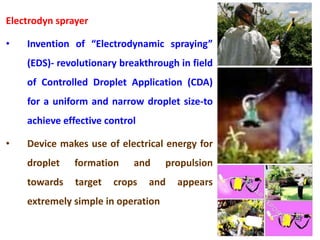
Electrodyn sprayer
• Invention of “Electrodynamic spraying”
(EDS)- revolutionary breakthrough in field
of Controlled Droplet Application (CDA)
for a uniform and narrow droplet size-to
achieve effective control
• Device makes use of electrical energy for
droplet formation and propulsion
towards target crops and appears
extremely simple in operation
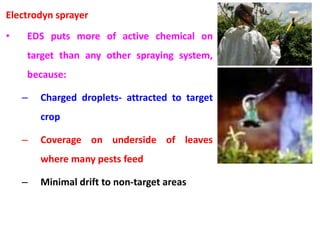
Electrodyn sprayer
• EDS puts more of active chemical on
target than any other spraying system,
because:
– Charged droplets- attracted to target
crop
– Coverage on underside of leaves
where many pests feed
– Minimal drift to non-target areas
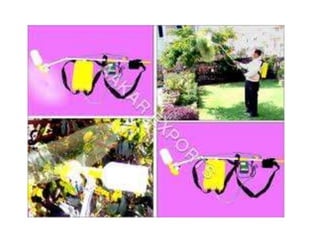
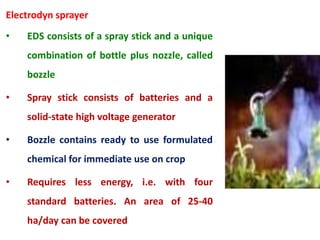
Electrodyn sprayer
• EDS consists of a spray stick and a unique
combination of bottle plus nozzle, called
bozzle
• Spray stick consists of batteries and a
solid-state high voltage generator
• Bozzle contains ready to use formulated
chemical for immediate use on crop
• Requires less energy, i.e. with four
standard batteries. An area of 25-40
ha/day can be covered
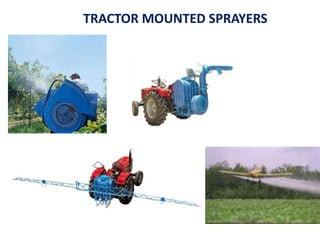
TRACTOR MOUNTED SPRAYERS
OTHER APPLIANCES
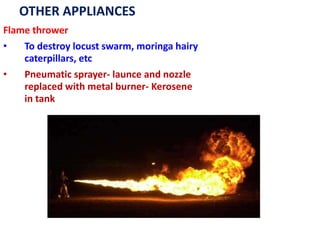
Flame thrower
• To destroy locust swarm, moringa hairy
caterpillars, etc
• Pneumatic sprayer- launce and nozzle
replaced with metal burner- Kerosene
in tank
OTHER APPLIANCES
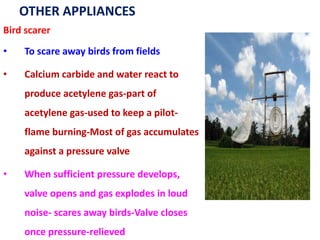
Bird scarer
• To scare away birds from fields
• Calcium carbide and water react to
produce acetylene gas-part of
acetylene gas-used to keep a pilot-
flame burning-Most of gas accumulates
against a pressure valve
• When sufficient pressure develops,
valve opens and gas explodes in loud
noise- scares away birds-Valve closes
once pressure-relieved
OTHER APPLIANCES
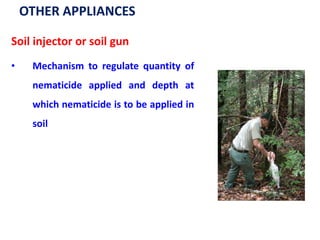
Soil injector or soil gun
• Mechanism to regulate quantity of
nematicide applied and depth at
which nematicide is to be applied in
soil
OTHER APPLIANCES
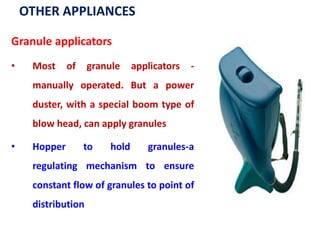
Granule applicators
• Most of granule applicators -
manually operated. But a power
duster, with a special boom type of
blow head, can apply granules
• Hopper to hold granules-a
regulating mechanism to ensure
constant flow of granules to point of
distribution

1,P.16 Sprayers of engineering management

  • 1.
  • 2.
    PLANT PROTECTION APPLIANCES 1.Dusters 2. Sprayers 3. Other appliances
  • 3.
    DUSTERS  Appliances thatare used for applying dry dust formulations of pesticides-dusters  Consist of a hopper, an agitator, an adjustable orifice or metering mechanism and delivery tubes  A rotary fan or a bellow provides conveying air.
  • 4.
    DIFFERENT TYPES DUSTERS Rotarydusters Knapsack duster Power operated dusters Package duster Plunger duster Bellow duster
  • 6.
    Rotary dusters • Alsocalled crank dusters or fan type dusters-Vary in design as shoulder mounted, back mounted or belly mounted • Consists of blower with gearbox and a hopper with a capacity to hold 4-5kg dusts • Operated by rotating a crank and motion-transmitted through gear box to blower
  • 7.
    • An agitator-connected to one of gears- air current produced by blower draws dust from hopper and discharges out through a delivery tube- may have one or two nozzles • Dusting field crops, vegetables and small trees and bushes in orchards-efficiency is 1-1.5 ha/day
  • 8.
    Knapsack duster • Consistsof a dust container of 2-5 kg capacity through which air current -blown by means of bellows - worked by hand lever attached to one side of container • Air blast takes dust into delivery pipe and discharges out in an intermittent manner • For low crops and for spot application
  • 9.
  • 10.
    Power operated dusters •Work by means of a petrol engine -1-3 HP • Larger dusters-many engines of 15-75 HP-mounted to tractors • For covering larger and tall trees and suitable for controlling locusts- A power duster with a single outlet can cover 2 ha/day
  • 11.
  • 12.
    Plunger duster: This isa simple pump to which a dust chamber is connected. The pump generates an air blast that is passed on to the dust chamber causing the dust to blow out through delivery tube. It is used in kitchen garden.
  • 13.
    Package duster • Providedwith a rubber on a leather or plastic container- when squeezed, a puff of air emits dust into a small cloud- • Capacity ranges from 0.5-1 kg-kitchen gardens
  • 14.
    Bellow duster: This typeof duster works on compressing bellow to produce an air blast for ejecting the dust out in small clouds.
  • 15.
    2. SPRAYERS Principle: • Usedto atomize spray fluid into small droplets • Droplets ejected with force through nozzle for evenly distribution • High, low, and ultra low volume sprayers depending on quantity of spray fluid used
  • 16.
    Parts of asprayer The important parts are  Tank  Pump  Agitator  Pressure gauge  Valves  Filters  Pressure chamber  Hose  Spray lance  Cut of device  Boom  Nozzle
  • 18.
    Parts of asprayer Tank • To hold spray fluid- may be built inside or outside- Capacity varies from 1-2700 litres of spray fluid • Made up of stainless steel, brass, fibre or plastic material • A filler hole-present at top and provided with an agitator and strainer Pump • Necessary for atomizing spray fluid • Consists of a piston (which creates pressure) and four valves to regulate fluid in one direction
  • 19.
    Parts of asprayer Agitator • Provided in most of sprayers to maintain uniform dispersal condition of pesticide used Pressure gauge • Provided along with sprayer to assess effective functioning of sprayer • To guide operator to adjust pressure for spraying
  • 20.
    Valves • Govern directionof flow of spray fluid • Fitted with system and direct fluid through nozzle Strainer/Filler • Present in a sprayer-to keep out dirty material and protect pump from abrasion, avoid mal-functioning of valves, and prevent clogging of nozzles • Present over filler hole between tank and pump, between pump and spray lance, and within spray lance
  • 21.
    Spray lance • Nozzleof a sprayer -usually attached to a brass rod of variable designs • Length varies from 35-90cm- detachable- nozzle may form a part of the lance Hose • Attached with the sprayer on one end and spray lance on other end • Light enough, non-absorbent, oil resistant, durable and flexible
  • 22.
    Cut-off device • Providedto shut-off flow of liquid-either spring activated or knob operated Boom • Spray lance carries more than one nozzle-known as boom- normally coupled with power sprayers
  • 24.
    Nozzle and otheratomizing devices • Spray fluid-disintegrated into fine spray particles in nozzle Components of a nozzle: • Body-piece of brass turned or pressed into a shape • Cap-holds nozzle strainer, orifice plate, swirl plate and water in position • Orifice plates/discs – Available in different diameter of apertures- Action is subjected to pressure of fluid, chemical action of toxicant and abrasive action of suspended soil particles • Swirl plate – Specially designed structure to give a definite spray pattern-two to many holes • Seal and spacer-known as washers –of various thicknesses-also prevents leakage of spray fluid • Stainer – An oval or cylindrical piece of screen to prevent blockage of nozzle
  • 25.
    Commonly used nozzles 1.Fan spray nozzle • Orifice plate has an oblong orifice • When spray fluid is forced through this orifice-produces a characteristic fan type spray swath • Droplet size will be smaller in centre of fan • Uniform pattern of spray- obtained when more than one nozzle is used • Recommended for spraying flat surface such as soil
  • 26.
    Cone spray nozzles •Commonly used- may be either hollow or solid cone • Hollow cone • Here liquid is forced through a slot in the swirl plate to impart a swirl to the spray fluid to produce a hollow cone shape • Used for insecticide and fungicide spraying • Solid cone • Here one more slots present at the centre of swirl plate • Used for herbicide spraying • Adjustable nozzle • Sprays in a cone pattern of various angles and also in a solid or broken form
  • 27.
    Flood jet nozzle •This type throw out spray in the form of a jet of coarser droplet • Since jet falls at right angle to the surface, drifting of chemical - minimized • Used for herbicide spray
  • 28.
  • 29.
  • 30.
    TYPES OF SPRAYERS: B1.Manually operated hydraulic sprayers B2. Power sprayer (Mist blower cum duster) (motorized knapsack sprayer) B3. Ultra low volume sprayer (ULV) (Hand carried, battery operated spinning dissprayer) B4. Electrodyne sprayer (EDS) B5. BATTERY SPRAYE
  • 31.
    TYPES OF SPRAYERS: B1.Manually operated hydraulic sprayers Hand syringe Hand sprayer Bucket pump sprayer Knapsack sprayer Rocker sprayer Foot sprayer (pedal pump)
  • 32.
    Manually operated compressionsprayers a. Pneumatic hand sprayer b.Pneumatic knapsack sprayer
  • 33.
    B2. Power sprayer(Mist blower cum duster) (motorized knapsack sprayer) The spray fluid is blown out by an air current produced in the machine. It consists of the following parts: 1. Chemical tank (12 lit.) 2. Fuel tank (2.5 lit.), 3. Engine (1 - 2 hp), 4. Carburetor, 5. Spark plug, 6. Blower assembly 7. Delivery system 8. Nozzle system 9. Starter pulley
  • 34.
    High volume sprayers Bucketsprayers • Consists of either a double action pump with two cylinders or a single pump with one cylinder • In single acting pimp- spray discharge - discontinuous since fluid is ejected only during downward compress stoke, while in double pump, discharge -continuous
  • 35.
  • 36.
    High volume sprayers Knapsacksprayer • Similar to bucket type and fits comfortably on back of operator • Operated by a lever handle-to be continuously operated for continuous discharge
  • 37.
  • 38.
    High volume sprayers Footsprayer/pedal pump • Hydraulic sprayer- operated by foot of operator • One suction tube with one or two delivery tubes, spray lances and nozzle • Continuous pumping-essential to deliver uniform quantity of spray fluid through nozzle • Vertical type of rocker sprayer -for spraying taller fruit trees
  • 39.
  • 40.
    High volume sprayers Rockersprayer • Used for spraying trees and tall field crops • Consists of pump assembly, a rocking lever, pressure chamber, suction hose, delivery hose and spray lance with nozzle • Rocking movement of lever, pressure can be built in tank
  • 41.
  • 42.
    High volume sprayers Pneumaticknapsack sprayer • Used to spray large quantity of liquid • Container of spray fluid - acts as pressure chamber- An air pump -attached to chamber • Inner end of discharge pipe runs down to bottom of container and its outlet ends in a nozzle • Tank -filled to ¾ capacity -pump worked to build sufficient pressure upon spray fluid
  • 43.
  • 44.
    LOW VOLUME SPRAYERS Handsyringe • Single acting pump -working on principle of cycle pump
  • 45.
    LOW VOLUME SPRAYERS Pneumatichand sprayer • Container of spray fluid -acts as pressure chamber-An air pump attached to chamber-inner end of discharge pipe runs down to bottom of container- outlet ends in a nozzle • Tank -filled to ¾ capacity -pump worked to build sufficient pressure upon spray fluid
  • 46.
  • 47.
    LOW VOLUME SPRAYERS Handcarried, battery operated spinning disc sprayer • Light weight sprayer- a plastic spray head with small DC motor which drives a rotating disc, a liquid reservoir, a handle and a power supply unit • Used on crops like rice, cotton, groundnut, tomato, maize, etc. in places where farmers have difficulties in collecting water for conventional spraying system
  • 48.
    Electrodyn sprayer • Inventionof “Electrodynamic spraying” (EDS)- revolutionary breakthrough in field of Controlled Droplet Application (CDA) for a uniform and narrow droplet size-to achieve effective control • Device makes use of electrical energy for droplet formation and propulsion towards target crops and appears extremely simple in operation
  • 49.
    Electrodyn sprayer • EDSputs more of active chemical on target than any other spraying system, because: – Charged droplets- attracted to target crop – Coverage on underside of leaves where many pests feed – Minimal drift to non-target areas
  • 51.
    Electrodyn sprayer • EDSconsists of a spray stick and a unique combination of bottle plus nozzle, called bozzle • Spray stick consists of batteries and a solid-state high voltage generator • Bozzle contains ready to use formulated chemical for immediate use on crop • Requires less energy, i.e. with four standard batteries. An area of 25-40 ha/day can be covered
  • 52.
  • 53.
    OTHER APPLIANCES Flame thrower •To destroy locust swarm, moringa hairy caterpillars, etc • Pneumatic sprayer- launce and nozzle replaced with metal burner- Kerosene in tank
  • 54.
    OTHER APPLIANCES Bird scarer •To scare away birds from fields • Calcium carbide and water react to produce acetylene gas-part of acetylene gas-used to keep a pilot- flame burning-Most of gas accumulates against a pressure valve • When sufficient pressure develops, valve opens and gas explodes in loud noise- scares away birds-Valve closes once pressure-relieved
  • 55.
    OTHER APPLIANCES Soil injectoror soil gun • Mechanism to regulate quantity of nematicide applied and depth at which nematicide is to be applied in soil
  • 56.
    OTHER APPLIANCES Granule applicators •Most of granule applicators - manually operated. But a power duster, with a special boom type of blow head, can apply granules • Hopper to hold granules-a regulating mechanism to ensure constant flow of granules to point of distribution