P.A.S.S. Pushpakumara | Advanced Technological Institute- Gampaha
AG 2105 Soil and Water Management
Practical No. 04
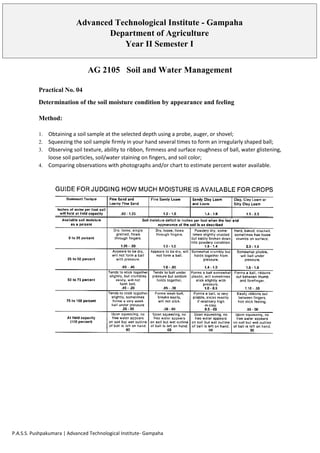
Determination of the soil moisture condition by appearance and feeling
Method:
1. Obtaining a soil sample at the selected depth using a probe, auger, or shovel;
2. Squeezing the soil sample firmly in your hand several times to form an irregularly shaped ball;
3. Observing soil texture, ability to ribbon, firmness and surface roughness of ball, water glistening,
loose soil particles, soil/water staining on fingers, and soil color;
4. Comparing observations with photographs and/or chart to estimate percent water available.
Advanced Technological Institute - Gampaha
Department of Agriculture
Year II Semester I
P.A.S.S. Pushpakumara | Advanced Technological Institute- Gampaha
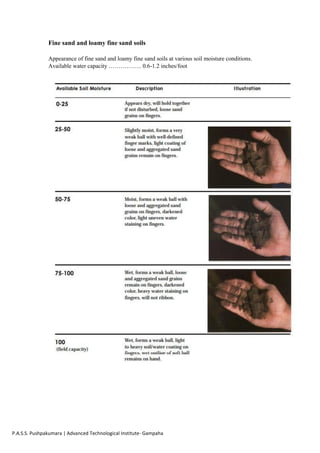
Fine sand and loamy fine sand soils
Appearance of fine sand and loamy fine sand soils at various soil moisture conditions.
Available water capacity …………….. 0.6-1.2 inches/foot
P.A.S.S. Pushpakumara | Advanced Technological Institute- Gampaha
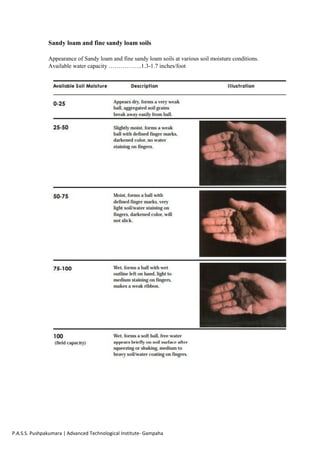
Sandy loam and fine sandy loam soils
Appearance of Sandy loam and fine sandy loam soils at various soil moisture conditions.
Available water capacity ……………..1.3-1.7 inches/foot
P.A.S.S. Pushpakumara | Advanced Technological Institute- Gampaha
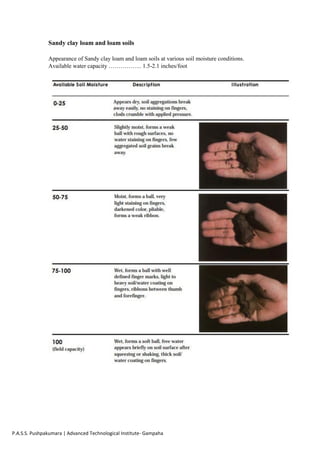
Sandy clay loam and loam soils
Appearance of Sandy clay loam and loam soils at various soil moisture conditions.
Available water capacity …………….. 1.5-2.1 inches/foot
P.A.S.S. Pushpakumara | Advanced Technological Institute- Gampaha
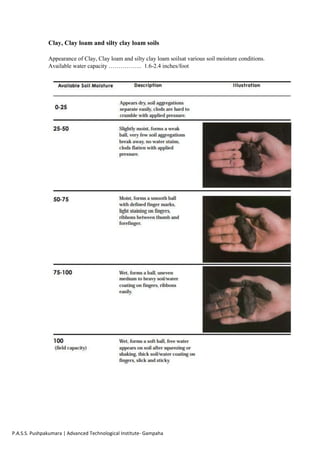
Clay, Clay loam and silty clay loam soils
Appearance of Clay, Clay loam and silty clay loam soilsat various soil moisture conditions.
Available water capacity …………….. 1.6-2.4 inches/foot

AG_2105_Practical_No._04.pdf

  • 1.
    P.A.S.S. Pushpakumara |Advanced Technological Institute- Gampaha AG 2105 Soil and Water Management Practical No. 04 Determination of the soil moisture condition by appearance and feeling Method: 1. Obtaining a soil sample at the selected depth using a probe, auger, or shovel; 2. Squeezing the soil sample firmly in your hand several times to form an irregularly shaped ball; 3. Observing soil texture, ability to ribbon, firmness and surface roughness of ball, water glistening, loose soil particles, soil/water staining on fingers, and soil color; 4. Comparing observations with photographs and/or chart to estimate percent water available. Advanced Technological Institute - Gampaha Department of Agriculture Year II Semester I
  • 2.
    P.A.S.S. Pushpakumara |Advanced Technological Institute- Gampaha Fine sand and loamy fine sand soils Appearance of fine sand and loamy fine sand soils at various soil moisture conditions. Available water capacity …………….. 0.6-1.2 inches/foot
  • 3.
    P.A.S.S. Pushpakumara |Advanced Technological Institute- Gampaha Sandy loam and fine sandy loam soils Appearance of Sandy loam and fine sandy loam soils at various soil moisture conditions. Available water capacity ……………..1.3-1.7 inches/foot
  • 4.
    P.A.S.S. Pushpakumara |Advanced Technological Institute- Gampaha Sandy clay loam and loam soils Appearance of Sandy clay loam and loam soils at various soil moisture conditions. Available water capacity …………….. 1.5-2.1 inches/foot
  • 5.
    P.A.S.S. Pushpakumara |Advanced Technological Institute- Gampaha Clay, Clay loam and silty clay loam soils Appearance of Clay, Clay loam and silty clay loam soilsat various soil moisture conditions. Available water capacity …………….. 1.6-2.4 inches/foot