Copyright © 2016 McGraw-Hill Education. All rights reserved. No reproduction or distribution without the prior written consent of McGraw-Hill Education.
Chapter 2
Transaction Processing in the AIS
2-2
Outline
• Learning objectives
• Accounting and bookkeeping
• Accounting cycle
• Internal controls
• Coding systems
• Human judgment and information
technology
2-3
Learning objectives
1. Differentiate accounting and bookkeeping.
2. List, discuss and complete, in order, the
steps in the accounting cycle.
3. Identify common internal controls associated
with the accounting cycle.
4. Describe common coding systems and how
they are used in the AIS.
5. Explain how human judgment and
information technology affect the accounting
cycle.
2-4
Accounting and bookkeeping
• Accounting
Accounting is the process
of identifying, measuring,
and communicating
economic information to
permit informed judgments
and decisions by users of
the information.
• Bookkeeping
The part of accounting
associated with identifying
and measuring economic
information.
2-5
Accounting and bookkeeping
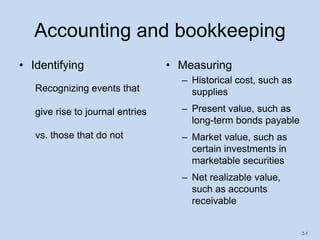
• Identifying
Recognizing events that
give rise to journal entries
vs. those that do not
• Measuring
– Historical cost, such as
supplies
– Present value, such as
long-term bonds payable
– Market value, such as
certain investments in
marketable securities
– Net realizable value,
such as accounts
receivable
2-6
Accounting cycle
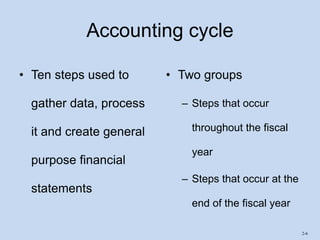
• Ten steps used to
gather data, process
it and create general
purpose financial
statements
• Two groups
– Steps that occur
throughout the fiscal
year
– Steps that occur at the
end of the fiscal year
2-7
Accounting cycle
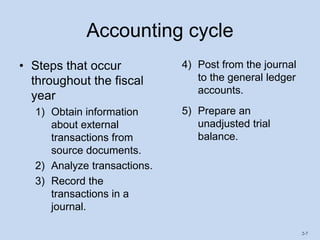
• Steps that occur
throughout the fiscal
year
1) Obtain information
about external
transactions from
source documents.
2) Analyze transactions.
3) Record the
transactions in a
journal.
4) Post from the journal
to the general ledger
accounts.
5) Prepare an
unadjusted trial
balance.
2-8
Accounting cycle
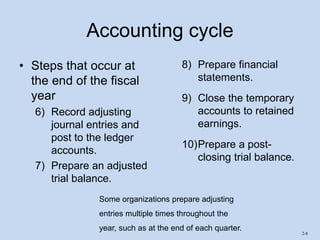
• Steps that occur at
the end of the fiscal
year
6) Record adjusting
journal entries and
post to the ledger
accounts.
7) Prepare an adjusted
trial balance.
8) Prepare financial
statements.
9) Close the temporary
accounts to retained
earnings.
10)Prepare a post-
closing trial balance.
Some organizations prepare adjusting
entries multiple times throughout the
year, such as at the end of each quarter.
2-9
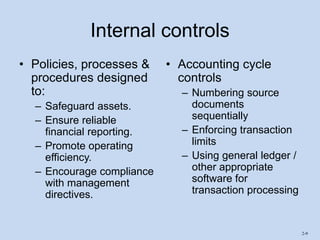
Internal controls
• Policies, processes &
procedures designed
to:
– Safeguard assets.
– Ensure reliable
financial reporting.
– Promote operating
efficiency.
– Encourage compliance
with management
directives.
• Accounting cycle
controls
– Numbering source
documents
sequentially
– Enforcing transaction
limits
– Using general ledger /
other appropriate
software for
transaction processing
2-10
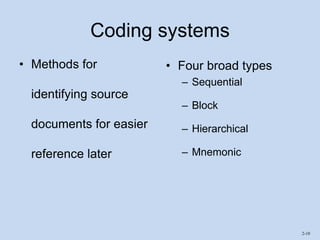
Coding systems
• Methods for
identifying source
documents for easier
reference later
• Four broad types
– Sequential
– Block
– Hierarchical
– Mnemonic
2-11
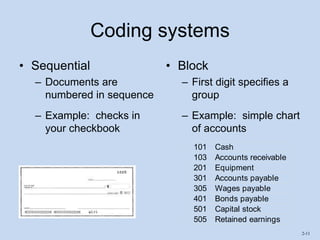
Coding systems
• Sequential
– Documents are
numbered in sequence
– Example: checks in
your checkbook
• Block
– First digit specifies a
group
– Example: simple chart
of accounts
101 Cash
103 Accounts receivable
201 Equipment
301 Accounts payable
305 Wages payable
401 Bonds payable
501 Capital stock
505 Retained earnings
2-12
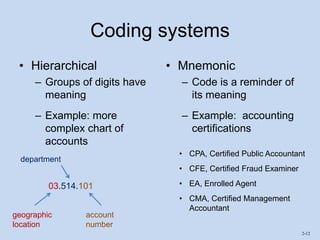
Coding systems
• Hierarchical
– Groups of digits have
meaning
– Example: more
complex chart of
accounts
• Mnemonic
– Code is a reminder of
its meaning
– Example: accounting
certifications
03.514.101
geographic
location
department
account
number
• CPA, Certified Public Accountant
• CFE, Certified Fraud Examiner
• EA, Enrolled Agent
• CMA, Certified Management
Accountant
2-13
Human judgment & information
technology
• Often incorporated in
accounting information
systems
• Information technology
is not the system; it is a
tool used in the
system.
• Human judgment
Determining which events
lead to journal entries
• Information technology
Spreadsheets, relational
databases, general ledger
software, ERP systems
2-14

Sppt chap002

  • 1.
    Copyright © 2016McGraw-Hill Education. All rights reserved. No reproduction or distribution without the prior written consent of McGraw-Hill Education. Chapter 2 Transaction Processing in the AIS
  • 2.
    2-2 Outline • Learning objectives •Accounting and bookkeeping • Accounting cycle • Internal controls • Coding systems • Human judgment and information technology
  • 3.
    2-3 Learning objectives 1. Differentiateaccounting and bookkeeping. 2. List, discuss and complete, in order, the steps in the accounting cycle. 3. Identify common internal controls associated with the accounting cycle. 4. Describe common coding systems and how they are used in the AIS. 5. Explain how human judgment and information technology affect the accounting cycle.
  • 4.
    2-4 Accounting and bookkeeping •Accounting Accounting is the process of identifying, measuring, and communicating economic information to permit informed judgments and decisions by users of the information. • Bookkeeping The part of accounting associated with identifying and measuring economic information.
  • 5.
    2-5 Accounting and bookkeeping •Identifying Recognizing events that give rise to journal entries vs. those that do not • Measuring – Historical cost, such as supplies – Present value, such as long-term bonds payable – Market value, such as certain investments in marketable securities – Net realizable value, such as accounts receivable
  • 6.
    2-6 Accounting cycle • Tensteps used to gather data, process it and create general purpose financial statements • Two groups – Steps that occur throughout the fiscal year – Steps that occur at the end of the fiscal year
  • 7.
    2-7 Accounting cycle • Stepsthat occur throughout the fiscal year 1) Obtain information about external transactions from source documents. 2) Analyze transactions. 3) Record the transactions in a journal. 4) Post from the journal to the general ledger accounts. 5) Prepare an unadjusted trial balance.
  • 8.
    2-8 Accounting cycle • Stepsthat occur at the end of the fiscal year 6) Record adjusting journal entries and post to the ledger accounts. 7) Prepare an adjusted trial balance. 8) Prepare financial statements. 9) Close the temporary accounts to retained earnings. 10)Prepare a post- closing trial balance. Some organizations prepare adjusting entries multiple times throughout the year, such as at the end of each quarter.
  • 9.
    2-9 Internal controls • Policies,processes & procedures designed to: – Safeguard assets. – Ensure reliable financial reporting. – Promote operating efficiency. – Encourage compliance with management directives. • Accounting cycle controls – Numbering source documents sequentially – Enforcing transaction limits – Using general ledger / other appropriate software for transaction processing
  • 10.
    2-10 Coding systems • Methodsfor identifying source documents for easier reference later • Four broad types – Sequential – Block – Hierarchical – Mnemonic
  • 11.
    2-11 Coding systems • Sequential –Documents are numbered in sequence – Example: checks in your checkbook • Block – First digit specifies a group – Example: simple chart of accounts 101 Cash 103 Accounts receivable 201 Equipment 301 Accounts payable 305 Wages payable 401 Bonds payable 501 Capital stock 505 Retained earnings
  • 12.
    2-12 Coding systems • Hierarchical –Groups of digits have meaning – Example: more complex chart of accounts • Mnemonic – Code is a reminder of its meaning – Example: accounting certifications 03.514.101 geographic location department account number • CPA, Certified Public Accountant • CFE, Certified Fraud Examiner • EA, Enrolled Agent • CMA, Certified Management Accountant
  • 13.
    2-13 Human judgment &information technology • Often incorporated in accounting information systems • Information technology is not the system; it is a tool used in the system. • Human judgment Determining which events lead to journal entries • Information technology Spreadsheets, relational databases, general ledger software, ERP systems
  • 14.