Copyright © 2016 McGraw-Hill Education. All rights reserved. No reproduction or distribution without the prior written consent of McGraw-Hill Education.
Accounting Information Systems:
Basic Concepts and Current
Issues
4th edition
Robert L. Hurt
Copyright © 2016 McGraw-Hill Education. All rights reserved. No reproduction or distribution without the prior written consent of McGraw-Hill Education.
Chapter 1
Role and Purpose of Accounting
Information Systems
1-3
Outline
• Learning objectives
• Definition of AIS
• AIS importance
• AIS generic structure
• Information literacy
1-4
Learning objectives
1. Define “accounting information systems.”
2. Discuss why AIS is an important area of
study for future accountants.
3. Compare and contrast AIS with other areas
of accounting.
4. Explain the structure of most AIS.
5. Locate and evaluate information sources on
AIS.
1-5
Definition of AIS
An accounting information system is:
– A set of interrelated activities, documents and
technologies
– Designed to collect data, process it and report
information
– To a diverse group of internal and external
decision makers in organizations
1-6
Definition of AIS
• Activities
– Business processes
• Sales / collection
• Acquisition / payment
• Conversion
• Financing
• Human resource
– Accounting cycle steps
• Documents
– Purchase orders
– Remittance advices
• Technologies
– General ledger
software
– ERP systems
Which steps in the accounting
cycle do you recall from
previous study?
1-7
Definition of AIS
• Data
– Stacks of sales
invoices
– Receipts for the
payment of rent
• Information
– General purpose
financial statements
– Cost variance analysis
• Decision makers
– Management (internal)
– Shareholders
(external)
• Organizations
– For profit (Microsoft)
– Not for profit (Red
Cross)
– Governmental (State
of California)
1-8
AIS importance
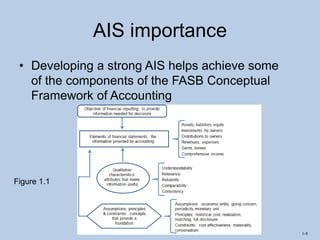
• Developing a strong AIS helps achieve some
of the components of the FASB Conceptual
Framework of Accounting
Figure 1.1
1-9
AIS importance
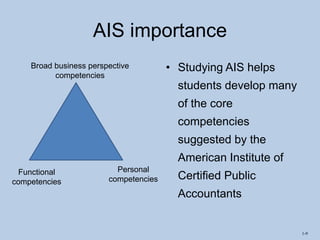
• Studying AIS helps
students develop many
of the core
competencies
suggested by the
American Institute of
Certified Public
Accountants
Broad business perspective
competencies
Functional
competencies
Personal
competencies
1-10
AIS importance
• Acquiring knowledge about AIS helps
students learn more about common
business processes
– Sales / collection process
– Acquisition / payment process
– Conversion process
– Human resource process
– Financing process
1-11
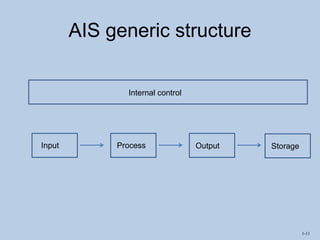
AIS generic structure
Internal control
Input Process Output Storage
1-12
AIS generic structure
• Inputs: source documents
• Processes: steps in the accounting cycle
• Outputs: general purpose financial
statements
• Storage: customer master file
• Internal controls: separation of duties
1-13
Information literacy
• Sometimes called “information competence”
• The ability to find, evaluate, use and
communicate information in all of its various
formats
1-14
Information literacy
criteria for evaluating information
– Authority: Who created it? Why?
– Accuracy: Is the source identified? Is the
information accurate?
1-15
Information literacy
criteria for evaluating information
– Objectivity: Does it include advertising? Is it
available freely?
– Currency: How old is the information?
– Coverage: Does the information have
sufficient depth?
1-16

Sppt chap001

  • 1.
    Copyright © 2016McGraw-Hill Education. All rights reserved. No reproduction or distribution without the prior written consent of McGraw-Hill Education. Accounting Information Systems: Basic Concepts and Current Issues 4th edition Robert L. Hurt
  • 2.
    Copyright © 2016McGraw-Hill Education. All rights reserved. No reproduction or distribution without the prior written consent of McGraw-Hill Education. Chapter 1 Role and Purpose of Accounting Information Systems
  • 3.
    1-3 Outline • Learning objectives •Definition of AIS • AIS importance • AIS generic structure • Information literacy
  • 4.
    1-4 Learning objectives 1. Define“accounting information systems.” 2. Discuss why AIS is an important area of study for future accountants. 3. Compare and contrast AIS with other areas of accounting. 4. Explain the structure of most AIS. 5. Locate and evaluate information sources on AIS.
  • 5.
    1-5 Definition of AIS Anaccounting information system is: – A set of interrelated activities, documents and technologies – Designed to collect data, process it and report information – To a diverse group of internal and external decision makers in organizations
  • 6.
    1-6 Definition of AIS •Activities – Business processes • Sales / collection • Acquisition / payment • Conversion • Financing • Human resource – Accounting cycle steps • Documents – Purchase orders – Remittance advices • Technologies – General ledger software – ERP systems Which steps in the accounting cycle do you recall from previous study?
  • 7.
    1-7 Definition of AIS •Data – Stacks of sales invoices – Receipts for the payment of rent • Information – General purpose financial statements – Cost variance analysis • Decision makers – Management (internal) – Shareholders (external) • Organizations – For profit (Microsoft) – Not for profit (Red Cross) – Governmental (State of California)
  • 8.
    1-8 AIS importance • Developinga strong AIS helps achieve some of the components of the FASB Conceptual Framework of Accounting Figure 1.1
  • 9.
    1-9 AIS importance • StudyingAIS helps students develop many of the core competencies suggested by the American Institute of Certified Public Accountants Broad business perspective competencies Functional competencies Personal competencies
  • 10.
    1-10 AIS importance • Acquiringknowledge about AIS helps students learn more about common business processes – Sales / collection process – Acquisition / payment process – Conversion process – Human resource process – Financing process
  • 11.
    1-11 AIS generic structure Internalcontrol Input Process Output Storage
  • 12.
    1-12 AIS generic structure •Inputs: source documents • Processes: steps in the accounting cycle • Outputs: general purpose financial statements • Storage: customer master file • Internal controls: separation of duties
  • 13.
    1-13 Information literacy • Sometimescalled “information competence” • The ability to find, evaluate, use and communicate information in all of its various formats
  • 14.
    1-14 Information literacy criteria forevaluating information – Authority: Who created it? Why? – Accuracy: Is the source identified? Is the information accurate?
  • 15.
    1-15 Information literacy criteria forevaluating information – Objectivity: Does it include advertising? Is it available freely? – Currency: How old is the information? – Coverage: Does the information have sufficient depth?
  • 16.