Copyright © 2016 McGraw-Hill Education. All rights reserved. No reproduction or distribution without the prior written consent of McGraw-Hill Education.
Chapter 16
Professionalism, Ethics, and
Career Planning
16-2
Outline
• Learning objectives
• Professionalism
• Ethics
• Cases
16-3
Learning objectives
1. List and discuss characteristics of a
professional.
2. Explain how those characteristics apply
to the accounting profession.
3. Define ethics.
4. Discuss various models/schools of ethical
decision making.
5. Explain how to resolve ethical dilemmas.
16-4
Professionalism
• Definition (www.dictionary.com)
A vocation requiring knowledge of some
department of learning or science
• Characteristics of a professional
– Bell
– McDonald
16-5
Professionalism
• Characteristics of a
professional (Bell)
– Communicates
effectively.
– Thinks rationally,
logically, and
coherently.
– Appropriately uses
technical knowledge.
– Integrates knowledge
from many disciplines.
– Exhibits ethical
professional behavior.
– Recognizes the
influence of political,
social, economic,
legal, and regulatory
forces.
– Actively seeks
additional knowledge.
16-6
Professionalism
• Characteristics of a professional
(McDonald)
– Specialized knowledge base
– Complex skills
– Autonomy of practice
– Adherence to a code of ethical behavior
16-7
Ethics • Definition of ethics
• Ethics issues in
accounting
• Schools of ethical
thought
• Ethical decision-making
model
Ethics have always been
important in the
accounting profession.
But, the profession
placed renewed
emphasis on them after
the corporate scandals
of the late 20th century.
16-8
Ethics
• Definitions (Boss, 2014)
– Ethics is a set of standards that
• Differentiates right from wrong
• Is established by a particular group
• Is imposed on members of the group to regulate
behavior
– Ethics is a discipline that
• Studies values and guidelines for living
• Considers the justification for those values
16-9
Ethics
Table 16.1
Ethics issues in accounting
Area Ethical questions
Revenue recognition
Is it ethical to boost revenue at the end of the
year by shipping unordered goods to
customers, telling them that they can send
them back after the new fiscal year starts?
Earnings smoothing
Is it ethical to use accounting policies (such
as depreciation methods) to ensure that
earnings do not fluctuate much from one
year to the next?
Asset valuation
Is it ethical to raise / lower an estimated
discount rate to change the price of an
acquired asset?
Fair value accounting
How much discretion should managers have
in determining an asset’s fair value for
accounting purposes?
16-10
Ethics
• Schools of ethical thought
– Almost no-one wakes up in the morning
thinking “I’ll behave unethically today.”
– But, people do have differing views on what
constitutes ethical behavior.
– One way to differentiate those views is
through schools of ethical thought.
16-11
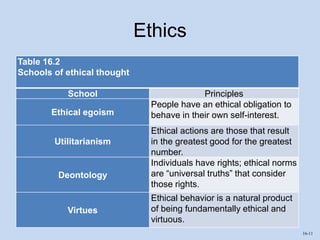
Ethics
Table 16.2
Schools of ethical thought
School Principles
Ethical egoism
People have an ethical obligation to
behave in their own self-interest.
Utilitarianism
Ethical actions are those that result
in the greatest good for the greatest
number.
Deontology
Individuals have rights; ethical norms
are “universal truths” that consider
those rights.
Virtues
Ethical behavior is a natural product
of being fundamentally ethical and
virtuous.
16-12
Ethics 1. Identify the facts.
2. Identify the ethics issues and
the stakeholders involved.
3. Define the norms, principles,
and values related to the
situation.
4. Identify the alternative
courses of action.
5. Evaluate the consequences
of each possible course of
action.
Langenderfer &
Rockness (1989)
proposed a
practical, well-
respected model for
making ethical
decisions in
accounting.
16-13
Ethics 6. Decide the best course of
action consistent with the
norms, principles, and
values.
7. If appropriate, discuss the
alternative with a trusted
person to help gain
greater perspective
regarding the alternatives.
8. Reach a decision as to
the appropriate course of
action.
Langenderfer &
Rockness (1989)
proposed a
practical, well-
respected model for
making ethical
decisions in
accounting.
16-14
Cases • Charles Ponzi
• Adelphia
Communications
Corporation
• Enron / Arthur Andersen
• Bernie Madoff
• Olympus Camera
Here are a few
cases that involved
ethics issues in
accounting contexts.
16-15
Cases
• Charles Ponzi
– Early 20th century
– International postal reply coupons
– Used new investors’ money to pay off old
investors
16-16
Cases
• Adelphia Communications Corporation
– Family-based business owned by the Rigas
brothers
– Deceptive accounting practices
– Personal loans from the company
– Comingled personal and business assets
16-17
Cases
• Enron / Arthur Andersen
– Multiple accounting & auditing related issues
• Mark-to-market accounting
• Auditor independence
• Use of special purpose entities
• Off balance sheet debt
– Primary impetus for the Sarbanes-Oxley Act of
2002 (SOX)
16-18
Cases
• Bernie Madoff
– Investment advisor with BMIS (Bernie Madoff
Investment Securities)
– Perpetrated multi-billion dollar Ponzi scheme
– Turned in by his sons
– Example of affinity fraud
– Pled guilty to 11 felonies in March 2009
– Projected release date in 2139
16-19
Cases
• Olympus Camera
– Japan-based manufacturer of cameras and
other optical devices
– Michael Woodford, from Great Britain,
appointed president in April 2011
– M & A activity called into question in the press
in July 2011
– Dismissed as president in October 2011
16-20

Sppt chap016

  • 1.
    Copyright © 2016McGraw-Hill Education. All rights reserved. No reproduction or distribution without the prior written consent of McGraw-Hill Education. Chapter 16 Professionalism, Ethics, and Career Planning
  • 2.
    16-2 Outline • Learning objectives •Professionalism • Ethics • Cases
  • 3.
    16-3 Learning objectives 1. Listand discuss characteristics of a professional. 2. Explain how those characteristics apply to the accounting profession. 3. Define ethics. 4. Discuss various models/schools of ethical decision making. 5. Explain how to resolve ethical dilemmas.
  • 4.
    16-4 Professionalism • Definition (www.dictionary.com) Avocation requiring knowledge of some department of learning or science • Characteristics of a professional – Bell – McDonald
  • 5.
    16-5 Professionalism • Characteristics ofa professional (Bell) – Communicates effectively. – Thinks rationally, logically, and coherently. – Appropriately uses technical knowledge. – Integrates knowledge from many disciplines. – Exhibits ethical professional behavior. – Recognizes the influence of political, social, economic, legal, and regulatory forces. – Actively seeks additional knowledge.
  • 6.
    16-6 Professionalism • Characteristics ofa professional (McDonald) – Specialized knowledge base – Complex skills – Autonomy of practice – Adherence to a code of ethical behavior
  • 7.
    16-7 Ethics • Definitionof ethics • Ethics issues in accounting • Schools of ethical thought • Ethical decision-making model Ethics have always been important in the accounting profession. But, the profession placed renewed emphasis on them after the corporate scandals of the late 20th century.
  • 8.
    16-8 Ethics • Definitions (Boss,2014) – Ethics is a set of standards that • Differentiates right from wrong • Is established by a particular group • Is imposed on members of the group to regulate behavior – Ethics is a discipline that • Studies values and guidelines for living • Considers the justification for those values
  • 9.
    16-9 Ethics Table 16.1 Ethics issuesin accounting Area Ethical questions Revenue recognition Is it ethical to boost revenue at the end of the year by shipping unordered goods to customers, telling them that they can send them back after the new fiscal year starts? Earnings smoothing Is it ethical to use accounting policies (such as depreciation methods) to ensure that earnings do not fluctuate much from one year to the next? Asset valuation Is it ethical to raise / lower an estimated discount rate to change the price of an acquired asset? Fair value accounting How much discretion should managers have in determining an asset’s fair value for accounting purposes?
  • 10.
    16-10 Ethics • Schools ofethical thought – Almost no-one wakes up in the morning thinking “I’ll behave unethically today.” – But, people do have differing views on what constitutes ethical behavior. – One way to differentiate those views is through schools of ethical thought.
  • 11.
    16-11 Ethics Table 16.2 Schools ofethical thought School Principles Ethical egoism People have an ethical obligation to behave in their own self-interest. Utilitarianism Ethical actions are those that result in the greatest good for the greatest number. Deontology Individuals have rights; ethical norms are “universal truths” that consider those rights. Virtues Ethical behavior is a natural product of being fundamentally ethical and virtuous.
  • 12.
    16-12 Ethics 1. Identifythe facts. 2. Identify the ethics issues and the stakeholders involved. 3. Define the norms, principles, and values related to the situation. 4. Identify the alternative courses of action. 5. Evaluate the consequences of each possible course of action. Langenderfer & Rockness (1989) proposed a practical, well- respected model for making ethical decisions in accounting.
  • 13.
    16-13 Ethics 6. Decidethe best course of action consistent with the norms, principles, and values. 7. If appropriate, discuss the alternative with a trusted person to help gain greater perspective regarding the alternatives. 8. Reach a decision as to the appropriate course of action. Langenderfer & Rockness (1989) proposed a practical, well- respected model for making ethical decisions in accounting.
  • 14.
    16-14 Cases • CharlesPonzi • Adelphia Communications Corporation • Enron / Arthur Andersen • Bernie Madoff • Olympus Camera Here are a few cases that involved ethics issues in accounting contexts.
  • 15.
    16-15 Cases • Charles Ponzi –Early 20th century – International postal reply coupons – Used new investors’ money to pay off old investors
  • 16.
    16-16 Cases • Adelphia CommunicationsCorporation – Family-based business owned by the Rigas brothers – Deceptive accounting practices – Personal loans from the company – Comingled personal and business assets
  • 17.
    16-17 Cases • Enron /Arthur Andersen – Multiple accounting & auditing related issues • Mark-to-market accounting • Auditor independence • Use of special purpose entities • Off balance sheet debt – Primary impetus for the Sarbanes-Oxley Act of 2002 (SOX)
  • 18.
    16-18 Cases • Bernie Madoff –Investment advisor with BMIS (Bernie Madoff Investment Securities) – Perpetrated multi-billion dollar Ponzi scheme – Turned in by his sons – Example of affinity fraud – Pled guilty to 11 felonies in March 2009 – Projected release date in 2139
  • 19.
    16-19 Cases • Olympus Camera –Japan-based manufacturer of cameras and other optical devices – Michael Woodford, from Great Britain, appointed president in April 2011 – M & A activity called into question in the press in July 2011 – Dismissed as president in October 2011
  • 20.