Intermediate Accounting Stice19th Edition Solutions
Manual download pdf
https://testbankmall.com/product/intermediate-accounting-stice-19th-
edition-solutions-manual/
Visit testbankmall.com today to download the complete set of
test banks or solution manuals!
2.
Here are somerecommended products for you. Click the link to
download, or explore more at testbankmall.com
Intermediate Accounting Stice 19th Edition Test Bank
https://testbankmall.com/product/intermediate-accounting-stice-19th-
edition-test-bank/
Solution Manual for Intermediate Accounting, 19th Edition,
Earl K. Stice James D. Stice
https://testbankmall.com/product/solution-manual-for-intermediate-
accounting-19th-edition-earl-k-stice-james-d-stice/
Test Bank for Intermediate Accounting, 19th Edition, Earl
K. Stice, James D. Stice
https://testbankmall.com/product/test-bank-for-intermediate-
accounting-19th-edition-earl-k-stice-james-d-stice/
Test Bank for Environment The Science Behind the Stories,
4th Edition : Withgott
https://testbankmall.com/product/test-bank-for-environment-the-
science-behind-the-stories-4th-edition-withgott/
3.
Test Bank forFundamentals of Taxation 2020 Edition, 13th
Edition, Ana Cruz, Michael Deschamps, Frederick Niswander,
Debra Prendergast, Dan Schisler
https://testbankmall.com/product/test-bank-for-fundamentals-of-
taxation-2020-edition-13th-edition-ana-cruz-michael-deschamps-
frederick-niswander-debra-prendergast-dan-schisler/
Federal Taxation 2013 Pratt 7th Edition Solutions Manual
https://testbankmall.com/product/federal-taxation-2013-pratt-7th-
edition-solutions-manual/
Solutions Manual to accompany CMOS VLSI Design 3rd edition
9780321149015
https://testbankmall.com/product/solutions-manual-to-accompany-cmos-
vlsi-design-3rd-edition-9780321149015/
Test Bank for The Economics of Money, Banking and
Financial Markets: The Business School Edition, 3/E
Frederic S. Mishkin
https://testbankmall.com/product/test-bank-for-the-economics-of-money-
banking-and-financial-markets-the-business-school-
edition-3-e-frederic-s-mishkin/
Test Bank for Police Administration Structures Processes
and Behavior 8th Edition Charles R Swanson Download
https://testbankmall.com/product/test-bank-for-police-administration-
structures-processes-and-behavior-8th-edition-charles-r-swanson-
download/
4.
Test bank forFinancial and Managerial Accounting 3rd
Edition by Weygandt
https://testbankmall.com/product/test-bank-for-financial-and-
managerial-accounting-3rd-edition-by-weygandt/
5.
2-2 Chapter 2A Review of the Accounting Cycle
2-16
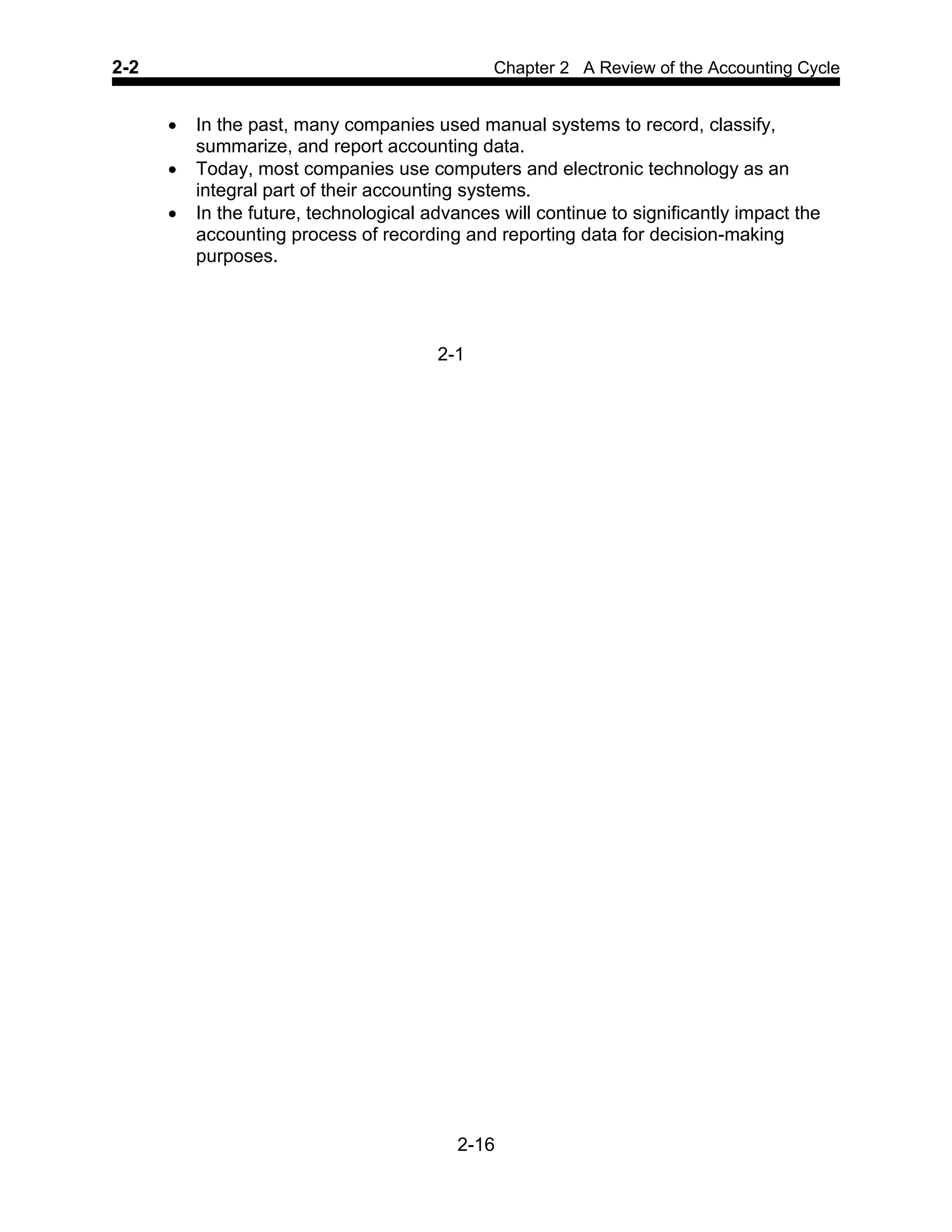
• In the past, many companies used manual systems to record, classify,
summarize, and report accounting data.
• Today, most companies use computers and electronic technology as an
integral part of their accounting systems.
• In the future, technological advances will continue to significantly impact the
accounting process of recording and reporting data for decision-making
purposes.
2-1
6.
Instructor’s Resource Guide
2-1
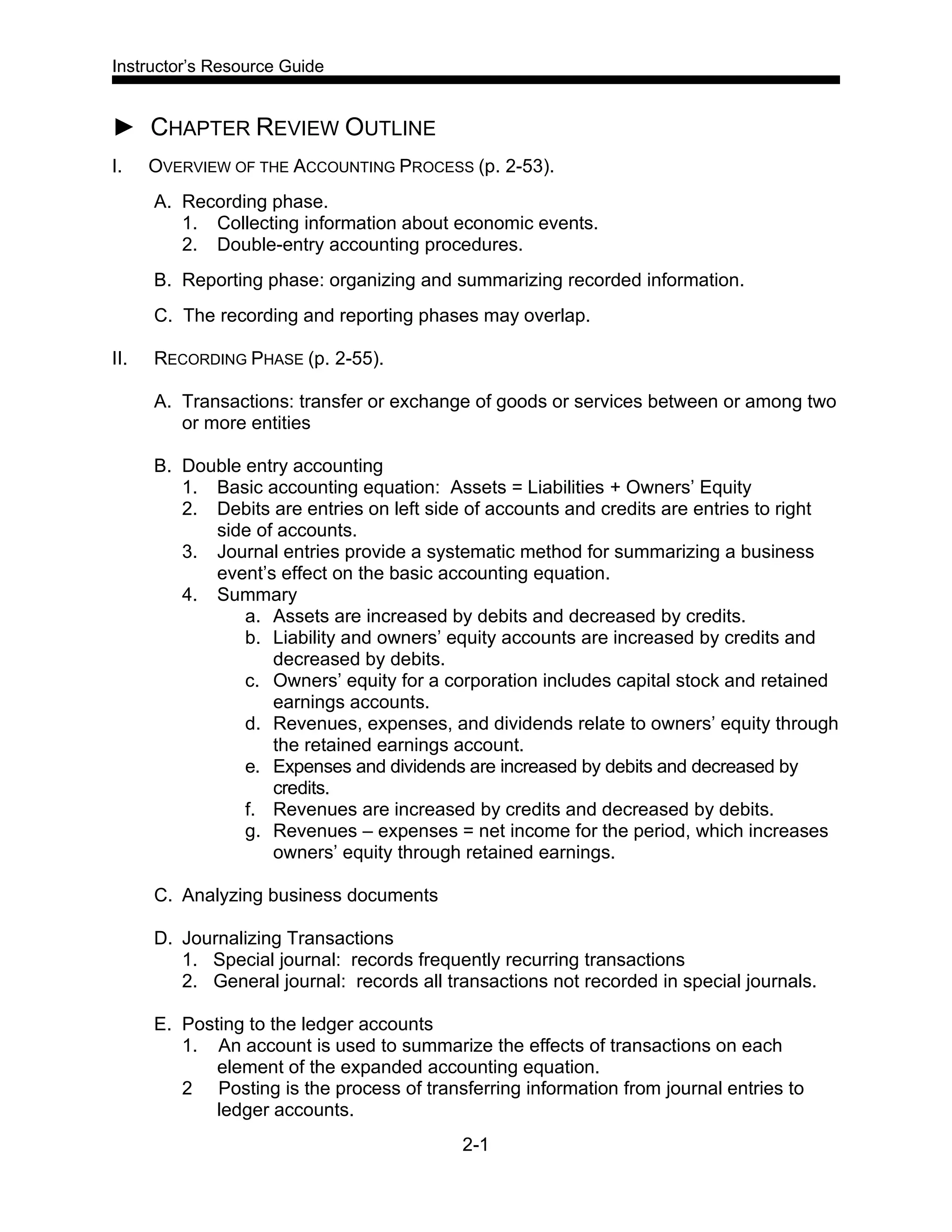
►CHAPTER REVIEW OUTLINE
I. OVERVIEW OF THE ACCOUNTING PROCESS (p. 2-53).
A. Recording phase.
1. Collecting information about economic events.
2. Double-entry accounting procedures.
B. Reporting phase: organizing and summarizing recorded information.
C. The recording and reporting phases may overlap.
II. RECORDING PHASE (p. 2-55).
A. Transactions: transfer or exchange of goods or services between or among two
or more entities
B. Double entry accounting
1. Basic accounting equation: Assets = Liabilities + Owners’ Equity
2. Debits are entries on left side of accounts and credits are entries to right
side of accounts.
3. Journal entries provide a systematic method for summarizing a business
event’s effect on the basic accounting equation.
4. Summary
a. Assets are increased by debits and decreased by credits.
b. Liability and owners’ equity accounts are increased by credits and
decreased by debits.
c. Owners’ equity for a corporation includes capital stock and retained
earnings accounts.
d. Revenues, expenses, and dividends relate to owners’ equity through
the retained earnings account.
e. Expenses and dividends are increased by debits and decreased by
credits.
f. Revenues are increased by credits and decreased by debits.
g. Revenues – expenses = net income for the period, which increases
owners’ equity through retained earnings.
C. Analyzing business documents
D. Journalizing Transactions
1. Special journal: records frequently recurring transactions
2. General journal: records all transactions not recorded in special journals.
E. Posting to the ledger accounts
1. An account is used to summarize the effects of transactions on each
element of the expanded accounting equation.
2 Posting is the process of transferring information from journal entries to
ledger accounts.
7.
Chapter 2 AReview of the Accounting Cycle
2-2
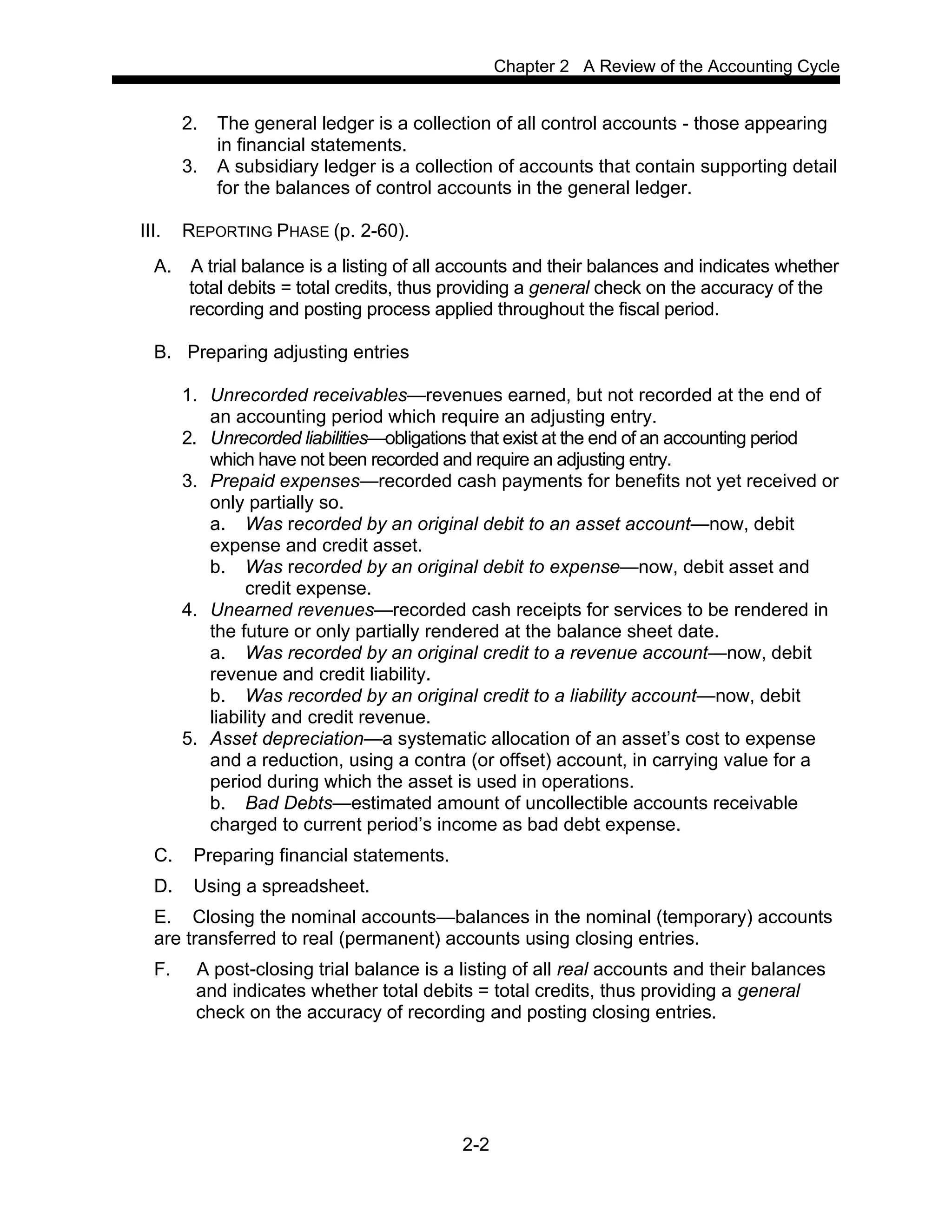
2. The general ledger is a collection of all control accounts - those appearing
in financial statements.
3. A subsidiary ledger is a collection of accounts that contain supporting detail
for the balances of control accounts in the general ledger.
III. REPORTING PHASE (p. 2-60).
A. A trial balance is a listing of all accounts and their balances and indicates whether
total debits = total credits, thus providing a general check on the accuracy of the
recording and posting process applied throughout the fiscal period.
B. Preparing adjusting entries
1. Unrecorded receivables—revenues earned, but not recorded at the end of
an accounting period which require an adjusting entry.
2. Unrecorded liabilities—obligations that exist at the end of an accounting period
which have not been recorded and require an adjusting entry.
3. Prepaid expenses—recorded cash payments for benefits not yet received or
only partially so.
a. Was recorded by an original debit to an asset account—now, debit
expense and credit asset.
b. Was recorded by an original debit to expense—now, debit asset and
credit expense.
4. Unearned revenues—recorded cash receipts for services to be rendered in
the future or only partially rendered at the balance sheet date.
a. Was recorded by an original credit to a revenue account—now, debit
revenue and credit liability.
b. Was recorded by an original credit to a liability account—now, debit
liability and credit revenue.
5. Asset depreciation—a systematic allocation of an asset’s cost to expense
and a reduction, using a contra (or offset) account, in carrying value for a
period during which the asset is used in operations.
b. Bad Debts—estimated amount of uncollectible accounts receivable
charged to current period’s income as bad debt expense.
C. Preparing financial statements.
D. Using a spreadsheet.
E. Closing the nominal accounts—balances in the nominal (temporary) accounts
are transferred to real (permanent) accounts using closing entries.
F. A post-closing trial balance is a listing of all real accounts and their balances
and indicates whether total debits = total credits, thus providing a general
check on the accuracy of recording and posting closing entries.
8.
Instructor’s Resource Guide
2-3
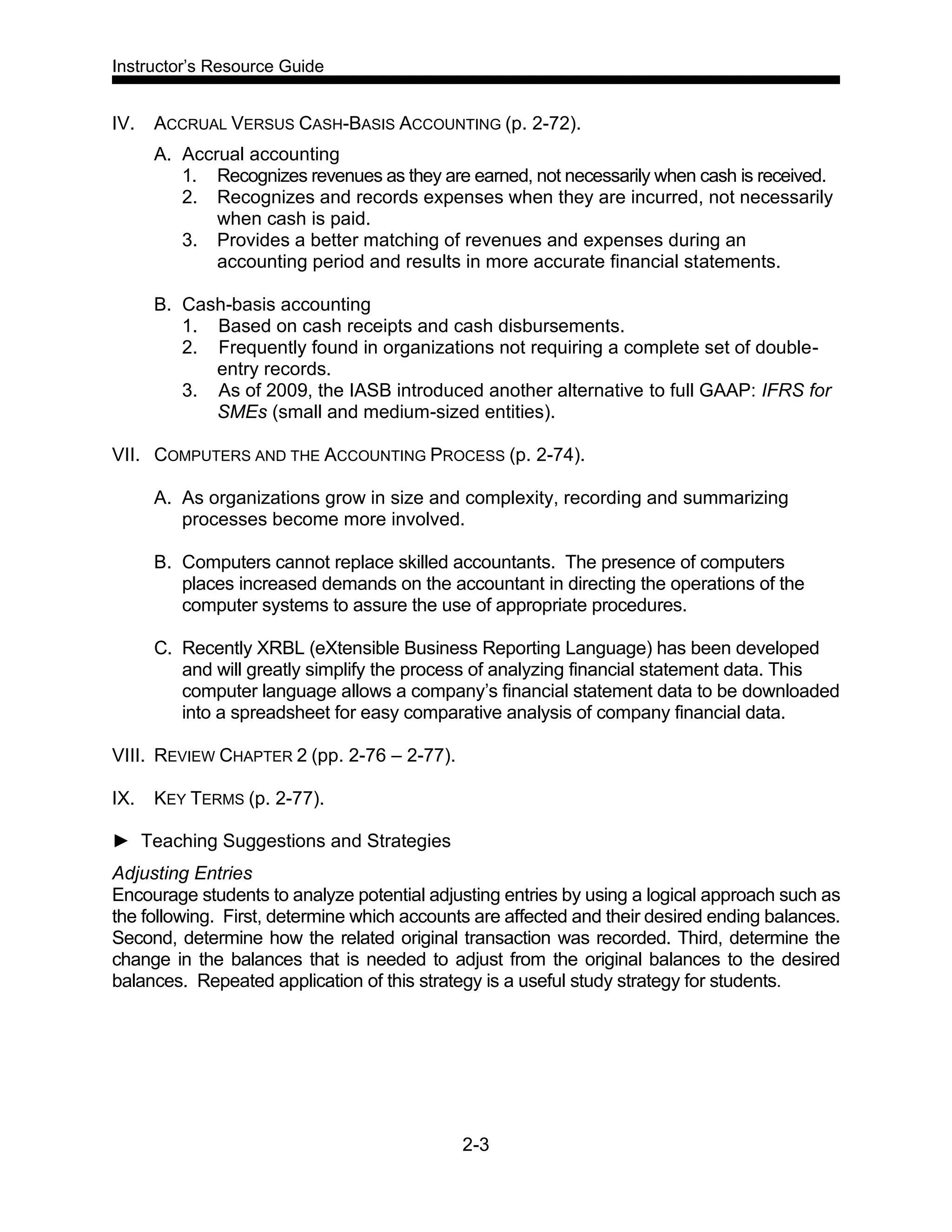
IV.ACCRUAL VERSUS CASH-BASIS ACCOUNTING (p. 2-72).
A. Accrual accounting
1. Recognizes revenues as they are earned, not necessarily when cash is received.
2. Recognizes and records expenses when they are incurred, not necessarily
when cash is paid.
3. Provides a better matching of revenues and expenses during an
accounting period and results in more accurate financial statements.
B. Cash-basis accounting
1. Based on cash receipts and cash disbursements.
2. Frequently found in organizations not requiring a complete set of double-
entry records.
3. As of 2009, the IASB introduced another alternative to full GAAP: IFRS for
SMEs (small and medium-sized entities).
VII. COMPUTERS AND THE ACCOUNTING PROCESS (p. 2-74).
A. As organizations grow in size and complexity, recording and summarizing
processes become more involved.
B. Computers cannot replace skilled accountants. The presence of computers
places increased demands on the accountant in directing the operations of the
computer systems to assure the use of appropriate procedures.
C. Recently XRBL (eXtensible Business Reporting Language) has been developed
and will greatly simplify the process of analyzing financial statement data. This
computer language allows a company’s financial statement data to be downloaded
into a spreadsheet for easy comparative analysis of company financial data.
VIII. REVIEW CHAPTER 2 (pp. 2-76 – 2-77).
IX. KEY TERMS (p. 2-77).
► Teaching Suggestions and Strategies
Adjusting Entries
Encourage students to analyze potential adjusting entries by using a logical approach such as
the following. First, determine which accounts are affected and their desired ending balances.
Second, determine how the related original transaction was recorded. Third, determine the
change in the balances that is needed to adjust from the original balances to the desired
balances. Repeated application of this strategy is a useful study strategy for students.
9.
Chapter 2 AReview of the Accounting Cycle
2-4
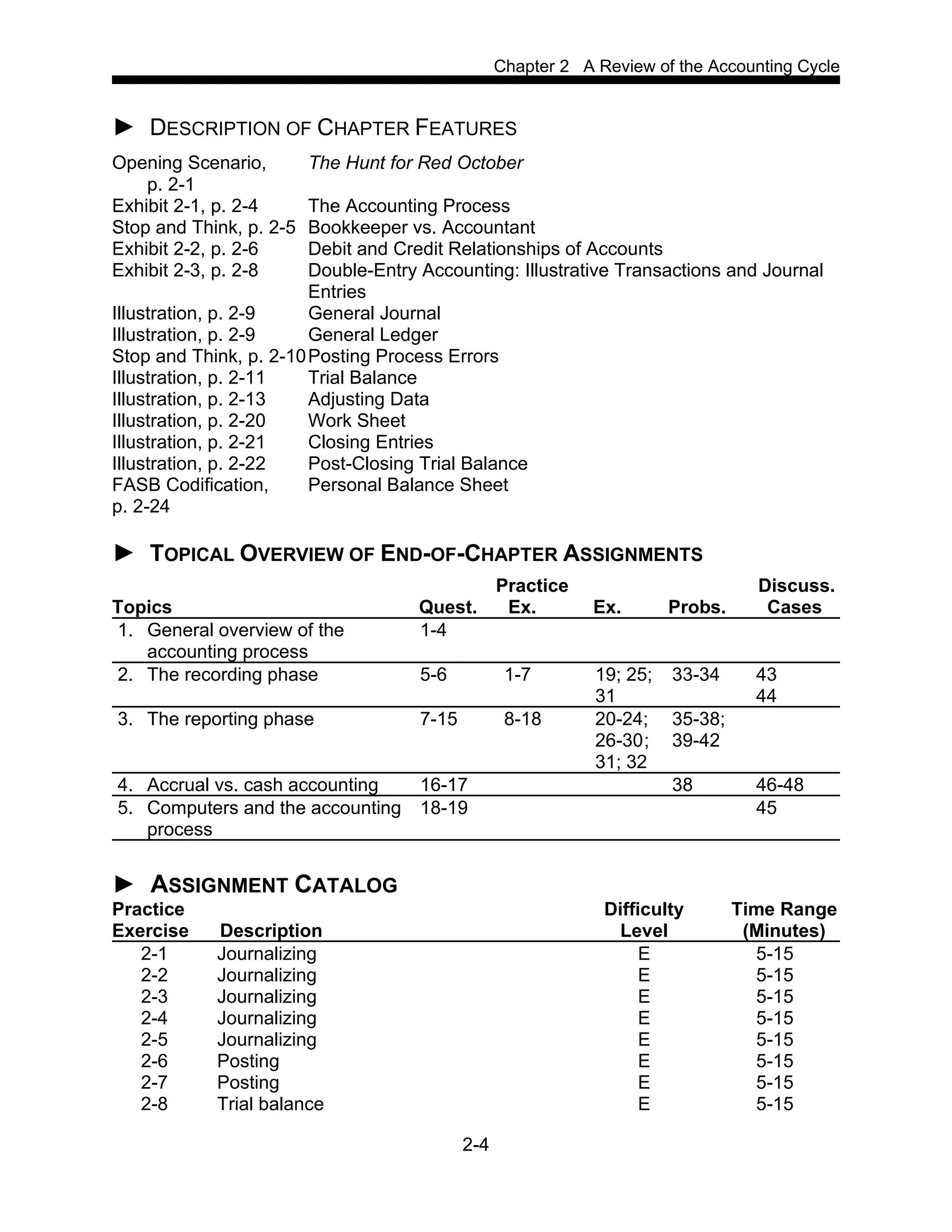
► DESCRIPTION OF CHAPTER FEATURES
Opening Scenario, The Hunt for Red October
p. 2-1
Exhibit 2-1, p. 2-4 The Accounting Process
Stop and Think, p. 2-5 Bookkeeper vs. Accountant
Exhibit 2-2, p. 2-6 Debit and Credit Relationships of Accounts
Exhibit 2-3, p. 2-8 Double-Entry Accounting: Illustrative Transactions and Journal
Entries
Illustration, p. 2-9 General Journal
Illustration, p. 2-9 General Ledger
Stop and Think, p. 2-10Posting Process Errors
Illustration, p. 2-11 Trial Balance
Illustration, p. 2-13 Adjusting Data
Illustration, p. 2-20 Work Sheet
Illustration, p. 2-21 Closing Entries
Illustration, p. 2-22 Post-Closing Trial Balance
FASB Codification, Personal Balance Sheet
p. 2-24
► TOPICAL OVERVIEW OF END-OF-CHAPTER ASSIGNMENTS
Practice Discuss.
Topics Quest. Ex. Ex. Probs. Cases
1. General overview of the 1-4
accounting process
2. The recording phase 5-6 1-7 19; 25; 33-34 43
31 44
3. The reporting phase 7-15 8-18 20-24; 35-38;
26-30; 39-42
31; 32
4. Accrual vs. cash accounting 16-17 38 46-48
5. Computers and the accounting 18-19 45
process
► ASSIGNMENT CATALOG
Practice Difficulty Time Range
Exercise Description Level (Minutes)
2-1 Journalizing E 5-15
2-2 Journalizing E 5-15
2-3 Journalizing E 5-15
2-4 Journalizing E 5-15
2-5 Journalizing E 5-15
2-6 Posting E 5-15
2-7 Posting E 5-15
2-8 Trial balance E 5-15
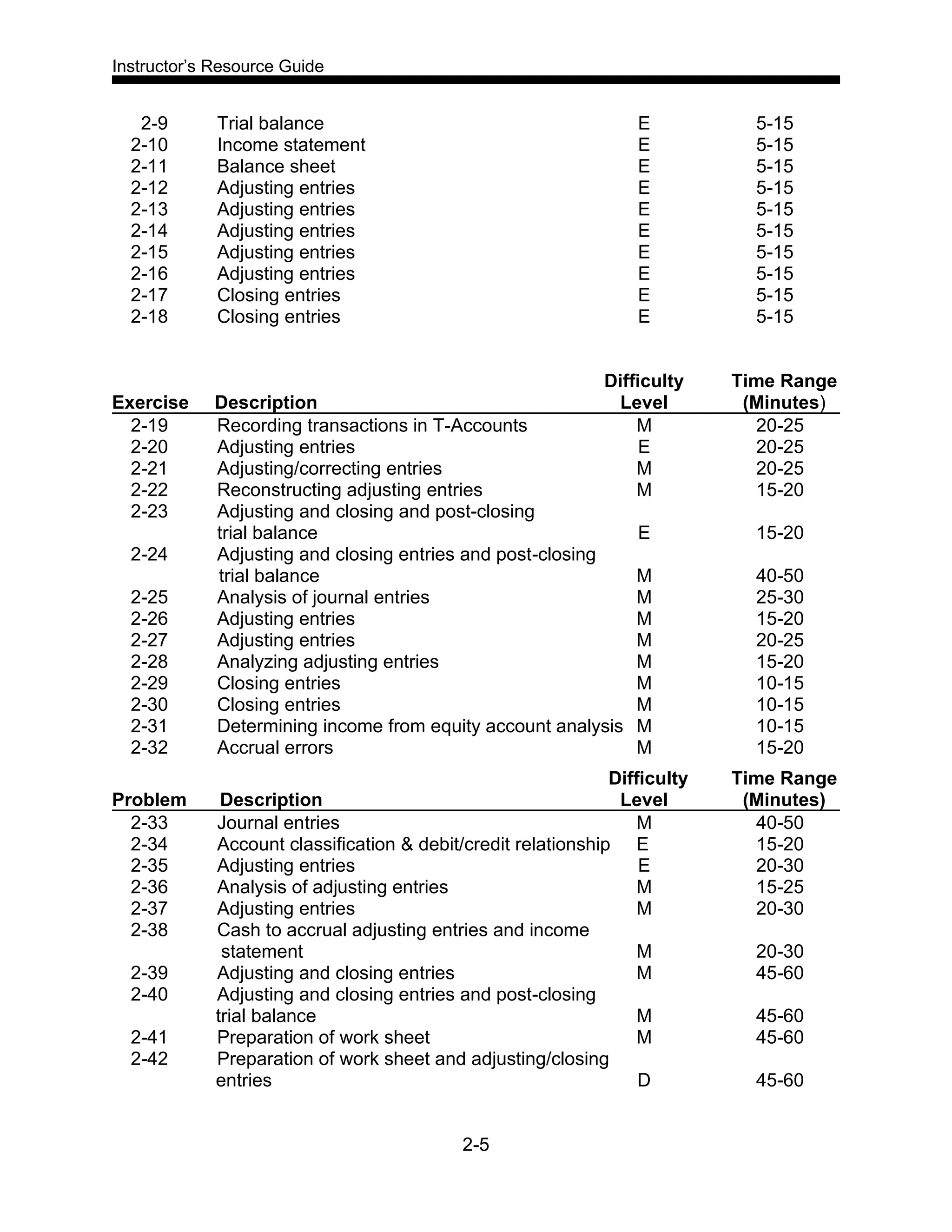
10.
Instructor’s Resource Guide
2-5
2-9Trial balance E 5-15
2-10 Income statement E 5-15
2-11 Balance sheet E 5-15
2-12 Adjusting entries E 5-15
2-13 Adjusting entries E 5-15
2-14 Adjusting entries E 5-15
2-15 Adjusting entries E 5-15
2-16 Adjusting entries E 5-15
2-17 Closing entries E 5-15
2-18 Closing entries E 5-15
Difficulty Time Range
Exercise Description Level (Minutes)
2-19 Recording transactions in T-Accounts M 20-25
2-20 Adjusting entries E 20-25
2-21 Adjusting/correcting entries M 20-25
2-22 Reconstructing adjusting entries M 15-20
2-23 Adjusting and closing and post-closing
trial balance E 15-20
2-24 Adjusting and closing entries and post-closing
trial balance M 40-50
2-25 Analysis of journal entries M 25-30
2-26 Adjusting entries M 15-20
2-27 Adjusting entries M 20-25
2-28 Analyzing adjusting entries M 15-20
2-29 Closing entries M 10-15
2-30 Closing entries M 10-15
2-31 Determining income from equity account analysis M 10-15
2-32 Accrual errors M 15-20
Difficulty Time Range
Problem Description Level (Minutes)
2-33 Journal entries M 40-50
2-34 Account classification & debit/credit relationship E 15-20
2-35 Adjusting entries E 20-30
2-36 Analysis of adjusting entries M 15-25
2-37 Adjusting entries M 20-30
2-38 Cash to accrual adjusting entries and income
statement M 20-30
2-39 Adjusting and closing entries M 45-60
2-40 Adjusting and closing entries and post-closing
trial balance M 45-60
2-41 Preparation of work sheet M 45-60
2-42 Preparation of work sheet and adjusting/closing
entries D 45-60
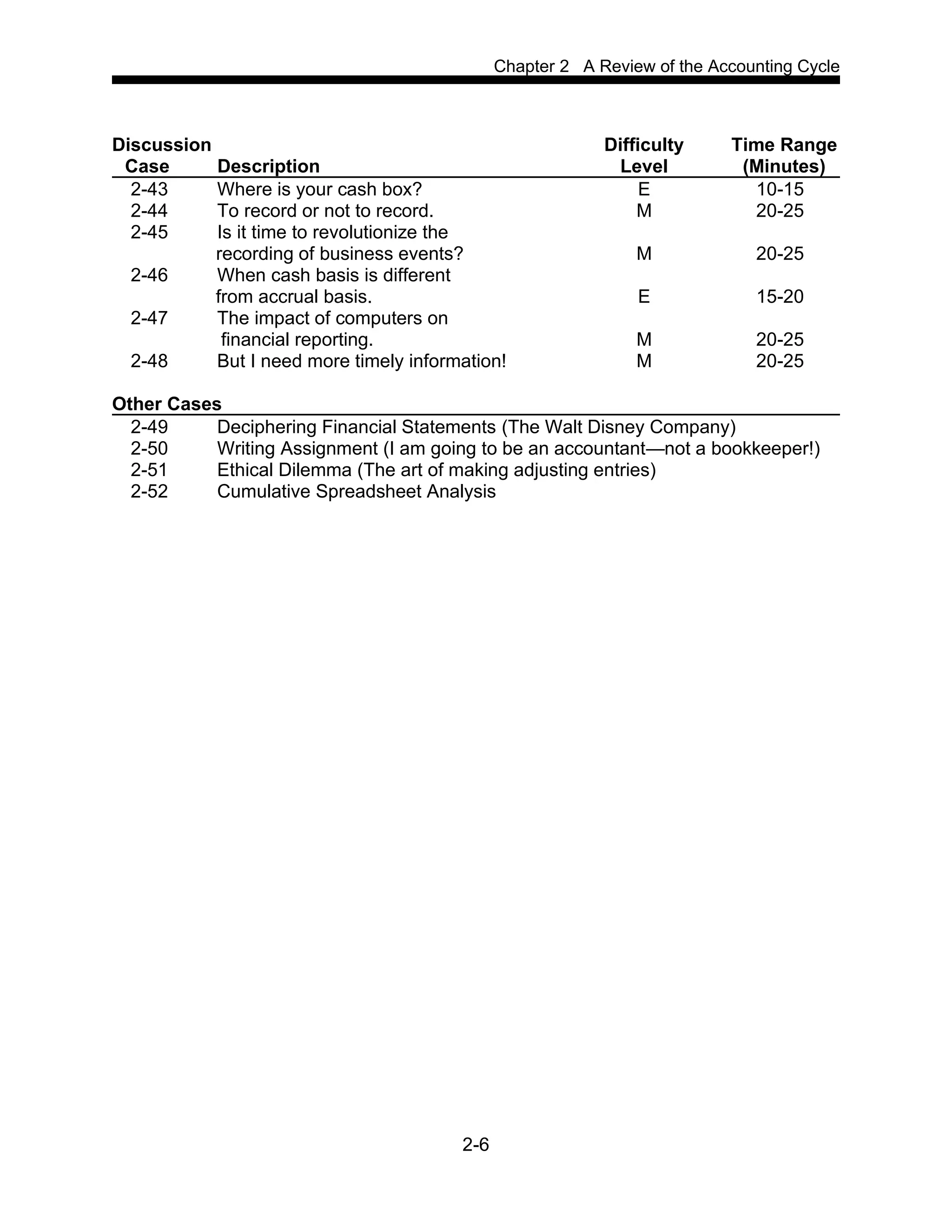
11.
Chapter 2 AReview of the Accounting Cycle
2-6
Discussion Difficulty Time Range
Case Description Level (Minutes)
2-43 Where is your cash box? E 10-15
2-44 To record or not to record. M 20-25
2-45 Is it time to revolutionize the
recording of business events? M 20-25
2-46 When cash basis is different
from accrual basis. E 15-20
2-47 The impact of computers on
financial reporting. M 20-25
2-48 But I need more timely information! M 20-25
Other Cases
2-49 Deciphering Financial Statements (The Walt Disney Company)
2-50 Writing Assignment (I am going to be an accountant—not a bookkeeper!)
2-51 Ethical Dilemma (The art of making adjusting entries)
2-52 Cumulative Spreadsheet Analysis
concerning swimming, whichcan neither do children harme in
learning, if the maister be wise, nor the common weale but good,
being once learned, if either priuate daunger or publike attempt do
bid them auenture. For he that oweth a life to his countrey, if he die
on lande, he doeth his duetie, and if he drowne in water, his duetie
is not drowned.
15.
I
CHAPTER 24.
Of riding.
fany wilbe so wilful as to denie Riding to be an exercise and that
a great one, and fittest also for greatest personages, set him
either vpon a trotting iade to iounce him thoroughly or vpon a
lame hakney to make him exercise his feete, when his courser failes
him. In all times, in all countries, among all degrees of people, it
hath euer bene taken, for a great, a worthy, and a gentlemanly
exercise. Though Aristophanes his testimonie, were naught against
honest Socrates, yet it is good to proue, that riding was a
gentlemanly traine, euen among the principles of education in
Athens. And Virgile in the legacie sent to Latinus, describeth the
same traine in the Romain children, which, sayeth he, exercised
themselues on horsebacke before the towne. And Horace accuseth
the young gentleman in his time as not able to hange on a horse.
But to deale with stories, either Greeke, or Latin, for the Romain or
other nations exercise in riding in a matter of such store, were more
then needeles. The Romains had their whole citie diuided into
partialities, by reason of the foure factions of those exercising
horsemen. Who of the foure colours, which they vsed, Russet,
White, Greene, and Blew, were named Russati, Albati, Prasini,
Veneti.40 For the warres how great a traine riding is, I would no
countrey had tried, nor had cause to complaine, nor the subdued
people to be sorofull, though the conquerour do vant himselfe, of his
valiantnesse on horsebacke. For health it must needes be of some
great moment, or els why do the Physicians seeme to make so much
of it? They saye that generally it encreaseth naturall heat, and that it
purgeth superfluities, as that to the contrarie it is naught for any
sicke bodie, or that hath taken Physicke hard before, or that is
troubled with infection or inflammation of the kidneies. They vse to
16.
deuide it intofiue kindes, Slow, quicke, trotting, ambling, and
posting.
1. Of Slow riding they write that it wearieth the grines very sore,
that it hurteth the buttokes, and legges, by hanging downe to long,
and yet it heateth not much: that it hindreth getting of children, and
breadeth aches and lamenesse.
2. Of quicke riding they saye, that of all exercises it shaketh the
bodie most, and that yet it is good for the head ache, comming of a
cold cause: for the falling euill, for deafnesse, for the stomack, for
yeaxing or hikup, for clearing and quickning the instrumentes of
sense: for dropsies: for thickning of thinne shankes: which was
found true in Germanicus Cæsar41 nephew to Tiberius the Emperour,
which so helped his spindle shankes. Againe quick riding is naught
for the bulke: for a weake bladder, which must forebeare all
exercises, when it hath any exulceration: for the Ischiatica, bycause
the hippes are to much heated and weakned, by the vehementnesse
of the motion. Whervpon the humours, which are styrred rest there:
and either breede new or augment olde aches.
Of trotting, it is said euen as we see, that it shaketh the bodie to
violently, that it causeth and encreaseth marueilous aches, that it
offendes the head, the necke, the shoulders, the hippes, and
disquieteth all the entrailes beyond all measure. And though it may
somewhat helpe the digestion of meate, and raw humours, loose the
belly, prouoke vrine, driue the stone or grauell from the kidneyes
downward, yet it is better forborne for greater euilles, then borne
with for some sorie small good.
Ambling as it exerciseth least, so it anoyeth least, and yet looseth
it the bellie.
As for posting, though it come last in reading, it will be first in
riding, though for making such hast, it harme eche part of the bodie,
and specially the bulke, the lungues, the bowells generally, the
kidneyes: as what doth it not allway anoy, and oftimes either breake
17.
or put outof ioynte by falles or straynes? It warmes and paires the
body to sore, and therfore abateth grossenes, though a grosse man
be ill either to ride post himselfe, or for a iade to beare. It infecteth
the head, it dulleth the senses, and especially the sight: euen til it
make his eyes that posteth to run with water, not to remember the
death of his friendes, but to thinke how sore his saddle shakes him,
and the ayer bites him.
19.
H
CHAPTER 25.
Of hunting.
vntingis a copious argument, for a poeticall humour to discours
of, whether in verse, with Homer, or in prose, with Heliodorus.
Dian would be alleged, as so auoyding Cupide. Hippolytus,
would be vsed in commendation of continence, and what would not
poetrie bring in to auaunce it, whose musicke being solitarie and
woddishe, must needes be, nay is very well acquainted with the
chace. If poets should faint, the Persians would fight, both for riding
and hunting: so that if patrocinie were in question, we neede not to
enquire, they would offer them selues, from all countries, and of all
languages. But we need not either for praise, or for prose, to vse
forraine aduocats. For hunting hath alway caried a great credit, both
for exercising the bodie, and deliting the mynde, as it semes to be
verie naturall, because it seeketh to maister, and to take beastes,
and byrdes, which are naturally appointed for mans vse, and
therefore though they be taken and killed, there is no wrong done
them. The courteous Xenophon42 as delited himselfe therein, and all
the auncient writers, as subscribing to a truth, commend it
marueilously, and chiefly, for a proper elementarie to warlike vses,
and Mars his schoole, whether for valiauntnes or for pollicy, because
the resemblaunces of the chiefe warlike executions do fall out in
hunting, as the qualitie or courage of the game offereth cause,
either to vse force and manhoode, or to flie to deuise and sutteltie.
The Romain Emperours did exhibit publike hunting vnto the whole
people in way of pastime and pleasure. The Physicians make much
of it: as being an exercise, which containeth vnder it most of the
other stirring exercises, for they that hunt, walke, runne, leape,
shout, hallow, ride, and what may they not do, hauing the whole
country for roome, and the whole day for time, to do in what they
20.
list? And thoughGalene43 do restraine it to men of great abilitie, as
if hunting were not for euery man to vse, which is one of the
markes, whereby to know the best exercises, that they be parable,
and purchaceable euen to meane purses: yet we see it in common
to most, where restraint by law doth not forbid it. Neither is the
charge in respect of the exercise, but in respect of the game,
whereon the exercise is employed. To hunt a hare, and course a
hart, to chase a bucke, and chase a bore is not all one, neither for
prouision, nor for perill though the exercise haue small oddes, which
being compounded of those exercises that I named, must nedes
haue the same effectes, that those exercises haue besides his owne.
To warme the bodie very well, to disperse superfluites, to abate
flesh, to lessen ouerflowing moysture, to make one sleepe soundly,
to digest meat, and raw humors, to quicken both the sight and the
hearing, to keepe of old age, and finally to make the body most
healthfull, and the health most lasting.
Rases44 a notable Arabicke Physician, writeth that in a great
plague there remained almost none aliue in a certaine towne, saue
hunters only, which escaped by reason of their preseruing exercise.
And Mitbridates that famous king vsed hunting so much for his
healthes sake, as in seuen yeares space, it is written that he neuer
came within house, neither in citie nor countrie. And yet hunting is
not good for the head, when it is vsed with vehemence, as no other
vehement exercise is.
There be but two kindes of Hunting to my purpose, the one on
horsebacke, the other one foote.
1. They that Hunt on horsebake, for so much as they sometime
gallop, sometime ride fast, sometime hallow, sometime be stil, and
varie so in most actions, seeme to trauel euery part of their body,
and therefore it is thought, that thereby the brest, the stomacke, the
entrailes, the backe and legges be strengthened: but it is ill for
them, which are troubled with any paine in their head, and
daungerous for feare of breaking some veine in the breast: for the
21.
stone in thekidneyes, for those that be of hoate constitution of
body: for weake bellicawles, and for feare of ruptures, because such
thinges fall out oftentimes in hunting on horsebacke: not without
losse sometime of life.
2. Hunting on foote, hath all the commodities, and incommodities
to, that hunting on horsebacke hath, sauing the daunger whereunto
it is not so much subiecte. And yet the trauell of the bodie is more,
the body hoater, the legges and feete more strengthened, the
appetite to meat more, to make children lesse. Neither of then is
good but for strong and healthful bodies, neither can hunting be but
harmefull vnto them, which vse it vnaduisedly, without consideration
how they runne, by way of pleasure and ordinarie exercise, or at the
suddaine of a head, for by tarying abroade all day, and feeding so
vncertainely, and so vnseasonably, there come sundrie
inconueniences.
But of all Hunting that is still best, wherein we exercise our selues
and our owne bodies most, not our hauks of howndes, because
exercises be meanes to make men healthfull, and other thinges be
meanes to bring that meane about. Such a kinde of hunting was it
which Chiron, Machaan, Podalyrius, Æsculapius, the parentes and
patrones of physike did vse, whose delite thererin, is our warrant in
choyce, bycause they being so great physicians, as physicke went
then in Platoes opinion, did trie that in their owne persons, which
they deliuered to posteritie for the same vse.
23.
T
CHAPTER 26.
Of shooting.
hephysicians seeme to commend shooting for the vse of health
sufficiently, in that they make Apollo and Æsculapius the
presidentes and protectors of Archerie, which both be the
greatest gods, and chiefest patrones of ther owne profession. And
that it is a thing to be beloued, and liked, what argument is there
that can be alleadged of comparable force to that of Cupide
himselfe, which in the matter of loue, doth bend with his bow, and
enamour with his arrow? But in sadnes to say enough of this
exercise in few wordes, which no wordes can praise enough for the
commodities which it bringeth to the health of the body: as it hath
bene vsed by diuers nations, in diuerse sortes, both on horsebacke
and on foote, both for peace and warre, for healthfull exercise and
pleasant pastime: so none either now doth vse it, or heretofore hath
vsed it, more to health, and bettering of the body then our owne
countrimen do. As if it were a thing somewhat naturall to Ilandes,
bycause they of Crete and Cyprus in olde stories, they of the Indian
Ilandes in new stories are noted also for neare Shooting, strong
Darting, and streight Slinging, whereof the Balear Ilandes seeme to
take their name. Nay by all auncient monumentes Shooting should
seeme to be both the eldest, and the vsuallest defence in fighting a
farre of, which though it haue now, and tofore, haue had great place
in the fielde for warfare: yet hath it a great deale better place in our
fields for wellfare: and therefore the more, because it consisteth
both of the best exercises, and the best effectes of the best
exercises. For he that shooteth in the free and open fields may
chuse, whether betweene his markes he will runne or walke, daunce
or leape, hallow or sing or do somewhat els, which belongeth to the
other, either vehement or gentle exercises. And whereas hunting on
foote is so much praised, what mouing of the body hath the foote
24.
hunter in hillesand dales, which the rouing Archer hath not in
varietie of growndes? Is his naturall heate more stirred then the
Archers is? Is his appetite better then the Archers is though the
prouerbe helpe the hungrie hunter? Nay in both these the Archer
hath the vantage. For both his howers be much better to eate, and
all his mouing is more at his choice: because the hunter must follow
his game of necessitie, the Archer neede not but at his owne
leasure. For his pastime will tarystil, till he come to it, the hunters
game is glad to get from him. In fine what good is there in any
particular exercise, either to helpe natural heat, or to cleare the
body, or to prouoke appetite, or to fine the senses, or to strengthen
the sinewes, or to better all partes, which is not altogither in this one
exercise? Onely regard to vse it in a meane doth warrant the archer
from daunger to himselfe: and an eye to looke about, doth defende
the passager from perill by him. I could here speake much, if it were
not to much, to say euen so much in such a thing, being so faire a
pastime, so pleasant to al people, so profitable to most, so familiar
to our country, so euery where in eye, so knowne a defence, such a
meane to offende, as there is no man but knoweth it to be a
preseruatiue to health, and therefore well to be numbred among the
trayning exercises. And chiefly as it is vsed in this Iland, wherein the
rouing must nedes be the best and most healthful, both for varieties
of motion in diuersities of soile, and by vsing all archery, in
exercising one kinde. For in rouing, you may vse either the butte, or
the pricke by the way for your marke, as your pleasure shalbe. This
exercise do I like best generally of any rownde stirring without the
dores, vpon the causes before alleadged, which if I did not, that
worthy man our late and learned countrieman maister Askam would
be halfe angrie with me, though he were of a milde disposition, who
both for trayning the Archer to his bow, and the scholler to his
booke, hath shewed him selfe a cunning Archer, and a skilfull
maister.
In the middest of so many earnest matters, I may be allowed to
entermingle one, which hath a relice of mirth, for in praysing of
Archerie, as a principall exercise, to the preseruing of health, how
25.
can I butprayse them, who professe it throughly, and maintaine it
nobly, the friendly and franke fellowship of prince Arthurs knightes in
and about the citie of London, which of late yeares haue so reuiued
the exercise, so countenaunced the artificers, so enflamed
emulation, as in themselues for friendly meting, in workemen for
good gayning, in companies for earnest comparing, it is almost
growne to an orderly discipline, to cherishe louing society, to enrich
labouring pouertie, to maintaine honest actiuity, which their so
encouraging the vnder trauellours, and so encreasing the healthfull
traine, if I had sacred to silence, would not my good friend in the
citie maister Hewgh Offly, and the same my noble fellow in that
order Syr Launcelot, at our next meeting, haue giuen me a sowre
nodde, being the chiefe furtherer of the fact, which I commend, and
the famosest knight, of the fellowship, which I am of? Nay would not
euen prince Arthur himselfe maister Thomas Smith, and the whole
table, of those wel known knights, and most actiue Archers haue
layd in their chaleng against their fellow knight, if speaking of their
pastime, I should haue spared their names? whereunto I am easily
led, bycause the exercise deseruing such praise, they that loue so
praiseworthie a thing neither can of them selues, neither ought at
my hand to be hudled vp in silence.
27.
T
CHAPTER 27.
Of theball.
he play at the Ball seemeth compound, bycause it may be vsed,
both within dores, and without. Wherof good writers haue
deliuered vs thus much: that in the olde time there were diuers
kindes of balles and diuers kindes of exercise therwith, according to
the diuers vse of the ball either small or great: both amongst the
Romaines and Greekes, whose names I vse so much, bycause they
were best acquainted both with the thinges, and with the right vse
therof. Galene in his first booke of maintaining health, speaking of
the Germains, who vsed then to dippe their new borne children into
extreme cold water ouer head and eares, to trie their courage and to
harden their skinne, sayeth that he wrate those lessons of health
and exercise, no more to the Dutch and such rude people as we also
were then, then to beares, boares and lyons: but to Greekes and
such people, as though barbarous in nature, yet by traine and
learning, were become greekish as we now are, and the Romains
then were. So that our examples be fetcht from these two nations,
which either vsed the thinges most, and handled them best: or else
enriched their owne tongues with all that was best, and when they
had so done set them ouer vnto vs. But of all their exercises with the
Ball, we haue not any so farre as I can gesse, by their notes, though
we retaine the name: and yet our playing with the Ball worketh the
same effectes, which theirs did, as it appeareth by their descriptions.
Wherfore seeing they be so farre different from ours, and almost
worne out of knowledge euen to curious coniectures, which seeke to
sift them out, I will neither trouble my selfe with studying to set
downe their names: nor my reader with reading to gesse what they
were, and how they were vsed.
28.
Three kindes shallcontent me, which our time knoweth, wherein
all the properties of their balles, and all the effectes of their
exercises, be most euidently seene. The hand ball, the footeball, the
armeball.
1. The litle hand ball whether it be of some softer stuffe, and vsed
by the hand alone, or of some harder, and vsed with the rackette,
whether by tennice play with an other, or against a wall alone, to
exercise the bodie with both the handes, in euerie kinde of motion,
that concerneth any, or all the other exercises, is generally noted, to
be one of the best exercises and the greatest preseruations of
health. In so much as Galene bestoweth an whole treatise vpon the
vse and praise of it, wherein he compareth it with other exercises,
and preferreth it before all, for parabilitie, to be all mens game: for
profitablenesse, to do all men good: for pleasauntnesse, to quicke all
mens spirites, and in short knits vp the some of his conclusion thus.
That the vse of the litle ball doth plant in the minde courage, in the
bodie health, in all the limmes a trim and wel proportionate
constitution: so it be moderately and aduisedly executed. Playing at
the ball in generall is a strong exercise, and maketh the bodie very
nimble, and strengtheneth all the vitall actions. The litle handball is
counted to be a swift exercise, without violence, and therefore the
rakketters in tennyse play, if they vse it in that kinde, which is
thought to be most healthfull, must shew them selues nymble
without strayning, and yet it falleth out most conmonly contrarie,
while desire to wynne some wager makes the winners loose a
benefit, which they wish for more, and would gladly get to better
their health by. This playing abateth grossenes and corpulence, as al
other of the same sort do: it maketh the flesh sownd and soft, it is
very good for the armes, the greene and growing ribbes, the back,
and by reason the legges are mightely stirred ther by, it is a great
furtherer to strength, it quickneth the eyes by looking now hither,
now thither, now vp, now downe, it helpeth the ridgebone, by
stowping, bending and coursing about: it is verie good for bellies
and stomakes, that be troubled with winde or any paine which
proceedeth from colde. Now to the contrary it is not good for ill and
29.
bleare eyes rawstomakes, vndigested meat, which haue more
neede of rest then stirring, and for such as will soone be turnesicke,
which the oft turning about of the head and eyes cannot but cause.
The playing at tennyse is more coastly and strayning to aunswere an
aduersary, but the playing against the wall is as healthfull, and the
more ready, bycause it needeth no aduersary, and yet practiseth
euery kinde of motion, euery ioynt of the body, and all without
danger. Children vse this ball diuersly, and euery way healthfully, in
regard of the exercise: if accidentarie faultes fall out among children,
in the vse of the play, the parties must beare the blame, and not the
play.
The second kinde I make the Footeball play, which could not
possibly haue growne to this greatnes, that it is now at, nor haue
bene so much vsed, as it is in all places, if it had not had great
helpes, both to health and strength, and to me the abuse of it is a
sufficient argument, that it hath a right vse: which being reuoked to
his primatiue will both helpe, strength, and comfort nature: though
as it is now conmonly vsed, with thronging of a rude multitude, with
bursting of shinnes, and breaking of legges, it be neither ciuil,
neither worthy the name of any traine to health. Wherin any man
may euidently see the use of the trayning maister. For if one stand
by, which can iudge of the play, and is iudge ouer the parties, and
hath authoritie to commaunde in the place, all those inconueniences
haue bene, I know, and wilbe I am sure very lightly redressed, nay
they wil neuer entermedle in the matter, neither shall there be
complaint, where there is no cause. Some smaller number with such
ouerlooking, sorted into sides and standings, not meeting with their
bodies so boisterously to trie their strength: nor shouldring or
shuffing one an other so barbarously, and vsing to walke after, may
vse footeball for as much good to the body, by the chiefe vse of the
legges, as the Armeball, for the same, by the vse of the armes. And
being so vsed, the Footeball strengtheneth and brawneth the whole
body, and by prouoking superfluities downeward, it dischargeth the
head, and vpper partes, it is good for the bowells, and to driue
downe the stone and grauell from both the bladder and kidneies. It
30.
helped weake hammes,by much mouing, beginning at a meane,
and simple shankes by thickening of the flesh no lesse then riding
doth. Yet rash running and to much force oftentimes breaketh some
inward conduit, and bringeth ruptures.
3. The third kind I call the Armeball which was inuented in the
kingdom of Naples, not many yeares agoe, and answereth most of
the olde games, with the great ball, which is executed with the
armes most, as the other was with the feete, and be both very great
helpers vnto health. The arme in this is fensed with a wooden brace,
as the shin in the other with some other thing for meeting with a
shrew. The armeball encreaseth the naturall heate, maketh way for
superfluities, causeth sound sleepe, digesteth meate wel, and
dispatcheth raw humors, though it stuffe the head, as all vehement
exercises do. It exerciseth the armes and backe chiefly, and next to
them the legges, and therfore it must needs be good for such, as
desire to haue those partes strong and perfit, to digest their meate
at will, to distribute profitable iuice to the whole body, and to auoide
needelesse matter, as well by sweate, as by any other kinde of
secret euacuation. And yet it is very ill for a naughtie backe, for hoat
kidneyes, for sharp vrine, and generally for any that is troubled with
infirmities and diseases in those parts which are strained with
stirring.
Thus much concerning the particular exercises, which I haue pickt
out from the rest, as most reducible to our time and countrie,
wherein I haue not followed the ordinarie diuision, which the training
maisters and Physicians do vse, but I deuised such a one, as I tooke
to be fittest for myne owne purpose regarding our soyle and our
seasons. Neither haue I rekened vp the other antique exercises, but
haue let them rest with their friends and fauorers, which be long ago
at rest. For the tumbling Cybistike, the thumping Pugillate, the
buffeting Cestus, the wrastling Pancrace, the quayting Discus, the
barlike Halteres, the swinging Petawre, and such old memorandums,
they are to auncient and to farre worne from the vse of our youth:
the considering whereof may rather stirre coniecture, then stai
31.
assurance, what theywere, when they were. And of these which I
haue named, many be farre beyond boyes plaie, for whom alone I
do not deale, but for all studentes in generall, neither yet do I
exclude either any age, or any person, if I may profit any else beside
studentes and scholers. Neither do I tie the trayne to these exercises
alone, but alway to some though not alway to one kinde. The cause
and consideration must leade all, which may bring forth the like, and
why not the better vpon due and wel obserued circunstance? For
though the general cause do direct much, yet the particular
circunstance directeth more, being it self enformed in the generall
iudgement. The most of these notes, which I haue alleaged, were
giuen in Italie, Greece & Spaine, and that climate farre distant, and
much differing from our degree. Wherefore our traine vpon
consideration of the degrees in soyle, in temperature, in constitution,
and such like, must appropriate it selfe where the difference is
apparent. Therefore both to vse these exercises which I haue
named, to the best, and to deuise other by comparison and
circumstance, as cause shal offer, I will runne thorough those
particularities, which either make by right, or marre by wrong
applying, both all that I haue said, or that can be deuised in this
kinde, to preserue health.
33.
T
CHAPTER 28.
Of thecircumstances which are to be considered in exercise.
here be six circumstances, which leade and direct all exercises,
and are carefully to be considered of, by the trayning maister.
For either the missing or mistaking of any one of them, may do
harme to more then one, and the vsing of them with circumspection
and warynes, doth procure that good to health, which this whole
discourse hitherto hath promised.
The sixe circumstances be these, the nature of the exercise which
ye entend to vse: the person and body which is to be exercised, the
place wherin, the time when, the quantitie how much, the maner
how, whereof I do meane to giue some particular aduertisements so
as I do finde the learned physicianes, and wise health maisters to
haue handled them in their writings, yet by the way least any man
either dispaire of the good, and therefore spare the prouing,
because the forme of exercise doth seeme so intricate, and there
with all to much: or if he be entred in triall, and thinke he shall faile,
if he misse in some litle, bycause the charge is giuen so precisely, to
keepe al that is enioyned: I wish him not to thinke either the errour
vnpardonable, to regard, or the thing vnauailable to health, if either
all, or any one of these circumstances be not absolutely hyt. For as a
perfit healthfull body is not to be found by enquirie, which is not to
be hoped for in nature, bycause in so continuall a chaunge such a
perfitnes cannot chaunce, our bodyes being subiect to so many
imperfections: so is it no wonder for men to do what they may, and
to wish for the best, though still beyond their reach. If any can come
neare them, he breakes no right of vse, though he misse the rule of
art, which alwaye enioyneth in the precisest sort, but yet resteth
content with that which falleth within compasse of ordynarie
circumstance. The reason is, art weyeth the matter abstracte, and
34.
free from circumstaunce,and therefore hauing the whole obiect at
commaundemet, she may set downe her precept, according to that
perfitnes, which she doth conceiue: but the execution being chekt
with a number of accidentarie occurrences, which art cannot
comprehend, as being to infinite to collect, must haue one eye to
her precept, and an other to hir power, and aske consideration
counsell, how to performe that with a number of lettes, and
thwartings which, art did prescribe, either without any, or at the lest,
with not so many.
36.
T
CHAPTER 29.
The natureand qualitie of the exercise.
he nature of the exercise which we vse, either to recouer health
and strength, if they be feebled: or to preserue them, that they
feeble not, as it is verie forcible to worke this healthfull effect: so
it deserueth verie circumspect consideration, in applying and fitting it
to the effect: that the exercise in his degree of motion may
aunswere the partie in his kinde of constitution: least by iarring that
way too farre, they fall into a greater discord. Galene45 examining
the thinges, which do please the displeased infantes, findes out that
all their naturall vnquietnesse is appeased by three natural meanes,
which the nurse vseth, the pappe to feede, the voice to still, the
arme to moue. Whervpon he concludeth that meat to nourish,
Musicke to delite, motion to exercise be most naturall, which being
so, then for the preseruation of nature, she must needes haue her
owne motion, which agreeth best with her owne disposition. For as
some exercises go before the maine to prepare the bodie, and some
follow to retourne it by degrees into his former state and temper: so
some be verie vehement, strong, and strainable: other verie gentle,
curteous, and remisse: which must haue echone their application,
according vnto the qualitie, and state of the bodie, wherunto they
are to be applyed. They be also as far distinct and different, as
particular circunstance can worke alteration in any respect, as their
particular titles before did shew in their particular braunching and
diuision. And yet therein they swarue not from the generalitie of
Physicke, which leaning vpon some vnfallible groundes, yet lighteth
still vpon some fallible euentes, which make the whole profession to
seeme coniecturall, though in the best and surest kinde of
coniecture, if the professour haue studied to sufficiencie and
obserued so long, till discretion haue saide, the thing is thus. I will
37.
not therfore spendany more labour, about a matter of so great
confusion, but as they shall fall out, so will I apply them, that by
their proper vse, their propertie maye appeare.
39.
I
CHAPTER 30.
Of thebodies which are to be exercised.
n the bodie which is to take good of exercise, there be three
pointes to be considered: 1. for either it is sickly hauing his
operations tainted and weake: 2. or it is healthy and without any
extraordinarie and sensible taint: 3. or it is valetudinarie, neither
pure sicke nor perfit whole.
To speake first of the weake and sickish bodie, it is to be noted, as
hath bene already in parte marked before, that sicknesse assaileth
vs three wayes: By distemperature, when either the whole bodie, or
some parte therof is anoyed with vnproportionate heat, cold,
drynesse, or moysture: or by misfashioning, when either the whole
bodie, or some parte therof, wanteth his due forme, his iumpe
quantitie, his iust number, his naturall seat: or by diuision, when any
part of the bodie being naturally vnited vpon some weaknesse is
dissolued and sundred. And as diseases come by one, or all these
three wayes, so health doth defend it selfe by the contrarie, good
temperature, good forme, good vniting of partes. It is graunted by
the best though contraried by some of the soryest Physicians, that
sicke bodies may be put to exercise: so it be well considered before,
what kinde of weaknesse the body is in: and what kinde of helpe
may be hoped for by the exercise. As for example in sicknesse which
commeth by distemperature: if a bodie be distempered with to much
heat, it may not be put to any great or earnest exercise, for ouer
heating. If it be to drie and withered, it must forbeare much exercise
for feare of ouerdrying. If it be to hoat and dry both, or to hoat and
to moyste both, it must quite abandon exercise, as in the first kinde
enflaming, in the second choking. If it be cold and drie it must either
neuer be exercised or verie gently. If it be cold or moyst, then
exercise can do it no harme. If it be cold and moyst, it maye boldly
40.
abide exercise: whichvariety commeth vpon the effectes, that are
wrought by exercises, either in augmenting heat, and stirring
humours, or auoiding superfluities. Whervpon the generall
conclusion is: that no distempered bodie may vse, any great or
vehement exercise though some there be, which may venture vp on
some meane and gentle kinde of stirring, whether the infirmitie
concerne the whole bodie, or be so in some parte, as it shake not
the whole. If the infirmitie in fashion be casuall and come by late
misfortune, (for in this kinde naturall weaknesse is euer excepted)
exercise maye do good, bycause it will make that streight, which was
croked, that smooth, which was rugged, lay that which was swollen,
raise that which was layd, emptie that which was full, fill that which
was emptie, open that which was close and shut: and so forth, still
working the contrarie to the defect, and thereby the amendment. If
the faulte be in quantitie, great and swift exercises will abate, and
pull downe the flesh, small and slow will fat and thicken it. If the
fault be in number, exercise helpeth, as vehement mouing driueth
the stone and grauell from the straite passages of the kidneyes to
the broader, and from thence downe into the bladder. If the fault be
in seat, no exercise is good, bycause till the part be restored to his
place and site, there is no mouing to be vsed, nor yet long after, for
feare of displacing it againe. If the fault come by disvnion,
exulration, or gaule, the disvniting of the nobler partes, as the
braine, the stomacke, the liuer, and such other, specially if it be
ioyned with any ague excludeth all exercises. The baser partes
refuse not meane stirring, as the skinne being deuided and disvnited
with scabbes, which come of salt and sharp humours, by motion is
freed and deliuered of them. This consideration is to be had in the
exercising of sicke bodies, whether the sicknesse come by
distemperature of humours, by deformitie in composition, or by
disvnion of partes.
Valetudinarie.
Concerning valetudinarie bodies, which be neither alwaye sicke,
nor euer whole, and such as be vpon recouerie after sicknesse, and
41.
aged men, whomyeares make weake and sickish, thus I read: that
exercise is verie necessarie for the two first, to strengthen their
limmes, to dispatche superfluities, to stirre heat, to restore the bodie
to his best habite, alwaye prouided that the exercise rise from some
mediocritie and slownes by degrees to that height, which the parties
may well abide. For to earnest and rash exercise will empaire their
health more. Olde men, as by want of naturall heat, they grow full of
superfluities, so they must haue some pleasant and gentle kinde of
exercise, both to stirre the heat, and to ridde awaye those needlesse
necessities, which of force inferre sicknes, if they be not enforced
awaye. And as they be naturally drie, so they must vse no exercise,
which dryeth to much. Wherein these foure circunstances are to be
considered, 1. First their strength, which being not great, requireth
but quiet and gentle exercises. For though Prodicus the warie
Philosopher in Plato, Antiochus the healthy Physician in Galene,
Spurina the considerate counsellour in Plinie, could do straunge
thinges in their olde age, by good forsight in their former yeares, yet
they be no generall presidentes. 2. Secondly the forme of their
bodies. For as good constitutions, can do that meanly and pretily
well in their olde age, which they did strongly and stowtly in their
youth, so the weake and misfashioned are vnfit for exercise. For
loude speaking will hurt to narrow bulkes, and any walking fainteth
weake legges, and so forth in all imperfections of the like sorte. 3.
Thirdly how they haue bene vsed: bycause they will better awaie
with their acquainted exercises, then with other, wherunto they haue
neuer bene vsed, the vehemencie and courage of their yong dayes
onely excepted. 4. Fourthly what infirmities they be subiect vnto, as
if their heades will soone be giddy, or their eyes sore, or if they be in
daunger of sudden falling, then they must auoide all exercises which
be offensiue to the head. And this rule is generally to be obserued in
all bodies, that the partes pacient maye not be pressed to sore.
Healthy bodyes.
As for healthy and strong bodies, they are to be esteemed not by
absolute perfitnesse in measure and rule, which will not be found,
42.
but by performingall naturall functions, without any greife or painfull
let: wherof in some places there is good plentie. For as generally in
so many wayes to weaknesse, our bodies neuer continuyng any one
minute in the same state, perfit health in the absolutest degree is
not to be hoped for: so in the second degree of perfection, where no
sensible let is, no felt feeblenesse, but all ordinaries excellent,
though no excellent extraordinarie, there be many bodies to be
found healthfull, lustie, and lasting verie long: as the soile wherin
they brede and be is of healthfulnesse, and wholesomnesse. Such a
praise doth Galene giue to his owne, and Hipocrates46 his country:
Nay that is the common proofe, where small diet, and much labour
accompanieth necessitie in state and good constitution in body. Now
these healthfull bodyes, as they dayly feede, and digest well, so to
auoide superfluities, which come thereby, bycause no meat is so
meete with the body, as it turneth all into nurriture, they must of
necessitie pray ayde of exercise, which must be neither to violent,
nor to immoderate, but sutable to their constitution, as in the priuate
description the particular exercise bewrayeth it selfe, and generally
the generall reason suffiseth such a trayner, as can vse the
consideration of circumstance wisely. In exercising of healthy bodies,
there be fiue speciall thinges to be obserued. 1. The first is how they
haue bene vsed, for looke wherewith they haue bene most
acquainted, and therein, or in the like they will best continew, and
with most ease. 2. The second is what age they be of, for old men
must haue gentle exercises, children somewhat more stirring, yong
men more then they, and yet but in a meane, bycause they are
subiect to more harme by violence then either children or old men,
for that hauing strong and drie bodyes, thicke and stiffe flesh, fast
cleauing to the bone, and the skinne stretched accordingly, they are
in great daunger of strong conuulsions, and diuers ruptures, both of
flesh and veines, through extremities of exercise. 3. The third is the
state of their body, because fat and grosse men, may abyde much
more exercise, then leane may and so in other. 4. The fourth is their
kinde of liuing, for he that eateth much, and sleepeth much, must
either exercise much or liue but a while. And to the contrary, the
43.
spare feeder orgreat waker, needeth not any such kinde of physicke.
5. The fift is the temperature of their bodyes, for small exercise
satisfieth drie or hoat bodyes, in any degree of eager heat. Againe
colde bodyes may away with both vehement and very much, for
moyst bodyes to auoide superfluities, exercise and labour is very
good, so the bodies be not hoat withall, the humor very much and
very soone turned into vapour, and that also neare to the lungues for
feare of choking after much stirring. Hoat and dry admit no exercise,
hoat and moyste, cold and dry admit some litle. But of all
constitutions none is more helpt by exercise then the colde and
moyst: because heat and clearing, the two effectes of exercise haue
their owne subiect whereon to worke, which must be weyed in
complexions, and states of the body.
45.
Welcome to ourwebsite – the perfect destination for book lovers and
knowledge seekers. We believe that every book holds a new world,
offering opportunities for learning, discovery, and personal growth.
That’s why we are dedicated to bringing you a diverse collection of
books, ranging from classic literature and specialized publications to
self-development guides and children's books.
More than just a book-buying platform, we strive to be a bridge
connecting you with timeless cultural and intellectual values. With an
elegant, user-friendly interface and a smart search system, you can
quickly find the books that best suit your interests. Additionally,
our special promotions and home delivery services help you save time
and fully enjoy the joy of reading.
Join us on a journey of knowledge exploration, passion nurturing, and
personal growth every day!
testbankmall.com
















![Tally.ERP 9 6.6.3 Crack 2025 Free Download Full Version [Latest]](https://cdn.slidesharecdn.com/ss_thumbnails/8881-250505005125-85bafed8-250715121305-bde34527-thumbnail.jpg?width=640&height=640&fit=bounds)


