BIT2117: ACCOUNTING
INFORMATION
SYSTEMS
By Gabriel Kamau
gabkkamau@gmail.com
Brief Outline
• Overview of AIS
• Transaction Cycle and Business Processes
• Developing Accounting Systems
• QuickBooks
• Systems Securities and Risk-control
• Emerging Trends and Ethical Issues
Text books
• B Romney, M., & Steinbart, P. J. (2016). Accounting
information systems. 5th ed. UK: Prentice Hall.
• Bodnar, G. H., & Hopwood, W. S. (2013). Accounting
information systems. Pearson.
TOPIC ONE: OVERVIEW OF AIS
1.1 Introduction
• An accounting information system (AIS) involves the collection,
storage, and processing of financial and accounting data used by
internal users to report information to other stakeholders like
managers, investors, etc.
• It captures and records the financial effects of the firm’s
transactions.
• The study of accounting information systems analyzes how events
affecting an organization are recorded, summarized, and reported.
• These events are recorded using that organization’s system of human and
computer resources, summarized using accounting methods and
objectives, and reported as information to interested persons both within
and outside of the organization.
• Accounting information systems are used for all different forms of
organizations (Sole proprietor, partnership, corporations, nonprofit
foundations).
• The functions an of AIS are to:
i) Collect and store data about events, resources, and agents. Input
Device/Input system.
ii) Transform that data into information that management can use to make
decisions about events, resources, and agents.
iii) Provide adequate controls to ensure that the entity’s resources (including
data) are available when needed, accurate and reliable
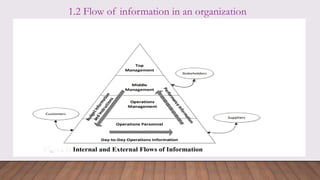
1.2 Flow of information in an organization
• Internally
• External sources
• A good system should to capture info
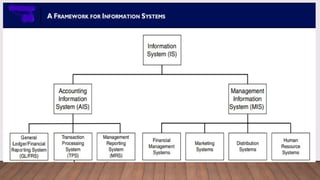
• Information systems in an organization comprise of AIS and MIS
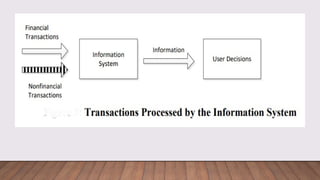
i) Accounting Information Systems (AIS) process financial transactions;
e.g. sale of goods
ii) Management Information Systems (MIS) process
a) Financial transaction
b) Nonfinancial transactions that are not normally processed by
traditional AIS; e.g., tracking customer complaints.
• The aim of both systems is to provide information to improve decision
making and increase the effectiveness and efficiency in an organization.
• Automation: To improve operations
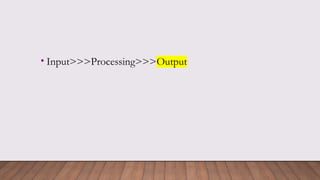
• Input>>>Processing>>>Output
1.3 Purpose of AIS
i) To automate and integrate all accounting activities
ii) To collect and process information relevant to enable managers to plan,
evaluate, and control the business activities of an organization.
iii) To improve the efficiency and effectiveness of accounting business processes.
iv) To provide the information needed to make key decisions in each business cycle
v) To have a risk detection and fraud control system in the accounting profession
vi) To ensure the highest level of accuracy in a company's financial transactions
and financial statements.
vii) To make financial information easily available, accurate and reliable.
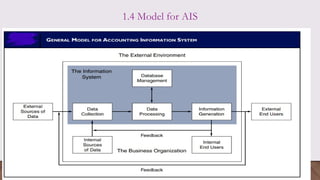
1.4 Model for AIS
• Activity 1: In groups of six, discuss the general model for AIS
presented above and show the importance of AIS in the business
organization.
1.5 Components of the AIS
i) People: Users, the ones operating the system
ii) Data: This the key component for the AIS. Financial data. At the
input (collection), the data processed into useful information.
iii) Software: Enables the people to communicate with the system
iv) Procedure: For every system, there should processes/step
through the user communicates with the other components
v) Information Technology: This supports the whole system
vi) Internal Controls: Needed for data protection and privacy.
Protect against data leakage.
• Planning: Situation analysis-mention the gap/challenges
that exist. Propose a solution. Gathering data on the
status quo.
• New features within the sytem
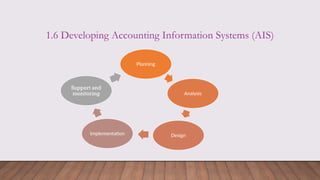
1.6 Developing Accounting Information Systems (AIS)
Planning
Analysis
Design
Implementation
Support and
monitoring
i) Planning: This involves determination of the scope and
objectives of the project, the definition of project
responsibilities, control requirements, project phases,
budgets, and final products.
ii) Analysis: To determine and document the accounting and
business processes used by the company.
iii) Design: Involves developing a working IS
iv) Implementation: Putting plans and designs to practice
v) Support and Monitoring: Provide continuous control,
support and evaluation of the performance of the system.
1.7 Characteristics of accounting information
i) Relevance: Info is considered relevant if it can influence decision
ii) Reliability:…if it is free from errors, any bias, is objective,
iii) Understandability:…if it easy to comprehend, not complicated, not
ambiguous
iv) Comparability:…analyze and compare our performance overtime, compare
with our competitors
v) Accuracy:… if it is complete, gives a true representation of the company’s
financial performance
vi) Timeliness:…if readily accessible, whenever needed
vii) Verifiable: …can be audited, checked and confirmed
1.8 Principles of accounting system design
The principles aim at designing an AIS that cover topics relating to
security, privacy, accuracy, data integrity, and cost-effectiveness.
i) Control principle: … should have its own control environment
ii) Relevance principle:…useful for us, helping the intended users
iii) Compatibility principle: AIS is a sub-system... the system
match with our processes
iv) Flexibility principle:…the ability to change the system to fit
changes in the organization
v) Cost-benefit principle:… measure the cost associated with
purchase, installation, the maintenance, against the expected
benefits.
Assignment 1: In groups of six
a) Discuss any 5 characteristics of Accounting information system (AIS)
b) Highlight and discuss any seven users of accounting information
TOPIC TWO: TRANSACTION CYCLE AND
BUSINESS PROCESSES
TOPIC TWO: TRANSACTION CYCLE AND
BUSINESS PROCESSES
2.1 Introduction
• A business process is a set of related, coordinated and structured
activities and tasks that are performed by a person, a computer or a
machine, and that help accomplish a specific organizational goal.
• Organizations must organize their business processes into groups of
related transactions.
• Many business activities are pairs of events involved in a give-get
exchange.
• A transaction is an agreement between two entities to exchange goods or
services or any other event that can be measured in economic terms by
the organization.
• Examples include
a) selling goods to customers
b) buying inventory from suppliers
c) paying employees, etc
• A transaction is an event that affects or is of interest to the organization.
• Two types:
i) Financial
ii) Non-Financial
• The transaction processing system (TPS) is the system able to collect
data from various input points, i.e. transactions, business activities
• It is central to the overall function of the accounting information
system by
i) Converting economic events into financial transactions
ii) Recording financial transactions in the accounting records (journals
and ledgers)
iii) Distributing essential financial information to operations personnel
to support their daily operations.
• The transaction processing system deals with business events that occur
frequently.
2.2 Classifications of TPS
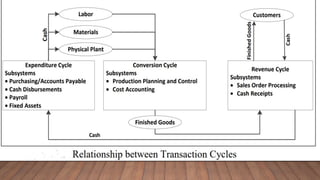
i) The Expenditure Cycle: Purchasing to Cash Disbursements.
Where companies purchase inventory for resale or raw
materials to use in producing products in exchange for cash or
a future promise to pay cash.
ii) The Production Cycle or Conversion Cycle, where raw
materials are transformed into finished goods.
iii) The Revenue Cycle: Sales to Cash Collections. Where goods
and services are sold for cash or a future promise to receive
cash.
iv) The Human Resources Management or Payroll Cycle: Where
employees are hired, trained, compensated, evaluated, promoted,
and terminated.
v) General Ledger and Reporting System: Where financial reports and
statements are generated to useful information for the end users.
2.3 Identifying Events in Business Process
• Most common financial transactions are economic exchanges with external
parties e.g. sales, purchases
• Financial transactions also include certain internal events such as the
depreciation of fixed assets; the use of labor, raw materials, and overhead to
the production process; and the transfer of inventory from one department
to another.
• Every business:
i) Incurs expenditures in exchange for resources (expenditure cycle),
ii) Provides value addition through its products or services (conversion cycle),
iii) Receives revenue (grant) from outside sources (revenue cycle).
2.3.1 The Expenditure Cycle
• Business activities begin with the acquisition of materials, property, and labor
in exchange for cash in the expenditure cycle.
• Most expenditure transactions are based on a credit relationship between the
trading parties.
• The actual disbursement of cash takes place at some point after the receipt of
the goods or services.
• From a systems perspective, this cycle has two parts:
i) a physical component (the acquisition of the goods/services)
ii) a financial component (the cash disbursement to the supplier).
• Each component of the cycle is processed separately by a different subsystem.
• The expenditure cycle comprises the following main
subsystems:
i) Purchases/accounts payable system
ii) Cash disbursements system
iii) Payroll system
iv) Fixed asset system
2.3.2 The Conversion Cycle
• The conversion cycle is composed of two major subsystems
i) The production system: involves the planning, scheduling, and
control of the physical product through the manufacturing process.
• This includes determining raw material requirements, authorizing the
work to be performed and the release of raw materials into
production, and directing the movement of the work-in process
through its various stages of manufacturing.
ii) The cost accounting system: monitors the flow of cost
information related to production.
• The information this system produces is used for inventory
valuation, budgeting, cost control, performance reporting, and
management decisions, such as make-or-buy decisions.
• Note: Manufacturing firms convert raw materials into finished
products through formal conversion cycle operations.
• However, the conversion cycle is not usually formal and observable
in service and retail enterprises
2.3.3 The Revenue Cycle
• Firms sell their finished goods to customers through the revenue cycle,
which involves processing cash sales, credit sales, and the receipt of cash
following a credit sale.
• Revenue cycle transactions comprise of
i) a physical component (sale of goods/services)
ii) a financial component (receipt of cash)
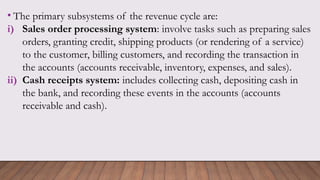
• The primary subsystems of the revenue cycle are:
i) Sales order processing system: involve tasks such as preparing sales
orders, granting credit, shipping products (or rendering of a service)
to the customer, billing customers, and recording the transaction in
the accounts (accounts receivable, inventory, expenses, and sales).
ii) Cash receipts system: includes collecting cash, depositing cash in
the bank, and recording these events in the accounts (accounts
receivable and cash).
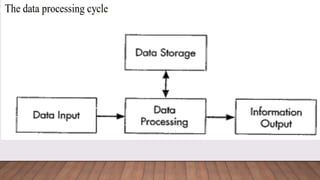
2.4 Transaction Processing: The Data Processing Cycle
• The data processing cycle consists of a series of steps where raw
data (input) is fed into a system to produce actionable insights
(output).
• Each step is taken in a specific order, but the entire process is
repeated in a cyclic manner.
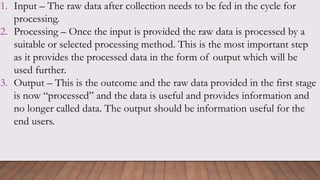
1. Input – The raw data after collection needs to be fed in the cycle for
processing.
2. Processing – Once the input is provided the raw data is processed by a
suitable or selected processing method. This is the most important step
as it provides the processed data in the form of output which will be
used further.
3. Output – This is the outcome and the raw data provided in the first stage
is now “processed” and the data is useful and provides information and
no longer called data. The output should be information useful for the
end users.
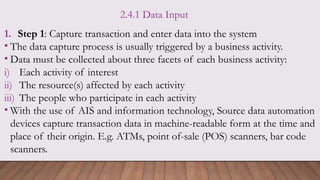
2.4.1 Data Input
1. Step 1: Capture transaction and enter data into the system
• The data capture process is usually triggered by a business activity.
• Data must be collected about three facets of each business activity:
i) Each activity of interest
ii) The resource(s) affected by each activity
iii) The people who participate in each activity
• With the use of AIS and information technology, Source data automation
devices capture transaction data in machine-readable form at the time and
place of their origin. E.g. ATMs, point of-sale (POS) scanners, bar code
scanners.
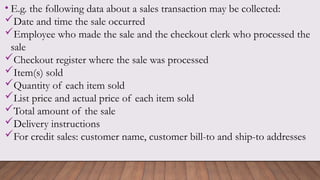
• E.g. the following data about a sales transaction may be collected:
Date and time the sale occurred
Employee who made the sale and the checkout clerk who processed the
sale
Checkout register where the sale was processed
Item(s) sold
Quantity of each item sold
List price and actual price of each item sold
Total amount of the sale
Delivery instructions
For credit sales: customer name, customer bill-to and ship-to addresses
2. Step 2: Make sure captured data are accurate and complete
• One way to do this is to use source data automation or well-designed
documents and data entry screens.
• These approaches help improve accuracy and completeness by providing
instructions or prompts about what data to collect, grouping logically
related pieces of information close together, using check off boxes or
pull-down menus to present the available options, and using appropriate
shading and borders to clearly separate data items.
3. Step 3: Make sure company policies and procedures are followed, such
as approving or verifying a transaction.
2.4.2 Data Storage
• A company's data are one of its most important resources.
• However, the mere existence of relevant data does not guarantee that they are
useful.
• To function properly, an organization must have ready and easy access to its
data.
• Therefore, accountants need to understand how data are organized and stored
in an AIS and how they can be accessed. In essence, they need to know how to
manage data for maximum corporate use.
• Transaction data are often recorded in a journal before they are entered into a
ledger. Cumulative accounting information is stored in general and subsidiary
ledgers.
Coding techniques
• Data in ledgers is organized logically using coding techniques.
• Coding is the systematic assignment of numbers or letters to items to
classify and organize them.
i) Sequence codes: items are numbered consecutively to account for all
items. Any missing items cause a gap in the numerical sequence.
Examples include pre-numbered checks, invoices, and purchase orders.
ii) Block code: blocks of numbers are reserved for specific categories of
data.
iii) Group codes: which are two or more subgroups of digits used to code
items, are often used in conjunction with block codes.
iv) Mnemonic codes: letters and numbers are combined to identify an item.
• Guidelines result in a better coding system. The code should:
i) Be consistent with its intended use, which requires that the code
designer determine desired system outputs prior to selecting the code.
ii) Allow for growth. For example, don't use a three-digit employee code
for a fast-growing company with 950 employees.
iii) Be as simple as possible to minimize costs, facilitate memorization and
interpretation, and ensure employee acceptance.
iv) Be consistent with the company's organizational structure and across
the company's divisions.
• E.g. of coding system is the Chart of Accounts.
• Note: An audit trail can be used to assess the accuracy, validity and
completeness of the transactions
• An audit trail is a traceable path of a transaction through a data
processing system from point of origin to final output, or backwards from
final output to point of origin.
2.4.3 Data Processing
• Once business activity data have been entered into the system, they must
be processed to keep the databases current.
• The four different types of data processing activities, referred to as
CRUD, are as follows:
i) Creating new data records, such as adding a newly hired employee to the
payroll database.
ii) Reading, retrieving, or viewing existing data.
iii) Updating previously stored data.
iv) Deleting data, such as removing the vendor master file of all vendors
the company no longer does business with.
Batch vs. Real-Time Processing
• Batch Processing system is where data updating and processing is done at regular
intervals of time.
• In a batch processing system, transactions are accumulated over a period of time
and processed as a single unit, or batch.
• Batch processing is cheaper and more efficient.
• The data are current and accurate only immediately after processing.
• Batch processing is used only for applications, such as payroll, that do not need
frequent updating and those naturally occurs or are processed at fixed time
periods.
• There is some time delay between the actual event and the processing of the
transaction to update the records of the organization
• In a real-time processing system, transactions are processed
immediately as they occur without any delay to accumulate transactions.
Real-time processing is also referred to as online transaction processing, or
OLTP.
• In this case, the records in the system always reflect the current status.
• Most companies update each transaction as it occurs.
• This increases decision making usefulness.
• It is also more accurate because data input errors can be corrected in real
time or refused.
• It also provides significant competitive advantages
2.4.4 Information Output
• The final step in the data processing cycle is information output which may be in soft
copy or hard copy.
• It may be given in three main forms:
i) Documents: Records of transaction or other company data eg invoices, receipts,
checks, purchase orders
ii) Reports: Used by employees to control operational activities and by managers to make
decisions and to formulate business strategies. External users need reports to evaluate
company profitability, judge creditworthiness, or comply with regulatory requirements.
E.g. Income statement, sales reports, balance sheet, etc.
iii) Query response: A database query is used to provide the information needed to deal
with problems and questions that need rapid action or answers. A user enters a request
for a specific piece of information; it is retrieved, displayed, or analyzed as requested.
2.5 Types of Files
2.5.1 Manual Process Model
• Manual systems constitute the physical events, resources, and personnel that
characterize many business processes.
• This includes such tasks as order-taking, warehousing materials, manufacturing
goods for sale, shipping goods to customers, and placing orders with vendors.
• Traditionally, this model also includes the physical task of record keeping.
• The files kept include
i) Documents: Source documents, product documents and Turnaround
Documents
ii) Journal: Enters transactions in chronological order.
iii) Ledgers: Accounts for various transactions
2.5.2 Computer-Based Systems
• There are four types of files:
i) Master File: Generally contains account data. The general ledger and subsidiary
ledgers are examples of master files. Data values in master files are updated from
transactions.
ii) Transaction File: Is a temporary file of transaction records used to change or update
data in a master file. E.g. Sales orders, inventory receipts, and cash receipts.
iii) Reference File: Stores data that are used as standards for processing transactions. E.g.
payroll program may refer to a tax table to calculate the proper amount of
employment tax, price lists used for preparing customer invoices, lists of authorized
suppliers and customer credit files for approving credit sales.
iv) Archive File. Contains records of past transactions that are retained for future
reference. These transactions form an important part of the audit trail.
2.6 Disadvantages of AIS
i) Stand alone information system (transaction processing system)
ii) Its only concern is financial data and accounting transactions.
Hence, it requires support from other subsystems that capture
non-financial information.
Note: Add other disadvantages
2.7 Enterprise Resource Planning (ERP) Systems
• A system that integrates all aspects of an organization’s activities into one
system.
• An ERP integrate all aspects of a company’s operations with a traditional
AIS.
• Most large and many medium-sized organizations use ERP systems to
coordinate and manage their data, business processes, and resources.
• The ERP system collects, processes, and stores data and provides the
information managers and external parties need to assess the company.
• An ERP facilitates information flow among the company’s various business
functions and manages communications with outside stakeholders.
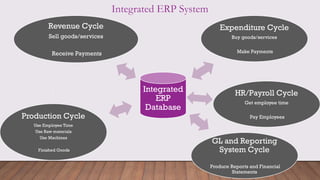
Integrated ERP System
Integrated
ERP
Database
Revenue Cycle
Sell goods/services
Receive Payments
Expenditure Cycle
Buy goods/services
Make Payments
HR/Payroll Cycle
Get employee time
Pay Employees
GL and Reporting
System Cycle
Produce Reports and Financial
Statements
Production Cycle
Use Employee Time
Use Raw materials
Use Machines
Finished Goods
• Assignment 2: Select a company of your choice and propose or
design an Accounting Information Systems.
a) The AIS designed should be complete and able to process the
business transactions from start to the preparation of final
accounts.
b) Discuss factors to consider when designing the AIS
c) Present the process of TPS in the AIS tracking the company’s
transactions from start to the preparation of Final Accounts.
d) Discuss the challenges that AIS designing may encounter and
propose strategies mitigating these challenges.
TOPIC THREE: DEVELOPING ACCOUNTING
SYSTEMS
3.1 Introduction
• System Development Life Cycle (SDLC): Is a formal process used by
organization to develop, introduce and implement an information system
• Accountants commonly apply the systems approach in the development of
new information systems.
• The recent adoption of computer technology in accounting has forced
accountants to be more attentive to the methods used in developing
accounting systems.
• It has initiated the debate of using information technology within the
accounting profession.
3.2 The qualities of a successful system
• A system is successful if it achieves most of the goals set.
i) It should produce correct and timely information.
ii) It should be developed within a reasonable amount of time.
iii) The system should meet the organization’s needs for information.
iv) The users should be satisfied with it
3.3 AIS Development Approaches
• Some of the main approaches in system development include:
i) Systems Development Life Cycle (SDLC)
ii) Rapid Application Development (RAD)
iii) Object-Oriented Approach (OOA)
3.3.1 The Systems Life Cycle (SLC) is a type of methodology used to
describe the process for building information systems, intended to develop
information systems in a very deliberate, structured and methodical way,
reiterating each stage of the life cycle.
• The stages of SDLC are:
i) Project planning, feasibility study: Establishes a high-level view of the intended project
and determines its goals.
ii) Systems analysis, requirements definition: Defines project goals into defined functions
and operation of the intended application. Analyzes end-user information needs.
iii) Systems design: Describes desired features and operations in detail, including screen
layouts, business rules, process diagrams, pseudocode and other documentation.
iv) Implementation: The real code is written here.
v) Integration and testing: Brings all the pieces together into a special testing environment,
then checks for errors, bugs and interoperability.
vi) Acceptance, installation, deployment: The final stage of initial development, where the
software is put into production and runs actual business.
vii) Maintenance: What happens during the rest of the software's life: changes, correction,
additions, moves to a different computing platform and more. This, the least glamorous
and perhaps most important step of all, goes on seemingly forever.
3.3.2 Rapid Application Development (RAD)
• This is a software development methodology that uses minimal planning in
favor of rapid prototyping.
• In rapid application development, structured techniques and prototyping are
especially used to define users' requirements and to design the final system.
The development process starts with the development of preliminary data
models and business process models using structured techniques. In the next
stage, requirements are verified using prototyping, eventually to refine the data
and process models. These stages are repeated iteratively; further development
results in "a combined business requirements and technical design statement
to be used for constructing new systems
3.3.3 Object-Oriented Approach
• Object-Oriented programming (OOP) is a programming
paradigm using "objects" – data structures consisting of data
fields and methods together with their interactions – to design
applications and computer programs.
• Programming techniques may include features such as data
abstraction, encapsulation, messaging, modularity,
polymorphism, and inheritance.
• Many modern programming languages now support OOP
3.4 System Development and Documentation: Tools and
Techniques
3.4.1 Introduction
• Documentation explains how AISs operate and is therefore a vital part of
any accounting system.
• Documentation describes the tasks for
i) recording accounting data
ii) the procedures that users must perform to operate computer
applications
iii) the processing steps that AISs follow
iv) the logical and physical flows of accounting data through the system.
• Document flowcharts describe the physical flow of order forms,
requisition slips, and similar hardcopy documents through an AIS.
• These flowcharts pictorially represent data paths in compact formats and
therefore save pages of narrative description.
• System flowcharts usually focus on the electronic flows of data in
computerized AISs.
3.4.2 Importance of documentation in System
Development
• Depicting how the system works
• Training users
• Designing new systems
• Controlling system development and maintenance costs
• Standardizing communications with others
• Auditing AISs
• Documenting business processes
• Establishing accountability
3.4.3 Documentation Tools
i) Data Flow Diagrams (DFD)
ii) Flow Charts: Include
a) Document Flow Chart: a graphical description of the flow of documents and
information between departments or areas of responsibility within an
organization. It traces the physical flow of documents through an organization.
b) System Flowchart: a graphical description of the relationship among the input,
processing, and output in an information system. It shows the electronic flow
of data and processing steps in an AIS.
c) Program Flowchart: a graphical description of the sequence of logical
operations that a computer performs as it executes a program.
Assignment
• An accounting information system (AIS) involves the
collection, storage, and processing of financial and
accounting data used by different decision makers. For the
AIS to be effective, it needs to have in place an appropriate
and effective internal control environment as well as system
maintenance.
• In groups of 4,
a) Discuss the role of internal control environment in AIS
b) Discuss system maintenance and its function in AIS
c) What is system audit? What significance does it have in AIS
TOPIC FOUR: QUICKBOOKS
TOPIC FIVE: ACCOUNTING SYSTEMS
SECURITIES AND RISK CONTROL
5.1 Accounting System Environment
5.2 Accounting System Analysis and Audit
5.3 Accounting System Security
5.4 Accounting System Maintenance
5.1 Accounting System Environment
• The accounting system environment includes the factors influencing the running
of the accounting using modern technology.
• Accounting functions in a dynamic environment. Changes in technology as well as
economic and political factors can significantly influence accounting practice.
• The environment includes
i) System environment: The overall operation, components, system, principles,
procedure
ii) Hardware components
iii) Control Environment: various measures put in place to protect the system
iv) Accounting processes: step by step procedure in accounting transaction
v) Accounting principles and standards: international guidelines on accounting
vi) Ethical principles: morals to be adhered
• The international nature of business requires organization to be able to
make their financial statements understandable to users all over the
world.
• Ethics are the basic moral principles that govern an individual’s
behavior, including how an individual conducts himself or herself in a
business-related activity.
• Personal ethics and morals should be intertwined with the accounting
profession.
• Control environment is necessary to ensure and promote AIS security
and protection.
5.2 Accounting System Analysis and Audit
• Every business firm follows a particular accounting system that is set up to keep
the records of all the transactions of the business.
• Is system meeting the intended goals, in line with the organization goals
• Accounting system analysis is the evaluation and analysis of the present accounting
system which a firm follows.
• Accounting system analysis evaluates the performance of the system from time to
time to ensure that the system meets the expectations of the business.
• An accounting system audit is an examination of the financial and accounting system
of an organization to determine compliance with the applicable accounting
requirements.
• The system audit checks the applicability of the accounting system to comply with the
accounting standards.
• It helps the firms to identify the prevailing drawbacks (form
feedback on the challenges) of the accounting system, and how
the firm can achieve the expected profits by tackling such
drawbacks.
• By conducting an accounting system analysis, the firms can
make required changes in the accounting system so that they
can effectively achieve the expected results.
• Overall performance of the system
• Core parts of accounting system analysis
• An accounting system analysis includes three main parts which are as follows:
i) Analysis: It is very important for the firms to analyze the accounting system
from time to time in order to identify the changes required to be made with the
change in the nature and type of the business and the transactions. After
analysis of the changes, the firms start to modify the accounting system as per
the new requirements.
ii) Design: After the analysis process, the designing of the accounting system gets
started. The new accounting system must fulfill the requirements of the
company as well as the requirements of the individuals who play an important
role in the accounting business. It must contain revised and updated accounting
laws and principles and other important updates. We want to make system to
be more and more relevant to the organization. Upgrading the existing
iii) Implementation: After the analysis and designing of the required
accounting system, the next part is implementation. This involves
putting the plans and design into effect. It is a time-consuming
process. The accounting team of the business must also be provided
with adequate training regarding the new accounting system. The
complexity of the accounting system is also a factor that decides the
time for implementation of the system. Even after the
implementation of the new system there may be many things that
may require changes.
System analysis is continuous process
• Factors to Consider When conducting System Analysis
i) The User: User friendly interface
ii) User requirements and system functionality
iii) Operating Environment
iv) Organizational goals: improve the efficiency in operation===Profitability
v) Performance evaluation: analyze the system, audited
vi) External Factors: competition, new changes in technologies, political, new rules
regulation, changes in customer preference, suppliers
• Advantages of accounting system analysis
i) It provides a better understanding of the business.
ii) It ensures the prosperity of the business in the best possible manner.
iii) Helps in the assessment of business competition and assists in its preparation.
iv) Optimum utilization of all the business resources. Efficient use of the resources
v) Allows compatibility of the system with the business
5.3 Accounting System Security
• AIS deals with financial data for the company, data on the customers,
suppliers, employees
• All of the data in an AIS should be encrypted, and access to the system
should be logged and monitored.
• System activity should be traceable. This increase transparency and
accountability.
• An AIS also needs internal controls that protect it from computer viruses,
hackers, and other internal and external threats to network security.
• An AIS must have internal controls to limit access to authorized users
and to protect against unauthorized access.
• The internal controls of an AIS are the security measures it maintains to
protect sensitive data.
• Authorized users will include individuals inside and outside the company.
• Internal controls must also prevent unauthorized file access by individuals
who are allowed to access certain select parts of the system.
• An AIS contains confidential information about the company, employees,
suppliers and customers. These information must be safeguarded.
• Accounting security plays a significant role in safeguarding sensitive
financial data.
• Security Framework: This is a set of policies, guidelines, and best
practices designed to manage an organization's information security
risks.
i) Advanced encryption
ii) Access controls: Physical control, logical control
iii) Regular audits: Assess the system performance/security
iv) Backup systems: Help us to retrieve info/data incase of data loss.
• In the contemporary digital era, data security has become a paramount
concern for businesses across all industries, and accounting firms are no
exception.
• Importance of financial data security include:
i) Protecting Confidential Information
ii) Regulatory Compliance
iii) Building Trust
iv) Preventing Financial Fraud
v) Ensure Business Continuity
5.4 Accounting System Maintenance
• System maintenance is the process of keeping a company's technology
infrastructure, equipment and software running smoothly and
efficiently.
• It is a crucial aspect of running a business as it ensures the smooth
functioning of all the systems that the company depends on to carry out
its operations.
• Accounting system analysis is the process of closely examining the
financial systems, processes, and data to ensure they are running at their
best.
•
• Types of system maintenance strategies
i) Corrective maintenance: Maintenance is carried out following detection of
an anomaly and aimed at restoring normal operating conditions. Reactive
ii) Preventive maintenance: Maintenance carried out at predetermined
intervals or according to prescribed criteria, aimed at reducing the failure risk
or performance degradation of the equipment. Proactive
iii) Risk-based maintenance: Maintenance carried out by integrating analysis,
measurement and periodic test activities to standard preventive maintenance.
The aim is to perform risk assessment and define the appropriate
maintenance program.
iv) Condition-based maintenance: Maintenance based on the equipment
performance monitoring and the control of the corrective actions taken as a
result.
TOPIC SIX: EMERGING TRENDS AND ETHICAL
ISSUES
• These are challenges and issues of concern in the modern business in the use of
Accounting Information Systems
i) Increased consumer awareness
ii) Consumer protection
iii) Advanced technology
iv) Cybercrime
v) System integration
vi) Protection of intellectual property such as copyrights and trade secrets
vii) Regional integration and globalization
viii)Fraud prevention and protection
ix) Accountability, transparency and integrity
THE END
THANK YOU
• Assignment 2: Within a company set-up, select a
transaction of your choice and present a flow chart
showing the business process.
• Discuss the significant of AIS in capturing the business
process.

ACCOUNTING INFORMATION SYSTEMS and Financial accounting

  • 1.
  • 2.
    Brief Outline • Overviewof AIS • Transaction Cycle and Business Processes • Developing Accounting Systems • QuickBooks • Systems Securities and Risk-control • Emerging Trends and Ethical Issues
  • 3.
    Text books • BRomney, M., & Steinbart, P. J. (2016). Accounting information systems. 5th ed. UK: Prentice Hall. • Bodnar, G. H., & Hopwood, W. S. (2013). Accounting information systems. Pearson.
  • 4.
  • 5.
    TOPIC ONE: OVERVIEWOF AIS 1.1 Introduction • An accounting information system (AIS) involves the collection, storage, and processing of financial and accounting data used by internal users to report information to other stakeholders like managers, investors, etc. • It captures and records the financial effects of the firm’s transactions.
  • 6.
    • The studyof accounting information systems analyzes how events affecting an organization are recorded, summarized, and reported. • These events are recorded using that organization’s system of human and computer resources, summarized using accounting methods and objectives, and reported as information to interested persons both within and outside of the organization. • Accounting information systems are used for all different forms of organizations (Sole proprietor, partnership, corporations, nonprofit foundations).
  • 7.
    • The functionsan of AIS are to: i) Collect and store data about events, resources, and agents. Input Device/Input system. ii) Transform that data into information that management can use to make decisions about events, resources, and agents. iii) Provide adequate controls to ensure that the entity’s resources (including data) are available when needed, accurate and reliable
  • 8.
    1.2 Flow ofinformation in an organization
  • 9.
    1.2 Flow ofinformation in an organization • Internally • External sources • A good system should to capture info
  • 10.
    • Information systemsin an organization comprise of AIS and MIS i) Accounting Information Systems (AIS) process financial transactions; e.g. sale of goods ii) Management Information Systems (MIS) process a) Financial transaction b) Nonfinancial transactions that are not normally processed by traditional AIS; e.g., tracking customer complaints. • The aim of both systems is to provide information to improve decision making and increase the effectiveness and efficiency in an organization. • Automation: To improve operations
  • 12.
  • 14.
    1.3 Purpose ofAIS i) To automate and integrate all accounting activities ii) To collect and process information relevant to enable managers to plan, evaluate, and control the business activities of an organization. iii) To improve the efficiency and effectiveness of accounting business processes. iv) To provide the information needed to make key decisions in each business cycle v) To have a risk detection and fraud control system in the accounting profession vi) To ensure the highest level of accuracy in a company's financial transactions and financial statements. vii) To make financial information easily available, accurate and reliable.
  • 15.
  • 16.
    • Activity 1:In groups of six, discuss the general model for AIS presented above and show the importance of AIS in the business organization.
  • 17.
    1.5 Components ofthe AIS i) People: Users, the ones operating the system ii) Data: This the key component for the AIS. Financial data. At the input (collection), the data processed into useful information. iii) Software: Enables the people to communicate with the system iv) Procedure: For every system, there should processes/step through the user communicates with the other components v) Information Technology: This supports the whole system vi) Internal Controls: Needed for data protection and privacy. Protect against data leakage.
  • 18.
    • Planning: Situationanalysis-mention the gap/challenges that exist. Propose a solution. Gathering data on the status quo. • New features within the sytem
  • 19.
    1.6 Developing AccountingInformation Systems (AIS) Planning Analysis Design Implementation Support and monitoring
  • 20.
    i) Planning: Thisinvolves determination of the scope and objectives of the project, the definition of project responsibilities, control requirements, project phases, budgets, and final products. ii) Analysis: To determine and document the accounting and business processes used by the company. iii) Design: Involves developing a working IS iv) Implementation: Putting plans and designs to practice v) Support and Monitoring: Provide continuous control, support and evaluation of the performance of the system.
  • 21.
    1.7 Characteristics ofaccounting information i) Relevance: Info is considered relevant if it can influence decision ii) Reliability:…if it is free from errors, any bias, is objective, iii) Understandability:…if it easy to comprehend, not complicated, not ambiguous iv) Comparability:…analyze and compare our performance overtime, compare with our competitors v) Accuracy:… if it is complete, gives a true representation of the company’s financial performance vi) Timeliness:…if readily accessible, whenever needed vii) Verifiable: …can be audited, checked and confirmed
  • 22.
    1.8 Principles ofaccounting system design The principles aim at designing an AIS that cover topics relating to security, privacy, accuracy, data integrity, and cost-effectiveness. i) Control principle: … should have its own control environment ii) Relevance principle:…useful for us, helping the intended users iii) Compatibility principle: AIS is a sub-system... the system match with our processes iv) Flexibility principle:…the ability to change the system to fit changes in the organization v) Cost-benefit principle:… measure the cost associated with purchase, installation, the maintenance, against the expected benefits.
  • 23.
    Assignment 1: Ingroups of six a) Discuss any 5 characteristics of Accounting information system (AIS) b) Highlight and discuss any seven users of accounting information
  • 24.
    TOPIC TWO: TRANSACTIONCYCLE AND BUSINESS PROCESSES
  • 25.
    TOPIC TWO: TRANSACTIONCYCLE AND BUSINESS PROCESSES 2.1 Introduction • A business process is a set of related, coordinated and structured activities and tasks that are performed by a person, a computer or a machine, and that help accomplish a specific organizational goal. • Organizations must organize their business processes into groups of related transactions. • Many business activities are pairs of events involved in a give-get exchange.
  • 26.
    • A transactionis an agreement between two entities to exchange goods or services or any other event that can be measured in economic terms by the organization. • Examples include a) selling goods to customers b) buying inventory from suppliers c) paying employees, etc • A transaction is an event that affects or is of interest to the organization. • Two types: i) Financial ii) Non-Financial
  • 27.
    • The transactionprocessing system (TPS) is the system able to collect data from various input points, i.e. transactions, business activities • It is central to the overall function of the accounting information system by i) Converting economic events into financial transactions ii) Recording financial transactions in the accounting records (journals and ledgers) iii) Distributing essential financial information to operations personnel to support their daily operations. • The transaction processing system deals with business events that occur frequently.
  • 28.
    2.2 Classifications ofTPS i) The Expenditure Cycle: Purchasing to Cash Disbursements. Where companies purchase inventory for resale or raw materials to use in producing products in exchange for cash or a future promise to pay cash. ii) The Production Cycle or Conversion Cycle, where raw materials are transformed into finished goods. iii) The Revenue Cycle: Sales to Cash Collections. Where goods and services are sold for cash or a future promise to receive cash.
  • 29.
    iv) The HumanResources Management or Payroll Cycle: Where employees are hired, trained, compensated, evaluated, promoted, and terminated. v) General Ledger and Reporting System: Where financial reports and statements are generated to useful information for the end users.
  • 30.
    2.3 Identifying Eventsin Business Process • Most common financial transactions are economic exchanges with external parties e.g. sales, purchases • Financial transactions also include certain internal events such as the depreciation of fixed assets; the use of labor, raw materials, and overhead to the production process; and the transfer of inventory from one department to another. • Every business: i) Incurs expenditures in exchange for resources (expenditure cycle), ii) Provides value addition through its products or services (conversion cycle), iii) Receives revenue (grant) from outside sources (revenue cycle).
  • 31.
    2.3.1 The ExpenditureCycle • Business activities begin with the acquisition of materials, property, and labor in exchange for cash in the expenditure cycle. • Most expenditure transactions are based on a credit relationship between the trading parties. • The actual disbursement of cash takes place at some point after the receipt of the goods or services. • From a systems perspective, this cycle has two parts: i) a physical component (the acquisition of the goods/services) ii) a financial component (the cash disbursement to the supplier). • Each component of the cycle is processed separately by a different subsystem.
  • 32.
    • The expenditurecycle comprises the following main subsystems: i) Purchases/accounts payable system ii) Cash disbursements system iii) Payroll system iv) Fixed asset system
  • 33.
    2.3.2 The ConversionCycle • The conversion cycle is composed of two major subsystems i) The production system: involves the planning, scheduling, and control of the physical product through the manufacturing process. • This includes determining raw material requirements, authorizing the work to be performed and the release of raw materials into production, and directing the movement of the work-in process through its various stages of manufacturing.
  • 34.
    ii) The costaccounting system: monitors the flow of cost information related to production. • The information this system produces is used for inventory valuation, budgeting, cost control, performance reporting, and management decisions, such as make-or-buy decisions. • Note: Manufacturing firms convert raw materials into finished products through formal conversion cycle operations. • However, the conversion cycle is not usually formal and observable in service and retail enterprises
  • 35.
    2.3.3 The RevenueCycle • Firms sell their finished goods to customers through the revenue cycle, which involves processing cash sales, credit sales, and the receipt of cash following a credit sale. • Revenue cycle transactions comprise of i) a physical component (sale of goods/services) ii) a financial component (receipt of cash)
  • 36.
    • The primarysubsystems of the revenue cycle are: i) Sales order processing system: involve tasks such as preparing sales orders, granting credit, shipping products (or rendering of a service) to the customer, billing customers, and recording the transaction in the accounts (accounts receivable, inventory, expenses, and sales). ii) Cash receipts system: includes collecting cash, depositing cash in the bank, and recording these events in the accounts (accounts receivable and cash).
  • 38.
    2.4 Transaction Processing:The Data Processing Cycle • The data processing cycle consists of a series of steps where raw data (input) is fed into a system to produce actionable insights (output). • Each step is taken in a specific order, but the entire process is repeated in a cyclic manner.
  • 40.
    1. Input –The raw data after collection needs to be fed in the cycle for processing. 2. Processing – Once the input is provided the raw data is processed by a suitable or selected processing method. This is the most important step as it provides the processed data in the form of output which will be used further. 3. Output – This is the outcome and the raw data provided in the first stage is now “processed” and the data is useful and provides information and no longer called data. The output should be information useful for the end users.
  • 41.
    2.4.1 Data Input 1.Step 1: Capture transaction and enter data into the system • The data capture process is usually triggered by a business activity. • Data must be collected about three facets of each business activity: i) Each activity of interest ii) The resource(s) affected by each activity iii) The people who participate in each activity • With the use of AIS and information technology, Source data automation devices capture transaction data in machine-readable form at the time and place of their origin. E.g. ATMs, point of-sale (POS) scanners, bar code scanners.
  • 42.
    • E.g. thefollowing data about a sales transaction may be collected: Date and time the sale occurred Employee who made the sale and the checkout clerk who processed the sale Checkout register where the sale was processed Item(s) sold Quantity of each item sold List price and actual price of each item sold Total amount of the sale Delivery instructions For credit sales: customer name, customer bill-to and ship-to addresses
  • 43.
    2. Step 2:Make sure captured data are accurate and complete • One way to do this is to use source data automation or well-designed documents and data entry screens. • These approaches help improve accuracy and completeness by providing instructions or prompts about what data to collect, grouping logically related pieces of information close together, using check off boxes or pull-down menus to present the available options, and using appropriate shading and borders to clearly separate data items. 3. Step 3: Make sure company policies and procedures are followed, such as approving or verifying a transaction.
  • 44.
    2.4.2 Data Storage •A company's data are one of its most important resources. • However, the mere existence of relevant data does not guarantee that they are useful. • To function properly, an organization must have ready and easy access to its data. • Therefore, accountants need to understand how data are organized and stored in an AIS and how they can be accessed. In essence, they need to know how to manage data for maximum corporate use. • Transaction data are often recorded in a journal before they are entered into a ledger. Cumulative accounting information is stored in general and subsidiary ledgers.
  • 45.
    Coding techniques • Datain ledgers is organized logically using coding techniques. • Coding is the systematic assignment of numbers or letters to items to classify and organize them. i) Sequence codes: items are numbered consecutively to account for all items. Any missing items cause a gap in the numerical sequence. Examples include pre-numbered checks, invoices, and purchase orders. ii) Block code: blocks of numbers are reserved for specific categories of data. iii) Group codes: which are two or more subgroups of digits used to code items, are often used in conjunction with block codes. iv) Mnemonic codes: letters and numbers are combined to identify an item.
  • 46.
    • Guidelines resultin a better coding system. The code should: i) Be consistent with its intended use, which requires that the code designer determine desired system outputs prior to selecting the code. ii) Allow for growth. For example, don't use a three-digit employee code for a fast-growing company with 950 employees. iii) Be as simple as possible to minimize costs, facilitate memorization and interpretation, and ensure employee acceptance. iv) Be consistent with the company's organizational structure and across the company's divisions. • E.g. of coding system is the Chart of Accounts.
  • 47.
    • Note: Anaudit trail can be used to assess the accuracy, validity and completeness of the transactions • An audit trail is a traceable path of a transaction through a data processing system from point of origin to final output, or backwards from final output to point of origin.
  • 48.
    2.4.3 Data Processing •Once business activity data have been entered into the system, they must be processed to keep the databases current. • The four different types of data processing activities, referred to as CRUD, are as follows: i) Creating new data records, such as adding a newly hired employee to the payroll database. ii) Reading, retrieving, or viewing existing data. iii) Updating previously stored data. iv) Deleting data, such as removing the vendor master file of all vendors the company no longer does business with.
  • 49.
    Batch vs. Real-TimeProcessing • Batch Processing system is where data updating and processing is done at regular intervals of time. • In a batch processing system, transactions are accumulated over a period of time and processed as a single unit, or batch. • Batch processing is cheaper and more efficient. • The data are current and accurate only immediately after processing. • Batch processing is used only for applications, such as payroll, that do not need frequent updating and those naturally occurs or are processed at fixed time periods. • There is some time delay between the actual event and the processing of the transaction to update the records of the organization
  • 50.
    • In areal-time processing system, transactions are processed immediately as they occur without any delay to accumulate transactions. Real-time processing is also referred to as online transaction processing, or OLTP. • In this case, the records in the system always reflect the current status. • Most companies update each transaction as it occurs. • This increases decision making usefulness. • It is also more accurate because data input errors can be corrected in real time or refused. • It also provides significant competitive advantages
  • 51.
    2.4.4 Information Output •The final step in the data processing cycle is information output which may be in soft copy or hard copy. • It may be given in three main forms: i) Documents: Records of transaction or other company data eg invoices, receipts, checks, purchase orders ii) Reports: Used by employees to control operational activities and by managers to make decisions and to formulate business strategies. External users need reports to evaluate company profitability, judge creditworthiness, or comply with regulatory requirements. E.g. Income statement, sales reports, balance sheet, etc. iii) Query response: A database query is used to provide the information needed to deal with problems and questions that need rapid action or answers. A user enters a request for a specific piece of information; it is retrieved, displayed, or analyzed as requested.
  • 52.
    2.5 Types ofFiles 2.5.1 Manual Process Model • Manual systems constitute the physical events, resources, and personnel that characterize many business processes. • This includes such tasks as order-taking, warehousing materials, manufacturing goods for sale, shipping goods to customers, and placing orders with vendors. • Traditionally, this model also includes the physical task of record keeping. • The files kept include i) Documents: Source documents, product documents and Turnaround Documents ii) Journal: Enters transactions in chronological order. iii) Ledgers: Accounts for various transactions
  • 53.
    2.5.2 Computer-Based Systems •There are four types of files: i) Master File: Generally contains account data. The general ledger and subsidiary ledgers are examples of master files. Data values in master files are updated from transactions. ii) Transaction File: Is a temporary file of transaction records used to change or update data in a master file. E.g. Sales orders, inventory receipts, and cash receipts. iii) Reference File: Stores data that are used as standards for processing transactions. E.g. payroll program may refer to a tax table to calculate the proper amount of employment tax, price lists used for preparing customer invoices, lists of authorized suppliers and customer credit files for approving credit sales. iv) Archive File. Contains records of past transactions that are retained for future reference. These transactions form an important part of the audit trail.
  • 54.
    2.6 Disadvantages ofAIS i) Stand alone information system (transaction processing system) ii) Its only concern is financial data and accounting transactions. Hence, it requires support from other subsystems that capture non-financial information. Note: Add other disadvantages
  • 55.
    2.7 Enterprise ResourcePlanning (ERP) Systems • A system that integrates all aspects of an organization’s activities into one system. • An ERP integrate all aspects of a company’s operations with a traditional AIS. • Most large and many medium-sized organizations use ERP systems to coordinate and manage their data, business processes, and resources. • The ERP system collects, processes, and stores data and provides the information managers and external parties need to assess the company. • An ERP facilitates information flow among the company’s various business functions and manages communications with outside stakeholders.
  • 56.
    Integrated ERP System Integrated ERP Database RevenueCycle Sell goods/services Receive Payments Expenditure Cycle Buy goods/services Make Payments HR/Payroll Cycle Get employee time Pay Employees GL and Reporting System Cycle Produce Reports and Financial Statements Production Cycle Use Employee Time Use Raw materials Use Machines Finished Goods
  • 57.
    • Assignment 2:Select a company of your choice and propose or design an Accounting Information Systems. a) The AIS designed should be complete and able to process the business transactions from start to the preparation of final accounts. b) Discuss factors to consider when designing the AIS c) Present the process of TPS in the AIS tracking the company’s transactions from start to the preparation of Final Accounts. d) Discuss the challenges that AIS designing may encounter and propose strategies mitigating these challenges.
  • 58.
    TOPIC THREE: DEVELOPINGACCOUNTING SYSTEMS 3.1 Introduction • System Development Life Cycle (SDLC): Is a formal process used by organization to develop, introduce and implement an information system • Accountants commonly apply the systems approach in the development of new information systems. • The recent adoption of computer technology in accounting has forced accountants to be more attentive to the methods used in developing accounting systems. • It has initiated the debate of using information technology within the accounting profession.
  • 59.
    3.2 The qualitiesof a successful system • A system is successful if it achieves most of the goals set. i) It should produce correct and timely information. ii) It should be developed within a reasonable amount of time. iii) The system should meet the organization’s needs for information. iv) The users should be satisfied with it
  • 60.
    3.3 AIS DevelopmentApproaches • Some of the main approaches in system development include: i) Systems Development Life Cycle (SDLC) ii) Rapid Application Development (RAD) iii) Object-Oriented Approach (OOA) 3.3.1 The Systems Life Cycle (SLC) is a type of methodology used to describe the process for building information systems, intended to develop information systems in a very deliberate, structured and methodical way, reiterating each stage of the life cycle.
  • 61.
    • The stagesof SDLC are: i) Project planning, feasibility study: Establishes a high-level view of the intended project and determines its goals. ii) Systems analysis, requirements definition: Defines project goals into defined functions and operation of the intended application. Analyzes end-user information needs. iii) Systems design: Describes desired features and operations in detail, including screen layouts, business rules, process diagrams, pseudocode and other documentation. iv) Implementation: The real code is written here. v) Integration and testing: Brings all the pieces together into a special testing environment, then checks for errors, bugs and interoperability. vi) Acceptance, installation, deployment: The final stage of initial development, where the software is put into production and runs actual business. vii) Maintenance: What happens during the rest of the software's life: changes, correction, additions, moves to a different computing platform and more. This, the least glamorous and perhaps most important step of all, goes on seemingly forever.
  • 62.
    3.3.2 Rapid ApplicationDevelopment (RAD) • This is a software development methodology that uses minimal planning in favor of rapid prototyping. • In rapid application development, structured techniques and prototyping are especially used to define users' requirements and to design the final system. The development process starts with the development of preliminary data models and business process models using structured techniques. In the next stage, requirements are verified using prototyping, eventually to refine the data and process models. These stages are repeated iteratively; further development results in "a combined business requirements and technical design statement to be used for constructing new systems
  • 63.
    3.3.3 Object-Oriented Approach •Object-Oriented programming (OOP) is a programming paradigm using "objects" – data structures consisting of data fields and methods together with their interactions – to design applications and computer programs. • Programming techniques may include features such as data abstraction, encapsulation, messaging, modularity, polymorphism, and inheritance. • Many modern programming languages now support OOP
  • 64.
    3.4 System Developmentand Documentation: Tools and Techniques 3.4.1 Introduction • Documentation explains how AISs operate and is therefore a vital part of any accounting system. • Documentation describes the tasks for i) recording accounting data ii) the procedures that users must perform to operate computer applications iii) the processing steps that AISs follow iv) the logical and physical flows of accounting data through the system.
  • 65.
    • Document flowchartsdescribe the physical flow of order forms, requisition slips, and similar hardcopy documents through an AIS. • These flowcharts pictorially represent data paths in compact formats and therefore save pages of narrative description. • System flowcharts usually focus on the electronic flows of data in computerized AISs.
  • 66.
    3.4.2 Importance ofdocumentation in System Development • Depicting how the system works • Training users • Designing new systems • Controlling system development and maintenance costs • Standardizing communications with others • Auditing AISs • Documenting business processes • Establishing accountability
  • 67.
    3.4.3 Documentation Tools i)Data Flow Diagrams (DFD) ii) Flow Charts: Include a) Document Flow Chart: a graphical description of the flow of documents and information between departments or areas of responsibility within an organization. It traces the physical flow of documents through an organization. b) System Flowchart: a graphical description of the relationship among the input, processing, and output in an information system. It shows the electronic flow of data and processing steps in an AIS. c) Program Flowchart: a graphical description of the sequence of logical operations that a computer performs as it executes a program.
  • 68.
    Assignment • An accountinginformation system (AIS) involves the collection, storage, and processing of financial and accounting data used by different decision makers. For the AIS to be effective, it needs to have in place an appropriate and effective internal control environment as well as system maintenance. • In groups of 4, a) Discuss the role of internal control environment in AIS b) Discuss system maintenance and its function in AIS c) What is system audit? What significance does it have in AIS
  • 69.
  • 70.
    TOPIC FIVE: ACCOUNTINGSYSTEMS SECURITIES AND RISK CONTROL 5.1 Accounting System Environment 5.2 Accounting System Analysis and Audit 5.3 Accounting System Security 5.4 Accounting System Maintenance
  • 71.
    5.1 Accounting SystemEnvironment • The accounting system environment includes the factors influencing the running of the accounting using modern technology. • Accounting functions in a dynamic environment. Changes in technology as well as economic and political factors can significantly influence accounting practice. • The environment includes i) System environment: The overall operation, components, system, principles, procedure ii) Hardware components iii) Control Environment: various measures put in place to protect the system iv) Accounting processes: step by step procedure in accounting transaction v) Accounting principles and standards: international guidelines on accounting vi) Ethical principles: morals to be adhered
  • 72.
    • The internationalnature of business requires organization to be able to make their financial statements understandable to users all over the world. • Ethics are the basic moral principles that govern an individual’s behavior, including how an individual conducts himself or herself in a business-related activity. • Personal ethics and morals should be intertwined with the accounting profession. • Control environment is necessary to ensure and promote AIS security and protection.
  • 73.
    5.2 Accounting SystemAnalysis and Audit • Every business firm follows a particular accounting system that is set up to keep the records of all the transactions of the business. • Is system meeting the intended goals, in line with the organization goals • Accounting system analysis is the evaluation and analysis of the present accounting system which a firm follows. • Accounting system analysis evaluates the performance of the system from time to time to ensure that the system meets the expectations of the business. • An accounting system audit is an examination of the financial and accounting system of an organization to determine compliance with the applicable accounting requirements. • The system audit checks the applicability of the accounting system to comply with the accounting standards.
  • 74.
    • It helpsthe firms to identify the prevailing drawbacks (form feedback on the challenges) of the accounting system, and how the firm can achieve the expected profits by tackling such drawbacks. • By conducting an accounting system analysis, the firms can make required changes in the accounting system so that they can effectively achieve the expected results. • Overall performance of the system
  • 75.
    • Core partsof accounting system analysis • An accounting system analysis includes three main parts which are as follows: i) Analysis: It is very important for the firms to analyze the accounting system from time to time in order to identify the changes required to be made with the change in the nature and type of the business and the transactions. After analysis of the changes, the firms start to modify the accounting system as per the new requirements. ii) Design: After the analysis process, the designing of the accounting system gets started. The new accounting system must fulfill the requirements of the company as well as the requirements of the individuals who play an important role in the accounting business. It must contain revised and updated accounting laws and principles and other important updates. We want to make system to be more and more relevant to the organization. Upgrading the existing
  • 76.
    iii) Implementation: Afterthe analysis and designing of the required accounting system, the next part is implementation. This involves putting the plans and design into effect. It is a time-consuming process. The accounting team of the business must also be provided with adequate training regarding the new accounting system. The complexity of the accounting system is also a factor that decides the time for implementation of the system. Even after the implementation of the new system there may be many things that may require changes. System analysis is continuous process
  • 77.
    • Factors toConsider When conducting System Analysis i) The User: User friendly interface ii) User requirements and system functionality iii) Operating Environment iv) Organizational goals: improve the efficiency in operation===Profitability v) Performance evaluation: analyze the system, audited vi) External Factors: competition, new changes in technologies, political, new rules regulation, changes in customer preference, suppliers • Advantages of accounting system analysis i) It provides a better understanding of the business. ii) It ensures the prosperity of the business in the best possible manner. iii) Helps in the assessment of business competition and assists in its preparation. iv) Optimum utilization of all the business resources. Efficient use of the resources v) Allows compatibility of the system with the business
  • 78.
    5.3 Accounting SystemSecurity • AIS deals with financial data for the company, data on the customers, suppliers, employees • All of the data in an AIS should be encrypted, and access to the system should be logged and monitored. • System activity should be traceable. This increase transparency and accountability. • An AIS also needs internal controls that protect it from computer viruses, hackers, and other internal and external threats to network security.
  • 79.
    • An AISmust have internal controls to limit access to authorized users and to protect against unauthorized access. • The internal controls of an AIS are the security measures it maintains to protect sensitive data. • Authorized users will include individuals inside and outside the company. • Internal controls must also prevent unauthorized file access by individuals who are allowed to access certain select parts of the system. • An AIS contains confidential information about the company, employees, suppliers and customers. These information must be safeguarded.
  • 80.
    • Accounting securityplays a significant role in safeguarding sensitive financial data. • Security Framework: This is a set of policies, guidelines, and best practices designed to manage an organization's information security risks. i) Advanced encryption ii) Access controls: Physical control, logical control iii) Regular audits: Assess the system performance/security iv) Backup systems: Help us to retrieve info/data incase of data loss.
  • 81.
    • In thecontemporary digital era, data security has become a paramount concern for businesses across all industries, and accounting firms are no exception. • Importance of financial data security include: i) Protecting Confidential Information ii) Regulatory Compliance iii) Building Trust iv) Preventing Financial Fraud v) Ensure Business Continuity
  • 82.
    5.4 Accounting SystemMaintenance • System maintenance is the process of keeping a company's technology infrastructure, equipment and software running smoothly and efficiently. • It is a crucial aspect of running a business as it ensures the smooth functioning of all the systems that the company depends on to carry out its operations. • Accounting system analysis is the process of closely examining the financial systems, processes, and data to ensure they are running at their best. •
  • 83.
    • Types ofsystem maintenance strategies i) Corrective maintenance: Maintenance is carried out following detection of an anomaly and aimed at restoring normal operating conditions. Reactive ii) Preventive maintenance: Maintenance carried out at predetermined intervals or according to prescribed criteria, aimed at reducing the failure risk or performance degradation of the equipment. Proactive iii) Risk-based maintenance: Maintenance carried out by integrating analysis, measurement and periodic test activities to standard preventive maintenance. The aim is to perform risk assessment and define the appropriate maintenance program. iv) Condition-based maintenance: Maintenance based on the equipment performance monitoring and the control of the corrective actions taken as a result.
  • 84.
    TOPIC SIX: EMERGINGTRENDS AND ETHICAL ISSUES • These are challenges and issues of concern in the modern business in the use of Accounting Information Systems i) Increased consumer awareness ii) Consumer protection iii) Advanced technology iv) Cybercrime v) System integration vi) Protection of intellectual property such as copyrights and trade secrets vii) Regional integration and globalization viii)Fraud prevention and protection ix) Accountability, transparency and integrity
  • 85.
  • 86.
    • Assignment 2:Within a company set-up, select a transaction of your choice and present a flow chart showing the business process. • Discuss the significant of AIS in capturing the business process.