PRACTICAL SPOKEN BOOK
Page 54 of 79
LODESTAR
LESSON-12 MY FAVOURITE
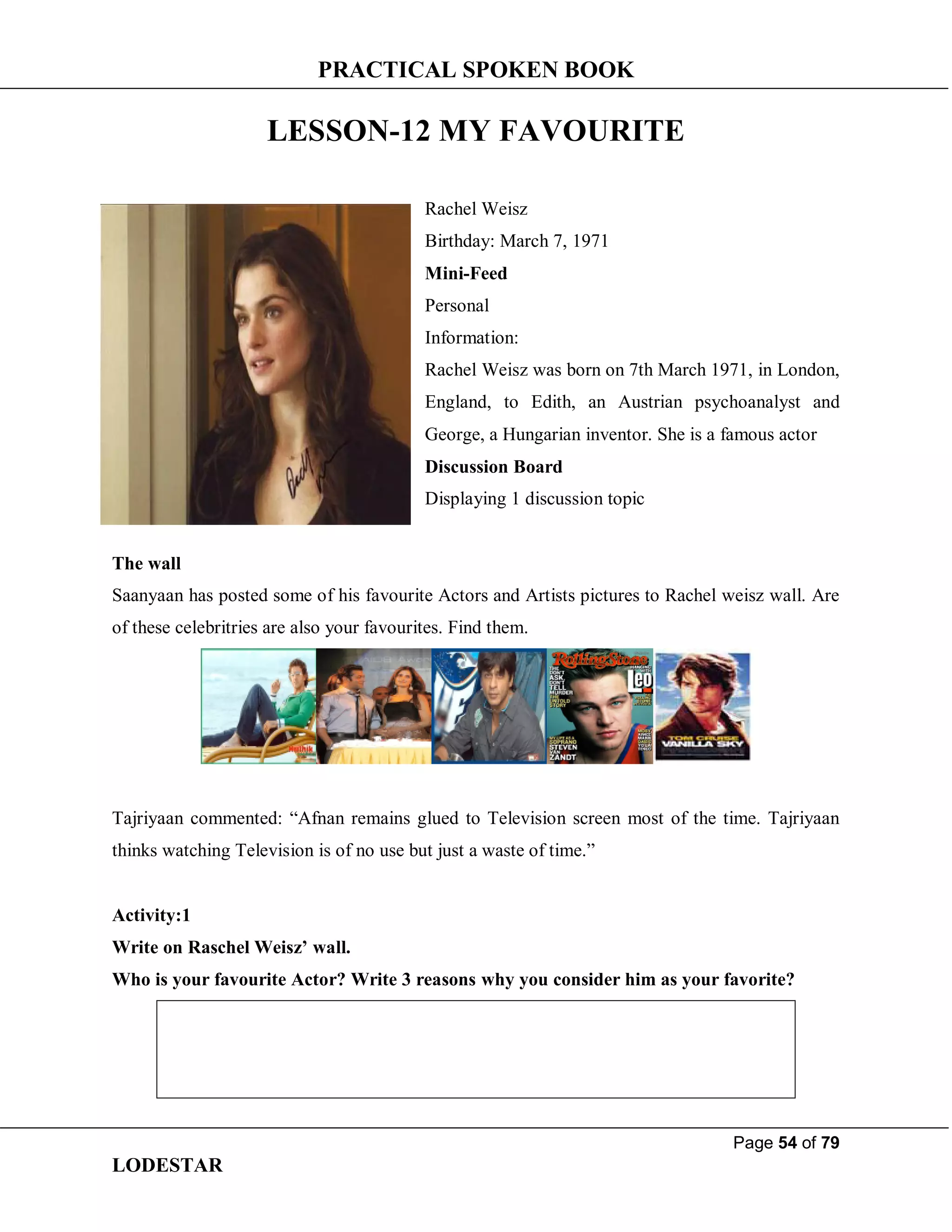
Rachel Weisz
Birthday: March 7, 1971
Mini-Feed
Personal
Information:
Rachel Weisz was born on 7th March 1971, in London,
England, to Edith, an Austrian psychoanalyst and
George, a Hungarian inventor. She is a famous actor
Discussion Board
Displaying 1 discussion topic
The wall
Saanyaan has posted some of his favourite Actors and Artists pictures to Rachel weisz wall. Are
of these celebritries are also your favourites. Find them.
Tajriyaan commented: “Afnan remains glued to Television screen most of the time. Tajriyaan
thinks watching Television is of no use but just a waste of time.”
Activity:1
Write on Raschel Weisz’ wall.
Who is your favourite Actor? Write 3 reasons why you consider him as your favorite?
PRACTICAL SPOKEN BOOK
Page 55 of 79
LODESTAR
Activity 2: Individual work
My favorite! Writing task
My favorite Music:
a. Bengali.…………………………..Singer………………………
My favorite Film
a. Hindi …………………………b. English……………………c. engali…………………
My favorite Actor:
a .English…………………………..b. Hindi……………………………….c. TV/Bengali
Activity 3: Pair work
All about your favorites: Asking question
Direction: Students should work in pair and swap their workbook. Now form questions as per the
formats given below and give reply to them. The questions and replies should generate
discussion on his favorite choice of Music, TV shows or film and related information as
mentioned below.
 Do you like.................?
(Music / TV Programs / Films)
 What kind of ..................... do you like?
(Music / TV Programs / Films)
 Which is your favorite......................?
(Music / TV Programs / Films)
 Why do you like......................
(Music / TV Programs / Films)
 Who is your favorite...................?
(Music / TV Programs / Films)
 Why is he / she your favorite?
(Music / TV Programs / Films)
and small groups of four to five. One student in each group acts as a spokesperson. Group
members prepare a list of their favorite music, TV programs, films and actors / actresses under
PRACTICAL SPOKEN BOOK
Page 56 of 79
LODESTAR
the title “Our Group Favorites”. Then students from each group take turns to ask the other groups
members about the topics listed in “Our Group’s Favorites” using these questions.
Activity: 4: Group Discussion
Our Group Favorite
Now 5 students would come forward as the group leader. They would individually tell 5 names
of popular actors/actress as their favourites. The teacher will then ask the class who have the
same favourite named by them. Now those who have the common favourite would form separate
group and engage in a vibrant discussion why they think their favourite is the best choice.
The activity would continue for the following categories:“Our Group’s Favorite”
Music ..................................
Film ..................................
Actress ..................................
Actor ..................................
TV Program ..................................
Singer ..................................
Activity 5: Speaking Task
 A dream comes true!
 Your favorite Teacher:
 Now write a short paragraph on your favorite teacher. Write about your favorite teacher
with the following inputs:
 What is his name?
 What subject he teaches?
 Why is he your favorite teacher?
 What is so special about his teaching style?
 What are things in him that inspire you?
PRACTICAL SPOKEN BOOK
Page 57 of 79
LODESTAR
Activity 6: Group Discussion
Is TV good or bad?
Discussion Wheels
Source: © Nick Peachey, teacher, trainer, materials writer, British Council
Discussion wheels are a good way of giving students time to think and formulate opinions before
they do discussion work. They work particularly well with areas of discussion which can have
ranges of agreement or disagreement.
• Preparation
To create a discussion wheel you simply need 8 or 10 contentious sentences based around a
theme which you would like the students to discuss.
Draw a circle on a piece of paper and draw lines through the circle (one line for each sentence)
so that the circle is divided into segments.
At the end of each line, write one of the sentences, and then next in the group would write his
line. A maximum of 10 students can form a group.
Example: Television and Entertainment
You may use the following arguments.
a. People don’t get any exercise. They just sit and watch TV.
b. It brings news from around the world into people’s homes.
c. People just want entertainment today. They don’t want to think.
d. There is a lot of crime and violence on TV today. The programs are terrible.
e. Children learn many useful things. It teaches them to tell the time.
f. It helps me to relax after a long day.
g. Programs on the radio are better. They make you think.
h. It is all adverts. I hate it!
The student should be divided into even number of groups each comprising 5-10 member
groups. Now the point of group discussion is “Is watching TV good or bad?” Each group will
take one stand either in favor or against the motion. The groups can discuss different points
among their members and argue in favor or against watching TV.

Practical lesson 12(b)

  • 1.
    PRACTICAL SPOKEN BOOK Page54 of 79 LODESTAR LESSON-12 MY FAVOURITE Rachel Weisz Birthday: March 7, 1971 Mini-Feed Personal Information: Rachel Weisz was born on 7th March 1971, in London, England, to Edith, an Austrian psychoanalyst and George, a Hungarian inventor. She is a famous actor Discussion Board Displaying 1 discussion topic The wall Saanyaan has posted some of his favourite Actors and Artists pictures to Rachel weisz wall. Are of these celebritries are also your favourites. Find them. Tajriyaan commented: “Afnan remains glued to Television screen most of the time. Tajriyaan thinks watching Television is of no use but just a waste of time.” Activity:1 Write on Raschel Weisz’ wall. Who is your favourite Actor? Write 3 reasons why you consider him as your favorite?
  • 2.
    PRACTICAL SPOKEN BOOK Page55 of 79 LODESTAR Activity 2: Individual work My favorite! Writing task My favorite Music: a. Bengali.…………………………..Singer……………………… My favorite Film a. Hindi …………………………b. English……………………c. engali………………… My favorite Actor: a .English…………………………..b. Hindi……………………………….c. TV/Bengali Activity 3: Pair work All about your favorites: Asking question Direction: Students should work in pair and swap their workbook. Now form questions as per the formats given below and give reply to them. The questions and replies should generate discussion on his favorite choice of Music, TV shows or film and related information as mentioned below.  Do you like.................? (Music / TV Programs / Films)  What kind of ..................... do you like? (Music / TV Programs / Films)  Which is your favorite......................? (Music / TV Programs / Films)  Why do you like...................... (Music / TV Programs / Films)  Who is your favorite...................? (Music / TV Programs / Films)  Why is he / she your favorite? (Music / TV Programs / Films) and small groups of four to five. One student in each group acts as a spokesperson. Group members prepare a list of their favorite music, TV programs, films and actors / actresses under
  • 3.
    PRACTICAL SPOKEN BOOK Page56 of 79 LODESTAR the title “Our Group Favorites”. Then students from each group take turns to ask the other groups members about the topics listed in “Our Group’s Favorites” using these questions. Activity: 4: Group Discussion Our Group Favorite Now 5 students would come forward as the group leader. They would individually tell 5 names of popular actors/actress as their favourites. The teacher will then ask the class who have the same favourite named by them. Now those who have the common favourite would form separate group and engage in a vibrant discussion why they think their favourite is the best choice. The activity would continue for the following categories:“Our Group’s Favorite” Music .................................. Film .................................. Actress .................................. Actor .................................. TV Program .................................. Singer .................................. Activity 5: Speaking Task  A dream comes true!  Your favorite Teacher:  Now write a short paragraph on your favorite teacher. Write about your favorite teacher with the following inputs:  What is his name?  What subject he teaches?  Why is he your favorite teacher?  What is so special about his teaching style?  What are things in him that inspire you?
  • 4.
    PRACTICAL SPOKEN BOOK Page57 of 79 LODESTAR Activity 6: Group Discussion Is TV good or bad? Discussion Wheels Source: © Nick Peachey, teacher, trainer, materials writer, British Council Discussion wheels are a good way of giving students time to think and formulate opinions before they do discussion work. They work particularly well with areas of discussion which can have ranges of agreement or disagreement. • Preparation To create a discussion wheel you simply need 8 or 10 contentious sentences based around a theme which you would like the students to discuss. Draw a circle on a piece of paper and draw lines through the circle (one line for each sentence) so that the circle is divided into segments. At the end of each line, write one of the sentences, and then next in the group would write his line. A maximum of 10 students can form a group. Example: Television and Entertainment You may use the following arguments. a. People don’t get any exercise. They just sit and watch TV. b. It brings news from around the world into people’s homes. c. People just want entertainment today. They don’t want to think. d. There is a lot of crime and violence on TV today. The programs are terrible. e. Children learn many useful things. It teaches them to tell the time. f. It helps me to relax after a long day. g. Programs on the radio are better. They make you think. h. It is all adverts. I hate it! The student should be divided into even number of groups each comprising 5-10 member groups. Now the point of group discussion is “Is watching TV good or bad?” Each group will take one stand either in favor or against the motion. The groups can discuss different points among their members and argue in favor or against watching TV.