Panyatree (Sunny) Kongkwanyuen


 Panyatree (Sunny) Kongkwanyuen

                10R

         Biology/Chemistry

Genetic Technology One World Essay

  Beijing BISS International School

         School Code: 1123

         October 14, 2011


            Gene Therapy: Changing the Field of Medicine 1
Criterion A: 


        Criterion B: 


                        Gene Therapy: Changing the Field of Medicine 2
Panyatree (Sunny) Kongkwanyuen


             Gene Therapy: Changing the Field of Medicine
       Gene therapy is a rapidly growing field in medicine that introduces a DNA into
the body to cure a specific disease. (Hunt, Katherine, and Teresa Odle, 2006) Genes
control heredity and contains basic biological codes for determining specific functions of a
cell. Gene therapy is to provide cells that correct or replace the disease-controlling cells to
prevent the person to develop the disease. Gene therapy has the potential to eliminate
and prevent hereditary diseases such as cystic fibrosis and is a possible cure for heart
disease, AIDS and cancer.


       Gene therapy is the transfer of DNA into your body. It is either done by mixing
this DNA with a substance that enhances the DNA in your body or by inserting the DNA
into a good virus, that doesn’t cause a disease, into the right part of your body. The virus
carries the DNA into the cell. The process is fairly simple to explain. The process starts by
first removing the cells from the patient’s body then re-introducing new cells that have
been appropriately modified to help cure a disease. (Gene therapy | The Human
Genome, 2002) The first step is to snip out many of the genes from a virus and substitute
the therapeutic gene. Then the virus is mixed with cells taken out of the body or directly
injected into a target tissue. Once the virus is locked in place, the receptor is switched on
and the cell begins sucking the virus inside, in a process called endocytosis. The virus
capsule break apart inside the cell and with most viruses used in gene therapy, the genetic
material inside then enters the nucleus Gene therapists can take advantage of viruses that
have the ability to code for an enzyme. At the same time the enzyme snips apart the cell’s
DNA and inserts the viral DNA, which carries the therapeutic gene. With the therapeutic
gene in place, the cell begins producing a working copy of the protein that had been
defective or lacking. In effect, the biochemical machinery of the cell has been fixed.
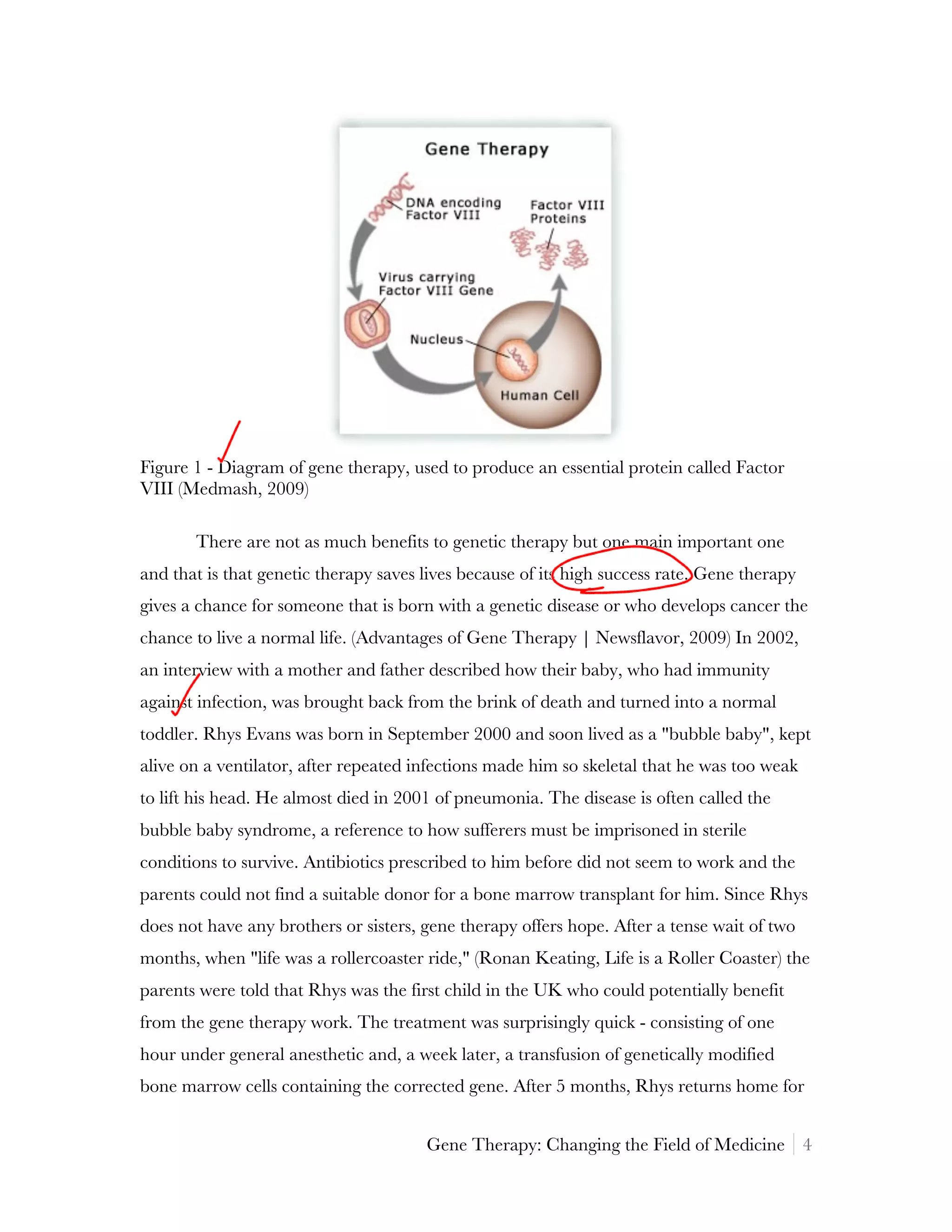
(INNOVATION - Gene Therapy Animation, no date) Below (Figure 1) is a simple
diagram explaining how gene therapy works.


                                        Gene Therapy: Changing the Field of Medicine 3
Figure 1 - Diagram of gene therapy, used to produce an essential protein called Factor
VIII (Medmash, 2009)

       There are not as much benefits to genetic therapy but one main important one
and that is that genetic therapy saves lives because of its high success rate. Gene therapy
gives a chance for someone that is born with a genetic disease or who develops cancer the
chance to live a normal life. (Advantages of Gene Therapy | Newsflavor, 2009) In 2002,
an interview with a mother and father described how their baby, who had immunity
against infection, was brought back from the brink of death and turned into a normal
toddler. Rhys Evans was born in September 2000 and soon lived as a "bubble baby", kept
alive on a ventilator, after repeated infections made him so skeletal that he was too weak
to lift his head. He almost died in 2001 of pneumonia. The disease is often called the
bubble baby syndrome, a reference to how sufferers must be imprisoned in sterile
conditions to survive. Antibiotics prescribed to him before did not seem to work and the
parents could not find a suitable donor for a bone marrow transplant for him. Since Rhys
does not have any brothers or sisters, gene therapy offers hope. After a tense wait of two
months, when "life was a rollercoaster ride," (Ronan Keating, Life is a Roller Coaster) the
parents were told that Rhys was the first child in the UK who could potentially benefit
from the gene therapy work. The treatment was surprisingly quick - consisting of one
hour under general anesthetic and, a week later, a transfusion of genetically modified
bone marrow cells containing the corrected gene. After 5 months, Rhys returns home for


                                       Gene Therapy: Changing the Field of Medicine 4
Panyatree (Sunny) Kongkwanyuen

Christmas, he showed huge signs of improvement. He was now allowed to play and go
outside, this was one of the miracles of gene therapy. (Gene therapy saves life of boy in a
bubble – Telegraph, 2002)


       With benefits, there are limitations. One is that patients must go through genetic
testing to identify the problem gene. For those people who found out their problem, they
face a dilemma. The dilemma is to find an adequate insurance to cover the treatment,
which could be gene therapy, or living out their lives knowing that they carry a gene for a
disease. This positive test has placed them in a high-risk group that they may have not
been in if they had not been tested. This high-risk tag makes insurance coverage almost
impossible to find. The insurance that will cover them may be extremely expensive. So,
choosing to have the test may be a question of whether they think their current insurance
will cover them or not. (Brandi Rochell, 1996)
       Another problem is the process itself. Scientists are still struggling to make gene
therapy work. There are still many complications such as: viruses and other agents used
to deliver the "good" genes can affect more than the cells for which they're intended. If a
gene is added to DNA, it could be placed in the wrong place, which could potentially
cause cancer, other damage or cause an immune response that could potentially kill the
patient. And a virus introduced into one person could be transmitted to others or into the
environment. Also Genes also can be "over expressed," meaning they can drive the
production of so much of a protein that they can be harmful. (Gene Therapy and
Children, 2010)


       “Gene therapy is thought of by some people as an terrific discovery that could
greatly improve the human population and also give people with certain disabilities some
glimmer of hope. And on the other side of the coin there are some people that think we
have no business playing God. They feel that playing God may possibly cause devastating
effects to the human gene pool and may also led to misuse.” (Eric Hogarth, 1006). There
are a few ethic issues relating to whether gene therapy should be used on patients or not.
Even if gene therapies have a high success rate, patients have the risk of dying in the
process. Gene therapy is used to help cure terminal illness, particularly cancer but this


                                       Gene Therapy: Changing the Field of Medicine 5
therapy is a risky treatment for people who are relatively healthy. A 36-year-old woman
with rheumatoid arthritis died in July 2007 while participating in a gene therapy clinical
trial. Experts say that patients should be very cautious when considering gene therapy,
especially if the disease is not life threatening or is under control with available
medication. Some scientists, however, argue with restricting the people for gene therapy
research. "If you wet your pants walking down the street, it's not life-threatening, but it's severe. Diseases
can have serious effects on quality of life but not be life-threatening," (Arnold Melman, an Albert
Einstein College of Medicine gene therapist.) Defenders of gene therapy say that they get
more criticism than old-fashioned pharmaceuticals. It is also true that restricting the
patients for gene therapy will make it difficult to get clearer results and develop gene
therapy. (Gene-Therapy Deaths Raise Ethics Issues, 2007)


         “I'm beautiful in my way 'cause God makes no mistakes. I'm on the right track, baby. I was born
this way. Don't hide yourself in regret. Just love yourself and you're set. I'm on the right track, baby. I was
born this way” (Lady Gaga, I was Born this way) If scientists could identify the gene that
contributes to youth or beauty, then the technique of gene therapy could be monopolized
by the cosmetic industry to enhance beauty or to make someone younger. The political
and social problem with this is whether baldness, height, or beauty should be enough of a
reason to require gene therapy. Federal regulation will have to come into play in deciding
whether a big nose is as important of a genetic problem as cystic fibrosis, which requires
gene therapy. As new technology is being discovered that can make plastic surgery look so
last century. Gene therapy and commercial human cloning techniques are now offering
the possibilities to radically change customers at the cellular level – making real
substantive changes to the person rather than simply reshaping the exterior.
Unfortunately most governments and medical bodies are instinctively conservative in
nature and tend to ban or excessively regulate the use of gene therapy. However the
people of the “Young and Beautiful Cosmetic Surgery Clinic” are firm believers of using
new technology to help youth and beauty. (Young and Beautiful Cosmetic Surgery Clinic
- Gene therapy and human cloning, 2005)


                                               Gene Therapy: Changing the Field of Medicine 6
Panyatree (Sunny) Kongkwanyuen

         “Gene therapy will change the field of medicine from what it is today. As scientists
discover more genes and their functions, the potential of this treatment is limitless. Our
genome is the blueprint of our body. The key to our future is locked in our genome. As
researchers start to understand this blueprint, our lives will be forever changed. We now
know our fate is indeed in our genes.” (Brandi Rochell, 1996) Today, scientists are still
working on improving gene therapy and finding out more possibilities so that there will be
more benefits from gene therapy. Because, right now, there are not many benefits and
there are limitations that concerns patients. Issues are still being debated on about who
controls the information and who has more rights to gene therapy.
         I think gene therapy is a wonderful new type of medicine that will definitely
develop and become perfect in the future. Even though I am for the idea of gene therapy,
after researching on the issues relating to gene therapy, I think that people should really
consider if their little “problems” (For example beauty) are as important as a person with
a life threatening disease. I think that until scientists have near perfected gene therapy,
gene therapy should only be used on people with terminal illness that could cause them
death.


                                        Gene Therapy: Changing the Field of Medicine 7
Works Cited
"Advantages of Gene Therapy | Newsflavor." Newsflavor | News In Any Flavor: Daily News,

        Latest News, Local News, Breaking News, US News, World News. N.p., n.d. Web. 22

        Sept. 2011. <http://newsflavor.com/opinions/advantages-of-gene-therapy/>.

Bartoshesky, Louis E.. "Gene Therapy and Children." KidsHealth - the Web's most visited site

        about children's health. N.p., n.d. Web. 22 Sept. 2011.

        <http://kidshealth.org/parent/system/medical/gene_therapy.html#>.

"Gene Therapy is the sh*t, and what you should know about it. | Medmash."Medmash |
       a self-proclaimed technophile gone med-student; the chronicles. . N.p., 22 Oct. 2009. Web. 5
       Oct. 2011.
       <http://www.medmash.com/2009/10/gene-therapy-is-the-sht-and-what-you-
       should-know-about-it/>.

Hunt, Katherine, and Teresa Odle. "Gene therapy Facts, information, pictures |

        Encyclopedia.com articles about gene therapy." Encyclopedia.com | Free Online

        Encyclopedia. Version Gale Encyclopedia of Medicine, 3rd ed.. N.p., n.d. Web. 27

        Sept. 2011. <http://www.encyclopedia.com/topic/gene_therapy.aspx>.

"INNOVATION - Gene Therapy Animation." edu365.cat. N.p., n.d. Web. 22 Sept. 2011.

        <http://www.edu365.cat/aulanet/comsoc/Lab_bio/simulacions/GeneTherapy

        /GeneTherapy.htm>.

Keim, Brandon. "Gene-Therapy Deaths Raise Ethics Issues." Wired.com . N.p., 30 Aug.

        2007. Web. 1 Oct. 2011.

        <http://www.wired.com/medtech/genetics/news/2007/08/gene_therapy?curr

        entPage=all#>.

Rocholl, Brandi. "Gene Therapy." NDSU - North Dakota State University. N.p., n.d. Web. 22

                                         Gene Therapy: Changing the Field of Medicine 8
Panyatree (Sunny) Kongkwanyuen


        Sept. 2011.

        <http://www.ndsu.edu/pubweb/~mcclean/plsc431/students/brandi.htm>.

The Telegraph. "Gene therapy saves life of boy in a bubble - Telegraph." Telegraph.co.uk -

        Telegraph online, Daily Telegraph and Sunday Telegraph - Telegraph. N.p., n.d. Web. 29

        Sept. 2011. <http://www.telegraph.co.uk/news/uknews/1389759/Gene-

        therapy-saves-life-of-boy-in-a-bubble.html>.

Twyman, Richard. "Gene therapy | The Human Genome." In the genome | The Human

        Genome. N.p., 27 Aug. 2002. Web. 27 Sept. 2011.

        <http://genome.wellcome.ac.uk/doc_WTD020911.html>.

"Young and Beautiful Cosmetic Surgery Clinic - Gene therapy and human cloning."

        Young and Beautiful Cosmetic Surgery Clinic - a whole new you!. N.p., n.d. Web. 26 Sept.

        2011. <http://www.youngandbeautifulclinic.com/gene.htm>.

MLA formatting by BibMe.org.


                                        Gene Therapy: Changing the Field of Medicine 9

SPK - Genetic OWE Graded

  • 1.
    Panyatree (Sunny) Kongkwanyuen Panyatree (Sunny) Kongkwanyuen 10R Biology/Chemistry Genetic Technology One World Essay Beijing BISS International School School Code: 1123 October 14, 2011 Gene Therapy: Changing the Field of Medicine 1
  • 2.
    Criterion A:        Criterion B:  Gene Therapy: Changing the Field of Medicine 2
  • 3.
    Panyatree (Sunny) Kongkwanyuen Gene Therapy: Changing the Field of Medicine Gene therapy is a rapidly growing field in medicine that introduces a DNA into the body to cure a specific disease. (Hunt, Katherine, and Teresa Odle, 2006) Genes control heredity and contains basic biological codes for determining specific functions of a cell. Gene therapy is to provide cells that correct or replace the disease-controlling cells to prevent the person to develop the disease. Gene therapy has the potential to eliminate and prevent hereditary diseases such as cystic fibrosis and is a possible cure for heart disease, AIDS and cancer. Gene therapy is the transfer of DNA into your body. It is either done by mixing this DNA with a substance that enhances the DNA in your body or by inserting the DNA into a good virus, that doesn’t cause a disease, into the right part of your body. The virus carries the DNA into the cell. The process is fairly simple to explain. The process starts by first removing the cells from the patient’s body then re-introducing new cells that have been appropriately modified to help cure a disease. (Gene therapy | The Human Genome, 2002) The first step is to snip out many of the genes from a virus and substitute the therapeutic gene. Then the virus is mixed with cells taken out of the body or directly injected into a target tissue. Once the virus is locked in place, the receptor is switched on and the cell begins sucking the virus inside, in a process called endocytosis. The virus capsule break apart inside the cell and with most viruses used in gene therapy, the genetic material inside then enters the nucleus Gene therapists can take advantage of viruses that have the ability to code for an enzyme. At the same time the enzyme snips apart the cell’s DNA and inserts the viral DNA, which carries the therapeutic gene. With the therapeutic gene in place, the cell begins producing a working copy of the protein that had been defective or lacking. In effect, the biochemical machinery of the cell has been fixed. (INNOVATION - Gene Therapy Animation, no date) Below (Figure 1) is a simple diagram explaining how gene therapy works. Gene Therapy: Changing the Field of Medicine 3
  • 4.
    Figure 1 -Diagram of gene therapy, used to produce an essential protein called Factor VIII (Medmash, 2009) There are not as much benefits to genetic therapy but one main important one and that is that genetic therapy saves lives because of its high success rate. Gene therapy gives a chance for someone that is born with a genetic disease or who develops cancer the chance to live a normal life. (Advantages of Gene Therapy | Newsflavor, 2009) In 2002, an interview with a mother and father described how their baby, who had immunity against infection, was brought back from the brink of death and turned into a normal toddler. Rhys Evans was born in September 2000 and soon lived as a "bubble baby", kept alive on a ventilator, after repeated infections made him so skeletal that he was too weak to lift his head. He almost died in 2001 of pneumonia. The disease is often called the bubble baby syndrome, a reference to how sufferers must be imprisoned in sterile conditions to survive. Antibiotics prescribed to him before did not seem to work and the parents could not find a suitable donor for a bone marrow transplant for him. Since Rhys does not have any brothers or sisters, gene therapy offers hope. After a tense wait of two months, when "life was a rollercoaster ride," (Ronan Keating, Life is a Roller Coaster) the parents were told that Rhys was the first child in the UK who could potentially benefit from the gene therapy work. The treatment was surprisingly quick - consisting of one hour under general anesthetic and, a week later, a transfusion of genetically modified bone marrow cells containing the corrected gene. After 5 months, Rhys returns home for Gene Therapy: Changing the Field of Medicine 4
  • 5.
    Panyatree (Sunny) Kongkwanyuen Christmas,he showed huge signs of improvement. He was now allowed to play and go outside, this was one of the miracles of gene therapy. (Gene therapy saves life of boy in a bubble – Telegraph, 2002) With benefits, there are limitations. One is that patients must go through genetic testing to identify the problem gene. For those people who found out their problem, they face a dilemma. The dilemma is to find an adequate insurance to cover the treatment, which could be gene therapy, or living out their lives knowing that they carry a gene for a disease. This positive test has placed them in a high-risk group that they may have not been in if they had not been tested. This high-risk tag makes insurance coverage almost impossible to find. The insurance that will cover them may be extremely expensive. So, choosing to have the test may be a question of whether they think their current insurance will cover them or not. (Brandi Rochell, 1996) Another problem is the process itself. Scientists are still struggling to make gene therapy work. There are still many complications such as: viruses and other agents used to deliver the "good" genes can affect more than the cells for which they're intended. If a gene is added to DNA, it could be placed in the wrong place, which could potentially cause cancer, other damage or cause an immune response that could potentially kill the patient. And a virus introduced into one person could be transmitted to others or into the environment. Also Genes also can be "over expressed," meaning they can drive the production of so much of a protein that they can be harmful. (Gene Therapy and Children, 2010) “Gene therapy is thought of by some people as an terrific discovery that could greatly improve the human population and also give people with certain disabilities some glimmer of hope. And on the other side of the coin there are some people that think we have no business playing God. They feel that playing God may possibly cause devastating effects to the human gene pool and may also led to misuse.” (Eric Hogarth, 1006). There are a few ethic issues relating to whether gene therapy should be used on patients or not. Even if gene therapies have a high success rate, patients have the risk of dying in the process. Gene therapy is used to help cure terminal illness, particularly cancer but this Gene Therapy: Changing the Field of Medicine 5
  • 6.
    therapy is arisky treatment for people who are relatively healthy. A 36-year-old woman with rheumatoid arthritis died in July 2007 while participating in a gene therapy clinical trial. Experts say that patients should be very cautious when considering gene therapy, especially if the disease is not life threatening or is under control with available medication. Some scientists, however, argue with restricting the people for gene therapy research. "If you wet your pants walking down the street, it's not life-threatening, but it's severe. Diseases can have serious effects on quality of life but not be life-threatening," (Arnold Melman, an Albert Einstein College of Medicine gene therapist.) Defenders of gene therapy say that they get more criticism than old-fashioned pharmaceuticals. It is also true that restricting the patients for gene therapy will make it difficult to get clearer results and develop gene therapy. (Gene-Therapy Deaths Raise Ethics Issues, 2007) “I'm beautiful in my way 'cause God makes no mistakes. I'm on the right track, baby. I was born this way. Don't hide yourself in regret. Just love yourself and you're set. I'm on the right track, baby. I was born this way” (Lady Gaga, I was Born this way) If scientists could identify the gene that contributes to youth or beauty, then the technique of gene therapy could be monopolized by the cosmetic industry to enhance beauty or to make someone younger. The political and social problem with this is whether baldness, height, or beauty should be enough of a reason to require gene therapy. Federal regulation will have to come into play in deciding whether a big nose is as important of a genetic problem as cystic fibrosis, which requires gene therapy. As new technology is being discovered that can make plastic surgery look so last century. Gene therapy and commercial human cloning techniques are now offering the possibilities to radically change customers at the cellular level – making real substantive changes to the person rather than simply reshaping the exterior. Unfortunately most governments and medical bodies are instinctively conservative in nature and tend to ban or excessively regulate the use of gene therapy. However the people of the “Young and Beautiful Cosmetic Surgery Clinic” are firm believers of using new technology to help youth and beauty. (Young and Beautiful Cosmetic Surgery Clinic - Gene therapy and human cloning, 2005) Gene Therapy: Changing the Field of Medicine 6
  • 7.
    Panyatree (Sunny) Kongkwanyuen “Gene therapy will change the field of medicine from what it is today. As scientists discover more genes and their functions, the potential of this treatment is limitless. Our genome is the blueprint of our body. The key to our future is locked in our genome. As researchers start to understand this blueprint, our lives will be forever changed. We now know our fate is indeed in our genes.” (Brandi Rochell, 1996) Today, scientists are still working on improving gene therapy and finding out more possibilities so that there will be more benefits from gene therapy. Because, right now, there are not many benefits and there are limitations that concerns patients. Issues are still being debated on about who controls the information and who has more rights to gene therapy. I think gene therapy is a wonderful new type of medicine that will definitely develop and become perfect in the future. Even though I am for the idea of gene therapy, after researching on the issues relating to gene therapy, I think that people should really consider if their little “problems” (For example beauty) are as important as a person with a life threatening disease. I think that until scientists have near perfected gene therapy, gene therapy should only be used on people with terminal illness that could cause them death. Gene Therapy: Changing the Field of Medicine 7
  • 8.
    Works Cited "Advantages ofGene Therapy | Newsflavor." Newsflavor | News In Any Flavor: Daily News, Latest News, Local News, Breaking News, US News, World News. N.p., n.d. Web. 22 Sept. 2011. <http://newsflavor.com/opinions/advantages-of-gene-therapy/>. Bartoshesky, Louis E.. "Gene Therapy and Children." KidsHealth - the Web's most visited site about children's health. N.p., n.d. Web. 22 Sept. 2011. <http://kidshealth.org/parent/system/medical/gene_therapy.html#>. "Gene Therapy is the sh*t, and what you should know about it. | Medmash."Medmash | a self-proclaimed technophile gone med-student; the chronicles. . N.p., 22 Oct. 2009. Web. 5 Oct. 2011. <http://www.medmash.com/2009/10/gene-therapy-is-the-sht-and-what-you- should-know-about-it/>. Hunt, Katherine, and Teresa Odle. "Gene therapy Facts, information, pictures | Encyclopedia.com articles about gene therapy." Encyclopedia.com | Free Online Encyclopedia. Version Gale Encyclopedia of Medicine, 3rd ed.. N.p., n.d. Web. 27 Sept. 2011. <http://www.encyclopedia.com/topic/gene_therapy.aspx>. "INNOVATION - Gene Therapy Animation." edu365.cat. N.p., n.d. Web. 22 Sept. 2011. <http://www.edu365.cat/aulanet/comsoc/Lab_bio/simulacions/GeneTherapy /GeneTherapy.htm>. Keim, Brandon. "Gene-Therapy Deaths Raise Ethics Issues." Wired.com . N.p., 30 Aug. 2007. Web. 1 Oct. 2011. <http://www.wired.com/medtech/genetics/news/2007/08/gene_therapy?curr entPage=all#>. Rocholl, Brandi. "Gene Therapy." NDSU - North Dakota State University. N.p., n.d. Web. 22 Gene Therapy: Changing the Field of Medicine 8
  • 9.
    Panyatree (Sunny) Kongkwanyuen Sept. 2011. <http://www.ndsu.edu/pubweb/~mcclean/plsc431/students/brandi.htm>. The Telegraph. "Gene therapy saves life of boy in a bubble - Telegraph." Telegraph.co.uk - Telegraph online, Daily Telegraph and Sunday Telegraph - Telegraph. N.p., n.d. Web. 29 Sept. 2011. <http://www.telegraph.co.uk/news/uknews/1389759/Gene- therapy-saves-life-of-boy-in-a-bubble.html>. Twyman, Richard. "Gene therapy | The Human Genome." In the genome | The Human Genome. N.p., 27 Aug. 2002. Web. 27 Sept. 2011. <http://genome.wellcome.ac.uk/doc_WTD020911.html>. "Young and Beautiful Cosmetic Surgery Clinic - Gene therapy and human cloning." Young and Beautiful Cosmetic Surgery Clinic - a whole new you!. N.p., n.d. Web. 26 Sept. 2011. <http://www.youngandbeautifulclinic.com/gene.htm>. MLA formatting by BibMe.org. Gene Therapy: Changing the Field of Medicine 9