Evidence-Based Geriatric Pharmacotherapy: 2010  H. Edward Davidson, PharmD, MPH Eastern Virginia Medical School Insight Therapeutics, LLC
Vaccines
Varicella Zoster Infection Primary Infection (Chickenpox) Latency Reactivation (Shingles) Varicella Zoster Dorsal   Ganglion
Varicella Zoster In US (Pre-Vaccine Era) Primary Infection in the U.S. 4 million cases annually 95% of persons infected by age 15 145 deaths annually; adult rate higher 12,000 hospitalizations annually
Varicella Zoster In US (Post-Vaccine Era) Primary Infection in the U.S. ~ 800,000 cases annually 81% of persons vaccinated ~ 1500 hospitalizations annually 66 deaths  annually
Risk Factors for “Shingles” Stressful events trauma, surgical procedures, X-ray, other physical, emotional stress Immune system alteration HIV, malignancy drugs - cytotoxic, corticosteroids Age age-related decline in cell mediated immunity
Reducing Incidence of “Shingles” Exposure to children with primary varicella infection (“Chickenpox”) Pediatricians have a reduced rate of zoster  Household exposure enhances cell mediated immunity Varicella vaccination of adults Several small studies and one large study (38, 500 patients) have shown reduced incidence of zoster  Vaccine (Zostavax) approved by FDA in 2006
Number of Herpes Zoster  Cases Observed in MSGP4 Age Zoster cases Data – Children < 16 years Data – No Children Model – Children < 16 years Model – No Children Brisson, M et al. Vaccine. 2002 MSGP4 = National Survey of Morbidity in General Practice 4
Prediction of Post-Vaccination Incidence of Herpes-Zoster No Vaccination Best Fit, 20yrs immunity 95% CI, 7-41yrs immunity Zoster incidence rate (per 100,000  per year) Year after start of vaccination Brisson, M et al. Vaccine. 2002
Herpes Zoster Related Hospitalizations and Expenditures Before and After Introduction of the Varicella Vaccine in the  United States Patel MS et al. Infect Control Hosp Epidemiol 2008;29:1157-63
Herpes-Zoster Related Hospitalizations Retrospective analysis of a deidentified dataset, Nationwide Inpatient Sample (NIS) (AHRQ) Nationally representative sample Study period 1993 – 2004 Herpes zoster-related hospital discharges (HZHDs) and varicella-related hospital discharges (VRHDs) identified (ICD-9) Resource utilization and clinical data analyzed
HZHDs and VRHDs by Year Universal Vaccination in U.S.
HZHDs by Year and Age Universal Vaccination in U.S.
Cost of HZHD and VRHD by Year Universal Vaccination in U.S.
Barriers to Use of  Herpes Zoster Vaccine Hurley LP et al. Ann Intern Med 2010;152;555-60. Mail + internet-based survey of general internists and family medicine physicians, July-Sept 2008 Funded by CDC Measured survey responses on: Current vaccination practices Knowledge and practice regarding reimbursement Barriers to vaccination
Perceived Barriers to Administering HZ Vaccine in the Office 56 19 13 12 Difficulty in obtaining vaccine 35 30 23 12 More pressing medical issues 42 22 20 16 Need to store in freezer 34 18 25 23 Patient pick-up at pharmacy 19 17 21 43 Up-front costs for practice 13 10 25 52 Reimbursement issues 7 10 30 53 Cost for patient Not at all Minor Somewhat Major Responses, % Barrier
Provider strength of recommendation for herpes zoster vaccine compared with other vaccines Hurley L P et al. Ann Intern Med 2010;152:555-560 ©2010 by American College of Physicians
Take away … Less than 7% of target population (> 59 yrs, no recent hx) for HZ vaccine have received it 1 Epidemiologic evidences suggest a “rash” of new cases in the elderly are coming Barriers exist to HZ vaccine administration Storage – refrigerator stable formulation licensed in EU Cost – covered by Medicare (under Part D); need to streamline reimbursement process Lack of awareness of epidemiology trend 1. Schiller JS, Euler GL. CDC, 2010.
Psychopharmacology
Snitz BE, O'Meara ES, Carlson MC, et al. Ginkgo biloba for preventing cognitive decline in older adults: a randomized trial. JAMA 2009;302:2663–2670.  DeKosky ST, Williamson JD, Fitzpatrick AL, et al. Ginkgo biloba for prevention of dementia. JAMA 2008; 300: 2253–2262.
Overview of GEMS Primary outcome :  Determine whether occurrence of dementia (any type) and Alzheimer’s disease specifically is lower for older people with normal memory treated with  Ginkgo biloba  compared with a placebo  Design: Randomized, double-blind, multi-center clinical trial 3,069 persons  ≥  75 years old with normal memory or very mild cognitive impairment (MCI = 10%)
Secondary Outcomes All-cause mortality Combined CHD – nonfatal MI, CHD death, coronary revascularization, hospitalized angina Combined CVD – combined CHD, stroke, lower extremity revascularization, treated angina, fatal/ hospitalized/treated CHF, hospitalized or outpatient PAD General cognitive function (change over time) Physical function
Sites in GEMS 5 clinical sites in the United States, all Academic Medical Centers: Johns Hopkins (Hagerstown, MD) University of California, Davis (Sacramento, CA) University of Pittsburgh, (Pittsburgh, PA) Wake Forest University  Winston-Salem, NC Greensboro, NC
Randomized Design of GEMS Persons with Normal Memory Function  or  Mild Cognitive Impairment (MCI) Consent / Randomize (3,069) Ginkgo biloba or Placebo Test every 6 months for:  New onset dementia of any type and Alzheimer’s disease specifically, and  Other outcomes until death or end of study (up to 6.5 years).
GEMS Results: Baseline Characteristics
GEMS Results:  Baseline Characteristics
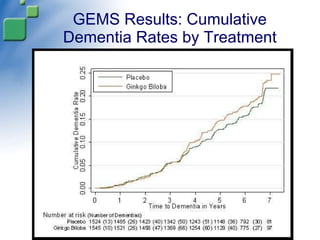
GEMS Results: Cumulative  Dementia Rates by Treatment
GEMS Results Hazard Ratios for Cox Regression Analyses All Dementia  and Subtypes of Dementia comparing Ginkgo to placebo
GEMS Results Adverse Events
Overall Conclusion Ginkgo biloba  at 120 mg twice a day is not effective in reducing the overall incidence of dementia or Alzheimer’s disease in older adults.  Neither is  Ginkgo biloba  effective in preventing dementia in persons with mild cognitive impairment.
GEMS Memory Study


A Case Study of Herbal Remedy Polypharmacy 77 yo wm referred to geriatric assessment clinic in CA spring 2009 Progressive problems with word finding, disorientation, agitation, and irritability Sister with dementia History of smoking (quit 30 yrs ago), ethanol abuse, illicit drug use Problem list (PCP); Alzheimer’s dementia (MMSE 15/30, could not draw clock), CAD with history of MI, bradycardia, hypertension, dyslipidemia, gait and balance problems, hx falls, incontinence, depression
Prescription Medications Pravastatin Lisinopril Aspirin Niacin  Triamterene/hydrochlorothiazide Sertraline Donepezil Memantine
Dietary and Herbal Supplements B-100 complex Coenzyme Q-10 Omega-3 fatty acids Core complex (quercetin) CardioHealth B-12 Folic Acid Vitamin C Vitamin E Beta carotene Valerian root complex Vitamin D3 Calcium complex Triple berry complex Schizandra plus Mega garlic plus Garden 7 phytonutrients Rose OX  Joint support Generic multivitamin Cell activator NiteWorks (amino acids)
Strategies to Address this Issue Include discussion of supplements/herbal remedies with each medication reconciliation Natural Medicines Comprehensive Database (available from Prescriber’s Letter,  www.naturaldatabase.com ) On-line version also available  Research is limited on these products May be a waste of limited resources
Preferred Medications in the Elderly Historically, medication use in the elderly has evolved around avoiding “potentially inappropriate medications” (e.g., Beers criteria) Medicare Part D and PDPs have developed formularies based primarily on cost/rebates Need for “geriatrics-focused expert review”
“Positive” Beers Criteria First article published August 2009 Consult Pharm 2009;24:601-10. http:// www.ascp.com/resources/clinical/upload/BeersCriteria.pdf Focus on CNS medications Consensus panel of geriatricians, other providers  Literature review using AHRQ criteria for comparative effectiveness  Delphi consensus process on final selection
Definition: IOM Comparative effectiveness research (CER) is the generation and synthesis of evidence that compares the benefits and harms of alternative methods to prevent, diagnose, treat and monitor a clinical condition or to improve the delivery of care. The purpose of CER is to assist consumers, clinicians, purchasers and policy makers to make informed decisions that will improve health care at both the individual and population levels. National Priorities for Comparative Effectiveness Research Institute of Medicine Report Brief June 2009
AHRQ’s Role in  Comparative Effectiveness Using Information to Drive Improvement: Scientific Infrastructure to Support Reform Lead federal funding Engage private sector Aggregate best evidence to inform complex learning  and implementation challenges Increase knowledge base  to spur high-value care 21 st  Century Health Care
Comparative Effectiveness  and the Recovery Act The American Recovery and Reinvestment Act of 2009 includes  $1.1 billion for comparative effectiveness research: AHRQ: $300 million NIH: $400 million (appropriated to AHRQ and transferred to NIH) Office of the Secretary: $400 million (allocated at the Secretary’s discretion) Federal Coordinating Council appointed to coordinate comparative effectiveness research across the federal government
Preferred CNS Medications for the Elderly Entacapone (add-on only) Ropinirole Carbidopa/Levodopa Parkinson’s Disease Citalopram Duloxetine Escitalopram Bupropion Mirtazapine Depression Donepezil Galantamine (ER only) Memantine (add-on only) Dementia Medication Therapeutic Area
Take Away … Comparative effectiveness is coming Research funded by American Recovery and Reinvestment Act of 2009 will begin soon This is an example of how criteria might be applied and the results NICE (National Institute for Clinical Evidence), the European Union equivalent to proposed comparative effectiveness, provides an example of what we might expect in the future http://www.nice.org.uk/
Chronic Kidney Disease
Creatinine Excretion and Serum Creatinine by Age Creatinine Excretion, mg/day Serum Creatinine Conc., mg % Average Age, years 20 40 60 80 10 73 122 152 94 68 29
Equations for Estimating GFR Abbreviated MDRD Study Equation GFR (mL/min/1.73 m 2 ) = 186.3    SCr   -1.154    Age -0.203       0.742 (if female)    1.210 (if African American)  MDRD = Modification of Diet in Renal Disease; CrCl = creatinine clearance;  SCr=serum creatinine in mg/dL Levey AS, et al. Ann Intern Med. 2003;139:137-47. Cockcroft-Gault Equation CrCl  = (mL/min) (140  – Age)    Weight in kg 72    SCr    0.85 if female
Prevalence of Low GFR in Nursing  Home Elderly – Cockcroft-Gault  Age (years) Percent of Patients Garg AX, et al. Kid Int 2004;65:649-53.
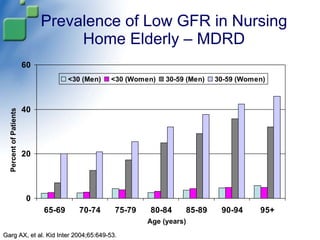
Prevalence of Low GFR in Nursing Home Elderly – MDRD Age (years) Percent of Patients Garg AX, et al. Kid Inter 2004;65:649-53.
Cockcroft-Gault (CG) or MDRD? Recent Study in JAGS 2009;57:1638-43 Measured CrCl based on 24-hour urine collection Comparison to measured value: CG slightly underestimates CrCl MDRD strongly overestimates CrCl KDOQI guidelines recommend MDRD for diagnosing and staging of CKD  CG should be used for dosing medications KDOQI = Kidney Disease Outcomes Quality Initiative
Drugs That Need Special Attention in CKD Warfarin Warfarin metabolism not significantly altered Hemorrhage more likely - probably due to platelet dysfunction/drug-interactions Low-molecular-weight heparins Cleared primarily by the kidneys Risk of hemorrhage more likely with CKD Dose reduction required for most (usual cut-off 30 ml/min) Direct thrombin inhibitors Reduce dose for most – Hirudin, lepirudin Fondaparinux – avoid when CrCl less than 30 ml/min Gabardi S, Abramson S. Med Clin N Am 2005;89:649-87.
Drugs That Need Special Attention in CKD (2) ACE inhibitors As a class, generally cleared by the kidney (exception is fosinopril – hepatobiliary excretion) Reduce dose, however use not contraindicated  ACEs beneficial in many with CKD (diabetes, CHF) NSAIDs should be avoided with ACEs in CKD ARBs Metabolized by liver – no adjustment needed Similar risk for ARF to ACE – monitor appropriately Combination of ACE + ARB seems to be safe in CKD Gabardi S, Abramson S. Med Clin N Am 2005;89:649-87.
Drugs That Need Special Attention in CKD (3) Antihypertensive agents Alpha-blockers – increased risk of orthostasis/hypotension Beta-blockers – increased risk of bradycardia: reduce dose of acebutolol, atenolol, nadolol, and sotalol Diuretics Spironolactone + ACE in HF ( ↑ K + ) ; careful in advanced CKD (SCr  ≥ 2.5; GFR <15 mL/min) Thiazides have little effect if used alone in CKD – trouble reaching the nephron Loops have similar problems, but dose increases or the addition of a thiazide may overcome resistance Ototoxicity is more common in CKD due to impaired clearance and higher doses of loops used Gabardi S, Abramson S. Med Clin N Am 2005;89:649-87.
Drugs That Need Special Attention in CKD (4) NSAIDs; problems in CKD include hyperkalemia, hyponatremia, fluid retention, acute renal failure Narcotics Meperidine metabolism altered in CKD, resulting in accumulation of normeperidine (metabolite); may cause seizures Morphine metabolites (morphine-3 and morphine-6-glucuronide) can accumulate in CKD causing prolonged sedation and respiratory depression Oxycodone concentrations about 50% higher in CKD Gabardi S, Abramson S. Med Clin N Am 2005;89:649-87.
Drugs That Need Special Attention in CKD (5) Oral Hypoglycemics Acetohexamide, chlorpropamide, glyburide, and tolazamide; all have active metabolites that may accumulate causing prolonged hypoglycemia Metformin: increased risk of lactic acidosis in CKD Antimicrobials Aminoglycosides/vancomycin: use with caution and if using, monitor serum concentrations closely Cephalosporins/penicillins; most are renally eliminated: in most cases, dose is reduced in lieu of interval; Efficacy in UTI may be reduced Fluoroquinolones; most are renally eliminated. Better in UTI than cephs/pens in CKD Gabardi S, Abramson S. Med Clin N Am 2005;89:649-87.
Transitions of Care
Transition of Care vs Transitional Care The  movement of patients  from one practitioner or setting to another Multiple levels Within Settings Primary care    Specialty care Between Settings Hospital    Home Across health states Curative care    Palliative care/Hospice A  set of actions  ensuring the coordination and continuity of  care as patients transfer between locations or levels of care Includes: Logistical arrangements Education of the patient and family Coordination among the health professionals involved in the transition Coleman E, et al. J Am Geriatr Soc 2003;51:556-7.
Ineffective Transitions  Lead to Poor Outcomes Wrong treatment Delay in diagnosis Severe adverse events Patient complaints Increased healthcare costs Increased length of stay Australian Council for Safety and Quality in Health Care. Clinical hand-over and Patient Safety literature Review Report. March 2005. Available www.safetyandquality.org/internet/safety/publishing.nsf/Content/ AA1369AD4AC5FC2ACA2571BF0081CD95/$File/clinhovrlitrev.pdf
Care Transitions 30 Days Following Acute Care Hospital Home 64% 77% 13% 11% Nursing Facility Hospital or TCU 16% 10% 74% TCU = Transitional Care Unit Coleman EA et al. Health Svcs Research 2004;37:1423-40
Predictors of Complicated  Care Transitions Heart disease Diabetes # of prior hospitalizations Visual impairment Medicaid recipient Prior stroke Coleman EA et al. Health Svcs Research 2004;37:1423-40. Increasing Risk
Medication Discrepancies:  Hospital to SNFs Transitions Tija et al. J Gen Intern Medicine 2009. Cross-sectional study of patients admitted to SNF for subacute care (N=199, 2319 meds) Results:  21.3% of medication orders had a discrepancy At least one discrepancy in 71.4% of patients CV agents, opioid analgesics, neuropsychiatric agents, hypoglycemics, antibiotics, and anticoagulants accounted for > 50% of all discrepancies SNF=Skilled nursing facility
Models of Care Guided Care http://www.guidedcare.org/ The Transitional Care Model (TCM) http://www.transitionalcare.info/ The Care Transitions Intervention (CTI) http://www.caretransitions.org/ Project RED http://www.bu.edu/fammed/projectred/
Project RED http:// www.bu.edu/fammed/projectred/index.html http://relationalagents.com/red_demo_4545.wmv
CTM-3 The hospital staff took my preferences and those of my family or caregiver into account  in deciding what my health care needs would be when I left the hospital.  When I left the hospital, I had a good understanding of the things I was responsible for in managing my health. When I left the hospital, I clearly understood the purpose for taking each of my medications. http://www.caretransitions.org/documents/CTM3Specs0807.pdf
“ Ideal Transition Record” (ACP, SGIM, SHM, AGS, ACEP,  and SAEM) Primary, secondary diagnoses and problems list Medication list (reconciliation) including OTC/other  Treatment and diagnostic plan  Clearly identifiable medical home/coordinating and transferring MD/institution and contact information Prognosis and outcome goals  Test results (available and pending) Patient cognitive status Advance directives, power of attorney, consent Planned interventions, med equipment, wound care Emergency plan, contact information  Assessment of caregiver status Snow V et al. J Gen Intern Med 2009;24:971-6.
Medication List Toolkit www.patientsafety.org/page/109587/
H.R. 3590 and H.R. 4872 Community-based Care Transitions Program Demonstration project to evaluate integrated care around hospitalization Independence at home demonstration program State option to provide health homes to Medicaid enrollees with chronic conditions Community Health Teams to support the Patient-Centered Medical Home CMS Innovation Center to test models of care
Working to Address the Issues www.ntocc.org
Recent Practice Guidelines  American Geriatrics Society  - Pharmacological Management of Persistent Pain in Older Persons  Infectious Disease Society of America/ Society for Healthcare Epidemiology of America  –  Clostridium difficile  infection in adults: 2010 update American Medical Directors Association  – Transitions of Care in the Long-Term Care Continuum
Questions?

Davidson Grandrounds2010 Final

  • 1.
    Evidence-Based Geriatric Pharmacotherapy:2010 H. Edward Davidson, PharmD, MPH Eastern Virginia Medical School Insight Therapeutics, LLC
  • 2.
  • 3.
    Varicella Zoster InfectionPrimary Infection (Chickenpox) Latency Reactivation (Shingles) Varicella Zoster Dorsal Ganglion
  • 4.
    Varicella Zoster InUS (Pre-Vaccine Era) Primary Infection in the U.S. 4 million cases annually 95% of persons infected by age 15 145 deaths annually; adult rate higher 12,000 hospitalizations annually
  • 5.
    Varicella Zoster InUS (Post-Vaccine Era) Primary Infection in the U.S. ~ 800,000 cases annually 81% of persons vaccinated ~ 1500 hospitalizations annually 66 deaths annually
  • 6.
    Risk Factors for“Shingles” Stressful events trauma, surgical procedures, X-ray, other physical, emotional stress Immune system alteration HIV, malignancy drugs - cytotoxic, corticosteroids Age age-related decline in cell mediated immunity
  • 7.
    Reducing Incidence of“Shingles” Exposure to children with primary varicella infection (“Chickenpox”) Pediatricians have a reduced rate of zoster Household exposure enhances cell mediated immunity Varicella vaccination of adults Several small studies and one large study (38, 500 patients) have shown reduced incidence of zoster Vaccine (Zostavax) approved by FDA in 2006
  • 8.
    Number of HerpesZoster Cases Observed in MSGP4 Age Zoster cases Data – Children < 16 years Data – No Children Model – Children < 16 years Model – No Children Brisson, M et al. Vaccine. 2002 MSGP4 = National Survey of Morbidity in General Practice 4
  • 9.
    Prediction of Post-VaccinationIncidence of Herpes-Zoster No Vaccination Best Fit, 20yrs immunity 95% CI, 7-41yrs immunity Zoster incidence rate (per 100,000 per year) Year after start of vaccination Brisson, M et al. Vaccine. 2002
  • 10.
    Herpes Zoster RelatedHospitalizations and Expenditures Before and After Introduction of the Varicella Vaccine in the United States Patel MS et al. Infect Control Hosp Epidemiol 2008;29:1157-63
  • 11.
    Herpes-Zoster Related HospitalizationsRetrospective analysis of a deidentified dataset, Nationwide Inpatient Sample (NIS) (AHRQ) Nationally representative sample Study period 1993 – 2004 Herpes zoster-related hospital discharges (HZHDs) and varicella-related hospital discharges (VRHDs) identified (ICD-9) Resource utilization and clinical data analyzed
  • 12.
    HZHDs and VRHDsby Year Universal Vaccination in U.S.
  • 13.
    HZHDs by Yearand Age Universal Vaccination in U.S.
  • 14.
    Cost of HZHDand VRHD by Year Universal Vaccination in U.S.
  • 15.
    Barriers to Useof Herpes Zoster Vaccine Hurley LP et al. Ann Intern Med 2010;152;555-60. Mail + internet-based survey of general internists and family medicine physicians, July-Sept 2008 Funded by CDC Measured survey responses on: Current vaccination practices Knowledge and practice regarding reimbursement Barriers to vaccination
  • 16.
    Perceived Barriers toAdministering HZ Vaccine in the Office 56 19 13 12 Difficulty in obtaining vaccine 35 30 23 12 More pressing medical issues 42 22 20 16 Need to store in freezer 34 18 25 23 Patient pick-up at pharmacy 19 17 21 43 Up-front costs for practice 13 10 25 52 Reimbursement issues 7 10 30 53 Cost for patient Not at all Minor Somewhat Major Responses, % Barrier
  • 17.
    Provider strength ofrecommendation for herpes zoster vaccine compared with other vaccines Hurley L P et al. Ann Intern Med 2010;152:555-560 ©2010 by American College of Physicians
  • 18.
    Take away …Less than 7% of target population (> 59 yrs, no recent hx) for HZ vaccine have received it 1 Epidemiologic evidences suggest a “rash” of new cases in the elderly are coming Barriers exist to HZ vaccine administration Storage – refrigerator stable formulation licensed in EU Cost – covered by Medicare (under Part D); need to streamline reimbursement process Lack of awareness of epidemiology trend 1. Schiller JS, Euler GL. CDC, 2010.
  • 19.
  • 20.
    Snitz BE, O'MearaES, Carlson MC, et al. Ginkgo biloba for preventing cognitive decline in older adults: a randomized trial. JAMA 2009;302:2663–2670. DeKosky ST, Williamson JD, Fitzpatrick AL, et al. Ginkgo biloba for prevention of dementia. JAMA 2008; 300: 2253–2262.
  • 21.
    Overview of GEMSPrimary outcome : Determine whether occurrence of dementia (any type) and Alzheimer’s disease specifically is lower for older people with normal memory treated with Ginkgo biloba compared with a placebo Design: Randomized, double-blind, multi-center clinical trial 3,069 persons ≥ 75 years old with normal memory or very mild cognitive impairment (MCI = 10%)
  • 22.
    Secondary Outcomes All-causemortality Combined CHD – nonfatal MI, CHD death, coronary revascularization, hospitalized angina Combined CVD – combined CHD, stroke, lower extremity revascularization, treated angina, fatal/ hospitalized/treated CHF, hospitalized or outpatient PAD General cognitive function (change over time) Physical function
  • 23.
    Sites in GEMS5 clinical sites in the United States, all Academic Medical Centers: Johns Hopkins (Hagerstown, MD) University of California, Davis (Sacramento, CA) University of Pittsburgh, (Pittsburgh, PA) Wake Forest University Winston-Salem, NC Greensboro, NC
  • 24.
    Randomized Design ofGEMS Persons with Normal Memory Function or Mild Cognitive Impairment (MCI) Consent / Randomize (3,069) Ginkgo biloba or Placebo Test every 6 months for: New onset dementia of any type and Alzheimer’s disease specifically, and Other outcomes until death or end of study (up to 6.5 years).
  • 25.
    GEMS Results: BaselineCharacteristics
  • 26.
    GEMS Results: Baseline Characteristics
  • 27.
    GEMS Results: Cumulative Dementia Rates by Treatment
  • 28.
    GEMS Results HazardRatios for Cox Regression Analyses All Dementia and Subtypes of Dementia comparing Ginkgo to placebo
  • 29.
  • 30.
    Overall Conclusion Ginkgobiloba at 120 mg twice a day is not effective in reducing the overall incidence of dementia or Alzheimer’s disease in older adults. Neither is Ginkgo biloba effective in preventing dementia in persons with mild cognitive impairment.
  • 31.
  • 32.
  • 33.
  • 34.
  • 35.
    A Case Studyof Herbal Remedy Polypharmacy 77 yo wm referred to geriatric assessment clinic in CA spring 2009 Progressive problems with word finding, disorientation, agitation, and irritability Sister with dementia History of smoking (quit 30 yrs ago), ethanol abuse, illicit drug use Problem list (PCP); Alzheimer’s dementia (MMSE 15/30, could not draw clock), CAD with history of MI, bradycardia, hypertension, dyslipidemia, gait and balance problems, hx falls, incontinence, depression
  • 36.
    Prescription Medications PravastatinLisinopril Aspirin Niacin Triamterene/hydrochlorothiazide Sertraline Donepezil Memantine
  • 37.
    Dietary and HerbalSupplements B-100 complex Coenzyme Q-10 Omega-3 fatty acids Core complex (quercetin) CardioHealth B-12 Folic Acid Vitamin C Vitamin E Beta carotene Valerian root complex Vitamin D3 Calcium complex Triple berry complex Schizandra plus Mega garlic plus Garden 7 phytonutrients Rose OX Joint support Generic multivitamin Cell activator NiteWorks (amino acids)
  • 38.
    Strategies to Addressthis Issue Include discussion of supplements/herbal remedies with each medication reconciliation Natural Medicines Comprehensive Database (available from Prescriber’s Letter, www.naturaldatabase.com ) On-line version also available Research is limited on these products May be a waste of limited resources
  • 39.
    Preferred Medications inthe Elderly Historically, medication use in the elderly has evolved around avoiding “potentially inappropriate medications” (e.g., Beers criteria) Medicare Part D and PDPs have developed formularies based primarily on cost/rebates Need for “geriatrics-focused expert review”
  • 40.
    “Positive” Beers CriteriaFirst article published August 2009 Consult Pharm 2009;24:601-10. http:// www.ascp.com/resources/clinical/upload/BeersCriteria.pdf Focus on CNS medications Consensus panel of geriatricians, other providers Literature review using AHRQ criteria for comparative effectiveness Delphi consensus process on final selection
  • 41.
    Definition: IOM Comparativeeffectiveness research (CER) is the generation and synthesis of evidence that compares the benefits and harms of alternative methods to prevent, diagnose, treat and monitor a clinical condition or to improve the delivery of care. The purpose of CER is to assist consumers, clinicians, purchasers and policy makers to make informed decisions that will improve health care at both the individual and population levels. National Priorities for Comparative Effectiveness Research Institute of Medicine Report Brief June 2009
  • 42.
    AHRQ’s Role in Comparative Effectiveness Using Information to Drive Improvement: Scientific Infrastructure to Support Reform Lead federal funding Engage private sector Aggregate best evidence to inform complex learning and implementation challenges Increase knowledge base to spur high-value care 21 st Century Health Care
  • 43.
    Comparative Effectiveness and the Recovery Act The American Recovery and Reinvestment Act of 2009 includes $1.1 billion for comparative effectiveness research: AHRQ: $300 million NIH: $400 million (appropriated to AHRQ and transferred to NIH) Office of the Secretary: $400 million (allocated at the Secretary’s discretion) Federal Coordinating Council appointed to coordinate comparative effectiveness research across the federal government
  • 44.
    Preferred CNS Medicationsfor the Elderly Entacapone (add-on only) Ropinirole Carbidopa/Levodopa Parkinson’s Disease Citalopram Duloxetine Escitalopram Bupropion Mirtazapine Depression Donepezil Galantamine (ER only) Memantine (add-on only) Dementia Medication Therapeutic Area
  • 45.
    Take Away …Comparative effectiveness is coming Research funded by American Recovery and Reinvestment Act of 2009 will begin soon This is an example of how criteria might be applied and the results NICE (National Institute for Clinical Evidence), the European Union equivalent to proposed comparative effectiveness, provides an example of what we might expect in the future http://www.nice.org.uk/
  • 46.
  • 47.
    Creatinine Excretion andSerum Creatinine by Age Creatinine Excretion, mg/day Serum Creatinine Conc., mg % Average Age, years 20 40 60 80 10 73 122 152 94 68 29
  • 48.
    Equations for EstimatingGFR Abbreviated MDRD Study Equation GFR (mL/min/1.73 m 2 ) = 186.3  SCr -1.154  Age -0.203  0.742 (if female)  1.210 (if African American) MDRD = Modification of Diet in Renal Disease; CrCl = creatinine clearance; SCr=serum creatinine in mg/dL Levey AS, et al. Ann Intern Med. 2003;139:137-47. Cockcroft-Gault Equation CrCl = (mL/min) (140 – Age)  Weight in kg 72  SCr  0.85 if female
  • 49.
    Prevalence of LowGFR in Nursing Home Elderly – Cockcroft-Gault Age (years) Percent of Patients Garg AX, et al. Kid Int 2004;65:649-53.
  • 50.
    Prevalence of LowGFR in Nursing Home Elderly – MDRD Age (years) Percent of Patients Garg AX, et al. Kid Inter 2004;65:649-53.
  • 51.
    Cockcroft-Gault (CG) orMDRD? Recent Study in JAGS 2009;57:1638-43 Measured CrCl based on 24-hour urine collection Comparison to measured value: CG slightly underestimates CrCl MDRD strongly overestimates CrCl KDOQI guidelines recommend MDRD for diagnosing and staging of CKD CG should be used for dosing medications KDOQI = Kidney Disease Outcomes Quality Initiative
  • 52.
    Drugs That NeedSpecial Attention in CKD Warfarin Warfarin metabolism not significantly altered Hemorrhage more likely - probably due to platelet dysfunction/drug-interactions Low-molecular-weight heparins Cleared primarily by the kidneys Risk of hemorrhage more likely with CKD Dose reduction required for most (usual cut-off 30 ml/min) Direct thrombin inhibitors Reduce dose for most – Hirudin, lepirudin Fondaparinux – avoid when CrCl less than 30 ml/min Gabardi S, Abramson S. Med Clin N Am 2005;89:649-87.
  • 53.
    Drugs That NeedSpecial Attention in CKD (2) ACE inhibitors As a class, generally cleared by the kidney (exception is fosinopril – hepatobiliary excretion) Reduce dose, however use not contraindicated ACEs beneficial in many with CKD (diabetes, CHF) NSAIDs should be avoided with ACEs in CKD ARBs Metabolized by liver – no adjustment needed Similar risk for ARF to ACE – monitor appropriately Combination of ACE + ARB seems to be safe in CKD Gabardi S, Abramson S. Med Clin N Am 2005;89:649-87.
  • 54.
    Drugs That NeedSpecial Attention in CKD (3) Antihypertensive agents Alpha-blockers – increased risk of orthostasis/hypotension Beta-blockers – increased risk of bradycardia: reduce dose of acebutolol, atenolol, nadolol, and sotalol Diuretics Spironolactone + ACE in HF ( ↑ K + ) ; careful in advanced CKD (SCr ≥ 2.5; GFR <15 mL/min) Thiazides have little effect if used alone in CKD – trouble reaching the nephron Loops have similar problems, but dose increases or the addition of a thiazide may overcome resistance Ototoxicity is more common in CKD due to impaired clearance and higher doses of loops used Gabardi S, Abramson S. Med Clin N Am 2005;89:649-87.
  • 55.
    Drugs That NeedSpecial Attention in CKD (4) NSAIDs; problems in CKD include hyperkalemia, hyponatremia, fluid retention, acute renal failure Narcotics Meperidine metabolism altered in CKD, resulting in accumulation of normeperidine (metabolite); may cause seizures Morphine metabolites (morphine-3 and morphine-6-glucuronide) can accumulate in CKD causing prolonged sedation and respiratory depression Oxycodone concentrations about 50% higher in CKD Gabardi S, Abramson S. Med Clin N Am 2005;89:649-87.
  • 56.
    Drugs That NeedSpecial Attention in CKD (5) Oral Hypoglycemics Acetohexamide, chlorpropamide, glyburide, and tolazamide; all have active metabolites that may accumulate causing prolonged hypoglycemia Metformin: increased risk of lactic acidosis in CKD Antimicrobials Aminoglycosides/vancomycin: use with caution and if using, monitor serum concentrations closely Cephalosporins/penicillins; most are renally eliminated: in most cases, dose is reduced in lieu of interval; Efficacy in UTI may be reduced Fluoroquinolones; most are renally eliminated. Better in UTI than cephs/pens in CKD Gabardi S, Abramson S. Med Clin N Am 2005;89:649-87.
  • 57.
  • 58.
    Transition of Carevs Transitional Care The movement of patients from one practitioner or setting to another Multiple levels Within Settings Primary care  Specialty care Between Settings Hospital  Home Across health states Curative care  Palliative care/Hospice A set of actions ensuring the coordination and continuity of care as patients transfer between locations or levels of care Includes: Logistical arrangements Education of the patient and family Coordination among the health professionals involved in the transition Coleman E, et al. J Am Geriatr Soc 2003;51:556-7.
  • 59.
    Ineffective Transitions Lead to Poor Outcomes Wrong treatment Delay in diagnosis Severe adverse events Patient complaints Increased healthcare costs Increased length of stay Australian Council for Safety and Quality in Health Care. Clinical hand-over and Patient Safety literature Review Report. March 2005. Available www.safetyandquality.org/internet/safety/publishing.nsf/Content/ AA1369AD4AC5FC2ACA2571BF0081CD95/$File/clinhovrlitrev.pdf
  • 60.
    Care Transitions 30Days Following Acute Care Hospital Home 64% 77% 13% 11% Nursing Facility Hospital or TCU 16% 10% 74% TCU = Transitional Care Unit Coleman EA et al. Health Svcs Research 2004;37:1423-40
  • 61.
    Predictors of Complicated Care Transitions Heart disease Diabetes # of prior hospitalizations Visual impairment Medicaid recipient Prior stroke Coleman EA et al. Health Svcs Research 2004;37:1423-40. Increasing Risk
  • 62.
    Medication Discrepancies: Hospital to SNFs Transitions Tija et al. J Gen Intern Medicine 2009. Cross-sectional study of patients admitted to SNF for subacute care (N=199, 2319 meds) Results: 21.3% of medication orders had a discrepancy At least one discrepancy in 71.4% of patients CV agents, opioid analgesics, neuropsychiatric agents, hypoglycemics, antibiotics, and anticoagulants accounted for > 50% of all discrepancies SNF=Skilled nursing facility
  • 63.
    Models of CareGuided Care http://www.guidedcare.org/ The Transitional Care Model (TCM) http://www.transitionalcare.info/ The Care Transitions Intervention (CTI) http://www.caretransitions.org/ Project RED http://www.bu.edu/fammed/projectred/
  • 64.
    Project RED http://www.bu.edu/fammed/projectred/index.html http://relationalagents.com/red_demo_4545.wmv
  • 65.
    CTM-3 The hospitalstaff took my preferences and those of my family or caregiver into account in deciding what my health care needs would be when I left the hospital. When I left the hospital, I had a good understanding of the things I was responsible for in managing my health. When I left the hospital, I clearly understood the purpose for taking each of my medications. http://www.caretransitions.org/documents/CTM3Specs0807.pdf
  • 66.
    “ Ideal TransitionRecord” (ACP, SGIM, SHM, AGS, ACEP, and SAEM) Primary, secondary diagnoses and problems list Medication list (reconciliation) including OTC/other Treatment and diagnostic plan Clearly identifiable medical home/coordinating and transferring MD/institution and contact information Prognosis and outcome goals Test results (available and pending) Patient cognitive status Advance directives, power of attorney, consent Planned interventions, med equipment, wound care Emergency plan, contact information Assessment of caregiver status Snow V et al. J Gen Intern Med 2009;24:971-6.
  • 67.
    Medication List Toolkitwww.patientsafety.org/page/109587/
  • 68.
    H.R. 3590 andH.R. 4872 Community-based Care Transitions Program Demonstration project to evaluate integrated care around hospitalization Independence at home demonstration program State option to provide health homes to Medicaid enrollees with chronic conditions Community Health Teams to support the Patient-Centered Medical Home CMS Innovation Center to test models of care
  • 69.
    Working to Addressthe Issues www.ntocc.org
  • 70.
    Recent Practice Guidelines American Geriatrics Society - Pharmacological Management of Persistent Pain in Older Persons Infectious Disease Society of America/ Society for Healthcare Epidemiology of America – Clostridium difficile infection in adults: 2010 update American Medical Directors Association – Transitions of Care in the Long-Term Care Continuum
  • 71.

Editor's Notes

  • #9 The number of cases of zoster observed in MSGP4 and predicted by the ‘best-fit’ model stratified by 5-year age group and household exposure to children (1-year age groups were actually used in the analysis). Figure 3(a) – Brisson M, Gay NJ, Edmunds WJ, Andrews NJ. Exposure to varicella boosts immunity to herpes-zoster: implications for mass vaccination against chickenpox. Vaccine. 2002;20:2500-7.
  • #10 Incidence of zoster over time after the introduction of vaccination for the ‘best-fit’ model (1/ σ = 20 years) and the 95% confidence bounds of 1/ σ (7 and 41 years). Figure 4(b) – Brisson M, Gay NJ, Edmunds WJ, Andrews NJ. Exposre to varicella boots immunity to herpes-zoster: implications for mass vaccination against chickenpox. Vaccine. 2002;20:2500-7.
  • #18 Provider strength of recommendation for herpes zoster vaccine compared with other vaccines.
  • #49 It is important to note that these estimates are assuming stable (or very slowly progression deterioration – as in most CKD conditions) renal function and cannot be expected to represent a true picture of renal function when the creatinine is rapidly changing. This variability in serum creatinine is less likely in patients with CKD unless they have acute or chronic renal failure from a superimposed insult. Ideal body weight (IBW) is recommended for using Cockcroft-Gault except when the patients actual body weight is less than ideal, in which case you use the actual weight. For obese pts, use of the IBW or a “fudge factor” such as an adjusted dosing weight may yield a better estimate. If the patient is greater than 20% over IBW, use the following: [(Actual weight – IBW) x 0.4 ] + IBW = Adjusted dosing weight Levey AS, Coresh J, Balk E, et al. National Kidney Foundation practice guidelines for chronic kidney disease: evaluation, classification, and stratification. Ann Intern Med. 2003;139:137-47
  • #50 The objective of this study was to estimate the prevalence of low glomerular filtration rate (GFR) in a large sample of elderly adults living in long-term care facilities, and to compare two commonly used methods for estimating GFR. A total of 9931 residents aged 65 years and older participated in a retrospective cross-sectional study of 87 long-term care facilities in Ontario. GFR was estimated by the Cockcroft-Gault and Modification of Diet in Renal Disease Study (MDRD) equations. The prevalence of low GFR, using the Cockcroft-Gault equation (&lt;30 mL/min), was compared with the MDRD equation (&lt;30 mL/min/1.73 m 2 ). A total of 17.0% (95% CI 15.6 to 18.5) of men and 14.4% (95% CI 13.6 to 15.3) of women had a serum creatinine concentration above the laboratory reported upper reference limit of normal. The prevalence of both elevated serum creatinine and low GFR were observed to increase with age (P &lt; 0.0001). The Cockcroft-Gault equation produced a consistently lower estimate of GFR than did the MDRD equation, a discrepancy most pronounced in the oldest residents. Among all men, a low GFR was more prevalent using the Cockcroft-Gault (10.3%, 95% CI 9.2 to 11.5) than MDRD (3.5%, 95% CI 2.8 to 4.2) equation, with a similar difference also seen in women (23.3%, 95% CI 22.4 to 24.3 versus 4.0%, 95% CI 3.6 to 4.5), respectively Garg AX, et al. Estimating the prevalence of renal insufficiency in seniors requiring long-term care. Kid Int 2004;65:649-53.
  • #51 Of all residents whose Cockcroft-Gault estimated GFR was under 30 mL/min, 14.7% (95% CI 13.2 to 16.3) were found to have GFR greater than 60 mL/min/1.73 m2 according to the MDRD equation. The authors concluded age-associated renal impairment is common among elderly long-term care residents, but there exists a clear discrepancy between the Cockcroft-Gault and MDRD equations in predicting GFR. Garg AX, et al. Estimating the prevalence of renal insufficiency in seniors requiring long-term care. Kid Inter 2004;65:649-53.
  • #52 The Cockcroft-Gault equation is best used for dosing medications. The K/DOQI recommends using the MDRD equation for diagnosing CKD. Levey AS, Coresh J, Balk E, et al. National Kidney Foundation practice guidelines for chronic kidney disease: evaluation, classification, and stratification. Ann Intern Med. 2003;139:137-47
  • #53 Patients with chronic kidney disease (CKD) are at high risk for adverse drug reactions and drug-drug interactions. Drug dosing in these patients often proves to be a difficult task. Renal dysfunction-induced changes in human pathophysiology regularly results may alter medication pharmacodynamics and handling. Several pharmacokinetic parameters are adversely affected by CKD, secondary to a reduced oral absorption and glomerular filtration; altered tubular secretion; and reabsorption and changes in intestinal, hepatic, and renal metabolism. In general, drug dosing can be accomplished by multiple methods; however, the most common recommendations are often to reduce the dose or expand the dosing interval, or use both methods simultaneously. Some medications need to be avoided all together in CKD either because of lack of efficacy or increased risk of toxicity. Nevertheless, specific recommendations are available for dosing of certain medications and are an important resource, because most are based on clinical or pharmacokinetic trials. Gabardi S, Abramson S. Drug dosing in chronic kidney disease. Med Clin N Am 2005;89:649-87.
  • #54 Gabardi S, Abramson S. Drug dosing in chronic kidney disease. Med Clin N Am 2005;89:649-87.
  • #55 Gabardi S, Abramson S. Drug dosing in chronic kidney disease. Med Clin N Am 2005;89:649-87.
  • #56 Gabardi S, Abramson S. Drug dosing in chronic kidney disease. Med Clin N Am 2005;89:649-87.
  • #57 A useful reminder is that insulin in cleared by the kidney (and sulfonylureas as well) and that hypoglycemia (or for that matter improvement of glycemic control) may be a sign of worsening renal function.
  • #59 Transition of care is the movement of patients from one health care practitioner or setting to another as their condition and care needs change and it necessarily occurs at multiple levels. It occurs 1) within settings, such as primary care and specialty care in the context of care in the community, 2) between settings, such as someone who moves from the hospital to the rehabilitation facility, and it occurs 3) across health states, such as from receiving care in the home to needing care in assisted living. Persons whose conditions require complex, continuous care frequently require services from different practitioners in multiple settings, but practitioners in each setting often operate independently, without knowledge of the problems addressed, services provided, information obtained, medications prescribed, or preferences expressed in previous settings. The growing national trend for physicians and other clinicians to restrict their practices to single settings (e.g., hospitals, skilled nursing facilities, or ambulatory clinics) and not to follow complex patients as they move between settings heightens this potential for fragmentation of care. During transitions, these patients are at risk for medical errors, service duplication, inappropriate care, and critical elements of the care plan “falling through the cracks.” Ultimately, poorly executed care transitions may lead to poor clinical outcomes; dissatisfaction among patients; and inappropriate use of hospital, emergency, postacute, and ambulatory services. Coleman EA, Boult C. Improving the quality of care for persons with complex care needs. J Am Geriatr Soc 2003;51:556-7.
  • #60 The Australian Resource Centre for Healthcare Innovations (ARCHI) was contracted by the Australian Council for Quality and Safety in Health Care (the Council) to undertake a comprehensive review of published and unpublished literature on clinical handover and patient safety. The literature review was designed to identify: • factors relating to clinical handover associated with patient safety; • the effectiveness of safety cultures within non-health industries; and • the quality of evidence and gaps in research. For the purpose of the report, clinical handover includes communication between the change of shift, communication between care providers about patient care, handoff, records, and information tools to assist in communication between care providers about patient care. Patient safety includes the variables that limit or affect preventable adverse patient outcomes and errors. Information that transfers between practitioners about patient care is becoming recognized as an important consideration in improving patient safety, work flow and quality care. Ineffective handover can lead to wrong treatment, delays in medical diagnosis, life threatening adverse events, patient complaints, increased health care expenditure, increased hospital length of stay, and a range of other effects that impact on the health system. A number of industries, unrelated to the health system, can provide new insights into improving handover and workers’ safety. For this reason there are sections relating to nonhealth related industries in this report. These industry areas are most commonly mining, heavy industries, and aviation. It is anticipated that the practices adopted and evaluated in non-health industries could be applied to the health sector. This review was undertaken over a 3-month period and used published and unpublished literature that describes the handover process and the impact on safety. Literature was drawn from the ARCHI extensive network of practitioners and researchers internationally contributing particularly to the collection of “grey literature” or unpublished material. Extensive searching was undertaken using electronic databases including websites.