George J Ferko V 1
The Effect of Ytterbium on the Grain Growth of Magnesium Aluminate Spinel
George J. Ferko V 1
12/10/2011
Abstract
Pressureless sintering of undoped magnesium aluminate spinel and spinel doped with 500
ppm of ytterbium has been investigated. It has been found that the addition of ytterbium at this
level causes an increase in grain growth and a decrease in abnormal grain growth. The
cumulative distribution functions of the grain size data have been evaluated using probability
plots and it has been found that the data fits a gamma distribution function much better than a
log- normal distribution function. This probability analysis allows for the grain size data to be
observed in a much more meaningful way then has been previously reported for this system. It
has also been found that the bi-modal, or duplex microstructure, often observed in spinel occurs
in undoped samples, thus it cannot be attributed to the presence of a specific dopant at this time.
Introduction
Polycrystalline magnesium aluminate spinel (spinel) has been found to have attractive
properties for the production of transparent armor and radar and detector domes and windows.
The recent availability of high purity spinel powders has brought spinel to the forefront of
transparent armor, window, and dome design by allowing for spinel to be manufactured with
high transparency in the midwave infrared (MWIR) range and the ultraviolet-visible (UV-VIS)
range[1-8]. Spinel has consistently exhibited high fracture toughness and hardness as well [9-
17]. When we combine these properties with the relatively low density of spinel compared to
other popular transparent armor materials such as AlON or sapphire the study of spinel becomes
an even more attractive venture [18].
Research on the spinel system over the last 50 years has focused on the study of sintering
additives, or dopants, and their ability to produce economical and consistent commercial spinel
[8]. Despite a large body of work precise control over the microstructure of spinel has yet to be
realized. Spinel continues to exhibit a common duplex microstructure where large grains seem
to be imbedded in a matrix of much smaller grains, a feature that has been attributed to the use of
LiF as a sintering additive [19]. This is particularly troubling in the spinel system as its
transparency depends on the porosity of the final product and the mechanical properties of spinel
are highly dependent on average grain size and grain size distribution. In order to improve spinel
so that it may reach its full potential it is necessary to analyze the sintering kinetics of spinel in
relation to certain model additives or dopants. The analysis of the sintering kinetics of doped
spinel should be done in conjunction with observation of the grain boundaries using high-angle
annular dark field scanning transmission electron microscopy (HAADF STEM) and high-
resolution STEM so that the structure at the grain boundary, or the grain boundary complexion,
can be related to the sintering kinetics. Rare earth dopants such as La, Dy, Eu, and Yb have
recently been found to be easily observable at the grain boundaries of spinel using HAADF
STEM by Perkins, et al. [20-22]. The drastically different atomic number of these dopants from
the molecular constituents of spinel makes the z-contrast produced by HAADF STEM
exceptional.


1
	
  Graduate Student – Lehigh University
Email: george.ferko.v@gmail.com
Phone: 610.597.8007
  George J Ferko V 2
Recently published data by Benamuer, et al. has shown a systematic evaluation of the
sintering kinetics of spinel using pressureless sintering and a commercially available high purity
spinel powder [23]. The experiment described in this report will, in many ways, be modeled
after the work done by Benamuer except a Yb dopant will also be used so that the grain
boundary structure can be observed at a later point. The goal of this experiment is to establish
the effect that Yb doping has on the grain growth and the grain size distribution of spinel as an
initial step to further understanding the microstructural development of spinel.
Experimental Methods
A commercially available high purity spinel powder (S30CR, Baikowski, Annecy,
France) was used as the starting powder. The impurity data for this powder, seen in table 1, is
available from the supplier and agrees well with the inductively coupled plasma spectroscopy
performed by Benamuer [23]. A Yb dopant
precursor in the form of high purity ytterbium
nitrate hydrate was obtained from (Alfa Aesar,
Ward Hill, MA). Ytterbium nitrate hydrate readily
dissolves in most solvents making it easier to
homogeneously distribute the dopant in the powder.
The dopant precursor is dissolved in 200 proof
ethanol and the powder is combined with the dopant
in ethanol to produce a doping level of 500ppm Yb.
The powder and dopant are mixed in a PFA jar
using a magnetic stirring rod under vacuum at a
temperature of 80o
C to facilitate the evaporation of the ethanol. This mixing method was used to
preserve the stoichiometry and purity of the powder. All of the labware used is cleaned using
aqua regia and hydrogen peroxide to remove any potential contaminants.
Both the doped and undoped powders are formed into pellets by uniaxially pressing the
powders in a high density polyethylene die and punch arrangement at 35 MPa. A large sample
size is chosen, 1” diameter by ¾” height, because Mg evaporation has been observed at the
surfaces of spinel samples when they are sintered in a reducing atmosphere [19]. The density of
the green pellets at this stage was not measured to prevent contamination and because the pellets
are very fragile at this stage. The pellets are cold isostatically pressed at 275 MPa for 2 minutes
giving them a green density of about 45%. The pellets are then packed in powder of the same
composition inside high purity alumina crucibles in a double crucible arrangement in preparation
for sintering. The sintering is performed in a high temperature graphite furnace (Thermal
Technologies, Santa Rosa, CA) in a 5% hydrogen 95% nitrogen reducing atmosphere. The
samples are first raised to 800o
C for 1 hour in a calcining step to remove the nitrates, water, and
hydrocarbons from the samples. The Yb precursor has been found to convert entirely into Yb2O3
at 550o
C so the calcining temperature and time should successfully remove the impurities from
the sample [24]. The furnace temperature is then raised to 1800o
C and held for dwell times of 1,
2, and 4 hours.
The large pellets were sectioned so that a 5mm by 5mm by 5mm square was removed
from the center of the pellet. The sample was then ground and polished in preparation for
EBSD. In order to ensure that there was little surface damage from the grinding a minimal force
of 4 MPa was used for all grinding and polishing steps and after each step the sample heights
Table 1: Impurity data for the S30CR
powder from Baikowski [23].
Baikowski S30CR Powder Purity
S (ppm) 800-900
K(ppm) 40
Na(ppm) 11
Fe(ppm) <10
Ca(ppm) <10
Si(ppm) <10
	
  
  George J Ferko V 3
were measured to ensure that four times the particle size of the previous grinding medium had
been removed to minimize the surface damage in the sample.
In preparation for EBSD the samples were given a 4nm coating of Ir to prevent charging
effects. EBSD patterns were obtained in a Hitachi 4300 Cold Field Emission High Resolution
Scanning Electron Microscope equipped with an EBSD detector using the EDAX TSL/OIM data
collection and analysis software. Each sample was scanned 10 to 15 times in order to obtain at
least 1000 grains per sample. Scans were done at varying magnifications and step sizes to ensure
that very small grains or very large grains were not absent in the scans of each sample. The
EBSD data for this experiment is meant to be used to automatically determine the grain size
distribution. The grain size distribution provides us with a lot more information than just the
average grain size and can be helpful in evaluating the abnormal grain growth in our samples.
The raw data cannot simply be measured for grain size, it must first be cleaned using
grain dilation and partitioned to eliminate grains that are only made up of a few pixels and are
either false readings from pores or are grains that are too small to be mapped with the EBSD step
sizes used. Then the data is overlaid onto the SEM signal to make sure the microstructure
produced is representative of what is actually there. Next the edge grains are subtracted out and
this data is used to form the grain size distributions. A schematic of the data processing is shown
in figure 1. By varying the step size and magnification any large grains excluded because they
were on the edge of the frame should be accounted for by other scans.
	
  
Figure 1: Schematic of the data processing used to go from the raw EBSD data to the data used
for the analysis of the grain size distribution.
The grain size data is binned to produce histograms of the grain size distributions;
however, in order to properly analyze the data it must be evaluated as a cumulative distribution
function and then plotted on a probability plot to see how well the data fits a distribution
function. The most common distribution function used is the log-normal distribution function
[25-27]; however, it has been found that some data fits the gamma distribution much better [28]
so both distributions are used in the statistical analysis. The distributions are used because they
are multiplicative like grain growth and the two distributions are actually quite similar. The
  George J Ferko V 4
literature explains the CDFs and how to apply them well so they will not be discussed here. The
probability plots are obtained by producing randomly generated numbers with the same mean
and standard deviation as the observed data and running the positive values through the inverse
of the CDFs. This yields data representing a perfect fit for the log-normal or gamma
distributions. If the experimentally observed CDF is plotted versus the calculated CDF a
probability plot is obtained. If the data forms a straight line then the grain size distribution fits
the CDF well. If data from some of the samples fits a CDF, but data from other samples does not
this may be an indication that the samples with data that does not fit the CDF are experiencing
some abnormal grain growth.
Results and Discussion
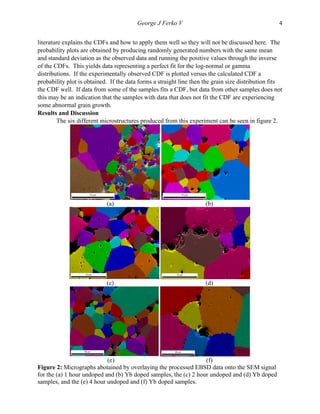
The six different microstructures produced from this experiment can be seen in figure 2.
(a) (b)


(c) (d)
(e) (f)
Figure 2: Micrographs abotained by overlaying the processed EBSD data onto the SEM signal
for the (a) 1 hour undoped and (b) Yb doped samples, the (c) 2 hour undoped and (d) Yb doped
samples, and the (e) 4 hour undoped and (f) Yb doped samples.
  George J Ferko V 5
The scale of the micrographs is not the same between different sintering times; however, the
scale is the same between the doped and undoped samples for each time. In figure 2a there are at
least two different kinds of grains present in what could be called a duplex microstructure. It
should be noted that these sorts of grain size distributions in spinel are often attributed to Li and
F ions, due to the common use of LiF as a dopant in spinel, causing an inhomogeneous
coarsening effect [19]; however, no LiF is present in this sample which makes this result
somewhat significant and might mean that the inhomogeneous coarsening or abnormal grains are
due to the other impurities found in the starting powders. Throughout the undoped sample very
large grains from 20 to 70um in diameter are observed as well as grains that range from 1 to 5
um in diameter. These large grains might be considered abnormal grains and the analysis of the
grain size distributions, to be discussed later, will help to identify whether or not the grains are
growing abnormally. There is a clear difference in grain size between the doped and undoped
samples even at 1 hour of annealing time. The micrographs in figure 2a and 2b show clearly that
even at a one hour dwell time the Yb-doped grains have grown to be much larger than those of
the undoped grains. The histograms of the grain size distributions for all of the samples are
shown in figure 3.
(a) (b)
	
  
(c) (d)
(e) (f)
Grain Size (µm) →
Figure 3: Plots of the grain size histograms for the (a) undoped 1 hour and (b) Yb doped
samples, the (c) 2 hour undoped and (d) Yb doped samples, and the (e) 4 hour undoped and (f)
Yb doped samples.
In figure 3b and 3a it can be seen that the grain size distribution for the doped grains in the 1
hour sample is much broader than that of the undoped grains. In the doped one hour sample we
have a range of grain sizes from 5-60um where it is not clear if any of the grains are growing
abnormally. This is in contrast with the undoped one hour sample where the distribution is very
sharp so that any grains outside of the distribution are easy to spot.
Frequency→
  George J Ferko V 6
In the two hour samples in figure 2c and d and figure 3c and d the grain size distributions
have broadened significantly as well as having increased in grain size. The broadening of the
undoped sample grain size distribution may be occurring because the abnormal grains are
becoming impinged and beginning to slow down while the normal grains continue to coarsen.
The 4 hour samples in figure 2e and f and figure 3e and f exhibit grain size distributions very
similar to those of the 2 hour samples. Significant broadening of the grain size distrtributions is
not discernable, however, as would be expected the grains have continued to grow in what
appears to be pure coarsening.
An attempt was made to quantify the pore size distribution by binarizing the SEM signal
from the EBSD scans, however, because the magnifications used were meant to capture the
range of grain sizes and not that of the pore sizes the data comes out nonsensical so the pore size
data that was obtained will not be included in this report as it cannot be quantified properly. This
also makes it impossible to fit any sort of microstructural development models for porous
compacts to the grain growth and densification data. It should be noted, however, that using
similar methods Benamuer, et al., were able to produce nearly fully dense samples in the range
of sintering times used here [23]. This difference may be due to the large sample size used here.
In figure 4 we see a plot of the log average grain size versus log time which shows that
the grain size of the Yb-doped grains is consistently higher than that of the undoped grains. This
shows that the Yb dopant is producing an increase in mobility that allows the spinel grains to
grow at a faster rate.
Figure 4: Plot of the log average grain size versus the log time for all of the samples produced.
As stated earlier the average grain size and the histograms do not show enough
information to convincingly say whether or not grains are growing abnormally so cumulative
distribution functions were applied to the grain size data and probability plots were produced to
determine which CDF the grain size data fits best and which grains deviate significantly from
that distribution function. The plots of the CDFs, i.e. cumulative percent versus CDF, are not
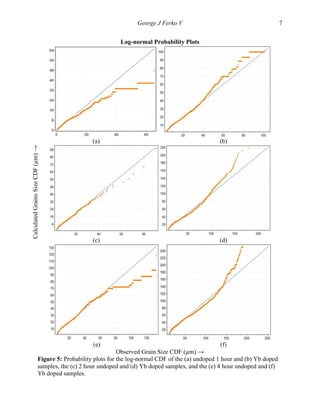
included here to save space. In figure 5 the probability plots for the log-normal distributions for
all of the samples are shown. The plot for each sample is shown individually because the large
number of data points from each sample becomes very confusing on a consolidated plot. Also,
500 ppm Yb-
doped
Undoped
0
0.2
0.4
0.6
0.8
1
1.2
1.4
1.6
1.8
2
3.5 3.6 3.7 3.8 3.9 4 4.1 4.2
log(Ḡ)(µm)
log(t) (s)
  George J Ferko V 7
Log-normal Probability Plots
(a) (b)
(c) (d)
(e) (f)
Observed Grain Size CDF (µm) →
Figure 5: Probability plots for the log-normal CDF of the (a) undoped 1 hour and (b) Yb doped
samples, the (c) 2 hour undoped and (d) Yb doped samples, and the (e) 4 hour undoped and (f)
Yb doped samples.
CalculatedGrainsSizeCDF(µm)→
  George J Ferko V 8
Gamma Probability Plots
(a) (b)
(c) (d)
(e) (f)
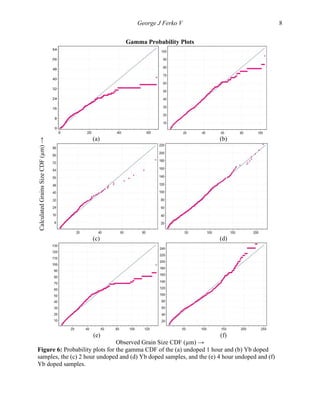
Observed Grain Size CDF (µm) →
Figure 6: Probability plots for the gamma CDF of the (a) undoped 1 hour and (b) Yb doped
samples, the (c) 2 hour undoped and (d) Yb doped samples, and the (e) 4 hour undoped and (f)
Yb doped samples.
CalculatedGrainsSizeCDF(µm)→
  George J Ferko V 9
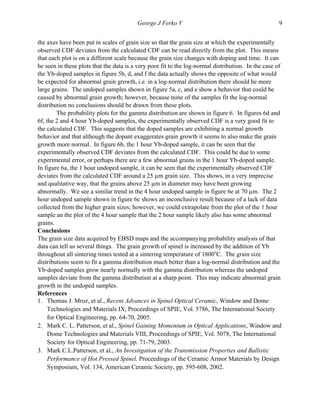
the axes have been put in scales of grain size so that the grain size at which the experimentally
observed CDF deviates from the calculated CDF can be read directly from the plot. This means
that each plot is on a different scale because the grain size changes with doping and time. It can
be seen in these plots that the data is a very poor fit to the log-normal distribution. In the case of
the Yb-doped samples in figure 5b, d, and f the data actually shows the opposite of what would
be expected for abnormal grain growth, i.e. in a log-normal distribution there should be more
large grains. The undoped samples shown in figure 5a, c, and e show a behavior that could be
caused by abnormal grain growth; however, because none of the samples fit the log-normal
distribution no conclusions should be drawn from these plots.
The probability plots for the gamma distribution are shown in figure 6. In figures 6d and
6f, the 2 and 4 hour Yb-doped samples, the experimentally observed CDF is a very good fit to
the calculated CDF. This suggests that the doped samples are exhibiting a normal growth
behavior and that although the dopant exaggerates grain growth it seems to also make the grain
growth more normal. In figure 6b, the 1 hour Yb-doped sample, it can be seen that the
experimentally observed CDF deviates from the calculated CDF. This could be due to some
experimental error, or perhaps there are a few abnormal grains in the 1 hour Yb-doped sample.
In figure 6a, the 1 hour undoped sample, it can be seen that the experimentally observed CDF
deviates from the calculated CDF around a 25 µm grain size. This shows, in a very imprecise
and qualitative way, that the grains above 25 µm in diameter may have been growing
abnormally. We see a similar trend in the 4 hour undoped sample in figure 6e at 70 µm. The 2
hour undoped sample shown in figure 6c shows an inconclusive result because of a lack of data
collected from the higher grain sizes; however, we could extrapolate from the plot of the 1 hour
sample an the plot of the 4 hour sample that the 2 hour sample likely also has some abnormal
grains.
Conclusions
The grain size data acquired by EBSD maps and the accompanying probability analysis of that
data can tell us several things. The grain growth of spinel is increased by the addition of Yb
throughout all sintering times tested at a sintering temperature of 1800o
C. The grain size
distributions seem to fit a gamma distribution much better than a log-normal distribution and the
Yb-doped samples grow nearly normally with the gamma distribution whereas the undoped
samples deviate from the gamma distribution at a sharp point. This may indicate abnormal grain
growth in the undoped samples.
References
1. Thomas J. Mroz, et al., Recent Advances in Spinel Optical Ceramic, Window and Dome
Technologies and Materials IX, Proceedings of SPIE, Vol. 5786, The International Society
for Optical Engineering, pp. 64-70, 2005.
2. Mark C. L. Patterson, et al., Spinel Gaining Momentum in Optical Applications, Window and
Dome Technologies and Materials VIII, Proceedings of SPIE, Vol. 5078, The International
Society for Optical Engineering, pp. 71-79, 2003.
3. Mark C.L.Patterson, et al., An Investigation of the Transmission Properties and Ballistic
Performance of Hot Pressed Spinel, Proceedings of the Ceramic Armor Materials by Design
Symposium, Vol. 134, American Ceramic Society, pp. 595-608, 2002.
  George J Ferko V 10
4. Parimal J. Patel, et al., Transparent Armor Materials: Needs and Requirements, Proceedings
of the Ceramic Armor Materials by Design Symposium, Vol. 134, American Ceramic
Society, pp. 573-586, 2002.
5. A. LaRoche, et al., An Economic Comparison of Hot Pressing vs. Pressureless Sintering for
Transparent Spinel Armor, Advances in Ceramic Armor IV: Ceramic Engineering and
Science Proceedings, Vol 29, Iss. 6, American Ceramic Society, pp. 55-62, 2008.
6. Juan L. Sepulveda, et al., Defect Free Spinel Ceramics of High Strength and High
Transparency, Advances in Ceramic Armor IV: Ceramic Engineering and Science
Proceedings, Vol 29, Iss. 6, American Ceramic Society, pp. 75-85, 2008.
7. Guillermo Villalobos, et al., Analysis of Scattering Sites in Transparent Magnesium
Aluminate Spinel, Advances in Ceramic Armor: Ceramic Engineering and Science
Proceedings, Vol 26, No. 7, American Ceramic Society, pp. 293-298, 2005.
8. Daniel C. Harris, History of Development of Polycrystalline Optical Spinel in the U.S.,
Window and Dome Technologies and Materials IX, Proceedings of SPIE, Vol. 5786, The
International Society for Optical Engineering, pp. 1-22, 2005.
9. R.W. Rice, Grain Size and Porosity Dependence of Ceramic Fracture Energy and Toughness
at 22o
C, Journal of Materials Science, Vol. 31, pp. 1969-1983, 1996.
10. Mototsugu, et al., The Toughness of Polycrystalline MgAl2O4, The Ceramic Society of Japan,
Vol. 96, No. 5, pp. 525-531, 1988.
11. Parimal J. Patel, et al., Indentation Size Effect (ISE) of Transparent AlON and MgAl2O4,
Army Research Laboratory, Report: ARL-TR-3852, Project: 622105H84, 2006.
12. C. Baudin, et al., Influence of Stoichiometry on Fracture Behavior of Magnesium Aluminate
Spinels at 1200o
C, Journal of the European Ceramic Society, Vol. 17, pp. 1501-1511, 1997.
13. R.L. Stewart, et al., Fracture of Polycrystalline MgAl2O4, Journal of the American Ceramic
Society, Vol. 63, No. 11-12, pp. 619-622, 1980.
14. Asish Ghosh, et al., Fracture Resistance of Tranparent Magnesium Aluminate Spinel, Journal
of the American Ceramics Society, Vol. 74, No. 7, pp. 1624-1630, 1991.
15. Kenneth W. White, et al., Fracture Mechanisms of a Coarse-Grained, Transparent MgAl2O4
at Elevated Temperatures, Journal of the American Ceramic Society, Vol. 75, No. 12, pp.
3440-3444, 1992.
16. R.W. Rice, et al., Fracture and Fracture Toughness of Stoichiometrtic MgAl2O4 Crystals at
Room Temperature, Journal of Materials Science, Vol. 31, pp. 1353-1360, 1996.
17. A.F. Desicioglu and Y Kagawa, Effect of Grain Boundary Microcracking on the Light
Transmittance of Sintered Transparent MgAl2O4, Journal of the European Ceramic Society,
Vol. 23, pp. 951-959, 2003.
18. Ivar E. Reimanis, et al., Fabrication of Transparent Spinel: The Role of Impurities, Window
and Dome Technologies and Materials IX, Proceedings of SPIE, Vol. 5786, The International
Society for Optical Engineering, pp. 48-55, 2005.
19. Ivar E Reimanis, et al., A review on the sintering and microstructure development of
transparent spinel (MgAl2O4), Journal of the American Ceramic Society, Vol. 92, No. 7, pp.
1472-1480, 2009.
  George J Ferko V 11
20. GD West, et al., Characteristics of fine-grained oxide ceramics, Journal of Materials
Science, Vol. 39, pp. 6687-6704, 2004.
21. JM Perkins, et al., Analysis and spectroscopy of rare earth doped magnesium aluminate
spinel, Advances in Applied Ceramics, Vol. 104, No. 3, pp. 131-134, 2005.
22. JM Perkins, Microstructure and properties of (rare earth) doped oxide ceramics, PhD
dissertation, University of Warwick, 2006.
23. Nassira Benamuer, et al., Sintering analysis of a fine-grained alumina-magnesia spinel
powder, Journal of the American Ceramic Society, Vol. 94, No. 5, pp. 1388-1396, 2011.
24. BAA Balboul, Physiochemical characterization of the decomposition course of hydrated
ytterbium nitrate: thermoanalytical studies, Thermochimica Acta, 419, pp. 173-179, 2004.
25. JC Tucker, et al., Tail departure of log-normal grain size distributions in synthetic three
dimensional microstructures, Metallurgical and Materials Transactions A, DOI:
10.1007/s11661-011-0851-4, 2004.
26. T Luther, et al., Polycrystal models for the analysis of intergranular crack growth in metallic
materials, Engineering Fracture Mechanics, Vol. 76, No. 15, pp. 2332-2343, 2009.
27. CV Thompson, Grain growth in thin films, Annual Review of Materials Science, Vol. 20, pp.
245-268, 1990.
28. MF Vaz, et al., Grain size distribution: The lognormal and gamma distribution functions,
Scripta Metallurgica, Vol. 22, No. 1, pp. 35-40, 1988.

Spinel-Yb grain growth and prob analysis

  • 1.
      George JFerko V 1 The Effect of Ytterbium on the Grain Growth of Magnesium Aluminate Spinel George J. Ferko V 1 12/10/2011 Abstract Pressureless sintering of undoped magnesium aluminate spinel and spinel doped with 500 ppm of ytterbium has been investigated. It has been found that the addition of ytterbium at this level causes an increase in grain growth and a decrease in abnormal grain growth. The cumulative distribution functions of the grain size data have been evaluated using probability plots and it has been found that the data fits a gamma distribution function much better than a log- normal distribution function. This probability analysis allows for the grain size data to be observed in a much more meaningful way then has been previously reported for this system. It has also been found that the bi-modal, or duplex microstructure, often observed in spinel occurs in undoped samples, thus it cannot be attributed to the presence of a specific dopant at this time. Introduction Polycrystalline magnesium aluminate spinel (spinel) has been found to have attractive properties for the production of transparent armor and radar and detector domes and windows. The recent availability of high purity spinel powders has brought spinel to the forefront of transparent armor, window, and dome design by allowing for spinel to be manufactured with high transparency in the midwave infrared (MWIR) range and the ultraviolet-visible (UV-VIS) range[1-8]. Spinel has consistently exhibited high fracture toughness and hardness as well [9- 17]. When we combine these properties with the relatively low density of spinel compared to other popular transparent armor materials such as AlON or sapphire the study of spinel becomes an even more attractive venture [18]. Research on the spinel system over the last 50 years has focused on the study of sintering additives, or dopants, and their ability to produce economical and consistent commercial spinel [8]. Despite a large body of work precise control over the microstructure of spinel has yet to be realized. Spinel continues to exhibit a common duplex microstructure where large grains seem to be imbedded in a matrix of much smaller grains, a feature that has been attributed to the use of LiF as a sintering additive [19]. This is particularly troubling in the spinel system as its transparency depends on the porosity of the final product and the mechanical properties of spinel are highly dependent on average grain size and grain size distribution. In order to improve spinel so that it may reach its full potential it is necessary to analyze the sintering kinetics of spinel in relation to certain model additives or dopants. The analysis of the sintering kinetics of doped spinel should be done in conjunction with observation of the grain boundaries using high-angle annular dark field scanning transmission electron microscopy (HAADF STEM) and high- resolution STEM so that the structure at the grain boundary, or the grain boundary complexion, can be related to the sintering kinetics. Rare earth dopants such as La, Dy, Eu, and Yb have recently been found to be easily observable at the grain boundaries of spinel using HAADF STEM by Perkins, et al. [20-22]. The drastically different atomic number of these dopants from the molecular constituents of spinel makes the z-contrast produced by HAADF STEM exceptional.                                                                                                                           1  Graduate Student – Lehigh University Email: george.ferko.v@gmail.com Phone: 610.597.8007
  • 2.
      George JFerko V 2 Recently published data by Benamuer, et al. has shown a systematic evaluation of the sintering kinetics of spinel using pressureless sintering and a commercially available high purity spinel powder [23]. The experiment described in this report will, in many ways, be modeled after the work done by Benamuer except a Yb dopant will also be used so that the grain boundary structure can be observed at a later point. The goal of this experiment is to establish the effect that Yb doping has on the grain growth and the grain size distribution of spinel as an initial step to further understanding the microstructural development of spinel. Experimental Methods A commercially available high purity spinel powder (S30CR, Baikowski, Annecy, France) was used as the starting powder. The impurity data for this powder, seen in table 1, is available from the supplier and agrees well with the inductively coupled plasma spectroscopy performed by Benamuer [23]. A Yb dopant precursor in the form of high purity ytterbium nitrate hydrate was obtained from (Alfa Aesar, Ward Hill, MA). Ytterbium nitrate hydrate readily dissolves in most solvents making it easier to homogeneously distribute the dopant in the powder. The dopant precursor is dissolved in 200 proof ethanol and the powder is combined with the dopant in ethanol to produce a doping level of 500ppm Yb. The powder and dopant are mixed in a PFA jar using a magnetic stirring rod under vacuum at a temperature of 80o C to facilitate the evaporation of the ethanol. This mixing method was used to preserve the stoichiometry and purity of the powder. All of the labware used is cleaned using aqua regia and hydrogen peroxide to remove any potential contaminants. Both the doped and undoped powders are formed into pellets by uniaxially pressing the powders in a high density polyethylene die and punch arrangement at 35 MPa. A large sample size is chosen, 1” diameter by ¾” height, because Mg evaporation has been observed at the surfaces of spinel samples when they are sintered in a reducing atmosphere [19]. The density of the green pellets at this stage was not measured to prevent contamination and because the pellets are very fragile at this stage. The pellets are cold isostatically pressed at 275 MPa for 2 minutes giving them a green density of about 45%. The pellets are then packed in powder of the same composition inside high purity alumina crucibles in a double crucible arrangement in preparation for sintering. The sintering is performed in a high temperature graphite furnace (Thermal Technologies, Santa Rosa, CA) in a 5% hydrogen 95% nitrogen reducing atmosphere. The samples are first raised to 800o C for 1 hour in a calcining step to remove the nitrates, water, and hydrocarbons from the samples. The Yb precursor has been found to convert entirely into Yb2O3 at 550o C so the calcining temperature and time should successfully remove the impurities from the sample [24]. The furnace temperature is then raised to 1800o C and held for dwell times of 1, 2, and 4 hours. The large pellets were sectioned so that a 5mm by 5mm by 5mm square was removed from the center of the pellet. The sample was then ground and polished in preparation for EBSD. In order to ensure that there was little surface damage from the grinding a minimal force of 4 MPa was used for all grinding and polishing steps and after each step the sample heights Table 1: Impurity data for the S30CR powder from Baikowski [23]. Baikowski S30CR Powder Purity S (ppm) 800-900 K(ppm) 40 Na(ppm) 11 Fe(ppm) <10 Ca(ppm) <10 Si(ppm) <10  
  • 3.
      George JFerko V 3 were measured to ensure that four times the particle size of the previous grinding medium had been removed to minimize the surface damage in the sample. In preparation for EBSD the samples were given a 4nm coating of Ir to prevent charging effects. EBSD patterns were obtained in a Hitachi 4300 Cold Field Emission High Resolution Scanning Electron Microscope equipped with an EBSD detector using the EDAX TSL/OIM data collection and analysis software. Each sample was scanned 10 to 15 times in order to obtain at least 1000 grains per sample. Scans were done at varying magnifications and step sizes to ensure that very small grains or very large grains were not absent in the scans of each sample. The EBSD data for this experiment is meant to be used to automatically determine the grain size distribution. The grain size distribution provides us with a lot more information than just the average grain size and can be helpful in evaluating the abnormal grain growth in our samples. The raw data cannot simply be measured for grain size, it must first be cleaned using grain dilation and partitioned to eliminate grains that are only made up of a few pixels and are either false readings from pores or are grains that are too small to be mapped with the EBSD step sizes used. Then the data is overlaid onto the SEM signal to make sure the microstructure produced is representative of what is actually there. Next the edge grains are subtracted out and this data is used to form the grain size distributions. A schematic of the data processing is shown in figure 1. By varying the step size and magnification any large grains excluded because they were on the edge of the frame should be accounted for by other scans.   Figure 1: Schematic of the data processing used to go from the raw EBSD data to the data used for the analysis of the grain size distribution. The grain size data is binned to produce histograms of the grain size distributions; however, in order to properly analyze the data it must be evaluated as a cumulative distribution function and then plotted on a probability plot to see how well the data fits a distribution function. The most common distribution function used is the log-normal distribution function [25-27]; however, it has been found that some data fits the gamma distribution much better [28] so both distributions are used in the statistical analysis. The distributions are used because they are multiplicative like grain growth and the two distributions are actually quite similar. The
  • 4.
      George JFerko V 4 literature explains the CDFs and how to apply them well so they will not be discussed here. The probability plots are obtained by producing randomly generated numbers with the same mean and standard deviation as the observed data and running the positive values through the inverse of the CDFs. This yields data representing a perfect fit for the log-normal or gamma distributions. If the experimentally observed CDF is plotted versus the calculated CDF a probability plot is obtained. If the data forms a straight line then the grain size distribution fits the CDF well. If data from some of the samples fits a CDF, but data from other samples does not this may be an indication that the samples with data that does not fit the CDF are experiencing some abnormal grain growth. Results and Discussion The six different microstructures produced from this experiment can be seen in figure 2. (a) (b)     (c) (d) (e) (f) Figure 2: Micrographs abotained by overlaying the processed EBSD data onto the SEM signal for the (a) 1 hour undoped and (b) Yb doped samples, the (c) 2 hour undoped and (d) Yb doped samples, and the (e) 4 hour undoped and (f) Yb doped samples.
  • 5.
      George JFerko V 5 The scale of the micrographs is not the same between different sintering times; however, the scale is the same between the doped and undoped samples for each time. In figure 2a there are at least two different kinds of grains present in what could be called a duplex microstructure. It should be noted that these sorts of grain size distributions in spinel are often attributed to Li and F ions, due to the common use of LiF as a dopant in spinel, causing an inhomogeneous coarsening effect [19]; however, no LiF is present in this sample which makes this result somewhat significant and might mean that the inhomogeneous coarsening or abnormal grains are due to the other impurities found in the starting powders. Throughout the undoped sample very large grains from 20 to 70um in diameter are observed as well as grains that range from 1 to 5 um in diameter. These large grains might be considered abnormal grains and the analysis of the grain size distributions, to be discussed later, will help to identify whether or not the grains are growing abnormally. There is a clear difference in grain size between the doped and undoped samples even at 1 hour of annealing time. The micrographs in figure 2a and 2b show clearly that even at a one hour dwell time the Yb-doped grains have grown to be much larger than those of the undoped grains. The histograms of the grain size distributions for all of the samples are shown in figure 3. (a) (b)   (c) (d) (e) (f) Grain Size (µm) → Figure 3: Plots of the grain size histograms for the (a) undoped 1 hour and (b) Yb doped samples, the (c) 2 hour undoped and (d) Yb doped samples, and the (e) 4 hour undoped and (f) Yb doped samples. In figure 3b and 3a it can be seen that the grain size distribution for the doped grains in the 1 hour sample is much broader than that of the undoped grains. In the doped one hour sample we have a range of grain sizes from 5-60um where it is not clear if any of the grains are growing abnormally. This is in contrast with the undoped one hour sample where the distribution is very sharp so that any grains outside of the distribution are easy to spot. Frequency→
  • 6.
      George JFerko V 6 In the two hour samples in figure 2c and d and figure 3c and d the grain size distributions have broadened significantly as well as having increased in grain size. The broadening of the undoped sample grain size distribution may be occurring because the abnormal grains are becoming impinged and beginning to slow down while the normal grains continue to coarsen. The 4 hour samples in figure 2e and f and figure 3e and f exhibit grain size distributions very similar to those of the 2 hour samples. Significant broadening of the grain size distrtributions is not discernable, however, as would be expected the grains have continued to grow in what appears to be pure coarsening. An attempt was made to quantify the pore size distribution by binarizing the SEM signal from the EBSD scans, however, because the magnifications used were meant to capture the range of grain sizes and not that of the pore sizes the data comes out nonsensical so the pore size data that was obtained will not be included in this report as it cannot be quantified properly. This also makes it impossible to fit any sort of microstructural development models for porous compacts to the grain growth and densification data. It should be noted, however, that using similar methods Benamuer, et al., were able to produce nearly fully dense samples in the range of sintering times used here [23]. This difference may be due to the large sample size used here. In figure 4 we see a plot of the log average grain size versus log time which shows that the grain size of the Yb-doped grains is consistently higher than that of the undoped grains. This shows that the Yb dopant is producing an increase in mobility that allows the spinel grains to grow at a faster rate. Figure 4: Plot of the log average grain size versus the log time for all of the samples produced. As stated earlier the average grain size and the histograms do not show enough information to convincingly say whether or not grains are growing abnormally so cumulative distribution functions were applied to the grain size data and probability plots were produced to determine which CDF the grain size data fits best and which grains deviate significantly from that distribution function. The plots of the CDFs, i.e. cumulative percent versus CDF, are not included here to save space. In figure 5 the probability plots for the log-normal distributions for all of the samples are shown. The plot for each sample is shown individually because the large number of data points from each sample becomes very confusing on a consolidated plot. Also, 500 ppm Yb- doped Undoped 0 0.2 0.4 0.6 0.8 1 1.2 1.4 1.6 1.8 2 3.5 3.6 3.7 3.8 3.9 4 4.1 4.2 log(Ḡ)(µm) log(t) (s)
  • 7.
      George JFerko V 7 Log-normal Probability Plots (a) (b) (c) (d) (e) (f) Observed Grain Size CDF (µm) → Figure 5: Probability plots for the log-normal CDF of the (a) undoped 1 hour and (b) Yb doped samples, the (c) 2 hour undoped and (d) Yb doped samples, and the (e) 4 hour undoped and (f) Yb doped samples. CalculatedGrainsSizeCDF(µm)→
  • 8.
      George JFerko V 8 Gamma Probability Plots (a) (b) (c) (d) (e) (f) Observed Grain Size CDF (µm) → Figure 6: Probability plots for the gamma CDF of the (a) undoped 1 hour and (b) Yb doped samples, the (c) 2 hour undoped and (d) Yb doped samples, and the (e) 4 hour undoped and (f) Yb doped samples. CalculatedGrainsSizeCDF(µm)→
  • 9.
      George JFerko V 9 the axes have been put in scales of grain size so that the grain size at which the experimentally observed CDF deviates from the calculated CDF can be read directly from the plot. This means that each plot is on a different scale because the grain size changes with doping and time. It can be seen in these plots that the data is a very poor fit to the log-normal distribution. In the case of the Yb-doped samples in figure 5b, d, and f the data actually shows the opposite of what would be expected for abnormal grain growth, i.e. in a log-normal distribution there should be more large grains. The undoped samples shown in figure 5a, c, and e show a behavior that could be caused by abnormal grain growth; however, because none of the samples fit the log-normal distribution no conclusions should be drawn from these plots. The probability plots for the gamma distribution are shown in figure 6. In figures 6d and 6f, the 2 and 4 hour Yb-doped samples, the experimentally observed CDF is a very good fit to the calculated CDF. This suggests that the doped samples are exhibiting a normal growth behavior and that although the dopant exaggerates grain growth it seems to also make the grain growth more normal. In figure 6b, the 1 hour Yb-doped sample, it can be seen that the experimentally observed CDF deviates from the calculated CDF. This could be due to some experimental error, or perhaps there are a few abnormal grains in the 1 hour Yb-doped sample. In figure 6a, the 1 hour undoped sample, it can be seen that the experimentally observed CDF deviates from the calculated CDF around a 25 µm grain size. This shows, in a very imprecise and qualitative way, that the grains above 25 µm in diameter may have been growing abnormally. We see a similar trend in the 4 hour undoped sample in figure 6e at 70 µm. The 2 hour undoped sample shown in figure 6c shows an inconclusive result because of a lack of data collected from the higher grain sizes; however, we could extrapolate from the plot of the 1 hour sample an the plot of the 4 hour sample that the 2 hour sample likely also has some abnormal grains. Conclusions The grain size data acquired by EBSD maps and the accompanying probability analysis of that data can tell us several things. The grain growth of spinel is increased by the addition of Yb throughout all sintering times tested at a sintering temperature of 1800o C. The grain size distributions seem to fit a gamma distribution much better than a log-normal distribution and the Yb-doped samples grow nearly normally with the gamma distribution whereas the undoped samples deviate from the gamma distribution at a sharp point. This may indicate abnormal grain growth in the undoped samples. References 1. Thomas J. Mroz, et al., Recent Advances in Spinel Optical Ceramic, Window and Dome Technologies and Materials IX, Proceedings of SPIE, Vol. 5786, The International Society for Optical Engineering, pp. 64-70, 2005. 2. Mark C. L. Patterson, et al., Spinel Gaining Momentum in Optical Applications, Window and Dome Technologies and Materials VIII, Proceedings of SPIE, Vol. 5078, The International Society for Optical Engineering, pp. 71-79, 2003. 3. Mark C.L.Patterson, et al., An Investigation of the Transmission Properties and Ballistic Performance of Hot Pressed Spinel, Proceedings of the Ceramic Armor Materials by Design Symposium, Vol. 134, American Ceramic Society, pp. 595-608, 2002.
  • 10.
      George JFerko V 10 4. Parimal J. Patel, et al., Transparent Armor Materials: Needs and Requirements, Proceedings of the Ceramic Armor Materials by Design Symposium, Vol. 134, American Ceramic Society, pp. 573-586, 2002. 5. A. LaRoche, et al., An Economic Comparison of Hot Pressing vs. Pressureless Sintering for Transparent Spinel Armor, Advances in Ceramic Armor IV: Ceramic Engineering and Science Proceedings, Vol 29, Iss. 6, American Ceramic Society, pp. 55-62, 2008. 6. Juan L. Sepulveda, et al., Defect Free Spinel Ceramics of High Strength and High Transparency, Advances in Ceramic Armor IV: Ceramic Engineering and Science Proceedings, Vol 29, Iss. 6, American Ceramic Society, pp. 75-85, 2008. 7. Guillermo Villalobos, et al., Analysis of Scattering Sites in Transparent Magnesium Aluminate Spinel, Advances in Ceramic Armor: Ceramic Engineering and Science Proceedings, Vol 26, No. 7, American Ceramic Society, pp. 293-298, 2005. 8. Daniel C. Harris, History of Development of Polycrystalline Optical Spinel in the U.S., Window and Dome Technologies and Materials IX, Proceedings of SPIE, Vol. 5786, The International Society for Optical Engineering, pp. 1-22, 2005. 9. R.W. Rice, Grain Size and Porosity Dependence of Ceramic Fracture Energy and Toughness at 22o C, Journal of Materials Science, Vol. 31, pp. 1969-1983, 1996. 10. Mototsugu, et al., The Toughness of Polycrystalline MgAl2O4, The Ceramic Society of Japan, Vol. 96, No. 5, pp. 525-531, 1988. 11. Parimal J. Patel, et al., Indentation Size Effect (ISE) of Transparent AlON and MgAl2O4, Army Research Laboratory, Report: ARL-TR-3852, Project: 622105H84, 2006. 12. C. Baudin, et al., Influence of Stoichiometry on Fracture Behavior of Magnesium Aluminate Spinels at 1200o C, Journal of the European Ceramic Society, Vol. 17, pp. 1501-1511, 1997. 13. R.L. Stewart, et al., Fracture of Polycrystalline MgAl2O4, Journal of the American Ceramic Society, Vol. 63, No. 11-12, pp. 619-622, 1980. 14. Asish Ghosh, et al., Fracture Resistance of Tranparent Magnesium Aluminate Spinel, Journal of the American Ceramics Society, Vol. 74, No. 7, pp. 1624-1630, 1991. 15. Kenneth W. White, et al., Fracture Mechanisms of a Coarse-Grained, Transparent MgAl2O4 at Elevated Temperatures, Journal of the American Ceramic Society, Vol. 75, No. 12, pp. 3440-3444, 1992. 16. R.W. Rice, et al., Fracture and Fracture Toughness of Stoichiometrtic MgAl2O4 Crystals at Room Temperature, Journal of Materials Science, Vol. 31, pp. 1353-1360, 1996. 17. A.F. Desicioglu and Y Kagawa, Effect of Grain Boundary Microcracking on the Light Transmittance of Sintered Transparent MgAl2O4, Journal of the European Ceramic Society, Vol. 23, pp. 951-959, 2003. 18. Ivar E. Reimanis, et al., Fabrication of Transparent Spinel: The Role of Impurities, Window and Dome Technologies and Materials IX, Proceedings of SPIE, Vol. 5786, The International Society for Optical Engineering, pp. 48-55, 2005. 19. Ivar E Reimanis, et al., A review on the sintering and microstructure development of transparent spinel (MgAl2O4), Journal of the American Ceramic Society, Vol. 92, No. 7, pp. 1472-1480, 2009.
  • 11.
      George JFerko V 11 20. GD West, et al., Characteristics of fine-grained oxide ceramics, Journal of Materials Science, Vol. 39, pp. 6687-6704, 2004. 21. JM Perkins, et al., Analysis and spectroscopy of rare earth doped magnesium aluminate spinel, Advances in Applied Ceramics, Vol. 104, No. 3, pp. 131-134, 2005. 22. JM Perkins, Microstructure and properties of (rare earth) doped oxide ceramics, PhD dissertation, University of Warwick, 2006. 23. Nassira Benamuer, et al., Sintering analysis of a fine-grained alumina-magnesia spinel powder, Journal of the American Ceramic Society, Vol. 94, No. 5, pp. 1388-1396, 2011. 24. BAA Balboul, Physiochemical characterization of the decomposition course of hydrated ytterbium nitrate: thermoanalytical studies, Thermochimica Acta, 419, pp. 173-179, 2004. 25. JC Tucker, et al., Tail departure of log-normal grain size distributions in synthetic three dimensional microstructures, Metallurgical and Materials Transactions A, DOI: 10.1007/s11661-011-0851-4, 2004. 26. T Luther, et al., Polycrystal models for the analysis of intergranular crack growth in metallic materials, Engineering Fracture Mechanics, Vol. 76, No. 15, pp. 2332-2343, 2009. 27. CV Thompson, Grain growth in thin films, Annual Review of Materials Science, Vol. 20, pp. 245-268, 1990. 28. MF Vaz, et al., Grain size distribution: The lognormal and gamma distribution functions, Scripta Metallurgica, Vol. 22, No. 1, pp. 35-40, 1988.