STONY BROOK UNIVERSITY
COLLEGE OF ENGINEERING AND APPLIED SCIENCES
Chemical and Molecular Engineering Program
Chemical Engineering Laboratory II:
CME 320
Spin Casting
By
Marcin Kielkiewicz
Team Members: Jennifer Imbrogno & Kathryn Margaret Caducio
TA: Ke Zho
Submitted to:
Prof. Miriam Rafailovich and Dr. Pinkas-Sarafova
Submitted: February 25, 2015
Marcin Kielkiewicz 108225444 CME 320 Spin Casting Lab Report Feb 25, 2015 pg 1 of 6
Abstract
The relationship between polystyrene molecular weight and thicknessof spin-coated polymer films was
examined in order to determine the unknown molecular weight of polystyrene foam from a disposable
coffee cup. Dilutesolutions of theunknownmolecularweightpolystyrene intoluenewerepreparedalong
with a control group of polystyrene pellets with a known molecular weight of 2.8*105
Da. Spin coating
andsubsequentmeasurementsof filmthicknessviaellipsometry allowedforthe graphicaldetermination
of a linearrelationshipbetweenfilmthicknessandsolutionconcentrationforboththe control groupand
the unknown. Throughextrapolationof the dataa theoretical concentrationthatwouldproduce 300 nm
thin film was determined. Comparing the theoretical concentrations to an established relationship
between molecular weight and solution concentration at 300 nm predicted the molecular weight of the
control polystyrene and the unknown extruded polystyrene foam. The molecular weight of the control
groupwasdetermined tobe 3.61*105 Da(Max: 4.87*105 Da, Min:3.46*105 Da).The unknownmolecular
weight of extrudedpolystyrene from a disposable coffee cup was determined to be 2.86*105 Da (Max:
3.29*105, Min: 2.43*105 Da). Although the molecular weight of the unknown polystyrene falls intothe
expected range the failure of our procedure to reproduce the accepted molecular weight of the control
group within the bounds of error renders our measurements of the unknown’s molecular weight
incorrect, even within the bounds of error.
Introduction
Polystyrene foam is a type of plastic
produced from the monomer styrene. It’s a
lightweight, moisture-resistant material with
exceptional insulation properties. Since it is
composedof more than90percentair,thisfoam
is also remarkably buoyant [1]
. Invented by the
Dow Chemical Company in 1941 and
trademarkedas Styrofoam™, itwasinitiallyused
by the U.S. Coast Guard and the U.S. Navy in life
rafts and preserver[2]
.The genericname for the
material isextrudedpolystyrenefoam(EPS),and
itisusedextensivelyasabuildingmaterial,inthe
packaging industry, etc. [3]
The appearance and physical properties
of various polystyrenes vary from one another
based on their intended use and method of
production. EPS is produced from styrene via a
free radical polymerization (seeFig.1) thatyields
polystyrene beads. The beads are then
subjectedto steam(orhotair) thatsustainstheir
expansionuntiltheyreachthe desireddensity.In
the final steptheEPSbeadsare senttoamolding
press. The molding process requires that the
chainlength of the polymerfallswithinaspecific
range because polystyrene with overly long
chains won't melt readily and polystyrene with
short chains will be brittle. The process is
designed to produce chains with a molecular
weight between 2.0*105
Da and 3.0*105
Da [4]
.
This study focused on determining the
average molecularweightof EPSin a disposable
coffee cup by comparing it to a sample of
polystyrene pellets (PSP) with a known
molecular weight (Mw). The Mw of the control
PSP was 2.8*105
Da, which lies withinthe range
of expected Mw distributionof the EPS. In order
to analyticallycompare the samples we created
solutions of both EPS and PSP in toluene and
fabricated a range of thins films from the
solutions through spin casting following
Marcin Kielkiewicz 108225444 CME 320 Spin Casting Lab Report Feb 25, 2015 pg 2 of 6
methodsinliterature[5]
.Thistechnique appliesa
centrifugal force onto a spinning substrate to
create thinfilmsonthe orderof 10-8
m to10-5
m.
Although spin casting is a well-established
experimental technique for thin film formation
the qualityof the filmproducedisthe resultof a
complex dynamic process. Vapor pressure,
solubility,viscosity,glasstransitiontemperature,
spinvelocity,andthe concentrationgradientare
some of the parametersthataffectthe thickness
of the film produced [6]
. By holding all of the
above parameters constant other than the
concentrationgradientthe relationshipbetween
polymer concentration and film thickness was
charted.
The film thickness was measured via
ellipsometrywhichhasbeensuccessfullyutilized
to determine the film thickness of thin polymer
layers with a high degree of accuracy [7]
. An
ellipsometer works by observing changes in the
state of polarizationof lightuponreflectionfrom
a surface [8]
.It isdesignedsuchthatlightreflects
firstoff a surface coated witha filmof unknown
thickness and then off a reference film with
known optical properties to determine the
thickness of the unknown layer [9]
.
To testwhetherthesurfaceof the silicon
wafers was indeed coated with a layer of
polystyrene a goniometer was used to observe
the contact angle of water on an untarnished
siliconwafervs.the contactangleonbothanEPS
coated wafer and a PSP wafer. Typically
hydrophilic substances exhibit contact angles of
lessthan90° while hydrophobicsubstanceshave
contact anglesabove 90° [10]
. Pure siliconwafers
are hydrophilic while those coated with
polystyrene are hydrophobic hence a significant
difference was expected to be observed.
To obtain the Mw of the EPS the
followingplotobtainedfromliteraturewasused
(Fig. 1) [11]
. The data in the plot derives a
correlation between the polystyrene solution
concentration and Mw of the polystyrene
necessarytofabricate athinfilmviaspincasting.
By extrapolating our plots of concentration vs.
film thickness we were able to determine the
concentration of both EPS and PSP solutions
necessary to produce a 300 nm thin film. By
comparingour theoretical concentrationtothat
predictedintheequationinFig.1we couldcheck
the reportedMw of the control PSP and findthe
unknown Mw of the EPS from the disposable
coffee cup.
Method and Materials
An EPScoffee cupfroman unknown
manufacturerwascut intosmall strips.Six
samplesfrom50 mg to 300 mg were prepared
by usinga massbalance [FIETKAUTechnology
Group INC.,ANDJewelryBalance FX-40CJ,Max:
41 g, d: 10-4
g]. The sampleswere placedinside
20 mL glassscintillationflasks and10 mL of
Figure 1. The combination of solution concentration and Mw
of polystyrene necessary to produce a 300 nm thin film.
Marcin Kielkiewicz 108225444 CME 320 Spin Casting Lab Report Feb 25, 2015 pg 3 of 6
Toluene [Sigma Aldrich, ChromaSolv for HPLC,
>99.9%] was added to dissolve the polystyrene.
Caution was used while administering toluene
with glass Pasteur pipettes so that the toluene
did not come into contact with the latex bulb
(which could partially dissolve in toluene). The
same procedure was followed with PSP [Sigma-
Aldrich, Typical MW: 280,000 Da]. Data for the
solution concentrations obtained can be found
in Table 1.
Large Circular silicon wafers from an
unknown manufacturer were cut into 1 cm2
wafers to be used for spin casting. Two wafers
were preparedforeach sample (inordertohave
a backup in case anything went wrong). The
wafers were then positioned on the spin caster
andapproximatelythreedrops(enoughtocover
the surface of the plate) were dropped onto it.
The spin caster [Headway Research Inc., Model
PWM32] was immediatelyrunfor30 secondsat
2512 rpm. Two wafers were coated with a thin
film for each sample (total: 24 samples). A film
could be observedvisuallyonthe wafersdue to
a rainbowof colorsof the reflective surface that
varied with concentrations (similar to the effect
seen when a thin layer of
petrol is present on the
surface of water). The
samples were removed
from the spin caster with
tweezers by carefully
grabbing the edge of the
wafersandplacingthemin
a container for
safekeeping.
The film thickness
of each sample was
calculated on a Rudolph Ellipsometer AutoEl II
(error: ± 5 Å). The values of delta and psi on a
frontpanel display were reducedtothe physical
quantitiesof thicknessandrefractiveindexwhen
using the data reduction software.This was run
on a PC that was interfaced directly via the
standard RS232 serial pan [6]
. The filmthickness
of each sample was measured three times at
three differentlocationsatornear the centerof
the plate.The datacollectedisshowninTable 2.
In order to confirm the presence of a
polystyrenefilmonthe platesagoniometer[KSV
Instruments LTD, CAM 200, Optical Contact
Angle Meter] was used to compare the contact
angle of water on an untarnished silicon wafer
vs.the contact angle onbotha EPS coatedwafer
anda PSPwafer. The contactanglesobtainedare
shown in Table 3.
Results/Discussion
Data for the preparation of polymer
solutions are shown in Table 1 and the data
obtained for film thickness measurements is
shown in Table 2. From these tables the
relationshipbetweensolutionconcentrationand
Table 1. The concentration of all polystyrene solutions prepared with uncertainty calculations.
The uncertainty in mass is 0.0005 g because the mass on the balance was fluctuating without
stabilizing. V of PhCh3 stands for volume of toluene. Pi stands for solution concentration. For
the uncertainty in concentration: δpi = pi*((δm/m)2+(δV/V)2)0.5
Marcin Kielkiewicz 108225444 CME 320 Spin Casting Lab Report Feb 25, 2015 pg 4 of 6
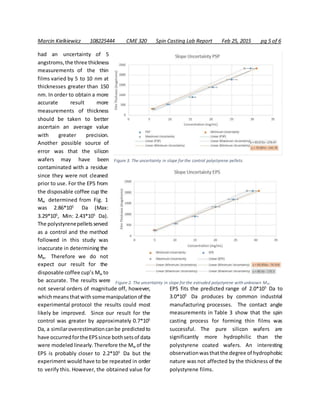
thin film thickness is
plottedinFig.2. A linearfit
was chosen to extrapolate
the data points from both
the EPS and PSP data
points. The uncertainty for
the slope of the linear fit
was determined by finding
the minimum and
maximum slope from the
uncertainty of the data
points through methods
obtained from literature [12, 13]
. The maximum
and minimum slope for both the EPS and PSP
linear fits are shown in Fig. 3 and Fig. 4. By
extrapolatingthe datafromFig.2 andusingthe
error obtained from Fig. 3 and Fig. 4 the
concentration of PSP in toluene necessary to
deposit a thin film 300 nm
thick was estimated to be
38.8 mg/mL (Max: 39.3
mg/mL, Min: 35.2 mg/mL).
The concentrationof EPS in
solution required to
produce a film of the same
thickness was determined
via the same method, with
the concentration being
equal to 41.8 mg/mL (Max:
44.1 mg/mL, Min: 39.3
mg/mL). By comparing the
theoretical concentrations
with the plot in Fig. 1 the Mw
of both samples was
determined. The Mw of the
control PSP was3.61*105
Da (Max: 4.87*105
Da,
Min: 3.46*105
Da). From the data a result that
more closelymatchedthe Mw reportedbySigma
Aldrich was expected – approximately 2.8*105
Da. The accepted value does not lie within the
bounds of uncertainty. A likely cause of the
discrepancy is that the linear model from Fig. 2
does not predict the necessary concentration
that produces300 nm thinfilm. Anothersource
of error may have been our measurements of
thin film thickness. Although the ellipsometer
Table 2. Three thickness measurements of each thin film coated silicon wafer. Avg. stands for
average thickness. For the uncertainty in the average thickness:
δAvg. = ((δTh1)2+(δTh2)2+(δTh3)2)0.5
Figure 2. A plot of polystyrene solution in concentration vs. the film thickness produced
through spin casting for both extruded polystyrene and the control polystyrene pellets. A
linear fit for both data were obtained.
Table 3. Contact angle of water droplets on pure silicon wafers and
polystyrene coated silicon wafers.
Marcin Kielkiewicz 108225444 CME 320 Spin Casting Lab Report Feb 25, 2015 pg 5 of 6
had an uncertainty of 5
angstroms,the three thickness
measurements of the thin
films varied by 5 to 10 nm at
thicknesses greater than 150
nm. In order to obtain a more
accurate result more
measurements of thickness
should be taken to better
ascertain an average value
with greater precision.
Another possible source of
error was that the silicon
wafers may have been
contaminated with a residue
since they were not cleaned
prior to use. For the EPS from
the disposable coffee cup the
Mw determined from Fig. 1
was 2.86*105
Da (Max:
3.29*105
, Min: 2.43*105
Da).
The polystyrenepelletsserved
as a control and the method
followed in this study was
inaccurate in determining the
Mw. Therefore we do not
expect our result for the
disposable coffee cup’s Mw to
be accurate. The results were
not several orders of magnitude off, however,
whichmeansthatwithsomemanipulationof the
experimental protocol the results could most
likely be improved. Since our result for the
control was greater by approximately 0.7*105
Da, a similaroverestimationcanbe predictedto
have occurredforthe EPSsince bothsetsof data
were modeled linearly.Therefore the Mw of the
EPS is probably closer to 2.2*105
Da but the
experiment would have to be repeated in order
to verify this. However, the obtained value for
EPS fits the predicted range of 2.0*105
Da to
3.0*105
Da produces by common industrial
manufacturing processes. The contact angle
measurements in Table 3 show that the spin
casting process for forming thin films was
successful. The pure silicon wafers are
significantly more hydrophilic than the
polystyrene coated wafers. An interesting
observationwasthatthe degree of hydrophobic
nature was not affected by the thickness of the
polystyrene films.
Figure 3. The uncertainty in slope for the control polystyrene pellets.
Figure 2. The uncertainty in slope for the extruded polystyrene with unknown Mw.
Marcin Kielkiewicz 108225444 CME 320 Spin Casting Lab Report Feb 25, 2015 pg 6 of 6
Conclusion
Polystyrene solutions in toluene were
successfullyspincastontosiliconwafersinorder
to determine a relationship between polymer
concentrationinsolutionandthinfilmthickness.
Through the extrapolation of data a theoretical
concentration that would result in 300 nm thin
film was predicted. Comparing the theoretical
concentrations to an established relationship
between molecular weight and solution
concentration at 300 nm gave results for the
molecular weight of the control polystyrene as
well as the molecular weight of the extruded
polystyrenefoam. The molecular weight of the
control groupwasdeterminedtobe 3.61*105
Da
(Max: 4.87*105
Da, Min: 3.46*105
Da). The
accepted value was 2.8*105
Da. The unknown
molecular weight of the extruded polystyrene
froma disposable coffeecupwasdeterminedto
be 2.86*105
Da (Max: 3.29*105
, Min: 2.43*105
Da). Although the molecular weight of the
unknown polystyrene falls into the expected
range the failure of our procedure to reproduce
the accepted molecular weight of the control
group within the bounds of error renders our
measurements of the unknown molecular
weight incorrect, even within the bounds of
error.
References
[1] Maier,Karyn, and Bronwyn Harris."WhatIs
Polystyrene Foam?" WiseGeek. Conjecture.
[2] "Invention of STYROFOAM™." Dow. Building
Solutions. Dow Chemical Company.
[3] Flynn, Hillary,and Bronwyn Harris."WhatAre the
Different Uses of Polystyrene?" WiseGeek.
Conjecture.
[4] Secrest, Rose. "Expanded Polystyrene
Foam." How Products Are Made. Advameg, Inc.
[5] D.W.Schubert. Spin Coating as a Method for
Molecular Weight Determination. Polymer Bulletin,
2007. Vol. 38,Issue2, pg 177-184
[6] Ennis,David,Heike Betz, and Harald Ade. "Direct
Spin casting of Polystyrene Thin Films onto
Poly(methyl Methacrylate)." Journal of Polymer
Science Part B: Polymer Physics 44.22 (2006): 3234-
244.
[7] Fujiwara,Hiroyuki."Spectroscopic Ellipsometry:
Principles and Applications."GoogleBooks. 2007
[8] "Rudolph AutoEL II." Rudolph Ellipsometer AutoEL
II.
[9] Goncalves,Debora. "Fundamentals and
Applications of Spectroscopic Ellipsometry." Química
Nova.
[10] Trotter, Brian,Garret Moddel, Rachel Ostroff,
and Gregory R. Bogart. "Fixed-polarizer Ellipsometry:
A SimpleTechnique to Measure the Thickness of
Very Thin Films." Optical Engineering 38.5 (1999):
902. Electrical and Computer Engineering
Dept. University of Colorado.
[11] Renate Förch, Holger Schönherr, A. Tobias A.
Jenkins (2009).Surface design: applications in
bioscience and nanotechnology. Wiley-VCH. p. 471.
[12] "Slope Uncertainty." Introductory Physics Lab.
[13] Sheehan, Michael."Uncertainty in Slope of
Trendline." YouTube.
cm320_lab01

cm320_lab01

  • 1.
    STONY BROOK UNIVERSITY COLLEGEOF ENGINEERING AND APPLIED SCIENCES Chemical and Molecular Engineering Program Chemical Engineering Laboratory II: CME 320 Spin Casting By Marcin Kielkiewicz Team Members: Jennifer Imbrogno & Kathryn Margaret Caducio TA: Ke Zho Submitted to: Prof. Miriam Rafailovich and Dr. Pinkas-Sarafova Submitted: February 25, 2015
  • 2.
    Marcin Kielkiewicz 108225444CME 320 Spin Casting Lab Report Feb 25, 2015 pg 1 of 6 Abstract The relationship between polystyrene molecular weight and thicknessof spin-coated polymer films was examined in order to determine the unknown molecular weight of polystyrene foam from a disposable coffee cup. Dilutesolutions of theunknownmolecularweightpolystyrene intoluenewerepreparedalong with a control group of polystyrene pellets with a known molecular weight of 2.8*105 Da. Spin coating andsubsequentmeasurementsof filmthicknessviaellipsometry allowedforthe graphicaldetermination of a linearrelationshipbetweenfilmthicknessandsolutionconcentrationforboththe control groupand the unknown. Throughextrapolationof the dataa theoretical concentrationthatwouldproduce 300 nm thin film was determined. Comparing the theoretical concentrations to an established relationship between molecular weight and solution concentration at 300 nm predicted the molecular weight of the control polystyrene and the unknown extruded polystyrene foam. The molecular weight of the control groupwasdetermined tobe 3.61*105 Da(Max: 4.87*105 Da, Min:3.46*105 Da).The unknownmolecular weight of extrudedpolystyrene from a disposable coffee cup was determined to be 2.86*105 Da (Max: 3.29*105, Min: 2.43*105 Da). Although the molecular weight of the unknown polystyrene falls intothe expected range the failure of our procedure to reproduce the accepted molecular weight of the control group within the bounds of error renders our measurements of the unknown’s molecular weight incorrect, even within the bounds of error. Introduction Polystyrene foam is a type of plastic produced from the monomer styrene. It’s a lightweight, moisture-resistant material with exceptional insulation properties. Since it is composedof more than90percentair,thisfoam is also remarkably buoyant [1] . Invented by the Dow Chemical Company in 1941 and trademarkedas Styrofoam™, itwasinitiallyused by the U.S. Coast Guard and the U.S. Navy in life rafts and preserver[2] .The genericname for the material isextrudedpolystyrenefoam(EPS),and itisusedextensivelyasabuildingmaterial,inthe packaging industry, etc. [3] The appearance and physical properties of various polystyrenes vary from one another based on their intended use and method of production. EPS is produced from styrene via a free radical polymerization (seeFig.1) thatyields polystyrene beads. The beads are then subjectedto steam(orhotair) thatsustainstheir expansionuntiltheyreachthe desireddensity.In the final steptheEPSbeadsare senttoamolding press. The molding process requires that the chainlength of the polymerfallswithinaspecific range because polystyrene with overly long chains won't melt readily and polystyrene with short chains will be brittle. The process is designed to produce chains with a molecular weight between 2.0*105 Da and 3.0*105 Da [4] . This study focused on determining the average molecularweightof EPSin a disposable coffee cup by comparing it to a sample of polystyrene pellets (PSP) with a known molecular weight (Mw). The Mw of the control PSP was 2.8*105 Da, which lies withinthe range of expected Mw distributionof the EPS. In order to analyticallycompare the samples we created solutions of both EPS and PSP in toluene and fabricated a range of thins films from the solutions through spin casting following
  • 3.
    Marcin Kielkiewicz 108225444CME 320 Spin Casting Lab Report Feb 25, 2015 pg 2 of 6 methodsinliterature[5] .Thistechnique appliesa centrifugal force onto a spinning substrate to create thinfilmsonthe orderof 10-8 m to10-5 m. Although spin casting is a well-established experimental technique for thin film formation the qualityof the filmproducedisthe resultof a complex dynamic process. Vapor pressure, solubility,viscosity,glasstransitiontemperature, spinvelocity,andthe concentrationgradientare some of the parametersthataffectthe thickness of the film produced [6] . By holding all of the above parameters constant other than the concentrationgradientthe relationshipbetween polymer concentration and film thickness was charted. The film thickness was measured via ellipsometrywhichhasbeensuccessfullyutilized to determine the film thickness of thin polymer layers with a high degree of accuracy [7] . An ellipsometer works by observing changes in the state of polarizationof lightuponreflectionfrom a surface [8] .It isdesignedsuchthatlightreflects firstoff a surface coated witha filmof unknown thickness and then off a reference film with known optical properties to determine the thickness of the unknown layer [9] . To testwhetherthesurfaceof the silicon wafers was indeed coated with a layer of polystyrene a goniometer was used to observe the contact angle of water on an untarnished siliconwafervs.the contactangleonbothanEPS coated wafer and a PSP wafer. Typically hydrophilic substances exhibit contact angles of lessthan90° while hydrophobicsubstanceshave contact anglesabove 90° [10] . Pure siliconwafers are hydrophilic while those coated with polystyrene are hydrophobic hence a significant difference was expected to be observed. To obtain the Mw of the EPS the followingplotobtainedfromliteraturewasused (Fig. 1) [11] . The data in the plot derives a correlation between the polystyrene solution concentration and Mw of the polystyrene necessarytofabricate athinfilmviaspincasting. By extrapolating our plots of concentration vs. film thickness we were able to determine the concentration of both EPS and PSP solutions necessary to produce a 300 nm thin film. By comparingour theoretical concentrationtothat predictedintheequationinFig.1we couldcheck the reportedMw of the control PSP and findthe unknown Mw of the EPS from the disposable coffee cup. Method and Materials An EPScoffee cupfroman unknown manufacturerwascut intosmall strips.Six samplesfrom50 mg to 300 mg were prepared by usinga massbalance [FIETKAUTechnology Group INC.,ANDJewelryBalance FX-40CJ,Max: 41 g, d: 10-4 g]. The sampleswere placedinside 20 mL glassscintillationflasks and10 mL of Figure 1. The combination of solution concentration and Mw of polystyrene necessary to produce a 300 nm thin film.
  • 4.
    Marcin Kielkiewicz 108225444CME 320 Spin Casting Lab Report Feb 25, 2015 pg 3 of 6 Toluene [Sigma Aldrich, ChromaSolv for HPLC, >99.9%] was added to dissolve the polystyrene. Caution was used while administering toluene with glass Pasteur pipettes so that the toluene did not come into contact with the latex bulb (which could partially dissolve in toluene). The same procedure was followed with PSP [Sigma- Aldrich, Typical MW: 280,000 Da]. Data for the solution concentrations obtained can be found in Table 1. Large Circular silicon wafers from an unknown manufacturer were cut into 1 cm2 wafers to be used for spin casting. Two wafers were preparedforeach sample (inordertohave a backup in case anything went wrong). The wafers were then positioned on the spin caster andapproximatelythreedrops(enoughtocover the surface of the plate) were dropped onto it. The spin caster [Headway Research Inc., Model PWM32] was immediatelyrunfor30 secondsat 2512 rpm. Two wafers were coated with a thin film for each sample (total: 24 samples). A film could be observedvisuallyonthe wafersdue to a rainbowof colorsof the reflective surface that varied with concentrations (similar to the effect seen when a thin layer of petrol is present on the surface of water). The samples were removed from the spin caster with tweezers by carefully grabbing the edge of the wafersandplacingthemin a container for safekeeping. The film thickness of each sample was calculated on a Rudolph Ellipsometer AutoEl II (error: ± 5 Å). The values of delta and psi on a frontpanel display were reducedtothe physical quantitiesof thicknessandrefractiveindexwhen using the data reduction software.This was run on a PC that was interfaced directly via the standard RS232 serial pan [6] . The filmthickness of each sample was measured three times at three differentlocationsatornear the centerof the plate.The datacollectedisshowninTable 2. In order to confirm the presence of a polystyrenefilmonthe platesagoniometer[KSV Instruments LTD, CAM 200, Optical Contact Angle Meter] was used to compare the contact angle of water on an untarnished silicon wafer vs.the contact angle onbotha EPS coatedwafer anda PSPwafer. The contactanglesobtainedare shown in Table 3. Results/Discussion Data for the preparation of polymer solutions are shown in Table 1 and the data obtained for film thickness measurements is shown in Table 2. From these tables the relationshipbetweensolutionconcentrationand Table 1. The concentration of all polystyrene solutions prepared with uncertainty calculations. The uncertainty in mass is 0.0005 g because the mass on the balance was fluctuating without stabilizing. V of PhCh3 stands for volume of toluene. Pi stands for solution concentration. For the uncertainty in concentration: δpi = pi*((δm/m)2+(δV/V)2)0.5
  • 5.
    Marcin Kielkiewicz 108225444CME 320 Spin Casting Lab Report Feb 25, 2015 pg 4 of 6 thin film thickness is plottedinFig.2. A linearfit was chosen to extrapolate the data points from both the EPS and PSP data points. The uncertainty for the slope of the linear fit was determined by finding the minimum and maximum slope from the uncertainty of the data points through methods obtained from literature [12, 13] . The maximum and minimum slope for both the EPS and PSP linear fits are shown in Fig. 3 and Fig. 4. By extrapolatingthe datafromFig.2 andusingthe error obtained from Fig. 3 and Fig. 4 the concentration of PSP in toluene necessary to deposit a thin film 300 nm thick was estimated to be 38.8 mg/mL (Max: 39.3 mg/mL, Min: 35.2 mg/mL). The concentrationof EPS in solution required to produce a film of the same thickness was determined via the same method, with the concentration being equal to 41.8 mg/mL (Max: 44.1 mg/mL, Min: 39.3 mg/mL). By comparing the theoretical concentrations with the plot in Fig. 1 the Mw of both samples was determined. The Mw of the control PSP was3.61*105 Da (Max: 4.87*105 Da, Min: 3.46*105 Da). From the data a result that more closelymatchedthe Mw reportedbySigma Aldrich was expected – approximately 2.8*105 Da. The accepted value does not lie within the bounds of uncertainty. A likely cause of the discrepancy is that the linear model from Fig. 2 does not predict the necessary concentration that produces300 nm thinfilm. Anothersource of error may have been our measurements of thin film thickness. Although the ellipsometer Table 2. Three thickness measurements of each thin film coated silicon wafer. Avg. stands for average thickness. For the uncertainty in the average thickness: δAvg. = ((δTh1)2+(δTh2)2+(δTh3)2)0.5 Figure 2. A plot of polystyrene solution in concentration vs. the film thickness produced through spin casting for both extruded polystyrene and the control polystyrene pellets. A linear fit for both data were obtained. Table 3. Contact angle of water droplets on pure silicon wafers and polystyrene coated silicon wafers.
  • 6.
    Marcin Kielkiewicz 108225444CME 320 Spin Casting Lab Report Feb 25, 2015 pg 5 of 6 had an uncertainty of 5 angstroms,the three thickness measurements of the thin films varied by 5 to 10 nm at thicknesses greater than 150 nm. In order to obtain a more accurate result more measurements of thickness should be taken to better ascertain an average value with greater precision. Another possible source of error was that the silicon wafers may have been contaminated with a residue since they were not cleaned prior to use. For the EPS from the disposable coffee cup the Mw determined from Fig. 1 was 2.86*105 Da (Max: 3.29*105 , Min: 2.43*105 Da). The polystyrenepelletsserved as a control and the method followed in this study was inaccurate in determining the Mw. Therefore we do not expect our result for the disposable coffee cup’s Mw to be accurate. The results were not several orders of magnitude off, however, whichmeansthatwithsomemanipulationof the experimental protocol the results could most likely be improved. Since our result for the control was greater by approximately 0.7*105 Da, a similaroverestimationcanbe predictedto have occurredforthe EPSsince bothsetsof data were modeled linearly.Therefore the Mw of the EPS is probably closer to 2.2*105 Da but the experiment would have to be repeated in order to verify this. However, the obtained value for EPS fits the predicted range of 2.0*105 Da to 3.0*105 Da produces by common industrial manufacturing processes. The contact angle measurements in Table 3 show that the spin casting process for forming thin films was successful. The pure silicon wafers are significantly more hydrophilic than the polystyrene coated wafers. An interesting observationwasthatthe degree of hydrophobic nature was not affected by the thickness of the polystyrene films. Figure 3. The uncertainty in slope for the control polystyrene pellets. Figure 2. The uncertainty in slope for the extruded polystyrene with unknown Mw.
  • 7.
    Marcin Kielkiewicz 108225444CME 320 Spin Casting Lab Report Feb 25, 2015 pg 6 of 6 Conclusion Polystyrene solutions in toluene were successfullyspincastontosiliconwafersinorder to determine a relationship between polymer concentrationinsolutionandthinfilmthickness. Through the extrapolation of data a theoretical concentration that would result in 300 nm thin film was predicted. Comparing the theoretical concentrations to an established relationship between molecular weight and solution concentration at 300 nm gave results for the molecular weight of the control polystyrene as well as the molecular weight of the extruded polystyrenefoam. The molecular weight of the control groupwasdeterminedtobe 3.61*105 Da (Max: 4.87*105 Da, Min: 3.46*105 Da). The accepted value was 2.8*105 Da. The unknown molecular weight of the extruded polystyrene froma disposable coffeecupwasdeterminedto be 2.86*105 Da (Max: 3.29*105 , Min: 2.43*105 Da). Although the molecular weight of the unknown polystyrene falls into the expected range the failure of our procedure to reproduce the accepted molecular weight of the control group within the bounds of error renders our measurements of the unknown molecular weight incorrect, even within the bounds of error. References [1] Maier,Karyn, and Bronwyn Harris."WhatIs Polystyrene Foam?" WiseGeek. Conjecture. [2] "Invention of STYROFOAM™." Dow. Building Solutions. Dow Chemical Company. [3] Flynn, Hillary,and Bronwyn Harris."WhatAre the Different Uses of Polystyrene?" WiseGeek. Conjecture. [4] Secrest, Rose. "Expanded Polystyrene Foam." How Products Are Made. Advameg, Inc. [5] D.W.Schubert. Spin Coating as a Method for Molecular Weight Determination. Polymer Bulletin, 2007. Vol. 38,Issue2, pg 177-184 [6] Ennis,David,Heike Betz, and Harald Ade. "Direct Spin casting of Polystyrene Thin Films onto Poly(methyl Methacrylate)." Journal of Polymer Science Part B: Polymer Physics 44.22 (2006): 3234- 244. [7] Fujiwara,Hiroyuki."Spectroscopic Ellipsometry: Principles and Applications."GoogleBooks. 2007 [8] "Rudolph AutoEL II." Rudolph Ellipsometer AutoEL II. [9] Goncalves,Debora. "Fundamentals and Applications of Spectroscopic Ellipsometry." Química Nova. [10] Trotter, Brian,Garret Moddel, Rachel Ostroff, and Gregory R. Bogart. "Fixed-polarizer Ellipsometry: A SimpleTechnique to Measure the Thickness of Very Thin Films." Optical Engineering 38.5 (1999): 902. Electrical and Computer Engineering Dept. University of Colorado. [11] Renate Förch, Holger Schönherr, A. Tobias A. Jenkins (2009).Surface design: applications in bioscience and nanotechnology. Wiley-VCH. p. 471. [12] "Slope Uncertainty." Introductory Physics Lab. [13] Sheehan, Michael."Uncertainty in Slope of Trendline." YouTube.