PECULIARITY OF NANOLEVEL
  STRUCTURING IN SYNTHESIS OF
 NOVEL FUNCTIONAL SOLIDS AND
  NANOSTRUCTURED MATERIALS


  V.M. Smirnov, I.P. Suzdalev
Saint-Petersburg State University,
    Department of Chemistry,
 Solid State Chemistry Division
The State of Two-Dimensional
Nanostructures on the Silica Surface
               •       А – with homogeneous character of distribution of
                   chemical composition and state, for example, monolayers
                   of element-oxygen groups of the same chemical
                   composition, l – monolayer thickness, L – layer thickness,
                   l1 = l2 = l3 = l4; 1– for example, Ti–O monolayers.
               •       B – periodic distribution of element-oxygen layers
                   along z axis, (L – layer thickness) consisting of the certain
                   quantity of monolayers, for example, according to the
                   scheme: 1 –Fe-O groups, 2 –Ti-O groups (a – two-layer
                   group, l1 = l2 , б, в – four-layer group l1 = l3 и l2 = l4 ).

               •       C – aperiodic distribution of element-oxygen layers
                   along z axis, four-layer structure l1 l2 l3 l4
               •       D – aperiodic distribution of atoms on the plane of
                   surface monolayer, top view: х –Fe-O groups, о –Ti-O
                   groups; а, б – different ratios of groups Fe-O and Ti-O.

               •       E - aperiodic distribution of “zero-dimensional"
                   structures on the plane of support: 1 –Si , 2 – [ Fe]
Energetic Diagram of Reaction with Kinetic and
                             Thermodynamic Control
              [SiO2]m-1O1,5SiOH + Cl2   [SiO2]m-1O1,5SiCl     SiCl4
                      A                       B                C

                                                  1 – reaction A → B
                                                  dominates, product
                                                  B is kinetically stable;
Free Energy


                                                  2 – side reaction A → C
                                                  dominates;
                                                  3 – reaction A → B
                                                  dominates, but the
                                                  product B is kinetically
                                                  unstable and converts
                                                  rapidly into C.

                      Reaction coordinate
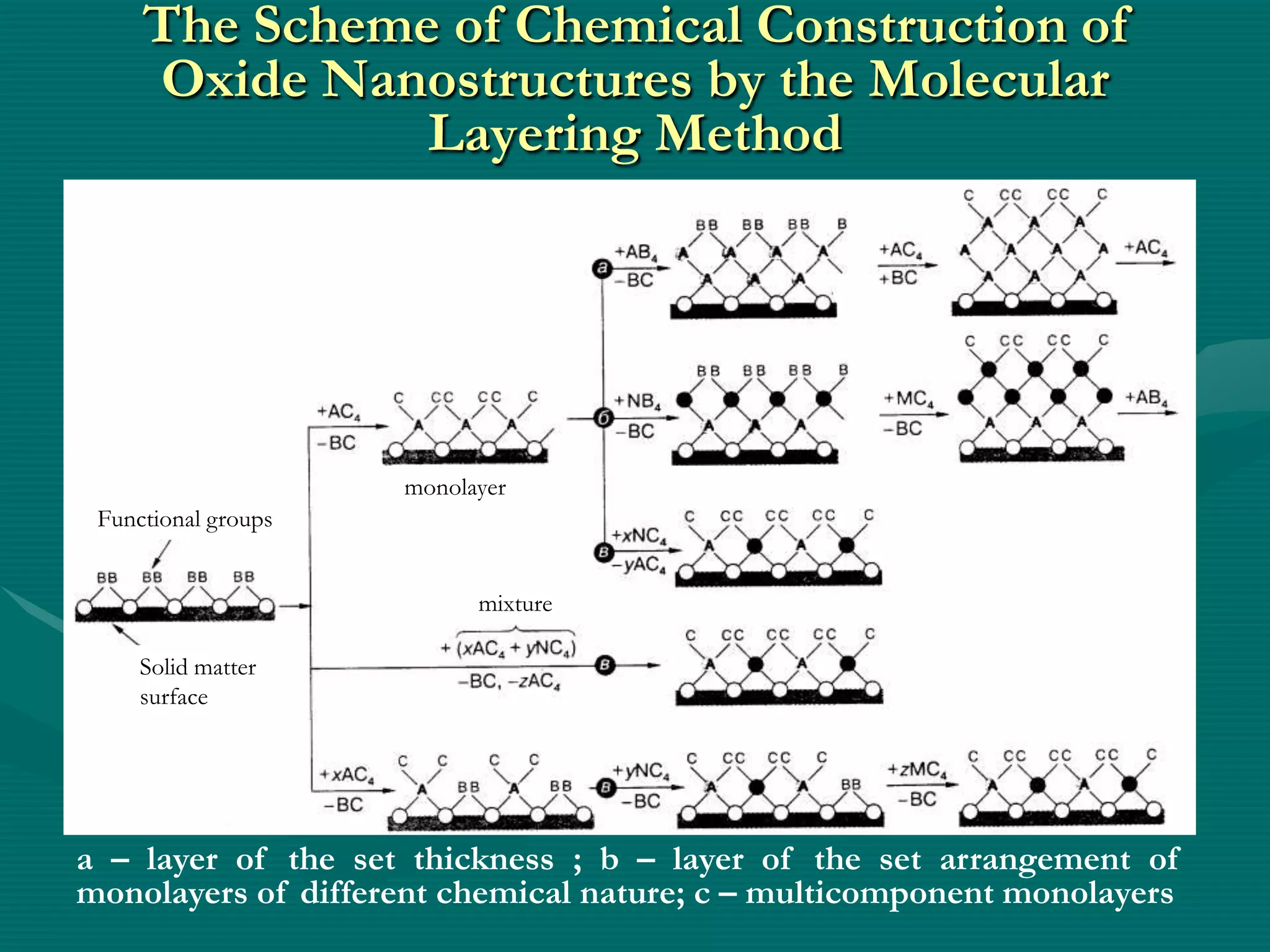
The Scheme of Chemical Construction of
        Oxide Nanostructures by the Molecular
                  Layering Method

    Si-OH
•                       O          +         CH3OH
•                       Si                           Si-O-CH3
                             monolayer
    Functional groups


                                   mixture

        Solid matter
        surface


a – layer of the set thickness ; b – layer of the set arrangement of
monolayers of different chemical nature; c – multicomponent monolayers
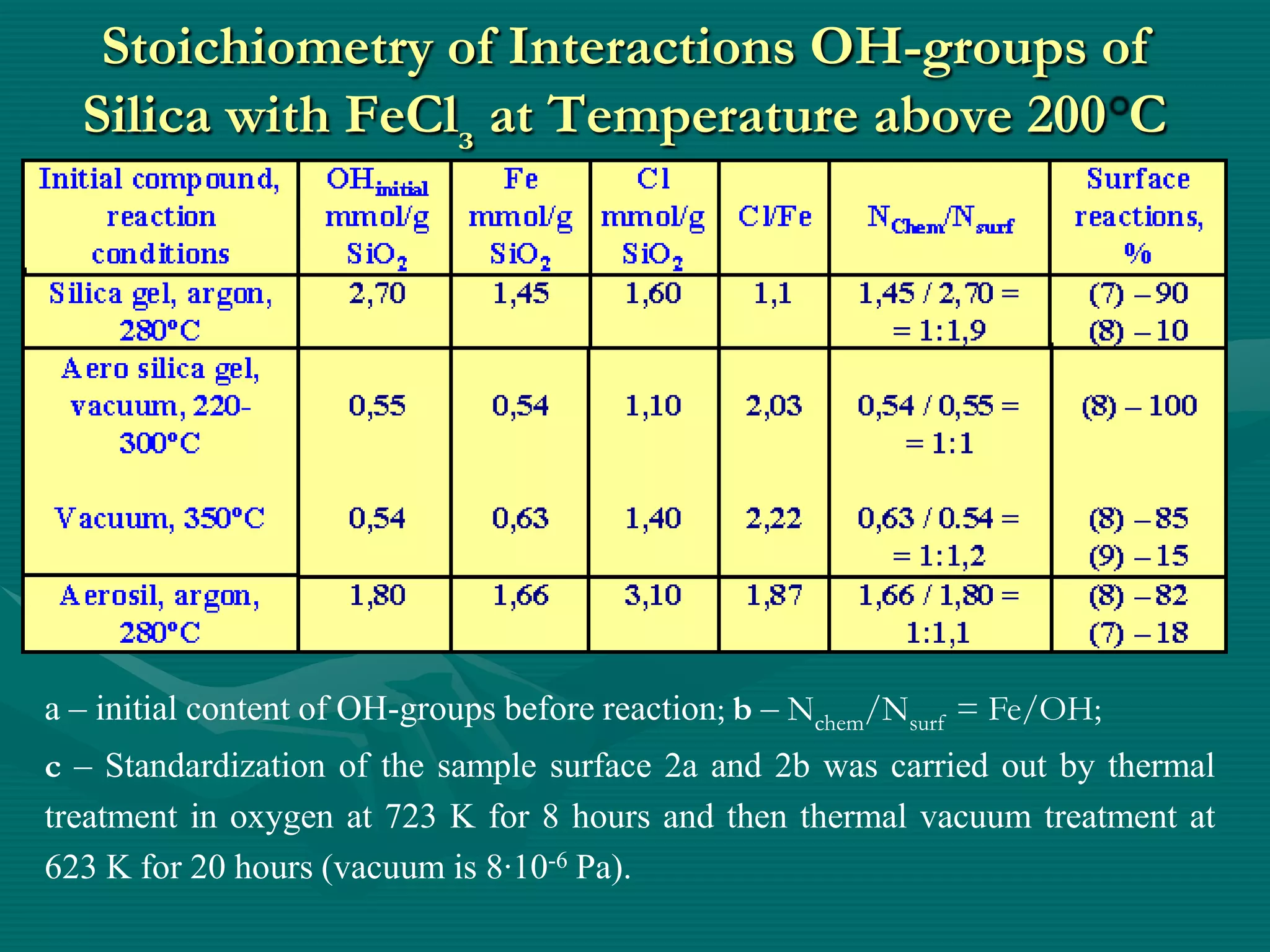
Stoichiometry of Interactions OH-groups of
  Silica with FeClз at Temperature above 200 C


a – initial content of ОН-groups before reaction; b – Nchem/Nsurf = Fe/ОН;
c – Standardization of the sample surface 2a and 2b was carried out by thermal
treatment in oxygen at 723 K for 8 hours and then thermal vacuum treatment at
623 K for 20 hours (vacuum is 8·10-6 Pa).
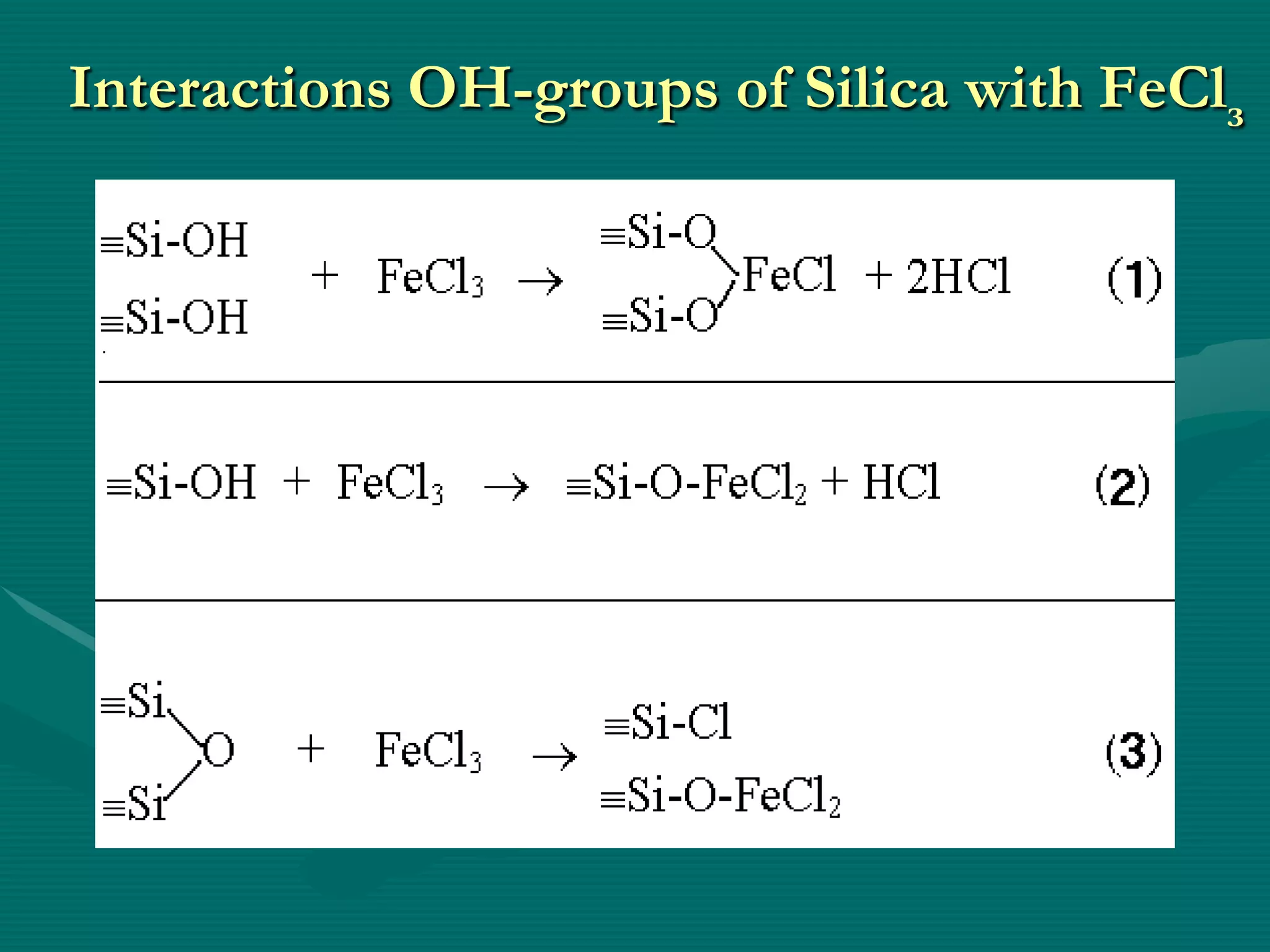
Interactions OH-groups of Silica with FeClз
The Scheme of State of
    Solid Chemical Compounds
               3

                          1 – initial metal
                          oxide (MOn);
        2
                          2–surface chemical
                          compound [MO]n-1
1
                          (M– O)2 Si(OH)2 ;
                          3–spatially divided
                          compound [MOn]–
                          [SiO2];
                          1 – conditional
                          (internal) border of
                          division
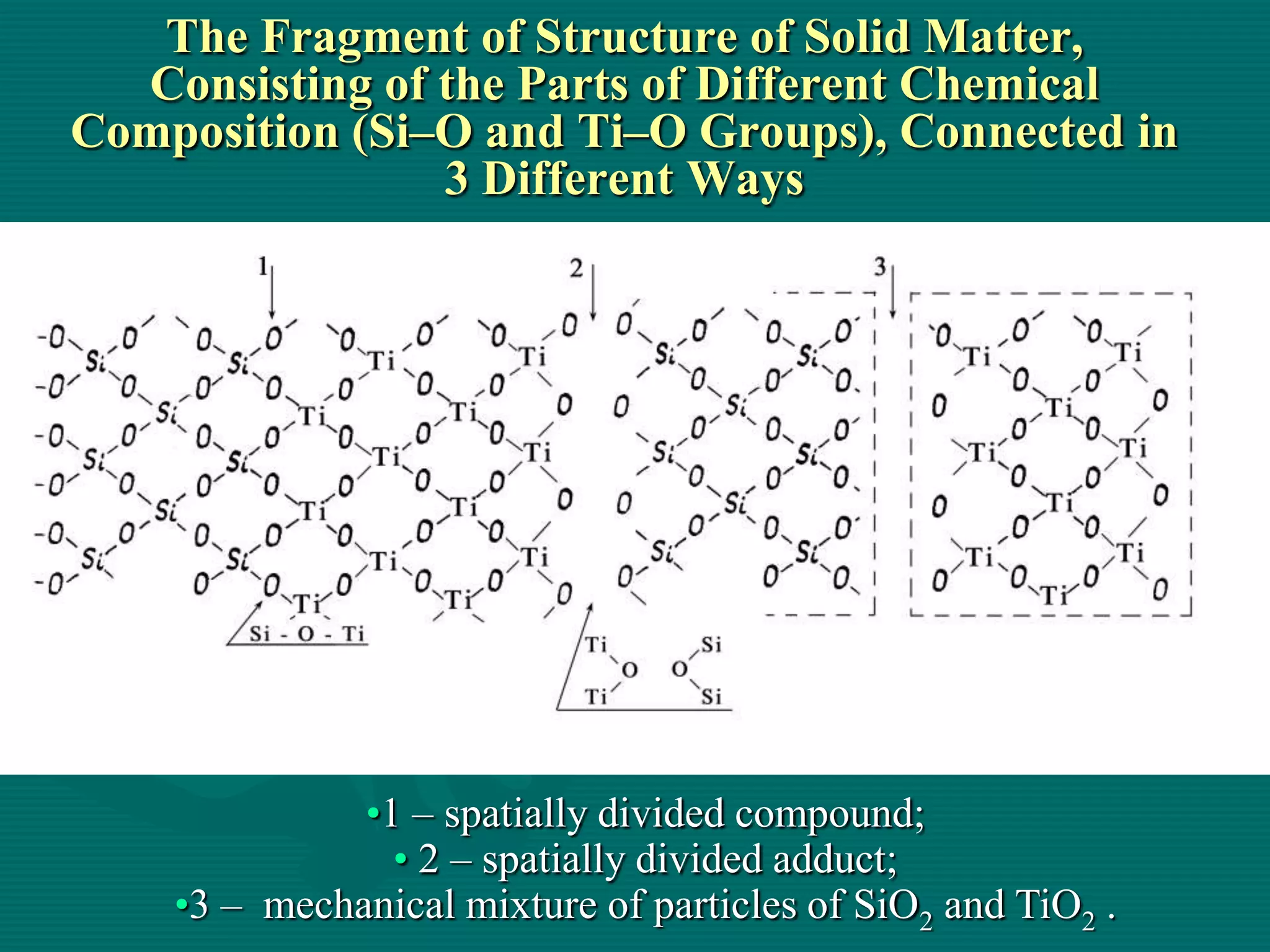
The Fragment of Structure of Solid Matter,
  Consisting of the Parts of Different Chemical
Composition (Si–O and Ti–O Groups), Connected in
                3 Different Ways


              •1 – spatially divided compound;
                • 2 – spatially divided adduct;
    •3 – mechanical mixture of particles of SiO2 and TiO2 .
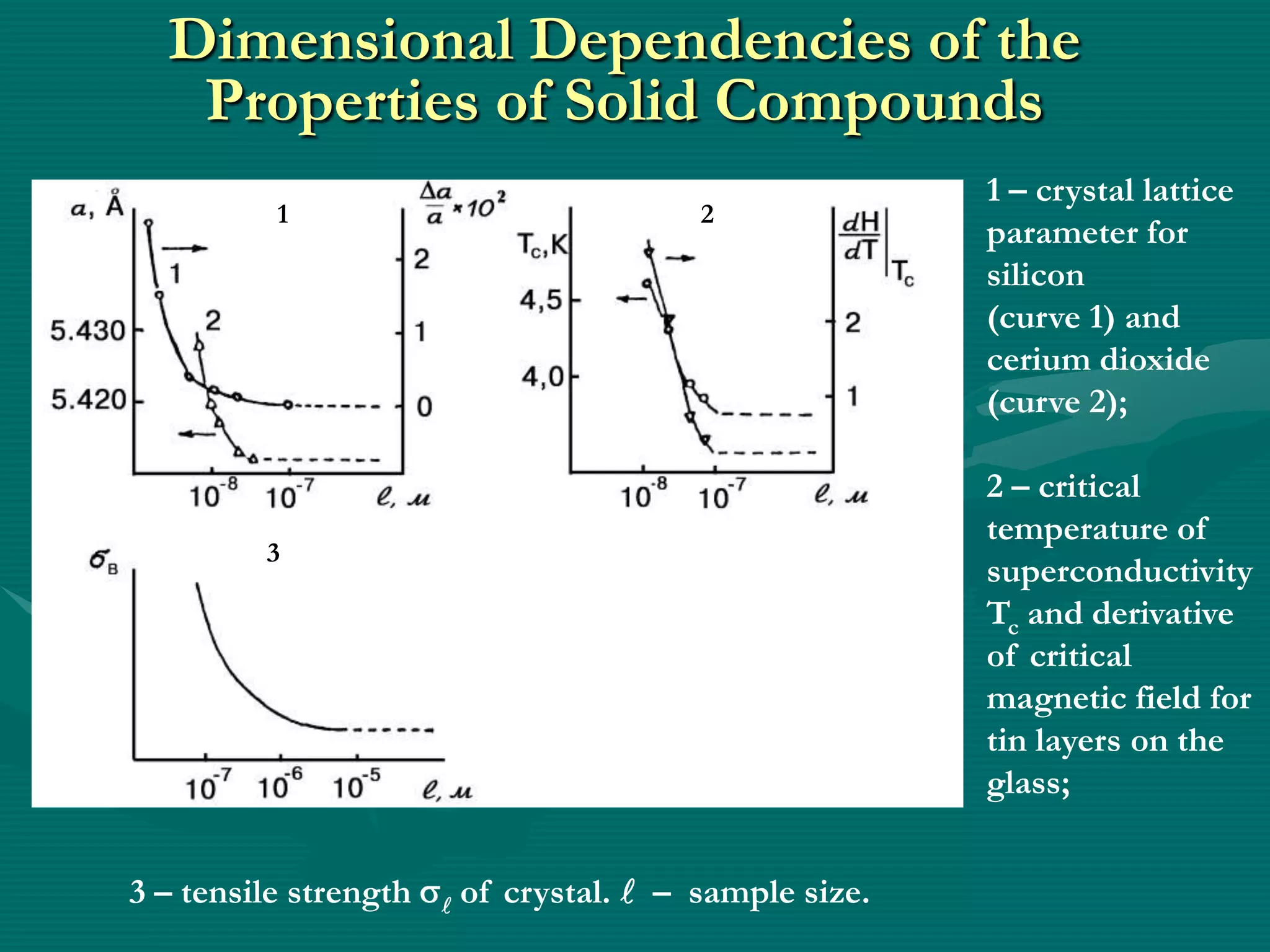
Dimensional Dependencies of the
   Properties of Solid Compounds
                                                          1 – crystal lattice
          1                                2
                                                          parameter for
                                                          silicon
                                                          (curve 1) and
                                                          cerium dioxide
                                                          (curve 2);

                                                          2 – critical
                                                          temperature of
         3
                                                          superconductivity
                                                          Tc and derivative
                                                          of critical
                                                          magnetic field for
                                                          tin layers on the
                                                          glass;


3 – tensile strength      of crystal.  – sample size.
Generalized View of Dependence of Properties
              on Size of Chemical Matter
           Subcrystal
Property


                            Massive
                            crystal   a – for the solid matter;
                                      b – change of the value of
                                      specific Surface S depending on
                                      Size of Solid Matter ()
                        b             [according to V.B. Aleskovskii].
                                      1 – size of minimal solid matter
                                      (nanoobject);
                                      2 – size of dispersed solid state
                                      (micro object);
                                      3 – massive (macroscopic) solid.
The State of Two-Dimensional
Nanostructures on the Silica Surface
               •       А – with homogeneous character of distribution of
                   chemical composition and state, for example, monolayers
                   of element-oxygen groups of the same chemical
                   composition, l – monolayer thickness, L – layer thickness,
                   l1 = l2 = l3 = l4; 1– for example, Ti–O monolayers.
               •       B – periodic distribution of element-oxygen layers
                   along z axis, (L – layer thickness) consisting of the certain
                   quantity of monolayers, for example, according to the
                   scheme: 1 –Fe-O groups, 2 –Ti-O groups (a – two-layer
                   group, l1 = l2 , б, в – four-layer group l1 = l3 и l2 = l4 ).

               •       C – aperiodic distribution of element-oxygen layers
                   along z axis, four-layer structure l1 l2 l3 l4
               •       D – aperiodic distribution of atoms on the plane of
                   surface monolayer, top view: х –Fe-O groups, о –Ti-O
                   groups; а, б – different ratios of groups Fe-O and Ti-O.

               •       E - aperiodic distribution of “zero-dimensional"
                   structures on the plane of support: 1 –Si , 2 – [ Fe]
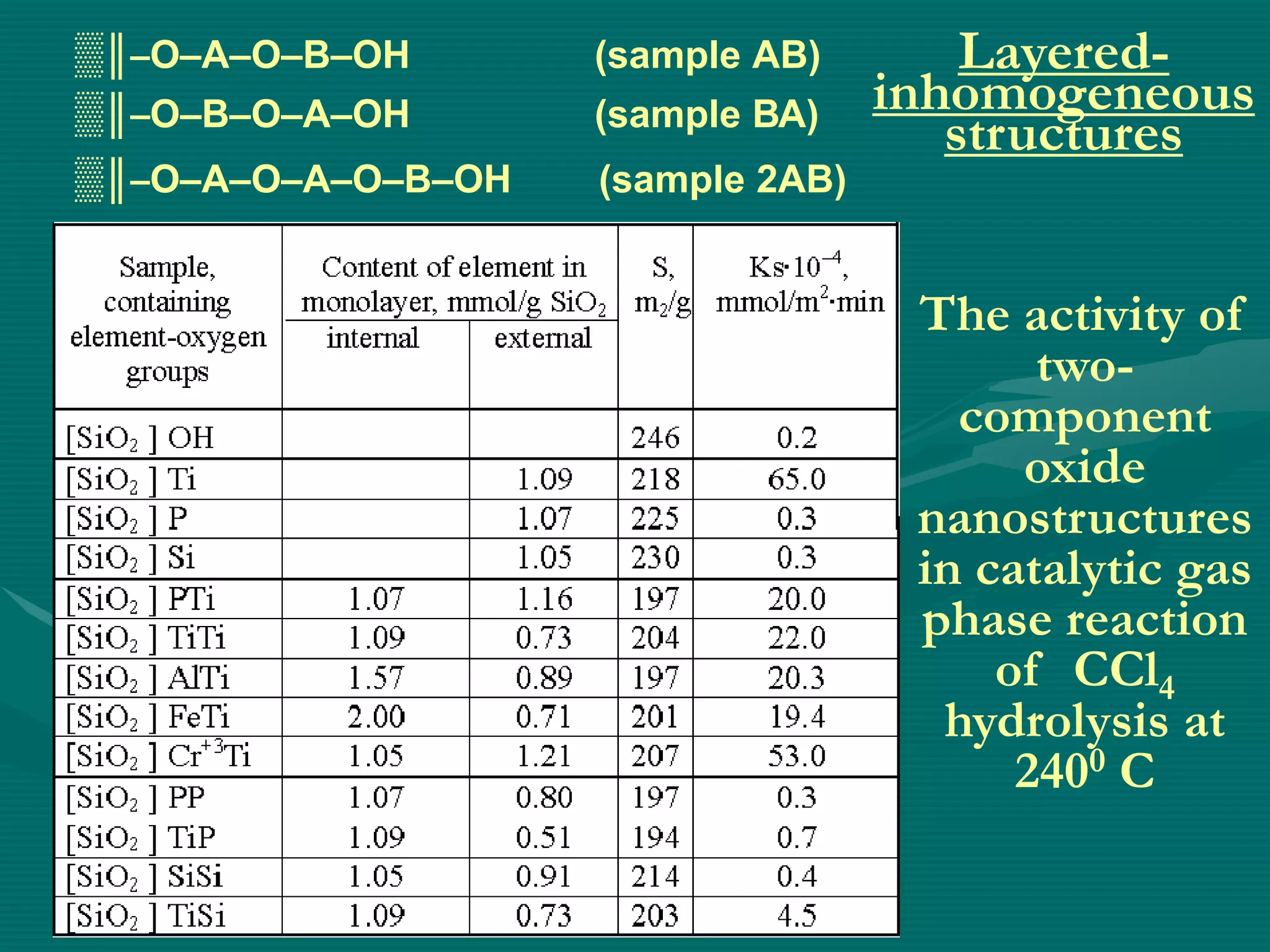
▒║–O–A–O–B–OH       (sample АВ)        Layered-
▒║–O–В–O–А–OH       (sample ВА)    inhomogeneous
                                      structures
▒║–O–A–O–А–О–B–OH   (sample 2АВ)


                                    The activity of
                                          two-
                                      component
                                         oxide
                                    nanostructures
                                    in catalytic gas
                                    phase reaction
                                        of CCl4
                                     hydrolysis at
                                         2400 C
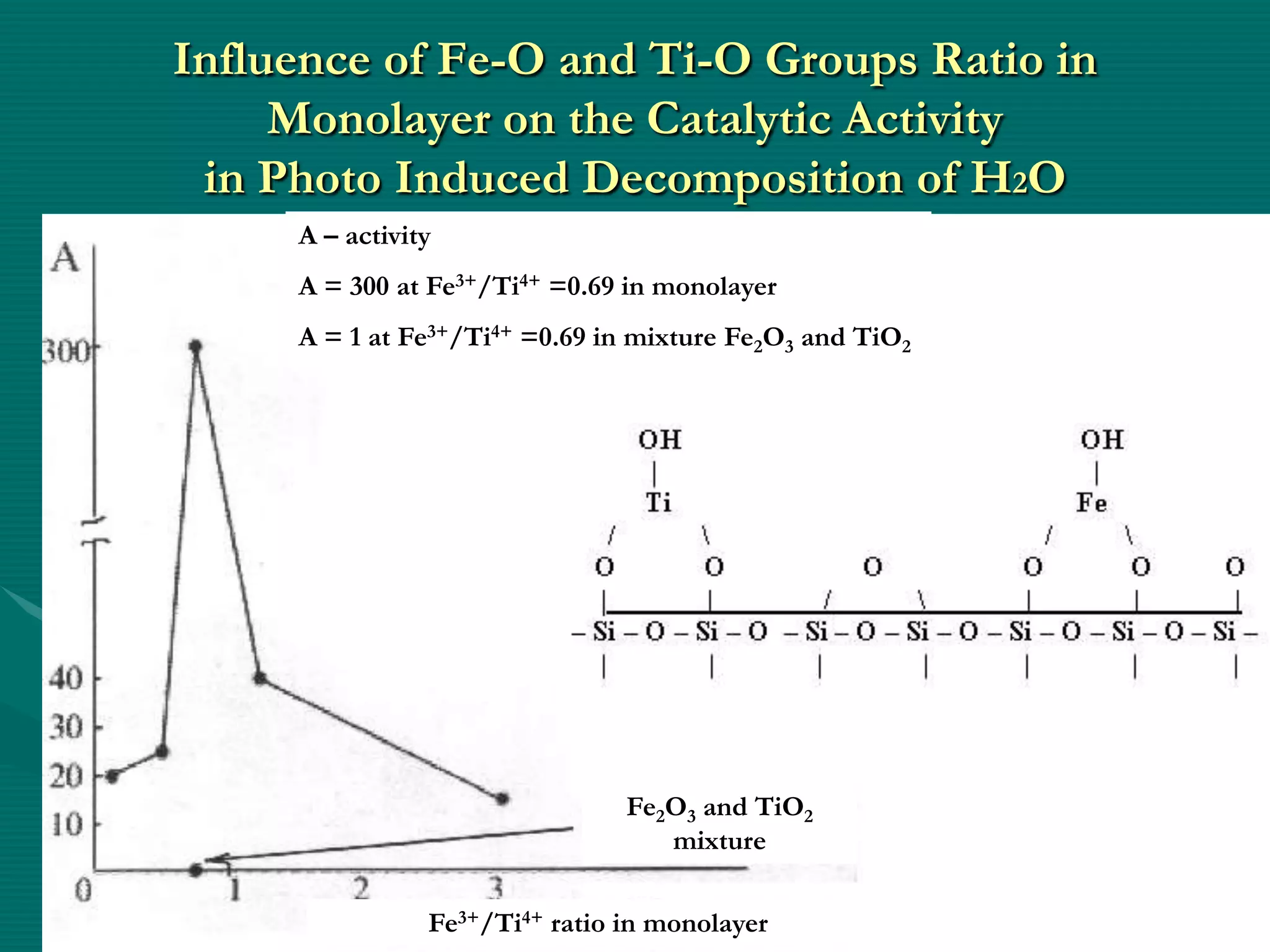
Influence of Fe-O and Ti-O Groups Ratio in
     Monolayer on the Catalytic Activity
 in Photo Induced Decomposition of H2O
     A – activity
     A = 300 at Fe3+/Ti4+ =0.69 in monolayer
     A = 1 at Fe3+/Ti4+ =0.69 in mixture Fe2O3 and TiO2


                                Fe2O3 and TiO2
                                   mixture

                Fe3+/Ti4+ ratio in monolayer
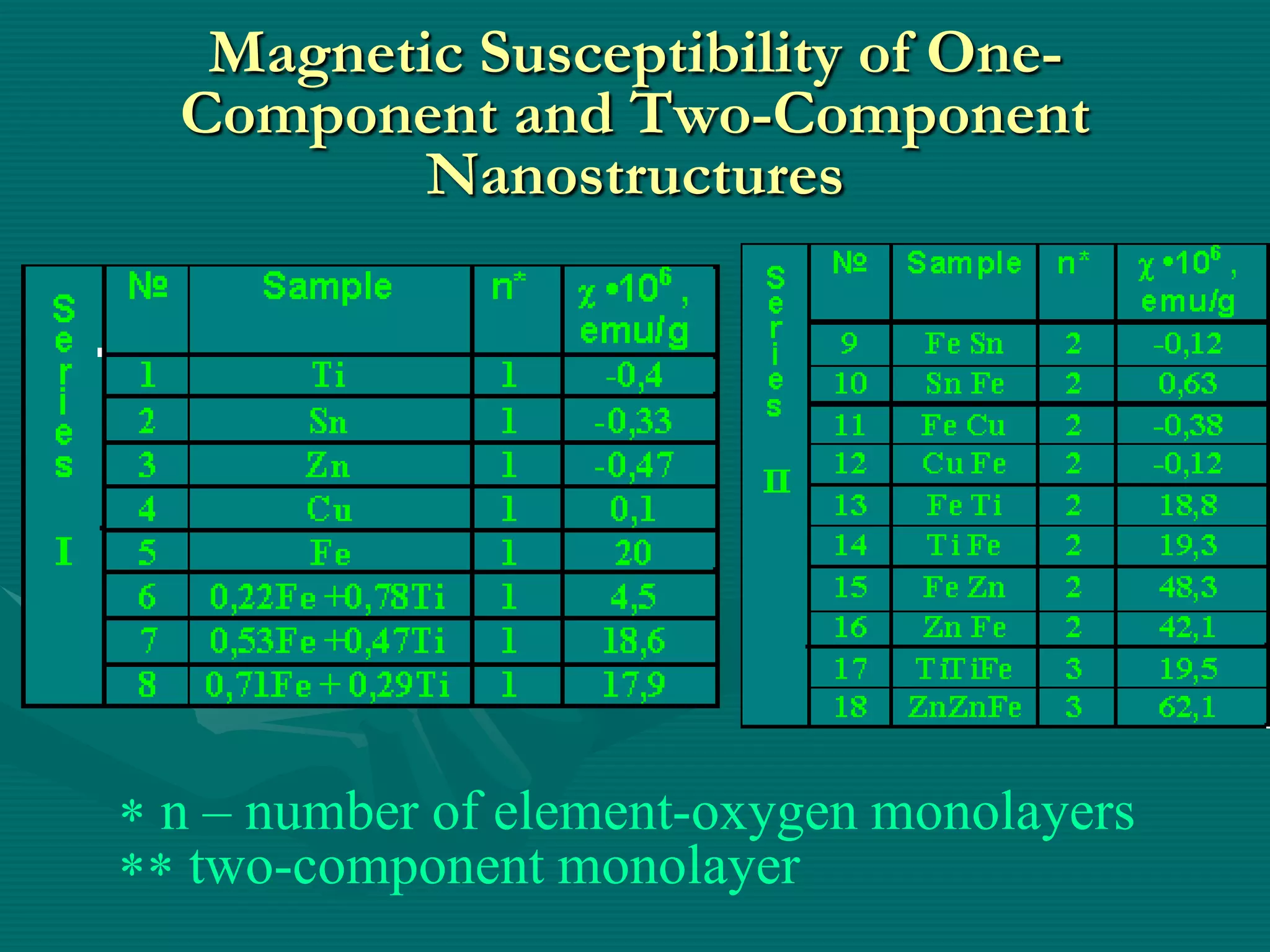
Magnetic Susceptibility of One-
Component and Two-Component
        Nanostructures


n – number of element-oxygen monolayers
 two-component monolayer
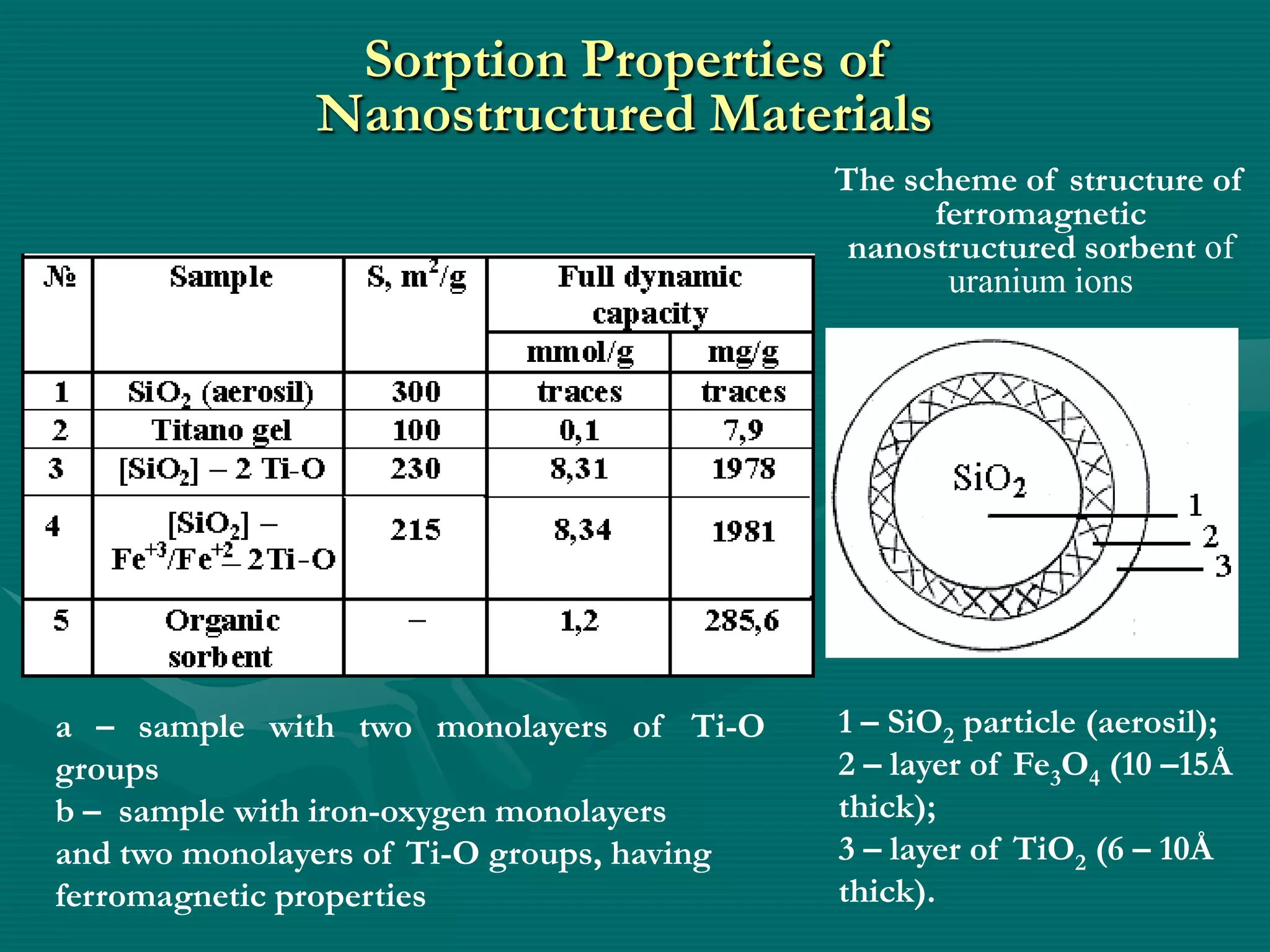
Sorption Properties of
               Nanostructured Materials
                                            The scheme of structure of
                                                  ferromagnetic
                                             nanostructured sorbent of
                                                   uranium ions


а – sample with two monolayers of Ti-O      1 – SiO2 particle (aerosil);
groups                                      2 – layer of Fe3O4 (10 –15Å
b – sample with iron-oxygen monolayers      thick);
and two monolayers of Ti-O groups, having   3 – layer of TiO2 (6 – 10Å
ferromagnetic properties                    thick).
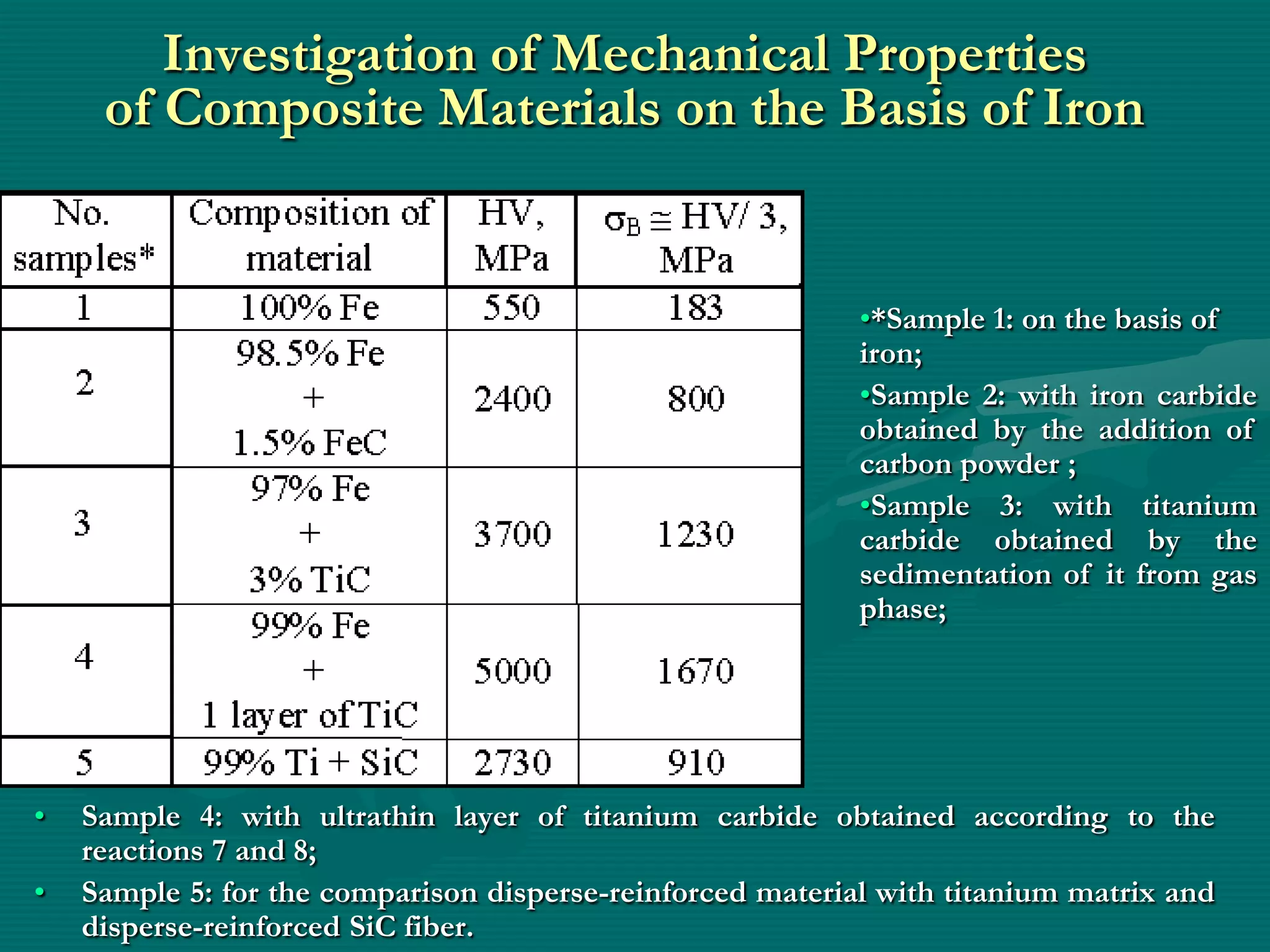
Investigation of Mechanical Properties
     of Composite Materials on the Basis of Iron


                                                            •*Sample 1: on the basis of
                                                            iron;
                                                            •Sample 2: with iron carbide
                                                            obtained by the addition of
                                                            carbon powder ;
                                                            •Sample 3: with titanium
                                                            carbide obtained by the
                                                            sedimentation of it from gas
                                                            phase;


•   Sample 4: with ultrathin layer of titanium carbide obtained according to the
    reactions 7 and 8;
•   Sample 5: for the comparison disperse-reinforced material with titanium matrix and
    disperse-reinforced SiC fiber.
Conclusion
   Therefore, we can ascertain that by present
  time, the scientific base is created allowing to
   solve complex synthetic problems, including
construction of highly organized nanostructured
          solid substances and materials.

Prezent eng

  • 1.
    PECULIARITY OF NANOLEVEL STRUCTURING IN SYNTHESIS OF NOVEL FUNCTIONAL SOLIDS AND NANOSTRUCTURED MATERIALS V.M. Smirnov, I.P. Suzdalev Saint-Petersburg State University, Department of Chemistry, Solid State Chemistry Division
  • 2.
    The State ofTwo-Dimensional Nanostructures on the Silica Surface • А – with homogeneous character of distribution of chemical composition and state, for example, monolayers of element-oxygen groups of the same chemical composition, l – monolayer thickness, L – layer thickness, l1 = l2 = l3 = l4; 1– for example, Ti–O monolayers. • B – periodic distribution of element-oxygen layers along z axis, (L – layer thickness) consisting of the certain quantity of monolayers, for example, according to the scheme: 1 –Fe-O groups, 2 –Ti-O groups (a – two-layer group, l1 = l2 , б, в – four-layer group l1 = l3 и l2 = l4 ). • C – aperiodic distribution of element-oxygen layers along z axis, four-layer structure l1 l2 l3 l4 • D – aperiodic distribution of atoms on the plane of surface monolayer, top view: х –Fe-O groups, о –Ti-O groups; а, б – different ratios of groups Fe-O and Ti-O. • E - aperiodic distribution of “zero-dimensional" structures on the plane of support: 1 –Si , 2 – [ Fe]
  • 3.
    Energetic Diagram ofReaction with Kinetic and Thermodynamic Control [SiO2]m-1O1,5SiOH + Cl2 [SiO2]m-1O1,5SiCl SiCl4 A B C 1 – reaction A → B dominates, product B is kinetically stable; Free Energy 2 – side reaction A → C dominates; 3 – reaction A → B dominates, but the product B is kinetically unstable and converts rapidly into C. Reaction coordinate
  • 4.
    The Scheme ofChemical Construction of Oxide Nanostructures by the Molecular Layering Method Si-OH • O + CH3OH • Si Si-O-CH3 monolayer Functional groups mixture Solid matter surface a – layer of the set thickness ; b – layer of the set arrangement of monolayers of different chemical nature; c – multicomponent monolayers
  • 5.
    Stoichiometry of InteractionsOH-groups of Silica with FeClз at Temperature above 200 C a – initial content of ОН-groups before reaction; b – Nchem/Nsurf = Fe/ОН; c – Standardization of the sample surface 2a and 2b was carried out by thermal treatment in oxygen at 723 K for 8 hours and then thermal vacuum treatment at 623 K for 20 hours (vacuum is 8·10-6 Pa).
  • 6.
    Interactions OH-groups ofSilica with FeClз
  • 7.
    The Scheme ofState of Solid Chemical Compounds 3 1 – initial metal oxide (MOn); 2 2–surface chemical compound [MO]n-1 1 (M– O)2 Si(OH)2 ; 3–spatially divided compound [MOn]– [SiO2]; 1 – conditional (internal) border of division
  • 8.
    The Fragment ofStructure of Solid Matter, Consisting of the Parts of Different Chemical Composition (Si–O and Ti–O Groups), Connected in 3 Different Ways •1 – spatially divided compound; • 2 – spatially divided adduct; •3 – mechanical mixture of particles of SiO2 and TiO2 .
  • 9.
    Dimensional Dependencies ofthe Properties of Solid Compounds 1 – crystal lattice 1 2 parameter for silicon (curve 1) and cerium dioxide (curve 2); 2 – critical temperature of 3 superconductivity Tc and derivative of critical magnetic field for tin layers on the glass; 3 – tensile strength  of crystal.  – sample size.
  • 10.
    Generalized View ofDependence of Properties on Size of Chemical Matter Subcrystal Property Massive crystal a – for the solid matter; b – change of the value of specific Surface S depending on Size of Solid Matter () b [according to V.B. Aleskovskii]. 1 – size of minimal solid matter (nanoobject); 2 – size of dispersed solid state (micro object); 3 – massive (macroscopic) solid.
  • 11.
    The State ofTwo-Dimensional Nanostructures on the Silica Surface • А – with homogeneous character of distribution of chemical composition and state, for example, monolayers of element-oxygen groups of the same chemical composition, l – monolayer thickness, L – layer thickness, l1 = l2 = l3 = l4; 1– for example, Ti–O monolayers. • B – periodic distribution of element-oxygen layers along z axis, (L – layer thickness) consisting of the certain quantity of monolayers, for example, according to the scheme: 1 –Fe-O groups, 2 –Ti-O groups (a – two-layer group, l1 = l2 , б, в – four-layer group l1 = l3 и l2 = l4 ). • C – aperiodic distribution of element-oxygen layers along z axis, four-layer structure l1 l2 l3 l4 • D – aperiodic distribution of atoms on the plane of surface monolayer, top view: х –Fe-O groups, о –Ti-O groups; а, б – different ratios of groups Fe-O and Ti-O. • E - aperiodic distribution of “zero-dimensional" structures on the plane of support: 1 –Si , 2 – [ Fe]
  • 12.
    ▒║–O–A–O–B–OH (sample АВ) Layered- ▒║–O–В–O–А–OH (sample ВА) inhomogeneous structures ▒║–O–A–O–А–О–B–OH (sample 2АВ) The activity of two- component oxide nanostructures in catalytic gas phase reaction of CCl4 hydrolysis at 2400 C
  • 13.
    Influence of Fe-Oand Ti-O Groups Ratio in Monolayer on the Catalytic Activity in Photo Induced Decomposition of H2O A – activity A = 300 at Fe3+/Ti4+ =0.69 in monolayer A = 1 at Fe3+/Ti4+ =0.69 in mixture Fe2O3 and TiO2 Fe2O3 and TiO2 mixture Fe3+/Ti4+ ratio in monolayer
  • 14.
    Magnetic Susceptibility ofOne- Component and Two-Component Nanostructures n – number of element-oxygen monolayers two-component monolayer
  • 15.
    Sorption Properties of Nanostructured Materials The scheme of structure of ferromagnetic nanostructured sorbent of uranium ions а – sample with two monolayers of Ti-O 1 – SiO2 particle (aerosil); groups 2 – layer of Fe3O4 (10 –15Å b – sample with iron-oxygen monolayers thick); and two monolayers of Ti-O groups, having 3 – layer of TiO2 (6 – 10Å ferromagnetic properties thick).
  • 16.
    Investigation of MechanicalProperties of Composite Materials on the Basis of Iron •*Sample 1: on the basis of iron; •Sample 2: with iron carbide obtained by the addition of carbon powder ; •Sample 3: with titanium carbide obtained by the sedimentation of it from gas phase; • Sample 4: with ultrathin layer of titanium carbide obtained according to the reactions 7 and 8; • Sample 5: for the comparison disperse-reinforced material with titanium matrix and disperse-reinforced SiC fiber.
  • 17.
    Conclusion Therefore, we can ascertain that by present time, the scientific base is created allowing to solve complex synthetic problems, including construction of highly organized nanostructured solid substances and materials.