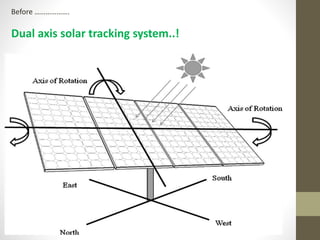
Before ……………….
Dual axis solar tracking system..!
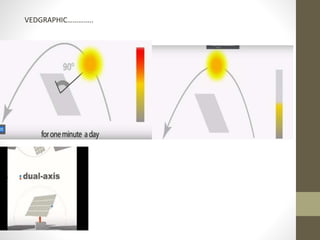
VEDGRAPHIC…………..
……………weather impact
Why Solar Energy?
 Easily accessible.
 Energy harnessed is free of cost.
 Pollution FREE.
 Available in infinite quantity.
Single Axis Trackers:
• A single axis tracker can pivot in only one plane –
horizontal or vertical. The horizontal type is used in
tropical regions where the sun gets very high at
noon, but the days are short. The vertical type is
used in high latitudes (such as in UK) where the sun
does not get very high, but summer days can be
very long.
• Although the construction is less complicated it is
also less effective in harnessing the total solar
energy.
Dual Axis Trackers:
• Dual axis solar tracker has two degrees of freedom
that act as axes of rotation. These axes are typically
normal to one another.
• It can rotate simultaneously in horizontal and vertical
directions and are able to point at the sun at all
times. Dual axis trackers track the sun both East to
West and North to South for added power output
(approx. 40% gain) and convenience.
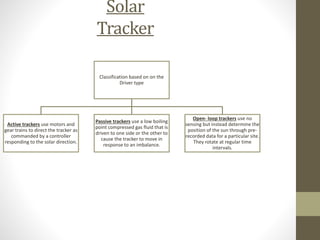
Classification based on on the
Driver type
Active trackers use motors and
gear trains to direct the tracker as
commanded by a controller
responding to the solar direction.
Passive trackers use a low boiling
point compressed gas fluid that is
driven to one side or the other to
cause the tracker to move in
response to an imbalance.
Open- loop trackers use no
sensing but instead determine the
position of the sun through pre-
recorded data for a particular site.
They rotate at regular time
intervals.
Solar
Tracker
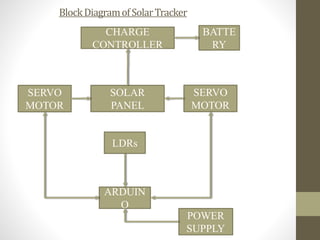
BlockDiagramofSolarTracker
LDRs
ARDUIN
O
POWER
SUPPLY
CHARGE
CONTROLLER
SOLAR
PANEL
SERVO
MOTOR
SERVO
MOTOR
BATTE
RY
Arduino
Uno• The Arduino uno is a microcontroller board based on
ATmega328. It has 14 digital inputs/output pins (of which
6 can be used as PWM outputs), 6 analog inputs, 16 MHz
Ceramic Resonator, a USB connection, a power jack and a
reset button.
• It has a number of libraries, including one for servo
motor control.
• The input supply needed is ideally 7-12V DC.
LDR
• Light dependent resistors work on the principle that, if
intensity of light on it increases, its resistance decreases
and thus more current flows through it.
• Bigger LDRs have higher sensitivity.
Solar Panel
• The rating of each Photo-Voltaic solar panel is, Pmax =
1.3W, Vmax = 7.5V.
• Two such panels are connected in series to get a stable
output voltage of 12V.
Charge Controller
• This is basically a voltage regulating circuit which is placed
between a solar panel and battery to be charged or any
load connected to the panel.
• It regulates the voltage that is received from solar panel.
Hardware
Implementation:
• Prototype 2
 Prototy
pe 1
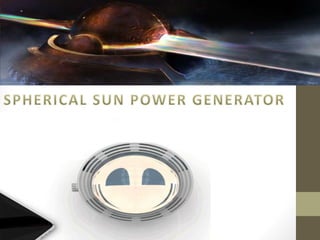
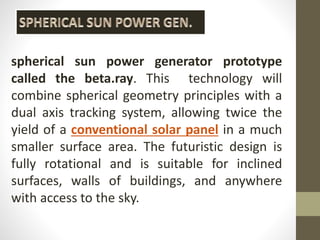
spherical sun power generator prototype
called the beta.ray. This technology will
combine spherical geometry principles with a
dual axis tracking system, allowing twice the
yield of a conventional solar panel in a much
smaller surface area. The futuristic design is
fully rotational and is suitable for inclined
surfaces, walls of buildings, and anywhere
with access to the sky.
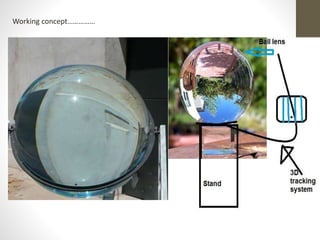
the project uses the advantageous strategy of
implementing a ball lens and specific
geometrical structure to improve energy
efficiency by 35%. in contrast to its traditional
photo-voltaic ‘dual-axis’ counterparts, the
device incorporates a fully rotational
weatherproof natural optical tracking device that
is adequate for functioning on inclined surfaces
and curtain walls
……………………………..
Concept…. Ball lens concept……
Working concept……………
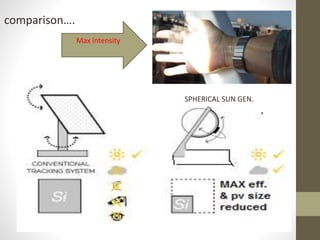
SPHERICAL SUN GEN.
comparison….
Max intensity
Tracking interface………….
Arduino LDR
Spherical Sun power Generator

Spherical Sun power Generator

  • 2.
    Before ………………. Dual axissolar tracking system..!
  • 3.
  • 4.
  • 5.
    Why Solar Energy? Easily accessible.  Energy harnessed is free of cost.  Pollution FREE.  Available in infinite quantity.
  • 6.
    Single Axis Trackers: •A single axis tracker can pivot in only one plane – horizontal or vertical. The horizontal type is used in tropical regions where the sun gets very high at noon, but the days are short. The vertical type is used in high latitudes (such as in UK) where the sun does not get very high, but summer days can be very long. • Although the construction is less complicated it is also less effective in harnessing the total solar energy. Dual Axis Trackers: • Dual axis solar tracker has two degrees of freedom that act as axes of rotation. These axes are typically normal to one another. • It can rotate simultaneously in horizontal and vertical directions and are able to point at the sun at all times. Dual axis trackers track the sun both East to West and North to South for added power output (approx. 40% gain) and convenience.
  • 7.
    Classification based onon the Driver type Active trackers use motors and gear trains to direct the tracker as commanded by a controller responding to the solar direction. Passive trackers use a low boiling point compressed gas fluid that is driven to one side or the other to cause the tracker to move in response to an imbalance. Open- loop trackers use no sensing but instead determine the position of the sun through pre- recorded data for a particular site. They rotate at regular time intervals. Solar Tracker
  • 8.
  • 9.
    Arduino Uno• The Arduinouno is a microcontroller board based on ATmega328. It has 14 digital inputs/output pins (of which 6 can be used as PWM outputs), 6 analog inputs, 16 MHz Ceramic Resonator, a USB connection, a power jack and a reset button. • It has a number of libraries, including one for servo motor control. • The input supply needed is ideally 7-12V DC.
  • 10.
    LDR • Light dependentresistors work on the principle that, if intensity of light on it increases, its resistance decreases and thus more current flows through it. • Bigger LDRs have higher sensitivity. Solar Panel • The rating of each Photo-Voltaic solar panel is, Pmax = 1.3W, Vmax = 7.5V. • Two such panels are connected in series to get a stable output voltage of 12V. Charge Controller • This is basically a voltage regulating circuit which is placed between a solar panel and battery to be charged or any load connected to the panel. • It regulates the voltage that is received from solar panel.
  • 11.
  • 12.
    spherical sun powergenerator prototype called the beta.ray. This technology will combine spherical geometry principles with a dual axis tracking system, allowing twice the yield of a conventional solar panel in a much smaller surface area. The futuristic design is fully rotational and is suitable for inclined surfaces, walls of buildings, and anywhere with access to the sky.
  • 13.
    the project usesthe advantageous strategy of implementing a ball lens and specific geometrical structure to improve energy efficiency by 35%. in contrast to its traditional photo-voltaic ‘dual-axis’ counterparts, the device incorporates a fully rotational weatherproof natural optical tracking device that is adequate for functioning on inclined surfaces and curtain walls ……………………………..
  • 14.
    Concept…. Ball lensconcept……
  • 15.
  • 16.
  • 18.