A PROJECT REPORT
ON
DUAL AXIS SOLAR TRACKING
SYSTEM USING ARDUINO
PRESENTED BY
B Sanjay Kumar 19UJ5A0204
N Goutham 19UJ5A0229
M Devi Sri 18UJ1A0216
D Vikas 19UJ5A0213
UNDER THE ESTEEMED GUIDENCE
OF
Mr. M.Chaitanya M.Tech (Asst Professor)
CONTENTS
 Introduction
 What is Solar Tracker?
 Improvements
 Aim of the Project
 Components
 Block Diagram
 Working
 Applications
 Advantages
 Conclusion
 Reference
INTRODUCTION
Solar energy is rapidly advancing as an important means of
renewable source of energy.
In verge of a major energy crisis, as energy consumption is
increasing day by day and energy sources are depleting.
Solar energy is universally accepted renewable energy
source, which can used to avoid the energy crisis.
An eco-friendly method of utilizing solar energy for
maximum energy consumption is dual axis solar tracker.
What is Solar Tracker?
 Solar tracker tracks
maximum solar energy.
 This energy can used b
y
converting it into other
forms.


IMPROVEMENTS
 We can able to collect the maximum solar energy since it
is Dual axis tracker.
 The speed of the servo motor and the movement of the
solar panel is controlled by using the arduino
 Thistracker will be more efficient than the above
mentioned trackers.
AIM OF THE PROJECT
 To utilize the maximum solar energy by using solar
panel.
 And hence to develop a arduino based dual axis solar
tracker.
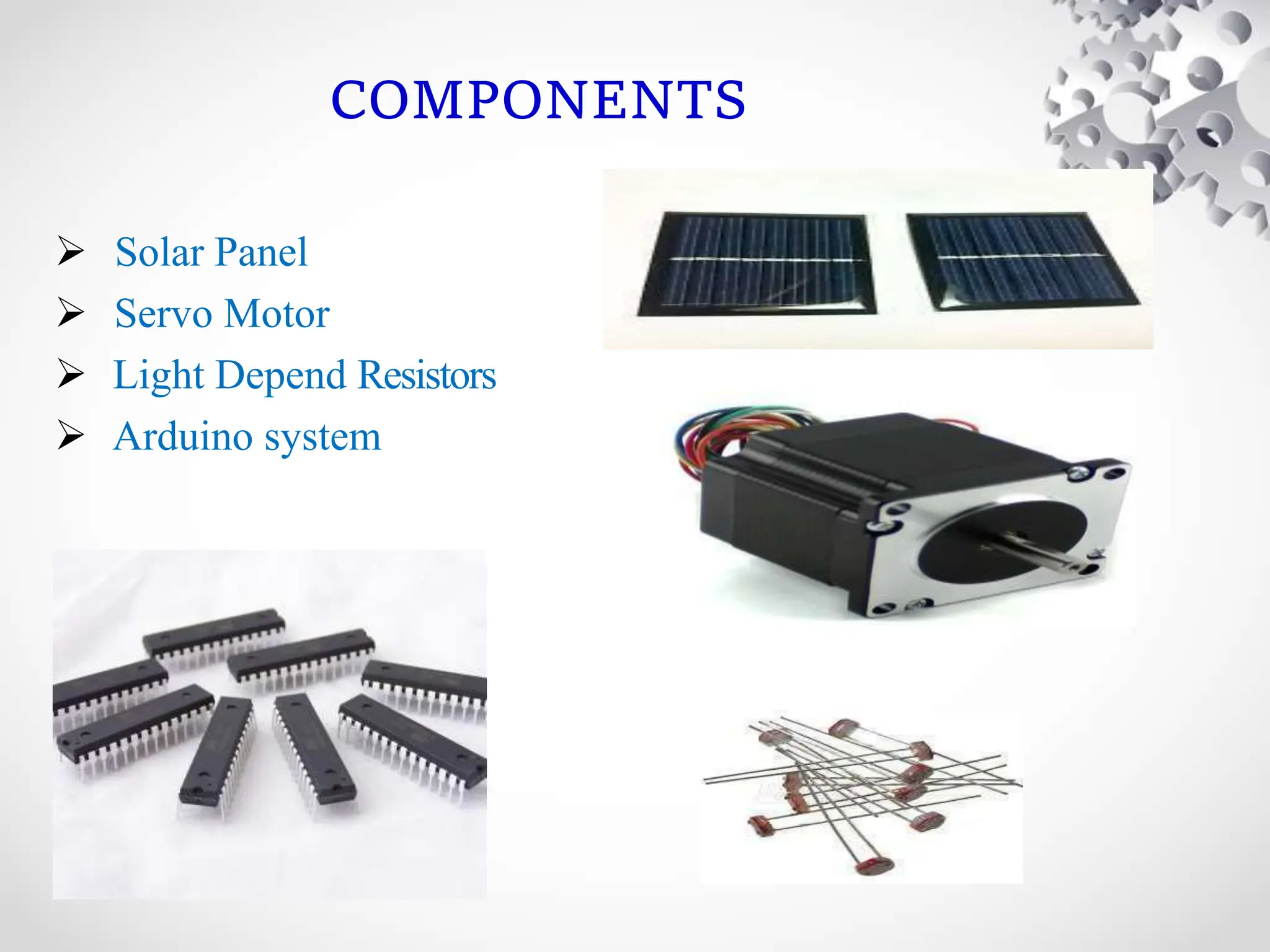
COMPONENTS
 Solar Panel
 Servo Motor
 Light Depend Resistors
 Arduino system
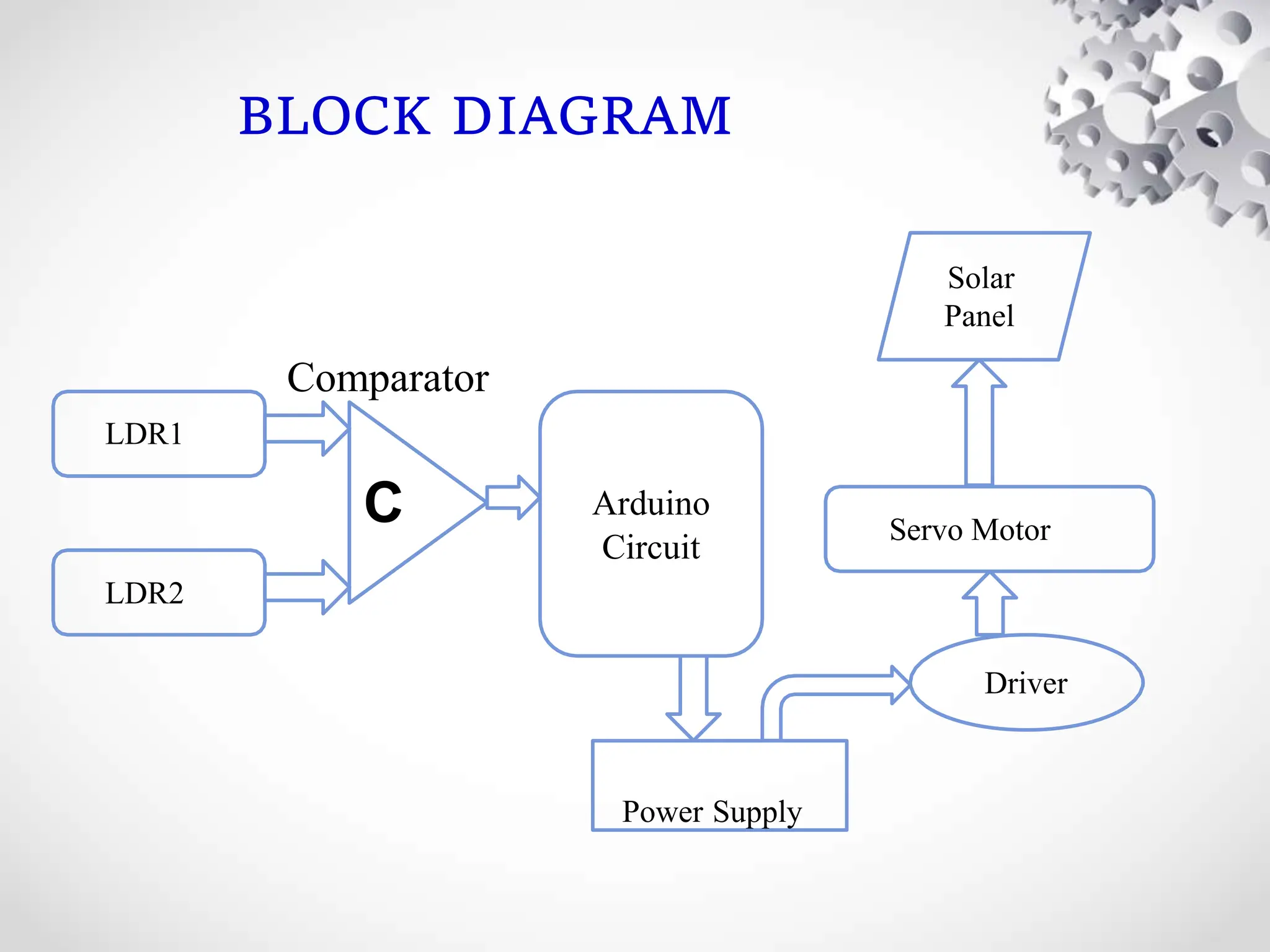
BLOCK DIAGRAM
LDR2
C Arduino
Circuit
Power Supply
Driver
Servo Motor
Solar
Panel
Comparator
LDR1
WORKING
 When sunlight incident on the solar tracker, it starts
calculating and comparing that from which direction
the maximum intensity sunlight is coming.
 After comparing the panel above the system start to
move toward the maximum intensity so that the
solar panel has the maximum intensity and makes
the maximum power.
 “The maximum intensity of light directly
proportional to the maximum power convert ”.
 There we are using the LDR which is known as the
Light dependent resistor when the sunlight incident the
LDR the resistor value of the LDR will decrease.
 It means it only controls the resistance by using light.
so, we are using this method. which LDR decreases the
maximum resistor the dual-axis solar tracking
system will move in that direction.
 This is the principle of this project there we are using
two servo motors which help to move the panel in all
directions. Arduino, help to make all processing.
calculation etc.
WORKING
APPLICATIONS
 Street light applications with out using normal power
supplies.
 In Remote areas implementing a small power systems
units at each home.
 Using this system to getting hot water.
 It can be used in Vehicles for Battery charging.
ADVANTAGES
 High degree of flexibility since it moves in two directions.
 Its flexibility allowing for higher energy output
during Sunny days.
 Higher degree of accuracy in directional point.
 Eco-Friendly.
CONCLUSION
 We presented a means of tracking the sun’s position with
the help of arduino. Specially, it demonstrates a working
solar tracker for maximizing solar cell output by
positioning a solar panel at the point of maximum light
intensity i.e., when Panel is Perpendicular to the Solar
energy.
 Solar tracking system is more efficient than any other
ordinary panel.
 It is possible to reduce the energy crisis to some large
extent.
REFERENCE
 Middle East J.Sci.Res.,19(11):1486-1489,2014.
International Journal of Scientific and Engineering
Research, Volume 4,Issue 6, June 2013.
International energy Agency, “Methodology Guidelines on
Lifecycle Assessment of Photovoltaic Electricity” ,IEA
PVPS Task 12,subtask 20,LCA Report IEA-PVPS T12-
01:2009 Oct 2009.
 www.iaeme.com/ijeet.asp
 " Solar Tracker Robot using Microcontroller" by A.B.
Afarulrazi, W. M. Utomo,K.L. Liew and M. Zarafi
published in 2011 International Conference on
Business,Engineering and IndustrialApplications
ANY QUERIES?
THANKYOU

dual%20axis%20solar%20tracking%20Sanjay.pptx

  • 1.
    A PROJECT REPORT ON DUALAXIS SOLAR TRACKING SYSTEM USING ARDUINO PRESENTED BY B Sanjay Kumar 19UJ5A0204 N Goutham 19UJ5A0229 M Devi Sri 18UJ1A0216 D Vikas 19UJ5A0213 UNDER THE ESTEEMED GUIDENCE OF Mr. M.Chaitanya M.Tech (Asst Professor)
  • 2.
    CONTENTS  Introduction  Whatis Solar Tracker?  Improvements  Aim of the Project  Components  Block Diagram  Working  Applications  Advantages  Conclusion  Reference
  • 3.
    INTRODUCTION Solar energy israpidly advancing as an important means of renewable source of energy. In verge of a major energy crisis, as energy consumption is increasing day by day and energy sources are depleting. Solar energy is universally accepted renewable energy source, which can used to avoid the energy crisis. An eco-friendly method of utilizing solar energy for maximum energy consumption is dual axis solar tracker.
  • 4.
    What is SolarTracker?  Solar tracker tracks maximum solar energy.  This energy can used b y converting it into other forms.  
  • 5.
    IMPROVEMENTS  We canable to collect the maximum solar energy since it is Dual axis tracker.  The speed of the servo motor and the movement of the solar panel is controlled by using the arduino  Thistracker will be more efficient than the above mentioned trackers.
  • 6.
    AIM OF THEPROJECT  To utilize the maximum solar energy by using solar panel.  And hence to develop a arduino based dual axis solar tracker.
  • 7.
    COMPONENTS  Solar Panel Servo Motor  Light Depend Resistors  Arduino system
  • 8.
    BLOCK DIAGRAM LDR2 C Arduino Circuit PowerSupply Driver Servo Motor Solar Panel Comparator LDR1
  • 9.
    WORKING  When sunlightincident on the solar tracker, it starts calculating and comparing that from which direction the maximum intensity sunlight is coming.  After comparing the panel above the system start to move toward the maximum intensity so that the solar panel has the maximum intensity and makes the maximum power.  “The maximum intensity of light directly proportional to the maximum power convert ”.
  • 10.
     There weare using the LDR which is known as the Light dependent resistor when the sunlight incident the LDR the resistor value of the LDR will decrease.  It means it only controls the resistance by using light. so, we are using this method. which LDR decreases the maximum resistor the dual-axis solar tracking system will move in that direction.  This is the principle of this project there we are using two servo motors which help to move the panel in all directions. Arduino, help to make all processing. calculation etc. WORKING
  • 11.
    APPLICATIONS  Street lightapplications with out using normal power supplies.  In Remote areas implementing a small power systems units at each home.  Using this system to getting hot water.  It can be used in Vehicles for Battery charging.
  • 12.
    ADVANTAGES  High degreeof flexibility since it moves in two directions.  Its flexibility allowing for higher energy output during Sunny days.  Higher degree of accuracy in directional point.  Eco-Friendly.
  • 13.
    CONCLUSION  We presenteda means of tracking the sun’s position with the help of arduino. Specially, it demonstrates a working solar tracker for maximizing solar cell output by positioning a solar panel at the point of maximum light intensity i.e., when Panel is Perpendicular to the Solar energy.  Solar tracking system is more efficient than any other ordinary panel.  It is possible to reduce the energy crisis to some large extent.
  • 14.
    REFERENCE  Middle EastJ.Sci.Res.,19(11):1486-1489,2014. International Journal of Scientific and Engineering Research, Volume 4,Issue 6, June 2013. International energy Agency, “Methodology Guidelines on Lifecycle Assessment of Photovoltaic Electricity” ,IEA PVPS Task 12,subtask 20,LCA Report IEA-PVPS T12- 01:2009 Oct 2009.  www.iaeme.com/ijeet.asp  " Solar Tracker Robot using Microcontroller" by A.B. Afarulrazi, W. M. Utomo,K.L. Liew and M. Zarafi published in 2011 International Conference on Business,Engineering and IndustrialApplications
  • 15.