AN ARDUINO BASED SOLAR
TRACKING SYSTEM
GUIDED BY
A.N. ABHIRAMI
H.O.D - EEE
S.L. SREEDEVI
PRESENTED
BY
A.CHAITANYA KUMAR (411517105002)
P.ILAVARUNA KARTHIK (411517105013)
M.MANOJ (411517105018)
C.SUGAN (411517105032)
PERI INSTITUTE OF TECHNOLOGY, MANNIVAKKAM, CHENNAI
OVERVIEW OF CONTENTS
 Abstract
 Scope
 Literature review
 Existing System
 Proposed System
 Block Diagram
 Hardware and Software used
 Working
 Circuit Diagram
 Conclusion
ABSTRACT
This project is discussed all about the design and construction mechanism
of the prototype for the solar tracking system having a Dual axis. The
system we are proposing requires less hardware than the systems presented
earlier. DC motor helps in tracking the axis of the sun and keeps the panel
in direction of the sun all day long. The one solar panel of 12v are used
which rotate along the direction of sun with the help of Dc motor which is
using initial code information we provided in Arduino Uno to activate the
LDR sensors used, thus these LDR sensors give system the information
about the best possible movement to be made in order to charge the solar
panels. The designed system increases the energy generation efficiency of
the solar cells
As the proposed prototype is a miniature of main system, it has some
limitations which can be mitigated through future developments. A
small cardboard is rotated in the system and 12v solar panel is used for
analysis. As a miniature system, it works out well. Larger Solar panel
must be integrated with the system to prepare better result and cost
analysis. It has been proven through our research and statistical analysis
that solar tracking system with Dual-axis freedom can increase energy
output by approximately 42.6%.Further mechanical enhancement can
be done to the prototype, to implement dual-axis tracking.
SCOPE
LITERATURE SURVEY
 In the paper[1]," IMPLEMENTATION OF A PROTOTYPE FOR A
TRADITIONAL SOLAR TRACKING SYSTEM" by Nader Barsoum
distributed in the 2009 Third UKSim Euro-pean Symposium on Computer
Modeling and Simulation depicts in detail the structure and development of a
model for sun oriented following framework with two degrees of opportunity,
which recognizes the daylight utilizing photocells. The control circuit for the
sun based tracker depends on an Arduino. This is modified to recognize the
daylight through the photocells and afterward impel the engine to position the
sun based board where it can get most extreme daylight. This paper is tied in
with moving a sun powered board alongside the heading of daylight; it utilizes
a rigging engine to control the situation of the sunlight based board, which gets
its information from an Arduino. The goal is to structure and execute a
computerized, twofold hub solar tracking instrument utilizing installed
framework configuration so as to streamline the efficiency of in general
sunlight based vitality yield.
 In the paper[2] entitled," Design and Construction of an Automatic Solar
Tracking System by Md. Tanvir Arafat Khan, S.M. ShahrearTanzil, Rifat
Rahman, S M Shafiul Alam distributed in sixth International Conference on
Electrical and Computer Engineering ICECE 2010, 18-20 December 2010,
Dhaka, Bangladesh depicts an Arduino based structure system of an automatic
sun powered tracker. Light needy resistors are utilized as the sensors of the
sunlight based tracker. The structured tracker has exact control instrument
which will give three different ways of controlling framework. A little model
of sun based following framework is likewise developed to execute the
structure approach displayed here. In this paper the plan approach of an
Arduino based basic and effectively modified programmed sun based tracker
is exhibited. A model of programmed sunlight based tracker guarantees
practicality of this plan approach.
 In the paper[3] entitled," Microcontroller-Based Two-Axis Solar Tracking
System" by Lwin Oo and Nang Kaythi Hlaing distributed in Second
International Conference on Computer Research and Development depicts to
create and execute a model of two pivot sun powered following framework
dependent on a PIC microcontroller. The allegorical reflector or illustrative
dish is built around two feed width to catch the suns vitality. The focal point
of the illustrative reflector is hypothetically determined down to an
infinitesimally little point to get very high temperature. This two pivot auto-
following framework has additionally been developed utilizing PIC 16F84A
microcontroller. The get together programming language is utilized to
interface the PIC with two-hub sun oriented following framework. The
temperature at the focal point of the explanatory reflector is estimated with
temperature tests. This auto-following framework is controlled with two 12V,
6W DC apparatus box engines. The five light sensors (LDR) are utilized to
follow the sun and to begin the activity (Day/Night task).
• Photovoltaic panels are used for harnessing solar energy from the sun
and converting them into electrical energy. But they can’t fully harness
the solar energy during the day if they are kept static at a particular
angle.
• In order to obtain maximum power output, photovoltaic panels should
be moved along with the sun.
• Single-axis tracker tracks the sun from east-west direction and with an
optimal tilt angle, it is found that electrical output from the single-axis
solar tracker is at an average of 30% more when compared to the fixed
solar panel.
EXISTING SYSTEM
PROPOSED SYSTEM
 In our proposed System we are going to reduce the loss of light energy by
using the Arduino Microcontroller
 Photovoltaic cell is nothing but a solar cell. Solar cell is made up of
semiconductor material silicon.
 Light Dependent Resistors or LDRs are the resistors whose resistance
values depend on intensity of the light.
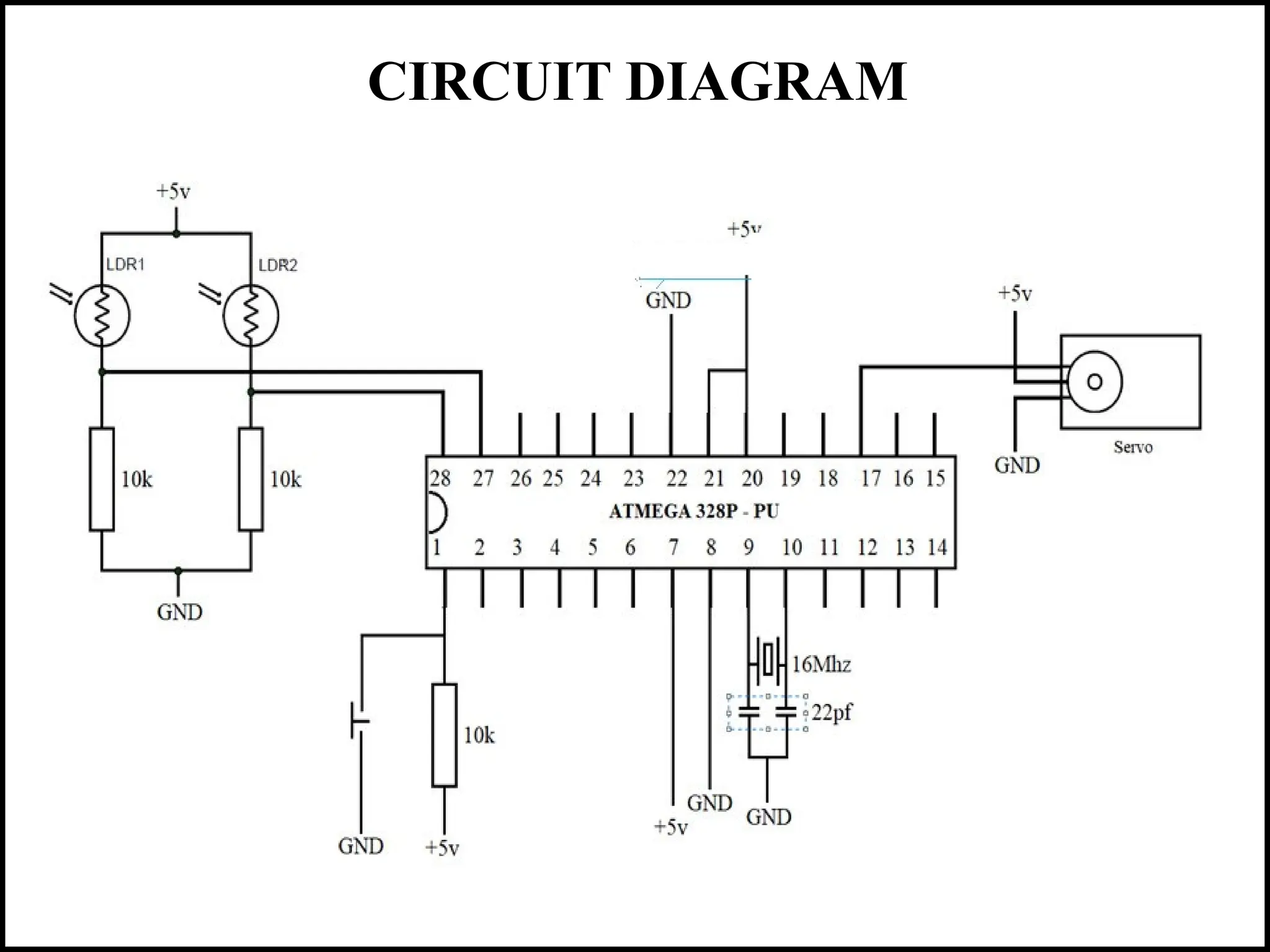
 Based on the light falling on the two LDRs, the ATmega328
Microcontroller changes the position of the dc Motor which in turn
moves in the panel.
HARDWARE AND SOFTWARE USED
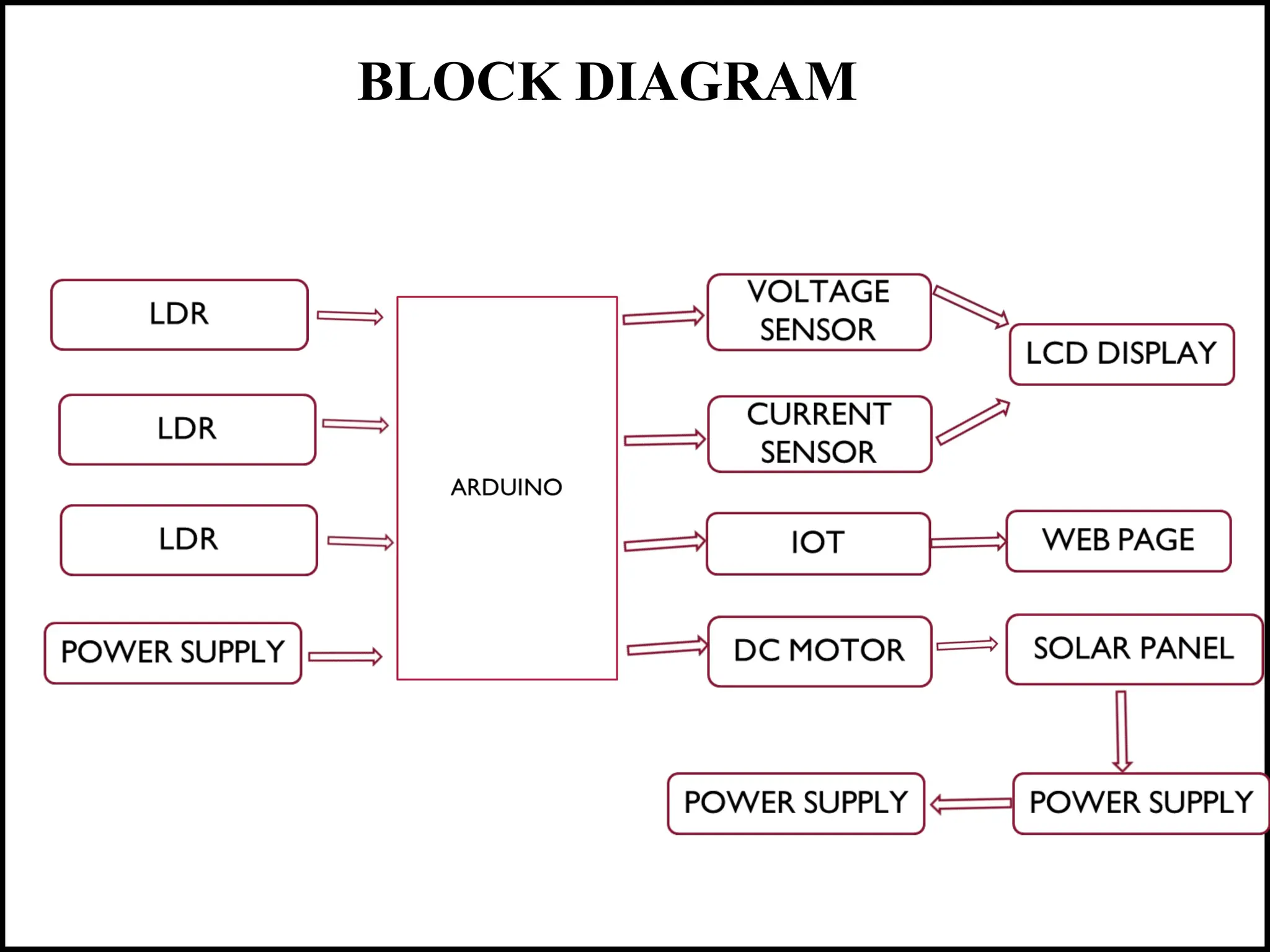
• Arduino Uno
• LCD
• LDR
• DC motor
• Solar panel
• Voltage sensor
• Current sensor
• IOT
BLOCK DIAGRAM
METHODOLOGY
There are several forms of tracking currently available: these vary mainly in the
method of implementing the designs. the two general forms of tracking used are
fixed control algorithms and dynamic tracking. the inherent difference between
the two methods is the manner in which the path of the sun is determined. in the
fixed control algorithm systems, the path of the sun is determined by referencing
an algorithm that calculates the position of the sun for each time period. that is,
the control system does not actively find the sun's position but works it out given
the current time, day, month, and year. the dynamic tracking system, on the other
hand actively searches for the sun's position at any time of day or night) .
Common on both forms of tracking is the control system. This system consists of
some method of direction control, such as DC motors, stepper motors, and servo
motors, which are directed by a control circuit, either digital or analog.
WORKING
 Three LDR sensors are used both placed at opposite ends of the solar
panels placed over a bridge tube connected with dc motor. We use two 9v
batteries connected to dc motor and Arduino separately.
 The LDR sensors follow a decrease in resistance indicating the falloff
light over them. As soon as any of the LDR sensors respond to the light
the dc motor gets activated using the initial programming information
present in the Arduino and rotates the bridge tube in the direction of that
particular LDR which has responded to the light.
 If the light falls over both the LDR sensors equally than there will be no
movement in the bridge tube done by the dc motor. Hence, the solar
panels gets charged and provide us an output i.e. illuminates a LED.
CIRCUIT DIAGRAM
ADVANTAGES
• As compared to single axis, dual-axis system provides high
abundant electrical energy output when compared to the fixed
mount system.
• The outputs in storage of IOT system can improve in the future by
improve or change the platform.
• The Dual axis tracker is having more efficiency.
• And the implementation of IoT can avoid human errors
APPLICATIONS
 These panels can be used to power the traffic lights and streetlights.
 These can be used in home to power the appliances using solar power.
 These can be used in industries as more energy can be saved by rotating the
panel.
PROJECT OUTCOME
 The sun tracking solar panel system is proposed here is quite efficient and
reliable for the proper solar energy used.
 The proposed system works according to the sunrays falling over on either of
the two LDR sensors attached at two different ends of the solar panel.
 The system performs its task quite efficiently and moves the solar panels in
desired direction of the sunlight.
THANK YOU

an aurdino based solar tracking system dual axis

  • 1.
    AN ARDUINO BASEDSOLAR TRACKING SYSTEM GUIDED BY A.N. ABHIRAMI H.O.D - EEE S.L. SREEDEVI PRESENTED BY A.CHAITANYA KUMAR (411517105002) P.ILAVARUNA KARTHIK (411517105013) M.MANOJ (411517105018) C.SUGAN (411517105032) PERI INSTITUTE OF TECHNOLOGY, MANNIVAKKAM, CHENNAI
  • 2.
    OVERVIEW OF CONTENTS Abstract  Scope  Literature review  Existing System  Proposed System  Block Diagram  Hardware and Software used  Working  Circuit Diagram  Conclusion
  • 3.
    ABSTRACT This project isdiscussed all about the design and construction mechanism of the prototype for the solar tracking system having a Dual axis. The system we are proposing requires less hardware than the systems presented earlier. DC motor helps in tracking the axis of the sun and keeps the panel in direction of the sun all day long. The one solar panel of 12v are used which rotate along the direction of sun with the help of Dc motor which is using initial code information we provided in Arduino Uno to activate the LDR sensors used, thus these LDR sensors give system the information about the best possible movement to be made in order to charge the solar panels. The designed system increases the energy generation efficiency of the solar cells
  • 4.
    As the proposedprototype is a miniature of main system, it has some limitations which can be mitigated through future developments. A small cardboard is rotated in the system and 12v solar panel is used for analysis. As a miniature system, it works out well. Larger Solar panel must be integrated with the system to prepare better result and cost analysis. It has been proven through our research and statistical analysis that solar tracking system with Dual-axis freedom can increase energy output by approximately 42.6%.Further mechanical enhancement can be done to the prototype, to implement dual-axis tracking. SCOPE
  • 5.
    LITERATURE SURVEY  Inthe paper[1]," IMPLEMENTATION OF A PROTOTYPE FOR A TRADITIONAL SOLAR TRACKING SYSTEM" by Nader Barsoum distributed in the 2009 Third UKSim Euro-pean Symposium on Computer Modeling and Simulation depicts in detail the structure and development of a model for sun oriented following framework with two degrees of opportunity, which recognizes the daylight utilizing photocells. The control circuit for the sun based tracker depends on an Arduino. This is modified to recognize the daylight through the photocells and afterward impel the engine to position the sun based board where it can get most extreme daylight. This paper is tied in with moving a sun powered board alongside the heading of daylight; it utilizes a rigging engine to control the situation of the sunlight based board, which gets its information from an Arduino. The goal is to structure and execute a computerized, twofold hub solar tracking instrument utilizing installed framework configuration so as to streamline the efficiency of in general sunlight based vitality yield.
  • 6.
     In thepaper[2] entitled," Design and Construction of an Automatic Solar Tracking System by Md. Tanvir Arafat Khan, S.M. ShahrearTanzil, Rifat Rahman, S M Shafiul Alam distributed in sixth International Conference on Electrical and Computer Engineering ICECE 2010, 18-20 December 2010, Dhaka, Bangladesh depicts an Arduino based structure system of an automatic sun powered tracker. Light needy resistors are utilized as the sensors of the sunlight based tracker. The structured tracker has exact control instrument which will give three different ways of controlling framework. A little model of sun based following framework is likewise developed to execute the structure approach displayed here. In this paper the plan approach of an Arduino based basic and effectively modified programmed sun based tracker is exhibited. A model of programmed sunlight based tracker guarantees practicality of this plan approach.
  • 7.
     In thepaper[3] entitled," Microcontroller-Based Two-Axis Solar Tracking System" by Lwin Oo and Nang Kaythi Hlaing distributed in Second International Conference on Computer Research and Development depicts to create and execute a model of two pivot sun powered following framework dependent on a PIC microcontroller. The allegorical reflector or illustrative dish is built around two feed width to catch the suns vitality. The focal point of the illustrative reflector is hypothetically determined down to an infinitesimally little point to get very high temperature. This two pivot auto- following framework has additionally been developed utilizing PIC 16F84A microcontroller. The get together programming language is utilized to interface the PIC with two-hub sun oriented following framework. The temperature at the focal point of the explanatory reflector is estimated with temperature tests. This auto-following framework is controlled with two 12V, 6W DC apparatus box engines. The five light sensors (LDR) are utilized to follow the sun and to begin the activity (Day/Night task).
  • 8.
    • Photovoltaic panelsare used for harnessing solar energy from the sun and converting them into electrical energy. But they can’t fully harness the solar energy during the day if they are kept static at a particular angle. • In order to obtain maximum power output, photovoltaic panels should be moved along with the sun. • Single-axis tracker tracks the sun from east-west direction and with an optimal tilt angle, it is found that electrical output from the single-axis solar tracker is at an average of 30% more when compared to the fixed solar panel. EXISTING SYSTEM
  • 9.
    PROPOSED SYSTEM  Inour proposed System we are going to reduce the loss of light energy by using the Arduino Microcontroller  Photovoltaic cell is nothing but a solar cell. Solar cell is made up of semiconductor material silicon.  Light Dependent Resistors or LDRs are the resistors whose resistance values depend on intensity of the light.  Based on the light falling on the two LDRs, the ATmega328 Microcontroller changes the position of the dc Motor which in turn moves in the panel.
  • 10.
    HARDWARE AND SOFTWAREUSED • Arduino Uno • LCD • LDR • DC motor • Solar panel • Voltage sensor • Current sensor • IOT
  • 11.
  • 12.
    METHODOLOGY There are severalforms of tracking currently available: these vary mainly in the method of implementing the designs. the two general forms of tracking used are fixed control algorithms and dynamic tracking. the inherent difference between the two methods is the manner in which the path of the sun is determined. in the fixed control algorithm systems, the path of the sun is determined by referencing an algorithm that calculates the position of the sun for each time period. that is, the control system does not actively find the sun's position but works it out given the current time, day, month, and year. the dynamic tracking system, on the other hand actively searches for the sun's position at any time of day or night) . Common on both forms of tracking is the control system. This system consists of some method of direction control, such as DC motors, stepper motors, and servo motors, which are directed by a control circuit, either digital or analog.
  • 13.
    WORKING  Three LDRsensors are used both placed at opposite ends of the solar panels placed over a bridge tube connected with dc motor. We use two 9v batteries connected to dc motor and Arduino separately.  The LDR sensors follow a decrease in resistance indicating the falloff light over them. As soon as any of the LDR sensors respond to the light the dc motor gets activated using the initial programming information present in the Arduino and rotates the bridge tube in the direction of that particular LDR which has responded to the light.  If the light falls over both the LDR sensors equally than there will be no movement in the bridge tube done by the dc motor. Hence, the solar panels gets charged and provide us an output i.e. illuminates a LED.
  • 14.
  • 15.
    ADVANTAGES • As comparedto single axis, dual-axis system provides high abundant electrical energy output when compared to the fixed mount system. • The outputs in storage of IOT system can improve in the future by improve or change the platform. • The Dual axis tracker is having more efficiency. • And the implementation of IoT can avoid human errors
  • 16.
    APPLICATIONS  These panelscan be used to power the traffic lights and streetlights.  These can be used in home to power the appliances using solar power.  These can be used in industries as more energy can be saved by rotating the panel.
  • 17.
    PROJECT OUTCOME  Thesun tracking solar panel system is proposed here is quite efficient and reliable for the proper solar energy used.  The proposed system works according to the sunrays falling over on either of the two LDR sensors attached at two different ends of the solar panel.  The system performs its task quite efficiently and moves the solar panels in desired direction of the sunlight.
  • 18.