





ADVANCED SPERM
PREPRATION TECHNIQUES
DR RAHUL SEN
CONSULTANT EMBRYOLOGIST
NEELKANTH FERTILITY JAIPUR
OF IVF & FIRST IVF BABY
CONVENTIONAL VS. ADVANCED
METHODS OF
SPERM PREPRATION
WHY USING DATE OLD TECHNIQUES
ARENT THERE ANY ADVANCEMENT ??
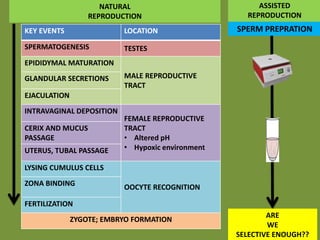
KEY EVENTS LOCATION
SPERMATOGENESIS TESTES
EPIDIDYMAL MATURATION
MALE REPRODUCTIVE
TRACT
GLANDULAR SECRETIONS
EJACULATION
INTRAVAGINAL DEPOSITION
FEMALE REPRODUCTIVE
TRACT
• Altered pH
• Hypoxic environment
CERIX AND MUCUS
PASSAGE
UTERUS, TUBAL PASSAGE
LYSING CUMULUS CELLS
OOCYTE RECOGNITION
ZONA BINDING
FERTILIZATION
ZYGOTE; EMBRYO FORMATION
NATURAL
REPRODUCTION
ASSISTED
REPRODUCTION
SPERM PREPRATION
ARE
WE
SELECTIVE ENOUGH??
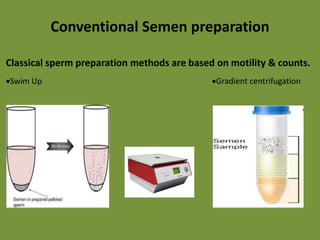
Conventional Semen preparation
Classical sperm preparation methods are based on motility & counts.
Swim Up Gradient centrifugation
Disadvantages of conventional sperm
preparation
In spite of the simplicity of the method,
repeated centrifugations without the separation
of the sperms from leukocytes and dead sperms
can produce many oxidative species and the
damage of the sperms function (Aitken & Clarkson,
1988, Irvine et al, 2000; Zini et al, 1993, 2009).
Disadvantages of conventional sperm
preparation
- Inefficient to prepare sperms with Testicular samples/
surgically retrieved sperms
- restricted to ejaculates with sub optimal sperm count and
motility
- Collected sperms does not guarantee fertilizing ability
- Low yield in sperm with higher fertilizing ability
- Cannot be used to process severe OAT samples, complete
necrospermia, higher incidences of DNA fragmentation
• With the advent of ICSI, just a single competent sperm is
needed to achieve fertilization
• Currently employed conventional sperm preparation
techniques select sperms based only on their count,
motility and morphology, while neglecting other
important factors such as DNA integrity, sub cellular
organization, non-apoptotic cells. (Henkel, 2012 ; Said &
Land, 2011)
• Clinical data has shown association of DNA
fragmentation with reduced live birth rates
Therefore, there is a need to develop and
implement improved sperm sorting techniques
and protocols in order to separate sperm
containing normal DNA and lesser ROS, improve
ART success rates, and decrease birth defects.
New sperm sorting methods closely mimic the
natural selectivity just like the female genital
tract to ensure only the healthy sperm are
selected for fertilization.
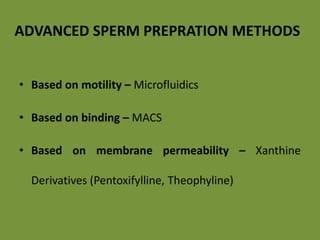
• Based on motility – Microfluidics
• Based on binding – MACS
• Based on membrane permeability – Xanthine
Derivatives (Pentoxifylline, Theophyline)
ADVANCED SPERM PREPRATION METHODS
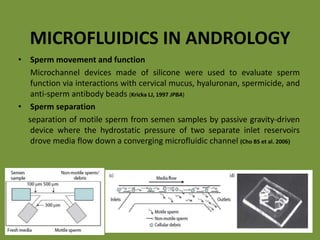
MICROFLUIDICS IN ANDROLOGY
• Sperm movement and function
Microchannel devices made of silicone were used to evaluate sperm
function via interactions with cervical mucus, hyaluronan, spermicide, and
anti-sperm antibody beads (Kricka LJ, 1997 JPBA)
• Sperm separation
separation of motile sperm from semen samples by passive gravity-driven
device where the hydrostatic pressure of two separate inlet reservoirs
drove media flow down a converging microfluidic channel (Cho BS et al. 2006)
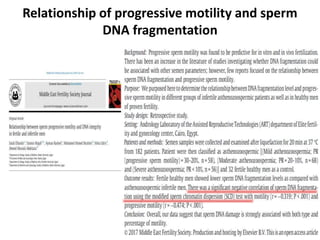
Relationship of progressive motility and sperm
DNA fragmentation
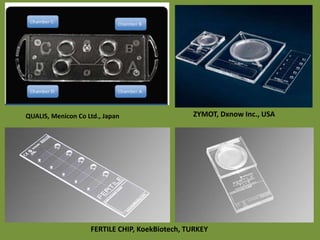
QUALIS, Menicon Co Ltd., Japan ZYMOT, Dxnow Inc., USA
FERTILE CHIP, KoekBiotech, TURKEY
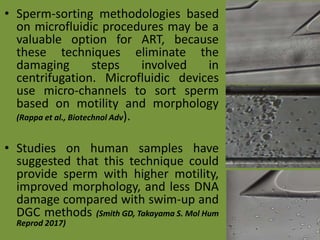
• Sperm-sorting methodologies based
on microfluidic procedures may be a
valuable option for ART, because
these techniques eliminate the
damaging steps involved in
centrifugation. Microfluidic devices
use micro-channels to sort sperm
based on motility and morphology
(Rappa et al., Biotechnol Adv).
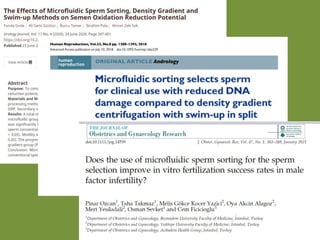
• Studies on human samples have
suggested that this technique could
provide sperm with higher motility,
improved morphology, and less DNA
damage compared with swim-up and
DGC methods (Smith GD, Takayama S. Mol Hum
Reprod 2017)
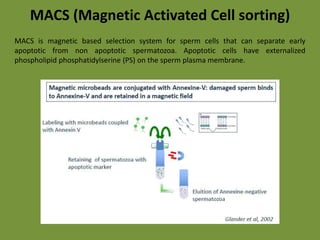
MACS (Magnetic Activated Cell sorting)
MACS is magnetic based selection system for sperm cells that can separate early
apoptotic from non apoptotic spermatozoa. Apoptotic cells have externalized
phospholipid phosphatidylserine (PS) on the sperm plasma membrane.
MACS
(Magnetic Activated Cell sorting)
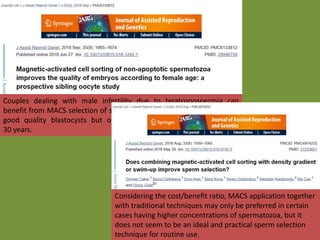
Couples dealing with male infertility due to teratozoospermia can
benefit from MACS selection of spermatozoa with higher percentage of
good quality blastocysts but only when the woman is older than
30 years.
Considering the cost/benefit ratio, MACS application together
with traditional techniques may only be preferred in certain
cases having higher concentrations of spermatozoa, but it
does not seem to be an ideal and practical sperm selection
technique for routine use.
Xanthine Derivatives
• Overall, Pentoxyfylline (PTX) is accepted as an
effective treatment for stimulating the motility
required for separation from dead sperms
• Pre-incubation of sperm in PTX is best known for
treatment of immotile sperm.
• It showed that 100% of immotile sperm from
fresh or frozen surgically retrieved or ejaculated
samples achieved sufficient motility (Terriou P et al., J
Assist Reprod Genet 2000)
• However, the data is conflicting and lacks in understanding of its effects on
oocyte & embryo development later, with obstetrical & neonatal outcome.
Ideal Sperm Preparation Technique
• be quick, easy and cost-effective,
• eliminate dead spermatozoa and other cells, including
leukocytes and bacteria,
• not cause sperm damage or non-physiological alterations
of the separated sperm cells,
• eliminate toxic or bioactive substances like
decapacitating factors or reactive oxygen species (ROS),
• allow processing of larger/ very low volumes of
ejaculates,
• Yield high number of sperms with good fertilizing ability
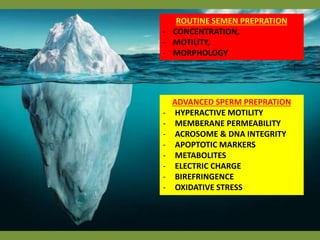
ROUTINE SEMEN PREPRATION
- CONCENTRATION,
- MOTILITY,
- MORPHOLOGY
ADVANCED SPERM PREPRATION
- HYPERACTIVE MOTILITY
- MEMBERANE PERMEABILITY
- ACROSOME & DNA INTEGRITY
- APOPTOTIC MARKERS
- METABOLITES
- ELECTRIC CHARGE
- BIREFRINGENCE
- OXIDATIVE STRESS
CONVENTIONAL VS. ADVANCED
METHODS OF
SPERM PREPRATION
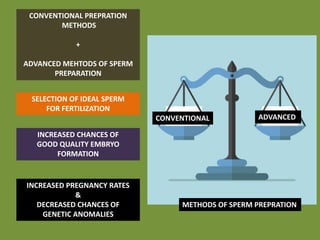
CONVENTIONAL PREPRATION
METHODS
+
ADVANCED MEHTODS OF SPERM
PREPARATION
SELECTION OF IDEAL SPERM
FOR FERTILIZATION
INCREASED CHANCES OF
GOOD QUALITY EMBRYO
FORMATION
INCREASED PREGNANCY RATES
&
DECREASED CHANCES OF
GENETIC ANOMALIES
CONVENTIONAL ADVANCED
METHODS OF SPERM PREPRATION
ADVANCED SPERM PREPARATION TECHNIQUES.pptx

ADVANCED SPERM PREPARATION TECHNIQUES.pptx

  • 1.
    ADVANCED SPERM PREPRATION TECHNIQUES DRRAHUL SEN CONSULTANT EMBRYOLOGIST NEELKANTH FERTILITY JAIPUR
  • 2.
    OF IVF &FIRST IVF BABY
  • 3.
  • 4.
    WHY USING DATEOLD TECHNIQUES ARENT THERE ANY ADVANCEMENT ??
  • 5.
    KEY EVENTS LOCATION SPERMATOGENESISTESTES EPIDIDYMAL MATURATION MALE REPRODUCTIVE TRACT GLANDULAR SECRETIONS EJACULATION INTRAVAGINAL DEPOSITION FEMALE REPRODUCTIVE TRACT • Altered pH • Hypoxic environment CERIX AND MUCUS PASSAGE UTERUS, TUBAL PASSAGE LYSING CUMULUS CELLS OOCYTE RECOGNITION ZONA BINDING FERTILIZATION ZYGOTE; EMBRYO FORMATION NATURAL REPRODUCTION ASSISTED REPRODUCTION SPERM PREPRATION ARE WE SELECTIVE ENOUGH??
  • 6.
    Conventional Semen preparation Classicalsperm preparation methods are based on motility & counts. Swim Up Gradient centrifugation
  • 7.
    Disadvantages of conventionalsperm preparation In spite of the simplicity of the method, repeated centrifugations without the separation of the sperms from leukocytes and dead sperms can produce many oxidative species and the damage of the sperms function (Aitken & Clarkson, 1988, Irvine et al, 2000; Zini et al, 1993, 2009).
  • 8.
    Disadvantages of conventionalsperm preparation - Inefficient to prepare sperms with Testicular samples/ surgically retrieved sperms - restricted to ejaculates with sub optimal sperm count and motility - Collected sperms does not guarantee fertilizing ability - Low yield in sperm with higher fertilizing ability - Cannot be used to process severe OAT samples, complete necrospermia, higher incidences of DNA fragmentation
  • 9.
    • With theadvent of ICSI, just a single competent sperm is needed to achieve fertilization • Currently employed conventional sperm preparation techniques select sperms based only on their count, motility and morphology, while neglecting other important factors such as DNA integrity, sub cellular organization, non-apoptotic cells. (Henkel, 2012 ; Said & Land, 2011) • Clinical data has shown association of DNA fragmentation with reduced live birth rates
  • 10.
    Therefore, there isa need to develop and implement improved sperm sorting techniques and protocols in order to separate sperm containing normal DNA and lesser ROS, improve ART success rates, and decrease birth defects. New sperm sorting methods closely mimic the natural selectivity just like the female genital tract to ensure only the healthy sperm are selected for fertilization.
  • 11.
    • Based onmotility – Microfluidics • Based on binding – MACS • Based on membrane permeability – Xanthine Derivatives (Pentoxifylline, Theophyline) ADVANCED SPERM PREPRATION METHODS
  • 12.
    MICROFLUIDICS IN ANDROLOGY •Sperm movement and function Microchannel devices made of silicone were used to evaluate sperm function via interactions with cervical mucus, hyaluronan, spermicide, and anti-sperm antibody beads (Kricka LJ, 1997 JPBA) • Sperm separation separation of motile sperm from semen samples by passive gravity-driven device where the hydrostatic pressure of two separate inlet reservoirs drove media flow down a converging microfluidic channel (Cho BS et al. 2006)
  • 13.
    Relationship of progressivemotility and sperm DNA fragmentation
  • 14.
    QUALIS, Menicon CoLtd., Japan ZYMOT, Dxnow Inc., USA FERTILE CHIP, KoekBiotech, TURKEY
  • 15.
    • Sperm-sorting methodologiesbased on microfluidic procedures may be a valuable option for ART, because these techniques eliminate the damaging steps involved in centrifugation. Microfluidic devices use micro-channels to sort sperm based on motility and morphology (Rappa et al., Biotechnol Adv). • Studies on human samples have suggested that this technique could provide sperm with higher motility, improved morphology, and less DNA damage compared with swim-up and DGC methods (Smith GD, Takayama S. Mol Hum Reprod 2017)
  • 17.
    MACS (Magnetic ActivatedCell sorting) MACS is magnetic based selection system for sperm cells that can separate early apoptotic from non apoptotic spermatozoa. Apoptotic cells have externalized phospholipid phosphatidylserine (PS) on the sperm plasma membrane.
  • 18.
  • 19.
    Couples dealing withmale infertility due to teratozoospermia can benefit from MACS selection of spermatozoa with higher percentage of good quality blastocysts but only when the woman is older than 30 years. Considering the cost/benefit ratio, MACS application together with traditional techniques may only be preferred in certain cases having higher concentrations of spermatozoa, but it does not seem to be an ideal and practical sperm selection technique for routine use.
  • 20.
    Xanthine Derivatives • Overall,Pentoxyfylline (PTX) is accepted as an effective treatment for stimulating the motility required for separation from dead sperms • Pre-incubation of sperm in PTX is best known for treatment of immotile sperm. • It showed that 100% of immotile sperm from fresh or frozen surgically retrieved or ejaculated samples achieved sufficient motility (Terriou P et al., J Assist Reprod Genet 2000) • However, the data is conflicting and lacks in understanding of its effects on oocyte & embryo development later, with obstetrical & neonatal outcome.
  • 21.
    Ideal Sperm PreparationTechnique • be quick, easy and cost-effective, • eliminate dead spermatozoa and other cells, including leukocytes and bacteria, • not cause sperm damage or non-physiological alterations of the separated sperm cells, • eliminate toxic or bioactive substances like decapacitating factors or reactive oxygen species (ROS), • allow processing of larger/ very low volumes of ejaculates, • Yield high number of sperms with good fertilizing ability
  • 22.
    ROUTINE SEMEN PREPRATION -CONCENTRATION, - MOTILITY, - MORPHOLOGY ADVANCED SPERM PREPRATION - HYPERACTIVE MOTILITY - MEMBERANE PERMEABILITY - ACROSOME & DNA INTEGRITY - APOPTOTIC MARKERS - METABOLITES - ELECTRIC CHARGE - BIREFRINGENCE - OXIDATIVE STRESS
  • 23.
  • 25.
    CONVENTIONAL PREPRATION METHODS + ADVANCED MEHTODSOF SPERM PREPARATION SELECTION OF IDEAL SPERM FOR FERTILIZATION INCREASED CHANCES OF GOOD QUALITY EMBRYO FORMATION INCREASED PREGNANCY RATES & DECREASED CHANCES OF GENETIC ANOMALIES CONVENTIONAL ADVANCED METHODS OF SPERM PREPRATION

Editor's Notes

  • #6 During in vivo process, sperms faces a series of environment changes from the male reproductive tract to female reproductive tract and finally recognizing ovum & when we compare it with in vitro in ART, the selection is not strict as in nature but till now in ART has managed to elute out normal sperms for the process of fertilization.
  • #7 Semen composed of Mixture of secretions, other cells and many anti capacitating factors, Risk of oxidative & osmotic damage in vitro , Needed to separate best motile and morphologically normal sperm Classical sperm preparation methods are based on motility & counts.
  • #17 Microuidic devices, “labs-on-a-chip,” are a disposable, easy to use, and inexpensive method for sperm sorting. Our results show that IVF success rates might improve with the use of a microuidic sperm-sorting chip for sperm selection in male infertility.
  • #18 Another technique which is MACS that selected non apoptotic spermatozoa from the apoptotic cohert There are the studies conducted on the use of macs in ART which are quite promising and providing good outcomes but large cohert studies are required for its clinical importance.