COMMUNICATION
PROCESS AND ITS
COMPONENTS
Nature of Language
What exactly is
language?
Linguists agree that a language can
be only called language if it has a
system of rules (also known as
grammar), a sound system (also
known as phonology), and a
vocabulary
(also known as lexicon).
Why do humans understand
each other using language?
When human use language,
they can understand each
other because they belong to
the same speech community,
in which they share the same set
of rules in the language system.
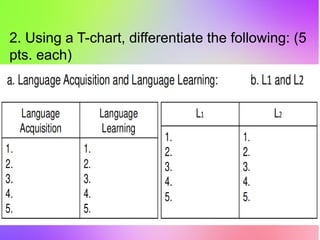
Language Acquisition and
Language Learning
While growing up, people acquire the language used
by those in the same community – same speech
community. This is the process of language
acquisition. Languages acquired while
growing up are known as mother tongues, which
may also be referred to as (first languages (L1).
Other than the first language, there are other
languages that are needed for various reason.
These other languages are referred to
as second languages (L2).People learn their
L2in school or on their own. This is the process
of language learning.
In our interaction with other people, our
languages come into contact with their
language, resulting in language change.
Language change is a natural behavior of
language.
Answer the following:
1. What makes human language different from
animal language?Support your answer. (5 pts.)
______________________________________
______________________________________
______________________________________
__________________________________
2. Using a T-chart, differentiate the following: (5
pts. each)
3. What happens after a language comes into
contact with another?
Briefly explain. 5 points
______________________________________
______________________________________
______________________________________
______________________________________
______________________________________
________________________________
4. What is communication?
______________________________________
______________________________________
______________________________________
______________________________________
______________________________________
________________________________
There are various types of communication upon
which linguists and experts agree to describe
its nature. These types can be divided
according to mode, context, and purpose and
style.
According to Mode
▪ Verbal Communication
- the use of language to transfer
information through speaking or
sign language.
▪ Non-Verbal Communication
- the use of body language, gestures
and facial expression to
convey information to others, it can
be used both intentionally and
unintentionally.
▪ Visual Communication
- is the conveyance of ideas and
information that can be seen.
- takes place through pictures,
graphs and charts, as well as
through signs, signals, and symbols.
According to Context
▪ Intrapersonal Communication
- Intra –means “within” or “inside”
- Communication to oneself
- Some label it as self or inner talk, inner
monologue, or inner dialogue
▪ Interpersonal Communication
- The Latin prefix inter –means
between or among people.
- Communication between two or
more people.
▪ Extended Communication
- Communication that involves the
use of electronic media
▪ Intercultural Communication
- Communication between or among
people having different linguistic,
religious, ethnic, social, and
professional background.
▪ Organizational Communication
- Communication within or outside
the organization
Identify the types of communication
of the following scenarios,
then justify your answer. Write your
answers on the space
provided.
____________1. A long conversation
between a long lost friends.
____________2. Filipinos twitch their lips in
pointing something.
____________3. No smoking sign on the
wall.
____________4. The teachers of 5 institution
attended a seminar for their advancement.
____________5. Ms. Laurel talks gay-lingua
with her gay friends.
____________6. OK signs in other culture
pertains to sexual insult.
____________7. Selling second hand clothes
through Facebook live.
____________8. Shaking hands firmly in an
interview.
____________9. She said to herself, “This is
not what I deserve.”
____________10. The head of each
department expressed their sentiments to
their new CEO.
General Principles of Effective Communication
For both oral and written communication, you should be able
to supply the following principles:
1. Know your purpose in communicating.
2. Know your audience.
3. Know your topic.
4. Adjust your speech or writing to the
context of the situation.
5. Work on the feedback given to you.
Principles of Effective ORAL Communication
1. Be clear with your purpose. You
should know by heart your objective in
communicating.
2. Be complete with the message you
deliver. Make sure that your claims are
supported by facts and essential
information.
3. Be concise. You do not need to be verbose
or wordy with your statements. Brevity in
speech is a must.
4. Be natural with your delivery. Punctuate
important words with the appropriate gestures
and movements. Exude a certain degree of
confidence even if you do not feel confident
enough.
5. Be specific and timely with your feedback.
Inputs are most
helpful when provided on time.
Principles of Effective WRITTEN
Communication (7 Cs)
1. Be clear. Be clear about your message.
Always be guided by your purpose in
communicating.
2. Be concise. Always stick to the point and
do not beat or run around the bush. Be brief
by focusing on your main point.
Principles of Effective WRITTEN
Communication (7 Cs)
3. Be concrete. Support your claims with
enough facts. Your readers will easily know if
you are bluffing or deceiving them
because there is nothing to substantiate your
claim.
4. Be correct. It is important that you observe
grammatical correctness in your writing.
Always have time to revise and edit your
work. Even simple errors may easily distract
your reader.
Principles of Effective WRITTEN
Communication (7 Cs)
5. Be coherent. Your writing becomes
coherent only when you convey logical
message. The ideas should be connected to
each other and related to the topic. Make sure
that you observe sound structure that will
present a smooth flow of your ideas. Use
transitional or cohesive devices so that the
ideas cohere with one
another.
Principles of Effective WRITTEN
Communication (7 Cs)
6. Be complete. Include all necessary and
relevant information so that the audience will
not be left wanting of any information. Always
place yourself in the shoes of the audience,
who is always interested to receive new
information.
7. Be courteous. The tone of your writing
should be friendly and appropriate. Avoid any
overtone/undertone or insinuation to
eliminate confusion and misinterpretation.
Ethics of Communication
Here is a list of ethical communication
developed by Lewis, J. Consider this 10 list
of basic ethical communication as basics as
ideals – ideals, in the sense that we all fall
short of meeting these at some times, and yet
we can continue to improve. One of the goals
of belonging to an Ethical Society is to get
support for learning to live more in accord
with our ideals!
10 Ethical Communication
1. Seek to “elicit the best” in communications
and interactions with other group members.
2. Listen when others speak.
3. Speak non-judgmentally.
4. Speak from your own experience and
perspective, expressing your own thoughts,
needs, and feelings.
5. Seek to understand others (rather that to
be “right” or “more ethical that thou”).
10 Ethical Communication
6. Avoid speaking for others, for example by
characterizing what others have said without
checking your understanding, or by
universalizing your opinions, beliefs, values,
and conclusions, --assuming everyone shares
them.
7. Manage your own personal boundaries:
share only what you are comfortable sharing.
10 Ethical Communication
8. Respect the personal boundaries of
others.
9. Avoid interrupting and side
conversations.
10. Make sure that everyone has time to
speak, that all members have relatively
equal “air time” if they want it.
Answer the following questions:
1. Why is it important to have a code of
conduct or a code of ethics?
Briefly explain your point. (5 pts.)
________________________________
________________________________
________________________________
________________________________
________________________________
What are the 7Cs of effective
written communication in
writing?
1.
2.
3.
4.
5.
6.
7.

Purposive Communication 8102024 communication process

  • 1.
  • 2.
    Nature of Language Whatexactly is language?
  • 3.
    Linguists agree thata language can be only called language if it has a system of rules (also known as grammar), a sound system (also known as phonology), and a vocabulary (also known as lexicon).
  • 4.
    Why do humansunderstand each other using language?
  • 5.
    When human uselanguage, they can understand each other because they belong to the same speech community, in which they share the same set of rules in the language system.
  • 6.
    Language Acquisition and LanguageLearning While growing up, people acquire the language used by those in the same community – same speech community. This is the process of language acquisition. Languages acquired while growing up are known as mother tongues, which may also be referred to as (first languages (L1).
  • 7.
    Other than thefirst language, there are other languages that are needed for various reason. These other languages are referred to as second languages (L2).People learn their L2in school or on their own. This is the process of language learning.
  • 8.
    In our interactionwith other people, our languages come into contact with their language, resulting in language change. Language change is a natural behavior of language.
  • 9.
    Answer the following: 1.What makes human language different from animal language?Support your answer. (5 pts.) ______________________________________ ______________________________________ ______________________________________ __________________________________
  • 10.
    2. Using aT-chart, differentiate the following: (5 pts. each)
  • 11.
    3. What happensafter a language comes into contact with another? Briefly explain. 5 points ______________________________________ ______________________________________ ______________________________________ ______________________________________ ______________________________________ ________________________________
  • 12.
    4. What iscommunication? ______________________________________ ______________________________________ ______________________________________ ______________________________________ ______________________________________ ________________________________
  • 13.
    There are varioustypes of communication upon which linguists and experts agree to describe its nature. These types can be divided according to mode, context, and purpose and style.
  • 14.
    According to Mode ▪Verbal Communication - the use of language to transfer information through speaking or sign language.
  • 15.
    ▪ Non-Verbal Communication -the use of body language, gestures and facial expression to convey information to others, it can be used both intentionally and unintentionally.
  • 16.
    ▪ Visual Communication -is the conveyance of ideas and information that can be seen. - takes place through pictures, graphs and charts, as well as through signs, signals, and symbols.
  • 17.
    According to Context ▪Intrapersonal Communication - Intra –means “within” or “inside” - Communication to oneself - Some label it as self or inner talk, inner monologue, or inner dialogue
  • 18.
    ▪ Interpersonal Communication -The Latin prefix inter –means between or among people. - Communication between two or more people.
  • 19.
    ▪ Extended Communication -Communication that involves the use of electronic media
  • 20.
    ▪ Intercultural Communication -Communication between or among people having different linguistic, religious, ethnic, social, and professional background.
  • 21.
    ▪ Organizational Communication -Communication within or outside the organization
  • 22.
    Identify the typesof communication of the following scenarios, then justify your answer. Write your answers on the space provided.
  • 23.
    ____________1. A longconversation between a long lost friends. ____________2. Filipinos twitch their lips in pointing something. ____________3. No smoking sign on the wall. ____________4. The teachers of 5 institution attended a seminar for their advancement. ____________5. Ms. Laurel talks gay-lingua with her gay friends.
  • 24.
    ____________6. OK signsin other culture pertains to sexual insult. ____________7. Selling second hand clothes through Facebook live. ____________8. Shaking hands firmly in an interview. ____________9. She said to herself, “This is not what I deserve.” ____________10. The head of each department expressed their sentiments to their new CEO.
  • 25.
    General Principles ofEffective Communication For both oral and written communication, you should be able to supply the following principles: 1. Know your purpose in communicating. 2. Know your audience. 3. Know your topic. 4. Adjust your speech or writing to the context of the situation. 5. Work on the feedback given to you.
  • 26.
    Principles of EffectiveORAL Communication 1. Be clear with your purpose. You should know by heart your objective in communicating. 2. Be complete with the message you deliver. Make sure that your claims are supported by facts and essential information.
  • 27.
    3. Be concise.You do not need to be verbose or wordy with your statements. Brevity in speech is a must. 4. Be natural with your delivery. Punctuate important words with the appropriate gestures and movements. Exude a certain degree of confidence even if you do not feel confident enough. 5. Be specific and timely with your feedback. Inputs are most helpful when provided on time.
  • 28.
    Principles of EffectiveWRITTEN Communication (7 Cs) 1. Be clear. Be clear about your message. Always be guided by your purpose in communicating. 2. Be concise. Always stick to the point and do not beat or run around the bush. Be brief by focusing on your main point.
  • 29.
    Principles of EffectiveWRITTEN Communication (7 Cs) 3. Be concrete. Support your claims with enough facts. Your readers will easily know if you are bluffing or deceiving them because there is nothing to substantiate your claim. 4. Be correct. It is important that you observe grammatical correctness in your writing. Always have time to revise and edit your work. Even simple errors may easily distract your reader.
  • 30.
    Principles of EffectiveWRITTEN Communication (7 Cs) 5. Be coherent. Your writing becomes coherent only when you convey logical message. The ideas should be connected to each other and related to the topic. Make sure that you observe sound structure that will present a smooth flow of your ideas. Use transitional or cohesive devices so that the ideas cohere with one another.
  • 31.
    Principles of EffectiveWRITTEN Communication (7 Cs) 6. Be complete. Include all necessary and relevant information so that the audience will not be left wanting of any information. Always place yourself in the shoes of the audience, who is always interested to receive new information. 7. Be courteous. The tone of your writing should be friendly and appropriate. Avoid any overtone/undertone or insinuation to eliminate confusion and misinterpretation.
  • 32.
    Ethics of Communication Hereis a list of ethical communication developed by Lewis, J. Consider this 10 list of basic ethical communication as basics as ideals – ideals, in the sense that we all fall short of meeting these at some times, and yet we can continue to improve. One of the goals of belonging to an Ethical Society is to get support for learning to live more in accord with our ideals!
  • 33.
    10 Ethical Communication 1.Seek to “elicit the best” in communications and interactions with other group members. 2. Listen when others speak. 3. Speak non-judgmentally. 4. Speak from your own experience and perspective, expressing your own thoughts, needs, and feelings. 5. Seek to understand others (rather that to be “right” or “more ethical that thou”).
  • 34.
    10 Ethical Communication 6.Avoid speaking for others, for example by characterizing what others have said without checking your understanding, or by universalizing your opinions, beliefs, values, and conclusions, --assuming everyone shares them. 7. Manage your own personal boundaries: share only what you are comfortable sharing.
  • 35.
    10 Ethical Communication 8.Respect the personal boundaries of others. 9. Avoid interrupting and side conversations. 10. Make sure that everyone has time to speak, that all members have relatively equal “air time” if they want it.
  • 36.
    Answer the followingquestions: 1. Why is it important to have a code of conduct or a code of ethics? Briefly explain your point. (5 pts.) ________________________________ ________________________________ ________________________________ ________________________________ ________________________________
  • 37.
    What are the7Cs of effective written communication in writing? 1. 2. 3. 4. 5. 6. 7.