lezione 15 del corso teorie della comunicazione – Genova CP
1. what are they?
LOCUTIONARY ACT
(act of saying)
ILLOCUTIONARY ACT
(act we do in saying...)
[conventions]
PERLOCUTIONARY ACT
(act we do by saying...)
[consequences]
phonetics (form)
syntax
semantics (content)
felicity conditions
(illocutionary “force”)
context dependence
(2 examples Mario and “her”)
2. how to classify them?
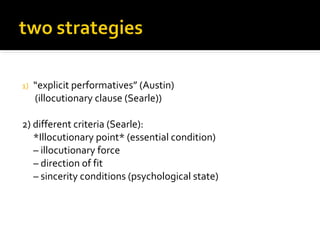
1) “explicit performatives” (Austin)
(illocutionary clause (Searle))
2) different criteria (Searle):
*Illocutionary point* (essential condition)
– illocutionary force
– direction of fit
– sincerity conditions (psychological state)
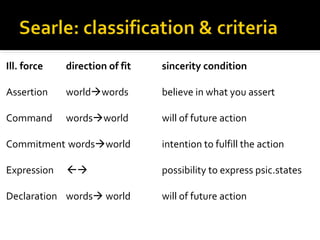
Ill. force direction of fit sincerity condition
Assertion worldwords believe in what you assert
Command wordsworld will of future action
Commitment wordsworld intention to fulfill the action
Expression  possibility to express psic.states
Declaration words world will of future action
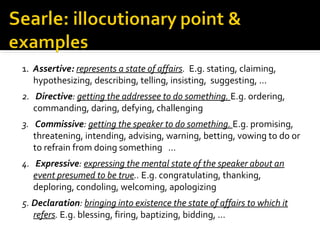
1.  Assertive: represents a state of affairs. E.g. stating, claiming, 
hypothesizing, describing, telling, insisting,  suggesting, ...
2. Directive: getting the addressee to do something. E.g. ordering, 
commanding, daring, defying, challenging
                            
3. Commissive: getting the speaker to do something. E.g. promising, 
threatening, intending, advising, warning, betting, vowing to do or 
to refrain from doing something   ...
                          
4. Expressive: expressing the mental state of the speaker about an
event presumed to be true.. E.g. congratulating, thanking, 
deploring, condoling, welcoming, apologizing    
 
5. Declaration: bringing into existence the state of affairs to which it
refers. E.g. blessing, firing, baptizing, bidding, ...
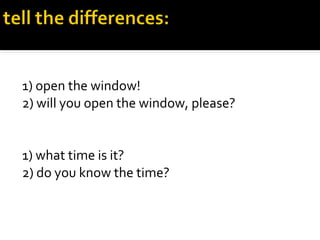
3. when and how to use which speech acts?
1) open the window!
2) will you open the window, please?
1) what time is it?
2) do you know the time?
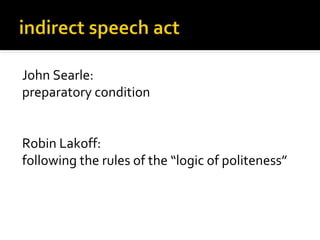
John Searle:
preparatory condition
Robin Lakoff:
following the rules of the “logic of politeness”
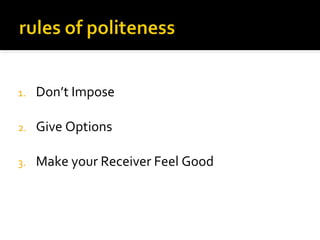
1. Don’t Impose
2. Give Options
3. Make your Receiver Feel Good
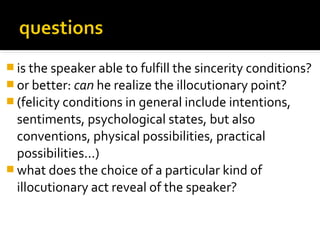
 is the speaker able to fulfill the sincerity conditions?
 or better: can he realize the illocutionary point?
 (felicity conditions in general include intentions,
sentiments, psychological states, but also
conventions, physical possibilities, practical
possibilities...)
 what does the choice of a particular kind of
illocutionary act reveal of the speaker?

Speech act 1

  • 1.
    lezione 15 delcorso teorie della comunicazione – Genova CP
  • 2.
  • 3.
    LOCUTIONARY ACT (act ofsaying) ILLOCUTIONARY ACT (act we do in saying...) [conventions] PERLOCUTIONARY ACT (act we do by saying...) [consequences] phonetics (form) syntax semantics (content) felicity conditions (illocutionary “force”) context dependence (2 examples Mario and “her”)
  • 4.
    2. how toclassify them?
  • 5.
    1) “explicit performatives”(Austin) (illocutionary clause (Searle)) 2) different criteria (Searle): *Illocutionary point* (essential condition) – illocutionary force – direction of fit – sincerity conditions (psychological state)
  • 6.
    Ill. force directionof fit sincerity condition Assertion worldwords believe in what you assert Command wordsworld will of future action Commitment wordsworld intention to fulfill the action Expression  possibility to express psic.states Declaration words world will of future action
  • 7.
    1.  Assertive: represents astate of affairs. E.g. stating, claiming,  hypothesizing, describing, telling, insisting,  suggesting, ... 2. Directive: getting the addressee to do something. E.g. ordering,  commanding, daring, defying, challenging                              3. Commissive: getting the speaker to do something. E.g. promising,  threatening, intending, advising, warning, betting, vowing to do or  to refrain from doing something   ...                            4. Expressive: expressing the mental state of the speaker about an event presumed to be true.. E.g. congratulating, thanking,  deploring, condoling, welcoming, apologizing       5. Declaration: bringing into existence the state of affairs to which it refers. E.g. blessing, firing, baptizing, bidding, ...
  • 8.
  • 9.
  • 10.
    John Searle: preparatory condition RobinLakoff: following the rules of the “logic of politeness”
  • 11.
    1. Don’t Impose 2.Give Options 3. Make your Receiver Feel Good
  • 12.
     is thespeaker able to fulfill the sincerity conditions?  or better: can he realize the illocutionary point?  (felicity conditions in general include intentions, sentiments, psychological states, but also conventions, physical possibilities, practical possibilities...)  what does the choice of a particular kind of illocutionary act reveal of the speaker?