Special Use Fibers
Nitin Neha Manish Kushagr Nishu
Nomex
Nomex is an aramid fiber with inherently flame-retardant
properties. When exposed to flame, it chars but does not
ignite or support combustion. As soon as the flame is
removed, the Nomex self-extinguishes. Unlike treated cotton
fabrics, the flame retardance will never wash out of Nomex.
Production
▪ The polymer is produced by condensation reaction from the monomers m-
phenylenediamine and isophthaloyl chloride.
▪ It is sold in both fiber and sheet forms and is used as a fabric wherever
resistance from heat and flame is required. Nomex sheet is actually
a calendared paper and made in a similar fashion. Nomex Type 410 paper is
the original and one of the larger grade types made, mostly for electrical
insulation purposes. Nomex fiber is made in the USA and in Spain
(Asturias).
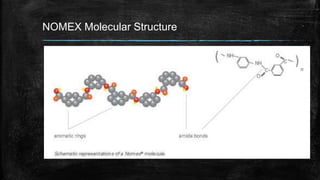
NOMEX Molecular Structure
 Excellent flame resistance and thermal protection
 Stands up to flame temperatures in excess of 2,000°F
 Fibers do not melt or drip
 Resistant to insects and fungi
 High elongation
 Cut resistant
 Abrasion resistant
 Outstanding resistance to degradation by radiation
 Outstanding resistance to degradation at cryogenic
conditions
 Resistant to chemicals and industrial solvents
 Low stiffness of fiber due to chemical bonding
arrangement.
• Industrial rope and cordage.
• Military rope and cordage.
• Safety rope.
• Firefighter rope.
• Extreme environment rope and cord.
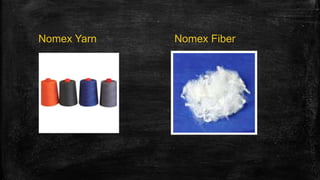
Nomex Yarn Nomex Fiber
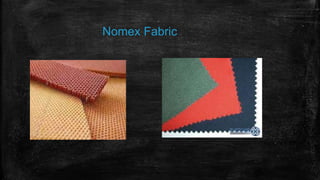
Nomex Fabric
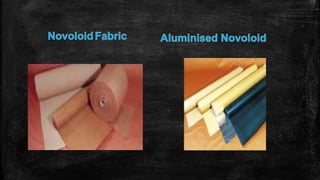
Novoloid
These are cross-linked, three-dimensional, phenolic aldehyde
fibers typically prepared by the acid-catalyzed, cross-linking of a
melt-spun novolac resin with formaldehyde. These fibers are
highly flame resistant, but are not considered to be high
temperature fibers. They are used with a wide variety of matrix
materials to form composites.
Production
A phenolic fiber made by cross-linking a melt-spun novolac
resin with formaldehyde. Novoloid fibers have good flame
resistance, can serve at temperatures to about 220°C, and are
used as reinforcement in a range of thermosetting matrices.
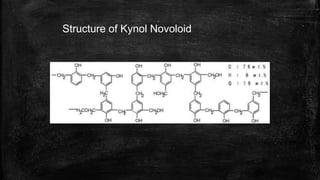
Structure of Kynol Novoloid
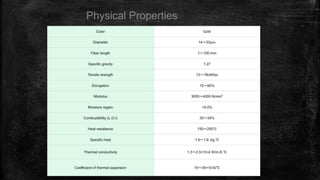
Physical Properties
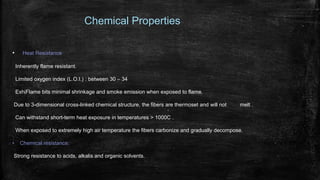
Chemical Properties
• Heat Resistance
Inherently flame resistant.
Limited oxygen index (L.O.I.) : between 30 – 34
ExhiFlame bits minimal shrinkage and smoke emission when exposed to flame.
Due to 3-dimensional cross-linked chemical structure, the fibers are thermoset and will not melt .
Can withstand short-term heat exposure in temperatures > 1000C .
When exposed to extremely high air temperature the fibers carbonize and gradually decompose.
• Chemical resistance:
Strong resistance to acids, alkalis and organic solvents.
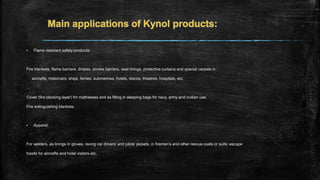
▪ Flame resistant safety products:
Fire blankets, flame barriers, drapes, smoke barriers, seat linings, protective curtains and special carpets in :
aircrafts, motorcars, ships, ferries, submarines, hotels, discos, theatres, hospitals, etc.
Cover (fire blocking layer) for mattresses and as filling in sleeping bags for navy, army and civilian use.
Fire extinguishing blankets.
▪ Apparel:
For welders, as linings in gloves, racing car drivers’ and pilots’ jackets, in firemen’s and other rescue coats or suits; escape
hoods for aircrafts and hotel visitors etc.
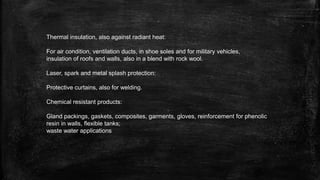
Thermal insulation, also against radiant heat:
For air condition, ventilation ducts, in shoe soles and for military vehicles,
insulation of roofs and walls, also in a blend with rock wool.
Laser, spark and metal splash protection:
Protective curtains, also for welding.
Chemical resistant products:
Gland packings, gaskets, composites, garments, gloves, reinforcement for phenolic
resin in walls, flexible tanks;
waste water applications
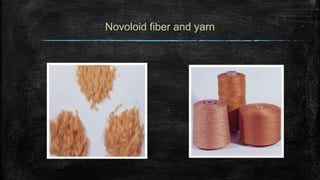
Novoloid fiber and yarn
Saran
Material with a greasy, dark green film, first called "Eonite" and then "Saran”.
Saran fiber comes in monofilament, multifilament-twist, and as a staple fiber. It is also
available in thermochromic (color changing) and luminescent (glow in the dark) form.
Saran is the trade name for a number of polymers made from vinylidene
chloride (especially polyvinylidene chloride or PVDC), along with other monomers.
Ralph Wiley accidentally discovered polyvinylidene chloride in 1933.
Properties
 remarkable barrier against water, oxygen and aromas
 superior chemical resistance to alkalies and acids
 insoluble in oil and organic solvents
 very low moisture regain; Moisture regain = 0.1-1.0%
 impervious to moisture, mold, bacteria, and insects
 soluble in polar solvents.
 good thermal stability, but above 125°C decomposes to produce HCl
 good chemical resistance to acids and alkalis
 do not lose their strength in sunlight
 do not tend to retain dirt and are easy to clean
 Heavy fabric
 high specific gravity
 Circular ross section
 Tenacity = 0.7 - 2.4 g/denier (dry or wet)
 Elongation = 15-30% (dry or wet)
 Melting point: 160 – 177
 Density: 1.1 – 1.7
Applications
PACKAGING : Polyvinylidene chloride is applied as a water-based coating to other
plastic films such as biaxially-oriented polypropylene (BOPP) and polyethylene terephthalate
(PET).
MILITARY : The military sprayed Saran on fighter planes to guard against salty sea spray and
carmakers used it for upholstery
HOUSEHOLD : Cleaning cloths, filters, screens, tape, shower curtains, garden furniture.
INDUSTRIAL : Screens, artificial turf, waste-water treatment materials, underground materials.
MISCELLANEOUS: also used for high-quality doll hair that is valued by collectors for its shine
and softness.
Disadvantage
It undergoes thermally induced dehydrochlorination at temperatures very near
to processing temperatures.
This degradation easily propagates, leaving polyene sequences long enough to
absorb visible light, and change the color of the material from colorless to an
undesirable transparent brown (unacceptable for one of polyvinylidene chloride
chief applications: food packaging).
Therefore, there is a significant amount of product loss in the manufacturing
process, which increases production and consumer costs.
Softens at 115 C and loses strength at 99C.
Trademarks(producers)
Saran TC and Saran LS (Asahi-Kasei)
Saran Wrap and Saranex (Dow Chemical)
Ixan and Diofan (SolVin).
PVC
Poly vinyl chloride, commonly abbreviated PVC, is the third-most widely
produced polymer, after polyethylene and polypropylene.
PVC comes in two basic forms: rigid (sometimes abbreviated as RPVC) and flexible.
Pure poly(vinyl chloride) is a white, brittle solid.
IUPAC name - poly(1-chloroethylene)
Molecular formula - (C2H3Cl)n
Applications
The rigid form of PVC is used in construction for pipe, and in profile applications such as
doors and windows. It is also used for bottles and other non-food packaging, and cards
(such as bank or membership cards). It can be made softer and more flexible by the addition
of plasticizers, the most widely used being phthalates. In this form, it is also used in
plumbing, electrical cable insulation, imitation leather, signage, inflatable products and many
applications where it replaces rubber.
Additives to finished polymer
There are several flexible PVC applications such as calendered films, extruded profiles,
injection moulded soles and footwear, extruded hoses and plastisols where PVC paste is
spread on to a backing (flooring, wall covering, artificial leather).
Properties
It is insoluble in alcohol, but slightly soluble in tetrahydrofuran.
Elongation at break: 20–40%
Notch test: 2–5 kJ/m2
Glass temperature: 82 °C
Melting point: 100–260 °C
Effective heat of combustion: 17.95 MJ/kg
Specific heat : 0.9 kJ/(kg·K)
Water absorption (ASTM): 0.04–0.4
Dielectric Breakdown Voltage: 40 MV/m
PVC is a thermoplastic polymer
Spandex
Spandex or elastane is a synthetic fiber known for its exceptional
elasticity. It is strong, but less durable than its major non-synthetic
competitor, natural latex. It is a polyurethane-polyurea copolymer that
was invented in 1959 by chemists C. L.
▪
Production
The polymer chain is a segmented block copolymer containing long, randomly
coiled, liquid, soft segments that move to a more linear, lower entropy, structure.
The hard segments act as “virtual cross-links” that tie all the polymer chains
together into an infinite network. This network prevents the polymer chains from
slipping past each other and taking on a permanent set or draw. When the
stretching force is removed, the linear, low entropy, soft segments move back to the
preferred randomly coiled, higher entropy state, causing the fiber to recover to its
original shape and length. This segmented block copolymer is formed in a multi-
step proprietary process. It is extruded into a fiber as a monofilament thread line or
for most products into a multiplicity of fine filaments that are coalesced shortly after
they are formed into a single thread line.
Properties
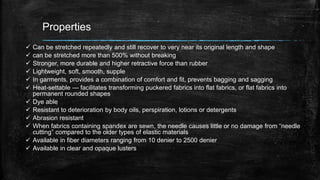
 Can be stretched repeatedly and still recover to very near its original length and shape
 can be stretched more than 500% without breaking
 Stronger, more durable and higher retractive force than rubber
 Lightweight, soft, smooth, supple
 In garments, provides a combination of comfort and fit, prevents bagging and sagging
 Heat-settable — facilitates transforming puckered fabrics into flat fabrics, or flat fabrics into
permanent rounded shapes
 Dye able
 Resistant to deterioration by body oils, perspiration, lotions or detergents
 Abrasion resistant
 When fabrics containing spandex are sewn, the needle causes little or no damage from “needle
cutting” compared to the older types of elastic materials
 Available in fiber diameters ranging from 10 denier to 2500 denier
 Available in clear and opaque lusters
Uses
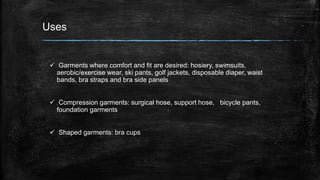
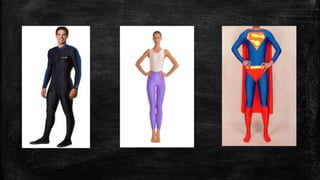
 Garments where comfort and fit are desired: hosiery, swimsuits,
aerobic/exercise wear, ski pants, golf jackets, disposable diaper, waist
bands, bra straps and bra side panels
 Compression garments: surgical hose, support hose, bicycle pants,
foundation garments
 Shaped garments: bra cups
Fiber Care Tips
 Hand or machine wash in lukewarm water
 Do not use chlorine bleach on any fabric containing spandex. Use oxygen
or sodium perborate type bleach
 Rise thoroughly
 Drip dry. If machine dried, use low temperature
 Ironing, if required, should be done rapidly. Do not leave the iron too long
in one position. Use low temperatures setting.
Kevlar
▪ a synthetic fiber of high tensile strength used especially
as a reinforcing agent in the manufacture of tyres and
other rubber products.
Properties
 five times stronger than steel, yet it is extremely lightweight.
 does not rust or corrode
 absorbs vibrations readily.
 breaks down when exposed to the ultraviolet rays in sunlight.
 Dry-cleaning agents bleach, and repeated washing can affect Kevlar negatively
 Kevlar is made in three common grades: Kevlar, Kevlar 29, and Kevlar 49.
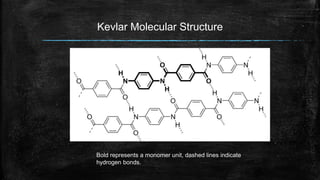
Kevlar Molecular Structure
Bold represents a monomer unit, dashed lines indicate
hydrogen bonds.
Applications
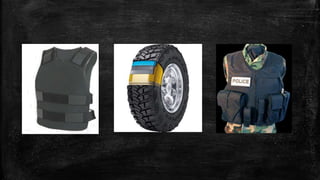
▪ Kevlar is typically used in tires.
▪ Kevlar 29 is used in body armour, industrial cable and brake linings
▪ Kevlar 49 is used in applications such as plastic reinforcement for boat hulls,
airplanes, and bicycles.
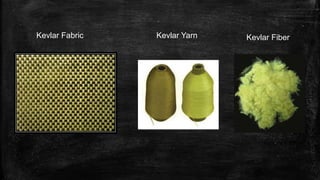
Kevlar Fabric Kevlar Yarn Kevlar Fiber
Bibliography
▪ P. Hedenberg and P. Gatenholm – Applied polymer
science
▪ V. Favier , H. Chanzy and J.Y. Cavaille –
Macromolecules and Polymers
▪ J. Johnson – What is Kenaf

Special Use Fibres

  • 1.
    Special Use Fibers NitinNeha Manish Kushagr Nishu
  • 2.
    Nomex Nomex is anaramid fiber with inherently flame-retardant properties. When exposed to flame, it chars but does not ignite or support combustion. As soon as the flame is removed, the Nomex self-extinguishes. Unlike treated cotton fabrics, the flame retardance will never wash out of Nomex.
  • 3.
    Production ▪ The polymeris produced by condensation reaction from the monomers m- phenylenediamine and isophthaloyl chloride. ▪ It is sold in both fiber and sheet forms and is used as a fabric wherever resistance from heat and flame is required. Nomex sheet is actually a calendared paper and made in a similar fashion. Nomex Type 410 paper is the original and one of the larger grade types made, mostly for electrical insulation purposes. Nomex fiber is made in the USA and in Spain (Asturias).
  • 4.
  • 5.
     Excellent flameresistance and thermal protection  Stands up to flame temperatures in excess of 2,000°F  Fibers do not melt or drip  Resistant to insects and fungi  High elongation  Cut resistant  Abrasion resistant
  • 6.
     Outstanding resistanceto degradation by radiation  Outstanding resistance to degradation at cryogenic conditions  Resistant to chemicals and industrial solvents  Low stiffness of fiber due to chemical bonding arrangement.
  • 7.
    • Industrial ropeand cordage. • Military rope and cordage. • Safety rope. • Firefighter rope. • Extreme environment rope and cord.
  • 8.
  • 9.
  • 10.
    Novoloid These are cross-linked,three-dimensional, phenolic aldehyde fibers typically prepared by the acid-catalyzed, cross-linking of a melt-spun novolac resin with formaldehyde. These fibers are highly flame resistant, but are not considered to be high temperature fibers. They are used with a wide variety of matrix materials to form composites.
  • 11.
    Production A phenolic fibermade by cross-linking a melt-spun novolac resin with formaldehyde. Novoloid fibers have good flame resistance, can serve at temperatures to about 220°C, and are used as reinforcement in a range of thermosetting matrices.
  • 12.
  • 13.
  • 14.
    Chemical Properties • HeatResistance Inherently flame resistant. Limited oxygen index (L.O.I.) : between 30 – 34 ExhiFlame bits minimal shrinkage and smoke emission when exposed to flame. Due to 3-dimensional cross-linked chemical structure, the fibers are thermoset and will not melt . Can withstand short-term heat exposure in temperatures > 1000C . When exposed to extremely high air temperature the fibers carbonize and gradually decompose. • Chemical resistance: Strong resistance to acids, alkalis and organic solvents.
  • 15.
    ▪ Flame resistantsafety products: Fire blankets, flame barriers, drapes, smoke barriers, seat linings, protective curtains and special carpets in : aircrafts, motorcars, ships, ferries, submarines, hotels, discos, theatres, hospitals, etc. Cover (fire blocking layer) for mattresses and as filling in sleeping bags for navy, army and civilian use. Fire extinguishing blankets. ▪ Apparel: For welders, as linings in gloves, racing car drivers’ and pilots’ jackets, in firemen’s and other rescue coats or suits; escape hoods for aircrafts and hotel visitors etc.
  • 16.
    Thermal insulation, alsoagainst radiant heat: For air condition, ventilation ducts, in shoe soles and for military vehicles, insulation of roofs and walls, also in a blend with rock wool. Laser, spark and metal splash protection: Protective curtains, also for welding. Chemical resistant products: Gland packings, gaskets, composites, garments, gloves, reinforcement for phenolic resin in walls, flexible tanks; waste water applications
  • 17.
  • 19.
    Saran Material with agreasy, dark green film, first called "Eonite" and then "Saran”. Saran fiber comes in monofilament, multifilament-twist, and as a staple fiber. It is also available in thermochromic (color changing) and luminescent (glow in the dark) form. Saran is the trade name for a number of polymers made from vinylidene chloride (especially polyvinylidene chloride or PVDC), along with other monomers. Ralph Wiley accidentally discovered polyvinylidene chloride in 1933.
  • 20.
    Properties  remarkable barrieragainst water, oxygen and aromas  superior chemical resistance to alkalies and acids  insoluble in oil and organic solvents  very low moisture regain; Moisture regain = 0.1-1.0%  impervious to moisture, mold, bacteria, and insects  soluble in polar solvents.  good thermal stability, but above 125°C decomposes to produce HCl  good chemical resistance to acids and alkalis  do not lose their strength in sunlight  do not tend to retain dirt and are easy to clean  Heavy fabric  high specific gravity  Circular ross section  Tenacity = 0.7 - 2.4 g/denier (dry or wet)  Elongation = 15-30% (dry or wet)  Melting point: 160 – 177  Density: 1.1 – 1.7
  • 21.
    Applications PACKAGING : Polyvinylidenechloride is applied as a water-based coating to other plastic films such as biaxially-oriented polypropylene (BOPP) and polyethylene terephthalate (PET). MILITARY : The military sprayed Saran on fighter planes to guard against salty sea spray and carmakers used it for upholstery HOUSEHOLD : Cleaning cloths, filters, screens, tape, shower curtains, garden furniture. INDUSTRIAL : Screens, artificial turf, waste-water treatment materials, underground materials. MISCELLANEOUS: also used for high-quality doll hair that is valued by collectors for its shine and softness.
  • 22.
    Disadvantage It undergoes thermallyinduced dehydrochlorination at temperatures very near to processing temperatures. This degradation easily propagates, leaving polyene sequences long enough to absorb visible light, and change the color of the material from colorless to an undesirable transparent brown (unacceptable for one of polyvinylidene chloride chief applications: food packaging). Therefore, there is a significant amount of product loss in the manufacturing process, which increases production and consumer costs. Softens at 115 C and loses strength at 99C.
  • 23.
    Trademarks(producers) Saran TC andSaran LS (Asahi-Kasei) Saran Wrap and Saranex (Dow Chemical) Ixan and Diofan (SolVin).
  • 24.
    PVC Poly vinyl chloride,commonly abbreviated PVC, is the third-most widely produced polymer, after polyethylene and polypropylene. PVC comes in two basic forms: rigid (sometimes abbreviated as RPVC) and flexible. Pure poly(vinyl chloride) is a white, brittle solid. IUPAC name - poly(1-chloroethylene) Molecular formula - (C2H3Cl)n
  • 25.
    Applications The rigid formof PVC is used in construction for pipe, and in profile applications such as doors and windows. It is also used for bottles and other non-food packaging, and cards (such as bank or membership cards). It can be made softer and more flexible by the addition of plasticizers, the most widely used being phthalates. In this form, it is also used in plumbing, electrical cable insulation, imitation leather, signage, inflatable products and many applications where it replaces rubber. Additives to finished polymer There are several flexible PVC applications such as calendered films, extruded profiles, injection moulded soles and footwear, extruded hoses and plastisols where PVC paste is spread on to a backing (flooring, wall covering, artificial leather).
  • 26.
    Properties It is insolublein alcohol, but slightly soluble in tetrahydrofuran. Elongation at break: 20–40% Notch test: 2–5 kJ/m2 Glass temperature: 82 °C Melting point: 100–260 °C Effective heat of combustion: 17.95 MJ/kg Specific heat : 0.9 kJ/(kg·K) Water absorption (ASTM): 0.04–0.4 Dielectric Breakdown Voltage: 40 MV/m PVC is a thermoplastic polymer
  • 27.
    Spandex Spandex or elastaneis a synthetic fiber known for its exceptional elasticity. It is strong, but less durable than its major non-synthetic competitor, natural latex. It is a polyurethane-polyurea copolymer that was invented in 1959 by chemists C. L. ▪
  • 28.
    Production The polymer chainis a segmented block copolymer containing long, randomly coiled, liquid, soft segments that move to a more linear, lower entropy, structure. The hard segments act as “virtual cross-links” that tie all the polymer chains together into an infinite network. This network prevents the polymer chains from slipping past each other and taking on a permanent set or draw. When the stretching force is removed, the linear, low entropy, soft segments move back to the preferred randomly coiled, higher entropy state, causing the fiber to recover to its original shape and length. This segmented block copolymer is formed in a multi- step proprietary process. It is extruded into a fiber as a monofilament thread line or for most products into a multiplicity of fine filaments that are coalesced shortly after they are formed into a single thread line.
  • 29.
    Properties  Can bestretched repeatedly and still recover to very near its original length and shape  can be stretched more than 500% without breaking  Stronger, more durable and higher retractive force than rubber  Lightweight, soft, smooth, supple  In garments, provides a combination of comfort and fit, prevents bagging and sagging  Heat-settable — facilitates transforming puckered fabrics into flat fabrics, or flat fabrics into permanent rounded shapes  Dye able  Resistant to deterioration by body oils, perspiration, lotions or detergents  Abrasion resistant  When fabrics containing spandex are sewn, the needle causes little or no damage from “needle cutting” compared to the older types of elastic materials  Available in fiber diameters ranging from 10 denier to 2500 denier  Available in clear and opaque lusters
  • 30.
    Uses  Garments wherecomfort and fit are desired: hosiery, swimsuits, aerobic/exercise wear, ski pants, golf jackets, disposable diaper, waist bands, bra straps and bra side panels  Compression garments: surgical hose, support hose, bicycle pants, foundation garments  Shaped garments: bra cups
  • 32.
    Fiber Care Tips Hand or machine wash in lukewarm water  Do not use chlorine bleach on any fabric containing spandex. Use oxygen or sodium perborate type bleach  Rise thoroughly  Drip dry. If machine dried, use low temperature  Ironing, if required, should be done rapidly. Do not leave the iron too long in one position. Use low temperatures setting.
  • 33.
    Kevlar ▪ a syntheticfiber of high tensile strength used especially as a reinforcing agent in the manufacture of tyres and other rubber products.
  • 34.
    Properties  five timesstronger than steel, yet it is extremely lightweight.  does not rust or corrode  absorbs vibrations readily.  breaks down when exposed to the ultraviolet rays in sunlight.  Dry-cleaning agents bleach, and repeated washing can affect Kevlar negatively  Kevlar is made in three common grades: Kevlar, Kevlar 29, and Kevlar 49.
  • 35.
    Kevlar Molecular Structure Boldrepresents a monomer unit, dashed lines indicate hydrogen bonds.
  • 36.
    Applications ▪ Kevlar istypically used in tires. ▪ Kevlar 29 is used in body armour, industrial cable and brake linings ▪ Kevlar 49 is used in applications such as plastic reinforcement for boat hulls, airplanes, and bicycles.
  • 38.
    Kevlar Fabric KevlarYarn Kevlar Fiber
  • 39.
    Bibliography ▪ P. Hedenbergand P. Gatenholm – Applied polymer science ▪ V. Favier , H. Chanzy and J.Y. Cavaille – Macromolecules and Polymers ▪ J. Johnson – What is Kenaf