.
Aththnagoda A.K.N.L
PGIS/Msc/cs/11/06
Post Graduate Institute Of Science
1/18/2017 1
Content
 Introduction
 Literature Review
 Methodology
 Implementation
 Results and discussion
 Recommendation
1/18/2017 2
Introduction
 Authentication
The process of confirming an individual’s identity,
either by verification or identification.
 This may be carried out by;
 A person recognizing a person
 Access control (PC, ATM, mobile phone)
 Physical access control (house, building, area)
 Identification (passport, driving license)
1/18/2017 3
User authentication methods
 Token – “something that you have” such as
smart card, magnetic card, key, passport, USB
token
 Knowledge – “something that you know” such as
password, PIN
 Biometrics – “something that you are”
 A physiological characteristic (such as fingerprint, iris
pattern, form of hand)
 A behavioral characteristic (such as the way you sign,
the way you speak)
1/18/2017 4
Literature Review
1/18/2017 5
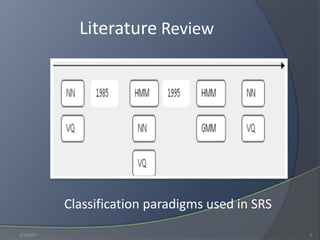
Classification paradigms used in SRS
Approaches to speech recognition
According to the literature speech recondition
approaches can be categorize into two main
different approaches.
 The Artificial Intelligence approach
 The Pattern Recognition approach
1/18/2017 6
Methodology
1/18/2017 7
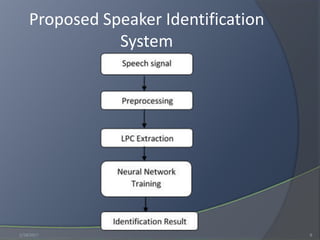
Proposed Speaker Identification
System
1/18/2017 8
Preprocessing of voice file
 Preprocessing covers digital filtering and end
point detection. Filtering is to filter out any
surrounding noise using several algorithms of
digital filtering
 In the proposed system preprocessing of the
voice has been done by using Daubechies' scaling
and wavelet filter
1/18/2017 9
Feature extraction of voice file
 It can be use many methods to feature
extraction of a voice file
 Dynamic information
 Log energy and ∆ log energy
 Discarding useless information
 Filter bank-based cepstral parameters
 Linear Predictive Coding
 Centered and reduced vectors
1/18/2017 10
Feature extraction of voice file
 The LPC (Linear Predictive Coding)
calculates a logarithmic power spectrum of
the voice signal
 Structure of the algorithm
LPC Analysis/Encoding
Input speech
Voice/Unvoiced Determination
Pitch Period Estimation
LPC Synthesis/Decoding
1/18/2017 11
Pattern matching
 The Pattern matching approach to speech is
basically one in which the speech patterns are
used directly without explicit feature
determination and segmentation.
 As in most pattern recognition approaches,
the method has two steps
 Training of speech patterns
 Recognition of patterns
1/18/2017 12
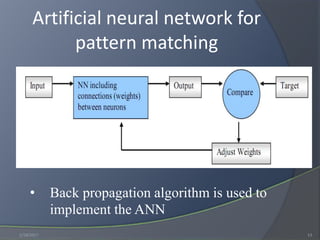
Artificial neural network for
pattern matching
1/18/2017 13
• Back propagation algorithm is used to
implement the ANN
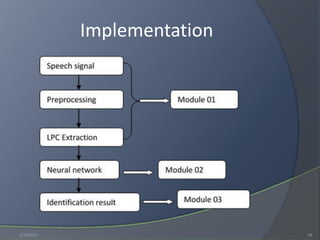
Implementation
1/18/2017 14
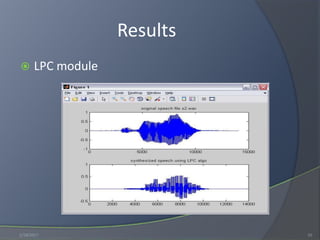
Results
 LPC module
1/18/2017 15
Results con’t
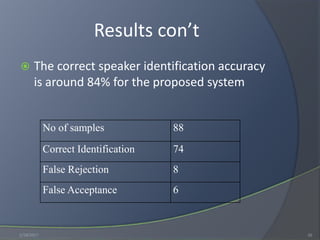
 The correct speaker identification accuracy
is around 84% for the proposed system
1/18/2017 16
No of samples 88
Correct Identification 74
False Rejection 8
False Acceptance 6
Conclusion
 Neural network and LPC techniques have
been used as a hybrid approach for speaker
identification, with the intention of that a
better performance of identification is to be
obtained
 The software works fine for identifying
speaker negligible, from number of different
speakers. But the system has limitation with
vocabulary, number of users, and it is works
only for ‘.wav ‘files
1/18/2017 17
Recommendations
 LPC module and neural network module should
be interconnected
 Text independent speaker identification
technologies (can only use specific word ‘zero’
only for the current system
 Increase the number of users that can be added
for the system, and increase the accuracy
 Cross platform development
1/18/2017 18
References
 Ing. Milan Sigmund, CSc. “Speaker Recognition, Identifying
People by their Voices”, Brno University of Technology, Czech
Republic, Habilitation Thesis, 2000.
 L. P. Cordella, P. Foggia, C. Sansone, M. Vento, “A Real-Time
Text-Independent Speaker Identification System”,
Proceedings of the ICIAP, pp. 632, 2003.
 D.A. Reynolds, L.P. Heck, “Automatic Speaker Recognition”,
AAAS 2000 Meeting, Humans, Computers and Speech
Symposium, 19 Feb 2000.
1/18/2017 19
Thank you.
1/18/2017 20

Speaker identification based user authentication system

  • 1.
  • 2.
    Content  Introduction  LiteratureReview  Methodology  Implementation  Results and discussion  Recommendation 1/18/2017 2
  • 3.
    Introduction  Authentication The processof confirming an individual’s identity, either by verification or identification.  This may be carried out by;  A person recognizing a person  Access control (PC, ATM, mobile phone)  Physical access control (house, building, area)  Identification (passport, driving license) 1/18/2017 3
  • 4.
    User authentication methods Token – “something that you have” such as smart card, magnetic card, key, passport, USB token  Knowledge – “something that you know” such as password, PIN  Biometrics – “something that you are”  A physiological characteristic (such as fingerprint, iris pattern, form of hand)  A behavioral characteristic (such as the way you sign, the way you speak) 1/18/2017 4
  • 5.
  • 6.
    Approaches to speechrecognition According to the literature speech recondition approaches can be categorize into two main different approaches.  The Artificial Intelligence approach  The Pattern Recognition approach 1/18/2017 6
  • 7.
  • 8.
  • 9.
    Preprocessing of voicefile  Preprocessing covers digital filtering and end point detection. Filtering is to filter out any surrounding noise using several algorithms of digital filtering  In the proposed system preprocessing of the voice has been done by using Daubechies' scaling and wavelet filter 1/18/2017 9
  • 10.
    Feature extraction ofvoice file  It can be use many methods to feature extraction of a voice file  Dynamic information  Log energy and ∆ log energy  Discarding useless information  Filter bank-based cepstral parameters  Linear Predictive Coding  Centered and reduced vectors 1/18/2017 10
  • 11.
    Feature extraction ofvoice file  The LPC (Linear Predictive Coding) calculates a logarithmic power spectrum of the voice signal  Structure of the algorithm LPC Analysis/Encoding Input speech Voice/Unvoiced Determination Pitch Period Estimation LPC Synthesis/Decoding 1/18/2017 11
  • 12.
    Pattern matching  ThePattern matching approach to speech is basically one in which the speech patterns are used directly without explicit feature determination and segmentation.  As in most pattern recognition approaches, the method has two steps  Training of speech patterns  Recognition of patterns 1/18/2017 12
  • 13.
    Artificial neural networkfor pattern matching 1/18/2017 13 • Back propagation algorithm is used to implement the ANN
  • 14.
  • 15.
  • 16.
    Results con’t  Thecorrect speaker identification accuracy is around 84% for the proposed system 1/18/2017 16 No of samples 88 Correct Identification 74 False Rejection 8 False Acceptance 6
  • 17.
    Conclusion  Neural networkand LPC techniques have been used as a hybrid approach for speaker identification, with the intention of that a better performance of identification is to be obtained  The software works fine for identifying speaker negligible, from number of different speakers. But the system has limitation with vocabulary, number of users, and it is works only for ‘.wav ‘files 1/18/2017 17
  • 18.
    Recommendations  LPC moduleand neural network module should be interconnected  Text independent speaker identification technologies (can only use specific word ‘zero’ only for the current system  Increase the number of users that can be added for the system, and increase the accuracy  Cross platform development 1/18/2017 18
  • 19.
    References  Ing. MilanSigmund, CSc. “Speaker Recognition, Identifying People by their Voices”, Brno University of Technology, Czech Republic, Habilitation Thesis, 2000.  L. P. Cordella, P. Foggia, C. Sansone, M. Vento, “A Real-Time Text-Independent Speaker Identification System”, Proceedings of the ICIAP, pp. 632, 2003.  D.A. Reynolds, L.P. Heck, “Automatic Speaker Recognition”, AAAS 2000 Meeting, Humans, Computers and Speech Symposium, 19 Feb 2000. 1/18/2017 19
  • 20.

Editor's Notes

  • #5 Within those methods the strongest method is using biometrics. Biometrics is the measurement and statistical analysis of biological data. In information Technology, biometrics refers to technologies for measuring and analyzing human body characteristics for authentication purposes. Importance of biometrics as authentication method will discuss with this slide Passwords can be forget, stolen etc
  • #6 different classification paradigms using different modeling techniques
  • #7 Expect to explain those three approaches and highlight the pattern recondition approach, which is used in this system
  • #9 Explain the diagram
  • #10 Explain Daubechies' scaling and wavelet filter
  • #11 Among those techniques Linear Predictive Coding (LPC) is a tool used mostly in audio signal processing and speech processing for representing the spectral envelope of a digital signal of speech in compressed form, using the information of a linear predictive model. It is one of the most powerful speech analysis techniques, and one of the most useful methods for encoding good quality speech at a low bit rate and provides extremely accurate estimates of speech parameters.
  • #13 In the pattern matching if compares the reference (training output of the neural net) with the unknown .wav file. If it is matching the .wav file should be accepted or if not the wav file should be rejected. That is done by using the decision rule. The training or the reference created using artificial neural networks.
  • #15 Technology adopted is MATLAB® Will explain the reasons like MATLAB provides tools to acquire, analyze, and visualize data – In this prototype voice data analyze by using algorithm developed by MATLAB. As algorithm development tool when implementing neural network Designing Graphical User Interfaces- Using GUIDE (Graphical User Interface Development Environment), you can lay out, design, and edit custom graphical user interfaces. You can include common controls such as list boxes, pull-down menus, and push buttons, as well as MATLAB plots And explain the modules and final GUI of the system which is intergrade all the other modules
  • #16 Separate module has separate results. LPC module NN module But in here I have only mention about the final results