State of the Environment in Ireland 2012
Meeting the Main Environmental Challenges
Workshop - 27 June 2012

2012


       Greenhouse Gas Emissions
         in Ireland – Trends and
                Projections

                Dr Maria Martin
       Climate Change and Environmental
             Research Programme
EPA’s role on inventories and projections


 EPA was established as the competent authority for the
  National Atmospheric Inventory System in 2007
 National Climate Change Strategy (2007) designated the
  EPA responsible for producing national emission
  projections
 EPA submits figures to EU and UN on an annual basis for
  inventories and EU biannually for projections
 EPA Team – Dr. Eimear Cotter, Paul Duffy, Bernard Hyde
  Stephan Leinert and Emilia Hanley
 Coordination, quality assurance and quality control of data
  from wide range of sources e.g.
    SEAI, Teagasc, CSO, Department of Agriculture and Marine, ESRI
Greenhouse Gas Trends 1990-2010

                 80
                                                                                                  -4%
                 70
                                    +27%                                                                                 -9%
                 60
Mtonnes, CO2eq


                 50


                 40


                 30


                 20


                 10


                  0
                      1990 1991 1992 1993 1994 1995 1996 1997 1998 1999 2000 2001 2002 2003 2004 2005 2006 2007 2008 2009 2010

                             Energy     Residential     Industry & Commercial      Agriculture     Transport     Waste
Sectoral Emission Trends 1990-2010
                 25


                 20
Mtonnes, CO2eq


                 15


                 10


                  5


                  0
                                                                            Waste
                                                                Transport   1.4%    Energy
                                                                  18.9%             21.8%
                       Energy                  Residential
                       Industry & Commercial   Agriculture
                       Transport               Waste
                                                                                        Residential
                                                                                          12.7%

                                                             Agriculture
                                                               30.5%                 Industry &
                                                                                    Commercial
                                                                            2010       14.6%
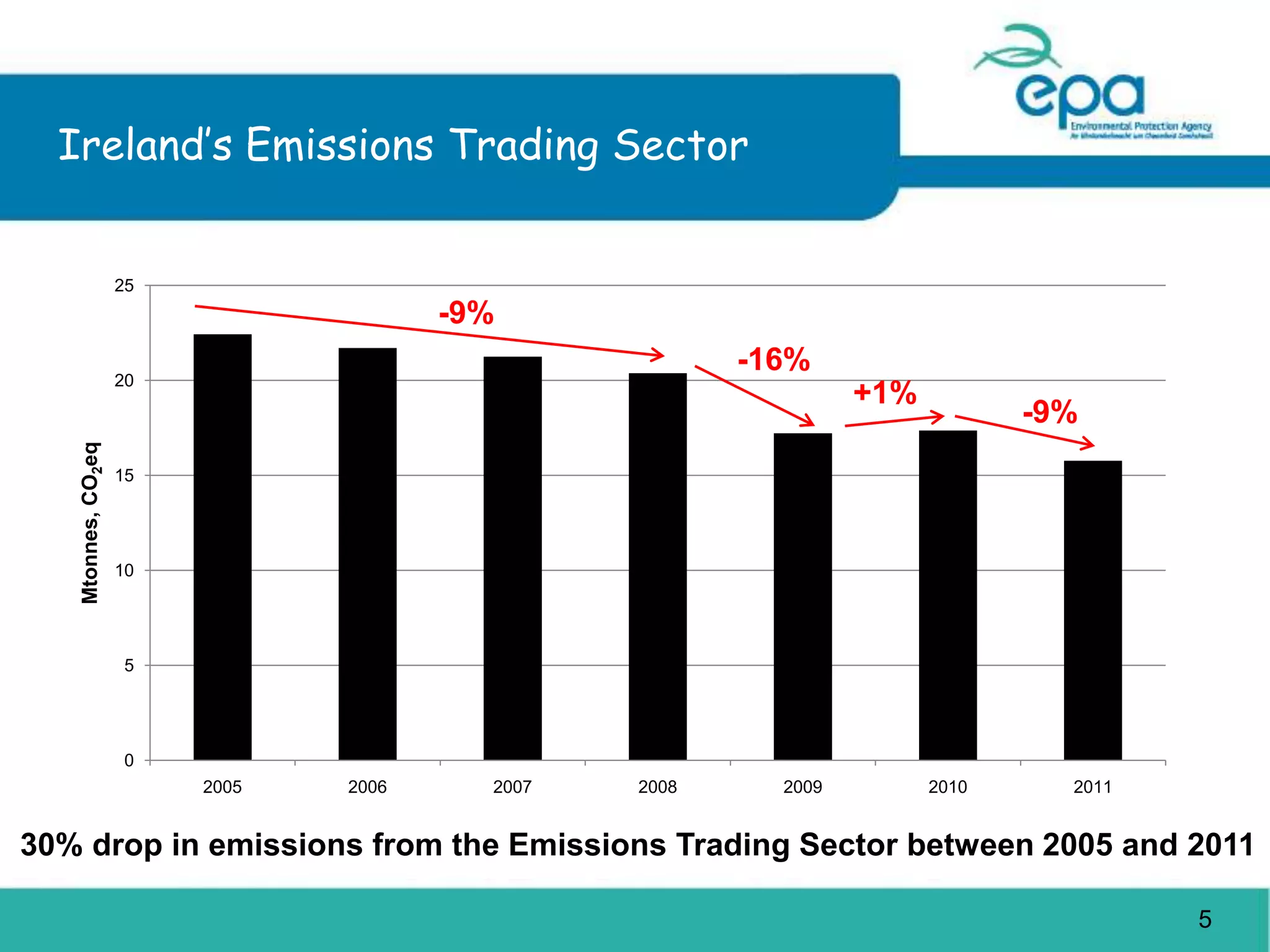
Ireland’s Emissions Trading Sector


                    25
                                       -9%
                                                       -16%
                    20
                                                                +1%
                                                                             -9%
   Mtonnes, CO2eq


                    15


                    10


                     5


                     0
                         2005   2006     2007   2008     2009         2010     2011


30% drop in emissions from the Emissions Trading Sector between 2005 and 2011

                                                                                      5
Greenhouse Gas Emission Projections

                  70


                  60


                  50
 Mtonnes, CO2eq


                  40          With Measures – existing policies and measures
                  With Additional Measures – existing and planned policies and measures
                  30


                  20


                  10


                   -
                       1990 1995 2000 2005 2006 2007 2008 2009 2010 2011 2012 2013 2014 2015 2016 2017 2018 2019 2020

                                            With Measures      With Additional Measures
Kyoto Protocol Limit


                 75
                                                                    Ireland is on track to
                 70
                                                                    meet its Kyoto
Mtonnes, CO2eq


                 65                          Kyoto Limit = 62.837
                                                                    commitment
                 60

                 55
                                                                    Projections indicate
                 50
                                                                    4.1-5.1 Mt CO2eq above
                 45                                                 KP limit over 2008-2012
                 40

                                                                    Range represents two
                                                                    scenarios – With
                      With Measures   With Additional Measures
                      Kyoto Limit     Baseline
                                                                    Measures and With
                                                                    Additional Measures


                                                                                              7
EU 2020 Targets

 Overall target is 20% reduction compared to 1990 levels
 Separates the effort to reduce greenhouse gas emissions between
  ETS and non-ETS sectors over period 2013-2020
 ETS – EU wide cap rather than national caps, reducing by 1.74%
  per annum to give an overall reduction of 21% by 2020 compared to
  2005.
 No free allocation to Powergen sector
 Limited free allocation starting at 70%, reducing to 30% benchmark
  in other areas
 Sectors subject to carbon leakage receive 100% benchmark
Non–ETS sectors


 Non-ETS sectors - transport, buildings, agriculture
  and waste - governed by the EU Effort Sharing
  Decision (ESD)

 Establishes annual binding greenhouse gas emission
  targets for EU Member States for non-ETS sectors
  for the period 2013–2020

 The target for Ireland for non-ETS sectors is to
  reduce emissions by 20% in 2020 relative to 2005
  levels
EU Effort Sharing Decision – 20%


                  45

                  40

                  35

                  30
 CO2eq, Mtonnes


                  25

                  20

                  15

                  10

                   5

                   0
                       2013   2014   2015        2016   2017            2018   2019   2020

                                            WM    WAM   Annual Limits


                                                                                             10
Sectoral Share – non-ETS sectors


         Residential   Waste 3%
                                                Agriculture and
            12%
                                                transport - 75% of non-
     Industry&                                  ETS sector emissions
    Commercial                                  in 2020
        10%
                                  Agriculture
                                     48%        Shows the important
                                                role that transport and
                                                agriculture will play in
  Transport 27%                                 developing mitigation
                                                options to achieve 2020
                                                targets
                          2020


                                                                           11
Transport


 EPA’s Transport projection assumes

    Technological improvements – improved fuel efficiency

    10% biofuels in 2020

    Achievement of electric vehicle target of 200,000 electric vehicles
     by 2020

    More efficient traffic movements
 Further improvements are possible – require behavioural
  changes and removal of barriers to new technologies
Agriculture


 Agriculture projection assumes

    Full achievement of Food Harvest targets

    Removal of milk quota by April 1 2015

    Efficiencies included in line with Sectoral Road Map for Dairying


 Teagasc (2012) – potential for further reductions-
  improvements in the Economic Breeding Index, extended
  grazing and nitrogen efficiency - require behavioural
  changes incentivisation.
Flexibilities under the Effort Sharing
Decision


 Carry forward from the following year a quantity of up to
  5% of its annual emission allocation

 Carry over of excess emission reductions to the
  subsequent years

 Transfer part of the annual emission allocation to other
  Member States

 Use of credits up to 3% of a Member States 2005
  emissions - additional 1% limit for some MS
Conclusions

 Ireland is on track to meet its Kyoto commitment taking into
  account the EU ETS and/or the potential use of credits already
  purchased by the State
 Ireland is projected to exceed its EU Effort Sharing Decision
  annual limits in 2015-2017 and its 2020 target
 Now is the time to set both the right level of ambition and the
  right pace of transition to a low-carbon economy
 Need to focus on delivering currently planned policies and
  measures to achieve With Additional Measures scenario and
  identify new policies and measures
 Focus should be on domestic action – agriculture and transport
 Domestic action can contribute to economic recovery,
  innovation and wider environmental benefits.

Greenhouse Gas Emissions in Ireland – Trends and Projections

  • 1.
    State of theEnvironment in Ireland 2012 Meeting the Main Environmental Challenges Workshop - 27 June 2012 2012 Greenhouse Gas Emissions in Ireland – Trends and Projections Dr Maria Martin Climate Change and Environmental Research Programme
  • 2.
    EPA’s role oninventories and projections  EPA was established as the competent authority for the National Atmospheric Inventory System in 2007  National Climate Change Strategy (2007) designated the EPA responsible for producing national emission projections  EPA submits figures to EU and UN on an annual basis for inventories and EU biannually for projections  EPA Team – Dr. Eimear Cotter, Paul Duffy, Bernard Hyde Stephan Leinert and Emilia Hanley  Coordination, quality assurance and quality control of data from wide range of sources e.g.  SEAI, Teagasc, CSO, Department of Agriculture and Marine, ESRI
  • 3.
    Greenhouse Gas Trends1990-2010 80 -4% 70 +27% -9% 60 Mtonnes, CO2eq 50 40 30 20 10 0 1990 1991 1992 1993 1994 1995 1996 1997 1998 1999 2000 2001 2002 2003 2004 2005 2006 2007 2008 2009 2010 Energy Residential Industry & Commercial Agriculture Transport Waste
  • 4.
    Sectoral Emission Trends1990-2010 25 20 Mtonnes, CO2eq 15 10 5 0 Waste Transport 1.4% Energy 18.9% 21.8% Energy Residential Industry & Commercial Agriculture Transport Waste Residential 12.7% Agriculture 30.5% Industry & Commercial 2010 14.6%
  • 5.
    Ireland’s Emissions TradingSector 25 -9% -16% 20 +1% -9% Mtonnes, CO2eq 15 10 5 0 2005 2006 2007 2008 2009 2010 2011 30% drop in emissions from the Emissions Trading Sector between 2005 and 2011 5
  • 6.
    Greenhouse Gas EmissionProjections 70 60 50 Mtonnes, CO2eq 40 With Measures – existing policies and measures With Additional Measures – existing and planned policies and measures 30 20 10 - 1990 1995 2000 2005 2006 2007 2008 2009 2010 2011 2012 2013 2014 2015 2016 2017 2018 2019 2020 With Measures With Additional Measures
  • 7.
    Kyoto Protocol Limit 75 Ireland is on track to 70 meet its Kyoto Mtonnes, CO2eq 65 Kyoto Limit = 62.837 commitment 60 55 Projections indicate 50 4.1-5.1 Mt CO2eq above 45 KP limit over 2008-2012 40 Range represents two scenarios – With With Measures With Additional Measures Kyoto Limit Baseline Measures and With Additional Measures 7
  • 8.
    EU 2020 Targets Overall target is 20% reduction compared to 1990 levels  Separates the effort to reduce greenhouse gas emissions between ETS and non-ETS sectors over period 2013-2020  ETS – EU wide cap rather than national caps, reducing by 1.74% per annum to give an overall reduction of 21% by 2020 compared to 2005.  No free allocation to Powergen sector  Limited free allocation starting at 70%, reducing to 30% benchmark in other areas  Sectors subject to carbon leakage receive 100% benchmark
  • 9.
    Non–ETS sectors  Non-ETSsectors - transport, buildings, agriculture and waste - governed by the EU Effort Sharing Decision (ESD)  Establishes annual binding greenhouse gas emission targets for EU Member States for non-ETS sectors for the period 2013–2020  The target for Ireland for non-ETS sectors is to reduce emissions by 20% in 2020 relative to 2005 levels
  • 10.
    EU Effort SharingDecision – 20% 45 40 35 30 CO2eq, Mtonnes 25 20 15 10 5 0 2013 2014 2015 2016 2017 2018 2019 2020 WM WAM Annual Limits 10
  • 11.
    Sectoral Share –non-ETS sectors Residential Waste 3% Agriculture and 12% transport - 75% of non- Industry& ETS sector emissions Commercial in 2020 10% Agriculture 48% Shows the important role that transport and agriculture will play in Transport 27% developing mitigation options to achieve 2020 targets 2020 11
  • 12.
    Transport  EPA’s Transportprojection assumes  Technological improvements – improved fuel efficiency  10% biofuels in 2020  Achievement of electric vehicle target of 200,000 electric vehicles by 2020  More efficient traffic movements  Further improvements are possible – require behavioural changes and removal of barriers to new technologies
  • 13.
    Agriculture  Agriculture projectionassumes  Full achievement of Food Harvest targets  Removal of milk quota by April 1 2015  Efficiencies included in line with Sectoral Road Map for Dairying  Teagasc (2012) – potential for further reductions- improvements in the Economic Breeding Index, extended grazing and nitrogen efficiency - require behavioural changes incentivisation.
  • 14.
    Flexibilities under theEffort Sharing Decision  Carry forward from the following year a quantity of up to 5% of its annual emission allocation  Carry over of excess emission reductions to the subsequent years  Transfer part of the annual emission allocation to other Member States  Use of credits up to 3% of a Member States 2005 emissions - additional 1% limit for some MS
  • 15.
    Conclusions  Ireland ison track to meet its Kyoto commitment taking into account the EU ETS and/or the potential use of credits already purchased by the State  Ireland is projected to exceed its EU Effort Sharing Decision annual limits in 2015-2017 and its 2020 target  Now is the time to set both the right level of ambition and the right pace of transition to a low-carbon economy  Need to focus on delivering currently planned policies and measures to achieve With Additional Measures scenario and identify new policies and measures  Focus should be on domestic action – agriculture and transport  Domestic action can contribute to economic recovery, innovation and wider environmental benefits.