Transition to low-emission development

                                                                                                    Daniela Carrington
                                                                                          Climate change policy advisor
                                                                                       Energy and Environment Practice
                                                                                                           UNDP BRC

                                                                                                         Zagreb, June, 2012

© 2009 UNDP. All Rights Reserved Worldwide.
Proprietary and Confidential. Not For Distribution Without Prior Written Permission.
Charting a course away from dangerous climate change:
                  A window of opportunity of 100 months
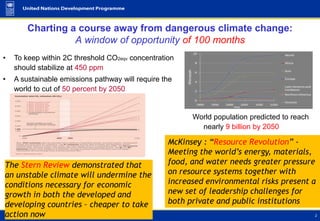
•   To keep within 2C threshold CO2eqv concentration
    should stabilize at 450 ppm
•   A sustainable emissions pathway will require the
    world to cut of 50 percent by 2050


                                                        World population predicted to reach
                                                          nearly 9 billion by 2050

                                                  McKinsey : “Resource Revolution” -
                                                  Meeting the world’s energy, materials,
The Stern Review demonstrated that                food, and water needs greater pressure
an unstable climate will undermine the            on resource systems together with
conditions necessary for economic                 increased environmental risks present a
growth in both the developed and                  new set of leadership challenges for
developing countries – cheaper to take            both private and public institutions
action now
Post 2012 international climate change regime:
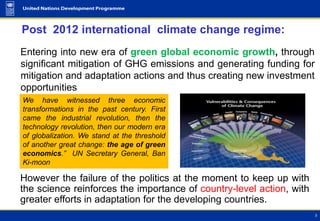
Entering into new era of green global economic growth, through
significant mitigation of GHG emissions and generating funding for
mitigation and adaptation actions and thus creating new investment
opportunities
We have witnessed three economic
transformations in the past century. First
came the industrial revolution, then the
technology revolution, then our modern era
of globalization. We stand at the threshold
of another great change: the age of green
economics.” UN Secretary General, Ban
Ki-moon

However the failure of the politics at the moment to keep up with
the science reinforces the importance of country-level action, with
greater efforts in adaptation for the developing countries.
EU ambition: to become the leading climate friendly region in the world
  • EU pledge: independent target of 20% below 1990
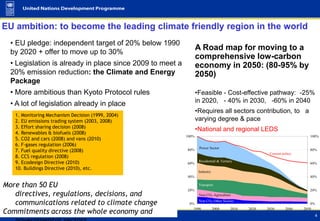
                                                                  A Road map for moving to a
  by 2020 + offer to move up to 30%
                                                                  comprehensive low-carbon
  • Legislation is already in place since 2009 to meet a          economy in 2050: (80-95% by
  20% emission reduction: the Climate and Energy                  2050)
  Package
  • More ambitious than Kyoto Protocol rules                      •Feasible - Cost-effective pathway: -25%
  • A lot of legislation already in place                         in 2020, - 40% in 2030, -60% in 2040
                                                                  •Requires all sectors contribution, to a
   1. Monitoring Mechanism Decision (1999, 2004)
   2. EU emissions trading system (2003, 2008)                    varying degree & pace
   3. Effort sharing decision (2008)
                                                                  •National and regional LEDS
   4. Renewables & biofuels (2008)
                                                           100%                                                        100%
   5. CO2 and cars (2008) and vans (2010)
   6. F-gases regulation (2006)
                                                                   Power Sector
   7. Fuel quality directive (2008)                        80%                                                         80%
                                                                                                    Current policy
   8. CCS regulation (2008)
   9. Ecodesign Directive (2010)                           60%
                                                                   Residential & Tertiary
                                                                                                                       60%
   10. Buildings Directive (2010), etc.
                                                                   Industry
                                                           40%                                                         40%

More than 50 EU                                                    Transport
                                                           20%                                                         20%
   directives, regulations, decisions, and                         Non CO2 Agriculture

   communications related to climate change                 0%
                                                                 Non CO2 Other Sectors
                                                                                                                        0%

Commitments across the whole economy and
                                                              1990     2000        2010     2020   2030       2040   2050
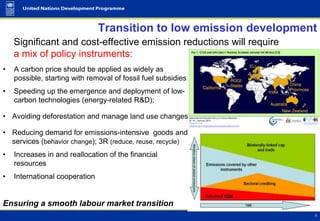
Transition to low emission development
    Significant and cost-effective emission reductions will require
    a mix of policy instruments:
•   A carbon price should be applied as widely as
    possible, starting with removal of fossil fuel subsidies
•   Speeding up the emergence and deployment of low-
    carbon technologies (energy-related R&D);

• Avoiding deforestation and manage land use changes

• Reducing demand for emissions-intensive goods and
  services (behavior change); 3R (reduce, reuse, recycle)
•   Increases in and reallocation of the financial
    resources
•   International cooperation


Ensuring a smooth labour market transition
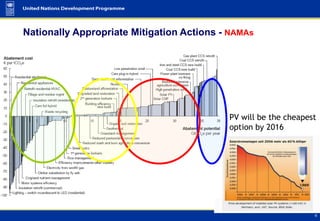
Nationally Appropriate Mitigation Actions - NAMAs


                                           PV will be the cheapest
                                           option by 2016
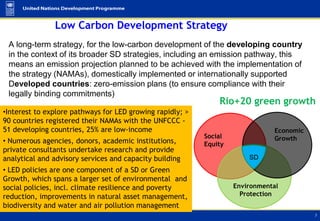
Low Carbon Development Strategy
 A long-term strategy, for the low-carbon development of the developing country
 in the context of its broader SD strategies, including an emission pathway, this
 means an emission projection planned to be achieved with the implementation of
 the strategy (NAMAs), domestically implemented or internationally supported
 Developed countries: zero-emission plans (to ensure compliance with their
 legally binding commitments)
                                                               Rio+20 green growth
•Interest to explore pathways for LED growing rapidly; >
90 countries registered their NAMAs with the UNFCCC -
51 developing countries, 25% are low-income                                    Economic
                                                           Social              Growth
• Numerous agencies, donors, academic institutions,        Equity
private consultants undertake research and provide
analytical and advisory services and capacity building                  SD
• LED policies are one component of a SD or Green
Growth, which spans a larger set of environmental and
social policies, incl. climate resilience and poverty               Environmental
reduction, improvements in natural asset management,                  Protection
biodiversity and water and air pollution management
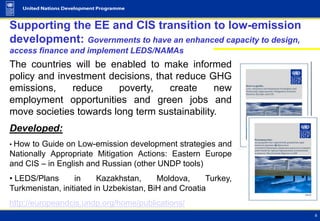
Supporting the EE and CIS transition to low-emission
development: Governments to have an enhanced capacity to design,
access finance and implement LEDS/NAMAs
Regional Project enabled to make informed
The countries will be
policy and investment decisions, that reduce GHG
emissions,    reduce    poverty,    create     new
employment opportunities and green jobs and
move societies towards long term sustainability.
Developed:
• How to Guide on Low-emission development strategies and
Nationally Appropriate Mitigation Actions: Eastern Europe
and CIS – in English and Russian (other UNDP tools)
• LEDS/Plans      in     Kazakhstan,     Moldova,     Turkey,
Turkmenistan, initiated in Uzbekistan, BiH and Croatia
http://europeandcis.undp.org/home/publications/
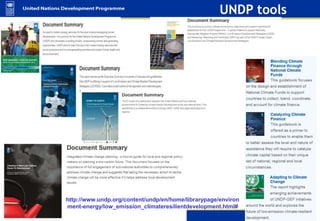
UNDP tools


http://www.undp.org/content/undp/en/home/librarypage/environ
ment-energy/low_emission_climateresilientdevelopment.html#
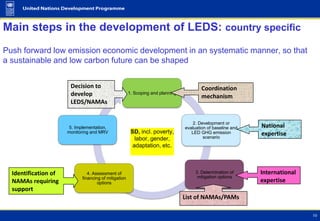
Main steps in the development of LEDS: country specific
Push forward low emission economic development in an systematic manner, so that
a sustainable and low carbon future can be shaped


                       Decision to                                                       Coordination
                       develop                         1. Scoping and planning
                                                                                         mechanism
                       LEDS/NAMAs


                                                                                     2. Development or
                       5. Implementation,                                        evaluation of baseline and   National
                      monitoring and MRV                SD, incl. poverty,          LED GHG emission          expertise
                                                          labor, gender,                  scenario
                                                         adaptation, etc.


  Identification of             4. Assessment of                                      3. Determination of     International
                             financing of mitigation                                   mitigation options
  NAMAs requiring                    options                                                                  expertise
  support
                                                                                 List of NAMAs/PAMs
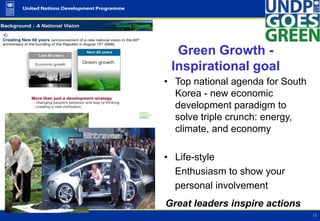
Green Growth -
 Inspirational goal
• Top national agenda for South
  Korea - new economic
  development paradigm to
  solve triple crunch: energy,
  climate, and economy

• Life-style
  Enthusiasm to show your
  personal involvement
Great leaders inspire actions
Thank you!

Low emission strategy dc zagreb_2012

  • 1.
    Transition to low-emissiondevelopment Daniela Carrington Climate change policy advisor Energy and Environment Practice UNDP BRC Zagreb, June, 2012 © 2009 UNDP. All Rights Reserved Worldwide. Proprietary and Confidential. Not For Distribution Without Prior Written Permission.
  • 2.
    Charting a courseaway from dangerous climate change: A window of opportunity of 100 months • To keep within 2C threshold CO2eqv concentration should stabilize at 450 ppm • A sustainable emissions pathway will require the world to cut of 50 percent by 2050 World population predicted to reach nearly 9 billion by 2050 McKinsey : “Resource Revolution” - Meeting the world’s energy, materials, The Stern Review demonstrated that food, and water needs greater pressure an unstable climate will undermine the on resource systems together with conditions necessary for economic increased environmental risks present a growth in both the developed and new set of leadership challenges for developing countries – cheaper to take both private and public institutions action now
  • 3.
    Post 2012 internationalclimate change regime: Entering into new era of green global economic growth, through significant mitigation of GHG emissions and generating funding for mitigation and adaptation actions and thus creating new investment opportunities We have witnessed three economic transformations in the past century. First came the industrial revolution, then the technology revolution, then our modern era of globalization. We stand at the threshold of another great change: the age of green economics.” UN Secretary General, Ban Ki-moon However the failure of the politics at the moment to keep up with the science reinforces the importance of country-level action, with greater efforts in adaptation for the developing countries.
  • 4.
    EU ambition: tobecome the leading climate friendly region in the world • EU pledge: independent target of 20% below 1990 A Road map for moving to a by 2020 + offer to move up to 30% comprehensive low-carbon • Legislation is already in place since 2009 to meet a economy in 2050: (80-95% by 20% emission reduction: the Climate and Energy 2050) Package • More ambitious than Kyoto Protocol rules •Feasible - Cost-effective pathway: -25% • A lot of legislation already in place in 2020, - 40% in 2030, -60% in 2040 •Requires all sectors contribution, to a 1. Monitoring Mechanism Decision (1999, 2004) 2. EU emissions trading system (2003, 2008) varying degree & pace 3. Effort sharing decision (2008) •National and regional LEDS 4. Renewables & biofuels (2008) 100% 100% 5. CO2 and cars (2008) and vans (2010) 6. F-gases regulation (2006) Power Sector 7. Fuel quality directive (2008) 80% 80% Current policy 8. CCS regulation (2008) 9. Ecodesign Directive (2010) 60% Residential & Tertiary 60% 10. Buildings Directive (2010), etc. Industry 40% 40% More than 50 EU Transport 20% 20% directives, regulations, decisions, and Non CO2 Agriculture communications related to climate change 0% Non CO2 Other Sectors 0% Commitments across the whole economy and 1990 2000 2010 2020 2030 2040 2050
  • 5.
    Transition to lowemission development Significant and cost-effective emission reductions will require a mix of policy instruments: • A carbon price should be applied as widely as possible, starting with removal of fossil fuel subsidies • Speeding up the emergence and deployment of low- carbon technologies (energy-related R&D); • Avoiding deforestation and manage land use changes • Reducing demand for emissions-intensive goods and services (behavior change); 3R (reduce, reuse, recycle) • Increases in and reallocation of the financial resources • International cooperation Ensuring a smooth labour market transition
  • 6.
    Nationally Appropriate MitigationActions - NAMAs PV will be the cheapest option by 2016
  • 7.
    Low Carbon DevelopmentStrategy A long-term strategy, for the low-carbon development of the developing country in the context of its broader SD strategies, including an emission pathway, this means an emission projection planned to be achieved with the implementation of the strategy (NAMAs), domestically implemented or internationally supported Developed countries: zero-emission plans (to ensure compliance with their legally binding commitments) Rio+20 green growth •Interest to explore pathways for LED growing rapidly; > 90 countries registered their NAMAs with the UNFCCC - 51 developing countries, 25% are low-income Economic Social Growth • Numerous agencies, donors, academic institutions, Equity private consultants undertake research and provide analytical and advisory services and capacity building SD • LED policies are one component of a SD or Green Growth, which spans a larger set of environmental and social policies, incl. climate resilience and poverty Environmental reduction, improvements in natural asset management, Protection biodiversity and water and air pollution management
  • 8.
    Supporting the EEand CIS transition to low-emission development: Governments to have an enhanced capacity to design, access finance and implement LEDS/NAMAs Regional Project enabled to make informed The countries will be policy and investment decisions, that reduce GHG emissions, reduce poverty, create new employment opportunities and green jobs and move societies towards long term sustainability. Developed: • How to Guide on Low-emission development strategies and Nationally Appropriate Mitigation Actions: Eastern Europe and CIS – in English and Russian (other UNDP tools) • LEDS/Plans in Kazakhstan, Moldova, Turkey, Turkmenistan, initiated in Uzbekistan, BiH and Croatia http://europeandcis.undp.org/home/publications/
  • 9.
  • 10.
    Main steps inthe development of LEDS: country specific Push forward low emission economic development in an systematic manner, so that a sustainable and low carbon future can be shaped Decision to Coordination develop 1. Scoping and planning mechanism LEDS/NAMAs 2. Development or 5. Implementation, evaluation of baseline and National monitoring and MRV SD, incl. poverty, LED GHG emission expertise labor, gender, scenario adaptation, etc. Identification of 4. Assessment of 3. Determination of International financing of mitigation mitigation options NAMAs requiring options expertise support List of NAMAs/PAMs
  • 11.
    Green Growth - Inspirational goal • Top national agenda for South Korea - new economic development paradigm to solve triple crunch: energy, climate, and economy • Life-style Enthusiasm to show your personal involvement Great leaders inspire actions
  • 12.

Editor's Notes

  • #3 The world only has 100-150 months to dramatically change the world’s energy supply trajectory and limit temperature rise to a "safe" 2 °C. Action – investment decisions that put the world on a different – more efficient resource use production and consumption path - is needed now.Significant investments are needed Stern review – cheaper to take action now. Investment decisions now will affect 2050 targets, action now is cheaper than inaction or late action;The transition to a low carbon world will transform our whole economy, the way we all live and work; Low-carbon growth is a new national development paradigm that creates new growth engines and increase of green jobs, green technology and clean energy Additionally: Population growth to 9 bln 2050 and;pressure on resource systems - McKinsey “Resource Revolution: Meeting the world’s energy, materials, food, and water needs greater pressure on resource systems together with increased environmental risks present a new set of leadership challenges for both private and public institutions; economic crisis
  • #4 We have witnessed three economic transformations in the past century. First came the industrial revolution, then the technology revolution, then our modern era of globalization. We stand at the threshold of another great change: the age of green economics.” UN Secretary General, Ban Ki-moon
  • #5 Climate and Energy Package: "20-20-20" targets. These are: A reduction in EU greenhouse gas emissions of at least 20% below 1990 levels; 20% of EU energy consumption to come from renewable resources; A 20% reduction in primary energy use compared with projected levels, to be achieved by improving energy efficiency. More ambitious than KP: e.g. inclusion of international aviation, LULUCF, higher CDM quality standards, supplementarity defined, recognition of early action (Kyoto bonus), no carry over of AAUs, single base year 1990, annual compliance cycle, higher penalties for non-compliance in emissions trading sectors, take account of direct and indirect effects of biofuels on land use change.Analysis of options to move beyond 20% greenhouse gas emission reductions and assessing the risk of carbon leakage 2010Since the EU policy was agreed, circumstances have been changing rapidly. We have seen an economic crisis of unprecedented scale. It has put huge pressure onto businesses and communities across Europe, as well as causing huge stress on public finances. But at the same time, it has confirmed that there are huge opportunities for Europe in building a resource-efficient society.There is now a widespread consensus that the development of resource-efficient and green technologies will be a major driver of growth. As countries worldwide sought to boost their economies in the crisis through stimulus packages, there was a clear pattern of investment being directed towards infrastructure for less polluting transport modes, such as public transport, intelligent traffic management systems (ITS), low-carbon energy production, smart electricity grids and clean transport- and energy-related R&D. Signs of the transition towards a low carbon economy are emerging across the world, with countries attracted to the greener option also because of its potential to create large numbers of new jobs.The total cost of a 30% reduction, including the costs to go to 20%, is now estimated at €81 billion, or 0.54% of GDP Options for addressing carbon leakage: The main issue for carbon leakage is the competitive difference between the EU and third countries. There are, therefore, broadly three ways in which carbon leakage could, if it can be demonstrated, be tackled: by giving further support to energy-intensive industries through continued free allowances; by adding to the costs of imports to compensate for the advantage of avoiding low-carbon policies; or by taking measures to bring the rest of the world closer to EU levels of effort.
  • #6 Brazil has established a stock exchange for voluntary carbon units which may precede a domestic trading scheme.China has made concrete steps towards the creation of regional ETS in various cities and provinces India has not shown much propensity for a domestic ETS due both to political and institutional reasons. However, trading schemes for energy efficiency and renewable energy are already in place Kazakhstan has very definite plans for an ETS, and has in fact a draft law in parliamentEnsuring a smooth labour market transitionGreener growth will see new jobs created, including skilled jobs in emerging green innovative activities. But some jobs will be at risk so there is a need to facilitate the re-allocation of workers from contracting to expanding sectors, such as those that replace polluting activities with cleaner alternatives or provide environmental services.Labour market policies should focus on preserving employment, not jobs. They need to ensure that workers and firms are able to adjust quickly to changes brought about by the greening of the economy, including by seizing new opportunities. By helping workers to move from jobs in contracting sectors to jobs in expanding sectors, they can also help to assure a just sharing of adjustment costs occasioned by the transition.2 New skills will be needed and this will require appropriate education policies. While many existing skills will remain appropriate, skill mismatches and gaps may emerge. Training and re-training programmes will be a key component of labour market policies. The scale of adjustment should not be overstated. For example, significant reductions of greenhouse gas emissions can be achieved with only limited effects on the pace of employment growth. Indeed labour market performance can improve if revenues from carbon pricing are used to promote labour demand. Furthermore, this does not take into account the positive impact on employment as a result of strategies fostering sources of green growth.Approximately $7 trillion of global annual cash flows by 2020 will be tied to a carbon-intensive economy. Sound policy can guide these investments toward a green economy, without slowing income growth. Performance standards for appliances, equipment, buildings, cars, and trucks, have both environmental and economic benefits. Sound economic signals can reduce waste, correct market failures, promote efficiency and spur innovation. Investments need to be reoriented to reduce emissions; with well designed policies
  • #7 High abatement potential low cost:Lightening, insulation retrofit, motor system efficiency, cropland nutrient management, clinker substitution by dry ash, electricity from landfill gas, efficiency improvements in other industries, rice management, 1st generation biofuels, small hydro, waste recycling, cars full hybrid, insulation residential, residential appliances, residential electronics
  • #8 Rio+20 green growth
  • #9 In Serbia with the support of JICA – green development strategyIn Macedonia – with the support of the World BankIn Albania –USAID has plans
  • #11 Follows the main principles for development of a strategy, following an established methodology or going its own wayThe goal in accordance with the GHG reduction commitment/goals and national prioritiesDevelopment of GHG emissions scenariosAssessment of the sectors of the economy and their reduction potential (incl. toward changed climate)Possible measures in different sector and cross sectoralEstimation of the financing needs, and economic impacts of shifting to low-emission development paths• Mechanisms for achieving it: investment, incentives, financial and economic policy initiatives (international support)• Consult and raise awareness for informed national consensus for policy actions and new investmentsEstablish collaboration mechanism with all stakeholdersDevelop relevant institutional arrangementsestablish a legal and regulatory framework Accumulate experience from other countries as well as national demonstrations and pilotsAssure adequate monitoring systemPush forward low emission economic development in an systematic manner, so that a sustainable and low carbon future can be shaped
  • #12 S. Korea: changing peoples behavior and way of thinking; creating a new civilization;