2017
Submitted by-Shubhajit
Dutta
Semester-v
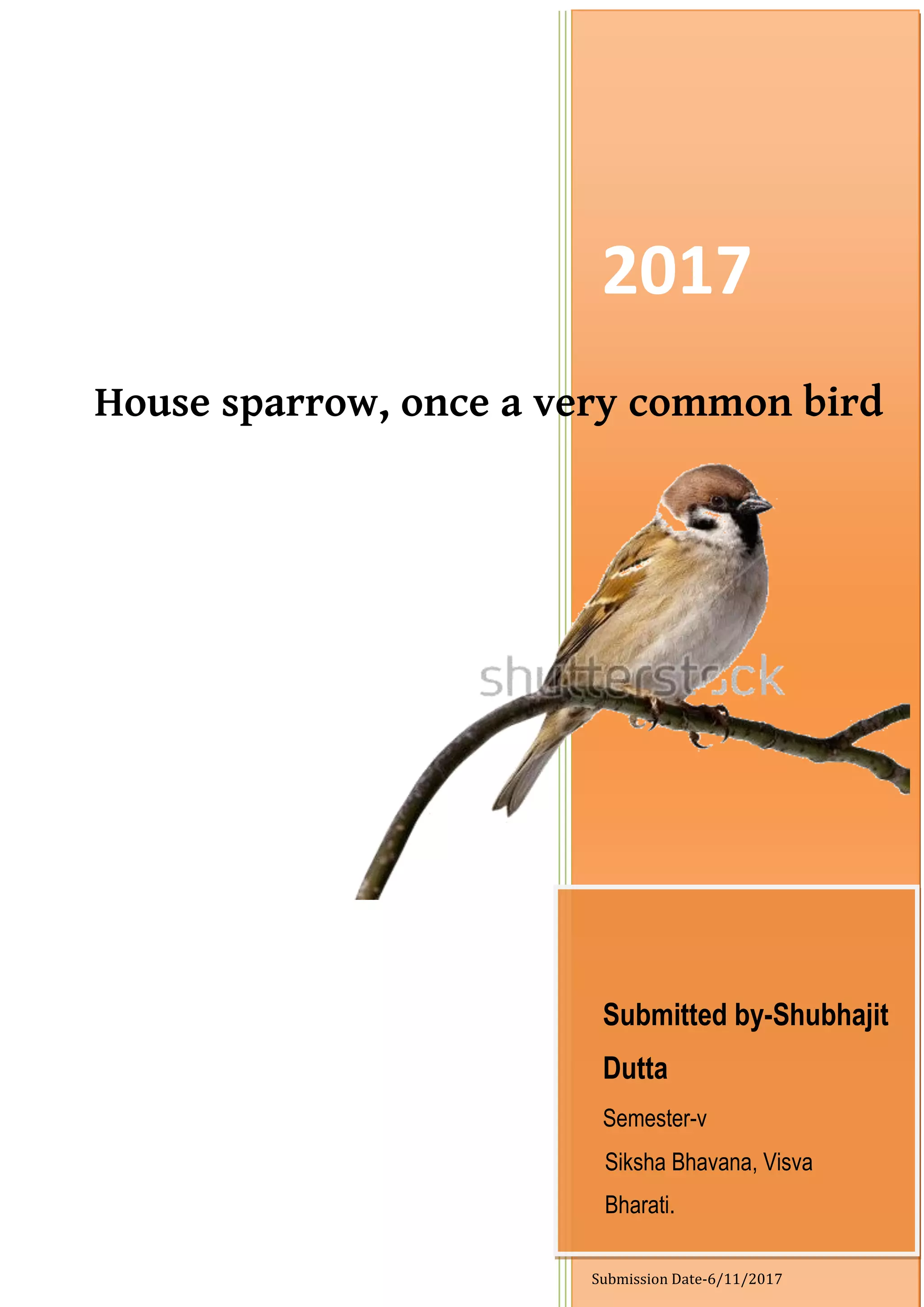
House sparrow, once a very common bird
Siksha Bhavana, Visva
Bharati.
Submission Date-6/11/2017
2
Abstract
The population of House sparrow (Passer domesticus), once a very common
bird, has declined markedly in most parts of the world including India.
Sparrows were distributed widely in the district Hoogly, West Bengal, India.
However over the past few decades, they became not so common in this
part of the world. A study has been conducted to establish the database for
their current population and to assess the possible causes of their decline at
Bandel (22 52'22''N/88 22'53''E) placed beside the river Hoogly from
September 2008 to May 2009. After prolonged searching, are latively dense
population of sparrow (total subject 270) was found in busy areas of railway
station and a nearby market in Bandel. The behavior of these birds was
studied extensively from early morning to late night. The noise level of the
area varied from 35 to 95 dB with an average of 70.6 dB from 04:30 am-
10:30 pm, IST. It was also observed that the sparrows took rest on the site of
the tree where the illumination level was low . Sparrows residing at the
Bandel station are habituated with the loud noise, being undisturbed by
passing trains. Thus, it can be concluded that inspite of heavy noise of trains,
crowdy travelers, and lack of nest sites, they remain at the station because of
availability of food in the nearby roadside market. Based on this observation,
sound pollution and availability of food are notresponsible for their decline.
3
Introduction
Birds are common inhabitants of our ecosystem. House sparrows are distributed widely
in India andabroad. As they are generally associated with human habitation, they tend to
stay in the region withstructures built of many holes under the tiles. Thesesites may
provide nestling sites and green areas for insect food. According to the latest sparrow
censusreported by various environmental organizations, there has been an 80 percent
decline in their numbers during the past decades in India. The disappearance of sparrows
in India has been widely reported, although responses have been quite muted. Their
recent decline around the world has put them in the list of the International Union for the
Conservation of Nature(IUCN). In an effort to draw the attention of government agencies
and the scientific community for more conservation measures and researches on common
bird species and urban biodiversity, March 20 has been designated as World House
Sparrow Day (www.worldhousesparrowday.org). The marking of the day is an
international initiative by the Nature Forever Society, in collaboration with the Bombay
Natural History Society, Cornell Lab of Ornithology (U.S.), Eco-Sys Action foundation
(France), Avon Wildlife Trust (U.K.) and numerous other international
organizations. In recent years, India has seen a sharp decline of several bird species
including Vulture, Great Indian Bustard, Sarus Crane, and sparrows. Over the past decade,
India has lost more than 95 percent of its vulture population. A number of hypotheses
have been put forward as possible causes of the decline of house sparrows in urban-
suburban habitats: predation, competition, lack of nest sites, disease, food availability and
pollution (Summers-Smith, 1999). An investigation has been conducted to know why the
population of house sparrow, once a very common bird, declined so dramatically not only
in India but around the world.
Another objective of this investigation was also to see if surrounding environment has
any impact on the maintenance of sparrow population.
4
CONTENT
PARTI DESCRIPTION
MEASURMENT AND SHAPE
PLUMAGE
VOICE
VARIATION
IDENTIFICATION
PART II TAXONOMY AND SYSTEMATICS
NAME
SUBSPECIES
PART III DISTRIBUTION AND HABITAT
PART IV BEHAVIOUR
PART V NESTING
NEST DESCRIPTION
NEST PLACEMENT
PART VI FOOD
PART VII LOCOMOTION
PART VIII DISPERSAL AND MIGRATION
PART IX SURVIVAL
PREDATION
PARASITES AND DISEASE
PART X A SURVEY ON HOUSE SPARROW POPULATION DECLINE AT
BANDEL, WEST BENGAL, IN
PART XI WHY DID THEY GO AWAY?
PART XII LET'S BRING BACK
THE LITTLE BROWN BIRD
PARTXIII BE A SPARROW SUPPORTER
5
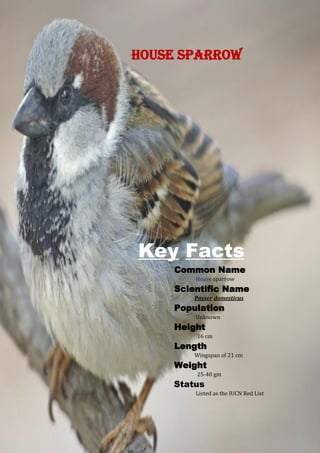
House sparrow
Key Facts
Common Name
House sparrow
Scientific Name
Passer domesticus
Population
Unknown
Height
16 cm
Length
Wingspan of 21 cm
Weight
25-40 gm
Status
Listed as the IUCN Red List
6
Description
Measurements and shape
The house sparrow is typically about 16 cm long, ranging
from 14 to 18 cm . It is a compact bird with a full chest and a
large, rounded head. Its bill is stout and conical with a culmen
length of 1.1–1.5cm,strongly built as an adaptation for eating
seeds. Its tail is short, at 5.2–6.5 cm long. The wing chord is
6.7–8.9 cm , and the tarsus is 1.6–2.5 cm . In mass, the house
sparrow ranges from 24 to 39.5 g (0.85 to 1.39 oz). Females
usually are slightly smaller than males. The median mass on
the European continent for both sexes is about 30 g , and in
more southerly subspecies is around 26 g . Younger birds are
smaller, males are larger during the winter, and females are
larger during the breeding season.Birds at higher latitudes,
colder climates, and sometimes higher altitudes are larger
(under Bergmann's rule), both between and within
subspecies.
Plumage
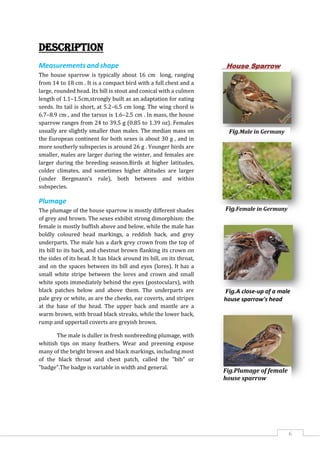
The plumage of the house sparrow is mostly different shades
of grey and brown. The sexes exhibit strong dimorphism: the
female is mostly buffish above and below, while the male has
boldly coloured head markings, a reddish back, and grey
underparts. The male has a dark grey crown from the top of
its bill to its back, and chestnut brown flanking its crown on
the sides of its head. It has black around its bill, on its throat,
and on the spaces between its bill and eyes (lores). It has a
small white stripe between the lores and crown and small
white spots immediately behind the eyes (postoculars), with
black patches below and above them. The underparts are
pale grey or white, as are the cheeks, ear coverts, and stripes
at the base of the head. The upper back and mantle are a
warm brown, with broad black streaks, while the lower back,
rump and uppertail coverts are greyish brown.
The male is duller in fresh nonbreeding plumage, with
whitish tips on many feathers. Wear and preening expose
many of the bright brown and black markings, including most
of the black throat and chest patch, called the "bib" or
"badge".The badge is variable in width and general.
Fig.Male in Germany
Fig.Female in Germany
House Sparrow
Fig.A close-up of a male
house sparrow's head
Fig.Plumage of female
house sparrow
7
size, and may signal social status or fitness This hypothesis
has led to a "veritable 'cottage industry'" of studies, which
have only conclusively shown that patches increase in size
with age. The male's bill is black in the breeding season and
horn (dark grey) during the rest of the year
Voice
Most house sparrow vocalisations are variations on its short
and incessant chirping call. Transcribed as chirrup, tschilp, or
philip, this note is made as a contact call by flocking or resting
birds, or by males to proclaim nest ownership and invite
pairing. In the breeding season, the male gives this call
repetitively, with emphasis and speed, but not much rhythm,
forming what is described either as a song or an "ecstatic
call" similar to a song.[ Young birds also give a true song,
especially in captivity, a warbling similar to that of the
European greenfinch.
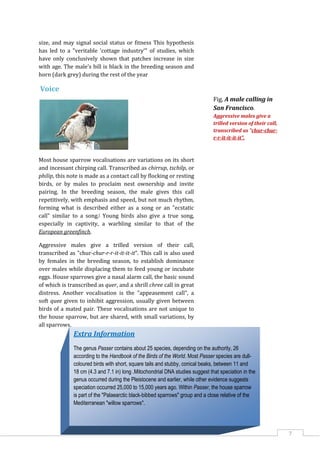
Aggressive males give a trilled version of their call,
transcribed as "chur-chur-r-r-it-it-it-it". This call is also used
by females in the breeding season, to establish dominance
over males while displacing them to feed young or incubate
eggs. House sparrows give a nasal alarm call, the basic sound
of which is transcribed as quer, and a shrill chree call in great
distress. Another vocalisation is the "appeasement call", a
soft quee given to inhibit aggression, usually given between
birds of a mated pair. These vocalisations are not unique to
the house sparrow, but are shared, with small variations, by
all sparrows.
Fig. A male calling in
San Francisco.
Aggressive males give a
trilled version of their call,
transcribed as "chur-chur-
r-r-it-it-it-it".
Extra Information
The genus Passer contains about 25 species, depending on the authority, 26
according to the Handbook of the Birds of the World. Most Passer species are dull-
coloured birds with short, square tails and stubby, conical beaks, between 11 and
18 cm (4.3 and 7.1 in) long .Mitochondrial DNA studies suggest that speciation in the
genus occurred during the Pleistocene and earlier, while other evidence suggests
speciation occurred 25,000 to 15,000 years ago. Within Passer, the house sparrow
is part of the "Palaearctic black-bibbed sparrows" group and a close relative of the
Mediterranean "willow sparrows".
8
Variation
Some variation is seen in the 12 subspecies of house
sparrows, which are divided into two groups, the Oriental P.
d. indicus group, and the Palaearctic P. d. domesticus group.
Birds of the P. d. domesticus group have grey cheeks, while P.
d. indicus group birds have white cheeks, as well as bright
colouration on the crown, a smaller bill, and a longer black
bib.[19] The subspecies P. d. tingitanus differs little from the
nominate subspecies, except in the worn breeding plumage
of the male, in which the head is speckled with black and
underparts are paler.[20] P. d. balearoibericus is slightly
paler than the nominate, but darker than P. d. bibilicus.[21] P.
d. bibilicus is paler than most subspecies, but has the grey
cheeks of P. d. domesticus group birds. The similar P. d.
persicus is paler and smaller, and P. d. niloticus is nearly
identical but smaller.[20] Of the less widespread P. d. indicus
group subspecies, P. d. hyrcanus is larger than P. d. indicus, P.
d. hufufae is paler, P. d. bactrianus is larger and paler, and P.
d. parkini is larger and darker with more black on the breast
than any other subspecies.
Identification
The house sparrow can be confused with a number of other
seed-eating birds, especially its relatives in the genus Passer.
Many of these relatives are smaller, with an appearance that
is neater or "cuter", as with the Dead Sea sparrow.The dull-
coloured female can often not be distinguished from other
females, and is nearly identical to those of the Spanish and
Italian sparrows. The Eurasian tree sparrow is smaller and
more slender with a chestnut crown and a black patch on
each cheek.The male Spanish sparrow and Italian sparrow
are distinguished by their chestnut crowns. The Sind sparrow
is very similar but smaller, with less black on the male's
throat and a distinct pale supercilium on the female
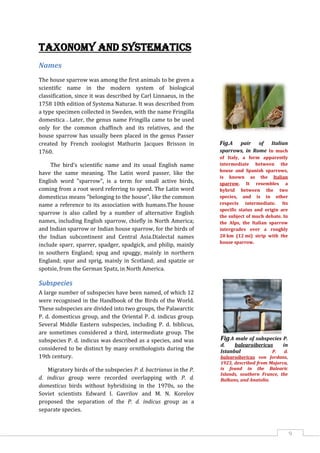
Fig.A male of subspecies P. d. indicus in
Kolkata, India
Fig.A male of subspecies P.
d. parkini at Rajkot, India
The male Spanish sparrow and
Italian sparrow are
distinguished by their chestnut
crowns. The Sind sparrow is
very similar but smaller, with
less black on the male's throat
and a distinct pale supercilium
on the female.
9
Taxonomy and systematics
Names
The house sparrow was among the first animals to be given a
scientific name in the modern system of biological
classification, since it was described by Carl Linnaeus, in the
1758 10th edition of Systema Naturae. It was described from
a type specimen collected in Sweden, with the name Fringilla
domestica . Later, the genus name Fringilla came to be used
only for the common chaffinch and its relatives, and the
house sparrow has usually been placed in the genus Passer
created by French zoologist Mathurin Jacques Brisson in
1760.
The bird's scientific name and its usual English name
have the same meaning. The Latin word passer, like the
English word "sparrow", is a term for small active birds,
coming from a root word referring to speed. The Latin word
domesticus means "belonging to the house", like the common
name a reference to its association with humans.The house
sparrow is also called by a number of alternative English
names, including English sparrow, chiefly in North America;
and Indian sparrow or Indian house sparrow, for the birds of
the Indian subcontinent and Central Asia.Dialectal names
include sparr, sparrer, spadger, spadgick, and philip, mainly
in southern England; spug and spuggy, mainly in northern
England; spur and sprig, mainly in Scotland; and spatzie or
spotsie, from the German Spatz, in North America.
Subspecies
A large number of subspecies have been named, of which 12
were recognised in the Handbook of the Birds of the World.
These subspecies are divided into two groups, the Palaearctic
P. d. domesticus group, and the Oriental P. d. indicus group.
Several Middle Eastern subspecies, including P. d. biblicus,
are sometimes considered a third, intermediate group. The
subspecies P. d. indicus was described as a species, and was
considered to be distinct by many ornithologists during the
19th century.
Migratory birds of the subspecies P. d. bactrianus in the P.
d. indicus group were recorded overlapping with P. d.
domesticus birds without hybridising in the 1970s, so the
Soviet scientists Edward I. Gavrilov and M. N. Korelov
proposed the separation of the P. d. indicus group as a
separate species.
Fig.A pair of Italian
sparrows, in Rome In much
of Italy, a form apparently
intermediate between the
house and Spanish sparrows,
is known as the Italian
sparrow. It resembles a
hybrid between the two
species, and is in other
respects intermediate. Its
specific status and origin are
the subject of much debate. In
the Alps, the Italian sparrow
intergrades over a roughly
20 km (12 mi) strip with the
house sparrow.
Fig.A male of subspecies P.
d. balearoibericus in
Istanbul P. d.
balearoibericus von Jordans,
1923, described from Majorca,
is found in the Balearic
Islands, southern France, the
Balkans, and Anatolia.
10
Distribution and habitat
The house sparrow is widespread across the world,
inhabiting every continent, except Antarctica, China and
Japan. It is native to Eurasia and North Africa, and was
introduced to South Africa, North and South America,
Australia, New Zealand, Middle East, India and Central Asia,
where its population thrived under a variety of
environmental and climatic conditions. Within India, it is
found throughout the country, up to the Assam valley and
lower parts of the Assam hills. Towards the eastern
Himalayas, the species is replaced by the Eurasian tree
sparrow. It is known to stay close to human habitations, and
is therefore among the most commonly found bird species in
urban cities. Flocks of sparrows are a common sighting near
residential colonies, gardens, farms, agricultural fields, office
buildings, and even highways with fast-moving traffic.
The house sparrow is closely associated with human
habitation and cultivation. It is not an obligate commensal of
humans as some have suggested: Central Asian house
sparrows usually breed away from humans in open country,
and birds elsewhere are occasionally found away from
humans. The only terrestrial habitats that the house sparrow
does not inhabit are dense forest and tundra. Well adapted to
living around humans, it frequently lives and even breeds
indoors, especially in factories, warehouses, and zoos.[88] It
has been recorded breeding in an English coal mine 640 m
(2,100 ft) below ground, and feeding on the Empire State
Building's observation deck at night. It reaches its greatest
densities in urban centres, but its reproductive success is
greater in suburbs, where insects are more abundant. On a
larger scale, it is most abundant in wheat-growing areas such
as the Midwestern United States.
It tolerates a variety of climates, but prefers drier conditions,
especially in moist tropical climates.It has several
adaptations to dry areas, including a high salt tolerance and
an ability to survive without water by ingesting berries.
Fig. By a nest in a
saguaro cactus in
Arizona he saguaro cactus
is a very unusual looking
tree of the desert. It has
been the subject of many
photographs, and
commonly conjures up
thoughts of the old west and
the beauty of the Southwest
desert.
Fig.House sparrows
perching on a roof during
winter in the Southern Alps
of New Zealand.
11
Behaviour
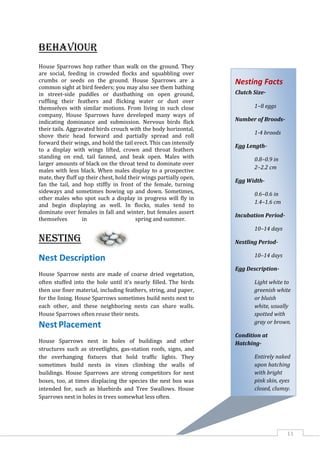
House Sparrows hop rather than walk on the ground. They
are social, feeding in crowded flocks and squabbling over
crumbs or seeds on the ground. House Sparrows are a
common sight at bird feeders; you may also see them bathing
in street-side puddles or dustbathing on open ground,
ruffling their feathers and flicking water or dust over
themselves with similar motions. From living in such close
company, House Sparrows have developed many ways of
indicating dominance and submission. Nervous birds flick
their tails. Aggravated birds crouch with the body horizontal,
shove their head forward and partially spread and roll
forward their wings, and hold the tail erect. This can intensify
to a display with wings lifted, crown and throat feathers
standing on end, tail fanned, and beak open. Males with
larger amounts of black on the throat tend to dominate over
males with less black. When males display to a prospective
mate, they fluff up their chest, hold their wings partially open,
fan the tail, and hop stiffly in front of the female, turning
sideways and sometimes bowing up and down. Sometimes,
other males who spot such a display in progress will fly in
and begin displaying as well. In flocks, males tend to
dominate over females in fall and winter, but females assert
themselves in spring and summer.
Nesting
Nest Description
House Sparrow nests are made of coarse dried vegetation,
often stuffed into the hole until it’s nearly filled. The birds
then use finer material, including feathers, string, and paper,
for the lining. House Sparrows sometimes build nests next to
each other, and these neighboring nests can share walls.
House Sparrows often reuse their nests.
NestPlacement
House Sparrows nest in holes of buildings and other
structures such as streetlights, gas-station roofs, signs, and
the overhanging fixtures that hold traffic lights. They
sometimes build nests in vines climbing the walls of
buildings. House Sparrows are strong competitors for nest
boxes, too, at times displacing the species the nest box was
intended for, such as bluebirds and Tree Swallows. House
Sparrows nest in holes in trees somewhat less often.
Nesting Facts
Clutch Size-
1–8 eggs
Number of Broods-
1-4 broods
Egg Length-
0.8–0.9 in
2–2.2 cm
Egg Width-
0.6–0.6 in
1.4–1.6 cm
Incubation Period-
10–14 days
Nestling Period-
10–14 days
Egg Description-
Light white to
greenish white
or bluish
white, usually
spotted with
gray or brown.
Condition at
Hatching-
Entirely naked
upon hatching
with bright
pink skin, eyes
closed, clumsy.
12
Food
House Sparrows eat mostly grains and seeds, as well as
livestock feed and, in cities, discarded food. Among the crops
they eat are corn, oats, wheat, and sorghum. Wild foods
include ragweed, crabgrass and other grasses, and
buckwheat. House Sparrows readily eat birdseed including
millet, milo, and sunflower seeds. Urban birds readily eat
commercial bird seed. In summer, House Sparrows eat
insects and feed them to their young. They catch insects in
the air, by pouncing on them, or by following lawnmowers or
visiting lights at dusk.
Locomotion
The house sparrow's flight is direct (not undulating) and
flapping, averaging 45.5 km/h (28.3 mph) and about 15
wingbeats per second. On the ground, the house sparrow
typically hops rather than walks. It can swim when pressed
to do so by pursuit from predators. Captive birds have been
recorded diving and swimming short distances under water.
Dispersal and migration
Most house sparrows do not move more than a few
kilometres during their lifetimes. However, limited migration
occurs in all regions. Some young birds disperse long
distances, especially on coasts, and mountain birds move to
lower elevations in winter.Two subspecies, P. d. bactrianus
and P. d. parkini, are predominantly migratory. Unlike the
birds in sedentary populations that migrate, birds of
migratory subspecies prepare for migration by putting on
weight.
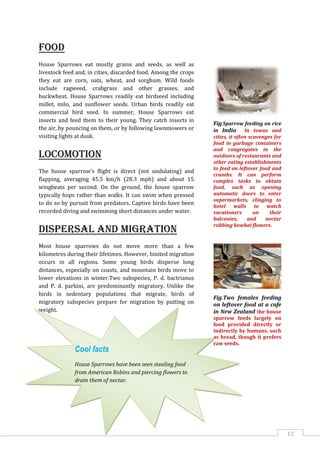
Fig.Sparrow feeding on rice
in India In towns and
cities, it often scavenges for
food in garbage containers
and congregates in the
outdoors of restaurants and
other eating establishments
to feed on leftover food and
crumbs. It can perform
complex tasks to obtain
food, such as opening
automatic doors to enter
supermarkets, clinging to
hotel walls to watch
vacationers on their
balconies, and nectar
robbing kowhai flowers.
Fig.Two females feeding
on leftover food at a cafe
in New Zealand the house
sparrow feeds largely on
food provided directly or
indirectly by humans, such
as bread, though it prefers
raw seeds.
Cool facts
House Sparrows have been seen stealing food
from American Robins and piercing flowers to
drain them of nectar.
13
BREEDING
House sparrows can breed in the breeding season
immediately following their hatching, and sometimes
attempt to do so. Some birds breeding for the first time in
tropical areas are only a few months old and still have
juvenile plumage. Birds breeding for the first time are rarely
successful in raising young, and reproductive success
increases with age, as older birds breed earlier in the
breeding season, and fledge more young. As the breeding
season approaches, hormone releases trigger enormous
increases in the size of the sexual organs and changes in day
length lead males to start calling by nesting sites. The timing
of mating and egg-laying varies geographically, and between
specific locations and years because a sufficient supply of
insects is needed for egg formation and feeding nestlings.
Males take up nesting sites before the breeding season, by
frequently calling beside them. Unmated males start nest
construction and call particularly frequently to attract
females. When a female approaches a male during this
period, the male displays by moving up and down while
drooping and shivering his wings, pushing up his head,
raising and spreading his tail, and showing his bib. Males may
try to mate with females while calling or displaying. In
response, a female will adopt a threatening posture and
attack a male before flying away, pursued by the male. The
male displays in front of her, attracting other males, which
also pursue and display to the female. This group display
usually does not immediately result in copulations. Other
males usually do not copulate with the female. Copulation is
typically initiated by the female giving a soft dee-dee-dee
call to the male. Birds of a pair copulate frequently until the
female is laying eggs, and the male mounts the female
repeatedly each time a pair mates.
The house sparrow is monogamous, and typically mates for
life. Birds from pairs often engage in extra-pair copulations,
so about 15% of house sparrow fledglings are unrelated to
their mother's mate. Male house sparrows guard their mates
carefully to avoid being cuckolded, and most extra-pair
copulation occurs away from nest sites. Males may
sometimes have multiple mates, and bigamy is mostly limited
by aggression between females. Many birds do not find a nest
and a mate, and instead may serve as helpers around the nest
for mated pairs, a role which increases the chances of being
chosen to replace a lost mate.
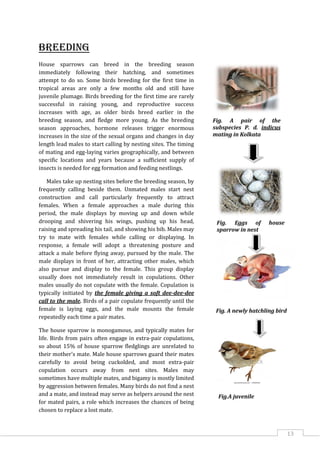
Fig. A pair of the
subspecies P. d. indicus
mating in Kolkata
Fig. A newly hatchling bird
Fig. Eggs of house
sparrow in nest
Fig.A juvenile
14
Survival
In adult house sparrows, annual survival is 45–65%. After
fledging and leaving the care of their parents, young
sparrows have a high mortality rate, which lessens as they
grow older and more experienced. Only about 20–25% of
birds hatched survive to their first breeding season. The
oldest known wild house sparrow lived for nearly two
decades; it was found dead 19 years and 9 months after it
was ringed in Denmark. The oldest recorded captive house
sparrow lived for 23 years. The typical ratio of males to
females in a population is uncertain due to problems in
collecting data, but a very slight preponderance of males at
all ages is usual.
Predation
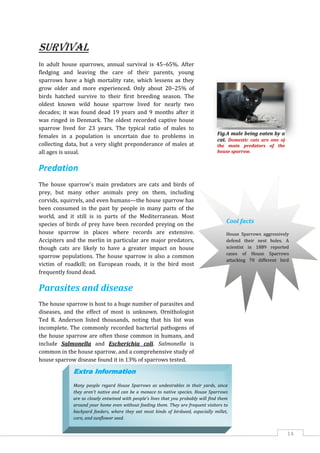
The house sparrow's main predators are cats and birds of
prey, but many other animals prey on them, including
corvids, squirrels, and even humans—the house sparrow has
been consumed in the past by people in many parts of the
world, and it still is in parts of the Mediterranean. Most
species of birds of prey have been recorded preying on the
house sparrow in places where records are extensive.
Accipiters and the merlin in particular are major predators,
though cats are likely to have a greater impact on house
sparrow populations. The house sparrow is also a common
victim of roadkill; on European roads, it is the bird most
frequently found dead.
Parasites and disease
The house sparrow is host to a huge number of parasites and
diseases, and the effect of most is unknown. Ornithologist
Ted R. Anderson listed thousands, noting that his list was
incomplete. The commonly recorded bacterial pathogens of
the house sparrow are often those common in humans, and
include Salmonella and Escherichia coli. Salmonella is
common in the house sparrow, and a comprehensive study of
house sparrow disease found it in 13% of sparrows tested.
Fig.A male being eaten by a
cat. Domestic cats are one of
the main predators of the
house sparrow.
Cool facts
House Sparrows aggressively
defend their nest holes. A
scientist in 1889 reported
cases of House Sparrows
attacking 70 different bird
species.
Extra Information
Many people regard House Sparrows as undesirables in their yards, since
they aren't native and can be a menace to native species. House Sparrows
are so closely entwined with people's lives that you probably will find them
around your home even without feeding them. They are frequent visitors to
backyard feeders, where they eat most kinds of birdseed, especially millet,
corn, and sunflower seed.
15
Results and Discussion
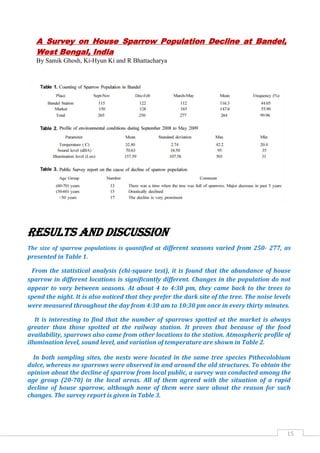
The size of sparrow populations is quantified at different seasons varied from 250- 277, as
presented in Table 1.
From the statistical analysis (chi-square test), it is found that the abundance of house
sparrow in different locations is significantly different. Changes in the population do not
appear to vary between seasons. At about 4 to 4:30 pm, they came back to the trees to
spend the night. It is also noticed that they prefer the dark site of the tree. The noise levels
were measured throughout the day from 4:30 am to 10:30 pm once in every thirty minutes.
It is interesting to find that the number of sparrows spotted at the market is always
greater than those spotted at the railway station. It proves that because of the food
availability, sparrows also came from other locations to the station. Atmospheric profile of
illumination level, sound level, and variation of temperature are shown in Table 2.
In both sampling sites, the nests were located in the same tree species Pithecolobium
dulce, whereas no sparrows were observed in and around the old structures. To obtain the
opinion about the decline of sparrow from local public, a survey was conducted among the
age group (20-70) in the local areas. All of them agreed with the situation of a rapid
decline of house sparrow, although none of them were sure about the reason for such
changes. The survey report is given in Table 3.
A Survey on House Sparrow Population Decline at Bandel,
West Bengal, India
By Samik Ghosh, Ki-Hyun Ki and R Bhattacharya
16
Why did they go away?
Loss of habitat:
Old spacious buildings have been changed to modern
dwelling units that are cramped, have no skylight ventilators
and no tiled rooftops. These tiled rooftops and ventilators
were favourite nesting places for the sparrow.
Lack of food:
The old Kirana shops have been converted into malls or
supermarkets, where food is found in packets. So, sparrows
do not find their food grains, which were once available on
the road sides.
Electromagnetic radiation:
The electromagnetic radiations released from our mobile
phones are also a major cause of decline in the number of
sparrows.
Modern agriculture:
In modern agriculture, insecticides and pesticides are widely
used which adversely affect the birds.
Pollution:
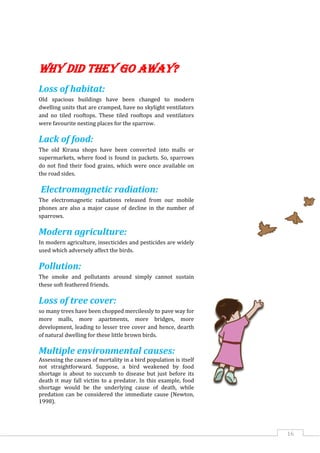
The smoke and pollutants around simply cannot sustain
these soft feathered friends.
Loss of tree cover:
so many trees have been chopped mercilessly to pave way for
more malls, more apartments, more bridges, more
development, leading to lesser tree cover and hence, dearth
of natural dwelling for these little brown birds.
Multiple environmental causes:
Assessing the causes of mortality in a bird population is itself
not straightforward. Suppose, a bird weakened by food
shortage is about to succumb to disease but just before its
death it may fall victim to a predator. In this example, food
shortage would be the underlying cause of death, while
predation can be considered the immediate cause (Newton,
1998).
17
Let's bring back
the little brown bird
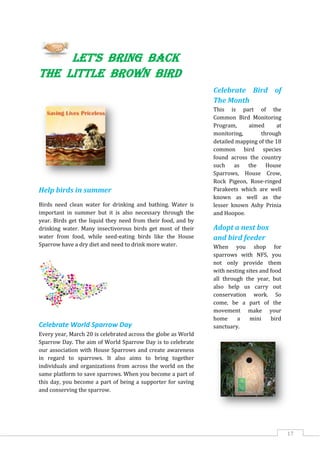
Help birds in summer
Birds need clean water for drinking and bathing. Water is
important in summer but it is also necessary through the
year. Birds get the liquid they need from their food, and by
drinking water. Many insectivorous birds get most of their
water from food, while seed-eating birds like the House
Sparrow have a dry diet and need to drink more water.
Celebrate World Sparrow Day
Every year, March 20 is celebrated across the globe as World
Sparrow Day. The aim of World Sparrow Day is to celebrate
our association with House Sparrows and create awareness
in regard to sparrows. It also aims to bring together
individuals and organizations from across the world on the
same platform to save sparrows. When you become a part of
this day, you become a part of being a supporter for saving
and conserving the sparrow.
Celebrate Bird of
The Month
This is part of the
Common Bird Monitoring
Program, aimed at
monitoring, through
detailed mapping of the 18
common bird species
found across the country
such as the House
Sparrows, House Crow,
Rock Pigeon, Rose-ringed
Parakeets which are well
known as well as the
lesser known Ashy Prinia
and Hoopoe.
Adopt a nest box
and bird feeder
When you shop for
sparrows with NFS, you
not only provide them
with nesting sites and food
all through the year, but
also help us carry out
conservation work. So
come, be a part of the
movement make your
home a mini bird
sanctuary.
18
BE A SPARROW SUPPORTER
Soon, children may hear stories that begin with, “Once
upon a time, there was a little bird called a sparrow.”
Soon, but not yet. It is not too late to stop this calamity.
Just the fact that you are reading this means, you have
realized that we have suddenly become sparrow-unfriendly.
You are curious to know if the House Sparrow can be saved
from extinction. That’s the first step to saving the House
Sparrow and to bring it back to neighborhoods where it has
disappeared from. Each of us can do our bit to save our
neighbor of thousands of years. When you become a Sparrow
Supporter, you make your locality and home; sparrow-
friendly. It’s not just the conservationist, researcher or
government agencies that can save the House Sparrow. This
bird depends on us to meet its ecological needs and it’s our
responsibility to provide it with nesting sites, food, water and
to keep its habitat safe.
You can also get associated with organizations like NFS
to help in conserving and preserving the House Sparrow for
generations to come.
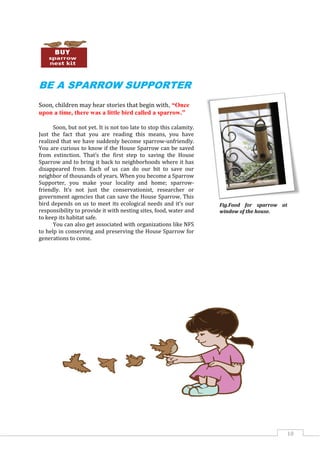
Fig.Food for sparrow at
window of the house.
19
CONCIUSION
When I was young, I was always fascinated by these little birds. Sadly, I am not able to find even a single
sparrow within the city limits these days .
The main cause of all this mass extinction of different species that has already begun is pollution!
Shame on us humans for allowing so much diversity to be destroyed. There is no other planet (as far as I
know) like ours in the universe.
Considering all these aspects, it is most likely that sparrow population is not decreasing
because of single factor. Based on the public opinion, it can be concluded that the sparrow’s
population is decreasing without specifications of the cause(s). However, several factors (like
predation, ecological reason, competition among the same or similar species, lack of nest sites,
disease, food availability and pollution) should interact each other to cause the disease or the
decrease of sparrow population .
Although some people and NGO try to save sparrow population but in my opinion most of the people
should have awareness about threatened species (not only Sparrow) and somebody or the others,
destroyers of so much wonderful diversity will be punished! There can be no escape.
It was a learning experience for me while working on this project. It was due to the project I came to
know very well about this little birds and their position in nature at present. I enjoyed each and every bit of
work I had put into this project. This project is further extendable.
20
Acknowledgment
I pleased to state that this project is a result of my honest labour and I want to express my sincere gratitude
to Prof. S. K. Saikia of the department of Zoology, Visva Bharati, for proposing the idea and support in
preparing this project report. I also express my thanks to my friends who helped me during the Completion
of this project.
DATE -25/8/2017 SHUBHAJIT DUTTA
References
Daniels, R.J.R., 2008, Can we save the sparrow. Current Science, 95, 1527-1528.
Juricova, Z., Pinowski, J., Literak, I., Hahm, K., and Romanowski, J., 1998, Antibodies to Alphaviruses,
Flavivirus, and Bunyavirus Arboviruses in House Sparrows and Tree Sparrows in Warsaw. Avian
Diseases,
Websites:
www.encyclopedia.com
www.google.com
www.yahoo.com
www.wikipedia.com

House sparrow, once a common bird

  • 1.
    2017 Submitted by-Shubhajit Dutta Semester-v House sparrow,once a very common bird Siksha Bhavana, Visva Bharati. Submission Date-6/11/2017
  • 2.
    2 Abstract The population ofHouse sparrow (Passer domesticus), once a very common bird, has declined markedly in most parts of the world including India. Sparrows were distributed widely in the district Hoogly, West Bengal, India. However over the past few decades, they became not so common in this part of the world. A study has been conducted to establish the database for their current population and to assess the possible causes of their decline at Bandel (22 52'22''N/88 22'53''E) placed beside the river Hoogly from September 2008 to May 2009. After prolonged searching, are latively dense population of sparrow (total subject 270) was found in busy areas of railway station and a nearby market in Bandel. The behavior of these birds was studied extensively from early morning to late night. The noise level of the area varied from 35 to 95 dB with an average of 70.6 dB from 04:30 am- 10:30 pm, IST. It was also observed that the sparrows took rest on the site of the tree where the illumination level was low . Sparrows residing at the Bandel station are habituated with the loud noise, being undisturbed by passing trains. Thus, it can be concluded that inspite of heavy noise of trains, crowdy travelers, and lack of nest sites, they remain at the station because of availability of food in the nearby roadside market. Based on this observation, sound pollution and availability of food are notresponsible for their decline.
  • 3.
    3 Introduction Birds are commoninhabitants of our ecosystem. House sparrows are distributed widely in India andabroad. As they are generally associated with human habitation, they tend to stay in the region withstructures built of many holes under the tiles. Thesesites may provide nestling sites and green areas for insect food. According to the latest sparrow censusreported by various environmental organizations, there has been an 80 percent decline in their numbers during the past decades in India. The disappearance of sparrows in India has been widely reported, although responses have been quite muted. Their recent decline around the world has put them in the list of the International Union for the Conservation of Nature(IUCN). In an effort to draw the attention of government agencies and the scientific community for more conservation measures and researches on common bird species and urban biodiversity, March 20 has been designated as World House Sparrow Day (www.worldhousesparrowday.org). The marking of the day is an international initiative by the Nature Forever Society, in collaboration with the Bombay Natural History Society, Cornell Lab of Ornithology (U.S.), Eco-Sys Action foundation (France), Avon Wildlife Trust (U.K.) and numerous other international organizations. In recent years, India has seen a sharp decline of several bird species including Vulture, Great Indian Bustard, Sarus Crane, and sparrows. Over the past decade, India has lost more than 95 percent of its vulture population. A number of hypotheses have been put forward as possible causes of the decline of house sparrows in urban- suburban habitats: predation, competition, lack of nest sites, disease, food availability and pollution (Summers-Smith, 1999). An investigation has been conducted to know why the population of house sparrow, once a very common bird, declined so dramatically not only in India but around the world. Another objective of this investigation was also to see if surrounding environment has any impact on the maintenance of sparrow population.
  • 4.
    4 CONTENT PARTI DESCRIPTION MEASURMENT ANDSHAPE PLUMAGE VOICE VARIATION IDENTIFICATION PART II TAXONOMY AND SYSTEMATICS NAME SUBSPECIES PART III DISTRIBUTION AND HABITAT PART IV BEHAVIOUR PART V NESTING NEST DESCRIPTION NEST PLACEMENT PART VI FOOD PART VII LOCOMOTION PART VIII DISPERSAL AND MIGRATION PART IX SURVIVAL PREDATION PARASITES AND DISEASE PART X A SURVEY ON HOUSE SPARROW POPULATION DECLINE AT BANDEL, WEST BENGAL, IN PART XI WHY DID THEY GO AWAY? PART XII LET'S BRING BACK THE LITTLE BROWN BIRD PARTXIII BE A SPARROW SUPPORTER
  • 5.
    5 House sparrow Key Facts CommonName House sparrow Scientific Name Passer domesticus Population Unknown Height 16 cm Length Wingspan of 21 cm Weight 25-40 gm Status Listed as the IUCN Red List
  • 6.
    6 Description Measurements and shape Thehouse sparrow is typically about 16 cm long, ranging from 14 to 18 cm . It is a compact bird with a full chest and a large, rounded head. Its bill is stout and conical with a culmen length of 1.1–1.5cm,strongly built as an adaptation for eating seeds. Its tail is short, at 5.2–6.5 cm long. The wing chord is 6.7–8.9 cm , and the tarsus is 1.6–2.5 cm . In mass, the house sparrow ranges from 24 to 39.5 g (0.85 to 1.39 oz). Females usually are slightly smaller than males. The median mass on the European continent for both sexes is about 30 g , and in more southerly subspecies is around 26 g . Younger birds are smaller, males are larger during the winter, and females are larger during the breeding season.Birds at higher latitudes, colder climates, and sometimes higher altitudes are larger (under Bergmann's rule), both between and within subspecies. Plumage The plumage of the house sparrow is mostly different shades of grey and brown. The sexes exhibit strong dimorphism: the female is mostly buffish above and below, while the male has boldly coloured head markings, a reddish back, and grey underparts. The male has a dark grey crown from the top of its bill to its back, and chestnut brown flanking its crown on the sides of its head. It has black around its bill, on its throat, and on the spaces between its bill and eyes (lores). It has a small white stripe between the lores and crown and small white spots immediately behind the eyes (postoculars), with black patches below and above them. The underparts are pale grey or white, as are the cheeks, ear coverts, and stripes at the base of the head. The upper back and mantle are a warm brown, with broad black streaks, while the lower back, rump and uppertail coverts are greyish brown. The male is duller in fresh nonbreeding plumage, with whitish tips on many feathers. Wear and preening expose many of the bright brown and black markings, including most of the black throat and chest patch, called the "bib" or "badge".The badge is variable in width and general. Fig.Male in Germany Fig.Female in Germany House Sparrow Fig.A close-up of a male house sparrow's head Fig.Plumage of female house sparrow
  • 7.
    7 size, and maysignal social status or fitness This hypothesis has led to a "veritable 'cottage industry'" of studies, which have only conclusively shown that patches increase in size with age. The male's bill is black in the breeding season and horn (dark grey) during the rest of the year Voice Most house sparrow vocalisations are variations on its short and incessant chirping call. Transcribed as chirrup, tschilp, or philip, this note is made as a contact call by flocking or resting birds, or by males to proclaim nest ownership and invite pairing. In the breeding season, the male gives this call repetitively, with emphasis and speed, but not much rhythm, forming what is described either as a song or an "ecstatic call" similar to a song.[ Young birds also give a true song, especially in captivity, a warbling similar to that of the European greenfinch. Aggressive males give a trilled version of their call, transcribed as "chur-chur-r-r-it-it-it-it". This call is also used by females in the breeding season, to establish dominance over males while displacing them to feed young or incubate eggs. House sparrows give a nasal alarm call, the basic sound of which is transcribed as quer, and a shrill chree call in great distress. Another vocalisation is the "appeasement call", a soft quee given to inhibit aggression, usually given between birds of a mated pair. These vocalisations are not unique to the house sparrow, but are shared, with small variations, by all sparrows. Fig. A male calling in San Francisco. Aggressive males give a trilled version of their call, transcribed as "chur-chur- r-r-it-it-it-it". Extra Information The genus Passer contains about 25 species, depending on the authority, 26 according to the Handbook of the Birds of the World. Most Passer species are dull- coloured birds with short, square tails and stubby, conical beaks, between 11 and 18 cm (4.3 and 7.1 in) long .Mitochondrial DNA studies suggest that speciation in the genus occurred during the Pleistocene and earlier, while other evidence suggests speciation occurred 25,000 to 15,000 years ago. Within Passer, the house sparrow is part of the "Palaearctic black-bibbed sparrows" group and a close relative of the Mediterranean "willow sparrows".
  • 8.
    8 Variation Some variation isseen in the 12 subspecies of house sparrows, which are divided into two groups, the Oriental P. d. indicus group, and the Palaearctic P. d. domesticus group. Birds of the P. d. domesticus group have grey cheeks, while P. d. indicus group birds have white cheeks, as well as bright colouration on the crown, a smaller bill, and a longer black bib.[19] The subspecies P. d. tingitanus differs little from the nominate subspecies, except in the worn breeding plumage of the male, in which the head is speckled with black and underparts are paler.[20] P. d. balearoibericus is slightly paler than the nominate, but darker than P. d. bibilicus.[21] P. d. bibilicus is paler than most subspecies, but has the grey cheeks of P. d. domesticus group birds. The similar P. d. persicus is paler and smaller, and P. d. niloticus is nearly identical but smaller.[20] Of the less widespread P. d. indicus group subspecies, P. d. hyrcanus is larger than P. d. indicus, P. d. hufufae is paler, P. d. bactrianus is larger and paler, and P. d. parkini is larger and darker with more black on the breast than any other subspecies. Identification The house sparrow can be confused with a number of other seed-eating birds, especially its relatives in the genus Passer. Many of these relatives are smaller, with an appearance that is neater or "cuter", as with the Dead Sea sparrow.The dull- coloured female can often not be distinguished from other females, and is nearly identical to those of the Spanish and Italian sparrows. The Eurasian tree sparrow is smaller and more slender with a chestnut crown and a black patch on each cheek.The male Spanish sparrow and Italian sparrow are distinguished by their chestnut crowns. The Sind sparrow is very similar but smaller, with less black on the male's throat and a distinct pale supercilium on the female Fig.A male of subspecies P. d. indicus in Kolkata, India Fig.A male of subspecies P. d. parkini at Rajkot, India The male Spanish sparrow and Italian sparrow are distinguished by their chestnut crowns. The Sind sparrow is very similar but smaller, with less black on the male's throat and a distinct pale supercilium on the female.
  • 9.
    9 Taxonomy and systematics Names Thehouse sparrow was among the first animals to be given a scientific name in the modern system of biological classification, since it was described by Carl Linnaeus, in the 1758 10th edition of Systema Naturae. It was described from a type specimen collected in Sweden, with the name Fringilla domestica . Later, the genus name Fringilla came to be used only for the common chaffinch and its relatives, and the house sparrow has usually been placed in the genus Passer created by French zoologist Mathurin Jacques Brisson in 1760. The bird's scientific name and its usual English name have the same meaning. The Latin word passer, like the English word "sparrow", is a term for small active birds, coming from a root word referring to speed. The Latin word domesticus means "belonging to the house", like the common name a reference to its association with humans.The house sparrow is also called by a number of alternative English names, including English sparrow, chiefly in North America; and Indian sparrow or Indian house sparrow, for the birds of the Indian subcontinent and Central Asia.Dialectal names include sparr, sparrer, spadger, spadgick, and philip, mainly in southern England; spug and spuggy, mainly in northern England; spur and sprig, mainly in Scotland; and spatzie or spotsie, from the German Spatz, in North America. Subspecies A large number of subspecies have been named, of which 12 were recognised in the Handbook of the Birds of the World. These subspecies are divided into two groups, the Palaearctic P. d. domesticus group, and the Oriental P. d. indicus group. Several Middle Eastern subspecies, including P. d. biblicus, are sometimes considered a third, intermediate group. The subspecies P. d. indicus was described as a species, and was considered to be distinct by many ornithologists during the 19th century. Migratory birds of the subspecies P. d. bactrianus in the P. d. indicus group were recorded overlapping with P. d. domesticus birds without hybridising in the 1970s, so the Soviet scientists Edward I. Gavrilov and M. N. Korelov proposed the separation of the P. d. indicus group as a separate species. Fig.A pair of Italian sparrows, in Rome In much of Italy, a form apparently intermediate between the house and Spanish sparrows, is known as the Italian sparrow. It resembles a hybrid between the two species, and is in other respects intermediate. Its specific status and origin are the subject of much debate. In the Alps, the Italian sparrow intergrades over a roughly 20 km (12 mi) strip with the house sparrow. Fig.A male of subspecies P. d. balearoibericus in Istanbul P. d. balearoibericus von Jordans, 1923, described from Majorca, is found in the Balearic Islands, southern France, the Balkans, and Anatolia.
  • 10.
    10 Distribution and habitat Thehouse sparrow is widespread across the world, inhabiting every continent, except Antarctica, China and Japan. It is native to Eurasia and North Africa, and was introduced to South Africa, North and South America, Australia, New Zealand, Middle East, India and Central Asia, where its population thrived under a variety of environmental and climatic conditions. Within India, it is found throughout the country, up to the Assam valley and lower parts of the Assam hills. Towards the eastern Himalayas, the species is replaced by the Eurasian tree sparrow. It is known to stay close to human habitations, and is therefore among the most commonly found bird species in urban cities. Flocks of sparrows are a common sighting near residential colonies, gardens, farms, agricultural fields, office buildings, and even highways with fast-moving traffic. The house sparrow is closely associated with human habitation and cultivation. It is not an obligate commensal of humans as some have suggested: Central Asian house sparrows usually breed away from humans in open country, and birds elsewhere are occasionally found away from humans. The only terrestrial habitats that the house sparrow does not inhabit are dense forest and tundra. Well adapted to living around humans, it frequently lives and even breeds indoors, especially in factories, warehouses, and zoos.[88] It has been recorded breeding in an English coal mine 640 m (2,100 ft) below ground, and feeding on the Empire State Building's observation deck at night. It reaches its greatest densities in urban centres, but its reproductive success is greater in suburbs, where insects are more abundant. On a larger scale, it is most abundant in wheat-growing areas such as the Midwestern United States. It tolerates a variety of climates, but prefers drier conditions, especially in moist tropical climates.It has several adaptations to dry areas, including a high salt tolerance and an ability to survive without water by ingesting berries. Fig. By a nest in a saguaro cactus in Arizona he saguaro cactus is a very unusual looking tree of the desert. It has been the subject of many photographs, and commonly conjures up thoughts of the old west and the beauty of the Southwest desert. Fig.House sparrows perching on a roof during winter in the Southern Alps of New Zealand.
  • 11.
    11 Behaviour House Sparrows hoprather than walk on the ground. They are social, feeding in crowded flocks and squabbling over crumbs or seeds on the ground. House Sparrows are a common sight at bird feeders; you may also see them bathing in street-side puddles or dustbathing on open ground, ruffling their feathers and flicking water or dust over themselves with similar motions. From living in such close company, House Sparrows have developed many ways of indicating dominance and submission. Nervous birds flick their tails. Aggravated birds crouch with the body horizontal, shove their head forward and partially spread and roll forward their wings, and hold the tail erect. This can intensify to a display with wings lifted, crown and throat feathers standing on end, tail fanned, and beak open. Males with larger amounts of black on the throat tend to dominate over males with less black. When males display to a prospective mate, they fluff up their chest, hold their wings partially open, fan the tail, and hop stiffly in front of the female, turning sideways and sometimes bowing up and down. Sometimes, other males who spot such a display in progress will fly in and begin displaying as well. In flocks, males tend to dominate over females in fall and winter, but females assert themselves in spring and summer. Nesting Nest Description House Sparrow nests are made of coarse dried vegetation, often stuffed into the hole until it’s nearly filled. The birds then use finer material, including feathers, string, and paper, for the lining. House Sparrows sometimes build nests next to each other, and these neighboring nests can share walls. House Sparrows often reuse their nests. NestPlacement House Sparrows nest in holes of buildings and other structures such as streetlights, gas-station roofs, signs, and the overhanging fixtures that hold traffic lights. They sometimes build nests in vines climbing the walls of buildings. House Sparrows are strong competitors for nest boxes, too, at times displacing the species the nest box was intended for, such as bluebirds and Tree Swallows. House Sparrows nest in holes in trees somewhat less often. Nesting Facts Clutch Size- 1–8 eggs Number of Broods- 1-4 broods Egg Length- 0.8–0.9 in 2–2.2 cm Egg Width- 0.6–0.6 in 1.4–1.6 cm Incubation Period- 10–14 days Nestling Period- 10–14 days Egg Description- Light white to greenish white or bluish white, usually spotted with gray or brown. Condition at Hatching- Entirely naked upon hatching with bright pink skin, eyes closed, clumsy.
  • 12.
    12 Food House Sparrows eatmostly grains and seeds, as well as livestock feed and, in cities, discarded food. Among the crops they eat are corn, oats, wheat, and sorghum. Wild foods include ragweed, crabgrass and other grasses, and buckwheat. House Sparrows readily eat birdseed including millet, milo, and sunflower seeds. Urban birds readily eat commercial bird seed. In summer, House Sparrows eat insects and feed them to their young. They catch insects in the air, by pouncing on them, or by following lawnmowers or visiting lights at dusk. Locomotion The house sparrow's flight is direct (not undulating) and flapping, averaging 45.5 km/h (28.3 mph) and about 15 wingbeats per second. On the ground, the house sparrow typically hops rather than walks. It can swim when pressed to do so by pursuit from predators. Captive birds have been recorded diving and swimming short distances under water. Dispersal and migration Most house sparrows do not move more than a few kilometres during their lifetimes. However, limited migration occurs in all regions. Some young birds disperse long distances, especially on coasts, and mountain birds move to lower elevations in winter.Two subspecies, P. d. bactrianus and P. d. parkini, are predominantly migratory. Unlike the birds in sedentary populations that migrate, birds of migratory subspecies prepare for migration by putting on weight. Fig.Sparrow feeding on rice in India In towns and cities, it often scavenges for food in garbage containers and congregates in the outdoors of restaurants and other eating establishments to feed on leftover food and crumbs. It can perform complex tasks to obtain food, such as opening automatic doors to enter supermarkets, clinging to hotel walls to watch vacationers on their balconies, and nectar robbing kowhai flowers. Fig.Two females feeding on leftover food at a cafe in New Zealand the house sparrow feeds largely on food provided directly or indirectly by humans, such as bread, though it prefers raw seeds. Cool facts House Sparrows have been seen stealing food from American Robins and piercing flowers to drain them of nectar.
  • 13.
    13 BREEDING House sparrows canbreed in the breeding season immediately following their hatching, and sometimes attempt to do so. Some birds breeding for the first time in tropical areas are only a few months old and still have juvenile plumage. Birds breeding for the first time are rarely successful in raising young, and reproductive success increases with age, as older birds breed earlier in the breeding season, and fledge more young. As the breeding season approaches, hormone releases trigger enormous increases in the size of the sexual organs and changes in day length lead males to start calling by nesting sites. The timing of mating and egg-laying varies geographically, and between specific locations and years because a sufficient supply of insects is needed for egg formation and feeding nestlings. Males take up nesting sites before the breeding season, by frequently calling beside them. Unmated males start nest construction and call particularly frequently to attract females. When a female approaches a male during this period, the male displays by moving up and down while drooping and shivering his wings, pushing up his head, raising and spreading his tail, and showing his bib. Males may try to mate with females while calling or displaying. In response, a female will adopt a threatening posture and attack a male before flying away, pursued by the male. The male displays in front of her, attracting other males, which also pursue and display to the female. This group display usually does not immediately result in copulations. Other males usually do not copulate with the female. Copulation is typically initiated by the female giving a soft dee-dee-dee call to the male. Birds of a pair copulate frequently until the female is laying eggs, and the male mounts the female repeatedly each time a pair mates. The house sparrow is monogamous, and typically mates for life. Birds from pairs often engage in extra-pair copulations, so about 15% of house sparrow fledglings are unrelated to their mother's mate. Male house sparrows guard their mates carefully to avoid being cuckolded, and most extra-pair copulation occurs away from nest sites. Males may sometimes have multiple mates, and bigamy is mostly limited by aggression between females. Many birds do not find a nest and a mate, and instead may serve as helpers around the nest for mated pairs, a role which increases the chances of being chosen to replace a lost mate. Fig. A pair of the subspecies P. d. indicus mating in Kolkata Fig. A newly hatchling bird Fig. Eggs of house sparrow in nest Fig.A juvenile
  • 14.
    14 Survival In adult housesparrows, annual survival is 45–65%. After fledging and leaving the care of their parents, young sparrows have a high mortality rate, which lessens as they grow older and more experienced. Only about 20–25% of birds hatched survive to their first breeding season. The oldest known wild house sparrow lived for nearly two decades; it was found dead 19 years and 9 months after it was ringed in Denmark. The oldest recorded captive house sparrow lived for 23 years. The typical ratio of males to females in a population is uncertain due to problems in collecting data, but a very slight preponderance of males at all ages is usual. Predation The house sparrow's main predators are cats and birds of prey, but many other animals prey on them, including corvids, squirrels, and even humans—the house sparrow has been consumed in the past by people in many parts of the world, and it still is in parts of the Mediterranean. Most species of birds of prey have been recorded preying on the house sparrow in places where records are extensive. Accipiters and the merlin in particular are major predators, though cats are likely to have a greater impact on house sparrow populations. The house sparrow is also a common victim of roadkill; on European roads, it is the bird most frequently found dead. Parasites and disease The house sparrow is host to a huge number of parasites and diseases, and the effect of most is unknown. Ornithologist Ted R. Anderson listed thousands, noting that his list was incomplete. The commonly recorded bacterial pathogens of the house sparrow are often those common in humans, and include Salmonella and Escherichia coli. Salmonella is common in the house sparrow, and a comprehensive study of house sparrow disease found it in 13% of sparrows tested. Fig.A male being eaten by a cat. Domestic cats are one of the main predators of the house sparrow. Cool facts House Sparrows aggressively defend their nest holes. A scientist in 1889 reported cases of House Sparrows attacking 70 different bird species. Extra Information Many people regard House Sparrows as undesirables in their yards, since they aren't native and can be a menace to native species. House Sparrows are so closely entwined with people's lives that you probably will find them around your home even without feeding them. They are frequent visitors to backyard feeders, where they eat most kinds of birdseed, especially millet, corn, and sunflower seed.
  • 15.
    15 Results and Discussion Thesize of sparrow populations is quantified at different seasons varied from 250- 277, as presented in Table 1. From the statistical analysis (chi-square test), it is found that the abundance of house sparrow in different locations is significantly different. Changes in the population do not appear to vary between seasons. At about 4 to 4:30 pm, they came back to the trees to spend the night. It is also noticed that they prefer the dark site of the tree. The noise levels were measured throughout the day from 4:30 am to 10:30 pm once in every thirty minutes. It is interesting to find that the number of sparrows spotted at the market is always greater than those spotted at the railway station. It proves that because of the food availability, sparrows also came from other locations to the station. Atmospheric profile of illumination level, sound level, and variation of temperature are shown in Table 2. In both sampling sites, the nests were located in the same tree species Pithecolobium dulce, whereas no sparrows were observed in and around the old structures. To obtain the opinion about the decline of sparrow from local public, a survey was conducted among the age group (20-70) in the local areas. All of them agreed with the situation of a rapid decline of house sparrow, although none of them were sure about the reason for such changes. The survey report is given in Table 3. A Survey on House Sparrow Population Decline at Bandel, West Bengal, India By Samik Ghosh, Ki-Hyun Ki and R Bhattacharya
  • 16.
    16 Why did theygo away? Loss of habitat: Old spacious buildings have been changed to modern dwelling units that are cramped, have no skylight ventilators and no tiled rooftops. These tiled rooftops and ventilators were favourite nesting places for the sparrow. Lack of food: The old Kirana shops have been converted into malls or supermarkets, where food is found in packets. So, sparrows do not find their food grains, which were once available on the road sides. Electromagnetic radiation: The electromagnetic radiations released from our mobile phones are also a major cause of decline in the number of sparrows. Modern agriculture: In modern agriculture, insecticides and pesticides are widely used which adversely affect the birds. Pollution: The smoke and pollutants around simply cannot sustain these soft feathered friends. Loss of tree cover: so many trees have been chopped mercilessly to pave way for more malls, more apartments, more bridges, more development, leading to lesser tree cover and hence, dearth of natural dwelling for these little brown birds. Multiple environmental causes: Assessing the causes of mortality in a bird population is itself not straightforward. Suppose, a bird weakened by food shortage is about to succumb to disease but just before its death it may fall victim to a predator. In this example, food shortage would be the underlying cause of death, while predation can be considered the immediate cause (Newton, 1998).
  • 17.
    17 Let's bring back thelittle brown bird Help birds in summer Birds need clean water for drinking and bathing. Water is important in summer but it is also necessary through the year. Birds get the liquid they need from their food, and by drinking water. Many insectivorous birds get most of their water from food, while seed-eating birds like the House Sparrow have a dry diet and need to drink more water. Celebrate World Sparrow Day Every year, March 20 is celebrated across the globe as World Sparrow Day. The aim of World Sparrow Day is to celebrate our association with House Sparrows and create awareness in regard to sparrows. It also aims to bring together individuals and organizations from across the world on the same platform to save sparrows. When you become a part of this day, you become a part of being a supporter for saving and conserving the sparrow. Celebrate Bird of The Month This is part of the Common Bird Monitoring Program, aimed at monitoring, through detailed mapping of the 18 common bird species found across the country such as the House Sparrows, House Crow, Rock Pigeon, Rose-ringed Parakeets which are well known as well as the lesser known Ashy Prinia and Hoopoe. Adopt a nest box and bird feeder When you shop for sparrows with NFS, you not only provide them with nesting sites and food all through the year, but also help us carry out conservation work. So come, be a part of the movement make your home a mini bird sanctuary.
  • 18.
    18 BE A SPARROWSUPPORTER Soon, children may hear stories that begin with, “Once upon a time, there was a little bird called a sparrow.” Soon, but not yet. It is not too late to stop this calamity. Just the fact that you are reading this means, you have realized that we have suddenly become sparrow-unfriendly. You are curious to know if the House Sparrow can be saved from extinction. That’s the first step to saving the House Sparrow and to bring it back to neighborhoods where it has disappeared from. Each of us can do our bit to save our neighbor of thousands of years. When you become a Sparrow Supporter, you make your locality and home; sparrow- friendly. It’s not just the conservationist, researcher or government agencies that can save the House Sparrow. This bird depends on us to meet its ecological needs and it’s our responsibility to provide it with nesting sites, food, water and to keep its habitat safe. You can also get associated with organizations like NFS to help in conserving and preserving the House Sparrow for generations to come. Fig.Food for sparrow at window of the house.
  • 19.
    19 CONCIUSION When I wasyoung, I was always fascinated by these little birds. Sadly, I am not able to find even a single sparrow within the city limits these days . The main cause of all this mass extinction of different species that has already begun is pollution! Shame on us humans for allowing so much diversity to be destroyed. There is no other planet (as far as I know) like ours in the universe. Considering all these aspects, it is most likely that sparrow population is not decreasing because of single factor. Based on the public opinion, it can be concluded that the sparrow’s population is decreasing without specifications of the cause(s). However, several factors (like predation, ecological reason, competition among the same or similar species, lack of nest sites, disease, food availability and pollution) should interact each other to cause the disease or the decrease of sparrow population . Although some people and NGO try to save sparrow population but in my opinion most of the people should have awareness about threatened species (not only Sparrow) and somebody or the others, destroyers of so much wonderful diversity will be punished! There can be no escape. It was a learning experience for me while working on this project. It was due to the project I came to know very well about this little birds and their position in nature at present. I enjoyed each and every bit of work I had put into this project. This project is further extendable.
  • 20.
    20 Acknowledgment I pleased tostate that this project is a result of my honest labour and I want to express my sincere gratitude to Prof. S. K. Saikia of the department of Zoology, Visva Bharati, for proposing the idea and support in preparing this project report. I also express my thanks to my friends who helped me during the Completion of this project. DATE -25/8/2017 SHUBHAJIT DUTTA References Daniels, R.J.R., 2008, Can we save the sparrow. Current Science, 95, 1527-1528. Juricova, Z., Pinowski, J., Literak, I., Hahm, K., and Romanowski, J., 1998, Antibodies to Alphaviruses, Flavivirus, and Bunyavirus Arboviruses in House Sparrows and Tree Sparrows in Warsaw. Avian Diseases, Websites: www.encyclopedia.com www.google.com www.yahoo.com www.wikipedia.com