RDF/XMLA brief introductionAlison Hunt      March 26, 2011for LIS469 XML
RDF/XML is a data formatIt represents information for a data model called RDF
RDFResource Description Frameworkis a data modelIt structures metadata forthe Semantic Web andthe RDA content standard(resource description and access)
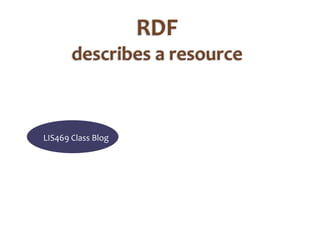
RDFdescribes a resourceLIS469 Class Blog
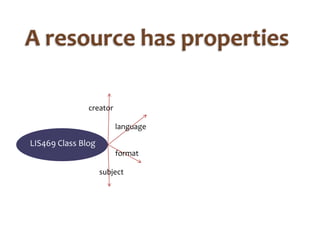
A resource has propertiescreatorlanguageLIS469 Class Blogformatsubject
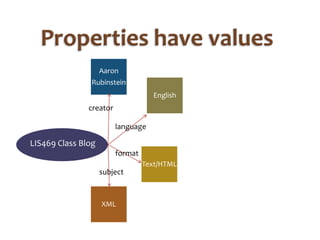
Properties have valuescreatorlanguageLIS469 Class Blogformatsubject
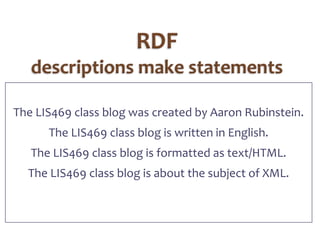
RDFdescriptions make statementsThe LIS469 class blog was created by Aaron Rubinstein.The LIS469 class blog is written in English.The LIS469 class blog is formatted as text/HTML.The LIS469 class blog is about the subject of XML.
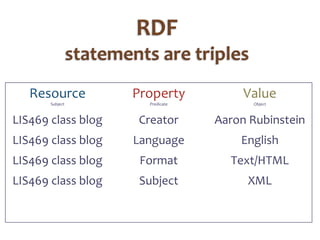
RDFstatements are triplesResourceSubjectLIS469 class blogLIS469 class blogLIS469 class blogLIS469 class blogPropertyPredicateCreatorLanguageFormatSubjectValueObjectAaron RubinsteinEnglishText/HTMLXML
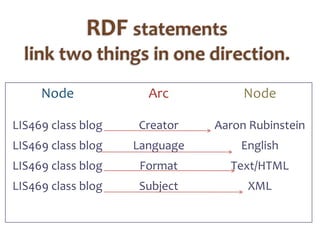
RDF statements link two things in one direction.NodeLIS469 class blogLIS469 class blogLIS469 class blogLIS469 class blogArcCreatorLanguageFormatSubjectNodeAaron RubinsteinEnglishText/HTMLXML
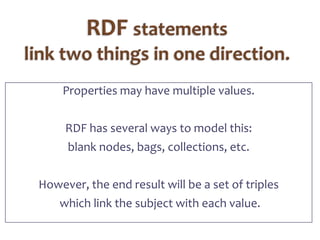
RDF statements link two things in one direction.Properties may have multiple values.RDF has several ways to model this:blank nodes, bags, collections, etc.However, the end result will be a set of triples which link the subject with each value.
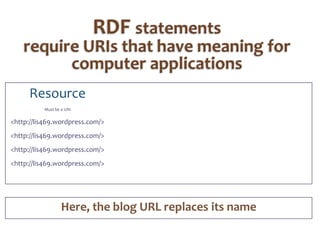
RDF statements require URIs that have meaning for computer applicationsResourceMust be a URI<http://lis469.wordpress.com/><http://lis469.wordpress.com/><http://lis469.wordpress.com/><http://lis469.wordpress.com/>Here, the blog URL replaces its name
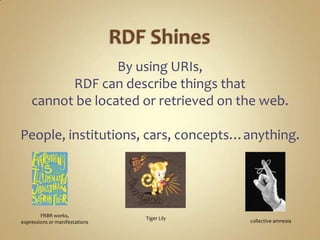
RDF ShinesBy using URIs, RDF can describe things that cannot be located or retrieved on the web.People, institutions, cars, concepts…anything.FRBR works, expressions or manifestationsTiger Lilycollective amnesia
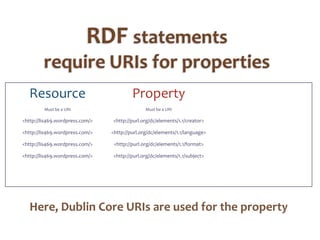
RDF statements require URIs for propertiesResourceMust be a URI<http://lis469.wordpress.com/><http://lis469.wordpress.com/><http://lis469.wordpress.com/><http://lis469.wordpress.com/>PropertyMust be a URI<http://purl.org/dc/elements/1.1/creator><http://purl.org/dc/elements/1.1/language><http://purl.org/dc/elements/1.1/format><http://purl.org/dc/elements/1.1/subject>Here, Dublin Core URIs are used for the property
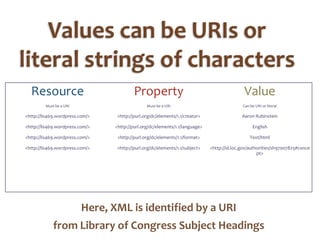
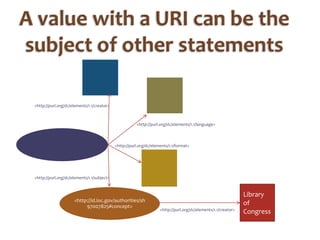
Values can be URIs or literal strings of charactersResourceMust be a URI<http://lis469.wordpress.com/><http://lis469.wordpress.com/><http://lis469.wordpress.com/><http://lis469.wordpress.com/>PropertyMust be a URI<http://purl.org/dc/elements/1.1/creator><http://purl.org/dc/elements/1.1/language><http://purl.org/dc/elements/1.1/format><http://purl.org/dc/elements/1.1/subject>ValueCan be URI or literalAaron RubinsteinEnglishText/html<http://id.loc.gov/authorities/sh97007825#concept>Here, XML is identified by a URI from Library of Congress Subject Headings
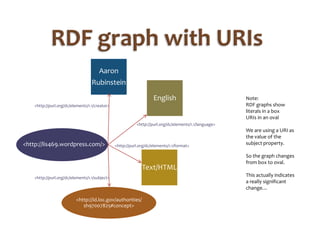
RDF graph with URIsNote:RDF graphs showliterals in a boxURIs in an ovalWe are using a URI as the value of the subject property.So the graph changes from box to oval.This actually indicates a really significant change…<http://purl.org/dc/elements/1.1/creator><http://purl.org/dc/elements/1.1/language><http://lis469.wordpress.com/><http://purl.org/dc/elements/1.1/format><http://purl.org/dc/elements/1.1/subject>
A value with a URI can be the subject of other statements<http://purl.org/dc/elements/1.1/creator><http://purl.org/dc/elements/1.1/language><http://purl.org/dc/elements/1.1/format><http://purl.org/dc/elements/1.1/subject>Library ofCongress<http://purl.org/dc/elements/1.1/creator>
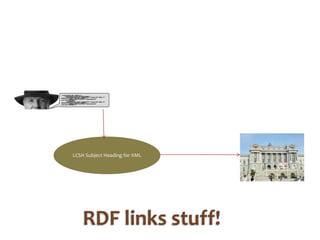
RDF links stuff!
RDF shinesIt is easy to work across different data sources, types and formats.RDF can link things by tapping massive databases of RDF statements called "triplestores."There are more than 27 billion triples stored now.
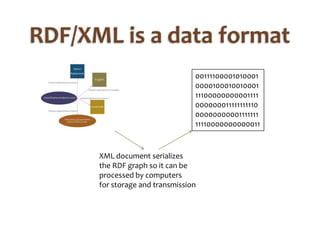
RDF/XML is a data format001111000010100010000100010010001111000000000011110000000111111111100000000000111111111110000000000011XML document serializes the RDF graph so it can beprocessed by computersfor storage and transmission
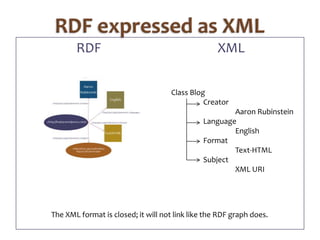
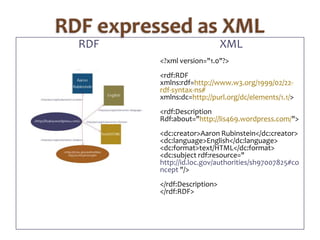
RDF expressed as XMLRDFXMLClass BlogCreator	Aaron RubinsteinLanguage	EnglishFormat	Text-HTMLSubject	XML URIThe XML format is closed; it will not link like the RDF graph does.
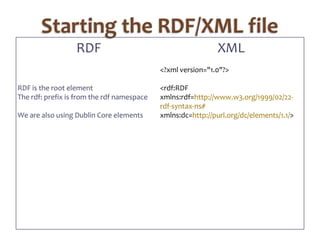
Starting the RDF/XML fileRDFRDF is the root elementThe rdf: prefix is from the rdf namespaceWe are also using Dublin Core elementsXML<?xml version="1.0"?><rdf:RDFxmlns:rdf=http://www.w3.org/1999/02/22-rdf-syntax-ns#xmlns:dc=http://purl.org/dc/elements/1.1/>
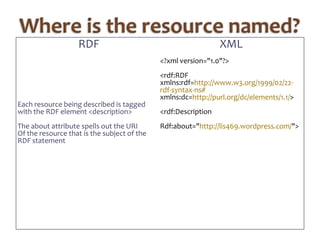
Where is the resource named?RDFEach resource being described is tagged with the RDF element <description>The about attribute spells out the URIOf the resource that is the subject of the RDF statementXML<?xml version="1.0"?><rdf:RDFxmlns:rdf=http://www.w3.org/1999/02/22-rdf-syntax-ns#xmlns:dc=http://purl.org/dc/elements/1.1/><rdf:DescriptionRdf:about="http://lis469.wordpress.com/">
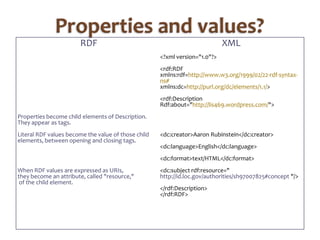
Properties and values?RDFProperties become child elements of Description.They appear as tags.Literal RDF values become the value of those child elements, between opening and closing tags.When RDF values are expressed as URIs, they become an attribute, called "resource," of the child element.XML<?xml version="1.0"?><rdf:RDFxmlns:rdf=http://www.w3.org/1999/02/22-rdf-syntax-ns#xmlns:dc=http://purl.org/dc/elements/1.1/><rdf:DescriptionRdf:about="http://lis469.wordpress.com/"><dc:creator>Aaron Rubinstein</dc:creator><dc:language>English</dc:language><dc:format>text/HTML</dc:format><dc:subjectrdf:resource=" http://id.loc.gov/authorities/sh97007825#concept "/></rdf:Description></rdf:RDF>
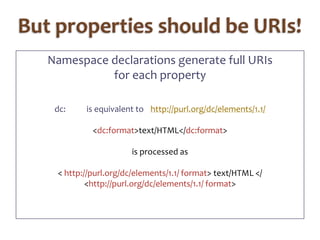
But properties should be URIs!Namespace declarations generate full URIs for each propertydc: 	is equivalent to 	http://purl.org/dc/elements/1.1/<dc:format>text/HTML</dc:format>is processed as<http://purl.org/dc/elements/1.1/ format> text/HTML </ <http://purl.org/dc/elements/1.1/ format>
RDF expressed as XMLRDFXML<?xml version="1.0"?><rdf:RDFxmlns:rdf=http://www.w3.org/1999/02/22-rdf-syntax-ns#xmlns:dc=http://purl.org/dc/elements/1.1/><rdf:DescriptionRdf:about="http://lis469.wordpress.com/"><dc:creator>Aaron Rubinstein</dc:creator><dc:language>English</dc:language><dc:format>text/HTML</dc:format><dc:subjectrdf:resource=" http://id.loc.gov/authorities/sh97007825#concept "/></rdf:Description></rdf:RDF>
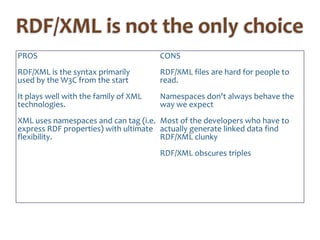
RDF/XML is not the only choicePROSRDF/XML is the syntax primarily used by the W3C from the startIt plays well with the family of XML technologies.XML uses namespaces and can tag (i.e. express RDF properties) with ultimate flexibility.CONSRDF/XML files are hard for people to read.Namespaces don't always behave the way we expectMost of the developers who have to actually generate linked data find RDF/XML clunky	RDF/XML obscures triples
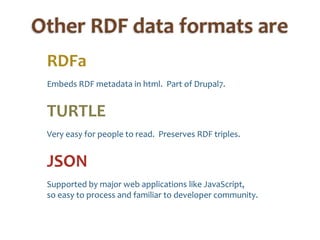
Other RDF data formats areRDFaEmbeds RDF metadata in html.  Part of Drupal7.TURTLEVery easy for people to read.  Preserves RDF triples.JSONSupported by major web applications like JavaScript,so easy to process and familiar to developer community.
You should knowW3C is overhauling its RDF recommendationshttp://www.w3.org/2011/01/rdf-wg-charterYou can create your own personal URIhttp://www.foaf-project.org/For a great overview, skim the new e-bookLinked Data: Evolving the Web into a Global Data Spacehttp://linkeddatabook.com/editions/1.0DBPedia is the hub of RDF-linked datahttp://dbpedia.org/About
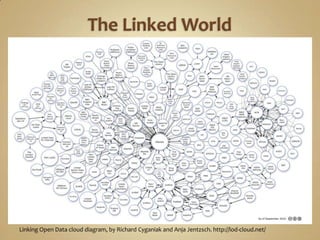
The Linked WorldLinking Open Data cloud diagram, by Richard Cyganiak and AnjaJentzsch. http://lod-cloud.net/

469 talk

  • 1.
    RDF/XMLA brief introductionAlisonHunt March 26, 2011for LIS469 XML
  • 2.
    RDF/XML is adata formatIt represents information for a data model called RDF
  • 3.
    RDFResource Description Frameworkisa data modelIt structures metadata forthe Semantic Web andthe RDA content standard(resource description and access)
  • 4.
  • 5.
    A resource haspropertiescreatorlanguageLIS469 Class Blogformatsubject
  • 6.
  • 7.
    RDFdescriptions make statementsTheLIS469 class blog was created by Aaron Rubinstein.The LIS469 class blog is written in English.The LIS469 class blog is formatted as text/HTML.The LIS469 class blog is about the subject of XML.
  • 8.
    RDFstatements are triplesResourceSubjectLIS469class blogLIS469 class blogLIS469 class blogLIS469 class blogPropertyPredicateCreatorLanguageFormatSubjectValueObjectAaron RubinsteinEnglishText/HTMLXML
  • 9.
    RDF statements linktwo things in one direction.NodeLIS469 class blogLIS469 class blogLIS469 class blogLIS469 class blogArcCreatorLanguageFormatSubjectNodeAaron RubinsteinEnglishText/HTMLXML
  • 10.
    RDF statements linktwo things in one direction.Properties may have multiple values.RDF has several ways to model this:blank nodes, bags, collections, etc.However, the end result will be a set of triples which link the subject with each value.
  • 11.
    RDF statements requireURIs that have meaning for computer applicationsResourceMust be a URI<http://lis469.wordpress.com/><http://lis469.wordpress.com/><http://lis469.wordpress.com/><http://lis469.wordpress.com/>Here, the blog URL replaces its name
  • 12.
    RDF ShinesBy usingURIs, RDF can describe things that cannot be located or retrieved on the web.People, institutions, cars, concepts…anything.FRBR works, expressions or manifestationsTiger Lilycollective amnesia
  • 13.
    RDF statements requireURIs for propertiesResourceMust be a URI<http://lis469.wordpress.com/><http://lis469.wordpress.com/><http://lis469.wordpress.com/><http://lis469.wordpress.com/>PropertyMust be a URI<http://purl.org/dc/elements/1.1/creator><http://purl.org/dc/elements/1.1/language><http://purl.org/dc/elements/1.1/format><http://purl.org/dc/elements/1.1/subject>Here, Dublin Core URIs are used for the property
  • 14.
    Values can beURIs or literal strings of charactersResourceMust be a URI<http://lis469.wordpress.com/><http://lis469.wordpress.com/><http://lis469.wordpress.com/><http://lis469.wordpress.com/>PropertyMust be a URI<http://purl.org/dc/elements/1.1/creator><http://purl.org/dc/elements/1.1/language><http://purl.org/dc/elements/1.1/format><http://purl.org/dc/elements/1.1/subject>ValueCan be URI or literalAaron RubinsteinEnglishText/html<http://id.loc.gov/authorities/sh97007825#concept>Here, XML is identified by a URI from Library of Congress Subject Headings
  • 15.
    RDF graph withURIsNote:RDF graphs showliterals in a boxURIs in an ovalWe are using a URI as the value of the subject property.So the graph changes from box to oval.This actually indicates a really significant change…<http://purl.org/dc/elements/1.1/creator><http://purl.org/dc/elements/1.1/language><http://lis469.wordpress.com/><http://purl.org/dc/elements/1.1/format><http://purl.org/dc/elements/1.1/subject>
  • 16.
    A value witha URI can be the subject of other statements<http://purl.org/dc/elements/1.1/creator><http://purl.org/dc/elements/1.1/language><http://purl.org/dc/elements/1.1/format><http://purl.org/dc/elements/1.1/subject>Library ofCongress<http://purl.org/dc/elements/1.1/creator>
  • 17.
  • 18.
    RDF shinesIt iseasy to work across different data sources, types and formats.RDF can link things by tapping massive databases of RDF statements called "triplestores."There are more than 27 billion triples stored now.
  • 19.
    RDF/XML is adata format001111000010100010000100010010001111000000000011110000000111111111100000000000111111111110000000000011XML document serializes the RDF graph so it can beprocessed by computersfor storage and transmission
  • 20.
    RDF expressed asXMLRDFXMLClass BlogCreator Aaron RubinsteinLanguage EnglishFormat Text-HTMLSubject XML URIThe XML format is closed; it will not link like the RDF graph does.
  • 21.
    Starting the RDF/XMLfileRDFRDF is the root elementThe rdf: prefix is from the rdf namespaceWe are also using Dublin Core elementsXML<?xml version="1.0"?><rdf:RDFxmlns:rdf=http://www.w3.org/1999/02/22-rdf-syntax-ns#xmlns:dc=http://purl.org/dc/elements/1.1/>
  • 22.
    Where is theresource named?RDFEach resource being described is tagged with the RDF element <description>The about attribute spells out the URIOf the resource that is the subject of the RDF statementXML<?xml version="1.0"?><rdf:RDFxmlns:rdf=http://www.w3.org/1999/02/22-rdf-syntax-ns#xmlns:dc=http://purl.org/dc/elements/1.1/><rdf:DescriptionRdf:about="http://lis469.wordpress.com/">
  • 23.
    Properties and values?RDFPropertiesbecome child elements of Description.They appear as tags.Literal RDF values become the value of those child elements, between opening and closing tags.When RDF values are expressed as URIs, they become an attribute, called "resource," of the child element.XML<?xml version="1.0"?><rdf:RDFxmlns:rdf=http://www.w3.org/1999/02/22-rdf-syntax-ns#xmlns:dc=http://purl.org/dc/elements/1.1/><rdf:DescriptionRdf:about="http://lis469.wordpress.com/"><dc:creator>Aaron Rubinstein</dc:creator><dc:language>English</dc:language><dc:format>text/HTML</dc:format><dc:subjectrdf:resource=" http://id.loc.gov/authorities/sh97007825#concept "/></rdf:Description></rdf:RDF>
  • 24.
    But properties shouldbe URIs!Namespace declarations generate full URIs for each propertydc: is equivalent to http://purl.org/dc/elements/1.1/<dc:format>text/HTML</dc:format>is processed as<http://purl.org/dc/elements/1.1/ format> text/HTML </ <http://purl.org/dc/elements/1.1/ format>
  • 25.
    RDF expressed asXMLRDFXML<?xml version="1.0"?><rdf:RDFxmlns:rdf=http://www.w3.org/1999/02/22-rdf-syntax-ns#xmlns:dc=http://purl.org/dc/elements/1.1/><rdf:DescriptionRdf:about="http://lis469.wordpress.com/"><dc:creator>Aaron Rubinstein</dc:creator><dc:language>English</dc:language><dc:format>text/HTML</dc:format><dc:subjectrdf:resource=" http://id.loc.gov/authorities/sh97007825#concept "/></rdf:Description></rdf:RDF>
  • 26.
    RDF/XML is notthe only choicePROSRDF/XML is the syntax primarily used by the W3C from the startIt plays well with the family of XML technologies.XML uses namespaces and can tag (i.e. express RDF properties) with ultimate flexibility.CONSRDF/XML files are hard for people to read.Namespaces don't always behave the way we expectMost of the developers who have to actually generate linked data find RDF/XML clunky RDF/XML obscures triples
  • 27.
    Other RDF dataformats areRDFaEmbeds RDF metadata in html. Part of Drupal7.TURTLEVery easy for people to read. Preserves RDF triples.JSONSupported by major web applications like JavaScript,so easy to process and familiar to developer community.
  • 28.
    You should knowW3Cis overhauling its RDF recommendationshttp://www.w3.org/2011/01/rdf-wg-charterYou can create your own personal URIhttp://www.foaf-project.org/For a great overview, skim the new e-bookLinked Data: Evolving the Web into a Global Data Spacehttp://linkeddatabook.com/editions/1.0DBPedia is the hub of RDF-linked datahttp://dbpedia.org/About
  • 29.
    The Linked WorldLinkingOpen Data cloud diagram, by Richard Cyganiak and AnjaJentzsch. http://lod-cloud.net/