by Rafael
Rodríguez
Pérez
PRESENTATION without answers
1
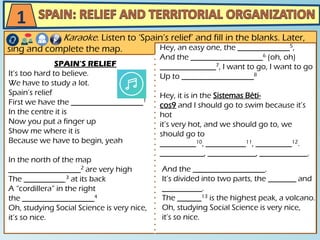
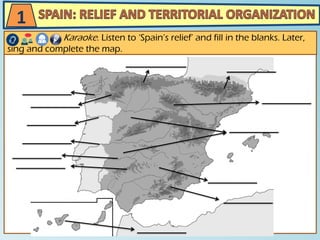
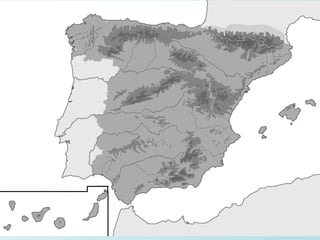
Karaoke. Listen to ‘Spain’s relief’ and fill in the blanks. Later,
sing and complete the map.
SPAIN’S RELIEF
It’s too hard to believe.
We have to study a lot.
Spain’s relief
First we have the __________________1
In the centre it is
Now you put a finger up
Show me where it is
Because we have to begin, yeah
In the north of the map
__________________2 are very high
The __________ 3 at its back
A “cordillera” in the right
the __________________4
Oh, studying Social Science is very nice,
it’s so nice.
Hey, an easy one, the _____________5,
And the __________________6 (oh, oh)
______________7, I want to go, I want to go
Up to __________________8
Hey, it is in the Sistemas Béti-
cos9 and I should go to swim because it’s
hot
it’s very hot, and we should go to, we
should go to
_________10, __________11, _________12.
___________, ____________, ____________.
And the __________________.
It’s divided into two parts, the _______ and
__________.
The ______13 is the highest peak, a volcano.
Oh, studying Social Science is very nice,
it’s so nice.
1
Karaoke. Listen to ‘Spain’s relief’ and fill in the blanks. Later,
sing and complete the map.
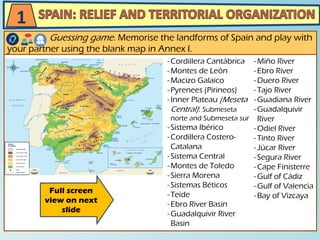
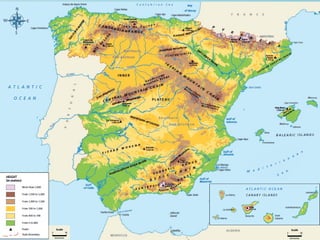
Guessing game. Memorise the landforms of Spain and play with
your partner using the blank map in Annex I.
1
Full screen
view on next
slide
- Cordillera Cantábrica
- Montes de León
- Macizo Galaico
- Pyrenees (Pirineos)
- Inner Plateau (Meseta
Central): Submeseta
norte and Submeseta sur
- Sistema Ibérico
- Cordillera Costero-
Catalana
- Sistema Central
- Montes de Toledo
- Sierra Morena
- Sistemas Béticos
- Teide
- Ebro River Basin
- Guadalquivir River
Basin
- Miño River
- Ebro River
- Duero River
- Tajo River
- Guadiana River
- Guadalquivir
River
- Odiel River
- Tinto River
- Júcar River
- Segura River
- Cape Finisterre
- Gulf of Cádiz
- Gulf of Valencia
- Bay of Vizcaya
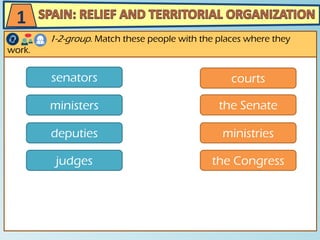
1-2-group. Match these people with the places where they
work.
1
senators
the Senate
deputies
ministers
judges
courts
the Congress
ministries
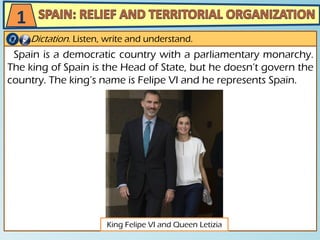
Spain is a democratic country with a parliamentary monarchy.
The king of Spain is the Head of State, but he doesn’t govern the
country. The king’s name is Felipe VI and he represents Spain.
Dictation. Listen, write and understand.
1
King Felipe VI and Queen Letizia
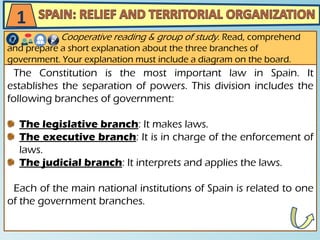
The Constitution is the most important law in Spain. It
establishes the separation of powers. This division includes the
following branches of government:
The legislative branch: It makes laws.
The executive branch: It is in charge of the enforcement of
laws.
The judicial branch: It interprets and applies the laws.
Each of the main national institutions of Spain is related to one
of the government branches.
Cooperative reading & group of study. Read, comprehend
and prepare a short explanation about the three branches of
government. Your explanation must include a diagram on the board.
1
Cooperative reading & group of study. Read, comprehend
and prepare a short explanation about the three branches of
government. Your explanation must include a diagram on the board.
1
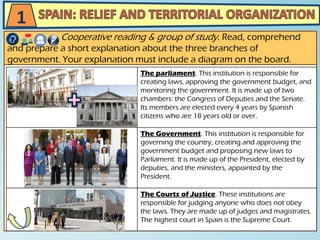
The parliament. This institution is responsible for
creating laws, approving the government budget, and
monitoring the government. It is made up of two
chambers: the Congress of Deputies and the Senate.
Its members are elected every 4 years by Spanish
citizens who are 18 years old or over.
The Government. This institution is responsible for
governing the country, creating and approving the
government budget and proposing new laws to
Parliament. It is made up of the President, elected by
deputies, and the ministers, appointed by the
President.
The Courts of Justice. These institutions are
responsible for judging anyone who does not obey
the laws. They are made up of judges and magistrates.
The highest court in Spain is the Supreme Court.
OPTION 1: I prefer a single institution having all the power
because…
OPTION 2: I think that power should be divided in more than
one institution because…
Debate. Are you for or against a single government institution
having all the power?
1
The Constitution of 1978 establishes that Spain is organized into municipalities,
provinces, autonomous communities and two autonomous cities.
Municipalities. A municipality is the smallest territorial and administrative division.
It is governed by a city hall, which consists of a mayor and local councillors.
Provinces. A province is made up of several municipalities. There are 50 provinces
in Spain. Most provinces have their own government, a Provincial government
(Diputación).
Autonomous communities and cities. Spain is organized into 17 autonomous
communities and 2 autonomous cities, Ceuta and Melilla. Each autonomous
community has a Statute of Autonomy. This law includes its institutions, such as the
Autonomous Parliament and Government, and the areas it can make decisions in,
such as education and health care.
1. Name two autonomous communities that are not located in the Iberian
Peninsula.
2. Name the two autonomous cities.
3. Name two autonomous communities with just one province.
4. What is Andalucía?
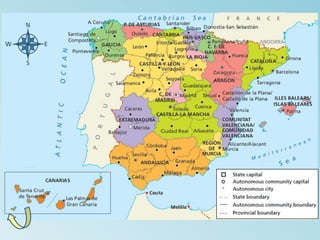
Pencils in the centre. Look at the map, read and answer.
1
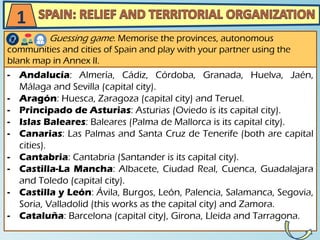
- Andalucía: Almería, Cádiz, Córdoba, Granada, Huelva, Jaén,
Málaga and Sevilla (capital city).
- Aragón: Huesca, Zaragoza (capital city) and Teruel.
- Principado de Asturias: Asturias (Oviedo is its capital city).
- Islas Baleares: Baleares (Palma de Mallorca is its capital city).
- Canarias: Las Palmas and Santa Cruz de Tenerife (both are capital
cities).
- Cantabria: Cantabria (Santander is its capital city).
- Castilla-La Mancha: Albacete, Ciudad Real, Cuenca, Guadalajara
and Toledo (capital city).
- Castilla y León: Ávila, Burgos, León, Palencia, Salamanca, Segovia,
Soria, Valladolid (this works as the capital city) and Zamora.
- Cataluña: Barcelona (capital city), Girona, Lleida and Tarragona.
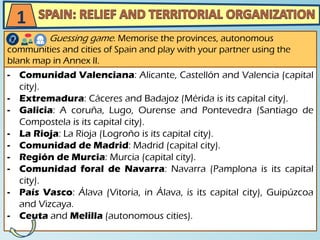
Guessing game. Memorise the provinces, autonomous
communities and cities of Spain and play with your partner using the
blank map in Annex II.
1
- Comunidad Valenciana: Alicante, Castellón and Valencia (capital
city).
- Extremadura: Cáceres and Badajoz (Mérida is its capital city).
- Galicia: A coruña, Lugo, Ourense and Pontevedra (Santiago de
Compostela is its capital city).
- La Rioja: La Rioja (Logroño is its capital city).
- Comunidad de Madrid: Madrid (capital city).
- Región de Murcia: Murcia (capital city).
- Comunidad foral de Navarra: Navarra (Pamplona is its capital
city).
- País Vasco: Álava (Vitoria, in Álava, is its capital city), Guipúzcoa
and Vizcaya.
- Ceuta and Melilla (autonomous cities).
Guessing game. Memorise the provinces, autonomous
communities and cities of Spain and play with your partner using the
blank map in Annex II.
1
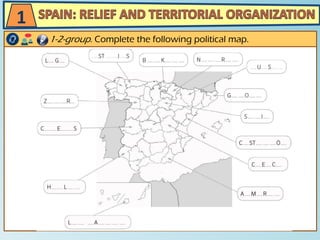
1-2-group. Complete the following political map.
1
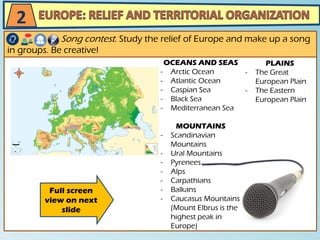
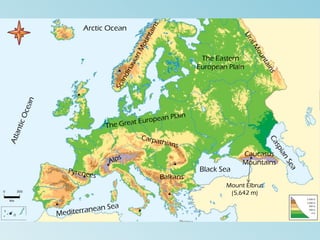
Song contest. Study the relief of Europe and make up a song
in groups. Be creative!
2
Full screen
view on next
slide
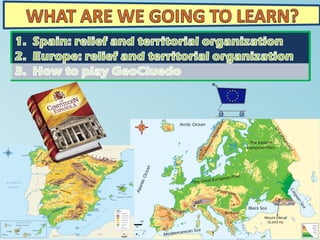
OCEANS AND SEAS
- Arctic Ocean
- Atlantic Ocean
- Caspian Sea
- Black Sea
- Mediterranean Sea
MOUNTAINS
- Scandinavian
Mountains
- Ural Mountains
- Pyrenees
- Alps
- Carpathians
- Balkans
- Caucasus Mountains
(Mount Elbrus is the
highest peak in
Europe)
PLAINS
- The Great
European Plain
- The Eastern
European Plain
Arctic Ocean
Black Sea
Balkans
Caucasus
Mountains
Mount Elbrus
(5,642 m)
The Eastern
European Plain
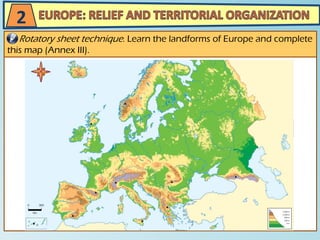
Rotatory sheet technique. Learn the landforms of Europe and complete
this map (Annex III).
2
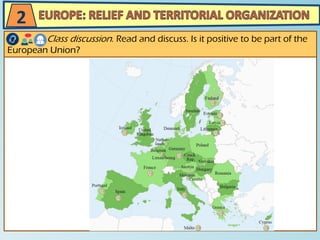
The European Union (EU) is an economic and political organization
formed by 28 democratic European countries, although the United
Kingdom is about to leave.
The formation of the EU started about sixty years ago:
- In 1967, Germany, Italy, Belgium, the Netherlands, Luxembourg
and France signed the Treaty of Rome and established the
European Economic Community (EEC). A common market was
created to make trade easier among these countries.
- In 1992, the members of the European Economic Community
signed the Treaty of Maastricht, and the EEC became the European
Union (EU).
- In 2009, the Treaty of Lisbon was signed. This treaty amended the
two previous treaties of the EU.
Class discussion. Read and discuss. Is it positive to be part of the
European Union?
2
The EU has promoted democracy and unity among the European
people, supported economic development and improved living
conditions of its citizens.
- At a political level, citizens of the EU have European citizenship,
which means they can live, study or work in any of the EU
countries.
- At an economic level, the common market means that products
from the EU can be sold in any EU country. In addition, countries in
the eurozone have the euro as their official currency.
- At a social level, the EU promotes equality between men and
women, consumer protection and student exchanges among
countries in the EU.
Class discussion. Read and discuss. Is it positive to be part of the
European Union?
2
Class discussion. Read and discuss. Is it positive to be part of the
European Union?
2
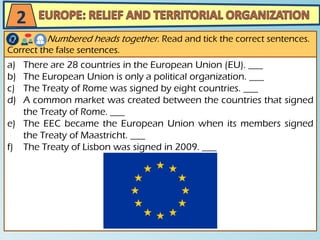
a) There are 28 countries in the European Union (EU). ___
b) The European Union is only a political organization. ___
c) The Treaty of Rome was signed by eight countries. ___
d) A common market was created between the countries that signed
the Treaty of Rome. ___
e) The EEC became the European Union when its members signed
the Treaty of Maastricht. ___
f) The Treaty of Lisbon was signed in 2009. ___
Numbered heads together. Read and tick the correct sentences.
Correct the false sentences.
2
Play and learn.
3
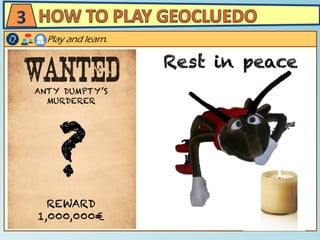
ANTY DUMPTY’S
MURDERER
REWARD
1,000,000€
Play and learn.
3
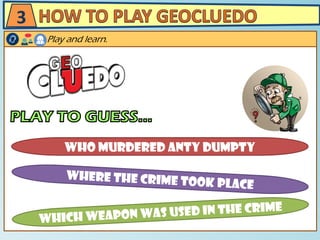
WHO murdered ANTY Dumpty
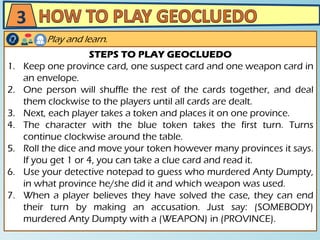
STEPS TO PLAY GEOCLUEDO
1. Keep one province card, one suspect card and one weapon card in
an envelope.
2. One person will shuffle the rest of the cards together, and deal
them clockwise to the players until all cards are dealt.
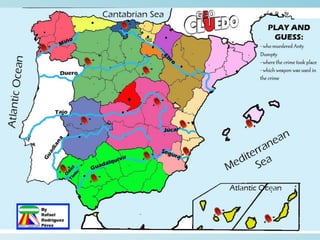
3. Next, each player takes a token and places it on one province.
4. The character with the blue token takes the first turn. Turns
continue clockwise around the table.
5. Roll the dice and move your token however many provinces it says.
If you get 1 or 4, you can take a clue card and read it.
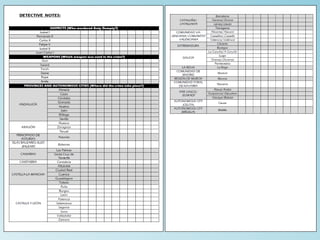
6. Use your detective notepad to guess who murdered Anty Dumpty,
in what province he/she did it and which weapon was used.
7. When a player believes they have solved the case, they can end
their turn by making an accusation. Just say: (SOMEBODY)
murdered Anty Dumpty with a (WEAPON) in (PROVINCE).
Play and learn.
3
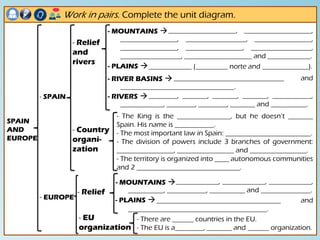
Work in pairs. Complete the unit diagram.
SPAIN
AND
EUROPE
- SPAIN
- EUROPE
- MOUNTAINS 
- PLAINS 
- RIVER BASINS 
- RIVERS 
___________________, ___________________,
________________, _________________, ________________,
________________, ________________, _________________,
_________________, ___________________ and ____________.
____________ (_________ norte and _____________).
_______________________________ and
________________________________.
________, _______, _______, _______, ___________,
____________, ________, ________, _______ and __________.
- Relief
and
rivers
- Country
organi-
zation
- The King is the _______________, but he doesn’t _______
Spain. His name is ___________.
- The most important law in Spain: ________________________.
- The division of powers include 3 branches of government:
________________, ________________ and ________________.
- The territory is organized into ____ autonomous communities
and 2 _____________________________.
- MOUNTAINS ____________, ____________, ____________,
__________, ___________, __________ and ______________.- Relief
- PLAINS ___________________________________ and
_______________________________________.
- EU
organization
- There are ______ countries in the EU.
- The EU is a________, _______ and ______ organization.
Presentation - Spain and Europe

Presentation - Spain and Europe

  • 1.
  • 4.
    1 Karaoke. Listen to‘Spain’s relief’ and fill in the blanks. Later, sing and complete the map. SPAIN’S RELIEF It’s too hard to believe. We have to study a lot. Spain’s relief First we have the __________________1 In the centre it is Now you put a finger up Show me where it is Because we have to begin, yeah In the north of the map __________________2 are very high The __________ 3 at its back A “cordillera” in the right the __________________4 Oh, studying Social Science is very nice, it’s so nice. Hey, an easy one, the _____________5, And the __________________6 (oh, oh) ______________7, I want to go, I want to go Up to __________________8 Hey, it is in the Sistemas Béti- cos9 and I should go to swim because it’s hot it’s very hot, and we should go to, we should go to _________10, __________11, _________12. ___________, ____________, ____________. And the __________________. It’s divided into two parts, the _______ and __________. The ______13 is the highest peak, a volcano. Oh, studying Social Science is very nice, it’s so nice.
  • 5.
    1 Karaoke. Listen to‘Spain’s relief’ and fill in the blanks. Later, sing and complete the map.
  • 6.
    Guessing game. Memorisethe landforms of Spain and play with your partner using the blank map in Annex I. 1 Full screen view on next slide - Cordillera Cantábrica - Montes de León - Macizo Galaico - Pyrenees (Pirineos) - Inner Plateau (Meseta Central): Submeseta norte and Submeseta sur - Sistema Ibérico - Cordillera Costero- Catalana - Sistema Central - Montes de Toledo - Sierra Morena - Sistemas Béticos - Teide - Ebro River Basin - Guadalquivir River Basin - Miño River - Ebro River - Duero River - Tajo River - Guadiana River - Guadalquivir River - Odiel River - Tinto River - Júcar River - Segura River - Cape Finisterre - Gulf of Cádiz - Gulf of Valencia - Bay of Vizcaya
  • 9.
    1-2-group. Match thesepeople with the places where they work. 1 senators the Senate deputies ministers judges courts the Congress ministries
  • 10.
    Spain is ademocratic country with a parliamentary monarchy. The king of Spain is the Head of State, but he doesn’t govern the country. The king’s name is Felipe VI and he represents Spain. Dictation. Listen, write and understand. 1 King Felipe VI and Queen Letizia
  • 11.
    The Constitution isthe most important law in Spain. It establishes the separation of powers. This division includes the following branches of government: The legislative branch: It makes laws. The executive branch: It is in charge of the enforcement of laws. The judicial branch: It interprets and applies the laws. Each of the main national institutions of Spain is related to one of the government branches. Cooperative reading & group of study. Read, comprehend and prepare a short explanation about the three branches of government. Your explanation must include a diagram on the board. 1
  • 12.
    Cooperative reading &group of study. Read, comprehend and prepare a short explanation about the three branches of government. Your explanation must include a diagram on the board. 1 The parliament. This institution is responsible for creating laws, approving the government budget, and monitoring the government. It is made up of two chambers: the Congress of Deputies and the Senate. Its members are elected every 4 years by Spanish citizens who are 18 years old or over. The Government. This institution is responsible for governing the country, creating and approving the government budget and proposing new laws to Parliament. It is made up of the President, elected by deputies, and the ministers, appointed by the President. The Courts of Justice. These institutions are responsible for judging anyone who does not obey the laws. They are made up of judges and magistrates. The highest court in Spain is the Supreme Court.
  • 13.
    OPTION 1: Iprefer a single institution having all the power because… OPTION 2: I think that power should be divided in more than one institution because… Debate. Are you for or against a single government institution having all the power? 1
  • 14.
    The Constitution of1978 establishes that Spain is organized into municipalities, provinces, autonomous communities and two autonomous cities. Municipalities. A municipality is the smallest territorial and administrative division. It is governed by a city hall, which consists of a mayor and local councillors. Provinces. A province is made up of several municipalities. There are 50 provinces in Spain. Most provinces have their own government, a Provincial government (Diputación). Autonomous communities and cities. Spain is organized into 17 autonomous communities and 2 autonomous cities, Ceuta and Melilla. Each autonomous community has a Statute of Autonomy. This law includes its institutions, such as the Autonomous Parliament and Government, and the areas it can make decisions in, such as education and health care. 1. Name two autonomous communities that are not located in the Iberian Peninsula. 2. Name the two autonomous cities. 3. Name two autonomous communities with just one province. 4. What is Andalucía? Pencils in the centre. Look at the map, read and answer. 1
  • 16.
    - Andalucía: Almería,Cádiz, Córdoba, Granada, Huelva, Jaén, Málaga and Sevilla (capital city). - Aragón: Huesca, Zaragoza (capital city) and Teruel. - Principado de Asturias: Asturias (Oviedo is its capital city). - Islas Baleares: Baleares (Palma de Mallorca is its capital city). - Canarias: Las Palmas and Santa Cruz de Tenerife (both are capital cities). - Cantabria: Cantabria (Santander is its capital city). - Castilla-La Mancha: Albacete, Ciudad Real, Cuenca, Guadalajara and Toledo (capital city). - Castilla y León: Ávila, Burgos, León, Palencia, Salamanca, Segovia, Soria, Valladolid (this works as the capital city) and Zamora. - Cataluña: Barcelona (capital city), Girona, Lleida and Tarragona. Guessing game. Memorise the provinces, autonomous communities and cities of Spain and play with your partner using the blank map in Annex II. 1
  • 17.
    - Comunidad Valenciana:Alicante, Castellón and Valencia (capital city). - Extremadura: Cáceres and Badajoz (Mérida is its capital city). - Galicia: A coruña, Lugo, Ourense and Pontevedra (Santiago de Compostela is its capital city). - La Rioja: La Rioja (Logroño is its capital city). - Comunidad de Madrid: Madrid (capital city). - Región de Murcia: Murcia (capital city). - Comunidad foral de Navarra: Navarra (Pamplona is its capital city). - País Vasco: Álava (Vitoria, in Álava, is its capital city), Guipúzcoa and Vizcaya. - Ceuta and Melilla (autonomous cities). Guessing game. Memorise the provinces, autonomous communities and cities of Spain and play with your partner using the blank map in Annex II. 1
  • 18.
    1-2-group. Complete thefollowing political map. 1
  • 20.
    Song contest. Studythe relief of Europe and make up a song in groups. Be creative! 2 Full screen view on next slide OCEANS AND SEAS - Arctic Ocean - Atlantic Ocean - Caspian Sea - Black Sea - Mediterranean Sea MOUNTAINS - Scandinavian Mountains - Ural Mountains - Pyrenees - Alps - Carpathians - Balkans - Caucasus Mountains (Mount Elbrus is the highest peak in Europe) PLAINS - The Great European Plain - The Eastern European Plain
  • 21.
    Arctic Ocean Black Sea Balkans Caucasus Mountains MountElbrus (5,642 m) The Eastern European Plain
  • 22.
    Rotatory sheet technique.Learn the landforms of Europe and complete this map (Annex III). 2
  • 23.
    The European Union(EU) is an economic and political organization formed by 28 democratic European countries, although the United Kingdom is about to leave. The formation of the EU started about sixty years ago: - In 1967, Germany, Italy, Belgium, the Netherlands, Luxembourg and France signed the Treaty of Rome and established the European Economic Community (EEC). A common market was created to make trade easier among these countries. - In 1992, the members of the European Economic Community signed the Treaty of Maastricht, and the EEC became the European Union (EU). - In 2009, the Treaty of Lisbon was signed. This treaty amended the two previous treaties of the EU. Class discussion. Read and discuss. Is it positive to be part of the European Union? 2
  • 24.
    The EU haspromoted democracy and unity among the European people, supported economic development and improved living conditions of its citizens. - At a political level, citizens of the EU have European citizenship, which means they can live, study or work in any of the EU countries. - At an economic level, the common market means that products from the EU can be sold in any EU country. In addition, countries in the eurozone have the euro as their official currency. - At a social level, the EU promotes equality between men and women, consumer protection and student exchanges among countries in the EU. Class discussion. Read and discuss. Is it positive to be part of the European Union? 2
  • 25.
    Class discussion. Readand discuss. Is it positive to be part of the European Union? 2
  • 26.
    a) There are28 countries in the European Union (EU). ___ b) The European Union is only a political organization. ___ c) The Treaty of Rome was signed by eight countries. ___ d) A common market was created between the countries that signed the Treaty of Rome. ___ e) The EEC became the European Union when its members signed the Treaty of Maastricht. ___ f) The Treaty of Lisbon was signed in 2009. ___ Numbered heads together. Read and tick the correct sentences. Correct the false sentences. 2
  • 28.
    Play and learn. 3 ANTYDUMPTY’S MURDERER REWARD 1,000,000€
  • 29.
    Play and learn. 3 WHOmurdered ANTY Dumpty
  • 30.
    STEPS TO PLAYGEOCLUEDO 1. Keep one province card, one suspect card and one weapon card in an envelope. 2. One person will shuffle the rest of the cards together, and deal them clockwise to the players until all cards are dealt. 3. Next, each player takes a token and places it on one province. 4. The character with the blue token takes the first turn. Turns continue clockwise around the table. 5. Roll the dice and move your token however many provinces it says. If you get 1 or 4, you can take a clue card and read it. 6. Use your detective notepad to guess who murdered Anty Dumpty, in what province he/she did it and which weapon was used. 7. When a player believes they have solved the case, they can end their turn by making an accusation. Just say: (SOMEBODY) murdered Anty Dumpty with a (WEAPON) in (PROVINCE). Play and learn. 3
  • 33.
    Work in pairs.Complete the unit diagram. SPAIN AND EUROPE - SPAIN - EUROPE - MOUNTAINS  - PLAINS  - RIVER BASINS  - RIVERS  ___________________, ___________________, ________________, _________________, ________________, ________________, ________________, _________________, _________________, ___________________ and ____________. ____________ (_________ norte and _____________). _______________________________ and ________________________________. ________, _______, _______, _______, ___________, ____________, ________, ________, _______ and __________. - Relief and rivers - Country organi- zation - The King is the _______________, but he doesn’t _______ Spain. His name is ___________. - The most important law in Spain: ________________________. - The division of powers include 3 branches of government: ________________, ________________ and ________________. - The territory is organized into ____ autonomous communities and 2 _____________________________. - MOUNTAINS ____________, ____________, ____________, __________, ___________, __________ and ______________.- Relief - PLAINS ___________________________________ and _______________________________________. - EU organization - There are ______ countries in the EU. - The EU is a________, _______ and ______ organization.