Let me take you to the word of FUTURE POWER
1
Wireless Power Transmission Via Solar
Power Satellite
Wireless Power Transmission
Via
Solar Power Satellite
Presenting by:
Jawad Usman
2
Wireless Power Transmission Via Solar Power Satellite
OUTLINE
Introduction
Working Of Wireless Power Transmission
System Design And Technologies
BASIC STRUCTURE OF SOLAR POWER SATELLITE
Advantages And Disadvantages
Future Aspects
Conclusions
3
Wireless Power Transmission Via Solar Power Satellite
More than 60 percent of energy is generated using coal-fired station
resulting in CO2 emission threatening the global warming.
Solar energy in space free from the weather conditions is quite
different from that on the earth.
The PV cells in the SPS produce 5 to 10 % times more power at space
than at ground.
INTRODUCTION
4
Wireless Power Transmission Via Solar
Power Satellite
Working of solar panel
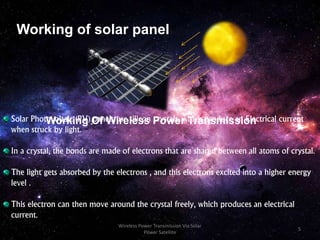
Working Of Wireless Power TransmissionSolar Photovoltaic (PV) panels use silicon crystals, which produce an Electrical current
when struck by light.
In a crystal, the bonds are made of electrons that are shared between all atoms of crystal.
The light gets absorbed by the electrons , and this electrons excited into a higher energy
level .
This electron can then move around the crystal freely, which produces an electrical
current.
5
Wireless Power Transmission Via Solar
Power Satellite
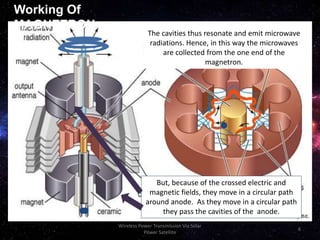
The liberated electrons will try to
move towards anode
But, because of the crossed electric and
magnetic fields, they move in a circular path
around anode. As they move in a circular path
they pass the cavities of the anode.
The cavities thus resonate and emit microwave
radiations. Hence, in this way the microwaves
are collected from the one end of the
magnetron.
Working Of
MAGNETRON
6
Wireless Power Transmission Via Solar
Power Satellite
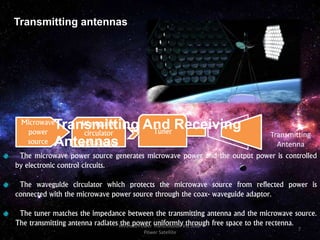
Transmitting antennas
The microwave power source generates microwave power and the output power is controlled
by electronic control circuits.
The waveguide circulator which protects the microwave source from reflected power is
connected with the microwave power source through the coax- waveguide adaptor.
The tuner matches the impedance between the transmitting antenna and the microwave source.
The transmitting antenna radiates the power uniformly through free space to the rectenna.
Microwave
power
source
Waveguide
circulator
and adaptor
Tuner Transmitting
Antenna
Transmitting And Receiving
Antennas
7
Wireless Power Transmission Via Solar
Power Satellite
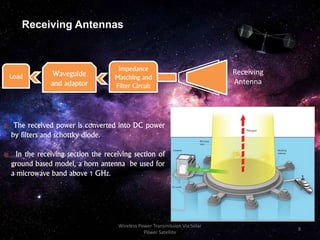
Receiving Antennas
The received power is converted into DC power
by filters and schottky diode.
In the receiving section the receiving section of
ground based model, a horn antenna be used for
a microwave band above 1 GHz.
Waveguide
and adaptor
Impedance
Matching and
Filter Circuit
Receiving
Antenna
Load
8
Wireless Power Transmission Via Solar
Power Satellite
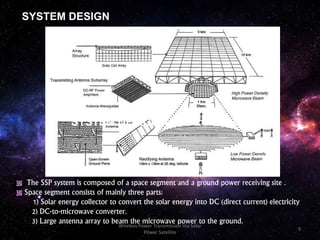
SYSTEM DESIGN
The SSP system is composed of a space segment and a ground power receiving site .
Space segment consists of mainly three parts:
1) Solar energy collector to convert the solar energy into DC (direct current) electricity
2) DC-to-microwave converter.
3) Large antenna array to beam the microwave power to the ground.
SYSTEM DESIGN AND TECHNOLOGIES
9
Wireless Power Transmission Via Solar
Power Satellite
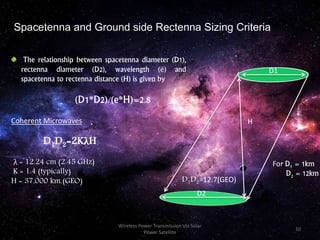
Spacetenna and Ground side Rectenna Sizing Criteria
The relationship between spacetenna diameter (D1),
rectenna diameter (D2), wavelength (ë) and
spacetenna to rectenna distance (H) is given by
(D1*D2)/(e*H)=2.8
Coherent Microwaves
D1D2=2KλH
λ = 12.24 cm (2.45 GHz)
K = 1.4 (typically)
H = 37,000 km (GEO)
D1
D2
H
For D1 = 1km
D2 = 12km
D1D2=12.7(GEO)
10
Wireless Power Transmission Via Solar
Power Satellite
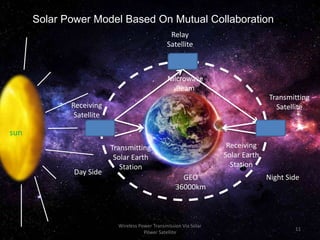
sun
Receiving
Satellite
Day Side
Relay
Satellite
Transmitting
Satellite
Night Side
Receiving
Solar Earth
Station
Transmitting
Solar Earth
Station
Microwave
Beam
GEO
36000km
Solar Power Model Based On Mutual Collaboration
11
Wireless Power Transmission Via Solar
Power Satellite
LOCATION OF SOLAR POWER SATELLITE
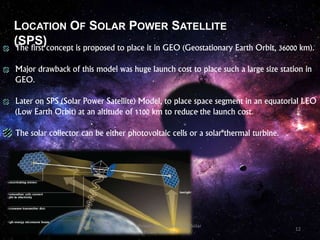
(SPS)The first concept is proposed to place it in GEO (Geostationary Earth Orbit, 36000 km).
Major drawback of this model was huge launch cost to place such a large size station in
GEO.
Later on SPS (Solar Power Satellite) Model, to place space segment in an equatorial LEO
(Low Earth Orbit) at an altitude of 1100 km to reduce the launch cost.
The solar collector can be either photovoltaic cells or a solar thermal turbine.
12
Wireless Power Transmission Via Solar
Power Satellite
ADVANTAGES
Remove physical infrastructure “Grids and Towers”.
Cost effective (Remove cost of towers and cables).
During rain and after natural disaster it is often hard to manage
cables and towers so it removes this.
Losses during transmission and distribution can be removed.
Microwaves (electricity) are more environments friendly. It does not
involve emission of carbon gases.
Zero fuel cost.
ADVANTAGES AND DISADVANTAGES
13
Wireless Power Transmission Via Solar
Power Satellite
Biological effects due to the high frequency microwave signals is the
first demerit of this technology.
High initial expenditure cost.
The transmission of electric current through this mode is
susceptible to security risks like cyber war fare.
Disadvantages
14
Wireless Power Transmission Via Solar
Power Satellite
FUTURE ASPECTS
The frequency of beamed radiation is to be at 2.45 GHz and
this frequency is used by communication satellites also.
Large-scale transportation and robotics for the construction
of large-scale structures in space include the other major fields
of technologies requiring further developments.
Power-Generating Solar Satellite Inhabitant.
To store electricity during off peak demand hours.
15
Wireless Power Transmission Via Solar
Power Satellite
CONCLUSIONS
The solar powered satellite transmitting power to the earth wirelessly is
expected to be the central attraction of space and technology in coming
decades.
The use of solar cells in space achieves 24 hour sunlight and are
unaffected by atmosphere and clouds.
The power generated is estimated to be approximately 3 to 4 times
more that that can be produced on ground.
16
Wireless Power Transmission Via Solar
Power Satellite
17
Wireless Power Transmission Via Solar
Power Satellite
Wireless Power Transmission Via Solar
Power Satellite
18
REFERENCES
[1] A. A. Nimje, S. M. Ali, “Solar Power Connectivity
Using Transmission Superhighway: Smart Grid”,
International Congress on Renewable Energy,
2010 [ICORE 2010], Tradeshow, Chandigarh,
India, 01-03 December 2010.
[2] “www.cea.nic.in/reports/yearly/lgbr_report.pdf”,
Central Electricity Authority of India.
[3] Geoffrey A. Landis, “Solar Power from Space:
Separating Speculation from Reality” XXIth Space
Photovoltaic
Research and Technology Conference (SPRAT-
2009), Cleveland, OH, October 6-8 2009.

Wireless power-transmission-using-microwave

  • 1.
    Let me takeyou to the word of FUTURE POWER 1 Wireless Power Transmission Via Solar Power Satellite
  • 2.
    Wireless Power Transmission Via SolarPower Satellite Presenting by: Jawad Usman 2 Wireless Power Transmission Via Solar Power Satellite
  • 3.
    OUTLINE Introduction Working Of WirelessPower Transmission System Design And Technologies BASIC STRUCTURE OF SOLAR POWER SATELLITE Advantages And Disadvantages Future Aspects Conclusions 3 Wireless Power Transmission Via Solar Power Satellite
  • 4.
    More than 60percent of energy is generated using coal-fired station resulting in CO2 emission threatening the global warming. Solar energy in space free from the weather conditions is quite different from that on the earth. The PV cells in the SPS produce 5 to 10 % times more power at space than at ground. INTRODUCTION 4 Wireless Power Transmission Via Solar Power Satellite
  • 5.
    Working of solarpanel Working Of Wireless Power TransmissionSolar Photovoltaic (PV) panels use silicon crystals, which produce an Electrical current when struck by light. In a crystal, the bonds are made of electrons that are shared between all atoms of crystal. The light gets absorbed by the electrons , and this electrons excited into a higher energy level . This electron can then move around the crystal freely, which produces an electrical current. 5 Wireless Power Transmission Via Solar Power Satellite
  • 6.
    The liberated electronswill try to move towards anode But, because of the crossed electric and magnetic fields, they move in a circular path around anode. As they move in a circular path they pass the cavities of the anode. The cavities thus resonate and emit microwave radiations. Hence, in this way the microwaves are collected from the one end of the magnetron. Working Of MAGNETRON 6 Wireless Power Transmission Via Solar Power Satellite
  • 7.
    Transmitting antennas The microwavepower source generates microwave power and the output power is controlled by electronic control circuits. The waveguide circulator which protects the microwave source from reflected power is connected with the microwave power source through the coax- waveguide adaptor. The tuner matches the impedance between the transmitting antenna and the microwave source. The transmitting antenna radiates the power uniformly through free space to the rectenna. Microwave power source Waveguide circulator and adaptor Tuner Transmitting Antenna Transmitting And Receiving Antennas 7 Wireless Power Transmission Via Solar Power Satellite
  • 8.
    Receiving Antennas The receivedpower is converted into DC power by filters and schottky diode. In the receiving section the receiving section of ground based model, a horn antenna be used for a microwave band above 1 GHz. Waveguide and adaptor Impedance Matching and Filter Circuit Receiving Antenna Load 8 Wireless Power Transmission Via Solar Power Satellite
  • 9.
    SYSTEM DESIGN The SSPsystem is composed of a space segment and a ground power receiving site . Space segment consists of mainly three parts: 1) Solar energy collector to convert the solar energy into DC (direct current) electricity 2) DC-to-microwave converter. 3) Large antenna array to beam the microwave power to the ground. SYSTEM DESIGN AND TECHNOLOGIES 9 Wireless Power Transmission Via Solar Power Satellite
  • 10.
    Spacetenna and Groundside Rectenna Sizing Criteria The relationship between spacetenna diameter (D1), rectenna diameter (D2), wavelength (ë) and spacetenna to rectenna distance (H) is given by (D1*D2)/(e*H)=2.8 Coherent Microwaves D1D2=2KλH λ = 12.24 cm (2.45 GHz) K = 1.4 (typically) H = 37,000 km (GEO) D1 D2 H For D1 = 1km D2 = 12km D1D2=12.7(GEO) 10 Wireless Power Transmission Via Solar Power Satellite
  • 11.
    sun Receiving Satellite Day Side Relay Satellite Transmitting Satellite Night Side Receiving SolarEarth Station Transmitting Solar Earth Station Microwave Beam GEO 36000km Solar Power Model Based On Mutual Collaboration 11 Wireless Power Transmission Via Solar Power Satellite
  • 12.
    LOCATION OF SOLARPOWER SATELLITE (SPS)The first concept is proposed to place it in GEO (Geostationary Earth Orbit, 36000 km). Major drawback of this model was huge launch cost to place such a large size station in GEO. Later on SPS (Solar Power Satellite) Model, to place space segment in an equatorial LEO (Low Earth Orbit) at an altitude of 1100 km to reduce the launch cost. The solar collector can be either photovoltaic cells or a solar thermal turbine. 12 Wireless Power Transmission Via Solar Power Satellite
  • 13.
    ADVANTAGES Remove physical infrastructure“Grids and Towers”. Cost effective (Remove cost of towers and cables). During rain and after natural disaster it is often hard to manage cables and towers so it removes this. Losses during transmission and distribution can be removed. Microwaves (electricity) are more environments friendly. It does not involve emission of carbon gases. Zero fuel cost. ADVANTAGES AND DISADVANTAGES 13 Wireless Power Transmission Via Solar Power Satellite
  • 14.
    Biological effects dueto the high frequency microwave signals is the first demerit of this technology. High initial expenditure cost. The transmission of electric current through this mode is susceptible to security risks like cyber war fare. Disadvantages 14 Wireless Power Transmission Via Solar Power Satellite
  • 15.
    FUTURE ASPECTS The frequencyof beamed radiation is to be at 2.45 GHz and this frequency is used by communication satellites also. Large-scale transportation and robotics for the construction of large-scale structures in space include the other major fields of technologies requiring further developments. Power-Generating Solar Satellite Inhabitant. To store electricity during off peak demand hours. 15 Wireless Power Transmission Via Solar Power Satellite
  • 16.
    CONCLUSIONS The solar poweredsatellite transmitting power to the earth wirelessly is expected to be the central attraction of space and technology in coming decades. The use of solar cells in space achieves 24 hour sunlight and are unaffected by atmosphere and clouds. The power generated is estimated to be approximately 3 to 4 times more that that can be produced on ground. 16 Wireless Power Transmission Via Solar Power Satellite
  • 17.
    17 Wireless Power TransmissionVia Solar Power Satellite
  • 18.
    Wireless Power TransmissionVia Solar Power Satellite 18 REFERENCES [1] A. A. Nimje, S. M. Ali, “Solar Power Connectivity Using Transmission Superhighway: Smart Grid”, International Congress on Renewable Energy, 2010 [ICORE 2010], Tradeshow, Chandigarh, India, 01-03 December 2010. [2] “www.cea.nic.in/reports/yearly/lgbr_report.pdf”, Central Electricity Authority of India. [3] Geoffrey A. Landis, “Solar Power from Space: Separating Speculation from Reality” XXIth Space Photovoltaic Research and Technology Conference (SPRAT- 2009), Cleveland, OH, October 6-8 2009.