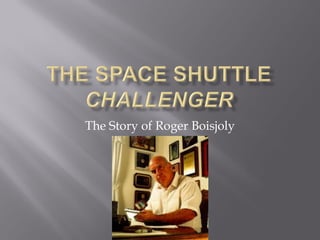
The Story of Roger Boisjoly
 On the night of January 27, 1986, Morton
Thiokol engineers conveyed their
recommendation against launching the
Challenger space shuttle the next morning.
 The recommendation was based on the
engineers’ worries about the ability of O-rings
to seal at low temperatures.
 Chief O-ring engineer Roger Boisjoly, more
than a year earlier, had warned his colleagues
of potentially serious problems.
 The technical evidence was incomplete but
ominous:
 There appeared to be a correlation between
temperature and resiliency.
 There was some leakage around the seal even at
relatively high temperatures.
 The worst leakage was at 53 degrees, however.
 Predicted ambient temperature at launch was 26
degrees.
 This was much lower than the launch temperatures
of any previous flight.
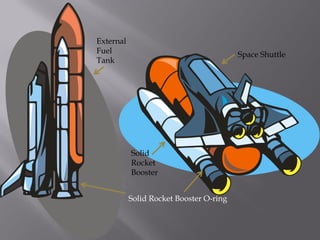
External
Fuel
Tank
Space Shuttle
Solid
Rocket
Booster
Solid Rocket Booster O-ring
 The space center would not fly without
approval from Morton Thiokol.
 Morton Thiokol’s management would not
recommend launching without approval from
its managers.
 Gerald Mason, senior vice-president at Morton
Thiokol, knew that NASA badly needed a
successful flight.
 He also knew that Morton Thiokol needed a
new Contract with NASA.
 Finally, Mason was aware that the engineering
data were inconclusive.
 The engineers could not give any firm figures
as to the precise temperature at which it would
be unsafe to fly.
 The teleconference with the space center would
resume shortly, and a decision had to be made.
 Mason turned to Robert Lund, supervising
engineer, and said, “Take off your engineering
hat and put on your management hat.”
 The earlier no-launch recommendation was
reversed.
 The next day, just 73 seconds into the launch,
the Challenger exploded, taking the lives of the
six astronauts and schoolteacher Christa
McAuliffe.
 In addition to the tragic loss of human life, the
disaster destroyed millions of dollars worth of
equipment and severely tarnished NASA’s
reputation.
 Morton Thiokol, Inc
 Wasatch Division
 Interoffice Memo
 31 July 1985
2870:FY86:073
TO: R. K. Lund
Vice President, Engineering
CC: B. C. Brinton, A. J. McDonald, L. H. Sayer, J. R. Kapp
FROM: R. M. Boisjoly
Applied Mechanics - Ext. 3525
SUBJECT: SRM O-Ring Erosion/Potential Failure Criticality
This letter is written to insure that management is fully aware of the seriousness of the current O-ring erosion problem in the SRM joints from an
engineering standpoint.
The mistakenly accepted position on the joint problem was to fly without fear of failure and to run a series of design evaluations which would
ultimately lead to a solution or at least a significant reduction of the erosion problem. This position is now drastically changed as a result of the SRM
16A nozzle joint erosion which eroded a secondary O-ring with the primary O-ring never sealing.
If the same scenario should occur in a field joint (and it could), then it is a jump ball as to the success or failure of the joint because the secondary O-
ring cannot respond to the clevis opening rate and may not be capable of pressurization. The result would be a catastrophe of the highest order - loss
of human life.
An unofficial team (a memo defining the team and its purpose was never published) with leader was formed on 19 July 1985 and was tasked with
solving the problem for both the short and long term. This unofficial team is essentially nonexistent at this time. In my opinion, the team must be
officially given the responsibility and the authority to execute the work that needs to be done on a non-interference basis (full time assignment until
completed.)
It is my honest and very real fear that if we do not take immediate action to dedicate a team to solve the problem with the field joint having the
number one priority, then we stand in jeopardy of losing a flight along with all the launch pad facilities.
R. M. Boisjoly
Concurred by:
J. R. Kapp, Manager
Applied Mechanics
The Story of Rodney Rocha
 On January 16, 2003, at 10:39 am Eastern Standard
Time, the Columbia lifted off at Kennedy Space
Center, destined for a 16-day mission in space.
 The seven person Columbia crew was scheduled to
conduct numerous scientific experiments and
return to earth on February 1.
 Only 81.7 seconds after liftoff, a briefcase-size piece
of the brownish-orange insulating foam that
covered the large external tank broke off and hit
the leading edge of the orbiter’s left wing.
 Unknown to the Columbia crew or the ground
support staff, the foam knocked a hole in the
leading edge of the wing that was
approximately 10 inches across.
 Cameras recorded the foam impact, but the
images provided insufficient detail to
determine either the exact point of impact or its
effect.
 Several NASA engineers, including Rodney
Rocha, requested that attempts be made to get
clearer images.
 There were requests that the Columbia crew be
directed to examine the wing for possible damage.
 It had become a matter of faith at NASA, however,
that foam strikes, although a known problem,
could not cause significant damage and were not a
safety-of-flight issue, so management rejected this
request.
 The astronauts were not told of the problem until
shortly before reentry, when they informed that
the foam strike was inconsequential, but that they
should know about it in case they were asked
about the strike by the press.
Debris is visible
coming off from
the left wing
(bottom).
 Upon reentry into the Earth’s atmosphere, a
snaking plume of superheated air, probably
exceeding 5,000 degrees Fahrenheit, entered the
breach in the wing and began to consume the wing
from the inside.
 The destruction of the spacecraft began when it
was over the Pacific Ocean and grew worse when
it entered United States airspace.
 Eventually, the bottom surface of the left wing
began to cave upwards into the interior of the
wing, finally causing Columbia to go out of control
and disintegrate, mostly over east Texas.
Columbia
debris in
red, orange,
and yellow.
 In my humble technical opinion, this is the wrong (and bordering on
irresponsible) answer from the SSP and orbiter not to request additional
imaging help from any outside source. I must emphasize (again) that severe
enough damage (3 or 4 multiple tiles knocked out down to the densification
layer) combined with the heating and resulting damage to the underlying
structure at the most critical location (viz. MLG
Door/wheels/tires/hydraulics or the X1191 spar cap) could present
potentially grave hazards. The engineering team will admit it might not
achieve definitive high confidence answer even with additional images, but
without action to request help clarify the damage visually, we will guarantee
it will not.
 Can we talk to Frank Benz before Friday's MMT? Remember the NASA safety
posters around the site stating "if it's not safe, say so"? Yes, its that serious.
 Rodney Rocha
Structural Engineering Division (ES-SED)
- ES Div, Chief Engineer (Space Shuttle DGE)
- Chair, Space Shuttle Loads & Dynamics Panel
 Mail Code ES2 Phone 281-483-8889
 [Handwritten note]
The Space Shuttle Disasters

The Space Shuttle Disasters

  • 1.
    The Story ofRoger Boisjoly
  • 2.
     On thenight of January 27, 1986, Morton Thiokol engineers conveyed their recommendation against launching the Challenger space shuttle the next morning.  The recommendation was based on the engineers’ worries about the ability of O-rings to seal at low temperatures.  Chief O-ring engineer Roger Boisjoly, more than a year earlier, had warned his colleagues of potentially serious problems.
  • 3.
     The technicalevidence was incomplete but ominous:  There appeared to be a correlation between temperature and resiliency.  There was some leakage around the seal even at relatively high temperatures.  The worst leakage was at 53 degrees, however.  Predicted ambient temperature at launch was 26 degrees.  This was much lower than the launch temperatures of any previous flight.
  • 5.
  • 12.
     The spacecenter would not fly without approval from Morton Thiokol.  Morton Thiokol’s management would not recommend launching without approval from its managers.  Gerald Mason, senior vice-president at Morton Thiokol, knew that NASA badly needed a successful flight.  He also knew that Morton Thiokol needed a new Contract with NASA.
  • 13.
     Finally, Masonwas aware that the engineering data were inconclusive.  The engineers could not give any firm figures as to the precise temperature at which it would be unsafe to fly.  The teleconference with the space center would resume shortly, and a decision had to be made.  Mason turned to Robert Lund, supervising engineer, and said, “Take off your engineering hat and put on your management hat.”
  • 14.
     The earlierno-launch recommendation was reversed.  The next day, just 73 seconds into the launch, the Challenger exploded, taking the lives of the six astronauts and schoolteacher Christa McAuliffe.  In addition to the tragic loss of human life, the disaster destroyed millions of dollars worth of equipment and severely tarnished NASA’s reputation.
  • 16.
     Morton Thiokol,Inc  Wasatch Division  Interoffice Memo  31 July 1985 2870:FY86:073 TO: R. K. Lund Vice President, Engineering CC: B. C. Brinton, A. J. McDonald, L. H. Sayer, J. R. Kapp FROM: R. M. Boisjoly Applied Mechanics - Ext. 3525 SUBJECT: SRM O-Ring Erosion/Potential Failure Criticality This letter is written to insure that management is fully aware of the seriousness of the current O-ring erosion problem in the SRM joints from an engineering standpoint. The mistakenly accepted position on the joint problem was to fly without fear of failure and to run a series of design evaluations which would ultimately lead to a solution or at least a significant reduction of the erosion problem. This position is now drastically changed as a result of the SRM 16A nozzle joint erosion which eroded a secondary O-ring with the primary O-ring never sealing. If the same scenario should occur in a field joint (and it could), then it is a jump ball as to the success or failure of the joint because the secondary O- ring cannot respond to the clevis opening rate and may not be capable of pressurization. The result would be a catastrophe of the highest order - loss of human life. An unofficial team (a memo defining the team and its purpose was never published) with leader was formed on 19 July 1985 and was tasked with solving the problem for both the short and long term. This unofficial team is essentially nonexistent at this time. In my opinion, the team must be officially given the responsibility and the authority to execute the work that needs to be done on a non-interference basis (full time assignment until completed.) It is my honest and very real fear that if we do not take immediate action to dedicate a team to solve the problem with the field joint having the number one priority, then we stand in jeopardy of losing a flight along with all the launch pad facilities. R. M. Boisjoly Concurred by: J. R. Kapp, Manager Applied Mechanics
  • 19.
    The Story ofRodney Rocha
  • 20.
     On January16, 2003, at 10:39 am Eastern Standard Time, the Columbia lifted off at Kennedy Space Center, destined for a 16-day mission in space.  The seven person Columbia crew was scheduled to conduct numerous scientific experiments and return to earth on February 1.  Only 81.7 seconds after liftoff, a briefcase-size piece of the brownish-orange insulating foam that covered the large external tank broke off and hit the leading edge of the orbiter’s left wing.
  • 23.
     Unknown tothe Columbia crew or the ground support staff, the foam knocked a hole in the leading edge of the wing that was approximately 10 inches across.  Cameras recorded the foam impact, but the images provided insufficient detail to determine either the exact point of impact or its effect.  Several NASA engineers, including Rodney Rocha, requested that attempts be made to get clearer images.
  • 24.
     There wererequests that the Columbia crew be directed to examine the wing for possible damage.  It had become a matter of faith at NASA, however, that foam strikes, although a known problem, could not cause significant damage and were not a safety-of-flight issue, so management rejected this request.  The astronauts were not told of the problem until shortly before reentry, when they informed that the foam strike was inconsequential, but that they should know about it in case they were asked about the strike by the press.
  • 26.
    Debris is visible comingoff from the left wing (bottom).
  • 29.
     Upon reentryinto the Earth’s atmosphere, a snaking plume of superheated air, probably exceeding 5,000 degrees Fahrenheit, entered the breach in the wing and began to consume the wing from the inside.  The destruction of the spacecraft began when it was over the Pacific Ocean and grew worse when it entered United States airspace.  Eventually, the bottom surface of the left wing began to cave upwards into the interior of the wing, finally causing Columbia to go out of control and disintegrate, mostly over east Texas.
  • 30.
  • 31.
     In myhumble technical opinion, this is the wrong (and bordering on irresponsible) answer from the SSP and orbiter not to request additional imaging help from any outside source. I must emphasize (again) that severe enough damage (3 or 4 multiple tiles knocked out down to the densification layer) combined with the heating and resulting damage to the underlying structure at the most critical location (viz. MLG Door/wheels/tires/hydraulics or the X1191 spar cap) could present potentially grave hazards. The engineering team will admit it might not achieve definitive high confidence answer even with additional images, but without action to request help clarify the damage visually, we will guarantee it will not.  Can we talk to Frank Benz before Friday's MMT? Remember the NASA safety posters around the site stating "if it's not safe, say so"? Yes, its that serious.  Rodney Rocha Structural Engineering Division (ES-SED) - ES Div, Chief Engineer (Space Shuttle DGE) - Chair, Space Shuttle Loads & Dynamics Panel  Mail Code ES2 Phone 281-483-8889  [Handwritten note]