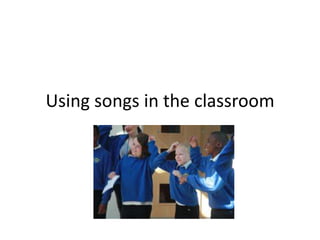
Using songs in the classroom
Advantages
• Help to develop language & pronunciation
• Natural and enjoyable repetition
• Can use to develop all skills
• Motivating and fun
• All children can participate
• Build confidence – children can learn ‘chunks’
• Help to develop cognitive skills (eg memory)
• Good tool for teacher – managing the class and adding
  variety and pace; cross-curricular topics; short, fixed time
• Develop cultural understanding
• A social shared experience
Think about…
• Level of your students – Is language
  appropriate? Adapt language?
• Age of your students
• Space in the classroom – can students do the
  song at their desk? Do they need to move?
• When to use songs: A warmer? To move from
  one activity to another? Introduce new
  language? Revise language? Channel energy?
  To get everyone’s attention? Change mood?
How? Activities and tips
• http://www.teachingenglish.org.uk/tips/using-
  songs-classroom
• http://www.teachingenglish.org.uk/teaching-
  kids/using-traditional-songs
• http://www.teachingenglish.org.uk/language-
  assistant/primary-tips/using-songs
Favourite and new activities
• Children suggesting/changing lyrics eg animals, parts of the
  body (eg Pinocchio)
• Listening for words and raising hand when hearing them
  (eg I can sing a rainbow)
• Performing actions (eg Incy Wincy Spider)
• Writing activities: write a new verse (eg Head, Shoulders,
  Knees and Toes); order sentences
• Singing songs quickly/slowly
• Missing out words
• Karaoke
• Singing competitions
• Making song books
Finding songs
• Topic internet searches (eg parts of the body:
   http://pinterest.com/simplesongs/teach-parts-
  of-the-body/
• Song websites:
  http://learnenglishkids.britishcouncil.org/en/son
  gs
• http://www.supersimplelearning.com/songs/
• BBC:
  http://www.bbc.co.uk/schoolradio/subjects/early
  learning/nurserysongs/A-E/big_ship_sails
More songs!
• Alice the Camel:
  http://www.youtube.com/watch?v=GpoqrvTL
  c8M
• Five little speckled frogs:
  http://www.youtube.com/watch?v=SVPmtaH
  mL4g
• Five little monkeys:
  http://www.youtube.com/watch?v=eL9mI3K8
  UiI
Adapting songs
• Make simpler for lower language levels
• Change to fit with a particular topic (eg 10
  little aeroplanes can become 10 little
  elephants…)
• http://learnenglishkids.britishcouncil.org/en/s
  ongs/ten-little-aeroplanes
• Blog!
  http://sonjaenglish.blogspot.co.uk/2012/04/t
  en-little-aeroplanes.html
One song – many uses!
• Alice the camel
• Make a song book – students make a page for
  the camel with eg 5 humps, 4 humps…
• Introducing topic of the desert
• Writing – amazing facts about camels
• Where do camels live? Using maps…
• Learning about animals adapting to different
  habitats (eg the desert)
Pop songs for older children
• Here is a presentation from IATEFL conference
  about exploiting pop songs:
  http://iatefl.britishcouncil.org/2010/sessions/
  2010-04-10/useful-exploitation-pop-songs-
  classroom
• A fantastic songs resource with free
  worksheets and lesson ideas (need to register
  but free – note for older learners):
  http://www.tuneintoenglish.com/?p=833
Your favourite pop songs
•   Some examples of songs used for upper primary to teach about culture,
    vocabulary and music styles. Mariachu thinks about: whether the songs have a
    moral lesson, lyrics that can apply to their own lives…

•   Country: "The Human Race“ by Randy Travis
•   R&B: "Video" by India Arie
•   Reggae: ”Turn your Light down Low" by Bob Marley & Lauryn Hill
•   POP: "We are the World" by USA for Africa
•   Soul: "Ain´t no Mountain High Enough" by Marvin Gaye & Tammi Terrell
•   Soul: "You Gotta Be" by Patty Austin
•   R&B: "Recipe for Love" by Harry Connick Jr.
•   Country: " Country Roads" by J. Denver
•   POP: " Yellow Submarine" by Beatles
•   http://www.tuneintoenglish.com/yellowsubmarine.pdf
•   POP: " You´ve Got a Friend" by James Taylor
Articles and books
• The Primary English Teacher’s Guide by
  Brewster, Ellis, Girard (Penguin English, 2002):
  Chapter 12

Spa mat dev_-_using_songs_in_the_classroom

  • 1.
    Using songs inthe classroom
  • 2.
    Advantages • Help todevelop language & pronunciation • Natural and enjoyable repetition • Can use to develop all skills • Motivating and fun • All children can participate • Build confidence – children can learn ‘chunks’ • Help to develop cognitive skills (eg memory) • Good tool for teacher – managing the class and adding variety and pace; cross-curricular topics; short, fixed time • Develop cultural understanding • A social shared experience
  • 3.
    Think about… • Levelof your students – Is language appropriate? Adapt language? • Age of your students • Space in the classroom – can students do the song at their desk? Do they need to move? • When to use songs: A warmer? To move from one activity to another? Introduce new language? Revise language? Channel energy? To get everyone’s attention? Change mood?
  • 4.
    How? Activities andtips • http://www.teachingenglish.org.uk/tips/using- songs-classroom • http://www.teachingenglish.org.uk/teaching- kids/using-traditional-songs • http://www.teachingenglish.org.uk/language- assistant/primary-tips/using-songs
  • 5.
    Favourite and newactivities • Children suggesting/changing lyrics eg animals, parts of the body (eg Pinocchio) • Listening for words and raising hand when hearing them (eg I can sing a rainbow) • Performing actions (eg Incy Wincy Spider) • Writing activities: write a new verse (eg Head, Shoulders, Knees and Toes); order sentences • Singing songs quickly/slowly • Missing out words • Karaoke • Singing competitions • Making song books
  • 6.
    Finding songs • Topicinternet searches (eg parts of the body: http://pinterest.com/simplesongs/teach-parts- of-the-body/ • Song websites: http://learnenglishkids.britishcouncil.org/en/son gs • http://www.supersimplelearning.com/songs/ • BBC: http://www.bbc.co.uk/schoolradio/subjects/early learning/nurserysongs/A-E/big_ship_sails
  • 7.
    More songs! • Alicethe Camel: http://www.youtube.com/watch?v=GpoqrvTL c8M • Five little speckled frogs: http://www.youtube.com/watch?v=SVPmtaH mL4g • Five little monkeys: http://www.youtube.com/watch?v=eL9mI3K8 UiI
  • 8.
    Adapting songs • Makesimpler for lower language levels • Change to fit with a particular topic (eg 10 little aeroplanes can become 10 little elephants…) • http://learnenglishkids.britishcouncil.org/en/s ongs/ten-little-aeroplanes • Blog! http://sonjaenglish.blogspot.co.uk/2012/04/t en-little-aeroplanes.html
  • 9.
    One song –many uses! • Alice the camel • Make a song book – students make a page for the camel with eg 5 humps, 4 humps… • Introducing topic of the desert • Writing – amazing facts about camels • Where do camels live? Using maps… • Learning about animals adapting to different habitats (eg the desert)
  • 10.
    Pop songs forolder children • Here is a presentation from IATEFL conference about exploiting pop songs: http://iatefl.britishcouncil.org/2010/sessions/ 2010-04-10/useful-exploitation-pop-songs- classroom • A fantastic songs resource with free worksheets and lesson ideas (need to register but free – note for older learners): http://www.tuneintoenglish.com/?p=833
  • 11.
    Your favourite popsongs • Some examples of songs used for upper primary to teach about culture, vocabulary and music styles. Mariachu thinks about: whether the songs have a moral lesson, lyrics that can apply to their own lives… • Country: "The Human Race“ by Randy Travis • R&B: "Video" by India Arie • Reggae: ”Turn your Light down Low" by Bob Marley & Lauryn Hill • POP: "We are the World" by USA for Africa • Soul: "Ain´t no Mountain High Enough" by Marvin Gaye & Tammi Terrell • Soul: "You Gotta Be" by Patty Austin • R&B: "Recipe for Love" by Harry Connick Jr. • Country: " Country Roads" by J. Denver • POP: " Yellow Submarine" by Beatles • http://www.tuneintoenglish.com/yellowsubmarine.pdf • POP: " You´ve Got a Friend" by James Taylor
  • 12.
    Articles and books •The Primary English Teacher’s Guide by Brewster, Ellis, Girard (Penguin English, 2002): Chapter 12