Using Songs for Different Purposes Cíntia Regina Lacerda Rabello IBEU 60th Seminar for Teachers of English  July 2004
Why use music and songs in the EFL classroom? Some authors’ opinions Tim Murphy (1992): Music is  everywhere  and  all  students have  musical tastes ; Songs  stick in our minds  and become part of us; It seems easier to  sing language  than to speak it; They appear to precede and aid the development of language in young children;  “ Adolescent motherese” –  affective attention ;  Songs work on our  short- and long-term memory   They may strongly activate the  repetition mechanism  of the language acquisition device;
Why use music and songs in the EFL classroom? Some authors’ opinions Tim Murphy (1992): They usually use simple, conversational language – are  affective , which  makes them many times more  motivating  than other texts; Songs are  relaxing , provide  variety  and  fun , and encourage  harmony  within oneself and within a group; Songs are  short ,  self-contained  texts, recordings, and films that are  easy  to handle in a lesson. And the  supply  is inexhaustible!
Why use music and songs in the EFL classroom? Some authors’ opinions Kevin Schoepp (2001): Affective Reasons - positive attitude, more learning Cognitive Reasons - fairly repetitive nature -help automatize the language development process Linguistic Reasons - genuine language/major source of language outside the classroom Suzanne L. Medina ( 2002):  Krashen’s Second Language Hypothesis; Gardner’s Theory of Multiple Intelligences; Psychological Research on Music and Rote Memorization;  Acquiring second Language Vocabulary Through Music.
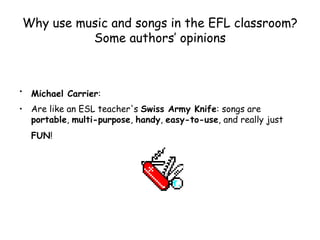
Why use music and songs in the EFL classroom? Some authors’ opinions Michael Carrier :   Are like an ESL teacher's  Swiss Army Knife : songs are  portable ,  multi-purpose ,  handy ,  easy-to-use , and really just  FUN !
Main Purposes:   To  teach/practice/review grammar or  vocabulary; to enrich vocabulary; to introduce topics for conversation, debates or writing; as a warm-up/follow-up activity; to develop students’ listening ability; to practice pronunciation/spelling; to practice translation; to practice reading/ writing/ speaking/ listening; to stimulate creativity; for relaxation; for fun;
Main Purposes: to cater for different Learning Styles: (visual, auditory, kinesthetic learners) to present cultural/historical aspects; to play games (eg. Hot Potato) other. . .
Some drawbacks... It’s difficult to please all students; it’s time-consuming; it involves preparation; students may get “too excited”; they’re noisy, may disturb other classes; students may already know the lyrics; some students just want to listen, not to work; comprehension may be difficult; other...
Hints for lesson planning: Be sure of the aims of the lesson; make sure instructions are clear; whenever possible, prepare pre-, while- and post-listening activities; select the song according to the aim of the lesson, group age, etc; when possible, let students choose the songs; use different activities; make use of visual aids; give some background information about the song, singer, group, if possible; stimulate students to sing; have fun  with them!
Some ideas of activities: Very little preparation: picking up words from the song; checking words on a list; numbering words; Bingo; Listening Comprehension Questions; True or False questions; ordering lines or stanzas (cut outs); making up a story from words on the board; predicting song by words, topic; mass distance dictation.
Some ideas of activities: Some preparation: gap filling; correcting wrong words; crossing out extra words; writing down verb forms; matching sentences halves; circling correct word/verb tense; unscrambling words or sentences.
Some ideas of activities: Some more preparation: info-gap activities;  interpreting the song;  matching pictures to the lyrics; reconstructing the song; discussions and debates; poster making; exploring new vocabulary.
Some variations for gap filling: Guess blanks before listening to the song (from context); number of dashes = number of words; expressions (number of words); give the first letter of each word; rhyming words; insert extra words; type wrong words (contractions X full forms, similar sound); zig-zag; synonyms and antonyms;
Using video clips:   According to Tim Murphy (1992), “we, as teachers, need to encourage student interaction with the video, and involve the students initially in predicting, describing, commenting, and sharing their perceptions.” Some ideas: predicting video; memory test; freeze-frame; half n’ half; comparing video clips; What makes a good video?.
There’s no human society without   its poetry. There is no human society without its music. When put together, they constitute a powerful force for both cultural cohesion and identity and for individual fulfillment. Alan Maley

Using songs for different purposes

  • 1.
    Using Songs forDifferent Purposes Cíntia Regina Lacerda Rabello IBEU 60th Seminar for Teachers of English July 2004
  • 2.
    Why use musicand songs in the EFL classroom? Some authors’ opinions Tim Murphy (1992): Music is everywhere and all students have musical tastes ; Songs stick in our minds and become part of us; It seems easier to sing language than to speak it; They appear to precede and aid the development of language in young children; “ Adolescent motherese” – affective attention ; Songs work on our short- and long-term memory They may strongly activate the repetition mechanism of the language acquisition device;
  • 3.
    Why use musicand songs in the EFL classroom? Some authors’ opinions Tim Murphy (1992): They usually use simple, conversational language – are affective , which makes them many times more motivating than other texts; Songs are relaxing , provide variety and fun , and encourage harmony within oneself and within a group; Songs are short , self-contained texts, recordings, and films that are easy to handle in a lesson. And the supply is inexhaustible!
  • 4.
    Why use musicand songs in the EFL classroom? Some authors’ opinions Kevin Schoepp (2001): Affective Reasons - positive attitude, more learning Cognitive Reasons - fairly repetitive nature -help automatize the language development process Linguistic Reasons - genuine language/major source of language outside the classroom Suzanne L. Medina ( 2002): Krashen’s Second Language Hypothesis; Gardner’s Theory of Multiple Intelligences; Psychological Research on Music and Rote Memorization; Acquiring second Language Vocabulary Through Music.
  • 5.
    Why use musicand songs in the EFL classroom? Some authors’ opinions Michael Carrier : Are like an ESL teacher's Swiss Army Knife : songs are portable , multi-purpose , handy , easy-to-use , and really just FUN !
  • 6.
    Main Purposes: To teach/practice/review grammar or vocabulary; to enrich vocabulary; to introduce topics for conversation, debates or writing; as a warm-up/follow-up activity; to develop students’ listening ability; to practice pronunciation/spelling; to practice translation; to practice reading/ writing/ speaking/ listening; to stimulate creativity; for relaxation; for fun;
  • 7.
    Main Purposes: tocater for different Learning Styles: (visual, auditory, kinesthetic learners) to present cultural/historical aspects; to play games (eg. Hot Potato) other. . .
  • 8.
    Some drawbacks... It’sdifficult to please all students; it’s time-consuming; it involves preparation; students may get “too excited”; they’re noisy, may disturb other classes; students may already know the lyrics; some students just want to listen, not to work; comprehension may be difficult; other...
  • 9.
    Hints for lessonplanning: Be sure of the aims of the lesson; make sure instructions are clear; whenever possible, prepare pre-, while- and post-listening activities; select the song according to the aim of the lesson, group age, etc; when possible, let students choose the songs; use different activities; make use of visual aids; give some background information about the song, singer, group, if possible; stimulate students to sing; have fun with them!
  • 10.
    Some ideas ofactivities: Very little preparation: picking up words from the song; checking words on a list; numbering words; Bingo; Listening Comprehension Questions; True or False questions; ordering lines or stanzas (cut outs); making up a story from words on the board; predicting song by words, topic; mass distance dictation.
  • 11.
    Some ideas ofactivities: Some preparation: gap filling; correcting wrong words; crossing out extra words; writing down verb forms; matching sentences halves; circling correct word/verb tense; unscrambling words or sentences.
  • 12.
    Some ideas ofactivities: Some more preparation: info-gap activities; interpreting the song; matching pictures to the lyrics; reconstructing the song; discussions and debates; poster making; exploring new vocabulary.
  • 13.
    Some variations forgap filling: Guess blanks before listening to the song (from context); number of dashes = number of words; expressions (number of words); give the first letter of each word; rhyming words; insert extra words; type wrong words (contractions X full forms, similar sound); zig-zag; synonyms and antonyms;
  • 14.
    Using video clips: According to Tim Murphy (1992), “we, as teachers, need to encourage student interaction with the video, and involve the students initially in predicting, describing, commenting, and sharing their perceptions.” Some ideas: predicting video; memory test; freeze-frame; half n’ half; comparing video clips; What makes a good video?.
  • 15.
    There’s no humansociety without its poetry. There is no human society without its music. When put together, they constitute a powerful force for both cultural cohesion and identity and for individual fulfillment. Alan Maley