






























Teaching Current Events in
the ESL Classroom
************
David Burns
Peace Corps Response
Univ. Latina – Santa Cruz, Costa Rica
7 April 2015
Contact Information
• David Burns – Santa Cruz, Guanacaste
• www.facebook.com/EnglishOnTheMove
• www.facebook.com/Rayuelando
• ‘Like’ my Facebook page for updates and links
to TEFL topics, lesson plans, photos, teaching
ideas, and more!
• Email: EnglishOnTheMove27@gmail.com
• Mobile: 8416 2367
Get Your Students’ Attention
• One, Two, Three – Eyes on me!
(Teacher)
• One, Two – Eyes on you! (Students)
Warmer & Filler Activities
• http://eslgamesbox.com/more-no-prep-warmer
• http://busyteacher.org/teaching_ideas_and_te
• http://www.onestopenglish.com/teenagers/skill
• http://www.simplyesl.com/categories/esl-activit
• https://teachertrove.wikispaces.com/Warmers+
Alliteration Name Game
• Introductions
• Public Speaking
• Memorization
• Subject & Possessive Pronouns (She, her)
• Vocabulary for JOBS
• Descriptive Adjectives
• Alliteration (repetition of the same sound)
If it weren’t for the last minute, nothing would get done.
Procrastination
• Procrastination – Procrastinate –
Procrastinators:
• Practice conditionals (C2)
• If it weren’t for the last minute, nothing
would ever get done.
• Nothing would ever get done, if it weren’t
for the last minute.
• Would anything ever get done if it weren’t
for the last minute?
Ice-breaker!
• Introduction name/memory game.
• Organize your students in a standing circle and
explain the game.
• Each student will give their name, followed by an
imaginary profession that starts with the same
letter as the 1st
letter of their name.
• “My name is David and I am a ____________.
• The following student must first remember all
the previous names and jobs and then introduce
themselves.
Where Do You Get Your News?
International (English)
• CNN
• New York Times
• Washington Post
• BBC
• The Guardian
• Al-Jazeera English
• VOA (VOA 60)
• NPR
Costa Rica
• La Nacion
• La Teja
• Tico Times
• TeleTica
• TV/Radio
• Radio2
American English On-line
• http://exchanges.state.gov/americanenglishon
• Sing Out Loud
http://exchanges.state.gov/englishteaching/resfo
• Shaping the Way We Teach English
http://exchanges.state.gov/englishteaching/r
esforteach/pubcat/teach-res-
mat/teachtech/shapingway.html
www.elprograms.org
Contact information:
• U.S. Embassy in San Jose
• IRC (Information Resource Center)
• Ligia Alpizar – IRC Director
• alpizarlm@state.gov
• http://sanjose.usembassy.gov
• https://www.facebook.com/sanjose.usemb
assy
www.slideshare.net
www.soundcloud.com
Writing & Speaking Prompts
• CreativeWritingPrompts.com
• WritersDigest.com
• Creative-Writing-Solutions.com
• Quick exercise using any prompt from one
of the above websites.
en.islcollective.com/
Selecting Articles
• There is news about everything.
• Plan by level:
– Level 1: personal information, transportation.
– Level 2: geographical places, qualities &
attributes of people, recycling, sports.
– Level 3: Nationalities, music, lifestyle.
– Level 4: World problems, environment.
– Level 5: Family concept, mass media, human
rights, democracy, philosophy, religion, etc.
Selecting Articles
• Select and translate.
• For English articles: even those with complex
vocabulary can be modified.
• Simplify the language;
shorten the article.
• Or – if not modified,
use the vocabulary;
use the article for a
longer period of time.
Useful Activities
• World Map/Geo
• Reading / Writing
• Poetry/Photos
• Speaking/Role
Play/Theater
• Translation
• Audience & bias
• Videos/PBL/Liste
ning
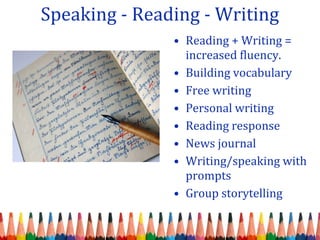
Speaking - Reading - Writing
• Reading + Writing =
increased fluency.
• Building vocabulary
• Free writing
• Personal writing
• Reading response
• News journal
• Writing/speaking with
prompts
• Group storytelling
Acronyms: What does____ stand for?
• News sources:
• AP
• UPI
• CNN
• BBC
• NPR
• AFP
• RAI
• TVE
• Famous groups:
• UNICEF
• UNESCO
• UNHCR
• MSF
• FBI, CIA, Interpol
• NASA
• WWF
• GATT, WTO
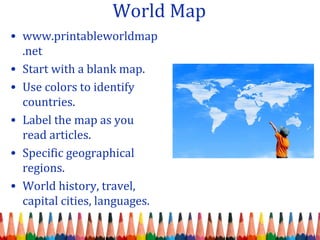
World Map
• www.printableworldmap
.net
• Start with a blank map.
• Use colors to identify
countries.
• Label the map as you
read articles.
• Specific geographical
regions.
• World history, travel,
capital cities, languages.
Activity!
Geography – Map
• Teachers needs to have one large world map on
the wall (or multiple, smaller printable maps –
free online)!
• Divide class into small groups; give each group
the name of a country.
• Explain that they need to locate the country on
the map, then write the name of the capital city,
and then the name of the bordering countries.
• PBL and homework (languages, religion, etc).
Practice with Reported Speech
• Newspaper, magazine, and internet
articles are perfect for direct/indirect
speech practice with your students.
• Change from Direct  Indirect Speech
• President Barack Obama said, “We want
to congratulate Costa Rica on the
anniversary of their independence.”
Or change from indirect 
direct speech
• President Barack Obama asked if we were
going to visit the White House the
following day.
Practice locating grammar
• Adaptable for all levels
• Print out from English news article from a
web-site, VOA, etc.
• Have students underline all the adjectives,
proper nouns, adverbs, etc.
• Then ask students to give synonyms and
antonyms for each underlined word.
Poetry from News
• Ask students to create a poem based on a news
article.
• Higher level: The content of the poem must
accurately represent the content of the article.
• Mid level: use key
words to make
poem.
• Lower level: acrostic
poem.
• All levels: Haiku
HAIKU
• Ancient form of written poetry from Japan.
• Simple 3-line pattern based on syllables.
• 5-7-5
Sample Haiku poem
My Tico country (5 syllables)
I love my beautiful home (7 syllables)
Please come visit me (5 syllables)
Haiku: Current Events (sports,
politics, etc).
************************
Soccer is my sport
Saprissa is the best team
Sorry La Liga.
************************
Try to write a ‘current events’ haiku.
Acrostic Poem
Use the first letters of a word to create a
poem.
Students should think of words that start
with each letter of the word. Encourage
creativity! Great for vocabulary building!
Let’s Try One!
• If I gave you an article using the word TICO, what
would your acrostic poem look like?
• T
• I
• C
• O
Poetry from News
• Writing: revision exercises without
intimidation.
• Reading comprehension.
• Vocabulary.
• Creativity & interest.
Warmer/stretch/break Activity!
• Students standing. Review human body
parts.
• Gets students moving, following
directions.
• Solicit the easier words. End with the
‘tongue’.
• Go into ‘Tongue-Twisters’ activity.
Tongue-Twisters
Fun phrases in English – often
using alliteration – repetitive
sounds that are often difficult
(but fun!) to pronounce when
spoken quickly.
Peter Piper
• Peter Piper picked a peck of pickled
peppers.
• How many pecks of pickled peppers
did Peter Piper pick?
Woodchuck
•How much wood could a
woodchuck chuck, if a
woodchuck could chuck
wood?
Write a Tongue-Twister
• Use as many words beginning
with “T” as possible to create a
tongue-twister about TICOS
• And one with STUDENTS using
‘S’ words
TICOS
• Twenty tall, tired, timid and terrific Ticos
tangled and tumbled too many times to
take the tawdry train to Tennessee.
Translation
• For higher-level students.
• Ask students to translate from
Spanish to English (written and oral).
• This allows them to see the differences in
grammar and vocabulary.
• You may also ask them to read an article in
Spanish and write a similar article in English
without translation.
• Simultaneous translation activity
• Write & translate ads in magazines
Audience & Bias
• Which newspapers are
biased?
• Do news sites have
particular audiences in
mind?
• Considering audience
helps students with
critical thinking.
• Pick articles of the
same topic that are
aimed at different
audiences.
• Students can pick out
subtle differences in
language.
GREAT places to find current events and articles!
• www.breakingnewsenglish.com
• www.economist.com
• www.voa.com
• www.odci.gov/cia/publications/factbook
• www.cnnfyi.com
• www.convert-me.com
• www.elibrary.com
• www.britannica.com
• www.factmonster.com
• www.gallup.com
• www.hoovers.com
• www.infoplease.com
• www.ipl.org
• www.itools.com
• www.loc.gov
• www.archives.gov
• www.si.edu
• www.census.gov
• http://stats.bls.gov
• www.fedstats.gov
• https://www.facebook.com/voa60
•
•
BINGO Song
There was a farmer
who had a dog,
and Bingo was his name-oh!
B-I-N-G-O (x3)
And Bingo was his name-oh!
Itsy-Bitsy Spider
Itsy-bitsy spider
went up the water spout.
Down came the rain
and washed the spider out.
Out came the sun
and dried up all the rain.
Itsy-bitsy spider
went up the spout again!
Muchas gracias!
Thank you very much!
And a big GRACIAS for the support from APCD Kevin Brown!
Teaching Current Events in the ESL Classroom

Teaching Current Events in the ESL Classroom

  • 1.
    Teaching Current Eventsin the ESL Classroom ************ David Burns Peace Corps Response Univ. Latina – Santa Cruz, Costa Rica 7 April 2015
  • 3.
    Contact Information • DavidBurns – Santa Cruz, Guanacaste • www.facebook.com/EnglishOnTheMove • www.facebook.com/Rayuelando • ‘Like’ my Facebook page for updates and links to TEFL topics, lesson plans, photos, teaching ideas, and more! • Email: EnglishOnTheMove27@gmail.com • Mobile: 8416 2367
  • 4.
    Get Your Students’Attention • One, Two, Three – Eyes on me! (Teacher) • One, Two – Eyes on you! (Students)
  • 5.
    Warmer & FillerActivities • http://eslgamesbox.com/more-no-prep-warmer • http://busyteacher.org/teaching_ideas_and_te • http://www.onestopenglish.com/teenagers/skill • http://www.simplyesl.com/categories/esl-activit • https://teachertrove.wikispaces.com/Warmers+
  • 6.
    Alliteration Name Game •Introductions • Public Speaking • Memorization • Subject & Possessive Pronouns (She, her) • Vocabulary for JOBS • Descriptive Adjectives • Alliteration (repetition of the same sound)
  • 7.
    If it weren’tfor the last minute, nothing would get done.
  • 8.
    Procrastination • Procrastination –Procrastinate – Procrastinators: • Practice conditionals (C2) • If it weren’t for the last minute, nothing would ever get done. • Nothing would ever get done, if it weren’t for the last minute. • Would anything ever get done if it weren’t for the last minute?
  • 9.
    Ice-breaker! • Introduction name/memorygame. • Organize your students in a standing circle and explain the game. • Each student will give their name, followed by an imaginary profession that starts with the same letter as the 1st letter of their name. • “My name is David and I am a ____________. • The following student must first remember all the previous names and jobs and then introduce themselves.
  • 10.
    Where Do YouGet Your News? International (English) • CNN • New York Times • Washington Post • BBC • The Guardian • Al-Jazeera English • VOA (VOA 60) • NPR Costa Rica • La Nacion • La Teja • Tico Times • TeleTica • TV/Radio • Radio2
  • 18.
    American English On-line •http://exchanges.state.gov/americanenglishon • Sing Out Loud http://exchanges.state.gov/englishteaching/resfo • Shaping the Way We Teach English http://exchanges.state.gov/englishteaching/r esforteach/pubcat/teach-res- mat/teachtech/shapingway.html
  • 19.
  • 22.
    Contact information: • U.S.Embassy in San Jose • IRC (Information Resource Center) • Ligia Alpizar – IRC Director • alpizarlm@state.gov • http://sanjose.usembassy.gov • https://www.facebook.com/sanjose.usemb assy
  • 27.
  • 29.
  • 33.
    Writing & SpeakingPrompts • CreativeWritingPrompts.com • WritersDigest.com • Creative-Writing-Solutions.com • Quick exercise using any prompt from one of the above websites.
  • 34.
  • 37.
    Selecting Articles • Thereis news about everything. • Plan by level: – Level 1: personal information, transportation. – Level 2: geographical places, qualities & attributes of people, recycling, sports. – Level 3: Nationalities, music, lifestyle. – Level 4: World problems, environment. – Level 5: Family concept, mass media, human rights, democracy, philosophy, religion, etc.
  • 38.
    Selecting Articles • Selectand translate. • For English articles: even those with complex vocabulary can be modified. • Simplify the language; shorten the article. • Or – if not modified, use the vocabulary; use the article for a longer period of time.
  • 39.
    Useful Activities • WorldMap/Geo • Reading / Writing • Poetry/Photos • Speaking/Role Play/Theater • Translation • Audience & bias • Videos/PBL/Liste ning
  • 40.
    Speaking - Reading- Writing • Reading + Writing = increased fluency. • Building vocabulary • Free writing • Personal writing • Reading response • News journal • Writing/speaking with prompts • Group storytelling
  • 41.
    Acronyms: What does____stand for? • News sources: • AP • UPI • CNN • BBC • NPR • AFP • RAI • TVE • Famous groups: • UNICEF • UNESCO • UNHCR • MSF • FBI, CIA, Interpol • NASA • WWF • GATT, WTO
  • 42.
    World Map • www.printableworldmap .net •Start with a blank map. • Use colors to identify countries. • Label the map as you read articles. • Specific geographical regions. • World history, travel, capital cities, languages.
  • 43.
    Activity! Geography – Map •Teachers needs to have one large world map on the wall (or multiple, smaller printable maps – free online)! • Divide class into small groups; give each group the name of a country. • Explain that they need to locate the country on the map, then write the name of the capital city, and then the name of the bordering countries. • PBL and homework (languages, religion, etc).
  • 44.
    Practice with ReportedSpeech • Newspaper, magazine, and internet articles are perfect for direct/indirect speech practice with your students. • Change from Direct  Indirect Speech • President Barack Obama said, “We want to congratulate Costa Rica on the anniversary of their independence.”
  • 45.
    Or change fromindirect  direct speech • President Barack Obama asked if we were going to visit the White House the following day.
  • 46.
    Practice locating grammar •Adaptable for all levels • Print out from English news article from a web-site, VOA, etc. • Have students underline all the adjectives, proper nouns, adverbs, etc. • Then ask students to give synonyms and antonyms for each underlined word.
  • 47.
    Poetry from News •Ask students to create a poem based on a news article. • Higher level: The content of the poem must accurately represent the content of the article. • Mid level: use key words to make poem. • Lower level: acrostic poem. • All levels: Haiku
  • 48.
    HAIKU • Ancient formof written poetry from Japan. • Simple 3-line pattern based on syllables. • 5-7-5
  • 49.
    Sample Haiku poem MyTico country (5 syllables) I love my beautiful home (7 syllables) Please come visit me (5 syllables)
  • 50.
    Haiku: Current Events(sports, politics, etc). ************************ Soccer is my sport Saprissa is the best team Sorry La Liga. ************************ Try to write a ‘current events’ haiku.
  • 51.
    Acrostic Poem Use thefirst letters of a word to create a poem. Students should think of words that start with each letter of the word. Encourage creativity! Great for vocabulary building!
  • 52.
    Let’s Try One! •If I gave you an article using the word TICO, what would your acrostic poem look like? • T • I • C • O
  • 53.
    Poetry from News •Writing: revision exercises without intimidation. • Reading comprehension. • Vocabulary. • Creativity & interest.
  • 54.
    Warmer/stretch/break Activity! • Studentsstanding. Review human body parts. • Gets students moving, following directions. • Solicit the easier words. End with the ‘tongue’. • Go into ‘Tongue-Twisters’ activity.
  • 55.
    Tongue-Twisters Fun phrases inEnglish – often using alliteration – repetitive sounds that are often difficult (but fun!) to pronounce when spoken quickly.
  • 56.
    Peter Piper • PeterPiper picked a peck of pickled peppers. • How many pecks of pickled peppers did Peter Piper pick?
  • 57.
    Woodchuck •How much woodcould a woodchuck chuck, if a woodchuck could chuck wood?
  • 58.
    Write a Tongue-Twister •Use as many words beginning with “T” as possible to create a tongue-twister about TICOS • And one with STUDENTS using ‘S’ words
  • 59.
    TICOS • Twenty tall,tired, timid and terrific Ticos tangled and tumbled too many times to take the tawdry train to Tennessee.
  • 60.
    Translation • For higher-levelstudents. • Ask students to translate from Spanish to English (written and oral). • This allows them to see the differences in grammar and vocabulary. • You may also ask them to read an article in Spanish and write a similar article in English without translation. • Simultaneous translation activity • Write & translate ads in magazines
  • 61.
    Audience & Bias •Which newspapers are biased? • Do news sites have particular audiences in mind? • Considering audience helps students with critical thinking. • Pick articles of the same topic that are aimed at different audiences. • Students can pick out subtle differences in language.
  • 62.
    GREAT places tofind current events and articles! • www.breakingnewsenglish.com • www.economist.com • www.voa.com • www.odci.gov/cia/publications/factbook • www.cnnfyi.com • www.convert-me.com • www.elibrary.com • www.britannica.com • www.factmonster.com • www.gallup.com • www.hoovers.com • www.infoplease.com • www.ipl.org • www.itools.com • www.loc.gov • www.archives.gov • www.si.edu • www.census.gov • http://stats.bls.gov • www.fedstats.gov • https://www.facebook.com/voa60 • •
  • 63.
    BINGO Song There wasa farmer who had a dog, and Bingo was his name-oh! B-I-N-G-O (x3) And Bingo was his name-oh!
  • 64.
    Itsy-Bitsy Spider Itsy-bitsy spider wentup the water spout. Down came the rain and washed the spider out. Out came the sun and dried up all the rain. Itsy-bitsy spider went up the spout again!
  • 65.
  • 66.
    And a bigGRACIAS for the support from APCD Kevin Brown!