LEARNING WITH
SONGS
Sara Falagán Izquierdo
Isabel Rojo Santamaría
Elena Castro Queipo
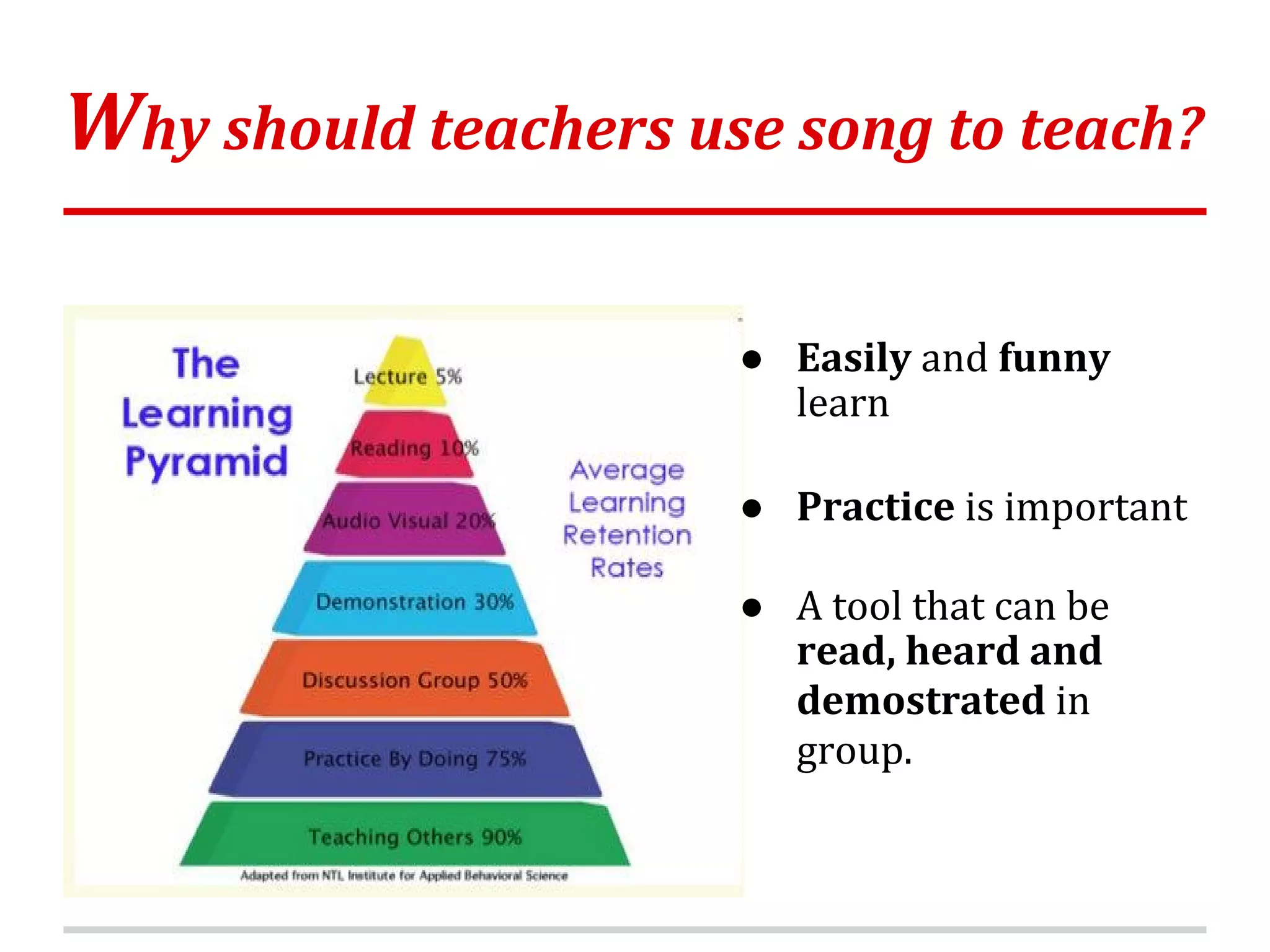
Why should teachers use song to teach?
● Easily and funny
learn
● Practice is important
● A tool that can be
read, heard and
demostrated in
group.
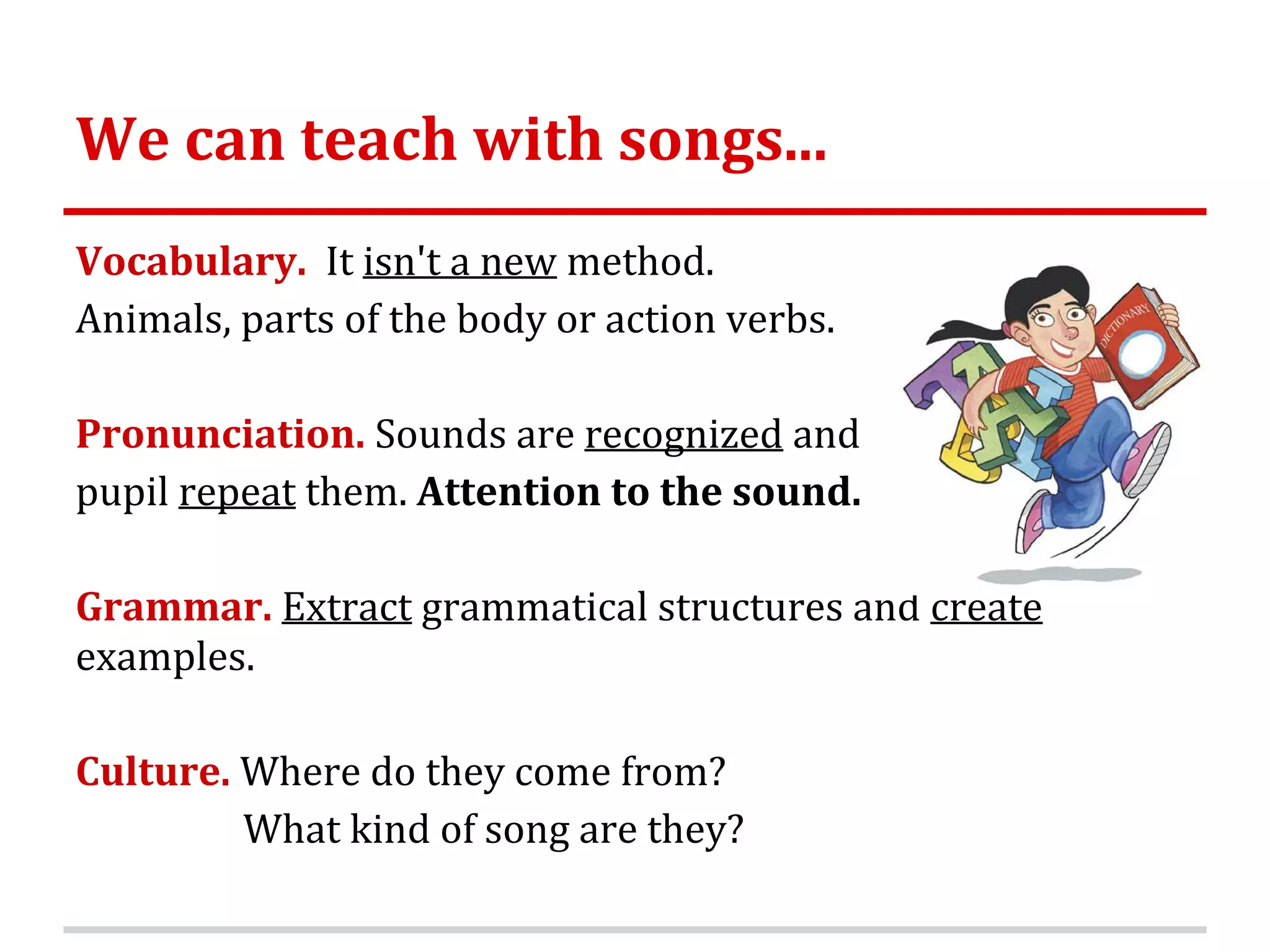
We can teach with songs...
Vocabulary. It isn't a new method.
Animals, parts of the body or action verbs.
Pronunciation. Sounds are recognized and
pupil repeat them. Attention to the sound.
Grammar. Extract grammatical structures and create
examples.
Culture. Where do they come from?
What kind of song are they?
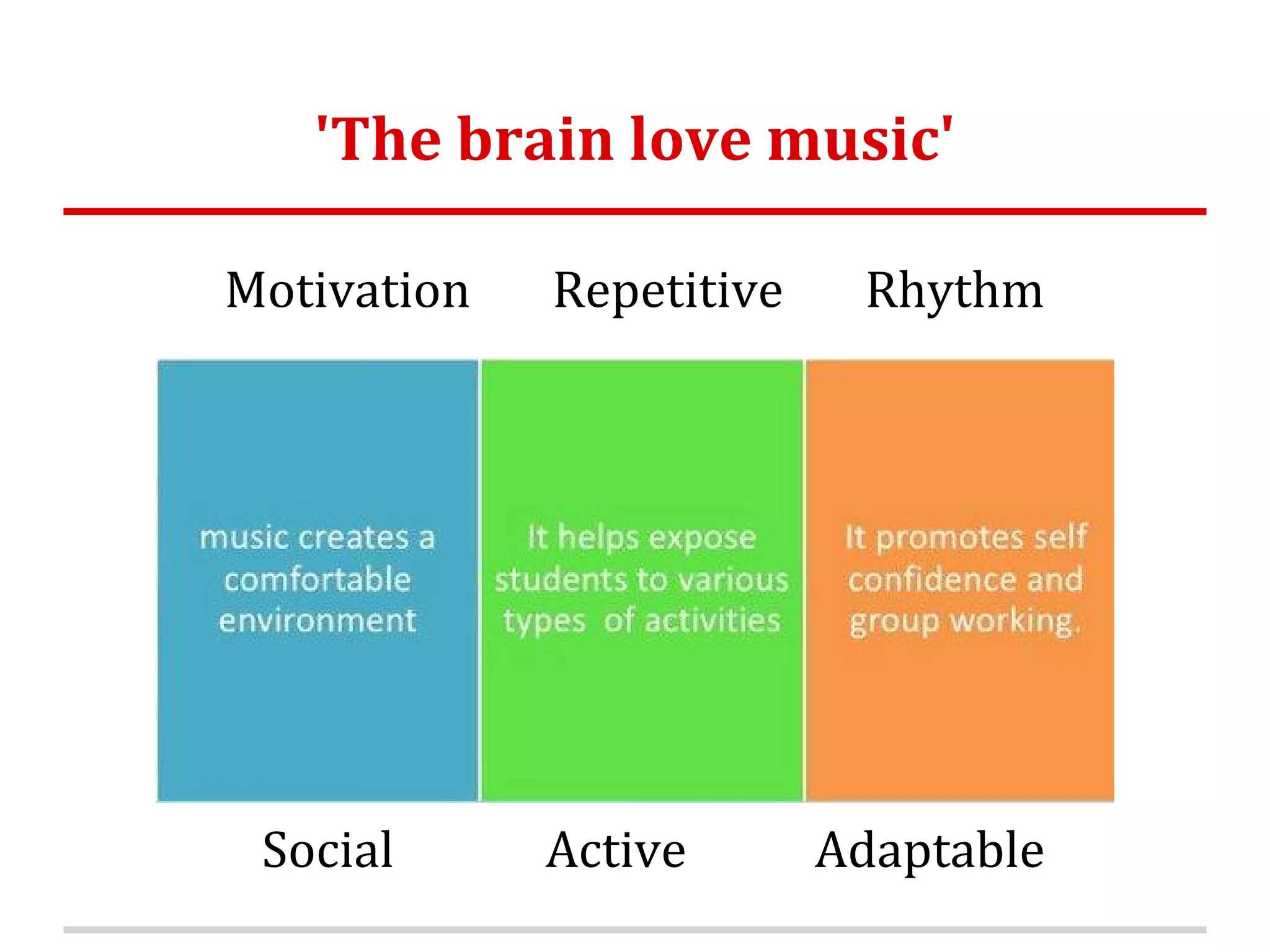
'The brain love music'
Motivation Repetitive Rhythm
Social Active Adaptable
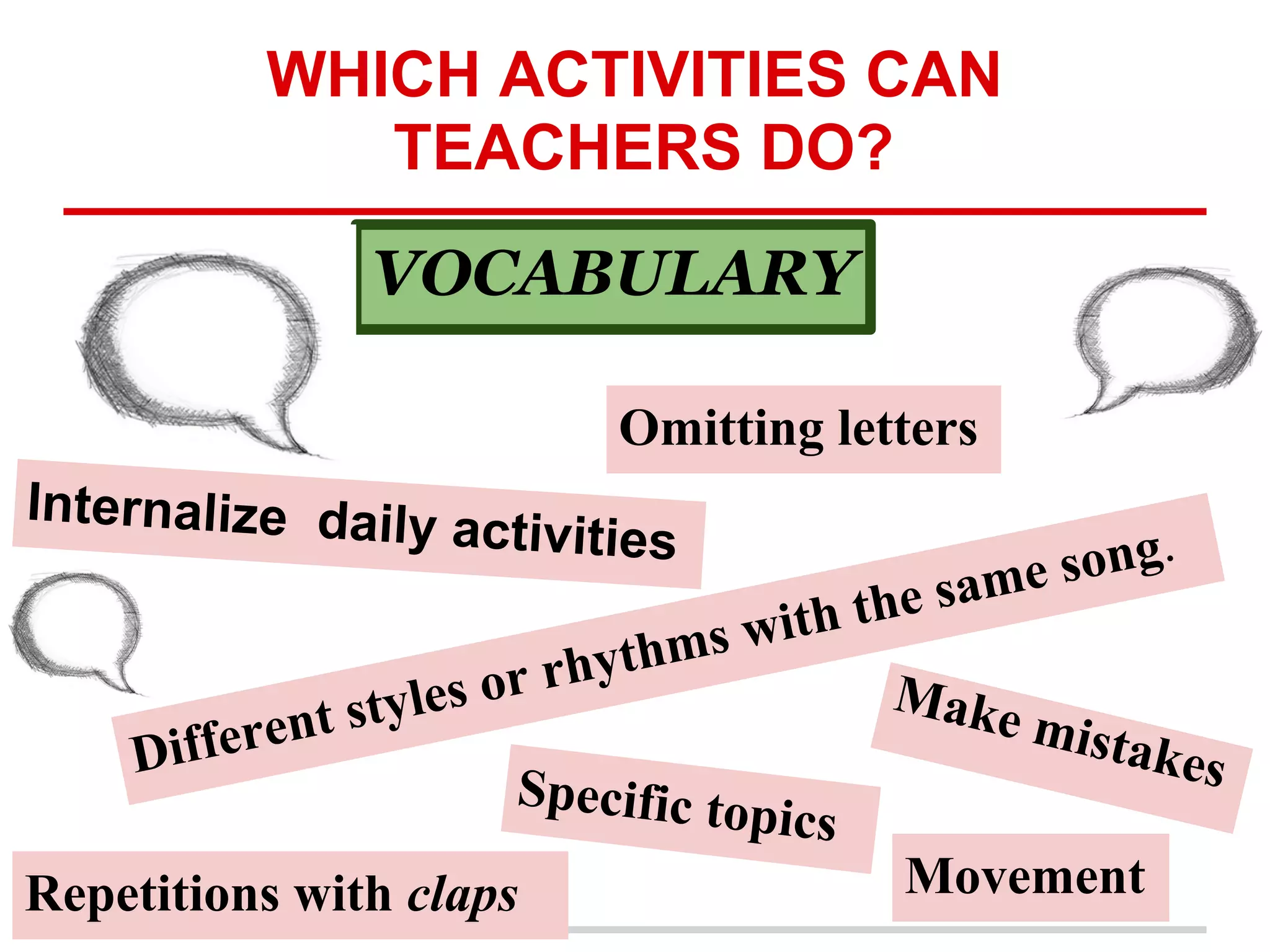
WHICH ACTIVITIES CAN
TEACHERS DO?
VOCABULARY
Repetitions with claps
Specific topics
Omitting letters
Make mistakes
Movement
Internalize daily activities
Different styles or rhythms with the same song.
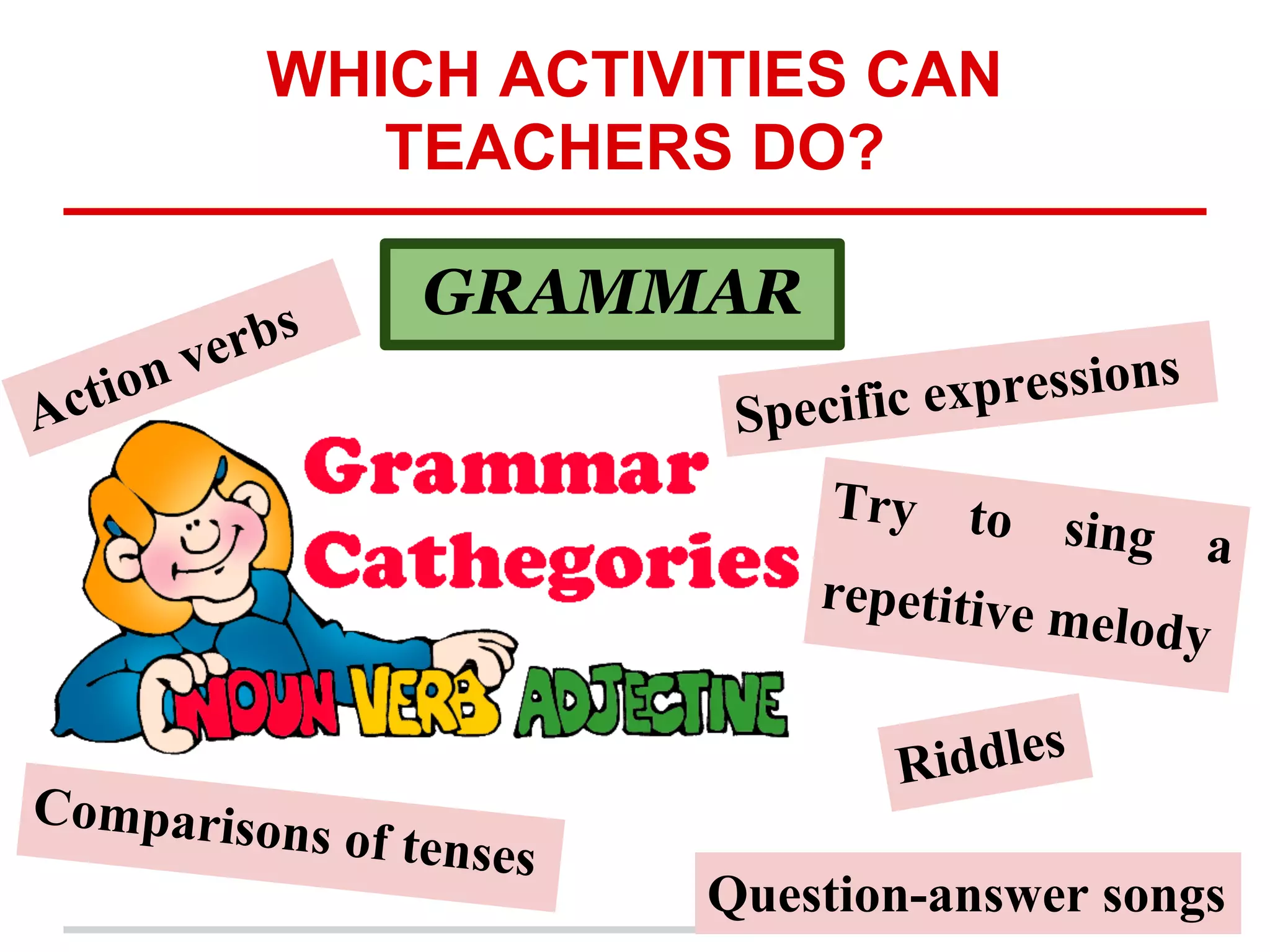
WHICH ACTIVITIES CAN
TEACHERS DO?
GRAMMAR
Comparisons of tenses
Question-answer songs
Action verbs
Riddles
Specific expressions
Try to sing a
repetitive melody
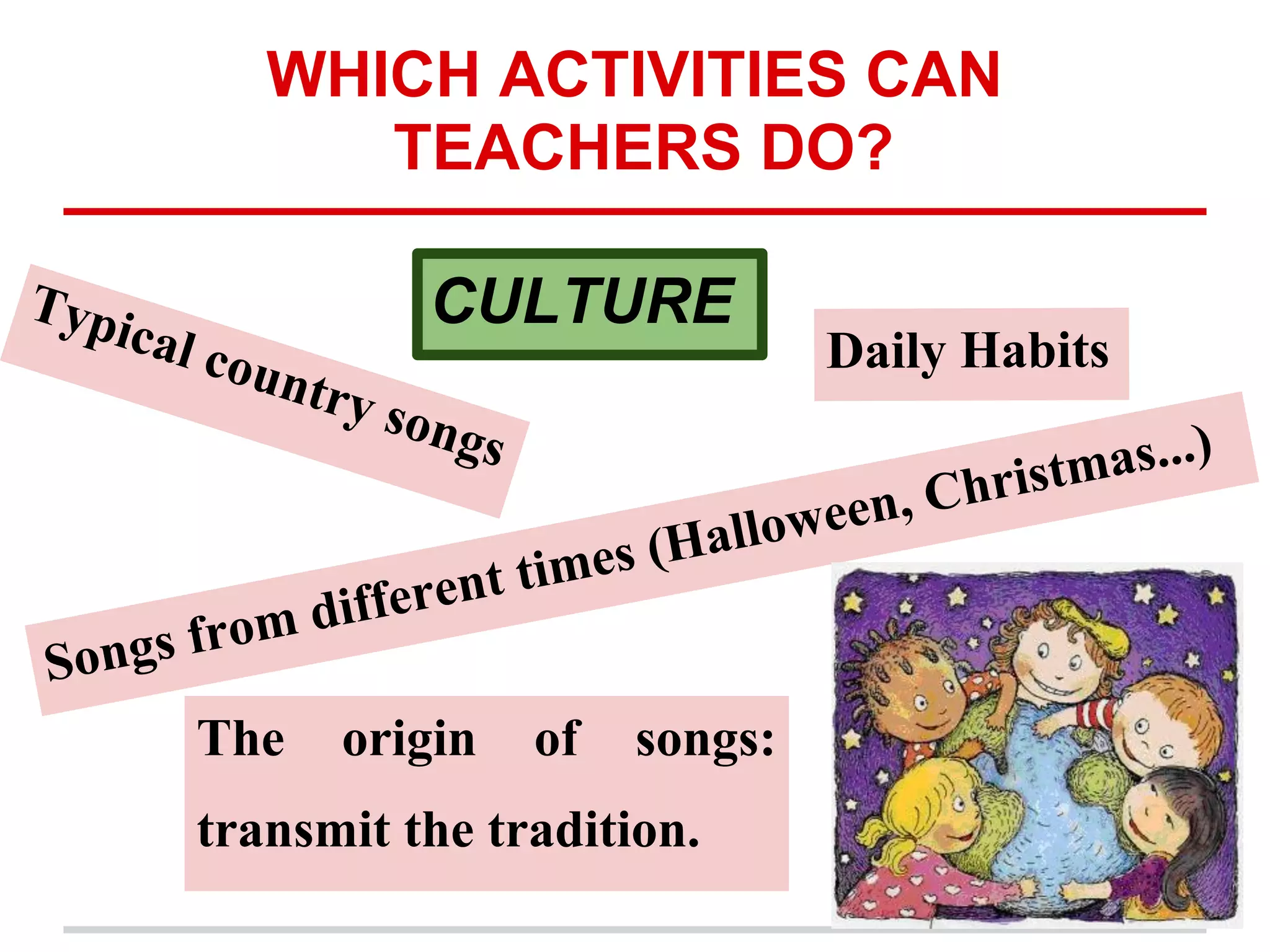
WHICH ACTIVITIES CAN
TEACHERS DO?
CULTURETypical country songs
Songs from different times (Halloween, Christmas...)
Daily Habits
The origin of songs:
transmit the tradition.
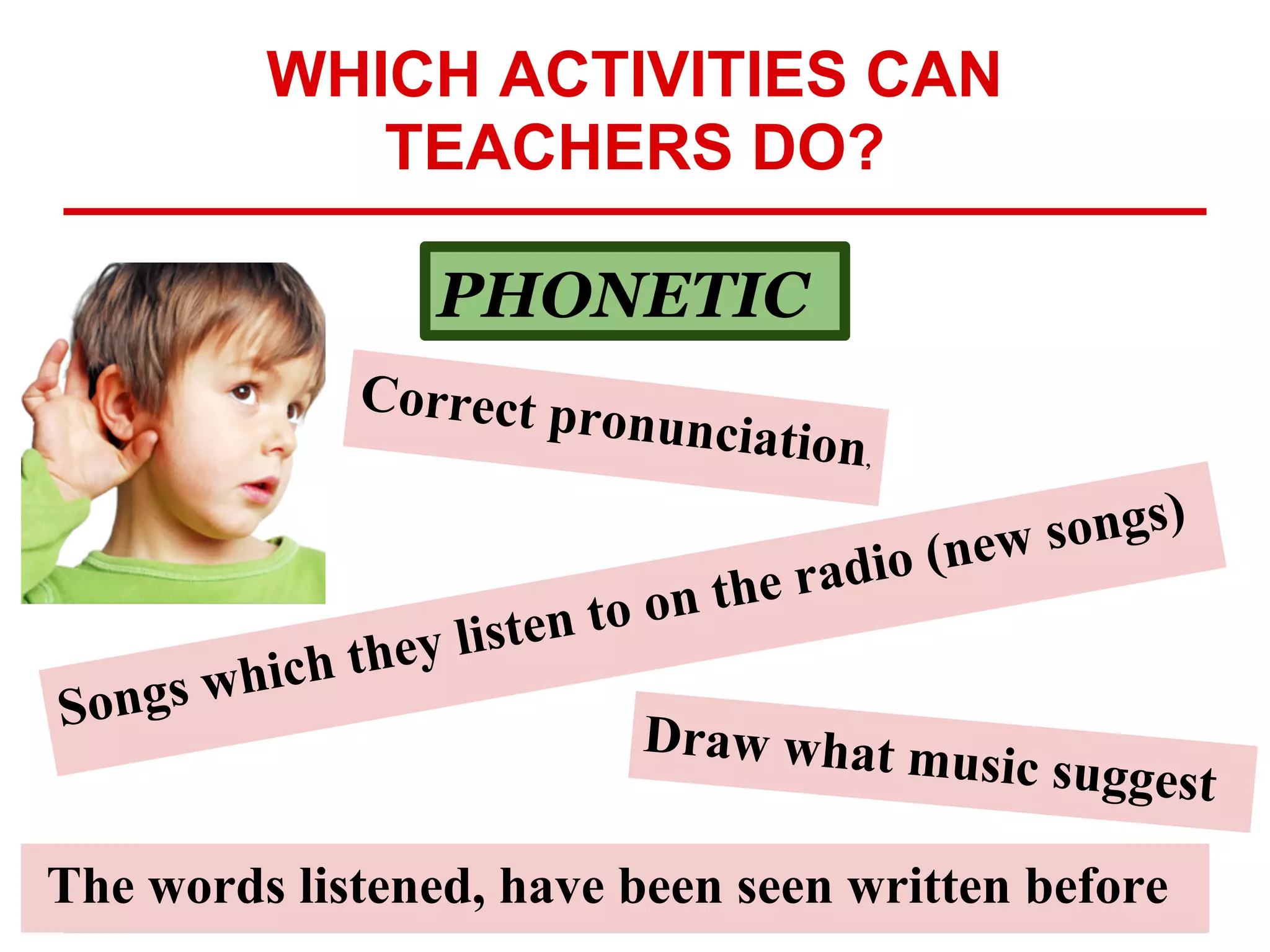
WHICH ACTIVITIES CAN
TEACHERS DO?
PHONETIC
Songs which they listen to on the radio (new songs)
Draw what music suggest
Correct pronunciation,
The words listened, have been seen written before
WHICH ACTIVITIES CAN
TEACHERS DO?
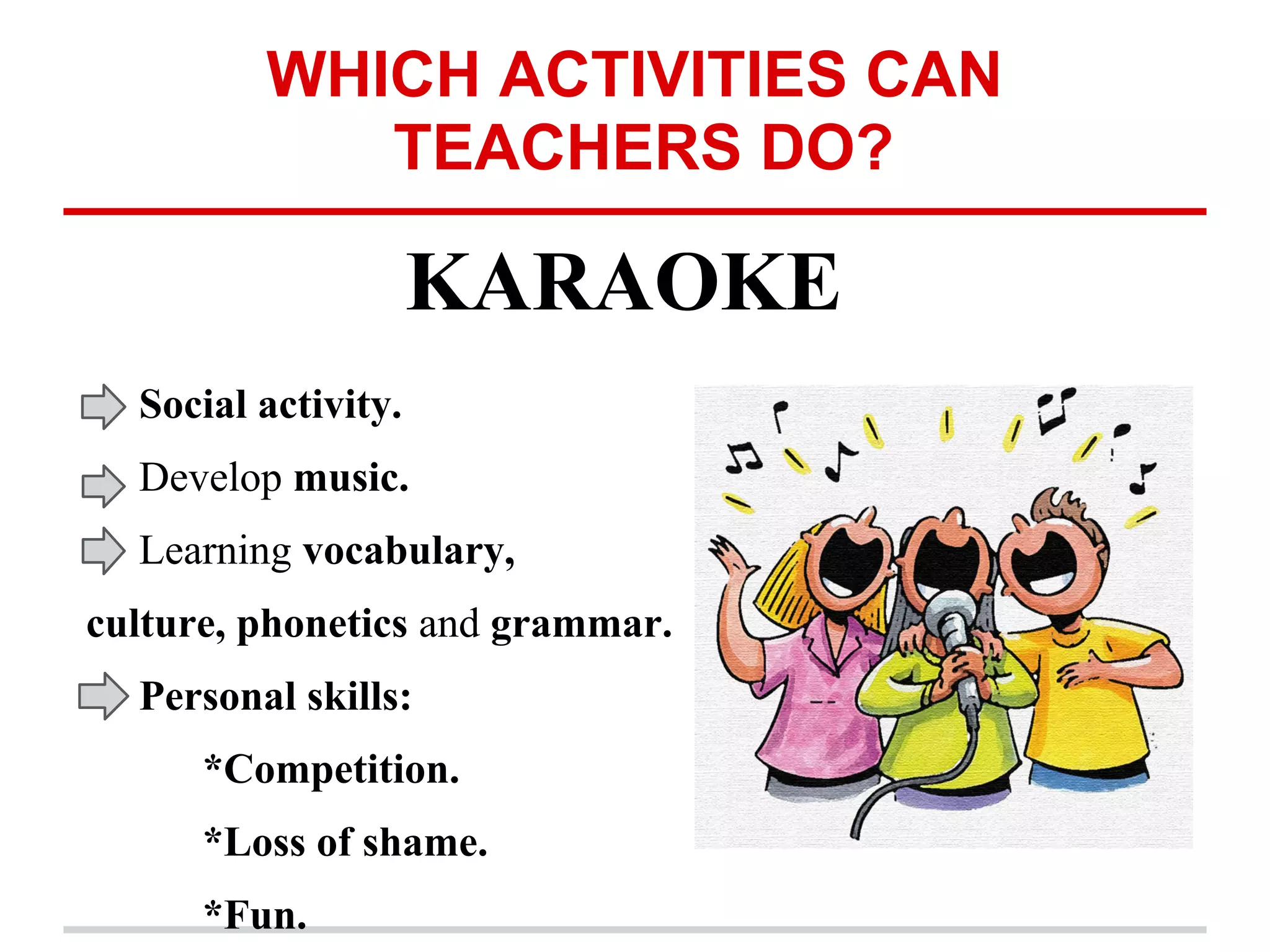
KARAOKE
Social activity.
Develop music.
Learning vocabulary,
culture, phonetics and grammar.
Personal skills:
*Competition.
*Loss of shame.
*Fun.
WHICH ACTIVITIES CAN
TEACHERS DO?
JAZZ CHANTS
Lots of possibilities to work with, even improvisation.
All ages, topics, grammar structures etc.
The main thing is follow the Jazz rhythm.
TYPE OF SONGS THAT YOU CAN FIND
In differents pages, you can find:
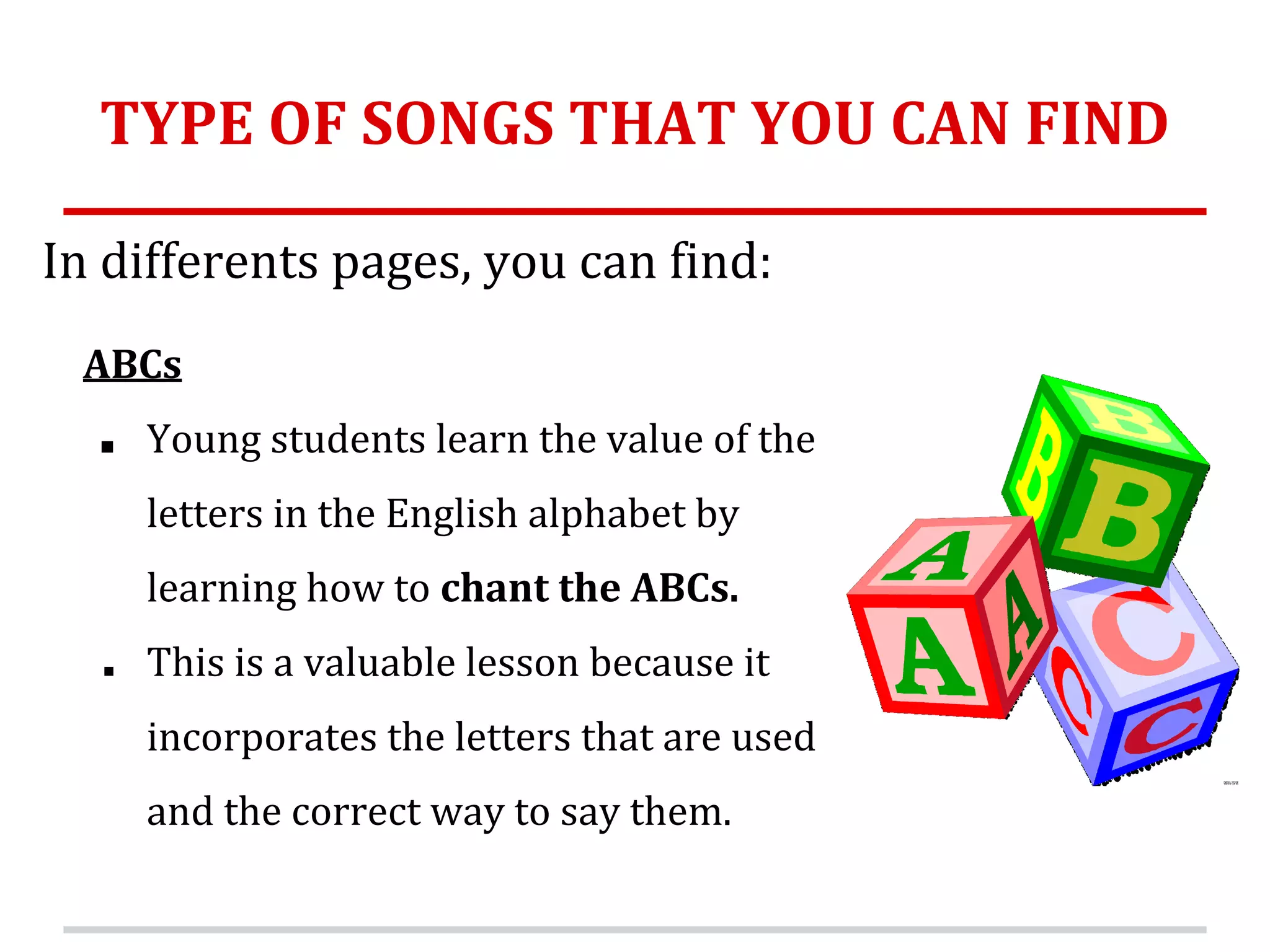
ABCs
■ Young students learn the value of the
letters in the English alphabet by
learning how to chant the ABCs.
■ This is a valuable lesson because it
incorporates the letters that are used
and the correct way to say them.
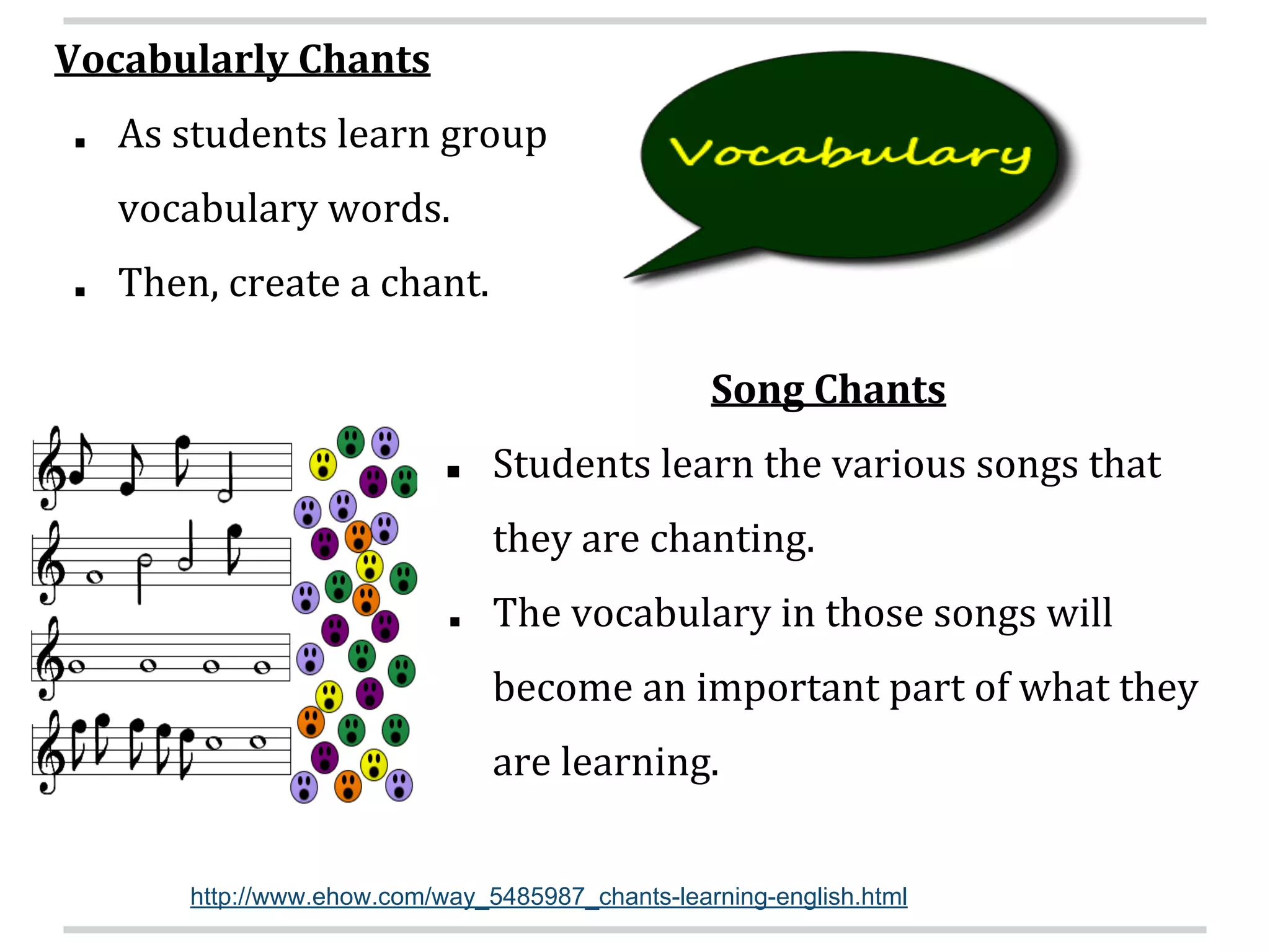
Vocabularly Chants
■ As students learn group
vocabulary words.
■ Then, create a chant.
Song Chants
■ Students learn the various songs that
they are chanting.
■ The vocabulary in those songs will
become an important part of what they
are learning.
http://www.ehow.com/way_5485987_chants-learning-english.html
PAGES
1. Dream Emglish
2. Anglomanicy
3. Teach Children ESL
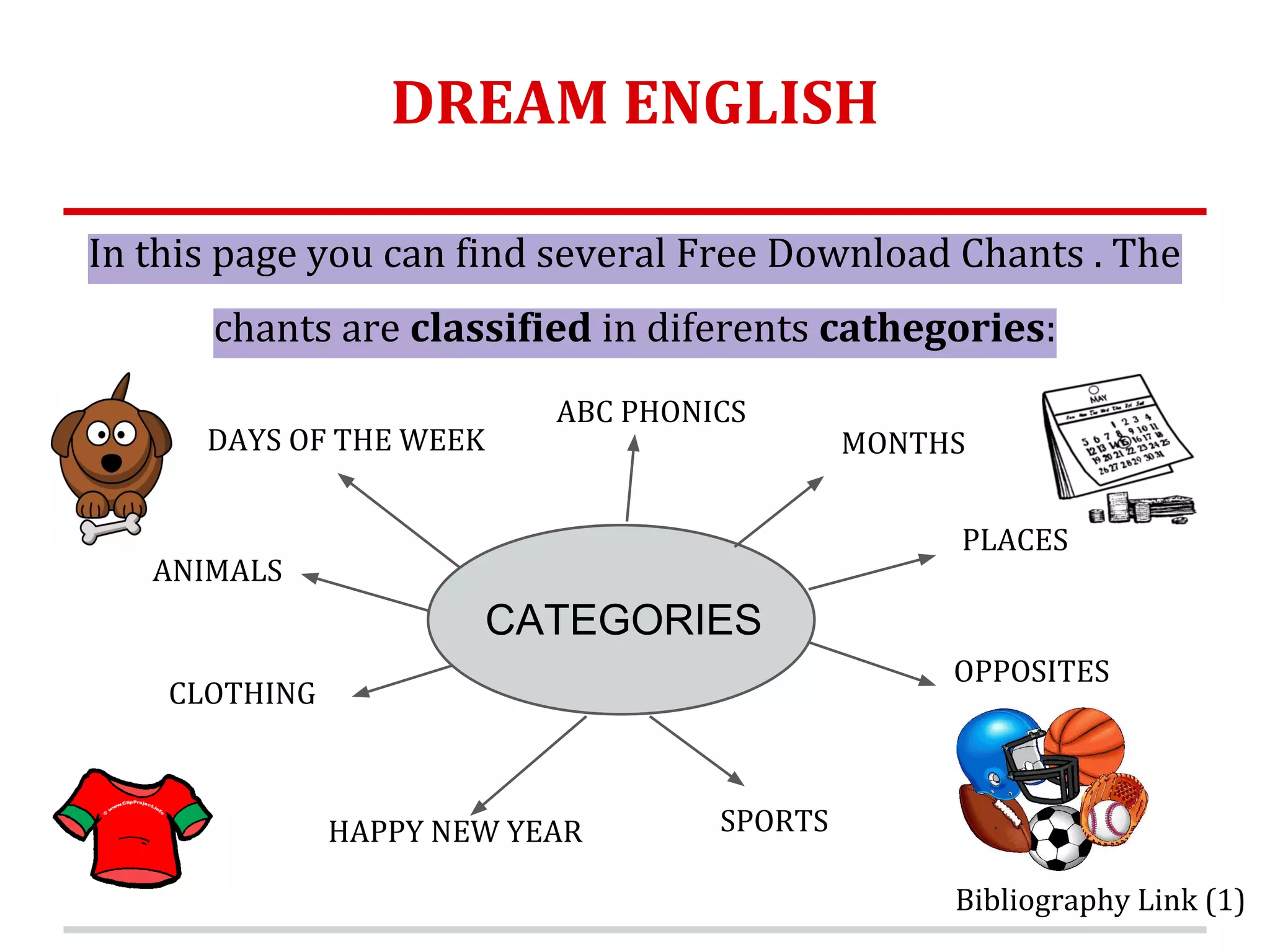
DREAM ENGLISH
In this page you can find several Free Download Chants . The
chants are classified in diferents cathegories:
CATEGORIES
ABC PHONICS
ANIMALS
MONTHS
CLOTHING
DAYS OF THE WEEK
SPORTSHAPPY NEW YEAR
OPPOSITES
PLACES
Bibliography Link (1)
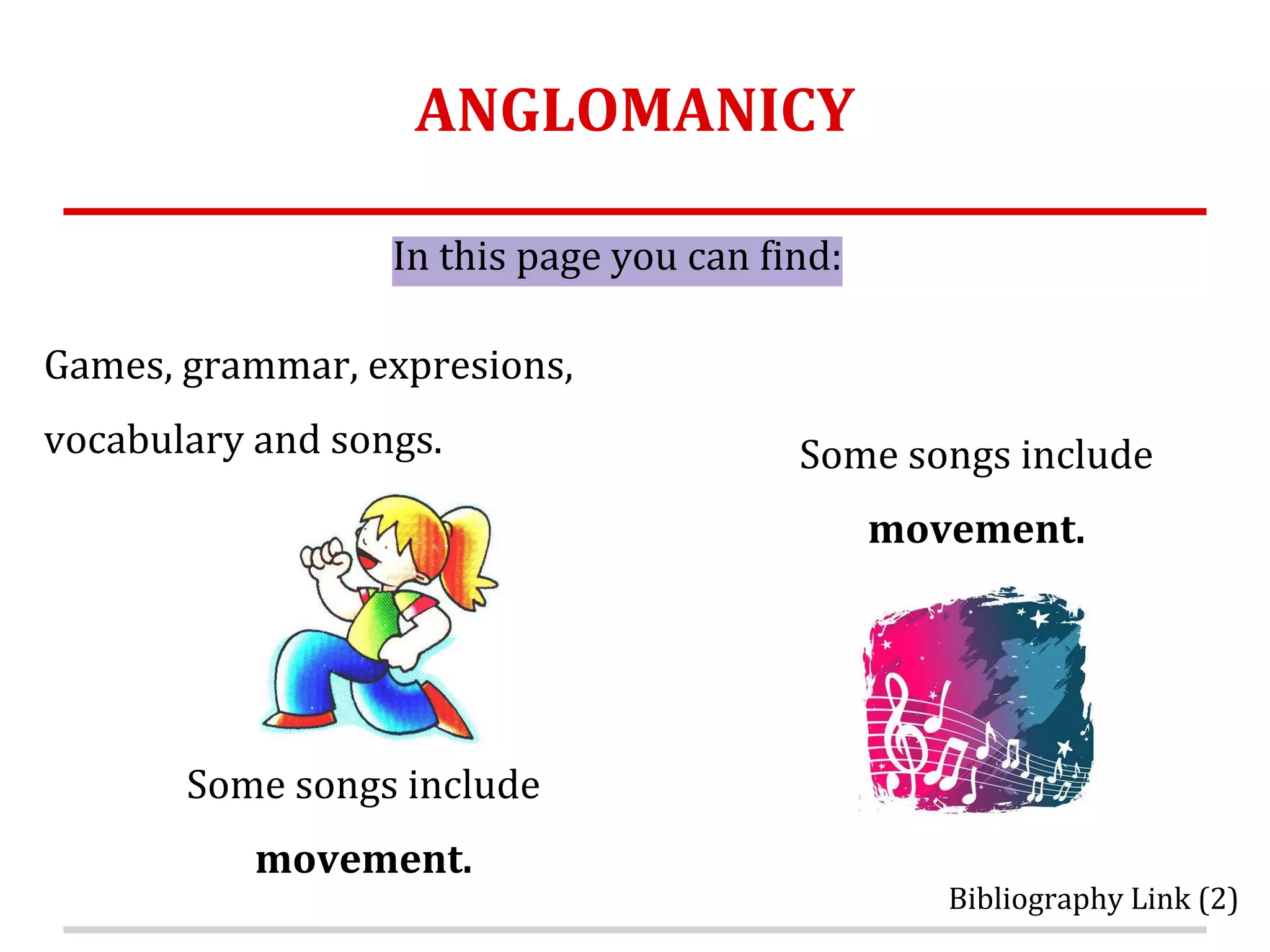
ANGLOMANICY
Games, grammar, expresions,
vocabulary and songs.
In this page you can find:
Some songs include
movement.
Some songs include
movement.
Bibliography Link (2)
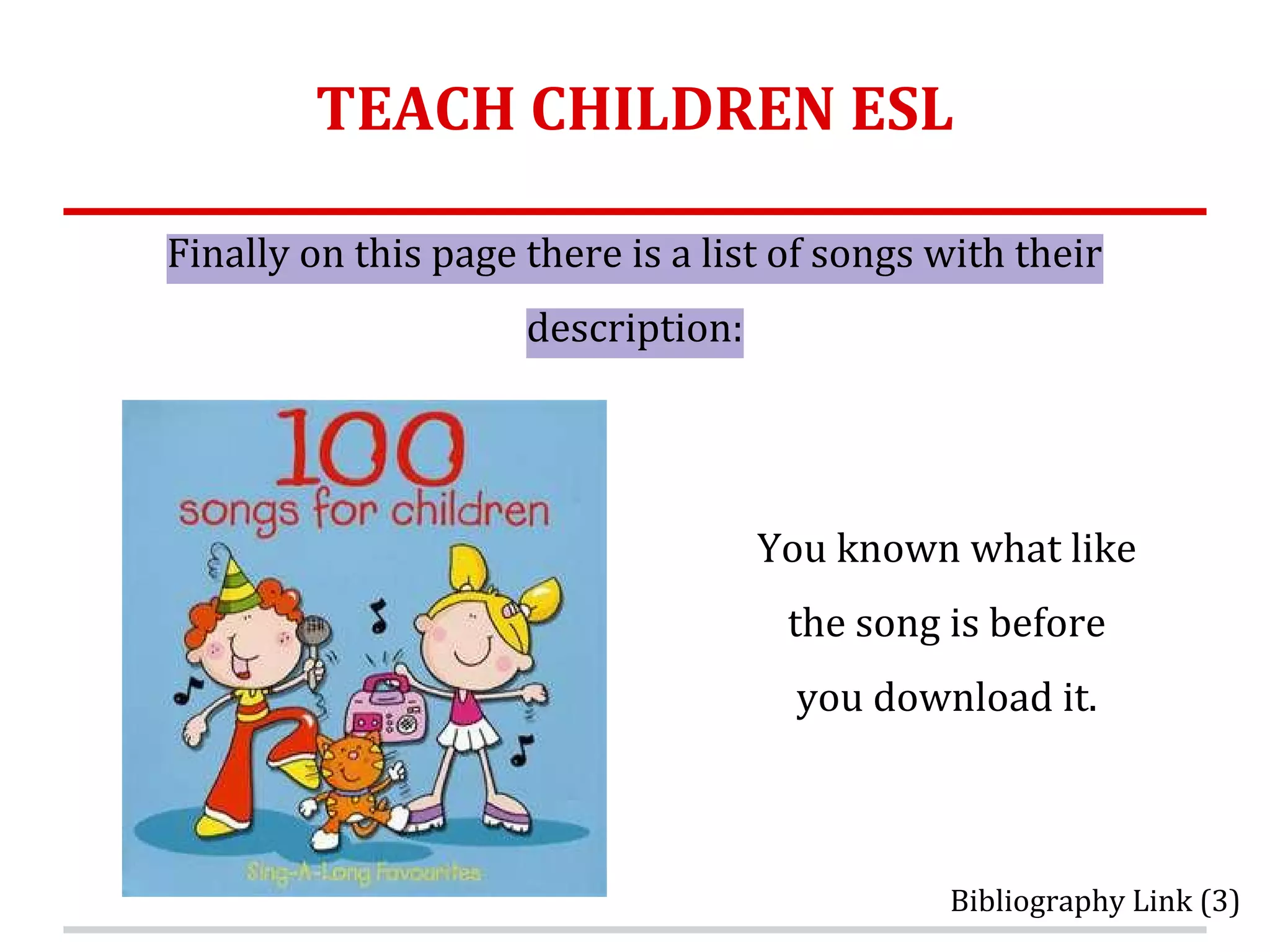
TEACH CHILDREN ESL
Finally on this page there is a list of songs with their
description:
You known what like
the song is before
you download it.
Bibliography Link (3)
Bibliography
Carolyn Graham (2011) Seen on http://jazzchants.net/
BBC Teaching English (2012) 'Using songs in the classroom'
Seen on http://www.teachingenglish.org.uk/tips/using-songs-classroom
David Deubelbeiss (2011) 'Using songs in the efl classroom'
Seen on http://www.slideshare.net/ddeubel/using-songs-in-the-efl-classroom
Types of songs. Seen on http://www.ehow.com/way_5485987_chants-learning-english.
html
http://dreaminenglish.wordpress.com/2008/05/09/teaching-children-english-
with-chants/ (1)
http://anglomaniacy.pl/carol3.htm (2)
http://www.teachchildrenesl.com/songs.htm (3)

Inglés ppt

  • 1.
    LEARNING WITH SONGS Sara FalagánIzquierdo Isabel Rojo Santamaría Elena Castro Queipo
  • 2.
    Why should teachersuse song to teach? ● Easily and funny learn ● Practice is important ● A tool that can be read, heard and demostrated in group.
  • 3.
    We can teachwith songs... Vocabulary. It isn't a new method. Animals, parts of the body or action verbs. Pronunciation. Sounds are recognized and pupil repeat them. Attention to the sound. Grammar. Extract grammatical structures and create examples. Culture. Where do they come from? What kind of song are they?
  • 4.
    'The brain lovemusic' Motivation Repetitive Rhythm Social Active Adaptable
  • 5.
    WHICH ACTIVITIES CAN TEACHERSDO? VOCABULARY Repetitions with claps Specific topics Omitting letters Make mistakes Movement Internalize daily activities Different styles or rhythms with the same song.
  • 6.
    WHICH ACTIVITIES CAN TEACHERSDO? GRAMMAR Comparisons of tenses Question-answer songs Action verbs Riddles Specific expressions Try to sing a repetitive melody
  • 7.
    WHICH ACTIVITIES CAN TEACHERSDO? CULTURETypical country songs Songs from different times (Halloween, Christmas...) Daily Habits The origin of songs: transmit the tradition.
  • 8.
    WHICH ACTIVITIES CAN TEACHERSDO? PHONETIC Songs which they listen to on the radio (new songs) Draw what music suggest Correct pronunciation, The words listened, have been seen written before
  • 9.
    WHICH ACTIVITIES CAN TEACHERSDO? KARAOKE Social activity. Develop music. Learning vocabulary, culture, phonetics and grammar. Personal skills: *Competition. *Loss of shame. *Fun.
  • 10.
    WHICH ACTIVITIES CAN TEACHERSDO? JAZZ CHANTS Lots of possibilities to work with, even improvisation. All ages, topics, grammar structures etc. The main thing is follow the Jazz rhythm.
  • 11.
    TYPE OF SONGSTHAT YOU CAN FIND In differents pages, you can find: ABCs ■ Young students learn the value of the letters in the English alphabet by learning how to chant the ABCs. ■ This is a valuable lesson because it incorporates the letters that are used and the correct way to say them.
  • 12.
    Vocabularly Chants ■ Asstudents learn group vocabulary words. ■ Then, create a chant. Song Chants ■ Students learn the various songs that they are chanting. ■ The vocabulary in those songs will become an important part of what they are learning. http://www.ehow.com/way_5485987_chants-learning-english.html
  • 13.
    PAGES 1. Dream Emglish 2.Anglomanicy 3. Teach Children ESL
  • 14.
    DREAM ENGLISH In thispage you can find several Free Download Chants . The chants are classified in diferents cathegories: CATEGORIES ABC PHONICS ANIMALS MONTHS CLOTHING DAYS OF THE WEEK SPORTSHAPPY NEW YEAR OPPOSITES PLACES Bibliography Link (1)
  • 15.
    ANGLOMANICY Games, grammar, expresions, vocabularyand songs. In this page you can find: Some songs include movement. Some songs include movement. Bibliography Link (2)
  • 16.
    TEACH CHILDREN ESL Finallyon this page there is a list of songs with their description: You known what like the song is before you download it. Bibliography Link (3)
  • 17.
    Bibliography Carolyn Graham (2011)Seen on http://jazzchants.net/ BBC Teaching English (2012) 'Using songs in the classroom' Seen on http://www.teachingenglish.org.uk/tips/using-songs-classroom David Deubelbeiss (2011) 'Using songs in the efl classroom' Seen on http://www.slideshare.net/ddeubel/using-songs-in-the-efl-classroom Types of songs. Seen on http://www.ehow.com/way_5485987_chants-learning-english. html
  • 18.