Songs in the
 Classroom:
A Useful Tool
Kathiuska Murcia Cortes
       FUNLAM
         2012
Songs are part of daily life…

  Who doesn’t enjoy music at home, while
   travelling or studying, or even at work?
Language teachers can use songs to open
or close their lessons, to illustrate themes
and topics, to add variety or a change of
pace, present new vocabulary or recycle
known language. But how do songs actually
benefit your students?
A useful tool


There is strong practical evidence supporting the use
of music in the English language classroom; there is
also a growing body of research confirming that songs
are a useful tool in language acquisition. In fact
musical and language processing occur in the same
area of the brain. (Medina, 1993)
Studies have shown that music...

• Improves concentration
• Improves memory
• Brings a sense of community to a group
• Motivates learning
• Relaxes people who are
overwhelmed or stressed
• Makes learning fun
• Helps people absorb material
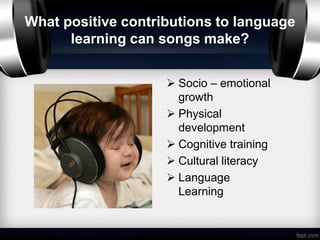
What positive contributions to language
      learning can songs make?


                     Socio – emotional
                      growth
                     Physical
                      development
                     Cognitive training
                     Cultural literacy
                     Language
                      Learning
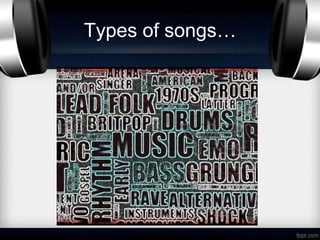
Types of songs…
Types of songs


 There are many types of songs which can be used in
  the classroom, ranging from nursery rhymes to
  contemporary pop music.
 There is also a lot of music written specifically for
  English language teaching
 ‘Real’ music that students hear and play every day can
  be extremely motivating in the classroom, too.

 WATCH OUT ! the lyrics may not always be suitable
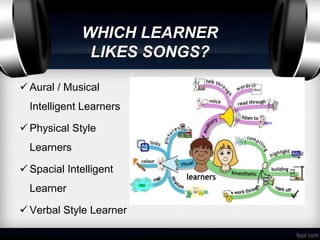
WHICH LEARNER
              LIKES SONGS?

 Aural / Musical
  Intelligent Learners

 Physical Style
  Learners

 Spacial Intelligent
  Learner

 Verbal Style Learner
Why are songs so suitable?
                Pop songs help learning a
                   second language:

• Contain
  common, short
  words
                                      • Lyrics are often sung at
• Language is
                                        a slower rate than
  conversational                        spoken words.
• Time and place are                  • There is repetition of
  usually imprecise                     words and grammar
                                      • Motivate learners to
                                        learn

                 Murphy (1992)
REFERENCES AND
             CIBERGRAPHY

 Lems, Kirsten, Using Music in the Adult ESL Classroom, ERIC Digest,
2001.
• Medina, Suzanne L, The Effect of Music on Second Language
Vocabulary Acquisition, ‘National Network for Early Language
Learning’, Vol 6-3, 1993.
• Murphy, T (1992), The discourse op pop songs, TESOL Quarterly
26”(4), 770-774.
• http:// www.englishclub.com/teaching-tips/music-classroom.htm
• http://www.eslbase.com/articles/songs
• http://www.eslbase.com/articles/pop-songs

Songs in the classroom

  • 1.
    Songs in the Classroom: A Useful Tool Kathiuska Murcia Cortes FUNLAM 2012
  • 2.
    Songs are partof daily life… Who doesn’t enjoy music at home, while travelling or studying, or even at work? Language teachers can use songs to open or close their lessons, to illustrate themes and topics, to add variety or a change of pace, present new vocabulary or recycle known language. But how do songs actually benefit your students?
  • 3.
    A useful tool Thereis strong practical evidence supporting the use of music in the English language classroom; there is also a growing body of research confirming that songs are a useful tool in language acquisition. In fact musical and language processing occur in the same area of the brain. (Medina, 1993)
  • 4.
    Studies have shownthat music... • Improves concentration • Improves memory • Brings a sense of community to a group • Motivates learning • Relaxes people who are overwhelmed or stressed • Makes learning fun • Helps people absorb material
  • 5.
    What positive contributionsto language learning can songs make?  Socio – emotional growth  Physical development  Cognitive training  Cultural literacy  Language Learning
  • 6.
  • 7.
    Types of songs There are many types of songs which can be used in the classroom, ranging from nursery rhymes to contemporary pop music.  There is also a lot of music written specifically for English language teaching  ‘Real’ music that students hear and play every day can be extremely motivating in the classroom, too.  WATCH OUT ! the lyrics may not always be suitable
  • 8.
    WHICH LEARNER LIKES SONGS?  Aural / Musical Intelligent Learners  Physical Style Learners  Spacial Intelligent Learner  Verbal Style Learner
  • 9.
    Why are songsso suitable? Pop songs help learning a second language: • Contain common, short words • Lyrics are often sung at • Language is a slower rate than conversational spoken words. • Time and place are • There is repetition of usually imprecise words and grammar • Motivate learners to learn Murphy (1992)
  • 10.
    REFERENCES AND CIBERGRAPHY Lems, Kirsten, Using Music in the Adult ESL Classroom, ERIC Digest, 2001. • Medina, Suzanne L, The Effect of Music on Second Language Vocabulary Acquisition, ‘National Network for Early Language Learning’, Vol 6-3, 1993. • Murphy, T (1992), The discourse op pop songs, TESOL Quarterly 26”(4), 770-774. • http:// www.englishclub.com/teaching-tips/music-classroom.htm • http://www.eslbase.com/articles/songs • http://www.eslbase.com/articles/pop-songs