A Presentation for
Southeastern Synod Convocation
The Evangelical Lutheran Church in America
By Dr. John Fairless
Understanding the Life Cycle
of Your Church
Acknowledgements
Dr. George Bullard, The Columbia Partnership,
332 Valley Springs Road, Columbia, SC
Dr. Kennon Callahan, Twelve Keys to an Effective Church,
Jossey-Bass Publishers, San Francisco, CA
Office of Congregational Development, The Episcopal
Church, 815 Second Avenue, New York, NY
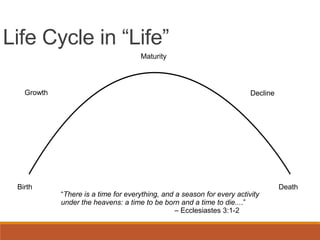
Life Cycle in “Life”
Birth
Growth
Maturity
Decline
Death
“There is a time for everything, and a season for every activity
under the heavens: a time to be born and a time to die....”
– Ecclesiastes 3:1-2
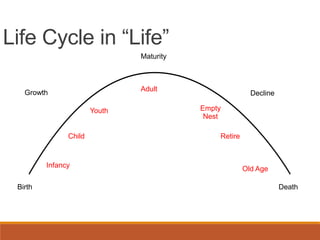
Life Cycle in “Life”
Birth
Growth
Maturity
Decline
Death
Infancy
Child
Youth
Adult
Empty
Nest
Retire
Old Age
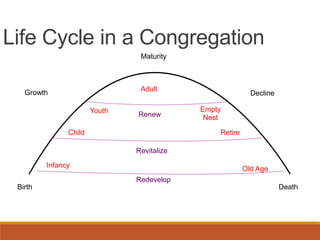
Life Cycle in a Congregation
Birth
Growth
Maturity
Decline
Death
Infancy
Child
Youth
Adult
Empty
Nest
Retire
Old Age
Renew
Revitalize
Redevelop
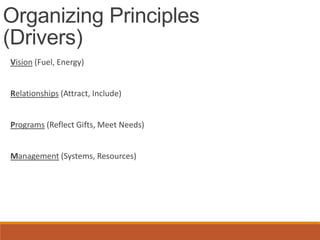
Organizing Principles
(Drivers)
Vision (Fuel, Energy)
Relationships (Attract, Include)
Programs (Reflect Gifts, Meet Needs)
Management (Systems, Resources)
Vision
Vision is the current understanding of God’s direction for a
congregation that is cast by leadership and owned by
everyone in the parish. Vision reflects the core values of the
congregation.
Vision is the fuel or energy that will drive the congregation
into the future with hope and a sense of potency.
Relationships
How the parish attracts new people into the Christian faith
journey, allows current parishioners deepen and mature in
their faith journey and nurtures relationships that help
people feel included within the church community.
Evidence of effective relationships is an ever-deepening
spirituality, widespread ownership of parish activities and
developing new leadership.
Programs
Programs (ministries and activities) embody the vision of
the church and reflect the gifts and vocations of parishioners.
Effective programs meet real, identified spiritual, social and
emotional needs of people in the neighborhood as well as the
church community. Evidence of effective programs is that the
church is known for the excellence of its programs, ministries
and activities.
Management
Management are those systems that facilitate orderly decision-making, the
allocation of resources, integrates new developments and establishes
boundaries (i.e., “the rules.”)
Effective management is efficient, well-defined and supports the vision,
relationships and programs of the church. Effective management is
accountable to the congregation as well as the larger church.
Life Cycle in a Congregation
Birth
Growth
Maturity
Decline
Death
Infancy V
Child VR
Youth VRP
Adult
VRPM
Empty Nest
RPM
Retire PM
Old Age M
v m
V = Vision R = Relationships P = Programs M = Management
Life Cycle in a Congregation
Birth v
Growth
Maturity
Decline
Death m
Infancy Vrpm
Child VRpm
Youth VRPm
Adult
VRPM
Empty Nest
vRPM
Retire vrPM
Old Age vrpM
Renew
Revitalize
Redevelop
V = Vision R = Relationships P = Programs M = Management
6-18 months
18-36 months
3-7 years
Time to Cuss and Discuss
Review
Reactions
Questions
Discussion
Insights
Observations
What If's?
Life Cycle in a Congregation
Birth v
Growth
Maturity
Decline
Death m
Infancy Vrpm
Child VRpm
Youth VRPm
Adult
VRPM
Empty Nest
vRPM
Retire vrPM
Old Age vrpM
Renew
Revitalize
Redevelop
V = Vision R = Relationships P = Programs M = Management
6-18 months
18-36 months
3-7 years
(1-2 Yrs)
(3-5 Yrs)
(5-6 Yrs)
(8-10 Yrs)
(18-22 Yrs Old)
(5-6 Yrs)
(22-27 Yrs Old)
(25-35 Yrs Old)
(35+ Yrs Old)
(50-60
Yrs Old)
(?? Yrs)
What Makes a Church
“Effective?”
Twelve characteristics have been identified in churches that
are effective in mission and successful in outreach.
These twelve characteristics fall into two categories:
Six are relational
Six are functional
Effective churches tend to have nine of these twelve
characteristics solidly in place; moreover, the majority of the
nine are relational rather than functional.
Characteristics of Effective
Churches
Relational
One mission outreach
Shepherding contacts with
members and community
Stirring, helpful worship
Significant relational groups
Strong leadership team (leaders,
pastor, staff)
Solid decision process (simple
organization)
Functional
One major program (among best
in community)
Open accessibility
High visibility
Adequate parking, land and
landscaping
Adequate space and facilities
Generous giving (solid financial
resources)
Very important!
1. The relational characteristics are the source of
satisfaction in a congregation.
2. The functional characteristics, to the degree they are not
in place, are the sources of dissatisfaction in a congregation.
3. There is no direct correlation between these two!
In other words…
Lowering the level of dissatisfaction does not raise the level
of satisfaction...
Raising the level of satisfaction does not lower the level of
dissatisfaction.
The only correlation – if one exists – is that the level of
satisfaction needs to be higher than the level of
dissatisfaction in order for the congregation to have a sense
of confidence and competence about its mission.
That is why...
It is important for a congregation
to nurture and put well in place
a greater number of relational
characteristics than functional characteristics.
The Path to the Future
Power for the future is found
in claiming strengths,
not in focusing on
weaknesses and shortcomings.
As You Pray and Plan...
Claim your strengths (gifts)...
Expand your strengths...
Add new strengths!
Remember that everything takes time!
Now to him who is able to do
immeasurably more than all we ask or
imagine, according to his power that is at
work within us, to him be glory in the
church and in Christ Jesus throughout all
generations, for ever and ever!
Amen.
Benediction
from Ephesians 3:20-21

Southeastern Synod ELCA Life Cycle Presentation

  • 1.
    A Presentation for SoutheasternSynod Convocation The Evangelical Lutheran Church in America By Dr. John Fairless Understanding the Life Cycle of Your Church
  • 2.
    Acknowledgements Dr. George Bullard,The Columbia Partnership, 332 Valley Springs Road, Columbia, SC Dr. Kennon Callahan, Twelve Keys to an Effective Church, Jossey-Bass Publishers, San Francisco, CA Office of Congregational Development, The Episcopal Church, 815 Second Avenue, New York, NY
  • 4.
    Life Cycle in“Life” Birth Growth Maturity Decline Death “There is a time for everything, and a season for every activity under the heavens: a time to be born and a time to die....” – Ecclesiastes 3:1-2
  • 5.
    Life Cycle in“Life” Birth Growth Maturity Decline Death Infancy Child Youth Adult Empty Nest Retire Old Age
  • 6.
    Life Cycle ina Congregation Birth Growth Maturity Decline Death Infancy Child Youth Adult Empty Nest Retire Old Age Renew Revitalize Redevelop
  • 7.
    Organizing Principles (Drivers) Vision (Fuel,Energy) Relationships (Attract, Include) Programs (Reflect Gifts, Meet Needs) Management (Systems, Resources)
  • 8.
    Vision Vision is thecurrent understanding of God’s direction for a congregation that is cast by leadership and owned by everyone in the parish. Vision reflects the core values of the congregation. Vision is the fuel or energy that will drive the congregation into the future with hope and a sense of potency.
  • 9.
    Relationships How the parishattracts new people into the Christian faith journey, allows current parishioners deepen and mature in their faith journey and nurtures relationships that help people feel included within the church community. Evidence of effective relationships is an ever-deepening spirituality, widespread ownership of parish activities and developing new leadership.
  • 10.
    Programs Programs (ministries andactivities) embody the vision of the church and reflect the gifts and vocations of parishioners. Effective programs meet real, identified spiritual, social and emotional needs of people in the neighborhood as well as the church community. Evidence of effective programs is that the church is known for the excellence of its programs, ministries and activities.
  • 11.
    Management Management are thosesystems that facilitate orderly decision-making, the allocation of resources, integrates new developments and establishes boundaries (i.e., “the rules.”) Effective management is efficient, well-defined and supports the vision, relationships and programs of the church. Effective management is accountable to the congregation as well as the larger church.
  • 12.
    Life Cycle ina Congregation Birth Growth Maturity Decline Death Infancy V Child VR Youth VRP Adult VRPM Empty Nest RPM Retire PM Old Age M v m V = Vision R = Relationships P = Programs M = Management
  • 13.
    Life Cycle ina Congregation Birth v Growth Maturity Decline Death m Infancy Vrpm Child VRpm Youth VRPm Adult VRPM Empty Nest vRPM Retire vrPM Old Age vrpM Renew Revitalize Redevelop V = Vision R = Relationships P = Programs M = Management 6-18 months 18-36 months 3-7 years
  • 14.
    Time to Cussand Discuss Review Reactions Questions Discussion Insights Observations What If's?
  • 15.
    Life Cycle ina Congregation Birth v Growth Maturity Decline Death m Infancy Vrpm Child VRpm Youth VRPm Adult VRPM Empty Nest vRPM Retire vrPM Old Age vrpM Renew Revitalize Redevelop V = Vision R = Relationships P = Programs M = Management 6-18 months 18-36 months 3-7 years (1-2 Yrs) (3-5 Yrs) (5-6 Yrs) (8-10 Yrs) (18-22 Yrs Old) (5-6 Yrs) (22-27 Yrs Old) (25-35 Yrs Old) (35+ Yrs Old) (50-60 Yrs Old) (?? Yrs)
  • 16.
    What Makes aChurch “Effective?” Twelve characteristics have been identified in churches that are effective in mission and successful in outreach. These twelve characteristics fall into two categories: Six are relational Six are functional Effective churches tend to have nine of these twelve characteristics solidly in place; moreover, the majority of the nine are relational rather than functional.
  • 17.
    Characteristics of Effective Churches Relational Onemission outreach Shepherding contacts with members and community Stirring, helpful worship Significant relational groups Strong leadership team (leaders, pastor, staff) Solid decision process (simple organization) Functional One major program (among best in community) Open accessibility High visibility Adequate parking, land and landscaping Adequate space and facilities Generous giving (solid financial resources)
  • 18.
    Very important! 1. Therelational characteristics are the source of satisfaction in a congregation. 2. The functional characteristics, to the degree they are not in place, are the sources of dissatisfaction in a congregation. 3. There is no direct correlation between these two!
  • 19.
    In other words… Loweringthe level of dissatisfaction does not raise the level of satisfaction... Raising the level of satisfaction does not lower the level of dissatisfaction. The only correlation – if one exists – is that the level of satisfaction needs to be higher than the level of dissatisfaction in order for the congregation to have a sense of confidence and competence about its mission.
  • 20.
    That is why... Itis important for a congregation to nurture and put well in place a greater number of relational characteristics than functional characteristics.
  • 21.
    The Path tothe Future Power for the future is found in claiming strengths, not in focusing on weaknesses and shortcomings.
  • 22.
    As You Prayand Plan... Claim your strengths (gifts)... Expand your strengths... Add new strengths! Remember that everything takes time!
  • 23.
    Now to himwho is able to do immeasurably more than all we ask or imagine, according to his power that is at work within us, to him be glory in the church and in Christ Jesus throughout all generations, for ever and ever! Amen. Benediction from Ephesians 3:20-21