LOGISTICS GROUP ASSIGNMENT 
Southwest Airlines 
1. Territory 
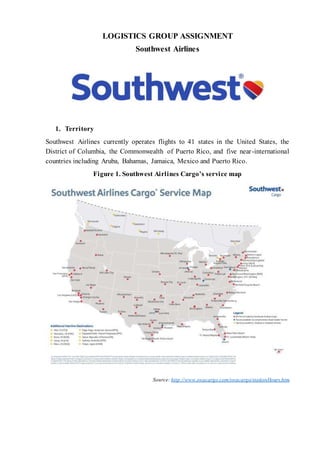
Southwest Airlines currently operates flights to 41 states in the United States, the 
District of Columbia, the Commonwealth of Puerto Rico, and five near -international 
countries including Aruba, Bahamas, Jamaica, Mexico and Puerto Rico. 
Figure 1. Southwest Airlines Cargo’s service map 
Source: http://www.swacargo.com/swacargo/stationHours.htm
2. Strategy 
2.1. Mission 
The mission of Southwest Airlines is dedication to the highest quality of customer 
service delivered with a sense of warmth, friendliness, individual pride, and Company 
Spirit. 
 To their employees 
Their employees are committed to be provided a stable work environment with equal 
opportunity for learning and personal growth. Creativity and innovation are encouraged 
for improving the effectiveness of Southwest Airlines. Above all, employees will be 
provided the same concern, respect, and caring attitude within the organization that they 
are expected to share externally with every Southwest customer. 
 To the communities 
Southwest Airlines aims at being the hometown airline of every community they serve, 
so that those communities will sustain and nurture them with their support and loyalty. 
They realize the importance of embracing each community with the Southwest Spirit of 
involvement, service, and caring to make those communities better places to live and 
work. 
 To the planet 
Southwest Airlines strive to be a good environmental steward across their system in all 
of their hometowns, and one component of their stewardship is efficiency, which, by its 
very nature, translates to eliminating waste and conserving resources. They tend to use 
cost-effective and environmentally beneficial operating procedures (including facilities 
and equipment) to reduce the amount of materials used, when combined with their 
ability to reuse and recycle material, preserves these environmental resources. 
 To their stakeholders 
Southwest Airlines’ vision for a sustainable future is one where there will be a balanc e 
in their business model between employees and community, the environment, and their 
financial viability. In order to protect the world for future generations and uphold their 
commitments to the employees, customers, and other stakeholders, they strive to lead 
their industry in innovative efficiency that conserves natural resources, maintains a 
creative and innovative workforce, and gives back to the communities in which they live 
and work. 
2.2. Vision 
 “Our vision is to become the world’s most loved, most flown, and most 
profitable airline”
SWA’s vision clearly state that being a low cost airline does not mean low quality 
services, they want to gain customer’s trust and loyalty. They understand that one people 
have loyalty rather than hundreds of people do not come back again, they want to be the 
world’s most loved. 
 “To connect People to what's important in their lives through friendly, 
reliable, and low-cost air travel” 
They have a desire to develop their scope both domestic and abroad by being the largest 
reasonable price airlines. They also want to become a successful company as an 
efficiently, low cost carriers in both short and long haul. On the other hand, they define 
themselves as an airline with the most productive, friendly and professional workforce 
to guarantee the best flight possible for every passenger. 
3. Tactical level activities 
 Cutting costs and keeping fares low: the primary tactical goal for Southwest Airline. 
 Enhance competitiveness of Southwest airline on condition of significant 
pressure from other low fare airlines and attract more customers with great 
loyalty, position a good image in customers’ insights and raise profits while cut 
down expenses. 
 The organization cuts costs in its maintenance program by doing more work on 
a plane when it is in for a check instead of bringing it in three different times. 
 Time: Limiting the turnaround time between flights to 20 minutes, compared to 
up to an hour for other airlines. 
 Place: Southwest usually flies to less-congested airports, thus saving time and 
money by avoiding traffic. 
 No dividing classes: There is just one class of seating, doing away with the 
distinction between coach and first class. Even the boarding passes are reusable, 
made of plastic. 
 In flight services: The airline saves by not feeding passengers: it serves mostly 
peanuts, no in-flight meals. 
 Save cost but still provide transportation services at reasonable quality. 
 Improving services quality by making arrival times more reliable. 
 “Reliable airline” – trustworthy. 
 Erasing old policy as guaranteed seat reservations before ticketing, so that no-shows 
will not complicate (and therefore delay) the boarding process.
 Passengers paying extra for “business select” fares would be placed at the front 
of the line. 
 Assuring that turning planes around in exactly 20 minutes, therefore on-time 
departures are more apt to produce on-time arrivals. 
4. Operating level activities 
The company developed operating strategy as a set of strategic decisions centered on 
reducing operating costs and offsetting the productivity disadvantages of short -haul, 
point-to-point flying. 
First, the company focuses on quick aircraft turnaround at the gate, minimizing 
the time on the ground, the time when airline’s most costly assets, its planes, are not 
utilized. Turning planes around quickly at the gate results in planes being able to log 
more hours in the air, increasing their utilization. This strategy, however, has kept them 
out of some markets where such a quick turnaround is not possible. 
Second, Southwest uses a standardized fleet of Boeing 737 jets, which reduces 
maintenance and pilot training expenses. The crews and spare parts are 
interchangeable and maintenance cycles more predictable. The single plane type also 
makes fueling, cleanup, catering, and ramp operations such as unloading and loading of 
baggage and cargo, more efficient and routine, which helps with the quick turnarounds. 
Third, when possible, Southwest uses smaller airports with less traffic and 
congestion with easy access to large metropolitan areas. They started at Dallas Love 
Field Airport, a much shorter drive to down-town compared with American Airlines 
dominated DFW. Some other examples are Chicago’s Midway and Houston’s Hobby 
airports, which ended up losing carriers to much larger and more modern airports such 
as Chicago’s O’Hare and Houston International. 
Fourth, Southwest offers “positively outrageous”, but “no frills” customer service. 
In particular, in-flight meals are not served, passengers get only peanuts. There is no 
baggage transfer to other airlines and the seats are not reserved. This did away with 
printing boarding passes, eliminated the time required to process them at the gate, which 
allowed for much quicker boarding process, speeding the plane turnaround time. 
All these operational strategies required an extremely high level of coordination and 
cooperation between various employee groups: pilots, flight attendants, gate operators, 
operations managers, ramp managers, baggage transfer and cargo handlers, mechanics, 
fuelers, cabin cleaners, and caterers.
Group members 
Name Student ID 
Hoàng Ngọc Mai 
Nguyễn Thị Trang 
Vũ Phương Thảo 
Mai Thu Hiền 
Thân Thị Tuyết 
Phạm Mai Linh 
Nguyễn Thị Thúy 
Nguyễn Hà Phương 
Phan Hà Phượng Vân 
Nguyễn Thị Thu Thảo 
Trương Thị Ánh Nguyên 
Nguyễn Thị Thu Thảo 
Nguyễn Minh Trang 
Phí Tiến Đại 
1111150074 
1111150166 
1112150100 
1115150050 
1114150118 
1111150136 
1117150087 
1111150162 
1117150083 
1111150029 
1111150191 
1111150035 
1111150134 
1111150167

Southeast airlines

  • 1.
    LOGISTICS GROUP ASSIGNMENT Southwest Airlines 1. Territory Southwest Airlines currently operates flights to 41 states in the United States, the District of Columbia, the Commonwealth of Puerto Rico, and five near -international countries including Aruba, Bahamas, Jamaica, Mexico and Puerto Rico. Figure 1. Southwest Airlines Cargo’s service map Source: http://www.swacargo.com/swacargo/stationHours.htm
  • 2.
    2. Strategy 2.1.Mission The mission of Southwest Airlines is dedication to the highest quality of customer service delivered with a sense of warmth, friendliness, individual pride, and Company Spirit.  To their employees Their employees are committed to be provided a stable work environment with equal opportunity for learning and personal growth. Creativity and innovation are encouraged for improving the effectiveness of Southwest Airlines. Above all, employees will be provided the same concern, respect, and caring attitude within the organization that they are expected to share externally with every Southwest customer.  To the communities Southwest Airlines aims at being the hometown airline of every community they serve, so that those communities will sustain and nurture them with their support and loyalty. They realize the importance of embracing each community with the Southwest Spirit of involvement, service, and caring to make those communities better places to live and work.  To the planet Southwest Airlines strive to be a good environmental steward across their system in all of their hometowns, and one component of their stewardship is efficiency, which, by its very nature, translates to eliminating waste and conserving resources. They tend to use cost-effective and environmentally beneficial operating procedures (including facilities and equipment) to reduce the amount of materials used, when combined with their ability to reuse and recycle material, preserves these environmental resources.  To their stakeholders Southwest Airlines’ vision for a sustainable future is one where there will be a balanc e in their business model between employees and community, the environment, and their financial viability. In order to protect the world for future generations and uphold their commitments to the employees, customers, and other stakeholders, they strive to lead their industry in innovative efficiency that conserves natural resources, maintains a creative and innovative workforce, and gives back to the communities in which they live and work. 2.2. Vision  “Our vision is to become the world’s most loved, most flown, and most profitable airline”
  • 3.
    SWA’s vision clearlystate that being a low cost airline does not mean low quality services, they want to gain customer’s trust and loyalty. They understand that one people have loyalty rather than hundreds of people do not come back again, they want to be the world’s most loved.  “To connect People to what's important in their lives through friendly, reliable, and low-cost air travel” They have a desire to develop their scope both domestic and abroad by being the largest reasonable price airlines. They also want to become a successful company as an efficiently, low cost carriers in both short and long haul. On the other hand, they define themselves as an airline with the most productive, friendly and professional workforce to guarantee the best flight possible for every passenger. 3. Tactical level activities  Cutting costs and keeping fares low: the primary tactical goal for Southwest Airline.  Enhance competitiveness of Southwest airline on condition of significant pressure from other low fare airlines and attract more customers with great loyalty, position a good image in customers’ insights and raise profits while cut down expenses.  The organization cuts costs in its maintenance program by doing more work on a plane when it is in for a check instead of bringing it in three different times.  Time: Limiting the turnaround time between flights to 20 minutes, compared to up to an hour for other airlines.  Place: Southwest usually flies to less-congested airports, thus saving time and money by avoiding traffic.  No dividing classes: There is just one class of seating, doing away with the distinction between coach and first class. Even the boarding passes are reusable, made of plastic.  In flight services: The airline saves by not feeding passengers: it serves mostly peanuts, no in-flight meals.  Save cost but still provide transportation services at reasonable quality.  Improving services quality by making arrival times more reliable.  “Reliable airline” – trustworthy.  Erasing old policy as guaranteed seat reservations before ticketing, so that no-shows will not complicate (and therefore delay) the boarding process.
  • 4.
     Passengers payingextra for “business select” fares would be placed at the front of the line.  Assuring that turning planes around in exactly 20 minutes, therefore on-time departures are more apt to produce on-time arrivals. 4. Operating level activities The company developed operating strategy as a set of strategic decisions centered on reducing operating costs and offsetting the productivity disadvantages of short -haul, point-to-point flying. First, the company focuses on quick aircraft turnaround at the gate, minimizing the time on the ground, the time when airline’s most costly assets, its planes, are not utilized. Turning planes around quickly at the gate results in planes being able to log more hours in the air, increasing their utilization. This strategy, however, has kept them out of some markets where such a quick turnaround is not possible. Second, Southwest uses a standardized fleet of Boeing 737 jets, which reduces maintenance and pilot training expenses. The crews and spare parts are interchangeable and maintenance cycles more predictable. The single plane type also makes fueling, cleanup, catering, and ramp operations such as unloading and loading of baggage and cargo, more efficient and routine, which helps with the quick turnarounds. Third, when possible, Southwest uses smaller airports with less traffic and congestion with easy access to large metropolitan areas. They started at Dallas Love Field Airport, a much shorter drive to down-town compared with American Airlines dominated DFW. Some other examples are Chicago’s Midway and Houston’s Hobby airports, which ended up losing carriers to much larger and more modern airports such as Chicago’s O’Hare and Houston International. Fourth, Southwest offers “positively outrageous”, but “no frills” customer service. In particular, in-flight meals are not served, passengers get only peanuts. There is no baggage transfer to other airlines and the seats are not reserved. This did away with printing boarding passes, eliminated the time required to process them at the gate, which allowed for much quicker boarding process, speeding the plane turnaround time. All these operational strategies required an extremely high level of coordination and cooperation between various employee groups: pilots, flight attendants, gate operators, operations managers, ramp managers, baggage transfer and cargo handlers, mechanics, fuelers, cabin cleaners, and caterers.
  • 5.
    Group members NameStudent ID Hoàng Ngọc Mai Nguyễn Thị Trang Vũ Phương Thảo Mai Thu Hiền Thân Thị Tuyết Phạm Mai Linh Nguyễn Thị Thúy Nguyễn Hà Phương Phan Hà Phượng Vân Nguyễn Thị Thu Thảo Trương Thị Ánh Nguyên Nguyễn Thị Thu Thảo Nguyễn Minh Trang Phí Tiến Đại 1111150074 1111150166 1112150100 1115150050 1114150118 1111150136 1117150087 1111150162 1117150083 1111150029 1111150191 1111150035 1111150134 1111150167