Business model
canvas of
Discount Airline
Strategy Case Study
1
Image via Flickr user columbuscameraop
© Jukka Ala-Mutka / jukkaam.com / @jukkaam
Background of the case:
Discount Airline
• Case description based on analysis of Southwest
Airlines, but the rules of the strategy can be applied to
discount airlines in general.
• A low-cost airline is also known as a no-frills, discount or
budget carrier or airline. It is an airline that generally has
lower fares and limited services.
• The term originated within the airline industry referring to
airlines with a lower operating cost structure than
traditional airlines.
• Low-cost carriers should not be confused with regional
airlines that operate short flights without service, or with
full-service airlines offering some reduced fares, because
they have different business model.
2© Jukka Ala-Mutka / jukkaam.com / @jukkaam
Identify industry recipe:
What are norms of your
industry?
3© Jukka Ala-Mutka / jukkaam.com / @jukkaam
In 1970 Airline industry was…
4
Hub and spoke
airline system More destinations
Premium
services for
high-end
customers
Glamour
atmosphere
© Jukka Ala-Mutka / jukkaam.com / @jukkaam
5
Create your own recipe:
Break all the rules and
start a different kind of
business
© Jukka Ala-Mutka / jukkaam.com / @jukkaam
The core idea of the discount
airline business
“If you get your passengers to their
destinations when they want to get there,
on time, at the lowest possible fares, and
make darn sure they have a good time
doing it, people will fly your airline.”
- Herb Kelleher
6© Jukka Ala-Mutka / jukkaam.com / @jukkaam
• Over 40 years ago, Rollin King and
Herb Kelleher got together and
decided to start a different kind of
airline.
• Southwest Airlines started operations
in 1971 and it was a novel business
model innovation that breaks all the
rules.
7© Jukka Ala-Mutka / jukkaam.com / @jukkaam
8
Charge the lowest
possible fare with
highest possible
volume
Charge the highest
possible fare with
premium services
”Norm strategy” in
the airline industry
in 1970s
New strategy for
Southwest Airlines
© Jukka Ala-Mutka / jukkaam.com / @jukkaam
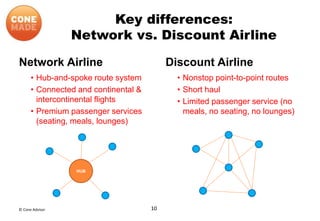
Key differences:
Network vs. Discount Airline
Network Airline
• Hub-and-spoke route system
• Connected and continental &
intercontinental flights
• Premium passenger services
(seating, meals, lounges)
Discount Airline
• Nonstop point-to-point routes
• Short haul
• Limited passenger service (no
meals, no seating, no lounges)
9
HUB
© Jukka Ala-Mutka / jukkaam.com / @jukkaam
Evidence of success:
growth
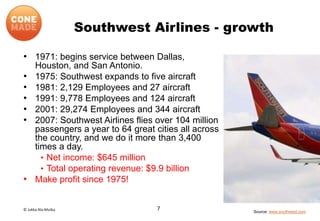
• 1971: begins service between Dallas,
Houston, and San Antonio.
• 1975: Southwest expands to 5 aircraft
• 1981: 2,129 Employees and 27 aircraft
• 1991: 9,778 Employees and 124 aircraft
• 2001: 29,274 Employees and 344 aircraft
• 2007: Southwest Airlines flies over 104
million passengers a year to 64 great cities
all across the country, and we do it more
than 3,400 times a day.
• Net income: $645 million
• Total operating revenue: $9.9 billion
• Making profit since 1975!
10
Source: www.southwest.com
© Jukka Ala-Mutka / jukkaam.com / @jukkaam
11
A mission statement,
while touted as
necessary for any
company, often is not
representative of the
true meaning of the
company.
Source: Guy Kawasaki, Stanford 20.10.2004
© Jukka Ala-Mutka / jukkaam.com / @jukkaam
Southwest Airlines’ Mission
The mission of Southwest Airlines is
dedication to the highest quality of
Customer Service delivered with a sense of
warmth, friendliness, individual pride, and
Company Spirit.
Source: www.southwest.com
12© Jukka Ala-Mutka / jukkaam.com / @jukkaam
13
Develop the true
meaning of the
company -
A mantra is shorter 3-4
words and captures the
essence of the
organization.
Source: Guy Kawasaki, Stanford 20.10.2004
© Jukka Ala-Mutka / jukkaam.com / @jukkaam
14
Frequent
FunLow price
Simple
I’m free to make my own schedule…
I know what to buy…
I have afford to fly…
I can make a choice…
© Jukka Ala-Mutka / jukkaam.com / @jukkaam
Southwest Airlines’ Mantra
Source: www.southwest.com
15
Frequent
Fun
Low
price
Simple
© Jukka Ala-Mutka / jukkaam.com / @jukkaam
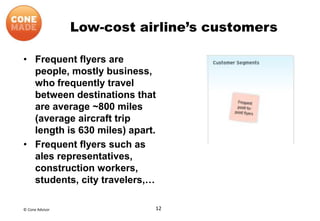
Low-cost airline’s customers
• Frequent flyers are
people, mostly business,
who frequently travel
between destinations that
are average ~800 miles
(average aircraft trip
length is 630 miles) apart.
• Frequent flyers such as
ales representatives,
construction workers,
students, city travelers,…
16© Jukka Ala-Mutka / jukkaam.com / @jukkaam
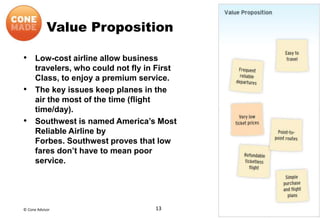
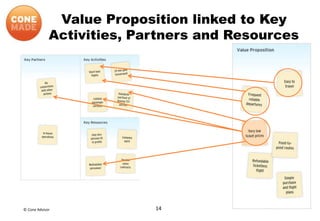
Value Proposition
• Low-cost airline allow business
travelers, who could not fly in First
Class, to enjoy a premium service.
• The key issues keep planes in the
air the most of the time (flight
time/day).
• Southwest is named America’s Most
Reliable Airline by
Forbes. Southwest proves that low
fares don’t have to mean poor
service.
17© Jukka Ala-Mutka / jukkaam.com / @jukkaam
Value Proposition linked to Key
Activities, Partners and Resources
18© Jukka Ala-Mutka / jukkaam.com / @jukkaam
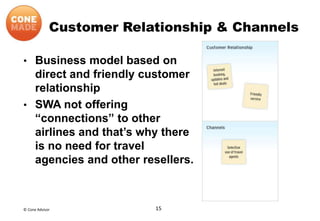
Customer Relationship & Channels
• Business model based on
direct and friendly customer
relationship
• SWA not offering
“connections” to other
airlines and that’s why there
is no need for travel
agencies and other resellers.
19© Jukka Ala-Mutka / jukkaam.com / @jukkaam
20
What we need to must-
win, if we charge the
lowest possible fare
with highest possible
volume?
© Jukka Ala-Mutka / jukkaam.com / @jukkaam
21
Fact:
The average aircraft trip
length is 630 miles with
an average duration of
one hour and 52
minutes.
Source: www.southwest.com
© Jukka Ala-Mutka / jukkaam.com / @jukkaam
Growth
22
Hub and spoke
airline system
Nonstop
point-to-point
routes
High utilization
rate
© Jukka Ala-Mutka / jukkaam.com / @jukkaam
23
Economically?
© Jukka Ala-Mutka / jukkaam.com / @jukkaam
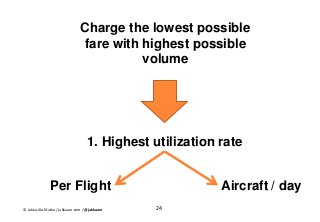
Charge the lowest possible
fare with highest possible
volume
24
1. Highest utilization rate
Per Flight Aircraft / day
© Jukka Ala-Mutka / jukkaam.com / @jukkaam
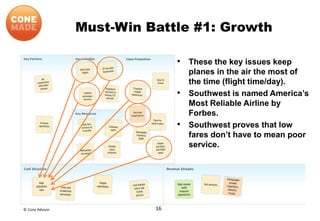
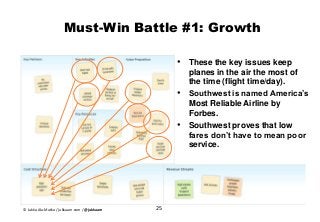
Must-Win Battle #1: Growth
• These the key issues keep
planes in the air the most of
the time (flight time/day).
• Southwest is named America’s
Most Reliable Airline by
Forbes.
• Southwest proves that low
fares don’t have to mean poor
service.
25© Jukka Ala-Mutka / jukkaam.com / @jukkaam
26
Operationally?
© Jukka Ala-Mutka / jukkaam.com / @jukkaam
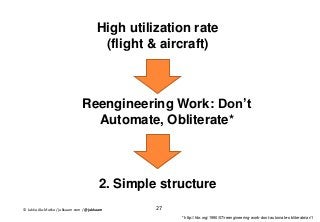
27
High utilization rate
(flight & aircraft)
Reengineering Work: Don’t
Automate, Obliterate*
* http://hbr.org/1990/07/reengineering-work-dont-automate-obliterate/ar/1
2. Simple structure
© Jukka Ala-Mutka / jukkaam.com / @jukkaam
28
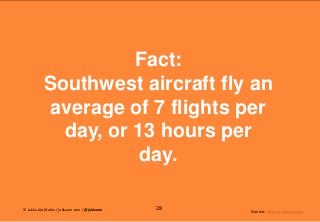
Fact:
Southwest aircraft fly an
average of 7 flights per
day, or 13 hours per
day.
Source: www.southwest.com
© Jukka Ala-Mutka / jukkaam.com / @jukkaam
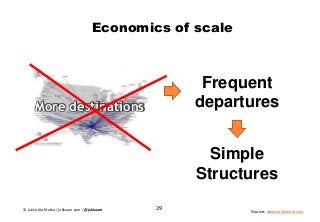
Economics of scale
29
More destinations
Frequent
departures
Source: www.southwest.com
Simple
Structures
© Jukka Ala-Mutka / jukkaam.com / @jukkaam
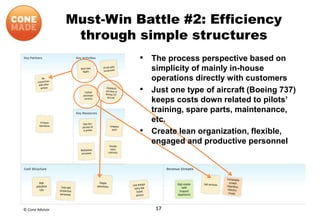
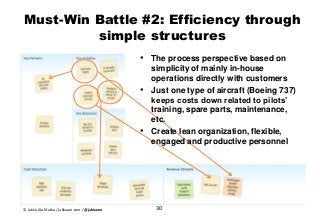
Must-Win Battle #2: Efficiency through
simple structures
30
• The process perspective based on
simplicity of mainly in-house
operations directly with customers
• Just one type of aircraft (Boeing 737)
keeps costs down related to pilots’
training, spare parts, maintenance,
etc.
• Create lean organization, flexible,
engaged and productive personnel
© Jukka Ala-Mutka / jukkaam.com / @jukkaam
31
Resources?
© Jukka Ala-Mutka / jukkaam.com / @jukkaam
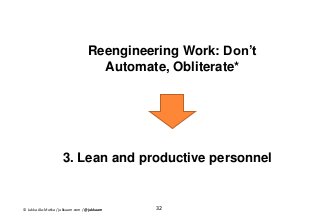
32
3. Lean and productive personnel
Reengineering Work: Don’t
Automate, Obliterate*
© Jukka Ala-Mutka / jukkaam.com / @jukkaam
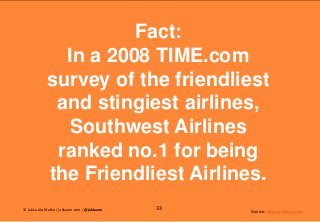
33
Fact:
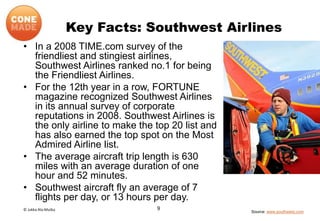
In a 2008 TIME.com
survey of the friendliest
and stingiest airlines,
Southwest Airlines
ranked no.1 for being
the Friendliest Airlines.
Source: www.southwest.com
© Jukka Ala-Mutka / jukkaam.com / @jukkaam
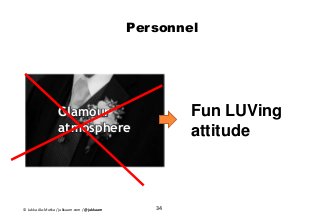
Personnel
34
Glamour
atmosphere
Fun LUVing
attitude
© Jukka Ala-Mutka / jukkaam.com / @jukkaam
35
Fact:
The airline adopted the first
profit-sharing plan in the U.S.
airline industry in 1973.
Through this plan and others,
Employees own at least eight
percent of the Company
stock.
Source: www.southwest.com
© Jukka Ala-Mutka / jukkaam.com / @jukkaam
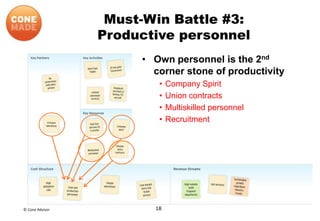
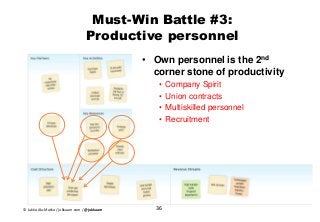
Must-Win Battle #3:
Productive personnel
36
• Own personnel is the 2nd
corner stone of productivity
• Company Spirit
• Union contracts
• Multiskilled personnel
• Recruitment
© Jukka Ala-Mutka / jukkaam.com / @jukkaam
37
Fact:
Southwest’s average
passenger airfare was
$114.48 (2007)
Source: www.southwest.com
© Jukka Ala-Mutka / jukkaam.com / @jukkaam
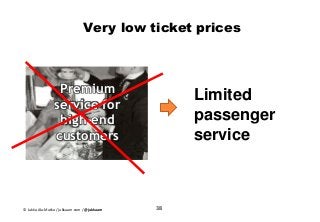
Very low ticket prices
38
Premium
service for
high-end
customers
Limited
passenger
service
© Jukka Ala-Mutka / jukkaam.com / @jukkaam
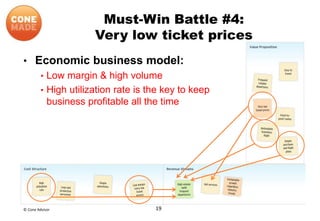
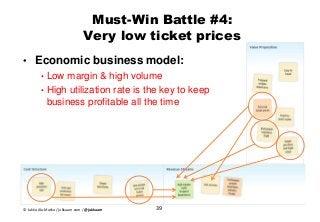
Must-Win Battle #4:
Very low ticket prices
39
• Economic business model:
• Low margin & high volume
• High utilization rate is the key to keep
business profitable all the time
© Jukka Ala-Mutka / jukkaam.com / @jukkaam
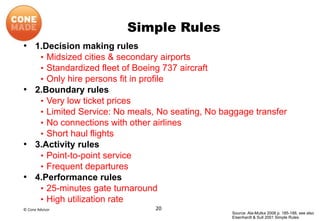
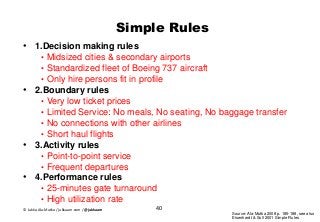
Simple Rules
• 1.Decision making rules
• Midsized cities & secondary airports
• Standardized fleet of Boeing 737 aircraft
• Only hire persons fit in profile
• 2.Boundary rules
• Very low ticket prices
• Limited Service: No meals, No seating, No baggage transfer
• No connections with other airlines
• Short haul flights
• 3.Activity rules
• Point-to-point service
• Frequent departures
• 4.Performance rules
• 25-minutes gate turnaround
• High utilization rate
40
Source: Ala-Mutka 2008 p. 185-188, see also
Eisenhardt & Sull 2001 Simple Rules
© Jukka Ala-Mutka / jukkaam.com / @jukkaam
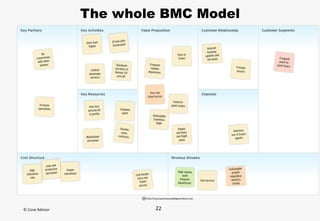
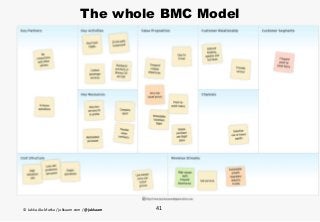
The whole BMC Model
41© Jukka Ala-Mutka / jukkaam.com / @jukkaam
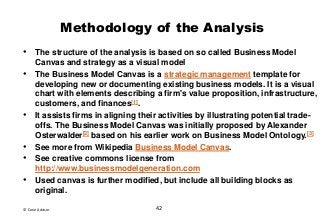
Methodology of the Analysis
• The structure of the analysis is based on so called Business Model
Canvas and strategy as a visual model
• The Business Model Canvas is a strategic management template for
developing new or documenting existing business models. It is a visual
chart with elements describing a firm's value proposition, infrastructure,
customers, and finances[1].
• It assists firms in aligning their activities by illustrating potential trade-
offs. The Business Model Canvas was initially proposed by Alexander
Osterwalder[2] based on his earlier work on Business Model Ontology.[3]
• See more from Wikipedia Business Model Canvas.
• See creative commons license from
http://www.businessmodelgeneration.com
• Used canvas is further modified, but include all building blocks as
original.
© Cone Advisor 42
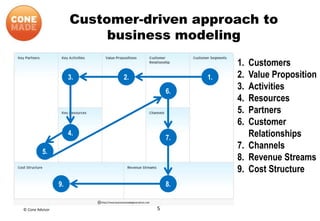
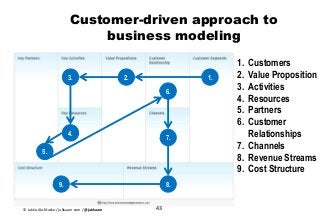
Customer-driven approach to
business modeling
1.2.3.
4.
5.
6.
7.
8.9.
1. Customers
2. Value Proposition
3. Activities
4. Resources
5. Partners
6. Customer
Relationships
7. Channels
8. Revenue Streams
9. Cost Structure
43© Jukka Ala-Mutka / jukkaam.com / @jukkaam
Author
@jukkaam
© Jukka Ala-Mutka / jukkaam.com / @jukkaam 44
Contact:
https://jukkaam.com/businesscard
Serial entrepreneur,
speaker, scientist and
consultant
Contact me for
assignments:
• Consulting & Training
• Keynote Speaker
• Board Member
• Co-Founder