


Executive Summary of the book
By
“Southwest Airlines Way”
Power of relationships to performance
by Ramki
ramaddster@gmail.com
About the Author
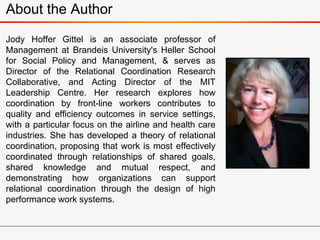
Jody Hoffer Gittel is an associate professor of
Management at Brandeis University's Heller School
for Social Policy and Management, & serves as
Director of the Relational Coordination Research
Collaborative, and Acting Director of the MIT
Leadership Centre. Her research explores how
coordination by front-line workers contributes to
quality and efficiency outcomes in service settings,
with a particular focus on the airline and health care
industries. She has developed a theory of relational
coordination, proposing that work is most effectively
coordinated through relationships of shared goals,
shared knowledge and mutual respect, and
demonstrating how organizations can support
relational coordination through the design of high
performance work systems.
Prelude
This book examines how Southwest Airlines, the largest carrier of passengers in the
largest market in the world has become the envy of financial performance, customer, and
employee satisfaction for the airline industry. For those of us who are involved in
Organization Development or Human Resources and toil under the belief that people make
a bottom line difference, this is our book. For leaders this is also your book, the lessons
learned at Southwest are transferable not only to the airline industry but to any industry. A
word of caution, the book is based on an academic/statistical study of the airline industry
and reported more as an academic treatise than a captivating book. Don't let the style of
writing get in the way of the important message:
Southwest's most powerful organizational competency--the "secret ingredient" that
makes it so distinctive--is its ability to build and sustained high performance
relationships among managers, employees, unions, and suppliers. These
relationships are characterized by shared goals, shared knowledge, and mutual
respect.
Over time Southwest Airlines has developed 10 organizational practices to facilitate
coordination among 12 distinct functions: pilots, flights attendants, gate agents, ticketing
agents, operations agents, ramp agents, baggage transfer agents, cargo agents,
mechanics, fuelers, aircraft cleaners, and caters by building relationships of shared goals,
shared knowledge, and mutual respect. The heart of this book is the description of these
10 practices and how managers in any setting can implement them to improve their
business performance.
1
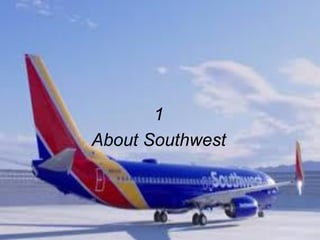
About Southwest
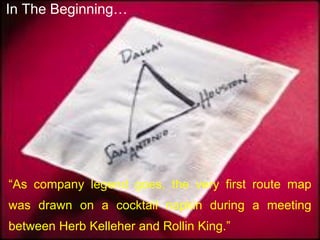
“As company legend goes, the very first route map
was drawn on a cocktail napkin during a meeting
between Herb Kelleher and Rollin King.”
In The Beginning…
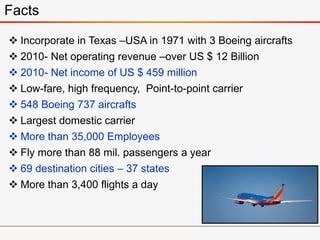
 Incorporate in Texas –USA in 1971 with 3 Boeing aircrafts
 2010- Net operating revenue –over US $ 12 Billion
 2010- Net income of US $ 459 million
 Low-fare, high frequency, Point-to-point carrier
 548 Boeing 737 aircrafts
 Largest domestic carrier
 More than 35,000 Employees
 Fly more than 88 mil. passengers a year
 69 destination cities – 37 states
 More than 3,400 flights a day
Facts
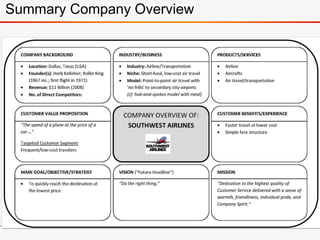
Summary Company Overview
2
Integrated Business Strategy
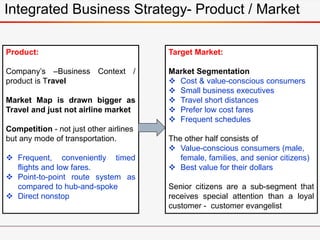
Product:
Company’s –Business Context /
product is Travel
Market Map is drawn bigger as
Travel and just not airline market
Competition - not just other airlines
but any mode of transportation.
 Frequent, conveniently timed
flights and low fares.
 Point-to-point route system as
compared to hub-and-spoke
 Direct nonstop
Target Market:
Market Segmentation
 Cost & value-conscious consumers
 Small business executives
 Travel short distances
 Prefer low cost fares
 Frequent schedules
The other half consists of
 Value-conscious consumers (male,
female, families, and senior citizens)
 Best value for their dollars
Senior citizens are a sub-segment that
receives special attention than a loyal
customer - customer evangelist
Integrated Business Strategy- Product / Market
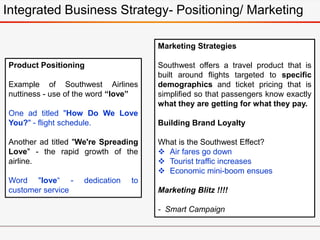
Product Positioning
Example of Southwest Airlines
nuttiness - use of the word “love”
One ad titled "How Do We Love
You?" - flight schedule.
Another ad titled "We're Spreading
Love" - the rapid growth of the
airline.
Word "love“ - dedication to
customer service
Marketing Strategies
Southwest offers a travel product that is
built around flights targeted to specific
demographics and ticket pricing that is
simplified so that passengers know exactly
what they are getting for what they pay.
Building Brand Loyalty
What is the Southwest Effect?
 Air fares go down
 Tourist traffic increases
 Economic mini-boom ensues
Marketing Blitz !!!!
- Smart Campaign
Integrated Business Strategy- Positioning/ Marketing
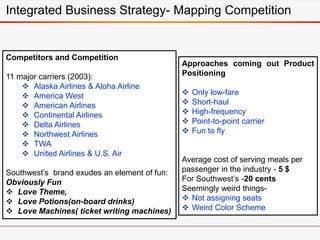
Competitors and Competition
11 major carriers (2003):
 Alaska Airlines & Aloha Airline
 America West
 American Airlines
 Continental Airlines
 Delta Airlines
 Northwest Airlines
 TWA
 United Airlines & U.S. Air
Southwest’s brand exudes an element of fun:
Obviously Fun
 Love Theme,
 Love Potions(on-board drinks)
 Love Machines( ticket writing machines)
Approaches coming out Product
Positioning
 Only low-fare
 Short-haul
 High-frequency
 Point-to-point carrier
 Fun to fly
Average cost of serving meals per
passenger in the industry - 5 $
For Southwest’s -20 cents
Seemingly weird things-
 Not assigning seats
 Weird Color Scheme
Integrated Business Strategy- Mapping Competition
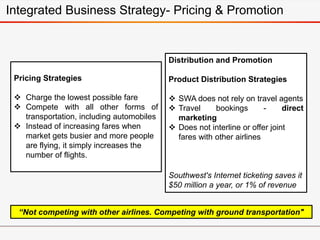
Pricing Strategies
 Charge the lowest possible fare
 Compete with all other forms of
transportation, including automobiles
 Instead of increasing fares when
market gets busier and more people
are flying, it simply increases the
number of flights.
Distribution and Promotion
Product Distribution Strategies
 SWA does not rely on travel agents
 Travel bookings - direct
marketing
 Does not interline or offer joint
fares with other airlines
Southwest's Internet ticketing saves it
$50 million a year, or 1% of revenue
“Not competing with other airlines. Competing with ground transportation"
Integrated Business Strategy- Pricing & Promotion
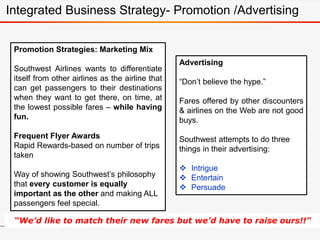
Promotion Strategies: Marketing Mix
Southwest Airlines wants to differentiate
itself from other airlines as the airline that
can get passengers to their destinations
when they want to get there, on time, at
the lowest possible fares – while having
fun.
Frequent Flyer Awards
Rapid Rewards-based on number of trips
taken
Way of showing Southwest’s philosophy
that every customer is equally
important as the other and making ALL
passengers feel special.
Advertising
“Don’t believe the hype.”
Fares offered by other discounters
& airlines on the Web are not good
buys.
Southwest attempts to do three
things in their advertising:
 Intrigue
 Entertain
 Persuade
“We’d like to match their new fares but we’d have to raise ours!!"
Integrated Business Strategy- Promotion /Advertising
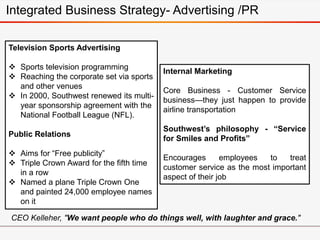
Television Sports Advertising
 Sports television programming
 Reaching the corporate set via sports
and other venues
 In 2000, Southwest renewed its multi-
year sponsorship agreement with the
National Football League (NFL).
Public Relations
 Aims for “Free publicity”
 Triple Crown Award for the fifth time
in a row
 Named a plane Triple Crown One
and painted 24,000 employee names
on it
Internal Marketing
Core Business - Customer Service
business—they just happen to provide
airline transportation
Southwest’s philosophy - “Service
for Smiles and Profits”
Encourages employees to treat
customer service as the most important
aspect of their job
CEO Kelleher, "We want people who do things well, with laughter and grace."
Integrated Business Strategy- Advertising /PR
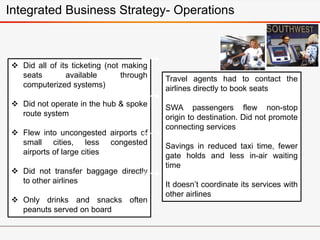
 Did all of its ticketing (not making
seats available through
computerized systems)
 Did not operate in the hub & spoke
route system
 Flew into uncongested airports of
small cities, less congested
airports of large cities
 Did not transfer baggage directly
to other airlines
 Only drinks and snacks often
peanuts served on board
Travel agents had to contact the
airlines directly to book seats
SWA passengers flew non-stop
origin to destination. Did not promote
connecting services
Savings in reduced taxi time, fewer
gate holds and less in-air waiting
time
It doesn’t coordinate its services with
other airlines
Integrated Business Strategy- Operations
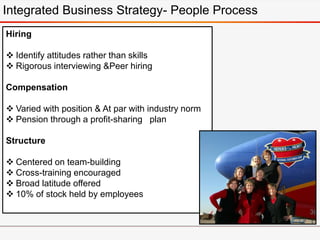
Hiring
 Identify attitudes rather than skills
 Rigorous interviewing &Peer hiring
Compensation
 Varied with position & At par with industry norm
 Pension through a profit-sharing plan
Structure
 Centered on team-building
 Cross-training encouraged
 Broad latitude offered
 10% of stock held by employees
Integrated Business Strategy- People Process
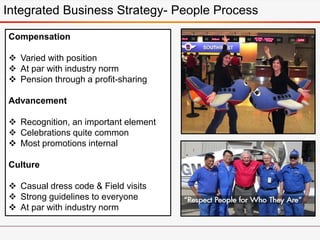
Compensation
 Varied with position
 At par with industry norm
 Pension through a profit-sharing
Advancement
 Recognition, an important element
 Celebrations quite common
 Most promotions internal
Culture
 Casual dress code & Field visits
 Strong guidelines to everyone
 At par with industry norm
Integrated Business Strategy- People Process
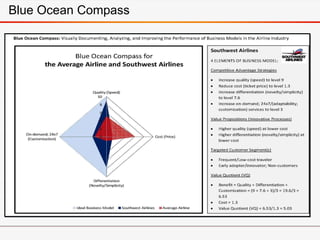
Blue Ocean Compass
 Be the best place to work
 Operate the safest, most reliable, most efficient
airline
 Offer Customers the preferred 737 flight schedule
with lots of flights to lots of places
 Deliver the best overall high value Customer
Experience
 Be the low cost provider
 Earn excellent financial returns on our investment
for our Shareholders and Employees
Vision Revisited - 2007
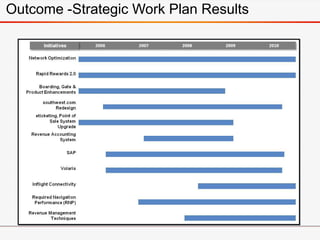
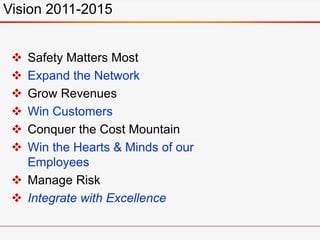
Outcome -Strategic Work Plan Results
 Safety Matters Most
 Expand the Network
 Grow Revenues
 Win Customers
 Conquer the Cost Mountain
 Win the Hearts & Minds of our
Employees
 Manage Risk
 Integrate with Excellence
Vision 2011-2015
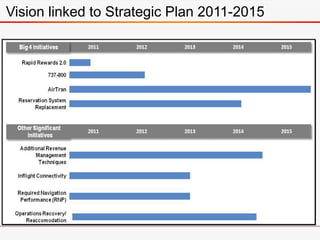
Vision linked to Strategic Plan 2011-2015
3
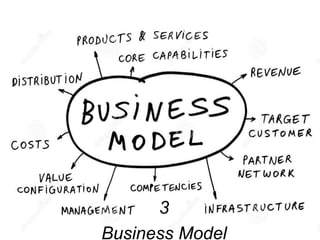
Business Model
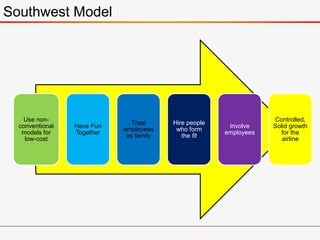
Use non-
conventional
models for
low-cost
Have Fun
Together
Treat
employees
as family
Hire people
who form
the fit
Involve
employees
Controlled,
Solid growth
for the
airline
Southwest Model
3
The Southwest Way
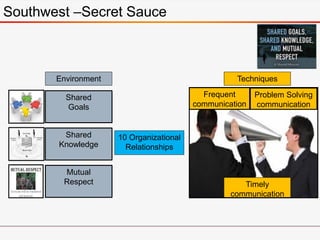
Southwest –Secret Sauce
Environment
Shared
Goals
Shared
Knowledge
Mutual
Respect
10 Organizational
Relationships
Techniques
Frequent
communication
Timely
communication
Problem Solving
communication
Shared goals
Every employee is working to achieve 3 quite straight forward
goals regardless of the functional area
 Safety
 On-time performance
 Creating satisfied customers
Every employee respond in a coordinated way whenever new
challenges arise or new information becomes available
Decisions are based on context & information shared
‘Shared goals at Southwest is strong. When discussing the need for on- time
Performance, nearly everybody explained that “ our aircraft are valuable & they
Don’t earn any money sitting on the ground”
Shared knowledge
 Every employee understand the overall work processes.
 They also know & understand the links between what they
do & the work others do in the organization.
 Shared knowledge enhances coordination & the emergence
of innovative ideas
Mutual Respect
 In most airlines, there are clear & definitive boundaries
between people working in different functional areas.
 Most employees will interact well with their peers but
disregard anyone else below them in the hierarchy.
 When delays occur, there is usually an attempt to pin the
blame for the delay on someone lower down the chain
 By contrast Southwest has a
culture in which each employee
treats others with respect.
 They acknowledge the different
roles each department play in
keeping planes flying.
4
What lead to their success ?
High performance Relationships
The “glue” that makes these 10 organizational relationships work
for Southwest is its business environment of shared goals ,shared
knowledge and mutual respect. Without this kind of environment,
the high performance relationships Southwest uses won’t have the
same kind of impact
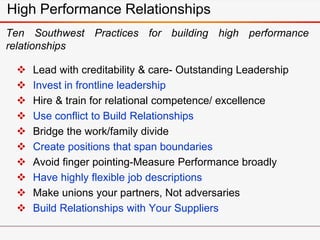
Ten Southwest Practices for building high performance
relationships
 Lead with creditability & care- Outstanding Leadership
 Invest in frontline leadership
 Hire & train for relational competence/ excellence
 Use conflict to Build Relationships
 Bridge the work/family divide
 Create positions that span boundaries
 Avoid finger pointing-Measure Performance broadly
 Have highly flexible job descriptions
 Make unions your partners, Not adversaries
 Build Relationships with Your Suppliers
High Performance Relationships
Be a Leader who Cares
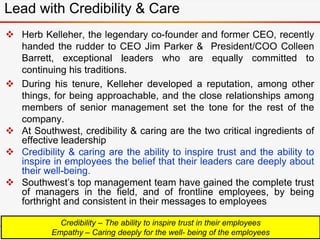
Lead with Credibility & Care
 Herb Kelleher, the legendary co-founder and former CEO, recently
handed the rudder to CEO Jim Parker & President/COO Colleen
Barrett, exceptional leaders who are equally committed to
continuing his traditions.
 During his tenure, Kelleher developed a reputation, among other
things, for being approachable, and the close relationships among
members of senior management set the tone for the rest of the
company.
 At Southwest, credibility & caring are the two critical ingredients of
effective leadership
 Credibility & caring are the ability to inspire trust and the ability to
inspire in employees the belief that their leaders care deeply about
their well-being.
 Southwest’s top management team have gained the complete trust
of managers in the field, and of frontline employees, by being
forthright and consistent in their messages to employees
Credibility – The ability to inspire trust in their employees
Empathy – Caring deeply for the well- being of the employees
Place More Supervisors in the frontline
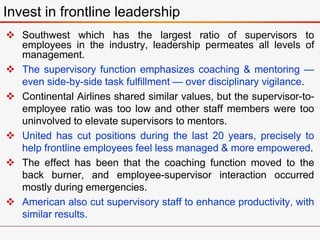
Invest in frontline leadership
 Southwest which has the largest ratio of supervisors to
employees in the industry, leadership permeates all levels of
management.
 The supervisory function emphasizes coaching & mentoring —
even side-by-side task fulfillment — over disciplinary vigilance.
 Continental Airlines shared similar values, but the supervisor-to-
employee ratio was too low and other staff members were too
uninvolved to elevate supervisors to mentors.
 United has cut positions during the last 20 years, precisely to
help frontline employees feel less managed & more empowered.
 The effect has been that the coaching function moved to the
back burner, and employee-supervisor interaction occurred
mostly during emergencies.
 American also cut supervisory staff to enhance productivity, with
similar results.
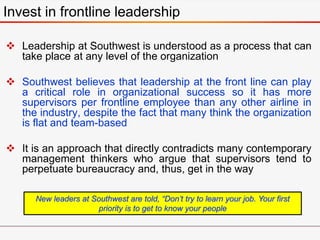
Invest in frontline leadership
 Leadership at Southwest is understood as a process that can
take place at any level of the organization
 Southwest believes that leadership at the front line can play
a critical role in organizational success so it has more
supervisors per frontline employee than any other airline in
the industry, despite the fact that many think the organization
is flat and team-based
 It is an approach that directly contradicts many contemporary
management thinkers who argue that supervisors tend to
perpetuate bureaucracy and, thus, get in the way
New leaders at Southwest are told, “Don’t try to learn your job. Your first
priority is to get to know your people
Role of Supervisors in Southwest’s Culture
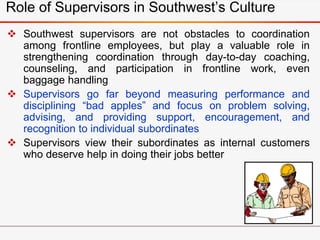
 Southwest supervisors are not obstacles to coordination
among frontline employees, but play a valuable role in
strengthening coordination through day-to-day coaching,
counseling, and participation in frontline work, even
baggage handling
 Supervisors go far beyond measuring performance and
disciplining “bad apples” and focus on problem solving,
advising, and providing support, encouragement, and
recognition to individual subordinates
 Supervisors view their subordinates as internal customers
who deserve help in doing their jobs better
Look for the right Qualities while Hiring
Right qualities in Hiring
 At Southwest, where most positions (except in the front line)
are filled from within, managers look for potential hires who
are not just technically competent, but who also recognize
the value of teamwork.
 The airline then works with them to hone their relational
competence skills.
 The company places a premium on people skills, sometimes
choosing this trait over airline experience. Managers are
actively involved in the hiring of front line employees and
considerable time is spent training and recruiting.
 The company’s culture promotes egalitarianism, and those
with a snobbish disposition don’t make the cut .
Hire & train relational competence
 Teamwork at Southwest is based on “relational
competence”—the ability to relate effectively with
others
 Relational competence is a critical ingredient of
organizational success, though it tends to be
undervalued in the world of work
“If you live by the Golden Rule, empowering your people do the right thing,
how can you go wrong?
 Teamwork at Southwest is based on “relational competence”—the
ability to relate effectively with others
 Relational competence is a critical ingredient of organizational
success, though it tends to be undervalued in the world of work
 Other organizations usually underestimate the importance of
relational competence, especially when it comes to people who
perform highly skilled jobs
 Often excellent performers are hired, but they cannot integrate their
work effectively with the work of others which results in
undermining of the organization’s goals, which does not happen at
Southwest
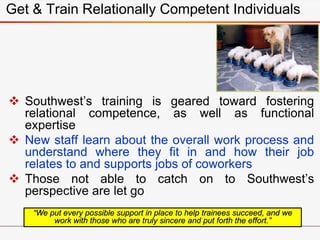
Get & Train Relationally Competent Individuals
 Southwest goes out of its way to hire
those who will contribute to the
“overall operation” of the airline—
“Elitists” need not apply
 In recruiting pilots or mechanics they
obtain the best who are also team
players and able to relate well with
other functional groups
 They then train & acculturate newly
hired-most of whom come from
other, more functionally divided
airlines
“A candidate who thinks he can “snow” a recruiter during the interview may
have already eliminated himself because he’s proven to other employees
that he isn’t a “fit” for the system.”
 Southwest’s training is geared toward fostering
relational competence, as well as functional
expertise
 New staff learn about the overall work process and
understand where they fit in and how their job
relates to and supports jobs of coworkers
 Those not able to catch on to Southwest’s
perspective are let go
Get & Train Relationally Competent Individuals
“We put every possible support in place to help trainees succeed, and we
work with those who are truly sincere and put forth the effort.”
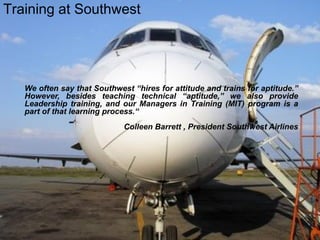
We often say that Southwest “hires for attitude and trains for aptitude.”
However, besides teaching technical “aptitude,” we also provide
Leadership training, and our Managers in Training (MIT) program is a
part of that learning process.“
Colleen Barrett , President Southwest Airlines
Training at Southwest
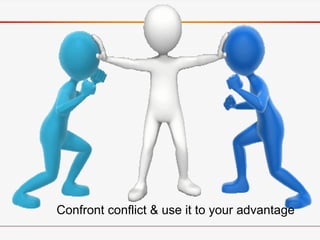
Confront conflict & use it to your advantage
Use conflict to build relationship
 In the airline industry, where highly
interdependent work processes span
multiple functions, not only are conflicts
the norm, they are likely to have highly
intensified effects
“Conflicts are part of life. Instead of viewing conflicts as a destructive force,
use them constructively to build relationships & improve performance
 People in different functions occupy different ‘thought worlds’
that make shared understanding difficult
 Although many believe conflicts are destructive and to be
avoided, Southwest believes constructive aspects exist, so
actively identifying and resolving conflicts is a means of
strengthening relationships that inspire effective coordination
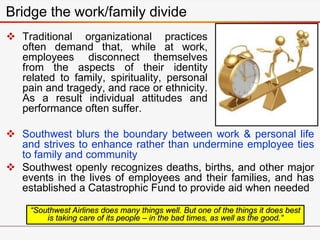
 Traditional organizational practices
often demand that, while at work,
employees disconnect themselves
from the aspects of their identity
related to family, spirituality, personal
pain and tragedy, and race or ethnicity.
As a result individual attitudes and
performance often suffer.
Bridge the work/family divide
“Southwest Airlines does many things well. But one of the things it does best
is taking care of its people – in the bad times, as well as the good.”
 Southwest blurs the boundary between work & personal life
and strives to enhance rather than undermine employee ties
to family and community
 Southwest openly recognizes deaths, births, and other major
events in the lives of employees and their families, and has
established a Catastrophic Fund to provide aid when needed
 Culture Committees were begun in the early 1990s to
ensure that the company’s rapid growth would not result in
barriers between functions.
 Each station has its own committee to organize fund-raisers,
parties, and ways for employees to give back to the
community. These events bring family and other personal
relationships into the workplace in a highly visible way.
 Southwest has a long tradition of bridging the work/family
divide by seeking to accommodate the needs of families
through flexible scheduling and ensuring that managers do
not devote too much time to the job at the expense of their
families.
Bridge the work/family divide
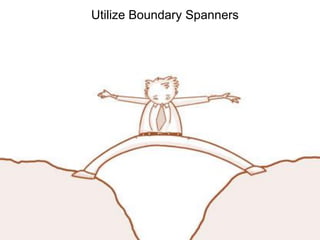
Utilize Boundary Spanners
Create positions that span boundaries
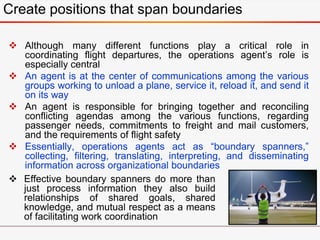
 Although many different functions play a critical role in
coordinating flight departures, the operations agent’s role is
especially central
 An agent is at the center of communications among the various
groups working to unload a plane, service it, reload it, and send it
on its way
 An agent is responsible for bringing together and reconciling
conflicting agendas among the various functions, regarding
passenger needs, commitments to freight and mail customers,
and the requirements of flight safety
 Essentially, operations agents act as “boundary spanners,”
collecting, filtering, translating, interpreting, and disseminating
information across organizational boundaries
 Effective boundary spanners do more than
just process information they also build
relationships of shared goals, shared
knowledge, and mutual respect as a means
of facilitating work coordination
 Since the mid 1980s, many airlines tried to reduce the cost
of this function by reducing the number of agents,
increasing the number of flights they are assigned to, and
relying more heavily on computer technology to coordinate
departures-quality and detail of communication is not very
high this way
 Southwest has chosen opposite tack and is unique its
operations agents are assigned to lead only one departure
at a time so that they can interact, face to face, with every
party involved in the flight departure process
 By developing a web of human relationships across
boundaries, Southwest operations agents are able to
create a broader sense of shared identity and vision among
previously divided functions, creating more opportunities
for collective action.
Create positions that span boundaries
Look for improvement rather than blame
Improvement
 Southwest Airlines resolved the accountability issue with the “team
delay” approach, which spreads the blame among a group of
people rather than one person or department.
 Focusing less on blame & more on solving the problem generates
more emphasis in learning and teamwork.
 Southwest uses incentives to encourage all employees, managers
or not, to do a better job.
 United recently expanded accountability for mishaps to up to three
departments to encourage cross-functional cooperation.
Continental limits delay accountability to two areas, but its efforts to
diffuse responsibility defeat the purpose by devoting excessive
time to past action rather than improvement. It also motivates with
fear.
 American doles out penalties for delays, which promotes employee
self-preservation rather than the larger goals of efficient flight
dispatch and customer satisfaction.
Use broad performance metrics
 Delays are measured as “ Team Delays” & not as functional
delays like refuellers, baggage handlers, ramp agents etc.
 Functional measurements can be counter- productive &
pointing fingers / blaming mode
 Incentive to information sharing if the measurement is on
team output
 Less precise about cause of the delay & measurement of
performance which matters to customers
 More emphasis on learning how to avoid a repeat in the
future than on the accountability
 A similar approach between field units and H. Q
Some firms spend more time analysing which department is at fault when problems
occur than they do on trying to fix the problem itself. Southwest avoids this by
measuring performance broadly. That way, when things go wrong, there is more of
a desire to learn how to avoid a repeat of the problem in the future than there is to
apportion blame
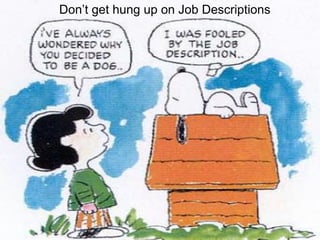
Don’t get hung up on Job Descriptions
 SW Pilots are willing to load luggage if that what takes for the on time
performance
 Generally in other organizations employees tend to use their job
descriptions as a defence mechanism against work overload.
 Some employees like job descriptions because they prevent their
managers assigning them tasks arbitrarily.
 By limiting areas of responsibility, employees can specialize and
develop expertise.
 Unions use job descriptions to protect the pool of available positions.
Have highly flexible job descriptions
Well-defined job descriptions are too static for a dynamic & evolving
economy. Instead, at Southwest everyone’s job description is clear and
specific but there is an added requirement that each employee is expected
to “do whatever is needed to enhance the overall operation – even if that
means helping out with a different type of job as required”
Partner with Unions
 Southwest accepts the unions as legitimate representatives
of employees and as valued partners in the organization.
 Doing this removes the traditional anti-union bias which is
the first major hurdle to good relations.
 By accepting whichever unions the employees choose to
align themselves with, the Southwest management team
demonstrate they trust the employee’s judgement.
 Southwest expects the unions to have an intense loyalty to
the company and a feeling of ownership. Therefore, when
negotiating with the unions, there is an anticipation they will
act reasonably. Due to the fact Southwest employees have
chosen to belong to six different unions, there is anticipation
the other unions will help ensure none of their number make
excessive demands.
Partner with Unions
 Southwest treats the unions as full partners, not like some
albatross hanging around their organization’s neck.
 From that perspective, Southwest supplies each union with
accurate information so negotiations can move forward in
the bright light of day rather than in an environment of
mistrust and confusion.
Partner with Unions
Most people assume Southwest has no unions because of its
flexible job descriptions. In fact, Southwest is actually the most
highly unionized U.S. airline. The difference is that Southwest
treats its unions as partners rather than adversaries.
Reach out to Suppliers
 Each company – Southwest and its suppliers – can focus on
what they do best – meaning the partnership ends up
generating better outcomes than would have been achieved
by working independently.
 Southwest extends its sphere of influence – beyond its own
company boundaries and into its entire value chain.
 Problems can be solved jointly – allowing Southwest to benefit
from the expertise of its supplier partners.
 New opportunities can be responded to quickly – using the
assets of not only Southwest but also its suppliers.
 Joint new business initiatives can be developed – which
harness the vision of more than a single organization
Build the supplier relationships
Southwest does not follow industry practice and form alliances with other airlines.
Instead, the company works closely with its suppliers – an aircraft manufacturer, airport
authorities and air traffic control – to form partnerships which deliver tangible benefits for
both sides. Plus, Southwest works very hard to keep its suppliers in the loop.
What Makes Southwest Unique?
 Much of Southwest's success is due to the
willingness of its leadership to be innovative
 Southwest's primary operating philosophy is low
fares and lots of flights
 Southwest management has created a culture
where employees are treated as the company's
number one asset
 The benefits it gives it employees, include: profit-
sharing and empowering employees to make
decisions
 Southwest mixes in New Age management
techniques, such as celebrating different
milestones, and letting love play a part in running
the airline
Take Away
 Southwest Airlines has turned a profit every year it’s been in business, even
though its industry is characterized by competition and staggering losses.
 Southwest’s reliance on relational coordination is the secret ingredient behind
the company’s success story.
 Southwest’s investment in relationships has been important to its success.
 Effective leaders inspire employees’ trust and show commitment to their
welfare.
 Southwest invests heavily in training and stresses an egalitarian work ethic.
 Face conflict head-on. Don’t let it pass or accept it as a natural, if unpleasant,
workplace reality.
 Companies where employees have a personal connection stand to reap the
full benefits of relational competence.
 Greater opportunities for learning exist where solving problems is
emphasized over placing blame.
 Flexible job descriptions help improve efficiency.
 Southwest’s conservative finances served it well after 9/11 — no one was laid
off.
“Southwest is a remarkable company with a consistent record
of profitability and performance in a turbulent industry.
Southwest’s most powerful organizational competency – the
‘secret ingredient’ that makes it so distinctive – is its ability to
build and sustain high performance relationships among
managers, employees, unions and suppliers. These
relationships are characterized by shared goals, shared
knowledge and mutual respect. Although these relationships
appear simple, appearances are deceptive. Over time,
Southwest Airlines has carefully developed a set of
organizational practices that build and sustain strong
relationships among those who are critical to the
organization’s success.”
Happy Reading, Learning & Application
Mail your comments to
ramaddster@gmail.com