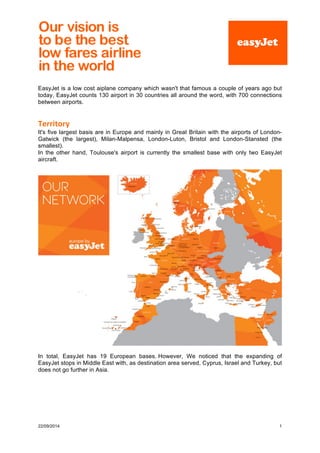
EasyJet is a low cost aiplane company which wasn't that famous a couple of years ago but 
today, EasyJet counts 130 airport in 30 countries all around the word, with 700 connections 
between airports.! 
Territory( 
It's five largest basis are in Europe and mainly in Great Britain with the airports of London- 
Gatwick (the largest), Milan-Malpensa, London-Luton, Bristol and London-Stansted (the 
smallest). 
In the other hand, Toulouse's airport is currently the smallest base with only two EasyJet 
aircraft. 
In total, EasyJet has 19 European bases. However, We noticed that the expanding of 
EasyJet stops in Middle East with, as destination area served, Cyprus, Israel and Turkey, but 
does not go further in Asia. 
22/09/2014 1
Strategy((vision(and(mission)( 
EasyJet was founded in 1995 by Sir Stelios Haji-Ioannou with the vision of creating a 
customer focused brand that would revolutionise the concept of air travel. More than fifteen 
years on, EasyJet is Europe’s leading airline, and the UK’s largest, carrying over 55m 
passengers a year. 
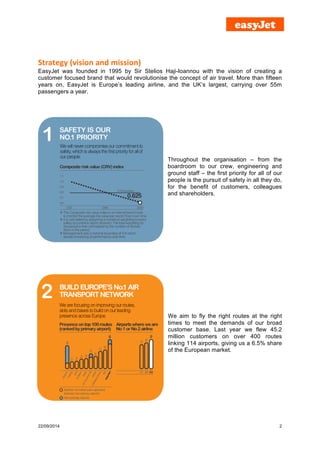
Throughout the organisation – from the 
boardroom to our crew, engineering and 
ground staff – the first priority for all of our 
people is the pursuit of safety in all they do, 
for the benefit of customers, colleagues 
and shareholders. 
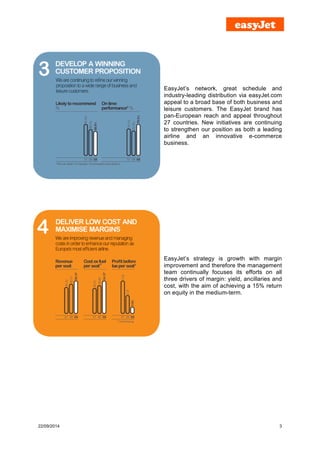
We aim to fly the right routes at the right 
times to meet the demands of our broad 
customer base. Last year we flew 45.2 
million customers on over 400 routes 
linking 114 airports, giving us a 6.5% share 
of the European market. 
22/09/2014 2
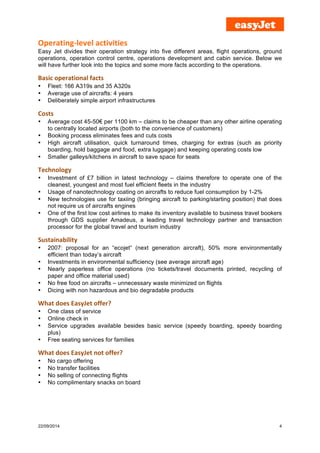
EasyJet’s network, great schedule and 
industry-leading distribution via easyJet.com 
appeal to a broad base of both business and 
leisure customers. The EasyJet brand has 
pan-European reach and appeal throughout 
27 countries. New initiatives are continuing 
to strengthen our position as both a leading 
airline and an innovative e-commerce 
business. 
EasyJet’s strategy is growth with margin 
improvement and therefore the management 
team continually focuses its efforts on all 
three drivers of margin: yield, ancillaries and 
cost, with the aim of achieving a 15% return 
on equity in the medium-term. 
( 
22/09/2014 3
Operating5level(activities( 
Easy Jet divides their operation strategy into five different areas, flight operations, ground 
operations, operation control centre, operations development and cabin service. Below we 
will have further look into the topics and some more facts according to the operations. 
Basic(operational(facts( 
• Fleet: 166 A319s and 35 A320s 
• Average use of aircrafts: 4 years 
• Deliberately simple airport infrastructures 
Costs( 
• Average cost 45-50€ per 1100 km – claims to be cheaper than any other airline operating 
to centrally located airports (both to the convenience of customers) 
• Booking process eliminates fees and cuts costs 
• High aircraft utilisation, quick turnaround times, charging for extras (such as priority 
boarding, hold baggage and food, extra luggage) and keeping operating costs low 
• Smaller galleys/kitchens in aircraft to save space for seats 
Technology( 
• Investment of £7 billion in latest technology – claims therefore to operate one of the 
cleanest, youngest and most fuel efficient fleets in the industry 
• Usage of nanotechnology coating on aircrafts to reduce fuel consumption by 1-2% 
• New technologies use for taxiing (bringing aircraft to parking/starting position) that does 
not require us of aircrafts engines 
• One of the first low cost airlines to make its inventory available to business travel bookers 
through GDS supplier Amadeus, a leading travel technology partner and transaction 
processor for the global travel and tourism industry 
Sustainability( 
• 2007: proposal for an “ecojet“ (next generation aircraft), 50% more environmentally 
efficient than today’s aircraft 
• Investments in environmental sufficiency (see average aircraft age) 
• Nearly paperless office operations (no tickets/travel documents printed, recycling of 
paper and office material used) 
• No free food on aircrafts – unnecessary waste minimized on flights 
• Dicing with non hazardous and bio degradable products 
What(does(EasyJet(offer?( 
• One class of service 
• Online check in 
• Service upgrades available besides basic service (speedy boarding, speedy boarding 
plus) 
• Free seating services for families 
What(does(EasyJet(not(offer?( 
• No cargo offering 
• No transfer facilities 
• No selling of connecting flights 
• No complimentary snacks on board 
22/09/2014 4
Tactical(Activities(Easyjet( 
EasyJet´s strategy is clearly transferred to its tactical activities. The airline´s focus on safety 
is observed in its strict tactical risk management (hazard analysis, control points). Further 
strategic aspirations such as strong networks, revenue and leisure customers as well as cost 
and high margins can be seen in EasyJet´s tactical activities: 
Building(strong(number(1(and(number(2(networks( 
• Reduction in growth to minimise margin erosion (sale and return of expensive aircraft e.g. 
A321 sale, accelerated return of B737-700) --> 7-8% cost per seat savings between 
current A319 and A320, 4-5% cost per seat savings between A320 and future A320neo 
aircraft --> more efficient use of fuel 
• Continue to invest in key markets e.g. Geneva (40% of market share in airport in 2013), 
Milan (39% of market share), Gatwick, Paris + domestic flight routes in France, Berlin 
• Address areas of underperformance (closing Dortmund) 
• Flexible fleet plan and financial strength (Airbus granted another acquirement of another 
100 A320 neo aircrafts additionally to the already ordered aircraft family of 100 planes, 
delivered between 2017 to 2022) 
Drive(demand,(conversion(and(yields(across(Europe:( 
• Continue to drive ancillary revenues 
• Target superior yield management versus peer group (Capitalise on supply side 
changes, Flexibility to react to changing demand patterns) 
• Allocated seating across the entire network and punctuality for greater customer 
satisfaction 
Maintain(cost(per(seat(advantage( 
• Cost per seat ex. fuel down 13% over last 3 years (due to reductions in ownership, 
maintenance, overheads) 
• Inflationary pressures primarily from airports and regulators (cost increases due to 
airports e.g. Gatwick, Stansted, Amsterdam, navigation, crew) 
• Further improvements possible, clear targets established 
Disciplined(use(of(capital( 
• Strong balance sheet to respond to significant fuel price increases, extended closure of 
airspace and further drive growth and returns for shareholders 
• 33,5 pence per share proposed ordinary dividend (133 mio. pounds in 2013) 
• 44,1 pence per share proposed special dividend (175 mio. pounds in 2013) 
Sources 
http://corporate.easyJet.com/~/media/Files/E/EasyJet-Plc-V2/pdf/content/press-info-kit.pdf 
http://www.easyjet.com/common/img/analyst_and_investor_day_2008.pdf 
http://cws.cengage.co.uk/barnes/students/sample_ch/ch2.pdf 
https://www.faa.gov/about/office_org/headquarters_offices/avs/offices/afs/afs200/media/aviat 
ion_fatigue_symposium/StewartComplete.pdf 
22/09/2014 5

Easyjet

  • 1.
    EasyJet is alow cost aiplane company which wasn't that famous a couple of years ago but today, EasyJet counts 130 airport in 30 countries all around the word, with 700 connections between airports.! Territory( It's five largest basis are in Europe and mainly in Great Britain with the airports of London- Gatwick (the largest), Milan-Malpensa, London-Luton, Bristol and London-Stansted (the smallest). In the other hand, Toulouse's airport is currently the smallest base with only two EasyJet aircraft. In total, EasyJet has 19 European bases. However, We noticed that the expanding of EasyJet stops in Middle East with, as destination area served, Cyprus, Israel and Turkey, but does not go further in Asia. 22/09/2014 1
  • 2.
    Strategy((vision(and(mission)( EasyJet wasfounded in 1995 by Sir Stelios Haji-Ioannou with the vision of creating a customer focused brand that would revolutionise the concept of air travel. More than fifteen years on, EasyJet is Europe’s leading airline, and the UK’s largest, carrying over 55m passengers a year. Throughout the organisation – from the boardroom to our crew, engineering and ground staff – the first priority for all of our people is the pursuit of safety in all they do, for the benefit of customers, colleagues and shareholders. We aim to fly the right routes at the right times to meet the demands of our broad customer base. Last year we flew 45.2 million customers on over 400 routes linking 114 airports, giving us a 6.5% share of the European market. 22/09/2014 2
  • 3.
    EasyJet’s network, greatschedule and industry-leading distribution via easyJet.com appeal to a broad base of both business and leisure customers. The EasyJet brand has pan-European reach and appeal throughout 27 countries. New initiatives are continuing to strengthen our position as both a leading airline and an innovative e-commerce business. EasyJet’s strategy is growth with margin improvement and therefore the management team continually focuses its efforts on all three drivers of margin: yield, ancillaries and cost, with the aim of achieving a 15% return on equity in the medium-term. ( 22/09/2014 3
  • 4.
    Operating5level(activities( Easy Jetdivides their operation strategy into five different areas, flight operations, ground operations, operation control centre, operations development and cabin service. Below we will have further look into the topics and some more facts according to the operations. Basic(operational(facts( • Fleet: 166 A319s and 35 A320s • Average use of aircrafts: 4 years • Deliberately simple airport infrastructures Costs( • Average cost 45-50€ per 1100 km – claims to be cheaper than any other airline operating to centrally located airports (both to the convenience of customers) • Booking process eliminates fees and cuts costs • High aircraft utilisation, quick turnaround times, charging for extras (such as priority boarding, hold baggage and food, extra luggage) and keeping operating costs low • Smaller galleys/kitchens in aircraft to save space for seats Technology( • Investment of £7 billion in latest technology – claims therefore to operate one of the cleanest, youngest and most fuel efficient fleets in the industry • Usage of nanotechnology coating on aircrafts to reduce fuel consumption by 1-2% • New technologies use for taxiing (bringing aircraft to parking/starting position) that does not require us of aircrafts engines • One of the first low cost airlines to make its inventory available to business travel bookers through GDS supplier Amadeus, a leading travel technology partner and transaction processor for the global travel and tourism industry Sustainability( • 2007: proposal for an “ecojet“ (next generation aircraft), 50% more environmentally efficient than today’s aircraft • Investments in environmental sufficiency (see average aircraft age) • Nearly paperless office operations (no tickets/travel documents printed, recycling of paper and office material used) • No free food on aircrafts – unnecessary waste minimized on flights • Dicing with non hazardous and bio degradable products What(does(EasyJet(offer?( • One class of service • Online check in • Service upgrades available besides basic service (speedy boarding, speedy boarding plus) • Free seating services for families What(does(EasyJet(not(offer?( • No cargo offering • No transfer facilities • No selling of connecting flights • No complimentary snacks on board 22/09/2014 4
  • 5.
    Tactical(Activities(Easyjet( EasyJet´s strategyis clearly transferred to its tactical activities. The airline´s focus on safety is observed in its strict tactical risk management (hazard analysis, control points). Further strategic aspirations such as strong networks, revenue and leisure customers as well as cost and high margins can be seen in EasyJet´s tactical activities: Building(strong(number(1(and(number(2(networks( • Reduction in growth to minimise margin erosion (sale and return of expensive aircraft e.g. A321 sale, accelerated return of B737-700) --> 7-8% cost per seat savings between current A319 and A320, 4-5% cost per seat savings between A320 and future A320neo aircraft --> more efficient use of fuel • Continue to invest in key markets e.g. Geneva (40% of market share in airport in 2013), Milan (39% of market share), Gatwick, Paris + domestic flight routes in France, Berlin • Address areas of underperformance (closing Dortmund) • Flexible fleet plan and financial strength (Airbus granted another acquirement of another 100 A320 neo aircrafts additionally to the already ordered aircraft family of 100 planes, delivered between 2017 to 2022) Drive(demand,(conversion(and(yields(across(Europe:( • Continue to drive ancillary revenues • Target superior yield management versus peer group (Capitalise on supply side changes, Flexibility to react to changing demand patterns) • Allocated seating across the entire network and punctuality for greater customer satisfaction Maintain(cost(per(seat(advantage( • Cost per seat ex. fuel down 13% over last 3 years (due to reductions in ownership, maintenance, overheads) • Inflationary pressures primarily from airports and regulators (cost increases due to airports e.g. Gatwick, Stansted, Amsterdam, navigation, crew) • Further improvements possible, clear targets established Disciplined(use(of(capital( • Strong balance sheet to respond to significant fuel price increases, extended closure of airspace and further drive growth and returns for shareholders • 33,5 pence per share proposed ordinary dividend (133 mio. pounds in 2013) • 44,1 pence per share proposed special dividend (175 mio. pounds in 2013) Sources http://corporate.easyJet.com/~/media/Files/E/EasyJet-Plc-V2/pdf/content/press-info-kit.pdf http://www.easyjet.com/common/img/analyst_and_investor_day_2008.pdf http://cws.cengage.co.uk/barnes/students/sample_ch/ch2.pdf https://www.faa.gov/about/office_org/headquarters_offices/avs/offices/afs/afs200/media/aviat ion_fatigue_symposium/StewartComplete.pdf 22/09/2014 5