Welcome To
Presentation
A.S.M Yeasser Arafat
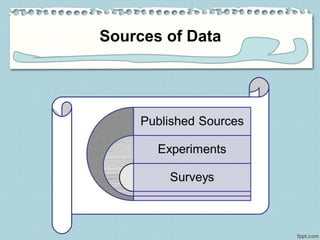
Sources of Data
Published Sources
CONCEPT
Data available in print, electronic, Internet websites.
Primary data, Secondary data.
EXAMPLE
Many U.S. federal agencies are publish primary data in
internet website. Business news sections of daily
newspapers…
Why we need to use?
Possible bias of the publisher and whether the data contain
all the necessary and relevant variables
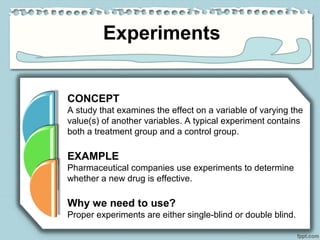
Experiments
CONCEPT
A study that examines the effect on a variable of varying the
value(s) of another variables. A typical experiment contains
both a treatment group and a control group.
EXAMPLE
Pharmaceutical companies use experiments to determine
whether a new drug is effective.
Why we need to use?
Proper experiments are either single-blind or double blind.
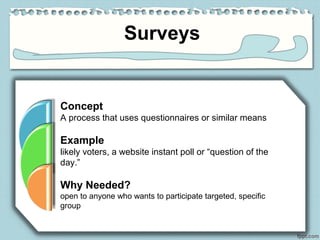
Surveys
Concept
A process that uses questionnaires or similar means
Example
likely voters, a website instant poll or “question of the
day.”
Why Needed?
open to anyone who wants to participate targeted, specific
group
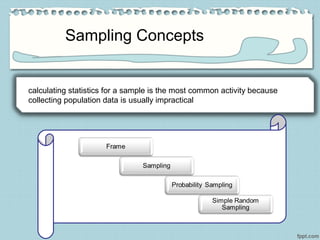
Sampling Concepts
calculating statistics for a sample is the most common activity because
collecting population data is usually impractical
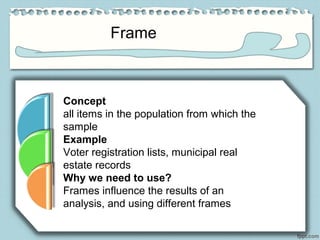
Frame
Concept
all items in the population from which the
sample
Example
Voter registration lists, municipal real
estate records
Why we need to use?
Frames influence the results of an
analysis, and using different frames
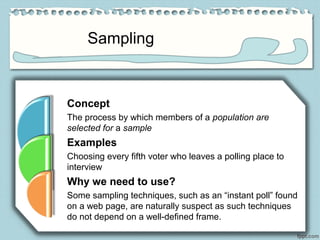
Sampling
Concept
The process by which members of a population are
selected for a sample
Examples
Choosing every fifth voter who leaves a polling place to
interview
Why we need to use?
Some sampling techniques, such as an “instant poll” found
on a web page, are naturally suspect as such techniques
do not depend on a well-defined frame.
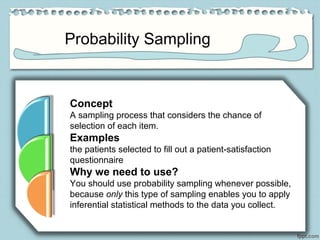
Probability Sampling
Concept
A sampling process that considers the chance of
selection of each item.
Examples
the patients selected to fill out a patient-satisfaction
questionnaire
Why we need to use?
You should use probability sampling whenever possible,
because only this type of sampling enables you to apply
inferential statistical methods to the data you collect.
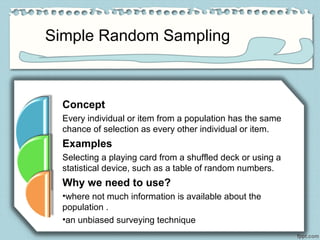
Simple Random Sampling
Concept
Every individual or item from a population has the same
chance of selection as every other individual or item.
Examples
Selecting a playing card from a shuffled deck or using a
statistical device, such as a table of random numbers.
Why we need to use?
•where not much information is available about the
population .
•an unbiased surveying technique
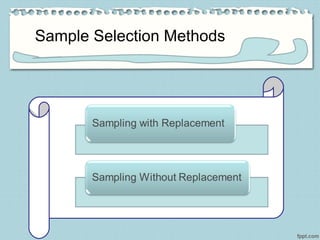
Sample Selection Methods
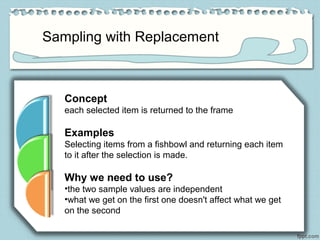
Sampling with Replacement
Concept
each selected item is returned to the frame
Examples
Selecting items from a fishbowl and returning each item
to it after the selection is made.
Why we need to use?
•the two sample values are independent
•what we get on the first one doesn't affect what we get
on the second
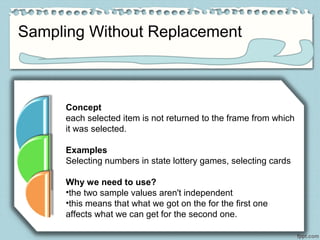
Sampling Without Replacement
Concept
each selected item is not returned to the frame from which
it was selected.
Examples
Selecting numbers in state lottery games, selecting cards
Why we need to use?
•the two sample values aren't independent
•this means that what we got on the for the first one
affects what we can get for the second one.

Source of data & sampling

  • 1.
  • 2.
  • 3.
    Published Sources CONCEPT Data availablein print, electronic, Internet websites. Primary data, Secondary data. EXAMPLE Many U.S. federal agencies are publish primary data in internet website. Business news sections of daily newspapers… Why we need to use? Possible bias of the publisher and whether the data contain all the necessary and relevant variables
  • 4.
    Experiments CONCEPT A study thatexamines the effect on a variable of varying the value(s) of another variables. A typical experiment contains both a treatment group and a control group. EXAMPLE Pharmaceutical companies use experiments to determine whether a new drug is effective. Why we need to use? Proper experiments are either single-blind or double blind.
  • 5.
    Surveys Concept A process thatuses questionnaires or similar means Example likely voters, a website instant poll or “question of the day.” Why Needed? open to anyone who wants to participate targeted, specific group
  • 6.
    Sampling Concepts calculating statisticsfor a sample is the most common activity because collecting population data is usually impractical
  • 7.
    Frame Concept all items inthe population from which the sample Example Voter registration lists, municipal real estate records Why we need to use? Frames influence the results of an analysis, and using different frames
  • 8.
    Sampling Concept The process bywhich members of a population are selected for a sample Examples Choosing every fifth voter who leaves a polling place to interview Why we need to use? Some sampling techniques, such as an “instant poll” found on a web page, are naturally suspect as such techniques do not depend on a well-defined frame.
  • 9.
    Probability Sampling Concept A samplingprocess that considers the chance of selection of each item. Examples the patients selected to fill out a patient-satisfaction questionnaire Why we need to use? You should use probability sampling whenever possible, because only this type of sampling enables you to apply inferential statistical methods to the data you collect.
  • 10.
    Simple Random Sampling Concept Everyindividual or item from a population has the same chance of selection as every other individual or item. Examples Selecting a playing card from a shuffled deck or using a statistical device, such as a table of random numbers. Why we need to use? •where not much information is available about the population . •an unbiased surveying technique
  • 11.
  • 12.
    Sampling with Replacement Concept eachselected item is returned to the frame Examples Selecting items from a fishbowl and returning each item to it after the selection is made. Why we need to use? •the two sample values are independent •what we get on the first one doesn't affect what we get on the second
  • 13.
    Sampling Without Replacement Concept eachselected item is not returned to the frame from which it was selected. Examples Selecting numbers in state lottery games, selecting cards Why we need to use? •the two sample values aren't independent •this means that what we got on the for the first one affects what we can get for the second one.