Am I Willing To Relate Online?
        A comprehensive understanding in promoting
        elearning communities


S. Costa Sousa
sonia.sousa@ie.uminho.pt

Instituto de Educação
Universidade do Minho
2011

                           © S. Costa Sousa, 2011
                                                     1
2


    Contributing subjects
     Social networks

     Online communities

     Trust

     Collaborative communications

     Cooperative actions; and

     Online learning


© S. Costa Sousa, 2011
3


    Possible interests
     Collaboration activities and process

     knowledge sharing activities

     Community and social sharing patterns


                                            SOCIAL
                                             and
                                         TECNOLOGICAL
                                              ISSUES


© S. Costa Sousa, 2011
4


    Reflection and motivation
     Main focus
        The people….

     Main aim: explore aspects that…
        relates peoples’ online social-behaviours online and
         their willingness to interact

    Why?
        Today we live in a connected world, with its
           Online communications;
           Shared knowledge; and
           Social networks and interactions

© S. Costa Sousa, 2011
5


    Reflection and motivation
    Motivation...

     Belief that trust is
        A key player on the success of a relationship
        A fundamental conditions for stable concerted
         actions

    Question?

     How does users predisposition to interact online
      relates with their trust beliefs


© S. Costa Sousa, 2011
What was done so far?


© S. Costa Sousa, 2011   6
7
      1


© S. Costa Sousa, 2011
8
      2


© S. Costa Sousa, 2011
9


    The aim
     Contribute to:
        Promote online interactions,
        The effective use of technology as a means of
           Communication, information and knowledge

     Anyway ... contribute to
        The development of virtual learning environments
         more efficient and effective.


© S. Costa Sousa, 2011
10


   Understand...
   1.     The relation between
         The use of online social tools; and
         People’s intentions to relate online;

   1.     Trust factors that somehow influence
         Online community development

   1.     Trust and people’s
         Behaviours, attitudes and beliefs towards a specific
          online relationship.


@ Sónia Sousa, 2011
11


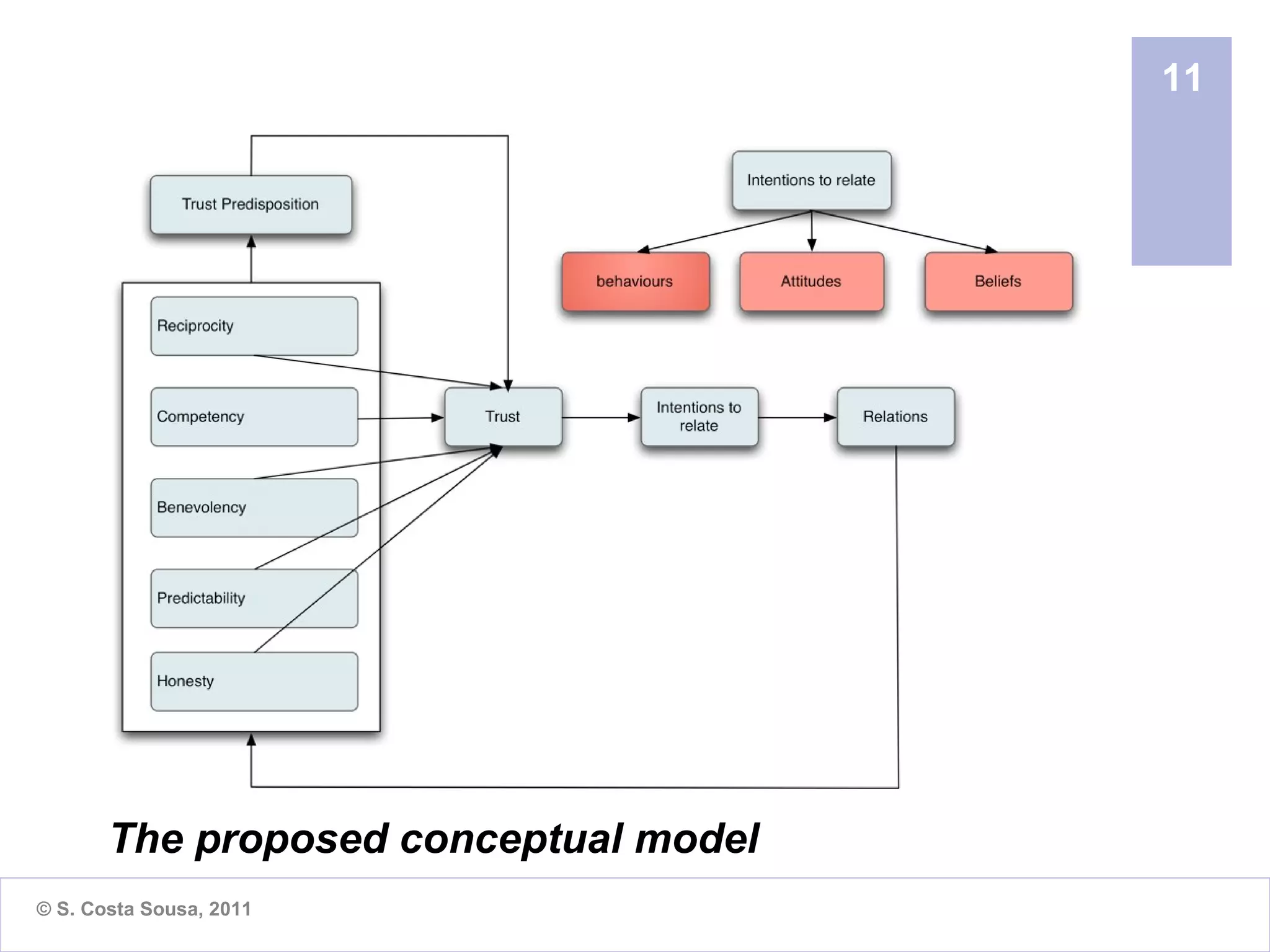
       The proposed conceptual model
© S. Costa Sousa, 2011
12


    Results
     the survey included 340 participants

     No bias towards gender [53.2% male, 46.8% female ]

     Age range [18 and 47]

     Was found a relevant relation between people’s trust
        and their predisposition interact online
        Trust indicators and their intentions to relate online


© S. Costa Sousa, 2011
?


© S. Costa Sousa, 2011       13

Sonia Sousa

  • 1.
    Am I WillingTo Relate Online? A comprehensive understanding in promoting elearning communities S. Costa Sousa sonia.sousa@ie.uminho.pt Instituto de Educação Universidade do Minho 2011 © S. Costa Sousa, 2011 1
  • 2.
    2 Contributing subjects  Social networks  Online communities  Trust  Collaborative communications  Cooperative actions; and  Online learning © S. Costa Sousa, 2011
  • 3.
    3 Possible interests  Collaboration activities and process  knowledge sharing activities  Community and social sharing patterns SOCIAL and TECNOLOGICAL ISSUES © S. Costa Sousa, 2011
  • 4.
    4 Reflection and motivation  Main focus  The people….  Main aim: explore aspects that…  relates peoples’ online social-behaviours online and their willingness to interact Why?  Today we live in a connected world, with its  Online communications;  Shared knowledge; and  Social networks and interactions © S. Costa Sousa, 2011
  • 5.
    5 Reflection and motivation Motivation...  Belief that trust is  A key player on the success of a relationship  A fundamental conditions for stable concerted actions Question?  How does users predisposition to interact online relates with their trust beliefs © S. Costa Sousa, 2011
  • 6.
    What was doneso far? © S. Costa Sousa, 2011 6
  • 7.
    7 1 © S. Costa Sousa, 2011
  • 8.
    8 2 © S. Costa Sousa, 2011
  • 9.
    9 The aim  Contribute to:  Promote online interactions,  The effective use of technology as a means of  Communication, information and knowledge  Anyway ... contribute to  The development of virtual learning environments more efficient and effective. © S. Costa Sousa, 2011
  • 10.
    10 Understand... 1. The relation between  The use of online social tools; and  People’s intentions to relate online; 1. Trust factors that somehow influence  Online community development 1. Trust and people’s  Behaviours, attitudes and beliefs towards a specific online relationship. @ Sónia Sousa, 2011
  • 11.
    11 The proposed conceptual model © S. Costa Sousa, 2011
  • 12.
    12 Results  the survey included 340 participants  No bias towards gender [53.2% male, 46.8% female ]  Age range [18 and 47]  Was found a relevant relation between people’s trust  and their predisposition interact online  Trust indicators and their intentions to relate online © S. Costa Sousa, 2011
  • 13.
    ? © S. CostaSousa, 2011 13

Editor's Notes

  • #12 The proposed conceptual model relates trust with learners’ predisposition interact online . Trust proposed indicators includes: one notions of Reciprocity in other words expectations that can be relate to the presumption of whether people will respond in kind, or not, in a given context. T wo notions of competency, characterized by the confidence that all parts involved will act in a competently and dutifully way. notions of Benevolence attitudes, that relates people’s expectation on the human nature, resulting in attitudes of caring about the benefits of others. Predictability notions, that depends on the level and capacity of perceiving others’ intentions in a given context. Perception of honesty, as predictability, honesty is a belief that depends on perceiving nature of the intentions of others. People’s predisposition to trust represented by their inclination to depend on another in some way, with a felling of relative security.
  • #13 the survey included 340 participants 86 from Cape Verde, 3 from Mozambique, 251 from Portugal . No bias towards gender 53.2% male, 46.8% female Age range from 18 years old to 47 years old Results, showed a relevant connection between people’s trust and their predisposition interact online . Between some trust indicators and people’s intentions to relate online