Workshop 1
Comparative evaluation
2015 Sónia Sousa 1
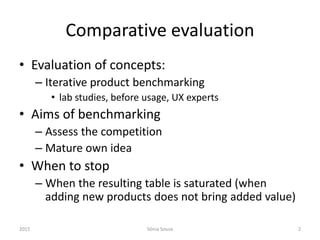
Comparative evaluation
• Evaluation of concepts:
– Iterative product benchmarking
• lab studies, before usage, UX experts
• Aims of benchmarking
– Assess the competition
– Mature own idea
• When to stop
– When the resulting table is saturated (when
adding new products does not bring added value)
2015 Sónia Sousa 2
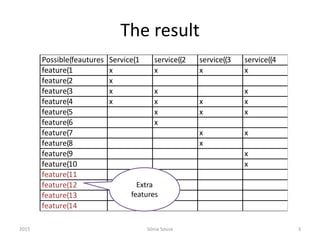
The result
2015 Sónia Sousa 3
Possible(feautures Service(1 service((2 service((3 service((4
feature(1 x x x x
feature(2 x
feature(3 x x x
feature(4 x x x x
feature(5 x x x
feature(6 x
feature(7 x x
feature(8 x
feature(9 x
feature(10 x
feature(11
feature(12
feature(13
feature(14
Extra
features
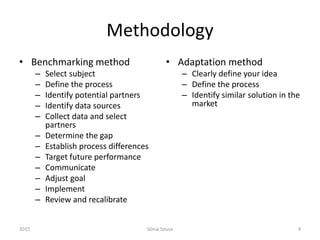
Methodology
• Benchmarking method
– Select subject
– Define the process
– Identify potential partners
– Identify data sources
– Collect data and select
partners
– Determine the gap
– Establish process differences
– Target future performance
– Communicate
– Adjust goal
– Implement
– Review and recalibrate
• Adaptation method
– Clearly define your idea
– Define the process
– Identify similar solution in the
market
2015 Sónia Sousa 4
Define your UX evaluation target
How to do that?
2015 Sónia Sousa 5
What to evaluate
1. Define your idea
– How to do that?
• Turn to your colleague and describe what your product
represents to you in 5 seconds
– Describe the service or product you wont to create.
• List the main ideas on the paper
2015 Sónia Sousa 6
Identify the users
2015 Sónia Sousa 7
3. Identify the participants
– Clearly identify who is going to use your system.
• Age, gender, technical knowledge, social status and so
on
What to observe
2. Define the process
– What you need to observe
• Tasks, content, layout, and so on
– Answer to the questions
• What is my strategy to achieve my objectives?
• What is the order of my actions?
• Will I need to use different resources in my actions?
2015 Sónia Sousa 8
Data collection
• Select the similar services you are going to
analyze
– Collect data
• Enumerating for each the most used features
– Follow this link and start to fill
• the Gdocs spread sheet table
2015 Sónia Sousa 9
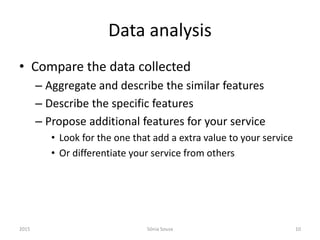
Data analysis
• Compare the data collected
– Aggregate and describe the similar features
– Describe the specific features
– Propose additional features for your service
• Look for the one that add a extra value to your service
• Or differentiate your service from others
2015 Sónia Sousa 10
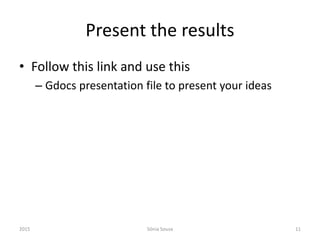
Present the results
• Follow this link and use this
– Gdocs presentation file to present your ideas
2015 Sónia Sousa 11

Comparative evaluation

  • 1.
  • 2.
    Comparative evaluation • Evaluationof concepts: – Iterative product benchmarking • lab studies, before usage, UX experts • Aims of benchmarking – Assess the competition – Mature own idea • When to stop – When the resulting table is saturated (when adding new products does not bring added value) 2015 Sónia Sousa 2
  • 3.
    The result 2015 SóniaSousa 3 Possible(feautures Service(1 service((2 service((3 service((4 feature(1 x x x x feature(2 x feature(3 x x x feature(4 x x x x feature(5 x x x feature(6 x feature(7 x x feature(8 x feature(9 x feature(10 x feature(11 feature(12 feature(13 feature(14 Extra features
  • 4.
    Methodology • Benchmarking method –Select subject – Define the process – Identify potential partners – Identify data sources – Collect data and select partners – Determine the gap – Establish process differences – Target future performance – Communicate – Adjust goal – Implement – Review and recalibrate • Adaptation method – Clearly define your idea – Define the process – Identify similar solution in the market 2015 Sónia Sousa 4
  • 5.
    Define your UXevaluation target How to do that? 2015 Sónia Sousa 5
  • 6.
    What to evaluate 1.Define your idea – How to do that? • Turn to your colleague and describe what your product represents to you in 5 seconds – Describe the service or product you wont to create. • List the main ideas on the paper 2015 Sónia Sousa 6
  • 7.
    Identify the users 2015Sónia Sousa 7 3. Identify the participants – Clearly identify who is going to use your system. • Age, gender, technical knowledge, social status and so on
  • 8.
    What to observe 2.Define the process – What you need to observe • Tasks, content, layout, and so on – Answer to the questions • What is my strategy to achieve my objectives? • What is the order of my actions? • Will I need to use different resources in my actions? 2015 Sónia Sousa 8
  • 9.
    Data collection • Selectthe similar services you are going to analyze – Collect data • Enumerating for each the most used features – Follow this link and start to fill • the Gdocs spread sheet table 2015 Sónia Sousa 9
  • 10.
    Data analysis • Comparethe data collected – Aggregate and describe the similar features – Describe the specific features – Propose additional features for your service • Look for the one that add a extra value to your service • Or differentiate your service from others 2015 Sónia Sousa 10
  • 11.
    Present the results •Follow this link and use this – Gdocs presentation file to present your ideas 2015 Sónia Sousa 11