
SIDE SCAN SONAR
Concept of Side Scan Sonar
• A pulsed beam of sound, narrow in the
horizontal plane and broad in the vertical
plane.
• It transmit either side of the ship track.
• The transmissions reflected back from the
seafloor to transducers.
• The beam geometry and short pulse length
provide good resolution of small object on
seafloor
Side Scan Sonar
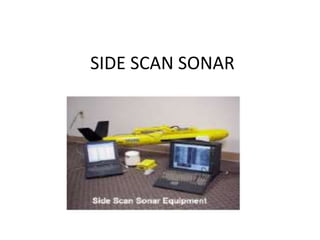
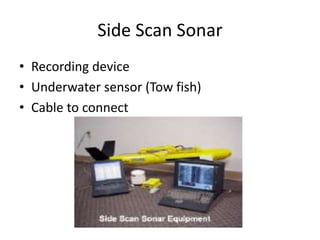
• Recording device
• Underwater sensor (Tow fish)
• Cable to connect
Fish Height
• Should maintain at 10-20% of the range scale in
use.
• This height provide optimum geometry for target
detection and classification.
• If the water is too shallow, reduce the range
scale.
• If the water is too deep, change the transducer
depression angle from 10% to 20%.
• A rough guide, an initial length of 30m should be
paid out from a water depth of 20m and speed of
6 knots.
Line Direction
• Lines should be run within 20 degrees of the
direction of tide stream. This reduces uncertainty
with respect to fish position.
• In condition of strong wind and/or tide it maybe
necessary to run lines into the wind/tide to retain
ship control at the low speed over the ground.
• Line should be run along the contours to maintain
fish height with ease.
• In area of large sandwave, lines should be run
perpendicular to the direction of the wave crests.
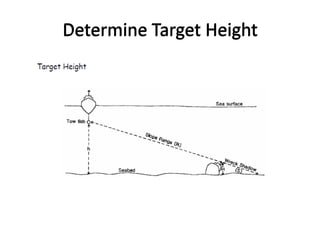
Determine Target HeightDetermine Target Height
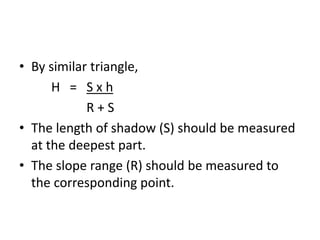
• By similar triangle,
H = S x h
R + S
• The length of shadow (S) should be measured
at the deepest part.
• The slope range (R) should be measured to
the corresponding point.
THANK YOU

Side scan sonar

  • 1.
  • 2.
    Concept of SideScan Sonar • A pulsed beam of sound, narrow in the horizontal plane and broad in the vertical plane. • It transmit either side of the ship track. • The transmissions reflected back from the seafloor to transducers. • The beam geometry and short pulse length provide good resolution of small object on seafloor
  • 3.
    Side Scan Sonar •Recording device • Underwater sensor (Tow fish) • Cable to connect
  • 4.
    Fish Height • Shouldmaintain at 10-20% of the range scale in use. • This height provide optimum geometry for target detection and classification. • If the water is too shallow, reduce the range scale. • If the water is too deep, change the transducer depression angle from 10% to 20%. • A rough guide, an initial length of 30m should be paid out from a water depth of 20m and speed of 6 knots.
  • 5.
    Line Direction • Linesshould be run within 20 degrees of the direction of tide stream. This reduces uncertainty with respect to fish position. • In condition of strong wind and/or tide it maybe necessary to run lines into the wind/tide to retain ship control at the low speed over the ground. • Line should be run along the contours to maintain fish height with ease. • In area of large sandwave, lines should be run perpendicular to the direction of the wave crests.
  • 7.
  • 8.
    • By similartriangle, H = S x h R + S • The length of shadow (S) should be measured at the deepest part. • The slope range (R) should be measured to the corresponding point.
  • 9.