Paper Machine Steam Systems  Session 4 Energy Management Seminar , Ho Chi Minh City, May 2008
PAPER INDUSTRY Classification of paper mills Terminology Steam & Condensate System Rotary Joints & Syphons
CLASSIFICATION Based on Raw Material Used Agro Based Rice, Wheat Straw, Husk, Jute Recycled Based Recycled Paper Integrated Pulp & Paper Mill Hardwood & Softwood IN PAPER MILLS
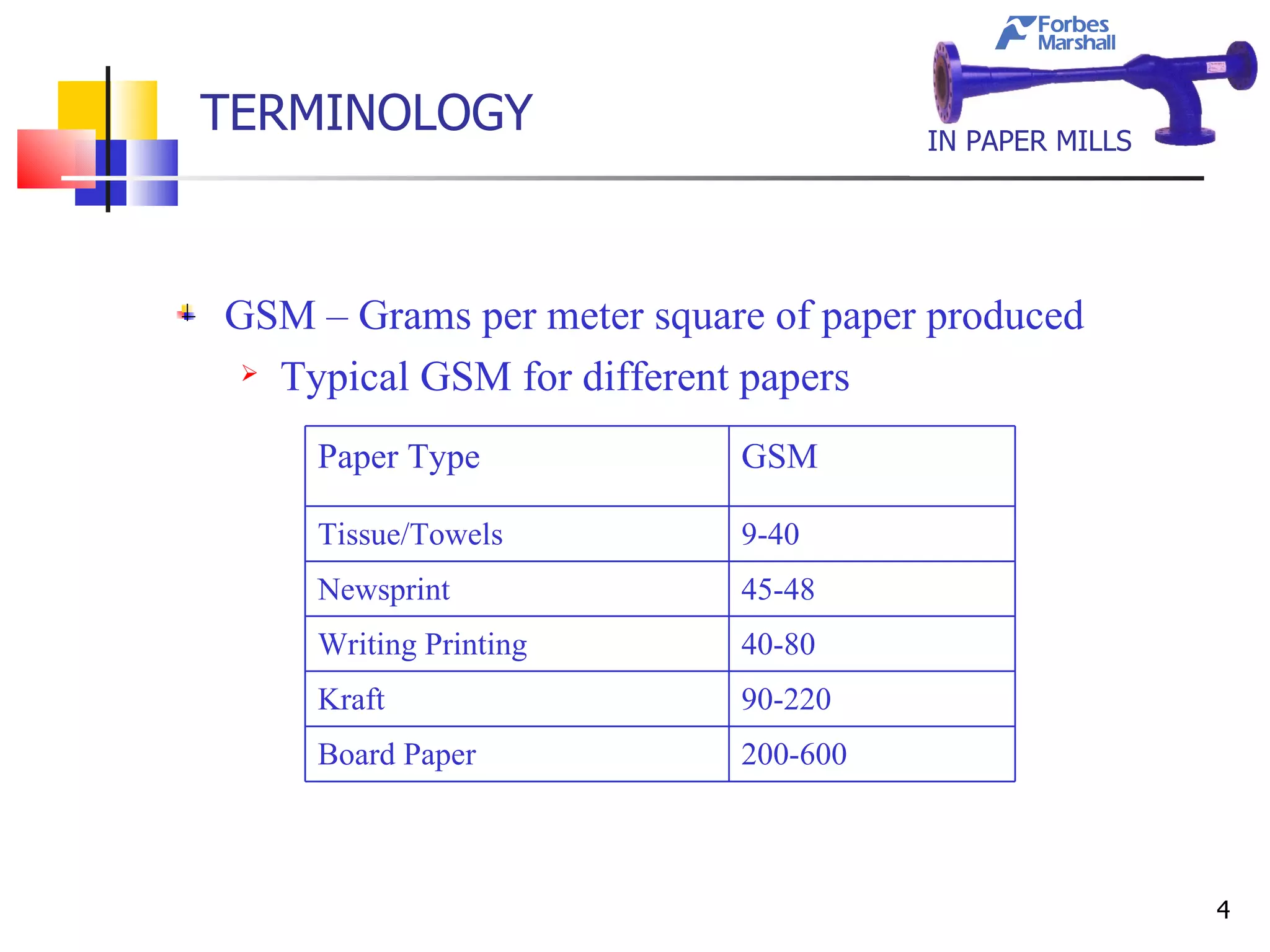
TERMINOLOGY GSM – Grams per meter square of paper produced Typical GSM for different papers  IN PAPER MILLS Paper Type GSM Tissue/Towels 9-40 Newsprint 45-48 Writing Printing 40-80 Kraft 90-220 Board Paper 200-600
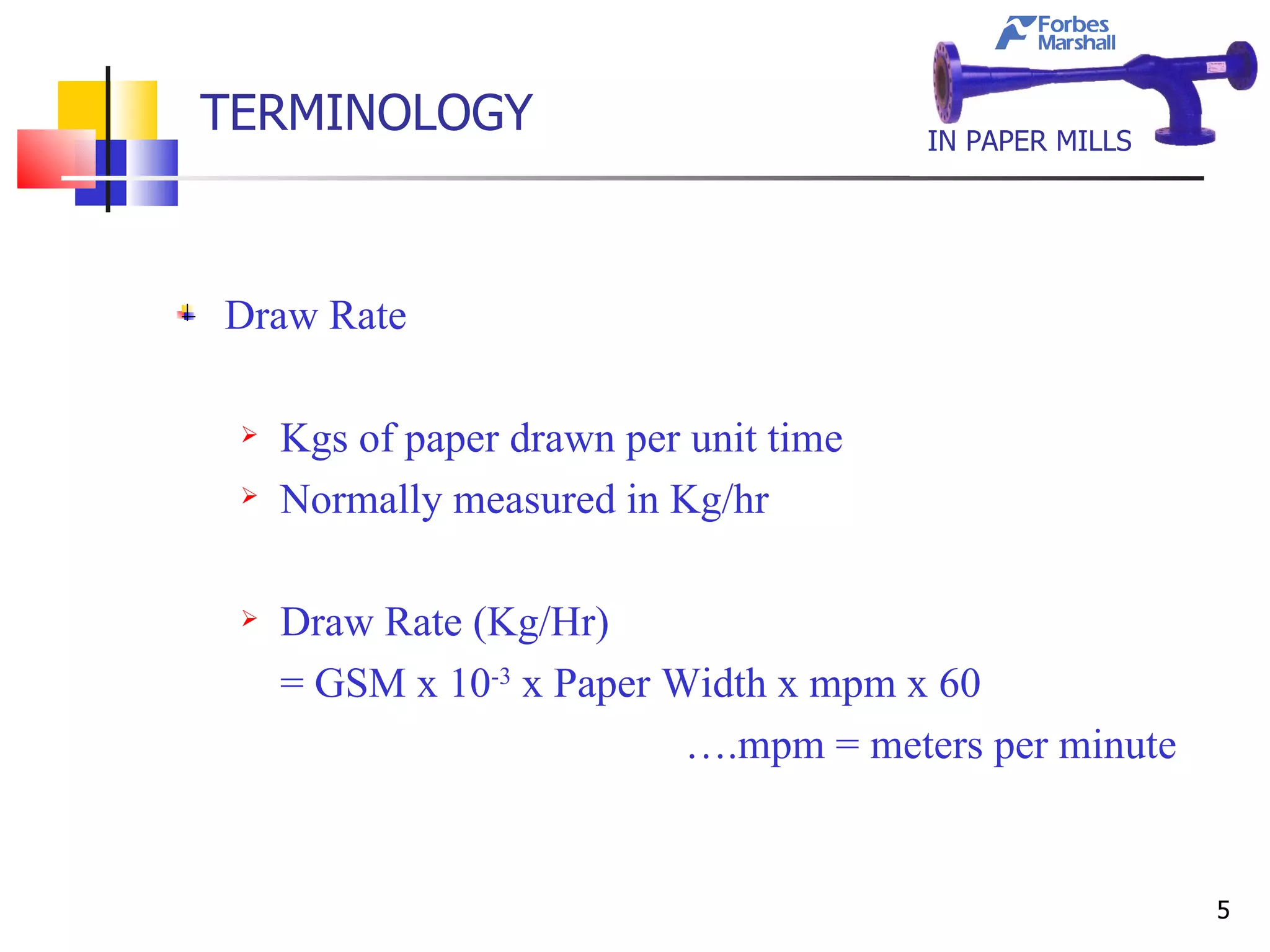
TERMINOLOGY Draw Rate Kgs of paper drawn per unit time Normally measured in Kg/hr Draw Rate (Kg/Hr) = GSM x 10 -3  x Paper Width x mpm x 60 … .mpm = meters per minute IN PAPER MILLS
TERMINOLOGY Drying Rate Rate   at which water is removed from dryer per unit area per hour = DR = M evap / Area = M evap / (   * D * L * n) … DR = Drying Rate Kg/Hr-m 2 … D = OD of drying cylinder - m … L = Cylinder Length - m … n = No. of cylinders  IN PAPER MILLS
TERMINOLOGY Typical Drying Rates Observed  (in Indian scenario, for reference only) IN PAPER MILLS Paper Quality DR – Kg/hr-m 2 Tissue 20 Writing Printing 18-20 Craft 15-20 Newsprint 20-25
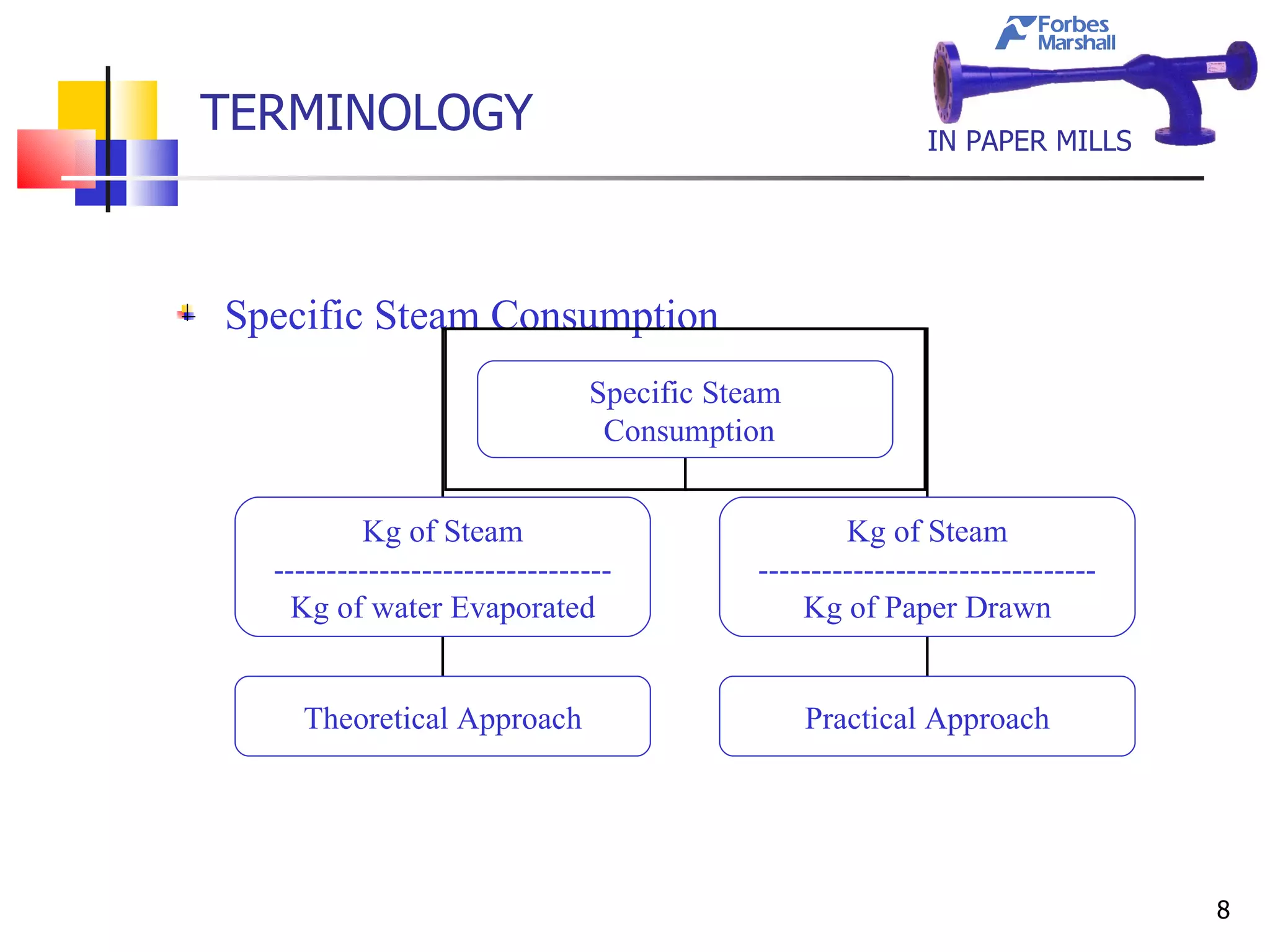
TERMINOLOGY Specific Steam Consumption IN PAPER MILLS Specific Steam Consumption Kg of Steam -------------------------------- Kg of water Evaporated Kg of Steam -------------------------------- Kg of Paper Drawn Theoretical Approach Practical Approach
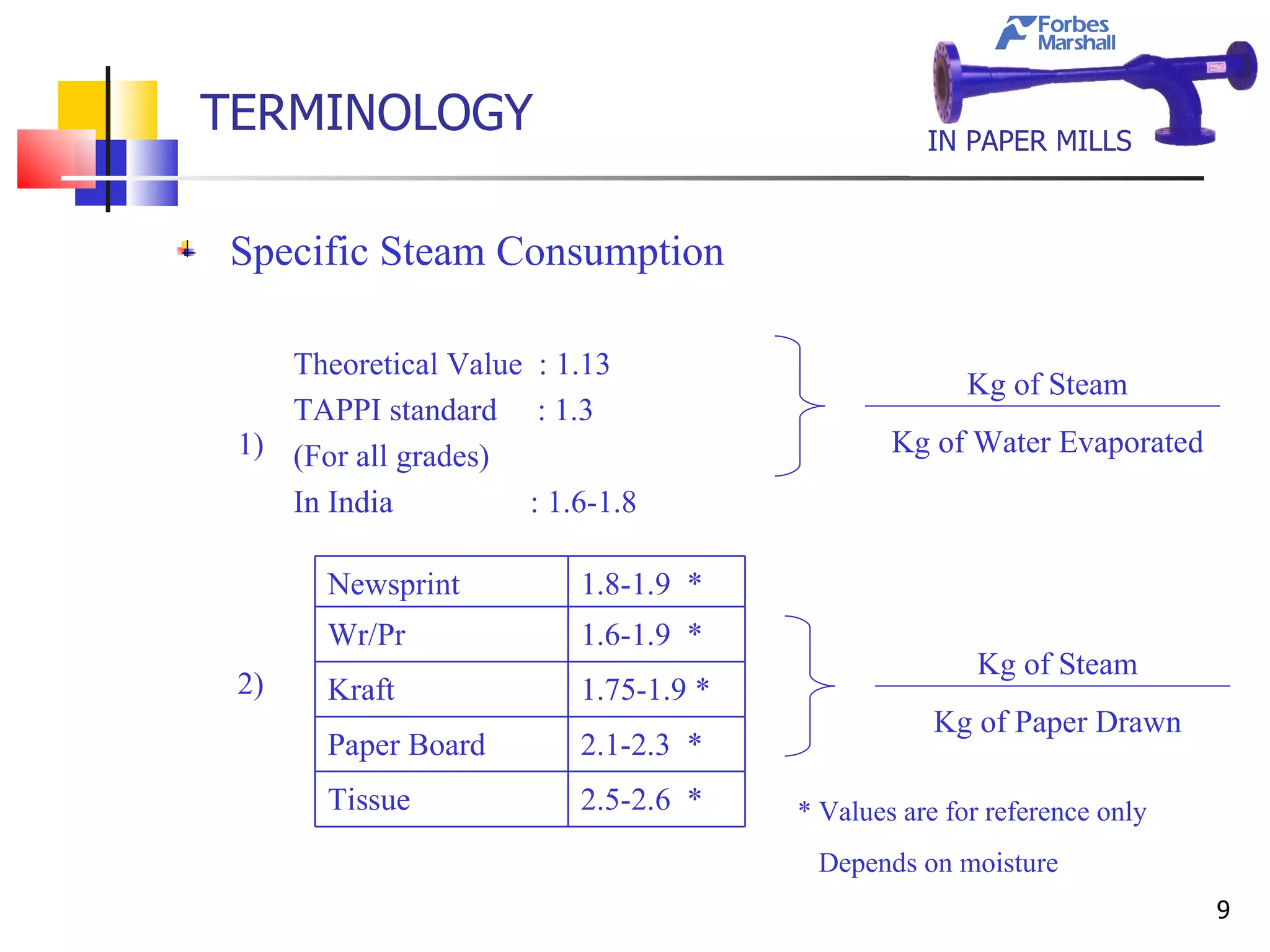
TERMINOLOGY Specific Steam Consumption Theoretical Value  : 1.13 TAPPI standard  : 1.3 (For all grades) In India  : 1.6-1.8 IN PAPER MILLS Kg of Steam Kg of Water Evaporated 2) Kg of Steam Kg of Paper Drawn * Values are for reference only Depends on moisture 1) Newsprint 1.8-1.9  * Wr/Pr 1.6-1.9  * Kraft 1.75-1.9 * Paper Board 2.1-2.3  * Tissue 2.5-2.6  *
FORMULAE Basic Formula for Calculating Mass of water evaporated: M  evap M  prod = D  exit D  enter -  1 …  M evap = Kg of moisture evaporated per unit time …  M prod = Kg of paper produced per unit time …  D exit  = Dryness at the exit of machine …  D enter = Dryness at entry of machine  IN PAPER MILLS
STEAM & CONDENSATE SYSTEM Major Three Type of Condensate Evacuation System: Conventional Trap Based System Cascaded System Thermocompressor based Blow Thru System IN PAPER MILLS
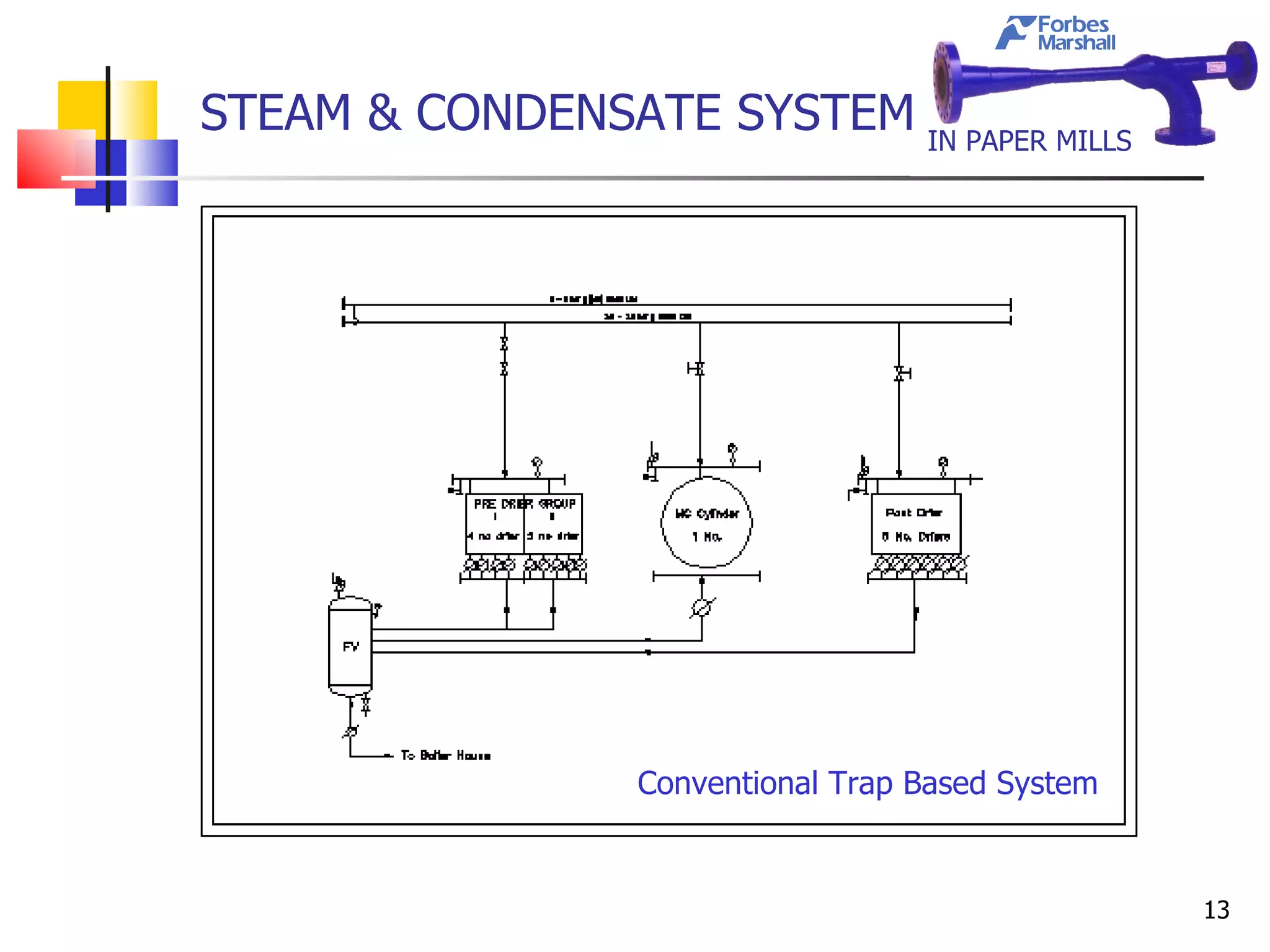
Conventional Trap Based System: Steam traps are installed for condensate evacuation from the cylinders. STEAM & CONDENSATE SYSTEM IN PAPER MILLS
STEAM & CONDENSATE SYSTEM Conventional Trap Based System IN PAPER MILLS
STEAM & CONDENSATE SYSTEM Conventional Trap Based System: Disadvantages: Not suitable for higher speed machines fitted with rotary syphons Low surface temperatures results in lower drying rates Adequate dP is not ensured IN PAPER MILLS
Cascade System: System installed on medium & high speed machines Blow thru steam from one dryer group is cascaded to previous dryer group STEAM & CONDENSATE SYSTEM IN PAPER MILLS
STEAM & CONDENSATE SYSTEM Cascade System IN PAPER MILLS
Cascade System: Disadvantages: Operating Pressure of main steam section dictates pressure limit for remaining sections Interdependency of drying groups reduces flexibility for machine operation and machine runnability STEAM & CONDENSATE SYSTEM IN PAPER MILLS
Thermocompressor based Blow thru system: Low pressure flash steam is boosted using Thermocompressor system Recompressed blow thru & flash steam is recirculated  back in the same drying group  STEAM & CONDENSATE SYSTEM IN PAPER MILLS
STEAM & CONDENSATE SYSTEM Thermocompressor based Blow thru system IN PAPER MILLS
Thermocompressor based Blow thru system: Advantages: Each steam group can be operated at highest steam pressure governed by temp profile for that GSM Each individual steam section can be controlled independently Greater degree of flexibility in addressing drying problems STEAM & CONDENSATE SYSTEM IN PAPER MILLS
STEAM & CONDENSATE SYSTEM Selection of Steam & Condensate System IN PAPER MILLS Speed Range Recommended System 150-250 Trap Based 250-650 TC based Blow Thru >650 TC based Blow Thru
ROTARY JOINTS AND SYPHONS IN PAPER MILLS
ROTARY JOINTS Rotary Joints: Interface between Rotating  Dryers and Stationary steam & condensate piping Performance requirement: To ensure adequate supply of steam and effective condensate evacuation from rotating dryers IN PAPER MILLS
ROTARY JOINT Construction : IN PAPER MILLS RRJ – For rotary syphon SRJ – For stationary syphon
ROTARY JOINT SRJ Construction: IN PAPER MILLS
ROTARY JOINT SRJ Mounting: IN PAPER MILLS
ROTARY JOINT RRJ Construction: IN PAPER MILLS
ROTARY JOINT RRJ Mounting: IN PAPER MILLS
SYPHON Collects and transfers the condensate in dryer, to rotary joint. Types: Stationary Syphons Rotary Syphons IN PAPER MILLS
SYPHONS Stationary Syphon: IN PAPER MILLS
SYPHONS Rotary Syphon: Syphon Shoe Profile IN PAPER MILLS
SYPHONS Syphon Selection: IN PAPER MILLS Syphon type Low speed Stationary Rotary High speed Stationary Speed range (mpm) 150-250 250-650 >650 Clearance (mm) 10 – 12 1.5 – 3.0 3.0-5.0

3 A Papermachine Steam Systems Part1

  • 1.
    Paper Machine SteamSystems Session 4 Energy Management Seminar , Ho Chi Minh City, May 2008
  • 2.
    PAPER INDUSTRY Classificationof paper mills Terminology Steam & Condensate System Rotary Joints & Syphons
  • 3.
    CLASSIFICATION Based onRaw Material Used Agro Based Rice, Wheat Straw, Husk, Jute Recycled Based Recycled Paper Integrated Pulp & Paper Mill Hardwood & Softwood IN PAPER MILLS
  • 4.
    TERMINOLOGY GSM –Grams per meter square of paper produced Typical GSM for different papers IN PAPER MILLS Paper Type GSM Tissue/Towels 9-40 Newsprint 45-48 Writing Printing 40-80 Kraft 90-220 Board Paper 200-600
  • 5.
    TERMINOLOGY Draw RateKgs of paper drawn per unit time Normally measured in Kg/hr Draw Rate (Kg/Hr) = GSM x 10 -3 x Paper Width x mpm x 60 … .mpm = meters per minute IN PAPER MILLS
  • 6.
    TERMINOLOGY Drying RateRate at which water is removed from dryer per unit area per hour = DR = M evap / Area = M evap / (  * D * L * n) … DR = Drying Rate Kg/Hr-m 2 … D = OD of drying cylinder - m … L = Cylinder Length - m … n = No. of cylinders IN PAPER MILLS
  • 7.
    TERMINOLOGY Typical DryingRates Observed (in Indian scenario, for reference only) IN PAPER MILLS Paper Quality DR – Kg/hr-m 2 Tissue 20 Writing Printing 18-20 Craft 15-20 Newsprint 20-25
  • 8.
    TERMINOLOGY Specific SteamConsumption IN PAPER MILLS Specific Steam Consumption Kg of Steam -------------------------------- Kg of water Evaporated Kg of Steam -------------------------------- Kg of Paper Drawn Theoretical Approach Practical Approach
  • 9.
    TERMINOLOGY Specific SteamConsumption Theoretical Value : 1.13 TAPPI standard : 1.3 (For all grades) In India : 1.6-1.8 IN PAPER MILLS Kg of Steam Kg of Water Evaporated 2) Kg of Steam Kg of Paper Drawn * Values are for reference only Depends on moisture 1) Newsprint 1.8-1.9 * Wr/Pr 1.6-1.9 * Kraft 1.75-1.9 * Paper Board 2.1-2.3 * Tissue 2.5-2.6 *
  • 10.
    FORMULAE Basic Formulafor Calculating Mass of water evaporated: M evap M prod = D exit D enter - 1 … M evap = Kg of moisture evaporated per unit time … M prod = Kg of paper produced per unit time … D exit = Dryness at the exit of machine … D enter = Dryness at entry of machine IN PAPER MILLS
  • 11.
    STEAM & CONDENSATESYSTEM Major Three Type of Condensate Evacuation System: Conventional Trap Based System Cascaded System Thermocompressor based Blow Thru System IN PAPER MILLS
  • 12.
    Conventional Trap BasedSystem: Steam traps are installed for condensate evacuation from the cylinders. STEAM & CONDENSATE SYSTEM IN PAPER MILLS
  • 13.
    STEAM & CONDENSATESYSTEM Conventional Trap Based System IN PAPER MILLS
  • 14.
    STEAM & CONDENSATESYSTEM Conventional Trap Based System: Disadvantages: Not suitable for higher speed machines fitted with rotary syphons Low surface temperatures results in lower drying rates Adequate dP is not ensured IN PAPER MILLS
  • 15.
    Cascade System: Systeminstalled on medium & high speed machines Blow thru steam from one dryer group is cascaded to previous dryer group STEAM & CONDENSATE SYSTEM IN PAPER MILLS
  • 16.
    STEAM & CONDENSATESYSTEM Cascade System IN PAPER MILLS
  • 17.
    Cascade System: Disadvantages:Operating Pressure of main steam section dictates pressure limit for remaining sections Interdependency of drying groups reduces flexibility for machine operation and machine runnability STEAM & CONDENSATE SYSTEM IN PAPER MILLS
  • 18.
    Thermocompressor based Blowthru system: Low pressure flash steam is boosted using Thermocompressor system Recompressed blow thru & flash steam is recirculated back in the same drying group STEAM & CONDENSATE SYSTEM IN PAPER MILLS
  • 19.
    STEAM & CONDENSATESYSTEM Thermocompressor based Blow thru system IN PAPER MILLS
  • 20.
    Thermocompressor based Blowthru system: Advantages: Each steam group can be operated at highest steam pressure governed by temp profile for that GSM Each individual steam section can be controlled independently Greater degree of flexibility in addressing drying problems STEAM & CONDENSATE SYSTEM IN PAPER MILLS
  • 21.
    STEAM & CONDENSATESYSTEM Selection of Steam & Condensate System IN PAPER MILLS Speed Range Recommended System 150-250 Trap Based 250-650 TC based Blow Thru >650 TC based Blow Thru
  • 22.
    ROTARY JOINTS ANDSYPHONS IN PAPER MILLS
  • 23.
    ROTARY JOINTS RotaryJoints: Interface between Rotating Dryers and Stationary steam & condensate piping Performance requirement: To ensure adequate supply of steam and effective condensate evacuation from rotating dryers IN PAPER MILLS
  • 24.
    ROTARY JOINT Construction: IN PAPER MILLS RRJ – For rotary syphon SRJ – For stationary syphon
  • 25.
    ROTARY JOINT SRJConstruction: IN PAPER MILLS
  • 26.
    ROTARY JOINT SRJMounting: IN PAPER MILLS
  • 27.
    ROTARY JOINT RRJConstruction: IN PAPER MILLS
  • 28.
    ROTARY JOINT RRJMounting: IN PAPER MILLS
  • 29.
    SYPHON Collects andtransfers the condensate in dryer, to rotary joint. Types: Stationary Syphons Rotary Syphons IN PAPER MILLS
  • 30.
  • 31.
    SYPHONS Rotary Syphon:Syphon Shoe Profile IN PAPER MILLS
  • 32.
    SYPHONS Syphon Selection:IN PAPER MILLS Syphon type Low speed Stationary Rotary High speed Stationary Speed range (mpm) 150-250 250-650 >650 Clearance (mm) 10 – 12 1.5 – 3.0 3.0-5.0